Soft computing methods for multiobjective location of garbage accumulation points in smart cities
Pith reviewed 2026-05-25 16:19 UTC · model grok-4.3
The pith
PageRank-based heuristics and evolutionary algorithms locate garbage bins to balance cost, coverage and accessibility in two cities.
A machine-rendered reading of the paper's core claim, the machinery that carries it, and where it could break.
Core claim
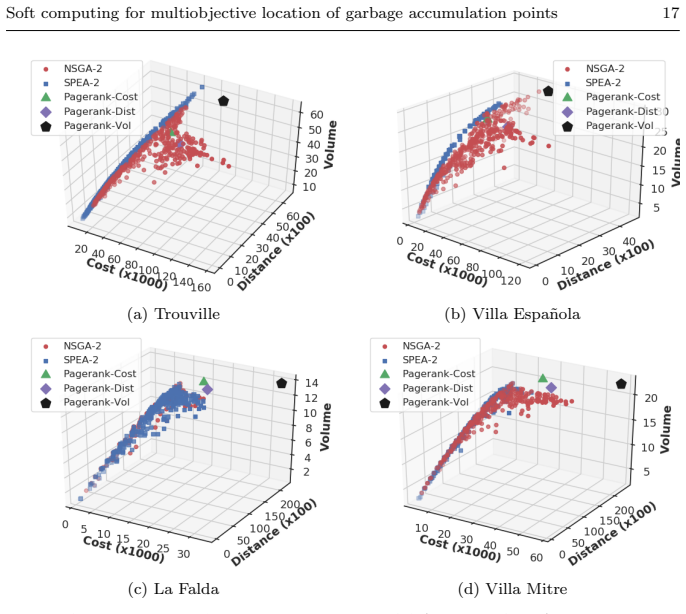
A family of single- and multi-objective heuristics based on the PageRank method and two multiobjective evolutionary algorithms solves the three-objective location problem for garbage accumulation points. The approach produces plannings with controllable trade-offs among investment cost, citizen coverage and accessibility; on real instances from Montevideo the computed solutions improve on the current layout, while for Bahia Blanca they yield reasonable budget and service levels.
What carries the argument
PageRank-derived single- and multi-objective heuristics together with two multiobjective evolutionary algorithms applied to a model whose three objectives are investment cost, number of citizens served, and accessibility measured by distance and demand metrics.
If this is right
- Decision makers can obtain multiple explicit trade-off solutions rather than a single plan.
- The computed Montevideo solutions reduce investment while increasing coverage and accessibility relative to the status quo.
- Bahia Blanca receives plans that keep total cost within a reasonable range while maintaining service quality.
- The same model and search methods can be rerun when population or road data are updated.
Where Pith is reading between the lines
- The framework could be tested on additional cities that publish comparable street-network and population data.
- Adding time-varying demand (for example from seasonal tourism) would be a direct extension that preserves the existing objective structure.
- The PageRank component might be replaced by other network-centrality measures to check whether solution quality changes.
Load-bearing premise
The chosen three objectives and the distance and demand metrics used to compute them match the real decision criteria employed by city administrations.
What would settle it
Apply the same algorithms to Montevideo's data and have municipal planners compare the resulting plans against the existing layout on actual usage, maintenance cost and resident complaints.
Figures




read the original abstract
This article describes the application of soft computing methods for solving the problem of locating garbage accumulation points in urban scenarios. This is a relevant problem in modern smart cities, in order to reduce negative environmental and social impacts in the waste management process, and also to optimize the available budget from the city administration to install waste bins. A specific problem model is presented, which accounts for reducing the investment costs, enhance the number of citizens served by the installed bins, and the accessibility to the system. A family of single- and multi-objective heuristics based on the PageRank method and two mutiobjective evolutionary algorithms are proposed. Experimental evaluation performed on real scenarios on the cities of Montevideo (Uruguay) and Bahia Blanca (Argentina) demonstrates the effectiveness of the proposed approaches. The methods allow computing plannings with different trade-off between the problem objectives. The computed results improve over the current planning in Montevideo and provide a reasonable budget cost and quality of service for Bahia Blanca.
Editorial analysis
A structured set of objections, weighed in public.
Referee Report
Summary. The paper presents a three-objective optimization model for locating garbage accumulation points in urban areas, minimizing investment cost while maximizing citizen coverage and accessibility (using chosen distance and demand metrics). It proposes a family of single- and multi-objective heuristics based on the PageRank method together with two multiobjective evolutionary algorithms. Experimental evaluation on real data from Montevideo (Uruguay) and Bahia Blanca (Argentina) is claimed to demonstrate that the computed plans improve over the current Montevideo layout and yield reasonable cost/service levels for Bahia Blanca, allowing different objective trade-offs.
Significance. If the reported computational results hold and the chosen objectives align with administrative practice, the work supplies concrete heuristics for generating non-dominated solutions to a practical multiobjective facility-location problem using real urban data. The application of PageRank-based methods to this domain and the explicit handling of budget-coverage-accessibility trade-offs could be useful for smart-city waste-management planning.
major comments (2)
- [Experimental evaluation] Experimental evaluation section: the manuscript states that experiments on real scenarios 'demonstrate the effectiveness' and that results 'improve over the current planning,' yet supplies no quantitative objective values, improvement percentages, error bars, baseline comparisons, or explicit comparison of the status-quo point against the computed non-dominated set. This prevents verification of the central improvement claim.
- [Problem model] Problem model section: the claim that computed plans constitute practical improvements rests on the three-objective formulation (cost, coverage, accessibility) accurately reflecting real city-administration criteria. No validation, expert elicitation, sensitivity analysis on omitted factors (e.g., maintenance logistics, traffic, equity), or comparison against actual planner priorities is provided; dominance inside the model does not automatically transfer to real-world improvement if the objective vector differs.
minor comments (2)
- [Abstract] Abstract: the claim of improvement is stated without any numerical indication of the magnitude of the gains or the specific trade-off points achieved, reducing informativeness.
- [Problem model] Notation and metrics: the precise definitions of the coverage and accessibility functions (distance/demand metrics) should be stated with explicit formulas and parameter values in the model section to allow reproducibility.
Simulated Author's Rebuttal
We thank the referee for the detailed and constructive feedback. We address the two major comments point by point below, indicating the changes we will make to the manuscript.
read point-by-point responses
-
Referee: [Experimental evaluation] Experimental evaluation section: the manuscript states that experiments on real scenarios 'demonstrate the effectiveness' and that results 'improve over the current planning,' yet supplies no quantitative objective values, improvement percentages, error bars, baseline comparisons, or explicit comparison of the status-quo point against the computed non-dominated set. This prevents verification of the central improvement claim.
Authors: We agree that the experimental evaluation would be more convincing with explicit numerical results. In the revised manuscript we will insert a new table (and accompanying text) that reports the three objective values achieved by the current Montevideo layout, the best solutions found by each proposed method, the percentage improvements relative to the status quo, and the position of the status-quo point with respect to the computed non-dominated set. Where multiple runs were performed we will also report mean values and standard deviations. revision: yes
-
Referee: [Problem model] Problem model section: the claim that computed plans constitute practical improvements rests on the three-objective formulation (cost, coverage, accessibility) accurately reflecting real city-administration criteria. No validation, expert elicitation, sensitivity analysis on omitted factors (e.g., maintenance logistics, traffic, equity), or comparison against actual planner priorities is provided; dominance inside the model does not automatically transfer to real-world improvement if the objective vector differs.
Authors: The three objectives were selected on the basis of standard criteria appearing in the urban waste-management literature. We acknowledge, however, that the manuscript contains no expert validation, sensitivity analysis on additional factors, or direct comparison with actual planner priorities. In the revision we will expand the discussion section with an explicit justification of the chosen objectives, a paragraph acknowledging the limitations (including omitted factors such as maintenance logistics, traffic impact and equity), and a statement that real-world adoption would require further validation by city administrations. revision: partial
Circularity Check
No circularity: empirical application of heuristics to stated multiobjective model
full rationale
The paper presents an application of PageRank-based heuristics and multiobjective evolutionary algorithms to a three-objective facility location model (minimize cost, maximize coverage, maximize accessibility) on real data from Montevideo and Bahia Blanca. No derivation chain, fitted parameters renamed as predictions, or self-citation load-bearing steps are present. The improvement claim is evaluated strictly inside the explicitly defined objective space against the status-quo point; this comparison does not reduce to a self-referential construction. The model itself is introduced as the authors' formulation without claiming it derives from prior self-cited uniqueness results or ansatzes. This is a standard empirical study whose central claims rest on computational results rather than any tautological reduction.
Axiom & Free-Parameter Ledger
Lean theorems connected to this paper
-
IndisputableMonolith/Cost/FunctionalEquation.leanwashburn_uniqueness_aczel unclear?
unclearRelation between the paper passage and the cited Recognition theorem.
A family of single- and multi-objective heuristics based on the PageRank method and two multiobjective evolutionary algorithms are proposed... minimize investment cost, maximize coverage, maximize accessibility.
-
IndisputableMonolith/Foundation/RealityFromDistinction.leanreality_from_one_distinction unclear?
unclearRelation between the paper passage and the cited Recognition theorem.
Experimental evaluation performed on real scenarios on the cities of Montevideo... and Bahía Blanca.
What do these tags mean?
- matches
- The paper's claim is directly supported by a theorem in the formal canon.
- supports
- The theorem supports part of the paper's argument, but the paper may add assumptions or extra steps.
- extends
- The paper goes beyond the formal theorem; the theorem is a base layer rather than the whole result.
- uses
- The paper appears to rely on the theorem as machinery.
- contradicts
- The paper's claim conflicts with a theorem or certificate in the canon.
- unclear
- Pith found a possible connection, but the passage is too broad, indirect, or ambiguous to say the theorem truly supports the claim.
Reference graph
Works this paper leans on
-
[1]
(eds.): Handbook of Evolutionary Computation
B¨ ack, T., Fogel, D., Michalewicz, Z. (eds.): Handbook of Evolutionary Computation. Oxford University Press (1997)
work page 1997
-
[2]
An application to the metropolitan area of Barcelona
Bautista, J., Pereira, J.: Modeling the problem of locating collection areas for urban waste management. An application to the metropolitan area of Barcelona. Omega 34(6), 617–629 (2006)
work page 2006
-
[3]
In: 3 rd International Conference on Connected Vehicles and Expo, pp
Ben Brahim, M., Drira, W., Filali, F.: Roadside units placement within city-scaled area in vehicular ad-hoc networks. In: 3 rd International Conference on Connected Vehicles and Expo, pp. 1010–1016. IEEE, Vienna, Austria (2014)
work page 2014
-
[4]
Waste Management & Research 33(12), 1094–1102 (2015)
Boskovic, G., Jovicic, N.: Fast methodology to design the optimal collection point loca- tions and number of waste bins: A case study. Waste Management & Research 33(12), 1094–1102 (2015)
work page 2015
-
[5]
Uncertain Supply Chain Manage- ment 6(4), 375–392 (2018)
Broz, D., Rossit, D.A., Rossit, D.G., Cavallin, A.: The Argentinian forest sector: oppor- tunities and challenges in supply chain management. Uncertain Supply Chain Manage- ment 6(4), 375–392 (2018)
work page 2018
-
[6]
(2018, November) Retrieved from http://www.cempre.org.uy
CEMPRE: Compromiso Empresarial Para el Reciclaje. (2018, November) Retrieved from http://www.cempre.org.uy
work page 2018
-
[7]
Fuzzy Sets and Systems 114(1), 133–149 (2000)
Chang, N.B., Wei, Y.: Siting recycling drop-off stations in urban area by genetic algorithm-based fuzzy multiobjective nonlinear integer programming modeling. Fuzzy Sets and Systems 114(1), 133–149 (2000)
work page 2000
-
[8]
(2018, February) Retrieved from http: //www.montevideo.gub.uy/gestion-de-residuos
City Hall of Montevideo: Gesti´ on de residuos. (2018, February) Retrieved from http: //www.montevideo.gub.uy/gestion-de-residuos
work page 2018
-
[9]
Coello, C., Van Veldhuizen, D., Lamont, G.: Evolutionary algorithms for solving multi- objective problems. Kluwer (2002)
work page 2002
-
[10]
Deakin, M., Waer, H.: From Intelligent to Smart Cities. Taylor & Francis (2012)
work page 2012
-
[11]
Deb, K.: Multi-Objective Optimization using Evolutionary Algorithms. John Wiley & Sons (2001)
work page 2001
-
[12]
Procedia-Social and Behavioral Sciences 147, 592–597 (2014)
Di Felice, P.: Integration of spatial and descriptive information to solve the urban waste accumulation problem: A pilot study. Procedia-Social and Behavioral Sciences 147, 592–597 (2014)
work page 2014
-
[13]
Journal of Machine Learning Research 13, 2171–2175 (2012)
Fortin, F., De Rainville, F., Gardner, M., Parizeau, M., Gagn´ e, C.: DEAP: Evolutionary algorithms made easy. Journal of Machine Learning Research 13, 2171–2175 (2012)
work page 2012
-
[14]
Waste Management 32(7), 1291–1296 (2012)
Ghiani, G., Lagan` a, D., Manni, E., Triki, C.: Capacitated location of collection sites in an urban waste management system. Waste Management 32(7), 1291–1296 (2012)
work page 2012
-
[15]
Waste Management 34(11), 1949–1956 (2014)
Ghiani, G., Manni, A., Manni, E., Toraldo, M.: The impact of an efficient collection sites location on the zoning phase in municipal solid waste management. Waste Management 34(11), 1949–1956 (2014)
work page 1949
-
[16]
Waste Manage- ment & Research 35(1), 3–28 (2017)
Goulart Coelho, L., Lange, L., Coelho, H.: Multi-criteria decision making to support waste management: A critical review of current practices and methods. Waste Manage- ment & Research 35(1), 3–28 (2017)
work page 2017
-
[17]
Transportation Science 48(1), 103–120 (2013)
Hemmelmayr, V.C., Doerner, K.F., Hartl, R.F., Vigo, D.: Models and algorithms for the integrated planning of bin allocation and vehicle routing in solid waste management. Transportation Science 48(1), 103–120 (2013)
work page 2013
-
[18]
Hoornweg, D., Bhada-Tata, P., Kennedy, C.: Peak waste: When is it likely to occur? Journal of Industrial Ecology 19(1), 117–128 (2015) Soft computing for multiobjective location of garbage accumulation points 29
work page 2015
-
[19]
In: Proceedings of the 5 th International Conference on Learning and Intelligent Optimization, pp
Hutter, F., Hoos, H., Leyton-Brown, K.: Sequential model-based optimization for gen- eral algorithm configuration. In: Proceedings of the 5 th International Conference on Learning and Intelligent Optimization, pp. 507–523 (2011)
work page 2011
-
[20]
Communications of the ACM 59(8), 46–57 (2016)
Khatoun, R., Zeadally, S.: Smart cities: Concepts, architectures, research opportunities. Communications of the ACM 59(8), 46–57 (2016)
work page 2016
-
[21]
Princeton University Press (2011)
Langville, A., Meyer, C.: Google’s PageRank and beyond: The science of search engine rankings. Princeton University Press (2011)
work page 2011
-
[22]
Risk Analysis 3(4), 245–253 (1983)
Lindell, M., Earle, T.: How close is close enough: Public perceptions of the risks of industrial facilities. Risk Analysis 3(4), 245–253 (1983)
work page 1983
-
[23]
International Journal of Intelligent Systems 32(8), 801–829 (2017)
Massobrio, R., Toutouh, J., Nesmachnow, S., Alba, E.: Infrastructure deployment in ve- hicular communication networks using a parallel multiobjective evolutionary algorithm. International Journal of Intelligent Systems 32(8), 801–829 (2017)
work page 2017
-
[24]
Operations Research Letters 1(5), 194–197 (1982)
Megiddo, N., Tamir, A.: On the complexity of locating linear facilities in the plane. Operations Research Letters 1(5), 194–197 (1982)
work page 1982
-
[25]
Ministerio de Vivienda, Ordenamiento Territorial y Medio Ambiente, Uruguay: Plan de gesti´ on de Montevideo para la recuperaci´ on de residuos de envases no retornables (2012). Retrived from http://www.ciu.com.uy/innovaportal/file/49874/1/pge_montevideo_ plan_2012-09-11_-_definitivo.pdf
work page 2012
-
[26]
Revista de la Asociaci´ on de Ingenieros del Uruguay61(1), 12–15 (2010)
Nesmachnow, S.: Computaci´ on cient´ ıfica de alto desempe˜ no en la Facultad de Ingenier´ ıa, Universidad de la Rep´ ublica. Revista de la Asociaci´ on de Ingenieros del Uruguay61(1), 12–15 (2010)
work page 2010
-
[27]
International Journal of Metaheuristics 3(4), 320–347 (2014)
Nesmachnow, S.: An overview of metaheuristics: accurate and efficient methods for optimisation. International Journal of Metaheuristics 3(4), 320–347 (2014)
work page 2014
-
[28]
Electronic Notes in Discrete Mathematics 69, 93–100 (2018)
Nesmachnow, S., Rossit, D.G., Toutouh, J.: Comparison of multiobjective evolutionary algorithms for prioritized urban waste collection in Montevideo, Uruguay. Electronic Notes in Discrete Mathematics 69, 93–100 (2018)
work page 2018
-
[29]
Operations Research Perspectives 3, 43–58 (2016)
nez, M.L.I., Dubois-Lacoste, J., P´ erez C´ aceres, L., Sttzle, T., Birattari, M.: The irace package: Iterated racing for automatic algorithm configuration. Operations Research Perspectives 3, 43–58 (2016)
work page 2016
-
[30]
Applied Soft Computing 70, 472–485 (2018)
P´ eres, M., Ruiz, G., Nesmachnow, S., Olivera, A.C.: Multiobjective evolutionary opti- mization of traffic flow and pollution in Montevideo, Uruguay. Applied Soft Computing 70, 472–485 (2018)
work page 2018
-
[31]
Planta Piloto de Ingenier´ ıa Qu´ ımica UNS-CONICET: An´ alisis estad´ ıstico de los residuos s´ olidos domiciliarios de Bah´ ıa Blanca (2013). Internal document
work page 2013
-
[32]
Purkayastha, D., Majumder, M., Chakrabarti, S.: Collection and recycle bin location- allocation problem in solid waste management: A review. Pollution1(2), 175–191 (2015)
work page 2015
-
[33]
In: I Ibero-American Congress of Smart Cities ICSC-CITIES, pp
Rossit, D., Nesmachnow, S., Toutouh, J.: Municipal solid waste management in smart cities: facility location of community bins. In: I Ibero-American Congress of Smart Cities ICSC-CITIES, pp. 102–115 (2018)
work page 2018
-
[34]
In: Learning and intelligent Optimiza- tion Conference LION
Toutouh, J., Rossit, D.G., Nesmachnow, S.: Computational intelligence for locating garbage accumulation points in urban scenarios. In: Learning and intelligent Optimiza- tion Conference LION. Kalamata, Greece (2018)
work page 2018
-
[35]
Journal of Urban Planning and Development 124(2), 93–99 (1998)
Valeo, C., Baetz, B., Tsanis, I.: Location of recycling depots with GIS. Journal of Urban Planning and Development 124(2), 93–99 (1998)
work page 1998
-
[36]
Habitat international 30(4), 797–808 (2006)
Wilson, D.C., Velis, C., Cheeseman, C.: Role of informal sector recycling in waste man- agement in developing countries. Habitat international 30(4), 797–808 (2006)
work page 2006
-
[37]
Zitzler, E., Laumanns, M., Thiele, L.: In: K. Giannakoglou, D. Tsahalis, J. P´ eriaux, K. Papailiou, T. Fogarty (eds.) Evolutionary Methods for Design Optimization and Control with Applications to Industrial Problems, pp. 95–100 (2001)
work page 2001
discussion (0)
Sign in with ORCID, Apple, or X to comment. Anyone can read and Pith papers without signing in.