pith. sign in

arxiv: 1907.08678 · v1 · pith:RSA7YSPHnew · submitted 2019-07-19 · 🧮 math.NA · cs.NA

A class of finite dimensional spaces and H(div) conformal elements on general polytopes

Pith reviewed 2026-05-24 18:54 UTC · model grok-4.3

classification 🧮 math.NA cs.NA
keywords finite element spacesH(div) conformitygeneral polytopesRaviart-Thomas elementsvirtual element methoddiscretizationnumerical analysispolyhedral meshes
0
0 comments X

The pith

H(div)-conformal finite element spaces can be built on arbitrary polytopes while preserving Raviart-Thomas divergence properties at every interface.

A machine-rendered reading of the paper's core claim, the machinery that carries it, and where it could break.

The paper constructs a family of finite-dimensional spaces on general polytopes that support H(div)-conforming discretizations. These spaces combine the shape flexibility found in virtual element methods with the boundary divergence properties of Raviart-Thomas elements. A direct restriction of the general construction reproduces the classical Raviart-Thomas interface behavior for every polynomial order and every polytope shape. The definitions rely on degrees of freedom, so the spaces can be adjusted to meet additional approximation requirements. Basis functions for selected two-dimensional cases are examined to illustrate the resulting element shapes.

Core claim

We present a class of discretisation spaces and H(div)-conformal elements that can be built on any polytope. Bridging the flexibility of the Virtual Element spaces towards the element's shape with the divergence properties of the Raviart-Thomas elements on the boundaries, the designed frameworks offer a wide range of H(div)-conformal discretisations. As those elements are set up through degrees of freedom, their definitions are easily amenable to the properties the approximated quantities are wished to fulfil. Furthermore, we show that one straightforward restriction of this general setting share its properties with the classical Raviart-Thomas elements at each interface, for any order and任何

What carries the argument

The construction of the spaces via boundary degrees of freedom chosen to enforce H(div) conformity while retaining Raviart-Thomas divergence behavior on every face of an arbitrary polytope.

If this is right

  • The spaces can be used on meshes composed of arbitrary polytopes without loss of H(div) conformity.
  • The Raviart-Thomas interface properties hold for every polynomial degree and every polytope shape.
  • The degree-of-freedom definition allows the spaces to be tailored to additional properties required by the target problem.
  • Basis functions for the resulting elements can be explicitly studied in two dimensions.

Where Pith is reading between the lines

These are editorial extensions of the paper, not claims the author makes directly.

  • The same boundary-degree-of-freedom strategy might be adapted to produce H(curl)-conforming spaces on general polytopes.
  • Meshes generated from arbitrary polyhedral decompositions of complex domains become directly usable without additional conformity fixes.
  • Hybrid discretizations that mix these elements with standard Raviart-Thomas elements on selected faces become feasible.

Load-bearing premise

It is possible to choose degrees of freedom on the boundaries of arbitrary polytopes so that the spaces remain H(div)-conforming and keep the divergence properties of Raviart-Thomas elements.

What would settle it

A concrete counter-example in which the normal traces of the constructed vector fields fail to be continuous across an interface between two non-convex polytopes of the same polynomial order.

Figures

Figures reproduced from arXiv: 1907.08678 by \'Elise Le M\'el\'edo, Philipp \"Offner, R\'emi Abgrall.

Figure 1
Figure 1. Figure 1: (0, 0) (0, 1) (1, 0) K y x y x K˜ (x1, y1) (x2, y2) (x3, y3) Reference triangle Target triangle F [PITH_FULL_IMAGE:figures/full_fig_p021_1.png] view at source ↗
Figure 2
Figure 2. Figure 2: Illustration of notations used to define the Piola transform in the quadrangle case Note. As in the simplicial case, though the Piola transform applied on quadrilateral shapes is valid in any dimension, the underlying change of co￾ordinates will only be presented in two dimensions for the sake of legibility. N Here, the used coordinates mapping from a reference quadrangle to a general one reads F : (x, y) … view at source ↗
Figure 3
Figure 3. Figure 3: Illustration of a possible transformation in the hexagonal case, where the shape’s inflexion implies a change in the normal’s definition In particular, if the distorted element has a different convexity that the reference one, the normal components of the impacted faces should not be preserved (as pictured in the [PITH_FULL_IMAGE:figures/full_fig_p024_3.png] view at source ↗
Figure 4
Figure 4. Figure 4: Illustration of a transformation in the hexagonal case, where the nor￾mal of the edge impacted by the inflexion change should be preserved. We then need to redefine the concept of orientation preserving, and de￾termine a transformation which is dependent on the shape of the polytope, at least locally. This will be considered in a future work [PITH_FULL_IMAGE:figures/full_fig_p024_4.png] view at source ↗
Figure 5
Figure 5. Figure 5: RT2(K) element for d = 2 on triangle 3.4.2 Conformity Proposition 3.13 The above-defined element (K, RTk(K), {σ}) is H(div)–conformal. Proof. Here, the H(div) conformity is equivalent to the continuity of the normal component at each interface. By definitions of the degrees of freedom and Rk(∂K), the unknowns that lie on the faces are Z f q · n pkdγ(x), ∀f ∈ ∂K, ∀pk ∈ Pk(f). Since q ·n also belongs to Pk(f… view at source ↗
Figure 6
Figure 6. Figure 6: Let us denote by n the number of edges of the element (here n = 3). In all the following, the edges’ normals nf are normalized with respect to the norm of the corresponding edge f, i.e. nf ← nf ||f||2 . n2 n1 n3 (0, 0) (1, 0) (0, 1) y x f1 f2 f3 [PITH_FULL_IMAGE:figures/full_fig_p049_6.png] view at source ↗
Figure 7
Figure 7. Figure 7: Example of sampling points distribution Multiplying each of those functions coordinate - wise with the previously introduced vectors ei forms a set that fulfil our requirements. Therefore, we set N = {(x, y) T 7→ li,m(x, y)ei(x, y)} i∈J1, nK m∈J1, k+1K . (30) Remark. In practice, the (k + 1) points are generated by a Gauss - Leg￾endre distribution. However, any other sampling method is admissible and may c… view at source ↗
Figure 8
Figure 8. Figure 8: Generating the functions lim at once as in (31) for k = 2 when the constant 1/| cos(αi)|is dropped. There, the functions li(x) are gen￾erated on the horizontal edge. The Lagrangian functions emerging from the vertical edges are computed using the function defined on the horizontal edge with flipped variables, while the Lagrangian func￾tions built from the last edge are just using the x - variable spanning … view at source ↗
Figure 9
Figure 9. Figure 9: Sampling points ordering in local indexing We can immediately derive some properties. Property 3.14 dim N = (1 + d) dim Pk(f) = dim Rk(∂K) Proof. We have dim N = n dim{li,m}m∈J1, k+1K = n(k + 1). As in the simplicial case n = 3, we retrieve dim N = 3(k + 1). Furthermore, since we are in the two-dimensional case, we have 3(k + 1) = (d + 1)(k + 1) and dim Pk(f) = (k+1). Thus, in the case of two dimensional s… view at source ↗
Figure 10
Figure 10. Figure 10: Edge integration of basis functions vanishing on any edge but one. Thus, writing the transfer matrix as explained in the Section 2.4 for the described couple basis functions – set of degrees of freedom leads to a matrix of the following shape.   ∗ 0 · · · 0 0 ∗ 0 . . . . . . 0 . . . 0 0 · · · 0 ∗ |{z} Basis functions not vanishing on the i thedge      M… view at source ↗
Figure 11
Figure 11. Figure 11: Gaussian points projection: In red, Gauss-Legendre points gener￾ated from f2 projected on f1, reversely for the black labels. When integrating over f2 through an edge parametrization by the variable x, only the black points will allow an exact quadrature. N Let us now generate I. We want to generate d dim Pk−1(K) functions that are free from each other and whose set is free with N . Those functions will l… view at source ↗
Figure 12
Figure 12. Figure 12: Coordinate - wise values of Lagrangian functions. Furthermore, the function l1, m is nothing else on f1 that the mth Lagrangian function associated to (k + 1) sampling points lying on that edge. Therefore, if one considers the Lagrangian set {l1, m}, the only constant value one can achieve on f1 when k > 0 is when all the lo￾cal Lagrangian functions are considered with the same weight (see the [PITH_FULL… view at source ↗
Figure 13
Figure 13. Figure 13: ). The constant will then necessarily value one. 1 0 1 x1 x2 x3 x4 [PITH_FULL_IMAGE:figures/full_fig_p068_13.png] view at source ↗
Figure 14
Figure 14. Figure 14: Offset modulation on triangle while respecting the La￾grangian constraints. (0, 0) [PITH_FULL_IMAGE:figures/full_fig_p069_14.png] view at source ↗
Figure 16
Figure 16. Figure 16: Example of cases where c1 vanishes (For any (x, y) T ∈ f, (x − 0, y − 0)T · nf = 0). If c1 6= 0, then one gets immediately the relation y = −njx njy (x+nix)+ niy. Simultaneously we know by definition of the element K that on that edge, y = −nix niy x + b for some real constant b. Therefore, the only vanishing possibility leads to the equation −nix niy x + b = −nix niy − njxnix njy + niy ⇒ niy + b = −nixnj… view at source ↗
Figure 17
Figure 17. Figure 17: Plot of the third canonical normal basis function in the case k = 3 [PITH_FULL_IMAGE:figures/full_fig_p076_17.png] view at source ↗
Figure 18
Figure 18. Figure 18: Plot of one internal canonical basis function in the case k = 3. The tuned set of local Lagrangian functions against the classical set of degrees of freedom of RTk(K) also observe the same behaviour. However, one can notice that the amplitude of the basis functions is much higher. This is due to the smallness of the coefficients in the transfer matrix [PITH_FULL_IMAGE:figures/full_fig_p076_18.png] view at source ↗
Figure 19
Figure 19. Figure 19: Plot of the third tuned normal basis function in the case k = 3 [PITH_FULL_IMAGE:figures/full_fig_p077_19.png] view at source ↗
Figure 20
Figure 20. Figure 20: Plot of one tuned canonical basis function in the case k = 3 [PITH_FULL_IMAGE:figures/full_fig_p077_20.png] view at source ↗
Figure 21
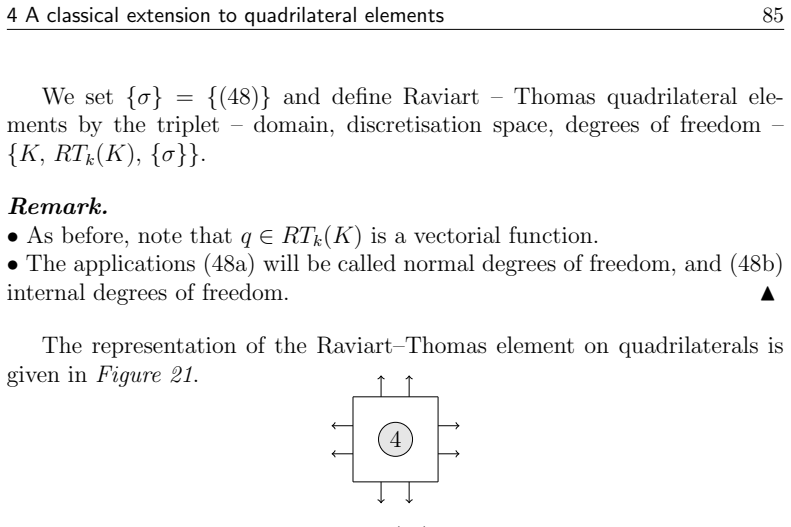
Figure 21. Figure 21: Representation of RTk(K) on a square, here for k = 2 Here again, the arrows represent the normal degrees of freedom, and the circled number the number of internal moments. 4.3.2 Conformity Proposition 4.6 The above-defined element (K, RTk(K), {σ}) is H(div)–conformal. Proof. The proof is analogous to the one given in the Paragraph 3.4.2, when replacing the space Pk by Qk.  4.3.3 Associated shape function… view at source ↗
Figure 22
Figure 22. Figure 22: Reference element for quadrangles As before, the basis functions will be split into two categories. • N, a free set of functions of RTk(K) whose dimension is dim Tk(∂K) = (2d) dim Qk(f). They should enforce the H(div) – conformity. • I, a free set of functions lying in RTk(K) whose dimension is dim Ψk(K). They should preserve the H(div) – conformity. Note that here as well, each of the functions in N or I… view at source ↗
Figure 23
Figure 23. Figure 23: Angle of the quadrilateral element Note that here, only the third and fourth case of (31) occur. However, one would then have to be careful here when ordering the basis function to keep the coherence. Indeed, as here the angles α are all multiples of π or π/2, if one wants to order the sampling points on the boundary element with a global indexing, the definition (31) should be modified as: ˜li, m(x, y) =… view at source ↗
Figure 25
Figure 25. Figure 25: Point mirroring example l0, m(xl , yl) = lj (xl) = δlm l1, m(xl , yl) = lj (yl) = δlm l2, m(xl , yl) = lj (xl) = δlm l3, m(xl , yl) = lj (yl) = δlm [PITH_FULL_IMAGE:figures/full_fig_p089_25.png] view at source ↗
Figure 24
Figure 24. Figure 24: Sampling point and labelling ordering for some one - dimensional Lagrangian function lm, m ∈ J1, k + 1K. Indeed, the edges of our reference element share the same length. Therefore, by the uniform distribution of the sampling points the Lagrangian functions will be identical, up to possibly flipping the x and y coordinates and reordering the points (see the [PITH_FULL_IMAGE:figures/full_fig_p090_24.png] view at source ↗
Figure 26
Figure 26. Figure 26: Homogeneous sampling. Left: Taking care of the orientation. Right: Disregarding the orientation. From there, we only detail the computations for the functions that have been generated from the first edge. The other ones can be derived in a similar way. Therefore we set i = 1 and get: l1, m(x, y)e1(x, y) · nj |fj = (xnjx + ynjy + (0 − njy))l1, m(x, y) [PITH_FULL_IMAGE:figures/full_fig_p092_26.png] view at source ↗
Figure 27
Figure 27. Figure 27: Layout of the functions li on the reference element [PITH_FULL_IMAGE:figures/full_fig_p102_27.png] view at source ↗
Figure 28
Figure 28. Figure 28: Locally Lagrangian third normal basis function in the case k = 3 [PITH_FULL_IMAGE:figures/full_fig_p105_28.png] view at source ↗
Figure 29
Figure 29. Figure 29: Representative of a canonical internal function in the case k = 3 [PITH_FULL_IMAGE:figures/full_fig_p105_29.png] view at source ↗
Figure 30
Figure 30. Figure 30: Globally Lagrangian third normal basis function in the case k = 3 [PITH_FULL_IMAGE:figures/full_fig_p106_30.png] view at source ↗
Figure 31
Figure 31. Figure 31: Representative of one internal function for k = 3 [PITH_FULL_IMAGE:figures/full_fig_p106_31.png] view at source ↗
Figure 32
Figure 32. Figure 32: Third normal basis function in the case k = 3 [PITH_FULL_IMAGE:figures/full_fig_p107_32.png] view at source ↗
Figure 33
Figure 33. Figure 33: Representative of one internal function for k = 3 [PITH_FULL_IMAGE:figures/full_fig_p107_33.png] view at source ↗
Figure 34
Figure 34. Figure 34: Left: Considered non - degenerated polytope. Right: Excluded de￾generated polytope. We start by explaining why an analogous construction to the simplicial and quadrilateral elements ones fails before building admissible elements. 5.1 Limitations of the classical formulation of Raviart – Thomas elements The definitions of simplicial and quadrilateral Raviart – Thomas elements cannot be directly extended to… view at source ↗
Figure 35
Figure 35. Figure 35: Inner discretisation drops when n increases at fixed order k. More dramatically, when one works with a non - homogeneous mesh (i.e. when gathering various element’s shapes) the quality of the discretisation is not homogeneous thorough the mesh. Indeed, for a same order k but two dif￾ferent shapes, the number of internal degrees of freedom will not be the same and the discretisation will not be performed i… view at source ↗
Figure 36
Figure 36. Figure 36: 20 16 [PITH_FULL_IMAGE:figures/full_fig_p111_36.png] view at source ↗
Figure 37
Figure 37. Figure 37 [PITH_FULL_IMAGE:figures/full_fig_p111_37.png] view at source ↗
Figure 37
Figure 37. Figure 37: Incompatible discretisation order within the mesh. In this case, there is a dramatic disequilibrium for two neighbouring cells between a fine inner representation of the discretised quantity (35 internal degrees of freedom) and absolutely no representation of the inner part. Even if this case is extreme and happens only when two polygons with highly dif￾ferent shapes are next to each other, this is not ac… view at source ↗
Figure 38
Figure 38. Figure 38: The classical definition of the degrees of freedom is impossible to set for the lowest order space.  This issue is only a dimensional problem. Therefore, changing the def￾inition of the degrees of freedom while preserving the wish of H(div, K) – conformity will not help. However, we do have the following proposition. Proposition 5.1 The application N −→ N k 7−→ dim RTk(K) − dim Tk(∂K) is increasing and o… view at source ↗
Figure 39
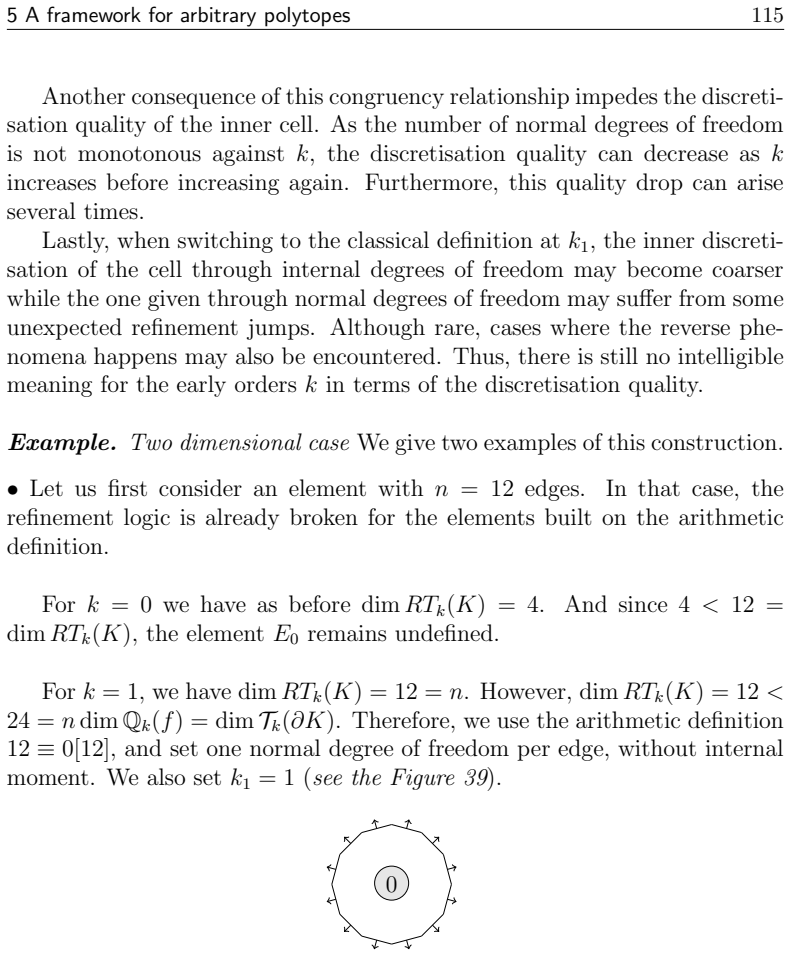
Figure 39. Figure 39: Distribution of normal and internal degrees of freedom for k = 1 and n = 12. For k = 2, we have dim RTk(K) = 24 > 12 = n. We still are in the arithmetic case as dim T2(∂K) = 12 × 3 = 36 > 24. We then set 24 ≡ 0[12] and have two normal moments per edge, still without internal moment (see the [PITH_FULL_IMAGE:figures/full_fig_p115_39.png] view at source ↗
Figure 40
Figure 40. Figure 40: Distribution of normal and internal degrees of freedom for k = 2 and n = 12. For k = 3, dim RTk(K) = 40 and dim T3(∂K) = 48. We are still in the case of arithmetic congruences and define the number of normal moments following the relation 40 ≡ 4[12]. We then have three normal moments per edge and four internal moments (see the [PITH_FULL_IMAGE:figures/full_fig_p116_40.png] view at source ↗
Figure 41
Figure 41. Figure 41: Distribution of normal and internal degrees of freedom for k = 2 and n = 12. For k = 4, we have dim RTk(K) = 60 and there, dim T4(∂K) = 60. Thus, we can switch to the classical definition of E4(K). We then set 5 = 4 + 1 normal moments per edge and set the remaining, 0, as internal moments within the cell. We set k0 = 4 (see the [PITH_FULL_IMAGE:figures/full_fig_p116_41.png] view at source ↗
Figure 42
Figure 42. Figure 42: Distribution of normal and internal degrees of freedom for k = 2 and n = 12 [PITH_FULL_IMAGE:figures/full_fig_p116_42.png] view at source ↗
Figure 43
Figure 43. Figure 43: Distribution of normal and internal degrees of freedom for k = 1 and n = 10. For k = 2, we have dim RTk(K) = 24 and dim Tk(∂K) = 10(2+1) = 30 > 24. Therefore, we are not yet allowed to define a classical element E2(K). Using again congruences, we have 24 ≡ 4[10] and get four internal degrees of freedom and two normal degrees of freedom per edge (see the [PITH_FULL_IMAGE:figures/full_fig_p117_43.png] view at source ↗
Figure 44
Figure 44. Figure 44: Distribution of normal and internal degrees of freedom for k = 2 and n = 10. So far, we are in a working example. The internal quality of discreti￾sation and the quantity of information available on the edges are refined homogeneously. However, for k = 3 we have dim RTk(K) = 40. There, dim Tk(∂K) = 10(3 + 1) = 40 = dim RTk(K). We can then set E3(K) in its classical definition and get four normal degrees o… view at source ↗
Figure 45
Figure 45. Figure 45: Distribution of normal and internal degrees of freedom for k = 3 and n = 10. In this example, the logic breaks in the switch to the classical definition. Indeed, there is no order k where one can have exactly three moments per edge, creating a jump in the edges’ discretisation refinement. Furthermore, the internal moments vanishes and the interior of the cell is not represented anymore.  Here we could ma… view at source ↗
Figure 46
Figure 46. Figure 46: Distribution of degrees of freedom for k = 0. • For k = 0, dim RTk(K) = 4. Since 4 < 5 = dim T0(∂K), we cannot use the classical definition of E0(K). Al￾though we do not want to arbitrarily omit some information on the edges, we define the moments as internal ones de￾spite the non H(div) – conformity it im￾plies (see the [PITH_FULL_IMAGE:figures/full_fig_p119_46.png] view at source ↗
Figure 47
Figure 47. Figure 47: Degrees of freedom for k = 0. However, the number of internal de￾grees of freedom drops by two and the discretisation quality within the cell de￾creases. In particular, there exists cases where there is no internal moment, as for n = 6. One can also observe that there is no case where there is only one mo￾ment per edge, which can be bothersome if one would like to prescribe only constants on the edges for… view at source ↗
Figure 48
Figure 48. Figure 48: Two - dimensional mesh with homogeneous order ˜k = 0, built on elements that have six and twelve edges. Remark. Meshes that use different shapes of elements should only be de￾fined from the highest starting order k0 of the collection of reference element. In the [PITH_FULL_IMAGE:figures/full_fig_p121_48.png] view at source ↗
Figure 49
Figure 49. Figure 49: Parallel with lowest order spaces • (Failing example) When considering the case n = 5, no element can be assimilated with RT0(K). Indeed, the first element that can be designed is E1(K), k0 = 1 being the smallest integer such that dim RTk(K) = 2(k + 1)(k + 2) ≥ 5(k + 1) = dim Tk(∂K). Thus, defining the space E1(K), we have: dim RTk(K) = 2(1 + 1)(1 + 2) = 12 dim Tk(∂K) = 5(1 + 1) = 10. Therefore, by distri… view at source ↗
Figure 50
Figure 50. Figure 50: Impossible parallel with the lowest quadrilateral RTk(K) space. A more arithmetical way to see this impossibility is to notice that there exists no non - negative integer such that 2(k + 1)(k + 2) −5(k + 1) = 0. And more generally, the equation 2(k + 1)(k + 2) − n(k + 1) = 0 does not always have a solution over the integers.  Furthermore, note that no matter the number of faces we have (for n ≥ 2d + 1) t… view at source ↗
Figure 51
Figure 51. Figure 51: Adaptiveness of the number of degrees of freedom 4. For a fixed order k, the increment in the dimension of the set of normal degrees of freedom matches the increment in the dimen￾sion of Hk(K) each supplementary face. 5. For a fixed number of faces n, the number of normal moments per face increases strictly monotonously with k in an understandable way (i.e. either linearly or following a predefined refine… view at source ↗
Figure 52
Figure 52. Figure 52: Intelligible discretisation refinement through the increase of the order [PITH_FULL_IMAGE:figures/full_fig_p126_52.png] view at source ↗
Figure 53
Figure 53. Figure 53: Two dimensional example of the profile of a function in Hk(∂K). Split view of a triangle’s edges where continuity is asked across the vertices. The remaining freedom per edge is dependent on the neigh￾bours. Here, the choices are initiated on the first edge. • In the same spirit, no space based on Hk(∂K) = {u|∂K ∈ Qk(∂K)} for both Ak and Bk can be designed, as here there is no dependency on the number of … view at source ↗
Figure 54
Figure 54. Figure 54: ). 0 1 f 0 1 f 0 1 f 0 1 f (a) (b) (c) (d) [PITH_FULL_IMAGE:figures/full_fig_p143_54.png] view at source ↗
Figure 55
Figure 55. Figure 55: Example of impact of the pointwise normal value on the offset of the determined polynomial when the space H1 is used. Left: non - shifted pointwise value. Right: Shifted pointwise value. • Using several pointwise values prevents from prescribing the global offset as they would then describe higher variations of polynomials rather that their constant part. Furthermore, using several pointwise values in com… view at source ↗
Figure 56
Figure 56. Figure 56: Example of a configuration leading to an empty Pk. Here, we have dim Hk(K) = 18. We distribute 6(0 + 3) = 18 normal mo￾ments on the edges. Therefore, we have a perfect distribution without any remaining internal moments. Thus, we are conformal and can set P0 = ∅ [PITH_FULL_IMAGE:figures/full_fig_p160_56.png] view at source ↗
Figure 57
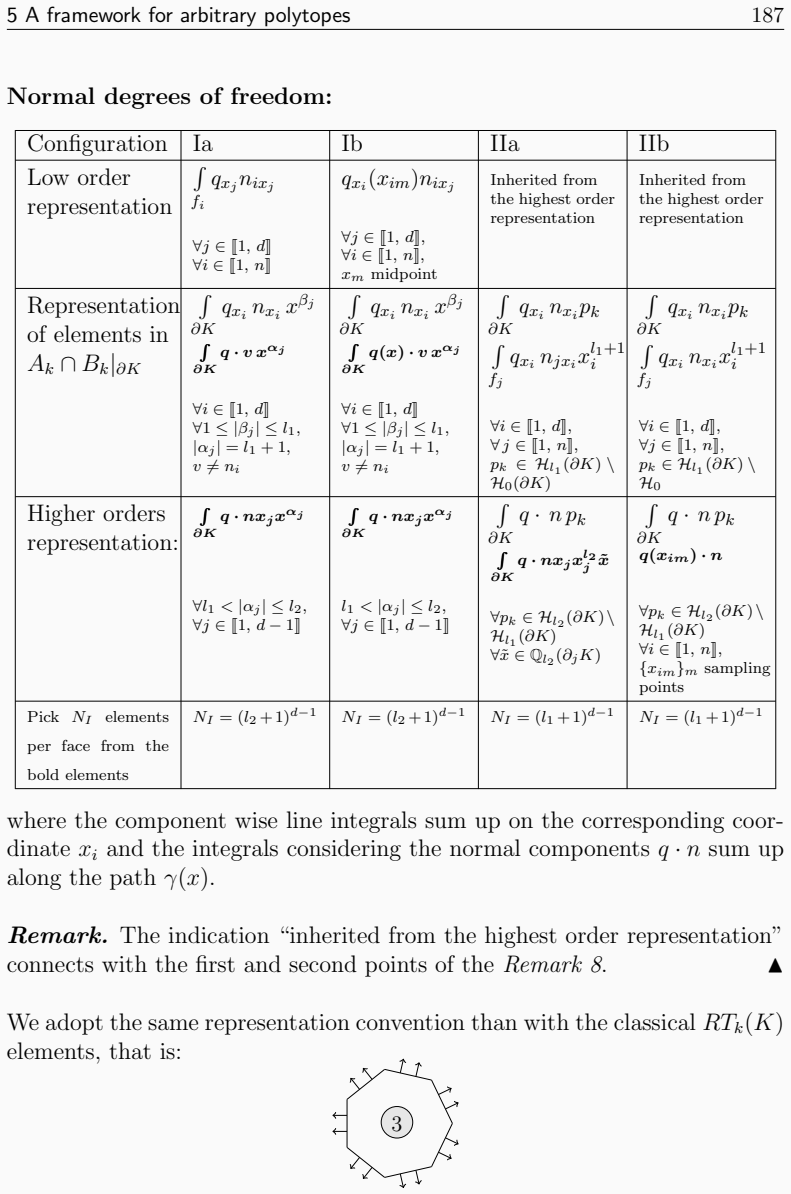
Figure 57. Figure 57: Representation of the element for a septagon [PITH_FULL_IMAGE:figures/full_fig_p187_57.png] view at source ↗
Figure 58
Figure 58. Figure 58: Notations for any reference shape with n edges, direct orientation [PITH_FULL_IMAGE:figures/full_fig_p192_58.png] view at source ↗
Figure 59
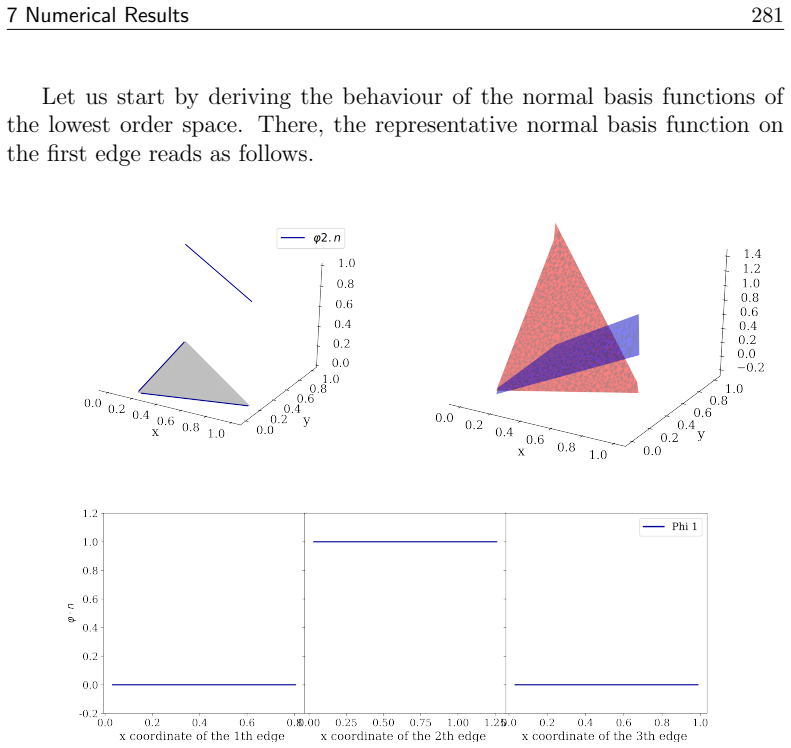
Figure 59. Figure 59: Reference elements used for testing the construction of the canonical basis functions of Hk(K). 7.1.1 Normal Basis functions To begin with, let us investigate the obtained normal basis functions through qualitative considerations. On the boundary, any normal function p lying in Hk(K) should fulfil the properties ( p · n|∂K ∈ Tk(∂K) p · n|∂K 6≡ 0. Therefore, we aim to see our computed normal basis function… view at source ↗
Figure 60
Figure 60. Figure 60: Representation of some φ · n|∂K for various orders and elements’ shapes. First row: k = 0. Second row: k = 1, last row: k = 2. As a by product, the boundary restrictions being built from Lagrangian sets, no normal function is identically vanishing on every edge. The second property is then naturally fulfilled. It also comes immediately that wherever the functions are not vanishing, they belong to Pk. Inde… view at source ↗
Figure 61
Figure 61. Figure 61: Component wise internal functions within the element. Blue: x component. Red: y component. Furthermore, it can be seen that the polynomial variations of the basis functions’ components on the boundary can be higher by one degree than their corresponding global normal component ϕ · n. Indeed, by construction the polynomials emerging from the space xBk are of degree k + 1 on each component, degree that redu… view at source ↗
Figure 62
Figure 62. Figure 62: Example of an higher polynomial order component wise than when testing the normal component The last property of the normal basis functions we would like to witness in the experiments involves the local property (6.5). We investigate it through the shift and local variations of ϕ · n. In the lowest order case represented in the [PITH_FULL_IMAGE:figures/full_fig_p216_62.png] view at source ↗
Figure 63
Figure 63. Figure 63 [PITH_FULL_IMAGE:figures/full_fig_p218_63.png] view at source ↗
Figure 64
Figure 64. Figure 64 [PITH_FULL_IMAGE:figures/full_fig_p219_64.png] view at source ↗
Figure 65
Figure 65. Figure 65 [PITH_FULL_IMAGE:figures/full_fig_p220_65.png] view at source ↗
Figure 66
Figure 66. Figure 66: Non - convex hexagon with edge similarities Let us focus on the case k = 0 and k = 1, being sufficient to draw general conclusions. The behavior of the normal components are represented in the [PITH_FULL_IMAGE:figures/full_fig_p221_66.png] view at source ↗
Figure 67
Figure 67. Figure 67: where for the sake of concision only their non - vanishing support is considered [PITH_FULL_IMAGE:figures/full_fig_p221_67.png] view at source ↗
Figure 68
Figure 68. Figure 68: Determination of x · n However, this dependence is smooth thorough the plane by the linearity of the dot product. There￾fore, slight variations in the angle α or of the posi￾tion of the edge only implies a slight variation in the growing rate of the basis function. As a con￾sequence, in order to avoid similarities in the basis functions (even if it would be up to their boundary support), it is advised to … view at source ↗
Figure 69
Figure 69. Figure 69: Impact of uncontrolled variations Indeed, as one can see for the first edge in the case k = 0 plotted in the top left corner of the [PITH_FULL_IMAGE:figures/full_fig_p222_69.png] view at source ↗
Figure 70
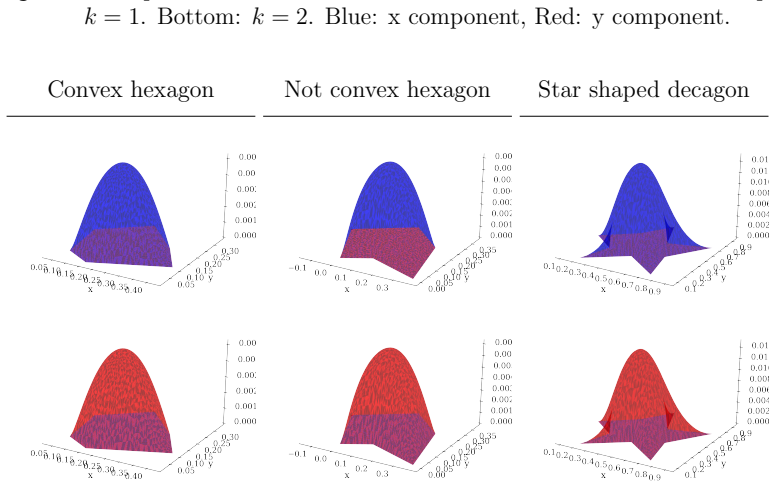
Figure 70. Figure 70: Example of the last internal basis function within the elements. Top: k = 1. Bottom: k = 2. Blue: x component, Red: y component. Convex hexagon Not convex hexagon Star shaped decagon [PITH_FULL_IMAGE:figures/full_fig_p224_70.png] view at source ↗
Figure 71
Figure 71. Figure 71: Some of coordinate wise internal basis function in the case k = 2. Blue: x component. Red: y component. In conclusion, our construction of the canonical basis fulfils our wishes of smooth functions within the elements that are preserving the split into inter￾nal and normal classifications. However, the reliability of the basis functions depends on the quality of the numerical approximations of the solutio… view at source ↗
Figure 72
Figure 72. Figure 72: Normal component of the last internal basis function on the bound￾ary of the elements. Top: k = 1. Bottom: k = 2. As our canonical basis construction is reliable, let us tune them against the previously described degrees of freedom (6.1) and (100) to form the de￾sired elements. 7.2 Tuning to the basis functions corresponding to the said elements In order to define the H(div, K) – conformal elements presen… view at source ↗
Figure 73
Figure 73. Figure 73: Triangle of reference. Let us show first the transfer matrices cor￾responding to the two main types of degrees of freedom, Ib and IIb, built on the previ￾ous basis function set. The relation of their structure with the definition of the degrees of freedom will show up. For the sake of concision we consider the simplicial element presented in the [PITH_FULL_IMAGE:figures/full_fig_p226_73.png] view at source ↗
Figure 74
Figure 74. Figure 74: Reference element where v = n3 Edge whose normal is collinear with the vector v For elements correspond￾ing to the sets of degrees of freedom Ia and Ib (see the Definitions 5.17 and 5.18 ), the case of edges whose normal is collinear with the vector v used in the definition of the degrees of freedom breaks the unisol￾vence. Indeed, any function q of H0(K) read q :  x y  7→  x y  C +  A B  for three … view at source ↗
Figure 75
Figure 75. Figure 75: Examples of elements have edges collinear to one of the axes. By example, considering the shapes given in the Figures 75a and 75b, computing the degrees of freedom that corresponds to the element IIb leads respectively to the following transfer matrices [PITH_FULL_IMAGE:figures/full_fig_p230_75.png] view at source ↗
Figure 76
Figure 76. Figure 76: Aligned origin Vertices aligned with the origin The third shape restriction that also impacts all the presented elements involves the align￾ment of the edges’ vertices with the origin of the axes. Indeed, for all edges fi whose vertices line up with the origin, the constant x · n van￾ishes. Therefore, all the normal components of the basis functions that are built from the vec￾tors ei, 2, ei, 3 and ei, 4 … view at source ↗
Figure 77
Figure 77. Figure 77: Normal component of the canonical basis functions when the fourth edge has his vertices collinear with the origin. As a consequence, the basis functions are not free and no element can be built in the way that we presented here. Indeed, in that case several rows will be linearly dependent and some columns will share important similarities. To emphasise it, let us consider the first block of the transfer m… view at source ↗
Figure 78
Figure 78. Figure 78: Element with two problematic edges This behaviour is proper to each edge and impacts only the respective matrix blocks. Thus, even when more that one problematic edges are encountered, this problem does not get global. By example, taking care of the element given in the Fig￾ure 78, we end up with the following be￾haviour where the problematic is restricted to the two mis - designed edges [PITH_FULL_IMAGE… view at source ↗
Figure 79
Figure 79. Figure 79: Canonical basis function when two edges are collinear with the origin Remark. Important remark The value of the term x · n is also related to the conditioning of the transfer matrix. Indeed, connecting with the end of the Paragraph 7.1.1, even if the coefficient x · n is not vanishing, it being small is enough to create similarities between the basis functions. Thus, the smaller this coefficient is, worse… view at source ↗
Figure 80
Figure 80. Figure 80: Sketch of the basis functions layout for two parallel edges having the same length. However, the restriction of the underneath canonical basis functions to the edges differ only from their support and from the values of n and x · n (see the [PITH_FULL_IMAGE:figures/full_fig_p234_80.png] view at source ↗
Figure 81
Figure 81. Figure 81: Element of reference having parallel edges Parallel similar edges In the case of el￾ements having parallel edges whose length is identical, the only difference in the nor￾mal component of the basis functions reside as always in the coefficient x · n and possi￾bly in the orientation of the term (nix, niy) T . Therefore, if the constant x · n is small, sim￾ilarities in the matrix blocks will appear. By exam… view at source ↗
Figure 82
Figure 82. Figure 82: Element with sim￾ilar aligned edges. Similar aligned edges Another limit case corresponds to two aligned similar edges within the same element. There, the obtained rows corresponding to global normal components of blocks linked to similar edges will be identical. By example, we can consider the element presented in the [PITH_FULL_IMAGE:figures/full_fig_p235_82.png] view at source ↗
Figure 83
Figure 83. Figure 83: Element with an hanging node. Hanging node A natural consequence of the case presented above concerns the hanging node. Indeed, a hanging node can be seen as a vertex delimiting two consecutively aligned edges hav￾ing a same outer normal. To point out this link, let us consider the polygon represented in the [PITH_FULL_IMAGE:figures/full_fig_p236_83.png] view at source ↗
Figure 84
Figure 84. Figure 84: Element with a problematic edge Though being disconnected from the lay￾out of the transfer matrix, let us derive an important last remark which is use￾ful when the tuned basis functions are wished to enjoy the same order of mag￾nitude. Indeed, we can note that having one edge whose normal is collinear with the vector (x − 0, y − 0)T for some x ly￾ing on that edge creates a disequilibrium in the amplitude … view at source ↗
Figure 85
Figure 85. Figure 85: Amplitude of the basis functions through Dofs when the face normal is collinear with the x vector. Top: canonical. Bottom: Tuned against Ib. On the third edge, the very high neighbouring constant is even numerically creating noisy unwanted variations. This problematic arises especially when using polynomial projectors that form a basis which is known for its bad conditioning. We represent such a case in t… view at source ↗
Figure 87
Figure 87. Figure 87 [PITH_FULL_IMAGE:figures/full_fig_p238_87.png] view at source ↗
Figure 86
Figure 86. Figure 86: Considered convex shapes (a) Non - convex quadrilat￾eral (b) Non - convex pentagon (c) Non - convex hexagon (d) Star shaped decagon [PITH_FULL_IMAGE:figures/full_fig_p239_86.png] view at source ↗
Figure 87
Figure 87. Figure 87: Considered non - convex shapes Note that as the shape impacts the internal degrees of freedom only by its size, squeezeness and by the quality of the underneath Laplacian solver, the obtained variations in the conditionings of the internal submatrix between two different shapes of comparable areas are negligible for the most common applications. We then consider only the case k = 0 and derive the results … view at source ↗
Figure 88
Figure 88. Figure 88: Considered triangular shapes of different scales Note. The polygons T0, T1 and lie within the unit circle while the polygon T3 and T4 are out of it. The case T2 represents a limit case where its shape mostly lies within the unit circle, but where one edge is totally out of it. N Let us derive the conditioning of the transfer matrices for the lowest order elements in the [PITH_FULL_IMAGE:figures/full_fig_… view at source ↗
Figure 89
Figure 89. Figure 89: Example of point wise evalu￾ations of the normal compo￾nents of two basis functions Let us also remark that for the elements Ib and IIb, the gain of con￾ditioning when doubling the triangle size is better than the gain obtained for the elements Ia and IIa, respec￾tively. Indeed, some of their degrees of freedom are pointwise values that are not averaged with respect to the length of the edge. Thus, provid… view at source ↗
Figure 90
Figure 90. Figure 90: Non - convex hexagon A dramatic increase can be observed. Let us determine which of the normal or internal sets of degrees of freedom weakens the most the transfer matrix across the order’s increments. k 0 1 2 3 Ia 32747 168806 85753753 450045582314 Ib 22406 134478 84440957 480280015315 IIa 15849 99636 174815839 448778665091 IIb 47571 253343 246522510 522414830048 Tab. 10: Conditionings of the transfer ma… view at source ↗
Figure 91
Figure 91. Figure 91: Chart representing the layout of the conditioning graphs. Note. The x - axis of the conditioning graphs only corresponds to the num￾ber of tested cases and has no particular meaning. N Remark. • In the case k = 0, the polynomials constructing the basis functions are either identically null or constant. Furthermore, there is no internal basis function nor internal moments. Thus, all the investigated types … view at source ↗
Figure 87
Figure 87. Figure 87 [PITH_FULL_IMAGE:figures/full_fig_p248_87.png] view at source ↗
Figure 92
Figure 92. Figure 92: Conditioning graph of the element Ib for k = 2 on a non - convex hexagon. Left: without considering the Laguerre cases. Right: full considered test. projectors are presented in the first parameter row, where large blocks of the same colour emerge. Observing those blocks while keeping in mind the con￾ditioning values they map with, it can be observed that any conditioning’s value contained within some cont… view at source ↗
Figure 93
Figure 93. Figure 93: Conditioning graphs for the element Ib at k = 2. Top left: Triangle case. Top right: Quadrangular case. First of all, we can observe that for any chosen parameter set the order of magnitude of the conditionings are greater for the non - convex hexagon than for the quadrilateral, which are in their turn greater than for the triangular shape. This matches the observations that were done in the previous subs… view at source ↗
Figure 87
Figure 87. Figure 87 [PITH_FULL_IMAGE:figures/full_fig_p252_87.png] view at source ↗
Figure 94
Figure 94. Figure 94: Conditioning graph for the element Ib constructed on a non - convex hexagon. Top left: k = 1. Top right: k = 2. Bottom left: k = 3. Bottom right: k = 4. Indeed, the choice of the boundary projector appears to be mainly of secondary importance, where a pattern driving the improvement of the con￾ditioning number can be clearly established. Indeed, a main repetition se￾quence blue (Lagrangian) – red (centred… view at source ↗
Figure 95
Figure 95. Figure 95: Conditioning graphs for elements built on a non - convex hexagon for k = 1. Top left: Ia. Top right: Ib. Bottom left: IIa. Bottom right: IIb. ple of taupe and blue blocks. There, all those parameters tend to compete as the corresponding conditioning values are concentrated within a small range. As the case II is always considering at least first order projections coor￾dinate wise, the ordering of the best… view at source ↗
Figure 96
Figure 96. Figure 96: Conditioning graphs for elements built on a non - convex hexagon for k = 2. Top left: Ia. Top right: Ib. Bottom left: IIa. Bottom right: IIb. There, as detailed in the previous paragraph, the impact of the boundary constructor is disregarded for the benefit of the inner constructor. Thus, as the inner characterisation of functions living in Hk(K)|K˚ is identical for any considered element, no significant … view at source ↗
Figure 97
Figure 97. Figure 97: Conditioning graphs for the element IIb constructed on a triangles. Left column: k = 1. Right column: k = 2. Top: Small triangle. Bottom: Bigger triangle [PITH_FULL_IMAGE:figures/full_fig_p258_97.png] view at source ↗
Figure 98
Figure 98. Figure 98: Conditioning graphs for the element IIb constructed on a triangle lying outside of the unit circle. Left column: k = 1. Right column: k = 2 [PITH_FULL_IMAGE:figures/full_fig_p258_98.png] view at source ↗
Figure 99
Figure 99. Figure 99: Internal components of a basis function representative of the order of the space. Blue: x component. Red: y component. From left to right: k = 0, k = 1, k = 2 [PITH_FULL_IMAGE:figures/full_fig_p260_99.png] view at source ↗
Figure 100
Figure 100. Figure 100: Representative normal component of normal tuned basis functions that have a non - identically vanishing normal component. Eclated view on every edges. Top to bottom: k = 0, k = 1, k = 2. It can be observed that the two components of the normal basis function still enjoy some smoothness within the element for any order k. And indeed, the new basis functions is only a linear combinations of the smooth cano… view at source ↗
Figure 101
Figure 101. Figure 101: Plot of all the functions emerging from the second edge on the second edge of the element. From left to right: k = 0, k = 1, k = 2 As a consequence, in the lowest order case the normal component of the normal functions do not scale to one. We can notice that their normal component is not merging either. More importantly, one function seems to be missing. In fact, during the tuning process one normal basi… view at source ↗
Figure 102
Figure 102. Figure 102: Plot of the normal component of the basis functions emerging from the former canonical normal basis functions in the case k = 1. From left to right: first normal basis function, second normal basis func￾tion, third degenerating basis function generated from a canonical normal basis function [PITH_FULL_IMAGE:figures/full_fig_p262_102.png] view at source ↗
Figure 103
Figure 103. Figure 103: Plot of the internal behaviour of the basis functions emerging from the former canonical normal basis functions in the case k = 1. From left to right: first normal basis function, second normal basis func￾tion, third degenerating basis function generated from a canonical normal basis function. None of the coordinate - wise components are vanishing identically on all the boundaries. Internal basis functio… view at source ↗
Figure 104
Figure 104. Figure 104: Plot of the last internal basis function. Top: k = 1. Bottom: k = 2. Left: Normal component of the basis functions. Right: internal behaviour of the basis function. There, we can draw the same conclusions as for the normal basis functions when considering the smoothness and the amplitude within the element. We also note that the vanishing property of the normal component on the boundary is well preserved… view at source ↗
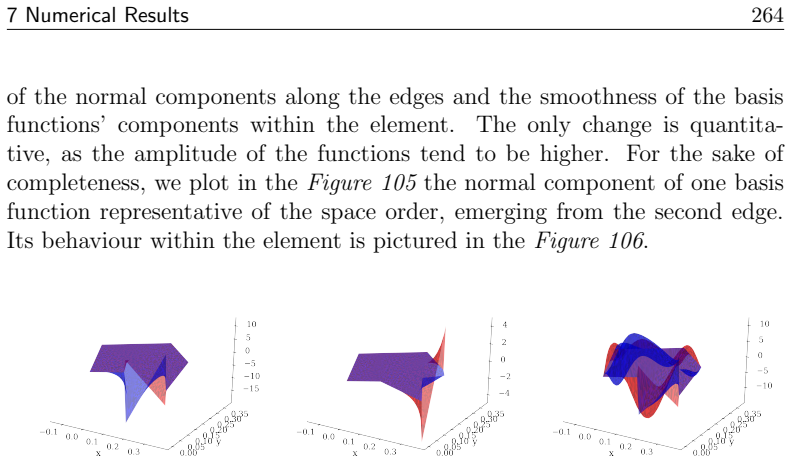
Figure 105
Figure 105. Figure 105: Internal components of a basis function representative of the order of the space. Blue: x component. Red: y component. From left to right: k = 0, k = 1, k = 2 [PITH_FULL_IMAGE:figures/full_fig_p264_105.png] view at source ↗
Figure 106
Figure 106. Figure 106: Representative normal component of normal tuned basis functions that have a non - identically vanishing normal component. Eclated view on every edges. Top to bottom: k = 0, k = 1, k = 2. However, slight changes can be noticed when paying a closer attention to the layout of the normal basis function, represented in the [PITH_FULL_IMAGE:figures/full_fig_p264_106.png] view at source ↗
Figure 107
Figure 107. Figure 107: Plot of all the functions emerging from the second edge on all the second edge of the element. From left to right: k = 0, k = 1, k = 2 Indeed, we can observe that the normal components of the normal basis function scales to one in the lowest order case, regardless the conditioning of the matrix. For the highest orders however, the Lagrangian behaviour is still not respected between the normal components … view at source ↗
Figure 108
Figure 108. Figure 108: Plot of the normal component of the basis functions emerging from the former canonical normal basis functions in the case k = 1. From left to right: first normal basis function, second normal basis func￾tion, third degenerating basis function generated from a canonical normal basis function [PITH_FULL_IMAGE:figures/full_fig_p265_108.png] view at source ↗
Figure 109
Figure 109. Figure 109: Plot of the internal behaviour of the basis functions emerging from the former canonical normal basis functions in the case k = 1. From left to right: first normal basis function, second normal basis func￾tion, third degenerating basis function generated from a canonical normal basis function. None of the coordinate - wise components are vanishing identically on all the boundaries. 7.3.1.3 Element IIa A … view at source ↗
Figure 110
Figure 110. Figure 110: Internal components of a basis function representative of the order of the space. Blue: x component. Red: y component. From left to right: k = 0, k = 1, k = 2. Similarly as in the previous cases, the two components of the normal basis function are smooth within the element for any order k. Their amplitudes are also comparable to the one found in the case of the element Ia [PITH_FULL_IMAGE:figures/full_f… view at source ↗
Figure 111
Figure 111. Figure 111: Representative normal component of normal tuned basis functions that have a non - identically vanishing normal component. Eclated view on every edges. Top to bottom: k = 0, k = 1, k = 2. Furthermore, the support of the normal component of the normal basis functions is also limited to a single edge and still allows an easier repre￾sentation of the discretized quantity across the boundaries. The observed v… view at source ↗
Figure 112
Figure 112. Figure 112: Plot of all the functions emerging from the second edge on all the second edge of the element. From left to right: k = 0, k = 1, k = 2 [PITH_FULL_IMAGE:figures/full_fig_p268_112.png] view at source ↗
Figure 113
Figure 113. Figure 113: Plot of the normal component of the basis functions emerging from the former canonical normal basis functions in the case k = 1. From left to right: first normal basis function, second normal basis func￾tion, third degenerating basis function generated from a canonical normal basis function [PITH_FULL_IMAGE:figures/full_fig_p268_113.png] view at source ↗
Figure 114
Figure 114. Figure 114: Plot of the internal behaviour of the basis functions emerging from the former canonical normal basis functions in the case k = 1. From left to right: first normal basis function, second normal basis func￾tion, third degenerating basis function generated from a canonical normal basis function. None of the coordinate - wise components are vanishing identically on all the boundaries [PITH_FULL_IMAGE:figur… view at source ↗
Figure 115
Figure 115. Figure 115: , while its normal behaviour is pictured in the [PITH_FULL_IMAGE:figures/full_fig_p269_115.png] view at source ↗
Figure 116
Figure 116. Figure 116: Representative normal component of normal tuned basis functions that have a non - identically vanishing normal component. Eclated view on every edges. Top to bottom: k = 0, k = 1, k = 2 [PITH_FULL_IMAGE:figures/full_fig_p269_116.png] view at source ↗
Figure 117
Figure 117. Figure 117: Normal functions emerging from the second edge. Lastly, we can witness that similarly as before, the functions whose nor￾mal component vanishes on the edges are not identically vanishing (see the Figures 118 and 119). Thus, due to their regularity they can be reuptaken as an internal basis function, even if component wise they are not vanishing on the boundary [PITH_FULL_IMAGE:figures/full_fig_p270_117.png] view at source ↗
Figure 118
Figure 118. Figure 118: Plot of the normal component of the basis functions emerging from the former canonical normal basis functions in the case k = 0. From left to right: first normal basis function, second normal basis func￾tion, third degenerating basis function generated from a canonical normal basis function [PITH_FULL_IMAGE:figures/full_fig_p270_118.png] view at source ↗
Figure 119
Figure 119. Figure 119: Plot of the internal behaviour of the basis functions emerging from the former canonical normal basis functions in the case k = 0. From left to right: first normal basis function, second normal basis func￾tion, third degenerating basis function generated from a canonical normal basis function. None of the coordinate - wise components are vanishing identically on all the boundaries. 7.3.2 Impact of the sh… view at source ↗
Figure 120
Figure 120. Figure 120: First normal moment built from the first edge in the case k = 0. Left: shifted pointwise value. Right: classical setting [PITH_FULL_IMAGE:figures/full_fig_p272_120.png] view at source ↗
Figure 121
Figure 121. Figure 121: First normal moment built from the first edge in the case k = 0: Top Ib shifted, Bottom Ib [PITH_FULL_IMAGE:figures/full_fig_p272_121.png] view at source ↗
Figure 122
Figure 122. Figure 122: First normal moment built from the first edge in the case k = 0. Left: shifted pointwise value. Right: classical setting [PITH_FULL_IMAGE:figures/full_fig_p273_122.png] view at source ↗
Figure 123
Figure 123. Figure 123: First normal moment built from the first edge in the case k = 0: Top Ib shifted, Bottom Ib [PITH_FULL_IMAGE:figures/full_fig_p273_123.png] view at source ↗
Figure 124
Figure 124. Figure 124: Normal components of functions emerging from the second edge. N [PITH_FULL_IMAGE:figures/full_fig_p274_124.png] view at source ↗
Figure 125
Figure 125. Figure 125: Normal components of basis functions living on the second edge. Computed for the element Ia on a non - convex hexagon, k = 1 [PITH_FULL_IMAGE:figures/full_fig_p276_125.png] view at source ↗
Figure 126
Figure 126. Figure 126: Normal components of basis functions living on the second edge. Computed for the element Ia on a non - convex hexagon, k = 2 [PITH_FULL_IMAGE:figures/full_fig_p276_126.png] view at source ↗
Figure 127
Figure 127. Figure 127: Normal components of basis functions living on the second edge. Computed for the element Ib on a non - convex hexagon, k = 1 [PITH_FULL_IMAGE:figures/full_fig_p277_127.png] view at source ↗
Figure 128
Figure 128. Figure 128: Normal components of basis functions living on the second edge. Computed for the element Ib on a non - convex hexagon, k = 2 [PITH_FULL_IMAGE:figures/full_fig_p277_128.png] view at source ↗
Figure 129
Figure 129. Figure 129: Normal components of basis functions living on the second edge. Computed for the element IIa on a non - convex hexagon, k = 1 [PITH_FULL_IMAGE:figures/full_fig_p278_129.png] view at source ↗
Figure 130
Figure 130. Figure 130: Normal components of basis functions living on the second edge. Computed for the element IIa on a non - convex hexagon, k = 2 [PITH_FULL_IMAGE:figures/full_fig_p279_130.png] view at source ↗
Figure 131
Figure 131. Figure 131: Normal components of basis functions living on the second edge. Computed for the element IIb on a non - convex hexagon, k = 1 [PITH_FULL_IMAGE:figures/full_fig_p279_131.png] view at source ↗
Figure 132
Figure 132. Figure 132: Normal components of basis functions living on the second edge. Computed for the element IIb on a non - convex hexagon, k = 2. 7.4 Comparison with classical RT As a last investigation, let us compare the results obtained from the reduced element IIb presented in the Section 6.2 with the classical Raviart – Thomas elements built on simplicial and quadrangular shapes. 7.4.1 Triangular shape [PITH_FULL_IMA… view at source ↗
Figure 133
Figure 133. Figure 133: Triangle We start by considering the triangular shape represented in the [PITH_FULL_IMAGE:figures/full_fig_p280_133.png] view at source ↗
Figure 134
Figure 134. Figure 134: First basis function in the case k = 0. Top left: normal component along the boundaries. Top right: internal behaviour of the basis function. Blue: x component. Red: y component. As in the Raviart – Thomas setting, the only normal basis functions whose normal component is non - vanishing scales to one. However, note that within the element its behaviour is not polynomial. Similarly, for a first order ele… view at source ↗
Figure 135
Figure 135. Figure 135: Second basis function in the case k = 1 [PITH_FULL_IMAGE:figures/full_fig_p282_135.png] view at source ↗
Figure 136
Figure 136. Figure 136: Fifth basis function in the case k = 2. Top left: normal component along the boundaries. Top right: internal behaviour of the basis function. Blue: x component. Red: y component [PITH_FULL_IMAGE:figures/full_fig_p282_136.png] view at source ↗
Figure 137
Figure 137. Figure 137: All the basis functions plotted on all the edges. From top to bottom: k = 0, k = 1, k = 2. On the side of internal functions, as expected, for any order k bigger or equal than one, the normal components of the internal moments are vanishing on the edges. The parallel with the Raviart – Thomas setting is here also immediate [PITH_FULL_IMAGE:figures/full_fig_p283_137.png] view at source ↗
Figure 138
Figure 138. Figure 138: Last internal basis function in the case k = 2. Lastly, let us derive a comment on the conditionings. As we work on a reduced space where no misc basis functions nor misc moments are consid￾ered, the conditioning is further reduced compared to the general setting. In particular, using the Hermite polynomials as projectors we retrieve the following truncated values. Order 1 2 3 Conditionings 15 12536 6702… view at source ↗
Figure 139
Figure 139. Figure 139: Quadrangle of refer￾ence We perform the same test for a quad￾rangular shape. Here too, we considered the reference shape of the quadrilateral Raviart – Thomas elements and rotated it not to fall in our shape limitations. The used element is depicted in the Fig￾ure 139. As before, for the sake of concision only one representative of the normal basis functions whose normal component is not vanishing on the… view at source ↗
Figure 140
Figure 140. Figure 140: Second basis function in the case k = 0. Top left: normal com￾ponent along the boundaries. Top right: internal behaviour of the basis function. Blue: x component. Red: y component [PITH_FULL_IMAGE:figures/full_fig_p285_140.png] view at source ↗
Figure 141
Figure 141. Figure 141: Fourth basis function in the case k = 1. Top left: normal com￾ponent along the boundaries. Top right: internal behaviour of the basis function. Blue: x component. Red: y component [PITH_FULL_IMAGE:figures/full_fig_p285_141.png] view at source ↗
Figure 142
Figure 142. Figure 142: Eight basis function in the case k = 2. Top left: normal component along the boundaries. Top right: internal behaviour of the basis function. Blue: x component. Red: y component. Furthermore, as shown on the [PITH_FULL_IMAGE:figures/full_fig_p286_142.png] view at source ↗
Figure 143
Figure 143. Figure 143: All the basis functions plotted on all the edges. From top to bottom: k = 0, k = 1, k = 2 [PITH_FULL_IMAGE:figures/full_fig_p287_143.png] view at source ↗
Figure 144
Figure 144. Figure 144: Internal study Lastly, let us comment the obtained conditionings in the quadrilateral case. As we work on a reduced space where no misc basis functions nor misc moments are considered, the conditioning is by far reduced compared to the general setting. In particular, using the Hermite polynomials as projectors we [PITH_FULL_IMAGE:figures/full_fig_p287_144.png] view at source ↗
Figure 145
Figure 145. Figure 145: Quadrangle of refer￾ence Let us end the discussion on the nu￾merical results by constructing the alter￾native element IIb on a non - convex hexagon given in the [PITH_FULL_IMAGE:figures/full_fig_p288_145.png] view at source ↗
Figure 147
Figure 147. Figure 147 [PITH_FULL_IMAGE:figures/full_fig_p288_147.png] view at source ↗
Figure 146
Figure 146. Figure 146: Second basis function in the case k = 0. Top left: normal com￾ponent along the boundaries. Top right: internal behaviour of the basis function. Blue: x component. Red: y component [PITH_FULL_IMAGE:figures/full_fig_p289_146.png] view at source ↗
Figure 147
Figure 147. Figure 147: Fourth basis function in the case k = 1. Top left: normal com￾ponent along the boundaries. Top right: internal behaviour of the basis function. Blue: x component. Red: y component [PITH_FULL_IMAGE:figures/full_fig_p289_147.png] view at source ↗
Figure 148
Figure 148. Figure 148: Eight basis function in the case k = 2. Top left: normal component along the boundaries. Top right: internal behaviour of the basis function. Blue: x component. Red: y component. Furthermore, as shown on the [PITH_FULL_IMAGE:figures/full_fig_p290_148.png] view at source ↗
Figure 149
Figure 149. Figure 149: All the basis functions plotted on all the edges. From top to bottom: k = 0, k = 1, k = 2 [PITH_FULL_IMAGE:figures/full_fig_p290_149.png] view at source ↗
Figure 150
Figure 150. Figure 150: Internal study Lastly, we can observe that the conditioning is increased compared to the two classical cases. Indeed, connecting with the discussion on the condition￾ing for the classical space, combining the squezeness of the element with an increased number of edges let us expect an increase of the conditioning. How￾ever, please note that we still retrieve lower values with the reduced space than with … view at source ↗
Figure 151
Figure 151. Figure 151: Triangular shape Edge Vertex1 Vertex2 Normal Norm 0 [0.20, 0.00] [1.00, 0.20] [0.24, -0.97] [0.82] 1 [1.00, 0.20] [0.80, 1.20] [0.98, 0.20] [1.02] 2 [0.80, 1.20] [0.00, 1.00] [-0.24, 0.97] [0.82] 3 [0.00, 1.00] [0.20, 0.00] [-0.98, -0.20] [1.02] [PITH_FULL_IMAGE:figures/full_fig_p303_151.png] view at source ↗
Figure 152
Figure 152. Figure 152: Quadrangular shape B.2 Convex elements Edge Vertex1 Vertex2 Normal Norm 0 [0.07, 0.18] [0.41, 0.05] [-0.34, -0.94] [0.37] 1 [0.41, 0.05] [0.36, 0.41] [0.99, 0.15] [0.36] 2 [0.36, 0.41] [0.07, 0.18] [-0.63, 0.78] [0.37] [PITH_FULL_IMAGE:figures/full_fig_p303_152.png] view at source ↗
Figure 153
Figure 153. Figure 153: Smallest considered triangular shape [PITH_FULL_IMAGE:figures/full_fig_p303_153.png] view at source ↗
Figure 154
Figure 154. Figure 154: Small considered triangular shape Edge Vertex1 Vertex2 Normal Norm 0 [0.30, 0.75] [1.77, 0.21] [-0.34, -0.94] [1.57] 1 [1.77, 0.21] [1.53, 1.74] [0.99, 0.15] [1.55] 2 [1.53, 1.74] [0.30, 0.75] [-0.63, 0.78] [1.58] [PITH_FULL_IMAGE:figures/full_fig_p304_154.png] view at source ↗
Figure 155
Figure 155. Figure 155: Considered triangular shape Edge Vertex1 Vertex2 Normal Norm 0 [0.60, 1.50] [3.54, 0.42] [-0.34, -0.94] [3.13] 1 [3.54, 0.42] [3.06, 3.48] [0.99, 0.15] [3.10] 2 [3.06, 3.48] [0.60, 1.50] [-0.63, 0.78] [3.16] [PITH_FULL_IMAGE:figures/full_fig_p304_155.png] view at source ↗
Figure 156
Figure 156. Figure 156: Big considered triangular shape Edge Vertex1 Vertex2 Normal Norm 0 [0.90, 2.25] [5.31, 0.63] [-0.34, -0.94] [4.70] 1 [5.31, 0.63] [4.59, 5.22] [0.99, 0.15] [4.65] 2 [4.59, 5.22] [0.90, 2.25] [-0.63, 0.78] [4.74] [PITH_FULL_IMAGE:figures/full_fig_p304_156.png] view at source ↗
Figure 157
Figure 157. Figure 157: Biggest considered triangular shape Edge Vertex1 Vertex2 Normal Norm 0 [0.25, 0.00] [0.50, 0.25] [0.71, -0.71] [0.35] 1 [0.50, 0.25] [0.25, 0.50] [0.71, 0.71] [0.35] 2 [0.25, 0.50] [0.00, 0.25] [-0.71, 0.71] [0.35] 3 [0.00, 0.25] [0.25, 0.00] [-0.71, -0.71] [0.35] [PITH_FULL_IMAGE:figures/full_fig_p304_157.png] view at source ↗
Figure 158
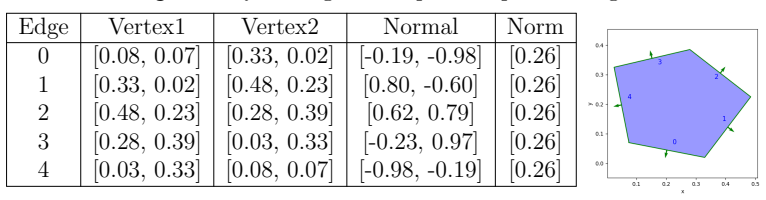
Figure 158. Figure 158: Quadrangular shape with parallel edges Edge Vertex1 Vertex2 Normal Norm 0 [0.08, 0.07] [0.33, 0.02] [-0.19, -0.98] [0.26] 1 [0.33, 0.02] [0.48, 0.23] [0.80, -0.60] [0.26] 2 [0.48, 0.23] [0.28, 0.39] [0.62, 0.79] [0.26] 3 [0.28, 0.39] [0.03, 0.33] [-0.23, 0.97] [0.26] 4 [0.03, 0.33] [0.08, 0.07] [-0.98, -0.19] [0.26] [PITH_FULL_IMAGE:figures/full_fig_p305_158.png] view at source ↗
Figure 159
Figure 159. Figure 159: Pentagonal shape Edge Vertex1 Vertex2 Normal Norm 0 [2.05, 1.98] [2.31, 1.92] [-0.25, -0.97] [0.26] 1 [2.31, 1.92] [2.35, 2.17] [0.99, -0.17] [0.26] 2 [2.35, 2.17] [2.31, 2.43] [0.99, 0.15] [0.26] 3 [2.31, 2.43] [2.08, 2.32] [-0.42, 0.91] [0.26] 4 [2.08, 2.32] [1.86, 2.16] [-0.61, 0.80] [0.26] 5 [1.86, 2.16] [2.05, 1.98] [-0.70, -0.72] [0.26] [PITH_FULL_IMAGE:figures/full_fig_p305_159.png] view at source ↗
Figure 160
Figure 160. Figure 160: Regular hexagonal shape Edge Vertex1 Vertex2 Normal Norm 0 [0.07, 0.07] [0.16, 0.02] [-0.43, -0.90] [0.11] 1 [0.16, 0.02] [0.42, 0.11] [0.31, -0.95] [0.27] 2 [0.42, 0.11] [0.34, 0.21] [0.80, 0.61] [0.13] 3 [0.34, 0.21] [0.20, 0.33] [0.65, 0.76] [0.18] 4 [0.20, 0.33] [0.04, 0.23] [-0.55, 0.84] [0.19] 5 [0.04, 0.23] [0.07, 0.07] [-0.99, -0.15] [0.16] [PITH_FULL_IMAGE:figures/full_fig_p305_160.png] view at source ↗
Figure 161
Figure 161. Figure 161: Hexagonal shape Edge Vertex1 Vertex2 Normal Norm 0 [0.13, 0.13] [0.32, 0.04] [-0.43, -0.90] [0.21] 1 [0.32, 0.04] [0.84, 0.21] [0.31, -0.95] [0.55] 2 [0.84, 0.21] [0.78, 0.38] [0.94, 0.33] [0.18] 3 [0.78, 0.38] [0.50, 0.66] [0.71, 0.71] [0.40] 4 [0.50, 0.66] [0.08, 0.45] [-0.45, 0.89] [0.47] 5 [0.08, 0.45] [0.13, 0.13] [-0.99, -0.15] [0.32] [PITH_FULL_IMAGE:figures/full_fig_p305_161.png] view at source ↗
Figure 162
Figure 162. Figure 162: Alternative hexagonal shape [PITH_FULL_IMAGE:figures/full_fig_p305_162.png] view at source ↗
Figure 163
Figure 163. Figure 163: Non - convex quadrilateral Edge Vertex1 Vertex2 Normal Norm 0 [0.17, 0.03] [0.38, 0.19] [0.59, -0.80] [0.26] 1 [0.38, 0.19] [0.30, 0.18] [-0.18, 0.98] [0.08] 2 [0.30, 0.18] [0.12, 0.36] [0.74, 0.68] [0.26] 3 [0.12, 0.36] [0.19, 0.11] [-0.97, -0.25] [0.26] 4 [0.19, 0.11] [0.17, 0.03] [-0.97, 0.24] [0.08] [PITH_FULL_IMAGE:figures/full_fig_p306_163.png] view at source ↗
Figure 164
Figure 164. Figure 164: Non - convex pentagon Edge Vertex1 Vertex2 Normal Norm 0 [0.00, 0.03] [0.12, 0.07] [0.37, -0.93] [0.13] 1 [0.12, 0.07] [0.38, 0.00] [-0.29, -0.96] [0.26] 2 [0.38, 0.00] [0.30, 0.25] [0.96, 0.29] [0.26] 3 [0.30, 0.25] [0.12, 0.38] [0.58, 0.81] [0.22] 4 [0.12, 0.38] [-0.12, 0.25] [-0.45, 0.89] [0.28] 5 [-0.12, 0.25] [0.00, 0.03] [-0.87, -0.49] [0.26] [PITH_FULL_IMAGE:figures/full_fig_p306_164.png] view at source ↗
Figure 165
Figure 165. Figure 165: Non - convex hexagon Edge Vertex1 Vertex2 Normal Norm 0 [0.07, 0.03] [0.35, 0.10] [0.24, -0.97] [0.29] 1 [0.35, 0.10] [0.45, 0.25] [0.83, -0.55] [0.18] 2 [0.45, 0.25] [0.25, 0.30] [0.24, 0.97] [0.21] 3 [0.25, 0.30] [0.05, 0.25] [-0.24, 0.97] [0.21] 4 [0.05, 0.25] [0.14, 0.16] [-0.73, -0.69] [0.12] 5 [0.14, 0.16] [0.07, 0.03] [-0.88, 0.47] [0.15] [PITH_FULL_IMAGE:figures/full_fig_p306_165.png] view at source ↗
Figure 166
Figure 166. Figure 166: Alternative non - convex hexagon [PITH_FULL_IMAGE:figures/full_fig_p306_166.png] view at source ↗
Figure 167
Figure 167. Figure 167: Non - convex decagon B.4 Elements used to test the failing and limit cases Edge Vertex1 Vertex2 Normal Norm 0 [0.20, 0.00] [1.00, 0.20] [0.24, -0.97] [0.82] 1 [1.00, 0.20] [1.60, 1.40] [0.89, -0.45] [1.34] 2 [1.60, 1.40] [0.80, 1.20] [-0.24, 0.97] [0.82] 3 [0.80, 1.20] [0.00, 1.00] [-0.24, 0.97] [0.82] 4 [0.00, 1.00] [0.20, 0.00] [-0.98, -0.20] [1.02] [PITH_FULL_IMAGE:figures/full_fig_p307_167.png] view at source ↗
Figure 168
Figure 168. Figure 168: Hanging node Edge Vertex1 Vertex2 Normal Norm 0 [0.20, 0.00] [1.00, 0.20] [0.24, -0.97] [0.82] 1 [1.00, 0.20] [3.50, 0.00] [-0.08, -1.00] [2.51] 2 [3.50, 0.00] [2.40, 1.60] [0.82, 0.57] [1.94] 3 [2.40, 1.60] [1.60, 1.40] [-0.24, 0.97] [0.82] 4 [1.60, 1.40] [1.70, 0.90] [-0.98, -0.20] [0.51] 5 [1.70, 0.90] [0.90, 0.70] [-0.24, 0.97] [0.82] 6 [0.90, 0.70] [0.80, 1.20] [0.98, 0.20] [0.51] 7 [0.80, 1.20] [0.… view at source ↗
Figure 169
Figure 169. Figure 169: Polygon having similar edges [PITH_FULL_IMAGE:figures/full_fig_p307_169.png] view at source ↗
Figure 170
Figure 170. Figure 170: Two vertices aligned with the origin Edge Vertex1 Vertex2 Normal Norm 0 [0.00, 0.00] [1.25, 0.38] [0.29, -0.96] [1.31] 1 [1.25, 0.38] [1.32, 0.90] [0.99, -0.14] [0.53] 2 [1.32, 0.90] [1.00, 1.25] [0.73, 0.68] [0.48] 3 [1.00, 1.25] [0.42, 1.23] [-0.04, 1.00] [0.58] 4 [0.42, 1.23] [0.00, 0.00] [-0.94, 0.33] [1.30] [PITH_FULL_IMAGE:figures/full_fig_p308_170.png] view at source ↗
Figure 171
Figure 171. Figure 171: Two vertices aligned with the origin Edge Vertex1 Vertex2 Normal Norm 0 [0.05, 0.05] [0.25, 0.05] [0.00, -1.00] [0.20] 1 [0.25, 0.05] [0.32, 0.16] [0.84, -0.54] [0.13] 2 [0.32, 0.16] [0.19, 0.29] [0.71, 0.71] [0.18] 3 [0.19, 0.29] [0.09, 0.23] [-0.53, 0.85] [0.12] 4 [0.09, 0.23] [0.05, 0.05] [-0.98, 0.20] [0.18] [PITH_FULL_IMAGE:figures/full_fig_p308_171.png] view at source ↗
Figure 172
Figure 172. Figure 172: Edge parallel to the x axis Edge Vertex1 Vertex2 Normal Norm 0 [0.05, 0.00] [0.25, 0.07] [0.31, -0.95] [0.21] 1 [0.25, 0.07] [0.32, 0.16] [0.81, -0.59] [0.12] 2 [0.32, 0.16] [0.19, 0.29] [0.71, 0.71] [0.18] 3 [0.19, 0.29] [0.05, 0.25] [-0.27, 0.96] [0.15] 4 [0.05, 0.25] [0.05, 0.00] [-1.00, -0.00] [0.25] [PITH_FULL_IMAGE:figures/full_fig_p308_172.png] view at source ↗
Figure 173
Figure 173. Figure 173: Edge parallel to the y axis [PITH_FULL_IMAGE:figures/full_fig_p308_173.png] view at source ↗
read the original abstract

We present a class of discretisation spaces and H(div)-conformal elements that can be built on any polytope. Bridging the flexibility of the Virtual Element spaces towards the element's shape with the divergence properties of the Raviart-Thomas elements on the boundaries, the designed frameworks offer a wide range of H(div)-conformal discretisations. As those elements are set up through degrees of freedom, their definitions are easily amenable to the properties the approximated quantities are wished to fulfil. Furthermore, we show that one straightforward restriction of this general setting share its properties with the classical Raviart-Thomas elements at each interface, for any order and any polytopial shape. Then, we investigate the shape of the basis functions corresponding to particular elements in the two dimensional case.

Editorial analysis

A structured set of objections, weighed in public.

Desk editor's note, referee report, simulated authors' rebuttal, and a circularity audit. Tearing a paper down is the easy half of reading it; the pith above is the substance, this is the friction.

Referee Report

1 major / 1 minor

Summary. The manuscript introduces a general class of finite-dimensional spaces and H(div)-conforming finite elements on arbitrary polytopes, combining the shape flexibility of Virtual Element Methods with the divergence properties of Raviart-Thomas elements on element boundaries. The spaces are defined via degrees of freedom, and the central result is that one straightforward restriction of the general construction reproduces the interface properties of classical Raviart-Thomas elements (normal traces and exact divergence mapping) for any polynomial order and any polytope shape. The paper also examines the geometry of basis functions in the two-dimensional case.

Significance. If the H(div)-conformity, normal continuity, and exact-sequence properties are established without hidden geometric restrictions on the polytopes, the framework would enable mixed finite-element discretizations on completely general polyhedral meshes. This flexibility is potentially useful for applications such as Darcy flow or incompressible elasticity on unstructured grids. The DOF-based definition is a methodological strength that facilitates adaptation to additional constraints.

major comments (1)
  1. [Abstract and section describing the construction of the spaces] Abstract / construction of the spaces: The claim that a restriction of the general setting reproduces the classical Raviart-Thomas normal traces and the exact div(P_k) property on every interface, for arbitrary polytopes and any order, rests on an unverified choice of face degrees of freedom. The manuscript must supply the explicit definition of these boundary DOFs together with the algebraic argument showing that they simultaneously enforce normal continuity, lie in the RT trace space, and preserve the surjectivity of the divergence operator onto the full polynomial space inside the element, without additional hypotheses (e.g., star-shapedness or convexity of the polytope or its faces).
minor comments (1)
  1. [Abstract] The sentence 'one straightforward restriction of this general setting share its properties' contains a subject-verb agreement error and should read 'shares its properties'.

Simulated Author's Rebuttal

1 responses · 0 unresolved

We thank the referee for the thorough review and for highlighting the need for greater explicitness in the construction of the restricted spaces. We address the single major comment below and will incorporate the requested clarifications in a revised manuscript.
read point-by-point responses
  1. Referee: [Abstract and section describing the construction of the spaces] Abstract / construction of the spaces: The claim that a restriction of the general setting reproduces the classical Raviart-Thomas normal traces and the exact div(P_k) property on every interface, for arbitrary polytopes and any order, rests on an unverified choice of face degrees of freedom. The manuscript must supply the explicit definition of these boundary DOFs together with the algebraic argument showing that they simultaneously enforce normal continuity, lie in the RT trace space, and preserve the surjectivity of the divergence operator onto the full polynomial space inside the element, without additional hypotheses (e.g., star-shapedness or convexity of the polytope or its faces).

    Authors: We agree that the original manuscript presented the restricted construction at a high level and did not spell out the face degrees of freedom or the accompanying algebraic verification in sufficient detail. In the revised version we will add an explicit subsection that defines the boundary degrees of freedom of the restricted space as the standard Raviart-Thomas moments ∫_f (v·n) q ds for all q ∈ P_k(f) on each face f. We will then supply a self-contained algebraic argument showing that these moments (i) force the normal trace on each face to lie in the RT trace space P_k(f), (ii) guarantee normal continuity across interfaces because adjacent elements share identical face moments, and (iii) preserve surjectivity of the divergence onto the full P_k inside the element by a dimension-counting argument that uses only the exact polynomial sequence on the boundary and the complementary internal degrees of freedom. The argument relies exclusively on the unisolvence of the chosen degrees of freedom and the algebraic properties of the polynomial spaces; it invokes no geometric hypotheses such as star-shapedness or convexity of the polytope or its faces. revision: yes

Circularity Check

0 steps flagged

No circularity: construction presented as independent of its target properties

full rationale

The abstract and description present a general class of spaces defined via degrees of freedom on polytopes, with a restriction to Raviart-Thomas-like behavior stated as a result that is shown rather than presupposed by definition. No equations, fitted parameters renamed as predictions, or self-citation chains appear in the provided text. The derivation is therefore treated as self-contained against external finite-element theory.

Axiom & Free-Parameter Ledger

0 free parameters · 0 axioms · 0 invented entities

Abstract-only; no explicit free parameters, axioms, or invented entities are stated.

pith-pipeline@v0.9.0 · 5671 in / 1072 out tokens · 19884 ms · 2026-05-24T18:54:05.458643+00:00 · methodology

discussion (0)

Sign in with ORCID, Apple, or X to comment. Anyone can read and Pith papers without signing in.

Reference graph

Works this paper leans on

21 extracted references · 21 canonical work pages · 1 internal anchor

  1. [1]

    Abgrall, E

    R. Abgrall, E. le M´ el´ edo, and P. ¨Offner. On the Connection be- tween Residual Distribution Schemes and Flux Reconstruction. https: //arxiv.org/abs/1807.01261, July 2018

  2. [2]

    D. Boffi, F. Brezzi, M. Fortin, et al. Mixed finite element methods and applications, volume 44. Springer, 2013

  3. [3]

    Brezzi, J

    F. Brezzi, J. Douglas, and L. D. Marini. Two families of mixed finite elements for second order elliptic problems. Numerische Mathematik , 47(2):217–235, Jun 1985

  4. [4]

    Brezzi and M

    F. Brezzi and M. Fortin, editors. Mixed and Hybrid Finite Element Methods. Springer New York, 1991

  5. [5]

    Chabrowski

    J. Chabrowski. The Dirichlet problem with L2-boundary data for elliptic linear equations. Springer, 2006

  6. [6]

    Cockburn, G

    B. Cockburn, G. E. Karniadakis, and C.-W. Shu. Discontinuous Galerkin methods: theory, computation and applications , volume 11. Springer Science & Business Media, 2012

  7. [7]

    D. A. Di Pietro and S. Lemaire. An extension of the Crouzeix-Raviart space to general meshes with application to quasi-incompressible linear elasticity and Stokes flow. Mathematics of Computation , 84(291):1–31, 2015

  8. [8]

    Raviart-Thomas finite elements of Petrov-Galerkin type

    F. Dubois, I. Greff, and C. Pierre. Raviart-thomas finite elements of petrov-galerkin type. arXiv preprint arXiv:1710.04395 , 2017

  9. [9]

    V. Ervin. Computational bases for rtk and bdmk on triangles. Comput- ers & Mathematics with Applications , 64(8):2765–2774, 2012

  10. [10]

    Gillette, A

    A. Gillette, A. Rand, and C. Bajaj. Construction of scalar and vector finite element families on polygonal and polyhedral meshes

  11. [11]

    Gopalakrishnan, L

    J. Gopalakrishnan, L. E. Garc´ ıa-Castillo, and L. F. Demkowicz. N´ ed´ elec spaces in affine coordinates. Computers & Mathematics with Applica- tions, 49(7-8):1285–1294, 2005

  12. [12]

    H. T. Huynh. A flux reconstruction approach to high-order schemes including discontinuous galerkin methods. In 18th AIAA Computational Fluid Dynamics Conference, page 4079, 2007. B Details of some elements used in the numerical experiments 310

  13. [13]

    N´ ed´ elec

    J.C. N´ ed´ elec. Mixed finite elements in R3. Numerische Mathematik , 35(3):315–341, 1980

  14. [14]

    M. V. Kondratieva, A. B. Levin, A. V. Mikhalev, and E. V. Pankratiev. Differential and Difference Dimension Polynomials . Springer Nether- lands, 1999

  15. [15]

    Ranocha, P

    H. Ranocha, P. ¨Offner, and T. Sonar. Summation-by-parts operators for correction procedure via reconstruction. Journal of Computational Physics, 311:299–328, 2016

  16. [16]

    P. A. Raviart and J. M. Thomas. A mixed finite element method for 2-nd order elliptic problems. In I. Galligani and E. Magenes, editors, Mathematical Aspects of Finite Element Methods, pages 292–315, Berlin, Heidelberg, 1977. Springer Berlin Heidelberg

  17. [17]

    Sukumar and E

    N. Sukumar and E. Malsch. Recent advances in the construction of polygonal finite element interpolants. Archives of Computational Meth- ods in Engineering, 13(1):129, 2006

  18. [18]

    Talischi, A

    C. Talischi, A. Pereira, G. H. Paulino, I. F. Menezes, and M. S. Carvalho. Polygonal finite elements for incompressible fluid flow. International Journal for Numerical Methods in Fluids , 74(2):134–151, oct 2013

  19. [19]

    J.-M. Thomas. M´ ethode des ´ el´ ements finis hybrides duaux pour les probl` emes elliptiques du second ordre. Revue fran¸ caise d’automatique, informatique, recherche op´ erationnelle. Analyse num´ erique, 10(R3):51– 79, 1976

  20. [20]

    L. B. D. Veiga, F. Brezzi, A. Cangiani, G. Manzini, L. D. Marini, and A. Russo. Basic principles of virtual element methods. Mathematical Models and Methods in Applied Sciences , 23(01):199–214, jan 2013

  21. [21]

    P. E. Vincent, P. Castonguay, and A. Jameson. A new class of high- order energy stable flux reconstruction schemes. Journal of Scientific Computing, 47(1):50–72, 2011