High-threshold, low-overhead and single-shot decodable fault-tolerant quantum memory
Pith reviewed 2026-05-24 00:13 UTC · model grok-4.3
The pith
Radial codes achieve surface-code error suppression using five times fewer physical qubits, even with single-shot decoding.
A machine-rendered reading of the paper's core claim, the machinery that carries it, and where it could break.
Core claim
Radial codes obtained from the lifted product of a specific subset of classical quasi-cyclic codes realize the parameters [[2r²s, 2(r-1)², ≤2s]] with average-case distance linear in s; under circuit-level noise they deliver logical error suppression comparable to surface codes of matching distance while using approximately five times fewer physical qubits, and this advantage remains when the codes are decoded in a single shot.
What carries the argument
The lifted-product construction that defines radial codes from a chosen family of classical quasi-cyclic codes, together with their visual representation and optimal-length stabilizer circuits.
Load-bearing premise
The circuit-level noise simulations and numerical distance studies are performed under representative noise models without post-selection that would change the reported qubit savings.
What would settle it
A circuit-level simulation or hardware experiment in which the logical error rate of a radial code of growing s fails to improve at the same rate as a surface code of equal distance would falsify the claimed performance advantage.
Figures




read the original abstract
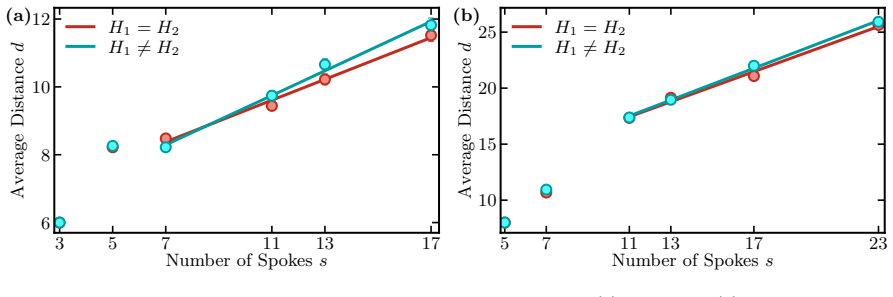
We present a new family of quantum low-density parity-check codes, which we call radial codes, obtained from the lifted product of a specific subset of classical quasi-cyclic codes. The codes are defined using a pair of integers $(r,s)$ and have parameters $[\![2r^2s,2(r-1)^2,\leq2s]\!]$, with numerical studies suggesting average-case distance linear in $s$. In simulations of circuit-level noise, we observe comparable error suppression to surface codes of similar distance while using approximately five times fewer physical qubits. This is true even when radial codes are decoded using a single-shot approach, which can allow for faster logical clock speeds and reduced decoding complexity. We describe an intuitive visual representation, canonical basis of logical operators and optimal-length stabiliser measurement circuits for these codes, and argue that their error correction capabilities, tunable parameters and small size make them promising candidates for implementation on near-term quantum devices.
Editorial analysis
A structured set of objections, weighed in public.
Referee Report
Summary. The manuscript introduces radial codes, a family of quantum LDPC codes obtained as the lifted product of a specific subset of classical quasi-cyclic codes. For parameters (r,s) the codes have explicit parameters [[2r²s, 2(r-1)², ≤2s]], with numerical studies indicating that the average-case distance scales linearly with s. Circuit-level noise simulations are reported to demonstrate error suppression comparable to surface codes of similar distance while using roughly five times fewer physical qubits; the advantage is claimed to persist under single-shot decoding.
Significance. If the reported simulation results hold under standard noise models and without post-hoc selection, the construction would provide a concrete low-overhead, single-shot-decodable alternative to the surface code, with tunable parameters and small block size that could be relevant for near-term hardware.
major comments (2)
- [Abstract] Abstract: the central performance claim of 'approximately five times fewer physical qubits' with 'comparable error suppression' rests on circuit-level simulations whose noise model, decoder implementation, sample sizes, fitting procedures, and exact surface-code baselines are not described. This information is load-bearing for the qubit-overhead advantage.
- [Abstract] Abstract: the statement that 'numerical studies suggest average-case distance linear in s' does not specify the range of s examined, the ensemble size, the precise distance estimator, or any statistical uncertainty, making it impossible to assess whether the linear scaling is robust or an artifact of the chosen instances.
minor comments (2)
- [Abstract] The abstract states the distance bound as ≤2s; it would be helpful to clarify whether this is a proven upper bound or an observed value and to indicate where the proof or evidence appears.
- The manuscript mentions an 'intuitive visual representation' and 'canonical basis of logical operators'; these should be cross-referenced to the relevant figures or sections for readers who wish to verify the construction.
Simulated Author's Rebuttal
We thank the referee for their careful reading and constructive feedback. We address the two major comments below and will revise the manuscript to incorporate additional details that strengthen the presentation of our results.
read point-by-point responses
-
Referee: [Abstract] Abstract: the central performance claim of 'approximately five times fewer physical qubits' with 'comparable error suppression' rests on circuit-level simulations whose noise model, decoder implementation, sample sizes, fitting procedures, and exact surface-code baselines are not described. This information is load-bearing for the qubit-overhead advantage.
Authors: We agree that these methodological details are necessary to fully substantiate the performance claims. Although the main text provides an overview of the simulation approach, we will revise the manuscript to include an expanded description of the circuit-level noise model, the specific decoder implementation (including single-shot aspects), the Monte Carlo sample sizes, the procedures used to fit logical error rates, and the precise surface-code parameters and distances used as baselines. These additions will be placed in the numerical results section to make the reported overhead advantage transparent and reproducible. revision: yes
-
Referee: [Abstract] Abstract: the statement that 'numerical studies suggest average-case distance linear in s' does not specify the range of s examined, the ensemble size, the precise distance estimator, or any statistical uncertainty, making it impossible to assess whether the linear scaling is robust or an artifact of the chosen instances.
Authors: We acknowledge that the abstract statement is brief and lacks these specifics. In the revised manuscript we will expand the relevant section on code parameters and distance to report the range of s values examined, the ensemble size for each s, the exact procedure used to estimate distance (minimum-weight logical operator search), and any associated statistical uncertainty across the ensemble. This will allow readers to evaluate the robustness of the observed scaling. revision: yes
Circularity Check
No significant circularity identified
full rationale
The paper derives the radial code family explicitly from the lifted-product construction applied to a specified subset of classical quasi-cyclic codes, yielding the closed-form parameters [[2r²s, 2(r-1)², ≤2s]] directly from the algebraic definition. The distance claim is an explicit upper bound ≤2s together with separate numerical sampling that reports average-case scaling linear in s; neither quantity is obtained by fitting a parameter to the same data later used to assert the result. Circuit-level simulations are presented as independent Monte-Carlo evidence under a stated noise model and are not required to close any derivation. No self-citation is invoked as a load-bearing uniqueness theorem, and no ansatz or renaming step reduces the central claims to their own inputs by construction. The derivation chain is therefore self-contained against external benchmarks.
Axiom & Free-Parameter Ledger
free parameters (1)
- r and s
axioms (1)
- standard math Lifted-product construction applied to classical quasi-cyclic codes yields valid quantum LDPC codes
Forward citations
Cited by 4 Pith papers
-
Simplified circuit-level decoding using Knill error correction
Knill error correction reduces circuit-level decoding for quantum LDPC codes to the simpler code-capacity decoder while remaining fault-tolerant under locally decaying noise.
-
Placing and routing quantum LDPC codes in multilayer superconducting hardware
HAL heuristic produces explicit layouts for bivariate bicycle, tile, radial, and Tanner qLDPC codes on multilayer superconducting hardware, demonstrating that open-boundary designs reduce hardware demands with only mo...
-
CAbLECAR: efficiently scheduling QLDPC codes on a tileable spin qubit chip with shuttling
CAbLECAR provides a robotics-inspired shuttle scheduler that enables QLDPC codes on tileable spin-qubit hardware, yielding up to 86% faster schedules and orders-of-magnitude gains in encoding efficiency and logical er...
-
Towards Ultra-High-Rate Quantum Error Correction with Reconfigurable Atom Arrays
A family of quantum LDPC codes with encoding rates exceeding 1/2 achieves logical error rates of 10^{-13} per round on atom arrays under 0.1% circuit noise using hierarchical decoding.
Reference graph
Works this paper leans on
-
[1]
Quan- tum Computation and Quantum Information: 10th Anniversary Edition
Michael A. Nielsen and Isaac L. Chuang. “Quan- tum Computation and Quantum Information: 10th Anniversary Edition”. Cambridge Univer- sity Press. New York, NY, USA (2011). 10th edition
work page 2011
-
[2]
Balanced product quantum codes
Nikolas P. Breuckmann and Jens N. Eber- hardt. “Balanced product quantum codes”. IEEE Transactions on Information Theory 67, 6653–6674 (2021)
work page 2021
-
[3]
Asymptot- ically good quantum and locally testable classical ldpc codes
Pavel Panteleev and Gleb Kalachev. “Asymptot- ically good quantum and locally testable classical ldpc codes”. In Proceedings of the 54th Annual ACM SIGACT Symposium on Theory of Com- puting. Pages 375–388. STOC 2022New York, NY, USA (2022). Association for Computing Ma- chinery
work page 2022
-
[4]
Good quantum ldpc codes with linear time decoders
Irit Dinur, Min-Hsiu Hsieh, Ting-Chun Lin, and Thomas Vidick. “Good quantum ldpc codes with linear time decoders” (2022). arxiv:2206.07750
-
[5]
Anthony Leverrier and Gilles Z´ emor. “Quantum tanner codes” (2022). arxiv:2202.13641
-
[6]
Quantum LDPC Codes with Almost Linear Minimum Dis- tance
Pavel Panteleev and Gleb Kalachev. “Quantum LDPC Codes with Almost Linear Minimum Dis- tance”. IEEE Transactions on Information The- ory 68, 213–229 (2022)
work page 2022
-
[7]
Degener- ate Quantum LDPC Codes With Good Finite Length Performance
Pavel Panteleev and Gleb Kalachev. “Degener- ate Quantum LDPC Codes With Good Finite Length Performance”. Quantum 5, 585 (2021)
work page 2021
-
[8]
Bias-tailored quantum LDPC codes
Joschka Roffe, Lawrence Z. Cohen, Armanda O. Quintavalle, Daryus Chandra, and Earl T. Campbell. “Bias-tailored quantum LDPC codes”. Quantum 7, 1005 (2023)
work page 2023
-
[9]
Finite Rate QLDPC-GKP Cod- ing Scheme that Surpasses the CSS Hamming Bound
Nithin Raveendran, Narayanan Rengaswamy, Filip Rozpedek, Ankur Raina, Liang Jiang, and Bane Vasi´ c. “Finite Rate QLDPC-GKP Cod- ing Scheme that Surpasses the CSS Hamming Bound”. Quantum 6, 767 (2022)
work page 2022
-
[10]
Constant-overhead fault-tolerant quantum com- putation with reconfigurable atom arrays
Qian Xu, J. Pablo Bonilla Ataides, Christo- pher A. Pattison, Nithin Raveendran, Dolev Blu- vstein, Jonathan Wurtz, Bane Vasi´ c, Mikhail D. Lukin, Liang Jiang, and Hengyun Zhou. “Constant-overhead fault-tolerant quantum com- putation with reconfigurable atom arrays”. Na- ture PhysicsPages 1–7 (2024)
work page 2024
-
[11]
Weight Reduced Stabilizer Codes with Lower Overhead
Eric Sabo, Lane G. Gunderman, Benjamin Ide, Michael Vasmer, and Guillaume Dauphinais. “Weight Reduced Stabilizer Codes with Lower Overhead” (2024). arXiv:2402.05228 [quant-ph]
-
[12]
High-threshold and low- overhead fault-tolerant quantum memory
Sergey Bravyi, Andrew W. Cross, Jay M. Gambetta, Dmitri Maslov, Patrick Rall, and Theodore J. Yoder. “High-threshold and low- overhead fault-tolerant quantum memory”. Na- ture 627, 778–782 (2024)
work page 2024
-
[13]
Tools for generation and study of quan- tum radial codes
“Tools for generation and study of quan- tum radial codes”. url: https://github.com/ tRowans/radial-codes-public
-
[14]
Quasicyclic low-density parity-check codes from circulant permutation matrices
M.P.C. Fossorier. “Quasicyclic low-density parity-check codes from circulant permutation matrices”. IEEE Transactions on Information Theory 50, 1788–1793 (2004)
work page 2004
-
[15]
Qdistrnd: A gap package for computing the distance of quantum error- correcting codes
Leonid P. Pryadko, Vadim A. Shabashov, and Valerii K. Kozin. “Qdistrnd: A gap package for computing the distance of quantum error- correcting codes”. Journal of Open Source Soft- ware 7, 4120 (2022)
work page 2022
-
[16]
Sur- face codes: Towards practical large-scale quan- tum computation
Austin G. Fowler, Matteo Mariantoni, John M. Martinis, and Andrew N. Cleland. “Sur- face codes: Towards practical large-scale quan- tum computation”. Physical Review A 86, 032324 (2012)
work page 2012
-
[17]
Stim: a fast stabilizer cir- cuit simulator
Craig Gidney. “Stim: a fast stabilizer cir- cuit simulator”. Quantum 5, 497 (2021). arxiv:2103.02202
-
[18]
A fault-tolerant hon- eycomb memory
Craig Gidney, Michael Newman, Austin Fowler, and Michael Broughton. “A fault-tolerant hon- eycomb memory” (2021). arxiv:2108.10457
-
[19]
Fault-tolerant error correction with the gauge color code
Benjamin J. Brown, Naomi H. Nickerson, and Dan E. Browne. “Fault-tolerant error correction with the gauge color code”. Nature Communica- tions 7, 12302 (2016)
work page 2016
-
[20]
Gauge color codes: optimal transversal gates and gauge fixing in topological stabilizer codes
H´ ector Bomb´ ın. “Gauge color codes: optimal transversal gates and gauge fixing in topological stabilizer codes”. New Journal of Physics 17, 083002 (2015)
work page 2015
-
[21]
Single- shot quantum error correction with the three- dimensional subsystem toric code
Aleksander Kubica and Michael Vasmer. “Single- shot quantum error correction with the three- dimensional subsystem toric code”. Nature Com- munications 13, 6272 (2022)
work page 2022
-
[22]
Eric Dennis, Alexei Kitaev, Andrew Landahl, and John Preskill. “Topological quantum mem- ory”. Journal of Mathematical Physics 43, 4452– 4505 (2002)
work page 2002
-
[23]
Analog in- formation decoding of bosonic quantum low- density parity-check codes
Lucas Berent, Timo Hillmann, Jens Eisert, Robert Wille, and Joschka Roffe. “Analog in- formation decoding of bosonic quantum low- density parity-check codes”. PRX Quantum 5, 020349 (2024)
work page 2024
-
[24]
Paral- lel window decoding enables scalable fault toler- ant quantum computation
Luka Skoric, Dan E. Browne, Kenton M. Barnes, Neil I. Gillespie, and Earl T. Campbell. “Paral- lel window decoding enables scalable fault toler- ant quantum computation”. Nature Communi- cations 14, 7040 (2023)
work page 2023
-
[25]
Improved noisy syndrome decoding of quantum ldpc codes with sliding window
Shilin Huang and Shruti Puri. “Improved noisy syndrome decoding of quantum ldpc codes with sliding window” (2023). arxiv:2311.03307
-
[26]
Subsystem Codes with High Thresholds by Gauge Fixing and Reduced Qubit Overhead
Oscar Higgott and Nikolas P. Breuckmann. “Subsystem Codes with High Thresholds by Gauge Fixing and Reduced Qubit Overhead”. Physical Review X 11, 031039 (2021)
work page 2021
-
[27]
Floquetify- ing the Colour Code
Alex Townsend-Teague, Julio Magdalena de la Fuente, and Markus Kesselring. “Floquetify- ing the Colour Code”. Electronic Proceed- ings in Theoretical Computer Science 384, 265– 303 (2023). 11
work page 2023
-
[28]
Floquet codes without parent subsystem codes
Margarita Davydova, Nathanan Tanti- vasadakarn, and Shankar Balasubramanian. “Floquet codes without parent subsystem codes”. PRX Quantum 4, 020341 (2023)
work page 2023
-
[29]
Decoding across the quan- tum low-density parity-check code landscape
Joschka Roffe, David R. White, Simon Burton, and Earl Campbell. “Decoding across the quan- tum low-density parity-check code landscape”. Physical Review Research 2, 043423 (2020)
work page 2020
-
[30]
Ldpc: Python tools for low den- sity parity check codes
Joschka Roffe. “Ldpc: Python tools for low den- sity parity check codes” (2022)
work page 2022
-
[31]
Logical quantum pro- cessor based on reconfigurable atom arrays
Dolev Bluvstein, Simon J. Evered, Alexan- dra A. Geim, Sophie H. Li, Hengyun Zhou, Tom Manovitz, Sepehr Ebadi, Madelyn Cain, Marcin Kalinowski, Dominik Hangleiter, J. Pablo Bonilla Ataides, Nishad Maskara, Iris Cong, Xun Gao, Pedro Sales Rodriguez, Thomas Karolyshyn, Giulia Semeghini, Michael J. Gullans, Markus Greiner, Vladan Vuletic, and Mikhail D. Luki...
-
[32]
Improved single-shot decoding of higher- dimensional hypergraph-product codes
Oscar Higgott and Nikolas P. Breuckmann. “Improved single-shot decoding of higher- dimensional hypergraph-product codes”. PRX Quantum 4, 020332 (2023). arxiv:2206.03122. 12 Appendices A Binary PCMs for a small QRC The following are the binary representations of the matrices (11) and (12) discussed in section 3.1. HX = 1 0 0 0 0 0 1 0 0 0 0 0 1 0 0 1 0 0 0...
discussion (0)
Sign in with ORCID, Apple, or X to comment. Anyone can read and Pith papers without signing in.