Observable CMB B-modes from Cosmological Phase Transitions
Pith reviewed 2026-05-23 18:32 UTC · model grok-4.3
The pith
Phase transitions can generate CMB B-modes that compete with inflation signals.
A machine-rendered reading of the paper's core claim, the machinery that carries it, and where it could break.
Core claim
Tensor perturbations sourced in the bubble collision stage of a first-order cosmological phase transition can yield non-negligible B-mode signals in the CMB that compete with inflationary predictions for appropriately chosen parameters.
What carries the argument
White noise power spectrum on super-horizon scales produced by bubble collisions in the phase transition, which sources tensor modes observable as CMB B-modes.
Load-bearing premise
The phase transition produces a white noise power spectrum on super-horizon scales that is not suppressed too strongly on the large scales relevant for CMB B-modes.
What would settle it
A B-mode power spectrum measurement that peaks at smaller angular scales than standard inflation predicts, with an amplitude matching the phase-transition calculation for some parameter set.
Figures


read the original abstract
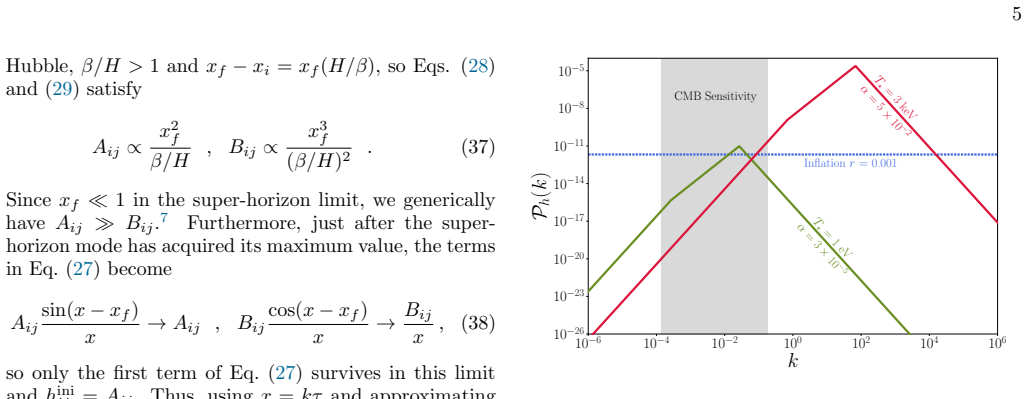
A B-mode polarization signal in the cosmic microwave background (CMB) is widely regarded as smoking gun evidence for gravitational waves produced during inflation. Here, we demonstrate that tensor perturbations sourced during non-inflationary epochs can yield non-negligible B-mode signals, which can in principle complicate the interpretation of future observational data. As a case study, we consider tensor perturbations sourced in the bubble collision stage of a first-order cosmological phase transition occurring in a secluded dark sector. Although phase transitions arise from causal sub-horizon physics, they nevertheless exhibit a white noise power spectrum on super-horizon scales. Power is suppressed on the large scales relevant for CMB B-mode polarization, but it is not necessarily negligible. We show that for appropriately chosen phase transition parameters, the maximal B-mode amplitude can compete with inflationary predictions that can be tested with current and future experiments. These scenarios can be differentiated by performing measurements on multiple angular scales, since the phase transition signal predicts peak power on smaller scales.
Editorial analysis
A structured set of objections, weighed in public.
Referee Report
Summary. The paper claims that tensor modes sourced by bubble collisions during a first-order phase transition in a secluded dark sector produce a white-noise-like tensor power spectrum on super-horizon scales. Although suppressed at the largest scales relevant for CMB B-modes, this spectrum can yield a maximal BB amplitude comparable to inflationary signals with r ~ 0.01–0.001 for appropriately chosen transition parameters (strength, wall velocity, dark-sector energy density). The phase-transition signal peaks at smaller angular scales than the inflationary one, allowing differentiation via multi-scale measurements.
Significance. If the low-k tail of the sourced tensor spectrum is indeed only mildly suppressed and the overall normalization can reach observable levels without violating back-reaction or completion constraints, the result would undermine the interpretation of any detected B-modes as unambiguous evidence for inflation and open a new observational window on dark-sector phase transitions.
major comments (1)
- The central claim that the bubble-collision tensor spectrum remains white-noise-like (rather than exhibiting the k^3 suppression expected for many causal sources) on super-horizon scales is load-bearing for the predicted CMB amplitude. Explicit analytic derivation or simulation results establishing the low-k behavior and its normalization must be provided; without them the assertion that suppression “is not necessarily negligible” at l~100 remains unverified.
Simulated Author's Rebuttal
We thank the referee for their careful reading of the manuscript and for highlighting the importance of the low-k behavior of the sourced tensor spectrum. We address the major comment below and will revise the manuscript to incorporate additional explicit support for this key aspect of our analysis.
read point-by-point responses
-
Referee: The central claim that the bubble-collision tensor spectrum remains white-noise-like (rather than exhibiting the k^3 suppression expected for many causal sources) on super-horizon scales is load-bearing for the predicted CMB amplitude. Explicit analytic derivation or simulation results establishing the low-k behavior and its normalization must be provided; without them the assertion that suppression “is not necessarily negligible” at l~100 remains unverified.
Authors: We agree that an explicit derivation of the low-k limit is essential to substantiate the central claim. The manuscript argues that the tensor spectrum is white-noise-like because bubble collisions constitute a stochastic, uncorrelated source active over a finite duration; on scales larger than the horizon at the transition time, the random spatial distribution of bubbles prevents the usual k^3 suppression that applies to a single causal event. The normalization is set by the fraction of dark-sector energy density converted into gravitational waves. To address the referee’s request directly, the revised manuscript will include a dedicated analytic derivation of the super-horizon tensor power spectrum (new subsection in Section III), demonstrating that P_T(k) approaches a nonzero constant as k → 0, together with the explicit dependence on transition parameters (α, v_w, β/H). We will also reference supporting results from existing numerical simulations of phase-transition gravitational waves that confirm this asymptotic behavior. These additions will quantify the mild suppression at ℓ ∼ 100 for the parameter choices that yield observable B-mode amplitudes. revision: yes
Circularity Check
No significant circularity; central claims rest on standard causal source expectations without self-referential reduction
full rationale
The provided abstract and reader summary present the B-mode signal as arising from the established property that causal sub-horizon phase transitions produce a white-noise tensor spectrum on super-horizon scales (with mild large-scale suppression). No equations, fitted parameters, or self-citations are shown that reduce the maximal amplitude or scale-dependent peak to a tautological input by construction. The differentiation via multiple angular scales follows directly from the causal peak location rather than any renaming or self-definition. This is the most common honest outcome when the derivation chain remains externally grounded in phase-transition physics.
Axiom & Free-Parameter Ledger
Lean theorems connected to this paper
-
IndisputableMonolith/Foundation/RealityFromDistinction.leanreality_from_one_distinction unclear?
unclearRelation between the paper passage and the cited Recognition theorem.
Although phase transitions arise from causal sub-horizon physics, they nevertheless exhibit a white noise power spectrum on super-horizon scales... Ph(k) ≃ 1.1 κ² (α/(1+α))² (H*/β)⁵ (kτ*)³ (k ≪ kp)
-
IndisputableMonolith/Foundation/AlexanderDuality.leanalexander_duality_circle_linking unclear?
unclearRelation between the paper passage and the cited Recognition theorem.
hij'' + 2H hij' + k² hij = 8π G a² Πij (wave equation with anisotropic stress from bubble collisions)
-
IndisputableMonolith/Cost/FunctionalEquation.leanwashburn_uniqueness_aczel unclear?
unclearRelation between the paper passage and the cited Recognition theorem.
Ph(k) = 3κ² (α/(1+α))² (H*/β)² Δ(k/a*β) with empirical fit Δ(tilde k)
What do these tags mean?
- matches
- The paper's claim is directly supported by a theorem in the formal canon.
- supports
- The theorem supports part of the paper's argument, but the paper may add assumptions or extra steps.
- extends
- The paper goes beyond the formal theorem; the theorem is a base layer rather than the whole result.
- uses
- The paper appears to rely on the theorem as machinery.
- contradicts
- The paper's claim conflicts with a theorem or certificate in the canon.
- unclear
- Pith found a possible connection, but the passage is too broad, indirect, or ambiguous to say the theorem truly supports the claim.
Forward citations
Cited by 1 Pith paper
-
Primordial Neutron Stars
Large initial baryon asymmetry allows Hubble patches to collapse into primordial neutron stars arrested by nuclear pressure, requiring later entropy dilution to match observed Y_B and BBN.
Reference graph
Works this paper leans on
-
[1]
D. Baumann, “Inflation,” in Theoretical Advanced Study Institute in Elementary Particle Physics: Physics of the Large and the Small , pp. 523–686. 2011. arXiv:0907.5424 [hep-th]
work page internal anchor Pith review Pith/arXiv arXiv 2011
-
[2]
J. Ellis and D. Wands, “Inflation (2023),” arXiv:2312.13238 [astro-ph.CO]
-
[3]
Cosmic Microwave Background Polarization
A. Kosowsky, “Cosmic microwave background polarization,” Annals Phys. 246 (1996) 49–85, arXiv:astro-ph/9501045
work page internal anchor Pith review Pith/arXiv arXiv 1996
-
[4]
A Probe of Primordial Gravity Waves and Vorticity
M. Kamionkowski, A. Kosowsky, and A. Stebbins, “A Probe of primordial gravity waves and vorticity,” Phys. Rev. Lett. 78 (1997) 2058–2061, arXiv:astro-ph/9609132
work page internal anchor Pith review Pith/arXiv arXiv 1997
-
[5]
Signature of Gravity Waves in Polarization of the Microwave Background
U. Seljak and M. Zaldarriaga, “Signature of gravity waves in polarization of the microwave background,” Phys. Rev. Lett. 78 (1997) 2054–2057, arXiv:astro-ph/9609169
work page internal anchor Pith review Pith/arXiv arXiv 1997
-
[6]
Statistics of Cosmic Microwave Background Polarization
M. Kamionkowski, A. Kosowsky, and A. Stebbins, “Statistics of cosmic microwave background polarization,” Phys. Rev. D 55 (1997) 7368–7388, arXiv:astro-ph/9611125
work page internal anchor Pith review Pith/arXiv arXiv 1997
-
[7]
An All-Sky Analysis of Polarization in the Microwave Background
M. Zaldarriaga and U. Seljak, “An all sky analysis of polarization in the microwave background,” Phys. Rev. D 55 (1997) 1830–1840, arXiv:astro-ph/9609170
work page internal anchor Pith review Pith/arXiv arXiv 1997
-
[8]
Measuring Polarization In Cosmic Microwave Background
U. Seljak, “Measuring polarization in cosmic microwave background,” Astrophys. J. 482 (1997) 6, arXiv:astro-ph/9608131
work page internal anchor Pith review Pith/arXiv arXiv 1997
-
[9]
W. Hu and M. J. White, “A CMB polarization primer,” New Astron. 2 (1997) 323, arXiv:astro-ph/9706147
work page internal anchor Pith review Pith/arXiv arXiv 1997
-
[10]
Primordial Gravity Waves and Weak Lensing
S. Dodelson, E. Rozo, and A. Stebbins, “Primordial gravity waves and weak lensing,” Phys. Rev. Lett. 91 (2003) 021301, arXiv:astro-ph/0301177
work page internal anchor Pith review Pith/arXiv arXiv 2003
-
[11]
Direct detection of the inflationary gravitational wave background
T. L. Smith, M. Kamionkowski, and A. Cooray, “Direct detection of the inflationary gravitational wave background,” Phys. Rev. D 73 (2006) 023504, arXiv:astro-ph/0506422
work page internal anchor Pith review Pith/arXiv arXiv 2006
-
[12]
CMB polarization features from inflation versus reionization
M. J. Mortonson, C. Dvorkin, H. V. Peiris, and W. Hu, “CMB polarization features from inflation versus reionization,” Phys. Rev. D 79 (2009) 103519, arXiv:0903.4920 [astro-ph.CO]
work page internal anchor Pith review Pith/arXiv arXiv 2009
-
[13]
The Quest for B Modes from Inflationary Gravitational Waves
M. Kamionkowski and E. D. Kovetz, “The Quest for B Modes from Inflationary Gravitational Waves,” Ann. Rev. Astron. Astrophys. 54 (2016) 227–269, arXiv:1510.06042 [astro-ph.CO]
work page internal anchor Pith review Pith/arXiv arXiv 2016
-
[14]
Gravitational waves from inflation
M. C. Guzzetti, N. Bartolo, M. Liguori, and S. Matarrese, “Gravitational waves from inflation,” Riv. Nuovo Cim. 39 no. 9, (2016) 399–495, arXiv:1605.01615 [astro-ph.CO]
work page internal anchor Pith review Pith/arXiv arXiv 2016
-
[15]
Damping of Tensor Modes in Cosmology
S. Weinberg, “Damping of tensor modes in cosmology,” Phys. Rev. D 69 (2004) 023503, arXiv:astro-ph/0306304
work page internal anchor Pith review Pith/arXiv arXiv 2004
-
[16]
Tensor Microwave Background Fluctuations for Large Multipole Order
R. Flauger and S. Weinberg, “Tensor Microwave Background Fluctuations for Large Multipole Order,” Phys. Rev. D 75 (2007) 123505, arXiv:astro-ph/0703179
work page internal anchor Pith review Pith/arXiv arXiv 2007
-
[17]
B-modes and the Nature of Inflation
D. Baumann, D. Green, and R. A. Porto, “B-modes and the Nature of Inflation,” JCAP 01 (2015) 016, arXiv:1407.2621 [hep-th]
work page internal anchor Pith review Pith/arXiv arXiv 2015
-
[18]
BICEP2 I: Detection Of B-mode Polarization at Degree Angular Scales
BICEP2 Collaboration, P. A. R. Ade et al. , “Detection of B-Mode Polarization at Degree Angular Scales by BICEP2,” Phys. Rev. Lett. 112 no. 24, (2014) 241101, arXiv:1403.3985 [astro-ph.CO]
work page internal anchor Pith review Pith/arXiv arXiv 2014
-
[19]
M. Geller, S. Lu, and Y. Tsai, “B modes from postinflationary gravitational waves sourced by axionic instabilities at cosmic reionization,” Phys. Rev. D 104 no. 8, (2021) 083517, arXiv:2104.08284 [hep-ph]
-
[20]
Gravitational waves from first order cosmological phase transitions,
A. Kosowsky, M. S. Turner, and R. Watkins, “Gravitational waves from first order cosmological phase transitions,” Phys. Rev. Lett. 69 (1992) 2026–2029
work page 1992
-
[21]
Gravitational Radiation from First-Order Phase Transitions
M. Kamionkowski, A. Kosowsky, and M. S. Turner, “Gravitational radiation from first order phase transitions,” Phys. Rev. D 49 (1994) 2837–2851, arXiv:astro-ph/9310044
work page internal anchor Pith review Pith/arXiv arXiv 1994
-
[22]
Gravitational Radiation From Cosmological Turbulence
A. Kosowsky, A. Mack, and T. Kahniashvili, “Gravitational radiation from cosmological turbulence,” Phys. Rev. D 66 (2002) 024030, arXiv:astro-ph/0111483
work page internal anchor Pith review Pith/arXiv arXiv 2002
-
[23]
Gravitational Waves from Electroweak Phase Transitions
R. Apreda, M. Maggiore, A. Nicolis, and A. Riotto, “Gravitational waves from electroweak phase transitions,” Nucl. Phys. B 631 (2002) 342–368, 11 arXiv:gr-qc/0107033
work page internal anchor Pith review Pith/arXiv arXiv 2002
-
[24]
Relic gravitational waves from colliding bubbles and cosmic turbulence
A. Nicolis, “Relic gravitational waves from colliding bubbles and cosmic turbulence,” Class. Quant. Grav. 21 (2004) L27, arXiv:gr-qc/0303084
work page internal anchor Pith review Pith/arXiv arXiv 2004
-
[25]
Gravitational Waves from Phase Transitions at the Electroweak Scale and Beyond
C. Grojean and G. Servant, “Gravitational Waves from Phase Transitions at the Electroweak Scale and Beyond,” Phys. Rev. D 75 (2007) 043507, arXiv:hep-ph/0607107
work page internal anchor Pith review Pith/arXiv arXiv 2007
-
[26]
Gravitational Wave Production by Collisions: More Bubbles
S. J. Huber and T. Konstandin, “Gravitational Wave Production by Collisions: More Bubbles,” JCAP 09 (2008) 022, arXiv:0806.1828 [hep-ph]
work page internal anchor Pith review Pith/arXiv arXiv 2008
-
[27]
Detectability of Gravitational Waves from Phase Transitions
T. Kahniashvili, A. Kosowsky, G. Gogoberidze, and Y. Maravin, “Detectability of Gravitational Waves from Phase Transitions,” Phys. Rev. D 78 (2008) 043003, arXiv:0806.0293 [astro-ph]
work page internal anchor Pith review Pith/arXiv arXiv 2008
-
[28]
Gravitational Radiation Generated by Cosmological Phase Transition Magnetic Fields
T. Kahniashvili, L. Kisslinger, and T. Stevens, “Gravitational Radiation Generated by Magnetic Fields in Cosmological Phase Transitions,” Phys. Rev. D 81 (2010) 023004, arXiv:0905.0643 [astro-ph.CO]
work page internal anchor Pith review Pith/arXiv arXiv 2010
-
[29]
General Properties of the Gravitational Wave Spectrum from Phase Transitions
C. Caprini, R. Durrer, T. Konstandin, and G. Servant, “General Properties of the Gravitational Wave Spectrum from Phase Transitions,” Phys. Rev. D 79 (2009) 083519, arXiv:0901.1661 [astro-ph.CO]
work page internal anchor Pith review Pith/arXiv arXiv 2009
-
[30]
Energy Budget of Cosmological First-order Phase Transitions
J. R. Espinosa, T. Konstandin, J. M. No, and G. Servant, “Energy Budget of Cosmological First-order Phase Transitions,” JCAP 06 (2010) 028, arXiv:1004.4187 [hep-ph]
work page internal anchor Pith review Pith/arXiv arXiv 2010
-
[31]
Gravitational waves from the sound of a first order phase transition
M. Hindmarsh, S. J. Huber, K. Rummukainen, and D. J. Weir, “Gravitational waves from the sound of a first order phase transition,” Phys. Rev. Lett. 112 (2014) 041301, arXiv:1304.2433 [hep-ph]
work page internal anchor Pith review Pith/arXiv arXiv 2014
-
[32]
C. Caprini et al. , “Science with the space-based interferometer eLISA. II: Gravitational waves from cosmological phase transitions,” JCAP 04 (2016) 001, arXiv:1512.06239 [astro-ph.CO]
work page internal anchor Pith review Pith/arXiv arXiv 2016
-
[33]
Stochastic background of gravitational waves from cosmological sources
C. Caprini, “Stochastic background of gravitational waves from cosmological sources,” J. Phys. Conf. Ser. 610 no. 1, (2015) 012004, arXiv:1501.01174 [gr-qc]
work page internal anchor Pith review Pith/arXiv arXiv 2015
-
[34]
Polarized Gravitational Waves from Cosmological Phase Transitions
L. Kisslinger and T. Kahniashvili, “Polarized Gravitational Waves from Cosmological Phase Transitions,” Phys. Rev. D 92 no. 4, (2015) 043006, arXiv:1505.03680 [astro-ph.CO]
work page internal anchor Pith review Pith/arXiv arXiv 2015
-
[35]
M. Hindmarsh, S. J. Huber, K. Rummukainen, and D. J. Weir, “Numerical simulations of acoustically generated gravitational waves at a first order phase transition,” Phys. Rev. D 92 no. 12, (2015) 123009, arXiv:1504.03291 [astro-ph.CO]
work page internal anchor Pith review Pith/arXiv arXiv 2015
-
[36]
Gravitational Waves From a Dark (Twin) Phase Transition
P. Schwaller, “Gravitational Waves from a Dark Phase Transition,” Phys. Rev. Lett. 115 no. 18, (2015) 181101, arXiv:1504.07263 [hep-ph]
work page internal anchor Pith review Pith/arXiv arXiv 2015
-
[37]
Probing the Scale of New Physics by Advanced LIGO/VIRGO
P. S. B. Dev and A. Mazumdar, “Probing the Scale of New Physics by Advanced LIGO/VIRGO,” Phys. Rev. D 93 no. 10, (2016) 104001, arXiv:1602.04203 [hep-ph]
work page internal anchor Pith review Pith/arXiv arXiv 2016
-
[38]
R. Jinno and M. Takimoto, “Gravitational waves from bubble dynamics: Beyond the Envelope,” JCAP 01 (2019) 060, arXiv:1707.03111 [hep-ph]
-
[39]
M. Hindmarsh, S. J. Huber, K. Rummukainen, and D. J. Weir, “Shape of the acoustic gravitational wave power spectrum from a first order phase transition,” Phys. Rev. D 96 no. 10, (2017) 103520, arXiv:1704.05871 [astro-ph.CO] . [Erratum: Phys.Rev.D 101, 089902 (2020)]
-
[40]
Gravitational waves from a first order electroweak phase transition: a brief review,
D. J. Weir, “Gravitational waves from a first order electroweak phase transition: a brief review,” Phil. Trans. Roy. Soc. Lond. A 376 no. 2114, (2018) 20170126, arXiv:1705.01783 [hep-ph] . [Erratum: Phil.Trans.Roy.Soc.Lond.A 381, 20230212 (2023)]
-
[41]
Gravitational Waves from First-Order Phase Transitions: LIGO as a Window to Unexplored Seesaw Scales
V. Brdar, A. J. Helmboldt, and J. Kubo, “Gravitational Waves from First-Order Phase Transitions: LIGO as a Window to Unexplored Seesaw Scales,” JCAP 02 (2019) 021, arXiv:1810.12306 [hep-ph]
work page internal anchor Pith review Pith/arXiv arXiv 2019
-
[43]
A. Mazumdar and G. White, “Review of cosmic phase transitions: their significance and experimental signatures,” Rept. Prog. Phys. 82 no. 7, (2019) 076901, arXiv:1811.01948 [hep-ph]
-
[44]
Gravitational waves from vacuum first-order phase transitions: from the envelope to the lattice
D. Cutting, M. Hindmarsh, and D. J. Weir, “Gravitational waves from vacuum first-order phase transitions: from the envelope to the lattice,” Phys. Rev. D 97 no. 12, (2018) 123513, arXiv:1802.05712 [astro-ph.CO]
work page internal anchor Pith review Pith/arXiv arXiv 2018
- [45]
- [46]
-
[47]
M. Hindmarsh and M. Hijazi, “Gravitational waves from first order cosmological phase transitions in the Sound Shell Model,” JCAP 12 (2019) 062, arXiv:1909.10040 [astro-ph.CO]
-
[48]
New Sensitivity Curves for Gravitational-Wave Signals from Cosmological Phase Transitions
K. Schmitz, “New Sensitivity Curves for Gravitational-Wave Signals from Cosmological Phase Transitions,” JHEP 01 (2021) 097, arXiv:2002.04615 [hep-ph]
work page internal anchor Pith review arXiv 2021
-
[49]
Phase transitions in the early universe,
M. B. Hindmarsh, M. L¨ uben, J. Lumma, and M. Pauly, “Phase transitions in the early universe,” SciPost Phys. Lect. Notes 24 (2021) 1, arXiv:2008.09136 [astro-ph.CO]
- [50]
-
[51]
Gravitational waves from vacuum first order phase transitions II: from thin to thick walls,
D. Cutting, E. G. Escartin, M. Hindmarsh, and D. J. Weir, “Gravitational waves from vacuum first order phase transitions II: from thin to thick walls,” Phys. Rev. D 103 no. 2, (2021) 023531, arXiv:2005.13537 [astro-ph.CO]
-
[52]
Cosmological phase transitions: From perturbative particle physics to gravitational waves,
P. Athron, C. Bal´ azs, A. Fowlie, L. Morris, and L. Wu, “Cosmological phase transitions: From perturbative particle physics to gravitational waves,” Prog. Part. Nucl. Phys. 135 (2024) 104094, arXiv:2305.02357 [hep-ph]
-
[53]
C. Caprini, R. Jinno, T. Konstandin, A. Roper Pol, H. Rubira, and I. Stomberg, “Gravitational waves from decaying sources in strong phase transitions,” arXiv:2409.03651 [gr-qc]
-
[54]
C. Caprini, R. Durrer, and G. Servant, “Gravitational wave generation from bubble collisions in first-order phase transitions: An analytic approach,” Phys. Rev. D 77 (2008) 124015, arXiv:0711.2593 [astro-ph] . 12
work page internal anchor Pith review Pith/arXiv arXiv 2008
-
[55]
Gravitational waves from bubble collisions: analytic derivation
R. Jinno and M. Takimoto, “Gravitational waves from bubble collisions: An analytic derivation,” Phys. Rev. D 95 no. 2, (2017) 024009, arXiv:1605.01403 [astro-ph.CO]
work page internal anchor Pith review Pith/arXiv arXiv 2017
-
[56]
Cosmological Backgrounds of Gravitational Waves
C. Caprini and D. G. Figueroa, “Cosmological Backgrounds of Gravitational Waves,” Class. Quant. Grav. 35 no. 16, (2018) 163001, arXiv:1801.04268 [astro-ph.CO]
work page internal anchor Pith review Pith/arXiv arXiv 2018
-
[57]
Finite Bubble Statistics Constrain Late Cosmological Phase Transitions,
G. Elor, R. Jinno, S. Kumar, R. McGehee, and Y. Tsai, “Finite Bubble Statistics Constrain Late Cosmological Phase Transitions,” arXiv:2311.16222 [hep-ph]
-
[58]
The Cosmic Linear Anisotropy Solving System (CLASS) I: Overview
J. Lesgourgues, “The Cosmic Linear Anisotropy Solving System (CLASS) I: Overview,” arXiv:1104.2932 [astro-ph.IM]
work page internal anchor Pith review Pith/arXiv arXiv
-
[59]
The Cosmic Linear Anisotropy Solving System (CLASS) II: Approximation schemes
D. Blas, J. Lesgourgues, and T. Tram, “The Cosmic Linear Anisotropy Solving System (CLASS) II: Approximation schemes,” JCAP 07 (2011) 034, arXiv:1104.2933 [astro-ph.CO]
work page internal anchor Pith review Pith/arXiv arXiv 2011
-
[60]
V. A. Rubakov and D. S. Gorbunov, Introduction to the Theory of the Early Universe: Hot big bang theory . World Scientific, Singapore, 2017
work page 2017
-
[61]
T. Kite, J. Chluba, A. Ravenni, and S. P. Patil, “Clarifying transfer function approximations for the large-scale gravitational wave background in ΛCDM,” Mon. Not. Roy. Astron. Soc. 509 no. 1, (2021) 1366–1376, arXiv:2107.13351 [astro-ph.CO]
-
[62]
Bubble Collisions in the Very Early Universe,
S. W. Hawking, I. G. Moss, and J. M. Stewart, “Bubble Collisions in the Very Early Universe,” Phys. Rev. D 26 (1982) 2681
work page 1982
-
[63]
A. Kosowsky and M. S. Turner, “Gravitational radiation from colliding vacuum bubbles: envelope approximation to many bubble collisions,” Phys. Rev. D 47 (1993) 4372–4391, arXiv:astro-ph/9211004
work page internal anchor Pith review Pith/arXiv arXiv 1993
-
[64]
M. Hindmarsh, “Sound shell model for acoustic gravitational wave production at a first-order phase transition in the early Universe,” Phys. Rev. Lett. 120 no. 7, (2018) 071301, arXiv:1608.04735 [astro-ph.CO]
work page internal anchor Pith review Pith/arXiv arXiv 2018
-
[65]
A. Roper Pol, S. Procacci, and C. Caprini, “Characterization of the gravitational wave spectrum from sound waves within the sound shell model,” Phys. Rev. D 109 no. 6, (2024) 063531, arXiv:2308.12943 [gr-qc]
-
[66]
Gravitational waves from stochastic relativistic sources: primordial turbulence and magnetic fields
C. Caprini and R. Durrer, “Gravitational waves from stochastic relativistic sources: Primordial turbulence and magnetic fields,” Phys. Rev. D 74 (2006) 063521, arXiv:astro-ph/0603476
work page internal anchor Pith review Pith/arXiv arXiv 2006
-
[67]
Gravitational Radiation from Primordial Helical Inverse Cascade MHD Turbulence
T. Kahniashvili, L. Campanelli, G. Gogoberidze, Y. Maravin, and B. Ratra, “Gravitational Radiation from Primordial Helical Inverse Cascade MHD Turbulence,” Phys. Rev. D 78 (2008) 123006, arXiv:0809.1899 [astro-ph] . [Erratum: Phys.Rev.D 79, 109901 (2009)]
work page internal anchor Pith review Pith/arXiv arXiv 2008
-
[68]
C. Caprini, R. Durrer, and G. Servant, “The stochastic gravitational wave background from turbulence and magnetic fields generated by a first-order phase transition,” JCAP 12 (2009) 024, arXiv:0909.0622 [astro-ph.CO]
work page internal anchor Pith review Pith/arXiv arXiv 2009
-
[69]
Generation of gravitational waves from freely decaying turbulence,
P. Auclair, C. Caprini, D. Cutting, M. Hindmarsh, K. Rummukainen, D. A. Steer, and D. J. Weir, “Generation of gravitational waves from freely decaying turbulence,” JCAP 09 (2022) 029, arXiv:2205.02588 [astro-ph.CO]
-
[70]
Gravitational wave energy budget in strongly supercooled phase transitions
J. Ellis, M. Lewicki, J. M. No, and V. Vaskonen, “Gravitational wave energy budget in strongly supercooled phase transitions,” JCAP 06 (2019) 024, arXiv:1903.09642 [hep-ph]
work page internal anchor Pith review Pith/arXiv arXiv 2019
-
[71]
Causal gravitational waves as a probe of free streaming particles and the expansion of the Universe,
A. Hook, G. Marques-Tavares, and D. Racco, “Causal gravitational waves as a probe of free streaming particles and the expansion of the Universe,” JHEP 02 (2021) 117, arXiv:2010.03568 [hep-ph]
-
[72]
Universal infrared scaling of gravitational wave background spectra,
R.-G. Cai, S. Pi, and M. Sasaki, “Universal infrared scaling of gravitational wave background spectra,” Phys. Rev. D 102 no. 8, (2020) 083528, arXiv:1909.13728 [astro-ph.CO]
-
[73]
CMB-S4 Science Book, First Edition
CMB-S4 Collaboration, K. N. Abazajian et al. , “CMB-S4 Science Book, First Edition,” arXiv:1610.02743 [astro-ph.CO]
work page internal anchor Pith review Pith/arXiv arXiv
-
[74]
GRAVITATIONAL LENSING EFFECT ON COSMIC MICROWAVE BACKGROUND ANISOTROPIES: A POWER SPECTRUM APPROACH
U. Seljak, “Gravitational lensing effect on cosmic microwave background anisotropies: A Power spectrum approach,” Astrophys. J. 463 (1996) 1, arXiv:astro-ph/9505109
work page internal anchor Pith review Pith/arXiv arXiv 1996
-
[75]
Weak Lensing Detection in CMB Maps
F. Bernardeau, “Weak lensing detection in CMB maps,” Astron. Astrophys. 324 (1997) 15–26, arXiv:astro-ph/9611012
work page internal anchor Pith review Pith/arXiv arXiv 1997
-
[76]
Gravitational Lensing Effect on Cosmic Microwave Background Polarization
M. Zaldarriaga and U. Seljak, “Gravitational lensing effect on cosmic microwave background polarization,” Phys. Rev. D 58 (1998) 023003, arXiv:astro-ph/9803150
work page internal anchor Pith review Pith/arXiv arXiv 1998
-
[77]
Mass Reconstruction with CMB Polarization
W. Hu and T. Okamoto, “Mass reconstruction with cmb polarization,” Astrophys. J. 574 (2002) 566–574, arXiv:astro-ph/0111606
work page internal anchor Pith review Pith/arXiv arXiv 2002
-
[78]
Dark Synergy: Gravitational Lensing and the CMB
W. Hu, “Dark synergy: Gravitational lensing and the CMB,” Phys. Rev. D 65 (2002) 023003, arXiv:astro-ph/0108090
work page internal anchor Pith review Pith/arXiv arXiv 2002
-
[79]
Benchmark Parameters for CMB Polarization Experiments
W. Hu, M. M. Hedman, and M. Zaldarriaga, “Benchmark parameters for CMB polarization experiments,” Phys. Rev. D 67 (2003) 043004, arXiv:astro-ph/0210096
work page internal anchor Pith review Pith/arXiv arXiv 2003
-
[80]
Gravitational lensing as a contaminant of the gravity wave signal in CMB
U. Seljak and C. M. Hirata, “Gravitational lensing as a contaminant of the gravity wave signal in CMB,” Phys. Rev. D 69 (2004) 043005, arXiv:astro-ph/0310163
work page internal anchor Pith review Pith/arXiv arXiv 2004
-
[81]
Weak Gravitational Lensing of the CMB
A. Lewis and A. Challinor, “Weak gravitational lensing of the CMB,” Phys. Rept. 429 (2006) 1–65, arXiv:astro-ph/0601594
work page internal anchor Pith review Pith/arXiv arXiv 2006
discussion (0)
Sign in with ORCID, Apple, or X to comment. Anyone can read and Pith papers without signing in.