Fast solvers for Tokamak fluid models with PETSC
Pith reviewed 2026-05-22 01:01 UTC · model grok-4.3
The pith
A toroidal semi-coarsening multigrid solver offers robust performance for implicit MHD solves in tokamak fluid models.
A machine-rendered reading of the paper's core claim, the machinery that carries it, and where it could break.
Core claim
By replacing the block Jacobi preconditioner with a geometric multigrid method that semi-coarsens in the toroidal direction, the implicit momentum solve in M3D-C1 becomes more robust and scalable for both axisymmetric tokamak disruptions and non-axisymmetric stellarator equilibria.
What carries the argument
semi-coarsening geometric multigrid applied only in the toroidal direction on the partially field-aligned grid
If this is right
- Convergence rates remain stable as toroidal resolution increases.
- The solver succeeds on stellarator models that defeat the production block Jacobi method.
- Performance stays competitive on SPARC-scale disruption simulations.
- The approach fits naturally into the existing PETSc-based linear solver infrastructure of M3D-C1.
Where Pith is reading between the lines
- Similar semi-coarsening ideas might apply to other toroidal devices or to the radial and poloidal directions with suitable adaptations.
- Faster and more reliable solvers could shorten the time needed for parameter scans in fusion reactor design.
- The method may generalize to other semi-implicit plasma fluid codes that share a toroidal grid structure.
Load-bearing premise
The grid remains regular and partially aligned with the magnetic field in the toroidal direction so that simple geometric coarsening captures the dominant error modes.
What would settle it
A simulation on a grid without regular toroidal spacing or without partial field alignment where the multigrid solver fails to converge faster or more reliably than block Jacobi.
Figures


read the original abstract
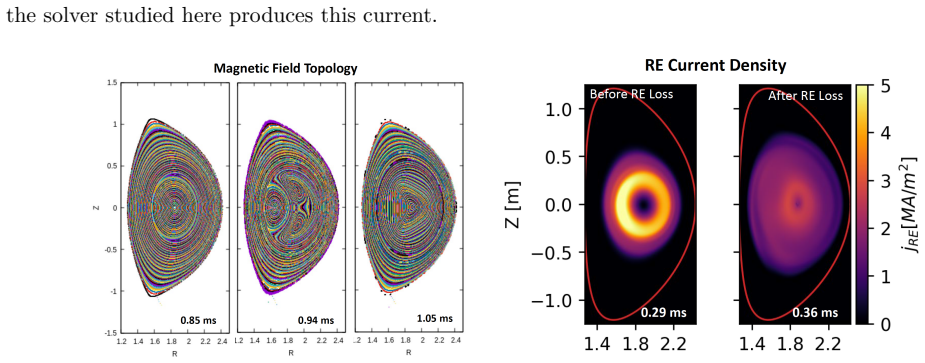
Multigrid (MG) is widely recognized as a highly effective solver for the model problem, the Laplacian, but textbook MG fails on most problems of interest. MG methods have been applied to complex, real-world applications with careful consideration of the physical model and discretization. This work develops the first step in applying MG methods to science and engineering relevant magnetohydrodynamics (MHD) tokamak models in the \textit{M3D-C1} https://m3dc1.pppl.gov fusion energy science code. The semi-implicit time integrator in \textit{M3D-C1} is composed of many linear solves. The implicit advance of the momentum equation is the most challenging and is the focus of this work. The current production solver in \textit{M3D-C1} is a block Jacobi (BJ) preconditioner within a Krylov solver, where blocks group degrees of freedom on planes of constant toroidal coordinate. BJ convergence degrades as the number of planes increases due to the spectral properties of the matrix preconditioned with BJ. The partially magnetic field-aligned, regular toroidal grid structure in \textit{M3D-C1} is amenable to semi-coarsening geometric MG in the toroidal direction. This paper develops such a solver and demonstrates competitive performance on a runaway electron model of a SPARC https://cfs.energy/technology/sparc disruption, and superior robustness on a stellarator model on which the BJ solver fails to converge.
Editorial analysis
A structured set of objections, weighed in public.
Referee Report
Summary. The manuscript develops a geometric multigrid solver with semi-coarsening in the toroidal direction, implemented via PETSc, for the implicit momentum equation in the semi-implicit time integrator of the M3D-C1 MHD code. It contrasts this approach with the existing block Jacobi (BJ) preconditioner, whose convergence degrades with increasing toroidal plane count, and reports competitive performance on a runaway-electron SPARC disruption test case together with superior robustness on a stellarator case where BJ fails to converge.
Significance. If the reported robustness holds under the stated grid assumptions, the work would provide a practical advance in scalable linear solvers for large-scale tokamak and stellarator fluid models, directly addressing a known bottleneck in disruption and equilibrium simulations. The reliance on standard PETSc infrastructure is a strength that supports reproducibility and adoption.
major comments (1)
- [MG solver construction and numerical results] The central claim that the partially magnetic field-aligned regular toroidal grid is amenable to effective semi-coarsening geometric MG rests on the unverified assumption that the chosen smoother damps high-toroidal-wavenumber error modes on the discrete momentum operator. No Fourier/symbol analysis, smoothing-factor computation, or spectral-radius verification (target <0.5) is supplied to confirm this damping; without it the superiority over BJ as plane count increases remains untested and load-bearing for the performance claims on both the SPARC and stellarator cases.
minor comments (2)
- [Abstract] The abstract states 'competitive performance' and 'superior robustness' without any quantitative metrics (iteration counts, residual histories, wall-clock times, or scaling data); adding at least one table or figure summarizing these quantities would strengthen the presentation.
- [Implementation details] Explicit specification of the PETSc MG components (smoother type, restriction/prolongation operators, coarsening ratio in the toroidal direction, and stopping tolerances) is needed for full reproducibility.
Simulated Author's Rebuttal
We thank the referee for the constructive review and the recommendation for major revision. The comment raises a valid point about the lack of theoretical smoothing analysis, which we address below by proposing specific additions to strengthen the presentation of the multigrid solver.
read point-by-point responses
-
Referee: [MG solver construction and numerical results] The central claim that the partially magnetic field-aligned regular toroidal grid is amenable to effective semi-coarsening geometric MG rests on the unverified assumption that the chosen smoother damps high-toroidal-wavenumber error modes on the discrete momentum operator. No Fourier/symbol analysis, smoothing-factor computation, or spectral-radius verification (target <0.5) is supplied to confirm this damping; without it the superiority over BJ as plane count increases remains untested and load-bearing for the performance claims on both the SPARC and stellarator cases.
Authors: We agree that a Fourier or symbol analysis of the smoother would provide additional theoretical support for the semi-coarsening strategy. However, the discrete momentum operator in the M3D-C1 MHD model incorporates variable coefficients arising from the partially field-aligned grid, density, and magnetic field, making a complete smoothing-factor computation or spectral-radius verification substantially more involved than for constant-coefficient model problems. The manuscript instead demonstrates the practical effectiveness of the approach through direct numerical comparisons: the geometric multigrid preconditioner maintains iteration counts and wall-clock performance as the number of toroidal planes is increased in the SPARC disruption case, while the block Jacobi preconditioner degrades; on the stellarator case the multigrid solver converges robustly where block Jacobi fails. To respond to this comment we will add a short subsection describing the chosen smoother (Chebyshev or SOR relaxation) together with supplementary numerical diagnostics that quantify residual reduction on representative high-toroidal-wavenumber modes extracted from the test problems. These additions will make the empirical evidence for damping more explicit without altering the core claims or results. revision: yes
Circularity Check
No circularity: standard MG application to existing grid and model
full rationale
The paper presents the construction of a semi-coarsening geometric multigrid solver in the toroidal direction for the M3D-C1 momentum equation, motivated by the known partially field-aligned regular toroidal grid. This is a direct engineering application of established PETSc MG components to a given discretization, followed by numerical demonstrations on SPARC and stellarator cases. No equations reduce a claimed result to its own inputs by construction, no parameters are fitted and then relabeled as predictions, and no load-bearing premise rests on a self-citation chain. The central performance claims are independently falsifiable through the reported timings and convergence behavior.
Axiom & Free-Parameter Ledger
axioms (1)
- domain assumption Multigrid methods can be effectively applied to the discretized MHD equations with the given grid structure.
Reference graph
Works this paper leans on
-
[1]
M. F. Adams. Multigrid Equation Solvers for Large Scale Nonlinear Finite Element Simulations . Ph.D. dissertation, University of California, Berkeley, 1998. Tech. report UCB//CSD-99-1033
work page 1998
-
[2]
M. F. Adams and M. K. Knepley. A bespoke multigrid approach for magnetohydrodynamics models of magnetized plasmas in petsc, 2023
work page 2023
-
[3]
M. F. Adams, R. Samtaney, and A. Brandt. Toward textbook multigrid efficiency for fully implicit resistive magnetohydrodynamics. Journal of Computational Physics , 229(18), 9 2010
work page 2010
-
[4]
M. F. Adams, P. Wang, J. Merson, K. Huck, and M. G. Knepley. A performance portable, fully implicit landau collision operator with batched linear solvers. SIAM Journal on Scientific Computing , 47(2):B360–B381, 2025
work page 2025
-
[5]
J. H. Adler, T. R. Benson, E. C. Cyr, P. E. Farrell, S. P. MacLachlan, and R. S. Tuminaro. Monolithic multigrid methods for magnetohydrodynamics. SIAM Journal on Scientific Computing , 43(5):S70– S91, 2021
work page 2021
-
[6]
K. Bell. A refined triangular plate bending finite element. International Journal for Numerical Methods in Engineering, 1(1):101–122, 1969
work page 1969
- [7]
-
[8]
J. P. Freidberg. Ideal magnetohydrodynamics. Plenum Press,New York, NY, 12 1986
work page 1986
-
[9]
J. P. H. Goedbloed and S. Poedts. Principles of Magnetohydrodynamics: With Applications to Labo- ratory and Astrophysical Plasmas. Cambridge University Press, 2004
work page 2004
-
[10]
D. S. Harned and D. D. Schnack. Semi-implicit method for long time scale magnetohydrodynamic computations in three dimensions. Journal of Computational Physics , 65(1):57–70, 1986
work page 1986
-
[11]
S. C. Jardin. A triangular finite element with first-derivative continuity applied to fusion MHD applications. J. Comp. Phys. , 200:133–152, 2004
work page 2004
-
[12]
S. C. Jardin. Review of implicit methods for the magnetohydrodynamic description of magnetically confined plasmas. Journal of Computational Physics , 231(3):822–838, 2012. Special Issue: Computa- tional Plasma Physics
work page 2012
-
[13]
U. Trottenberg, C. W. Oosterlee, and A. Sch¨ uller.Multigrid. Academic Press, London, 2000. A Appendix: The Resistive MHD Equations This appendix sketches the numerical methods in the evolution of the momentum equations with a focus on the algebraic form of the diagonal blocks of the Jacobian matrix in M3D-C1, which is of the most relevance to algebraic s...
work page 2000
-
[14]
the velocity solve ... vn+1
-
[15]
the magnetic field solve ... Bn+1
-
[16]
the pressure solve ... pn+1 where vn+1 is solved as nR2(νi, ˙U)−n[νi, ˙χ] =··· nR2νi ˙ω=··· n R4 (νi, ˙χ) +n[νi, ˙U] =··· (28) The inner product is defined as (a,b )≡∇⊥a·∇⊥b =aRbR +aZbZ and the Poisson bracket as [a,b ]≡[∇a×∇b·∇ϕ] =R−1(aZbR−aRbZ) After parabolization: nR2(νi, ˙U)−n[νi, ˙χ] −θ2δt2{δW0 11(νi, ˙U) +δW1 11(νi, ˙U′) +δW2 11(νi, ˙U′′)+ δW1 12(ν...
discussion (0)
Sign in with ORCID, Apple, or X to comment. Anyone can read and Pith papers without signing in.