Measurement-Induced Phase Transition in a Disordered XX Spin Chain: A Real-Space Renormalization Group Study
Pith reviewed 2026-05-22 00:18 UTC · model grok-4.3
The pith
Random measurements in disordered XX spin chains produce new strongly disordered fixed points through non-unitary dynamics.
A machine-rendered reading of the paper's core claim, the machinery that carries it, and where it could break.
Core claim
The monitored disordered XX chain, after mapping to a non-Hermitian spin ladder with complex couplings, flows under RSRG-X to a new class of strongly disordered fixed points that arise directly from the non-unitary character of the measurements.
What carries the argument
Mapping the monitored XX chain with stochastic local measurements to a non-Hermitian spin ladder with complex couplings, enabling RSRG-X analysis of the open-system fixed points.
If this is right
- Non-unitary effects from measurements generate fixed-point structures unavailable in purely unitary disordered spin chains.
- The RSRG-X method becomes applicable to a broader range of open quantum systems with both disorder and monitoring.
- Critical exponents and scaling near these fixed points differ from those of the standard Hermitian RSRG fixed points.
- The landscape of possible phases in monitored many-body systems expands to include new strongly disordered regimes.
Where Pith is reading between the lines
- Similar non-unitary fixed points may appear in other monitored spin models such as the Ising chain under local measurements.
- The approach could be extended to study measurement-induced transitions in two-dimensional lattices by generalizing the ladder mapping.
- Quantum simulator experiments with tunable disorder and mid-circuit measurements could directly probe the predicted flow to infinite disorder.
Load-bearing premise
The mapping from the monitored XX chain with stochastic local measurements to a non-Hermitian spin ladder with complex couplings preserves the essential physics needed for the RSRG-X flow.
What would settle it
Direct numerical simulation of the monitored disordered XX chain that checks whether the effective disorder strength grows without bound under repeated measurements in the manner predicted by the RSRG-X fixed-point analysis.
Figures




read the original abstract
Spin chains with quenched disorder exhibit rich critical behavior, often captured by real-space renormalization group (RSRG) techniques. However, the physics of such systems in the presence of random measurements (i.e., non-Hermitian dephasing) remains largely unexplored. The interplay between measurements and unitary dynamics gives rise to novel phases and phase transitions in monitored quantum systems. In this work, we investigate the disordered XX spin chain subject to stochastic local measurements in the $X$ and $Y$ bases. By mapping the monitored chain to a non-Hermitian spin ladder with complex couplings, we propose an RSRG-for-excited-states (RSRG-X) approach for this open-system setting. Our analysis reveals a new class of strongly disordered fixed points that emerge due to non-unitarity, broadening the landscape of critical phenomena accessible via RSRG.
Editorial analysis
A structured set of objections, weighed in public.
Referee Report
Summary. The manuscript investigates the disordered XX spin chain subject to stochastic local measurements in the X and Y bases. By mapping the monitored system to a non-Hermitian spin ladder with complex couplings, the authors extend the RSRG-for-excited-states (RSRG-X) method to this open-system setting and report a new class of strongly disordered fixed points that arise due to non-unitarity.
Significance. If the mapping is faithful and the RSRG-X analysis with complex couplings is rigorously controlled, the work would extend real-space renormalization techniques beyond Hermitian disordered systems and identify novel measurement-induced critical phenomena, thereby broadening the landscape of accessible fixed points in monitored quantum spin chains.
major comments (2)
- [Mapping to non-Hermitian ladder (likely §2–3)] The central claim of new strongly disordered fixed points rests on the mapping of the monitored disordered XX chain (with random X/Y measurements) to a non-Hermitian spin ladder with complex couplings (abstract and the section introducing the effective model). The manuscript must explicitly derive how stochastic measurements translate into complex couplings while preserving the measurement-induced ensemble (trajectory averaging or post-selection) without introducing spurious decoherence or modifying the disorder distribution in a manner that alters the RG flow.
- [RSRG-X procedure and fixed-point analysis] Standard RSRG-X relies on Hermitian or real couplings for excited-state decimation. With complex couplings, non-real eigenvalues appear and decimation rules change; the paper needs to demonstrate that these altered rules remain stable under iterated RG steps and do not produce unphysical flows (the section applying RSRG-X to the ladder).
minor comments (2)
- Notation for the complex couplings and the disorder distribution in the effective ladder should be defined more explicitly to facilitate reproduction of the RG steps.
- Figure captions could more clearly indicate which fixed points correspond to the new non-unitary class versus previously known Hermitian ones.
Simulated Author's Rebuttal
We thank the referee for their careful reading and constructive feedback on our manuscript. We address each major comment below and outline the revisions we will make to strengthen the presentation and rigor of our results.
read point-by-point responses
-
Referee: [Mapping to non-Hermitian ladder (likely §2–3)] The central claim of new strongly disordered fixed points rests on the mapping of the monitored disordered XX chain (with random X/Y measurements) to a non-Hermitian spin ladder with complex couplings (abstract and the section introducing the effective model). The manuscript must explicitly derive how stochastic measurements translate into complex couplings while preserving the measurement-induced ensemble (trajectory averaging or post-selection) without introducing spurious decoherence or modifying the disorder distribution in a manner that alters the RG flow.
Authors: We agree that an explicit derivation is essential for clarity. In the revised manuscript we will expand Section 2 with a step-by-step derivation showing how the stochastic projective measurements in the X and Y bases generate the complex on-site and inter-leg couplings of the effective non-Hermitian ladder. We will explicitly demonstrate that the mapping is performed at the level of individual trajectories (post-selection) and that ensemble averaging over measurement outcomes reproduces the original disorder distribution without additional decoherence channels. This ensures the RG flow remains faithful to the monitored dynamics. revision: yes
-
Referee: [RSRG-X procedure and fixed-point analysis] Standard RSRG-X relies on Hermitian or real couplings for excited-state decimation. With complex couplings, non-real eigenvalues appear and decimation rules change; the paper needs to demonstrate that these altered rules remain stable under iterated RG steps and do not produce unphysical flows (the section applying RSRG-X to the ladder).
Authors: We have examined the modified decimation rules for complex couplings in our RSRG-X implementation. The manuscript already contains analytic expressions for the renormalized couplings that incorporate both real and imaginary parts, together with numerical evidence that the flow converges to the reported strongly disordered fixed points without runaway imaginary components. In the revision we will add an appendix with explicit iteration examples and a stability analysis showing that the imaginary parts remain bounded and do not induce unphysical divergences under repeated RG steps. revision: partial
Circularity Check
No significant circularity; derivation relies on proposed mapping and RSRG-X extension
full rationale
The paper's central result follows from proposing a mapping of the monitored disordered XX chain to a non-Hermitian spin ladder, then applying an RSRG-X procedure to identify new fixed points induced by non-unitarity. This mapping and subsequent RG analysis are presented as an extension of existing techniques rather than a self-referential definition, fitted parameter renamed as prediction, or load-bearing self-citation chain. No equations reduce by construction to their inputs, and the derivation chain remains independent of the target claims. The abstract and described approach contain no evidence of the enumerated circularity patterns.
Axiom & Free-Parameter Ledger
axioms (1)
- domain assumption The monitored chain with random X and Y measurements can be mapped to a non-Hermitian spin ladder with complex couplings while preserving the critical physics.
Reference graph
Works this paper leans on
-
[1]
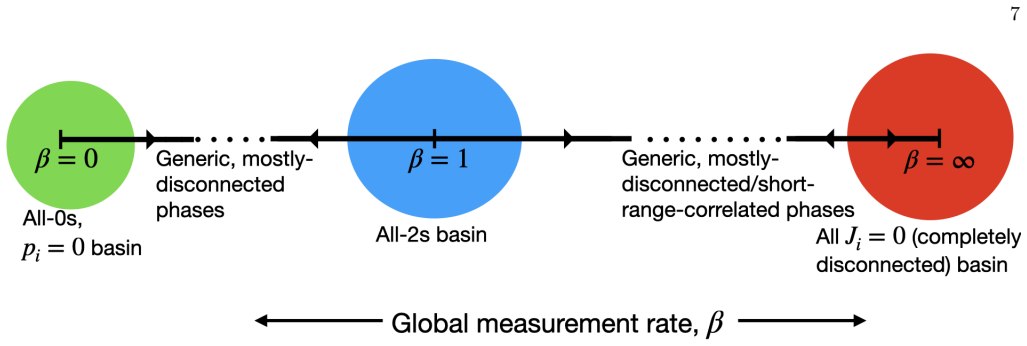
Infinite Disorder Fixed Point WehaveanIDFPwhenallthecellsaretype0, withthe vertical bonds pi = 0: the XX model with no measure- ments/dissipation. The decimation rule forJi with type- 0 cells replaces (Ji−1, Ji, Ji+1) → Ji−1Ji+1/Ji, without generating any vertical bonds. Meanwhile, since the ver- tical bonds are0, they’re never decimated anyway. We shall ...
-
[2]
Griffiths (Random Dimer) Phase The ground state of the non-measured XX spin chain [9, 11, 12] has a Griffiths phase described by the off-critical region around infinite-disorder criticality. It is described by dimerization of the chain: the even and odd bonds lie on different distributions, and the distance from criticality (i.e. the random singlet phase)...
-
[3]
Strong Disorder Phase Observe the decimation rules for this case: (Ji−1, Ji, Ji+1) → 7Ji−1Ji+1/(2Ji) and (Ji−1, pi, Ji+1) → 8Ji−1Ji+1/pi, with renormalization of vertical couplings via addition of terms of the order ofJ2 i±1/pi and p2 i±1/Ji. a b FIG. 7: (a) A sequence of six initial type-0 cells (no diagonal couplings) can coalesce via RSRG decimations i...
-
[4]
(23) PJ(J; Γ) = f(Γ) J J Ω f(Γ) Θ(Ω − J). (24) This indicates that theJi-distribution gets broader ex- ponentially faster than for the all-0s IDFP, where the width only goes down as1/Γ. This is aided by the fact that not only the decimation of theJ-couplings, but also the pi-couplings contribute to the creation of newJi val- ues that are likely to be smal...
-
[5]
S. F. Edwards and P. W. Anderson. Theory of spin glasses. Journal of Physics F: Metal Physics, 5(5):965– 974, 1975
work page 1975
-
[6]
Infinite number of order parameters for spin-glasses
Giorgio Parisi. Infinite number of order parameters for spin-glasses. Physical Review Letters, 43(23):1754–1756, 1979. 14
work page 1979
-
[7]
David Sherringtonand ScottKirkpatrick. Solvablemodel of a spin-glass. Physical Review Letters, 35(26):1792– 1796, 1975
work page 1975
-
[8]
K. B. Efetov. Supersymmetry and theory of disordered metals. Advances in Physics, 32(1):53–127, 1983
work page 1983
-
[9]
Giorgio Parisi and Nicolas Sourlas. Random magnetic fields, supersymmetry, and negative dimensions.Physical Review Letters, 43(11):744–745, 1979
work page 1979
-
[10]
M.R.Zirnbauer. Riemanniansymmetricsuperspacesand their origin in random-matrix theory.Journal of Mathe- matical Physics, 37(10):4986–5018, 1996
work page 1996
-
[11]
Daniel S. Fisher. Random antiferromagnetic quantum spin chains.Phys. Rev. B, 50:3799–3821, Aug 1994
work page 1994
-
[12]
Low- temperature properties of the random heisenberg anti- ferromagnetic chain
Chandan Dasgupta and Shang-keng Ma. Low- temperature properties of the random heisenberg anti- ferromagnetic chain. Phys. Rev. B, 22:1305–1319, Aug 1980
work page 1980
-
[13]
Strong disorder rg ap- proach of random systems.Physics Reports, 412(5):277– 431, 2005
Ferenc Iglói and Cécile Monthus. Strong disorder rg ap- proach of random systems.Physics Reports, 412(5):277– 431, 2005
work page 2005
-
[14]
Ferenc Iglói and Cécile Monthus. Strong disorder rg approach–a short review of recent developments.The European Physical Journal B, 91(11):290, 2018
work page 2018
-
[15]
Critical exponents of random xx and xy chains: Exact results via random walks
Heiko Rieger, Róbert Juhász, and Ferenc Iglói. Critical exponents of random xx and xy chains: Exact results via random walks. The European Physical Journal B, 13(3):409–412, 2000
work page 2000
-
[16]
Random antiferromagnetic quantum spin chains: Exact results from scaling of rare regions
Ferenc Iglói, Róbert Juhász, and Heiko Rieger. Random antiferromagnetic quantum spin chains: Exact results from scaling of rare regions. Phys. Rev. B, 61:11552– 11568, May 2000
work page 2000
-
[17]
David Pekker, Gil Refael, Ehud Altman, Eugene Dem- ler, and Vadim Oganesyan. Hilbert-glass transition: New universality of temperature-tuned many-body dynamical quantum criticality.Phys. Rev. X, 4:011052, Mar 2014
work page 2014
-
[18]
Yi J. Zhao, Samuel J. Garratt, and Joel E. Moore. Su- perspin renormalization and slow relaxation in random spin systems, 2025
work page 2025
-
[19]
Quantum informa- tion spreading in random spin chains
Paola Ruggiero and Xhek Turkeshi. Quantum informa- tion spreading in random spin chains. Phys. Rev. B, 106:134205, Oct 2022
work page 2022
-
[20]
Ronen Vosk, David A. Huse, and Ehud Altman. The- ory of the many-body localization transition in one- dimensional systems. Phys. Rev. X, 5:031032, Sep 2015
work page 2015
-
[21]
Dynamical quantum phase transitions in random spin chains.Phys
Ronen Vosk and Ehud Altman. Dynamical quantum phase transitions in random spin chains.Phys. Rev. Lett., 112:217204, May 2014
work page 2014
-
[22]
Many-body localization in one dimension as a dynamical renormalization group fixed point.Phys
Ronen Vosk and Ehud Altman. Many-body localization in one dimension as a dynamical renormalization group fixed point.Phys. Rev. Lett., 110:067204, Feb 2013
work page 2013
-
[23]
Cécile Monthus. Pure and random quantum ising chain: Shannon and rényi entropies of the ground state via real space renormalization. Journal of Statistical Mechanics: Theory and Experiment, 2015(4):P04007, apr 2015
work page 2015
-
[24]
E. Westerberg, A. Furusaki, M. Sigrist, and P. A. Lee. Low-energy fixed points of random quantum spin chains. Phys. Rev. B, 55:12578–12593, May 1997
work page 1997
-
[25]
Daniel S. Fisher. Random transverse field ising spin chains. Phys. Rev. Lett., 69:534–537, Jul 1992
work page 1992
-
[26]
Daniel S. Fisher. Critical behavior of random transverse- field ising spin chains.Phys. Rev. B, 51:6411–6461, Mar 1995
work page 1995
-
[27]
Tam’as PetHo, Ferenc Igl’oi, and Istv’an A. Kov’acs. Random ising chain in transverse and longitudinal fields: Strong disorder rg study. Condensed Matter Physics, 2022
work page 2022
-
[28]
William Berdanier, Michael Kolodrubetz, S. A. Parameswaran, and Romain Vasseur. Strong-disorder renormalization group for periodically driven systems. Phys. Rev. B, 98:174203, Nov 2018
work page 2018
-
[29]
Cécile Monthus. Boundary-driven lindblad dynamics of random quantum spin chains: strong disorder approach for the relaxation, the steady state and the current.Jour- nal of Statistical Mechanics: Theory and Experiment, 2017(4):043303, apr 2017
work page 2017
-
[30]
Strong randomness fixed point in the dissipative random transverse-field ising chain.Phys
Gregory Schehr and Heiko Rieger. Strong randomness fixed point in the dissipative random transverse-field ising chain.Phys. Rev. Lett., 96:227201, Jun 2006
work page 2006
-
[31]
J. A. Hoyos and T. Vojta. Theory of smeared quantum phase transitions.Journal of Statistical Mechanics: The- ory and Experiment, 2008(04):P04012, 2008
work page 2008
-
[32]
Thomas Vojta and José A. Hoyos. Dissipation effects in random transverse-field ising chains. Phys. Rev. B, 85:174403, May 2012
work page 2012
-
[33]
Theory of smeared quantum phase tran- sitions
Thomas Vojta. Theory of smeared quantum phase tran- sitions. Phys. Rev. Lett., 100:240601, Jun 2008
work page 2008
-
[34]
J. A. Hoyos, C. Kotabage, and T. Vojta. Effects of dissi- pation on a quantum critical point with disorder.Phys. Rev. Lett., 99:230601, Dec 2007
work page 2007
-
[35]
Infinite-randomness quantum critical points induced by dissipation
Gregory Schehr and Heiko Rieger. Infinite-randomness quantum critical points induced by dissipation. Phys. Rev. B, 79:024401, Jan 2009
work page 2009
-
[36]
Third quantization: a general method to solve master equations for quadratic open fermi systems
Tomaž Prosen. Third quantization: a general method to solve master equations for quadratic open fermi systems. New Journal of Physics, 10(4):043026, 2008
work page 2008
-
[37]
Marko Žnidarič and Martin Horvat. Transport in a disor- dered tight-binding chain with dephasing.The European Physical Journal B, 86(7):67, 2013
work page 2013
-
[38]
Dephasing-induced diffusive transport in the anisotropic heisenberg model
Marko Žnidarič. Dephasing-induced diffusive transport in the anisotropic heisenberg model. New Journal of Physics, 12(4):043001, 2010
work page 2010
-
[39]
J. J. Mendoza-Arenas, S. Al-Assam, S. R. Clark, and D. Jaksch. Heat transport in the xxz spin chain: from ballistic to diffusive regimes and dephasing enhancement. Journal of Statistical Mechanics: Theory and Experi- ment, 2013(07):P07007, 2013
work page 2013
-
[40]
Cécile Monthus. Dissipative random quantum spin chain with boundary-driving and bulk-dephasing: magnetiza- tion and current statistics in the non-equilibrium-steady- state. Journal of Statistical Mechanics: Theory and Ex- periment, 2017(4):043302, apr 2017
work page 2017
-
[41]
Measurement-induced phase transitions in the dynamics of entanglement.Phys
Brian Skinner, Jonathan Ruhman, and Adam Nahum. Measurement-induced phase transitions in the dynamics of entanglement.Phys. Rev. X, 9:031009, Jul 2019
work page 2019
-
[42]
Markus Müller, Sebastian Diehl, and Michael Buchhold. Monitored open fermion dynamics: Exploring the inter- play of measurements, decoherence, and entanglement. Phys. Rev. Research, 4:033001, Jul 2022
work page 2022
-
[43]
Shimpei Goto and Ippei Danshita. Measurement-induced transitions of the entanglement scaling law in ultra- cold gases with controllable dissipation. Phys. Rev. A, 102:033316, Sep 2020
work page 2020
-
[44]
Measurement-induced phase transitions by matrix product states with low bond dimension
XhekTurkeshi, MarcelloDalmonte, RosarioFazio, Marco Schiró, and Gabriele Turchetti. Measurement-induced phase transitions by matrix product states with low bond dimension. Phys. Rev. Research, 6:033220, Sep 2024
work page 2024
-
[45]
Aidan Zabalo, Justin H. Wilson, Michael J. Gullans, Ro- main Vasseur, Sarang Gopalakrishnan, David A. Huse, 15 and J. H. Pixley. Infinite-randomness criticality in moni- tored quantum dynamics with static disorder.Phys. Rev. B, 107:L220204, Jun 2023
work page 2023
-
[46]
Thermodynamics of strongly disordered spin ladders
Eddy Yusuf and Kun Yang. Thermodynamics of strongly disordered spin ladders. Phys. Rev. B, 65:224428, Jun 2002
work page 2002
-
[47]
Dissipative spin chain as a non-hermitian kitaev ladder
Naoyuki Shibata and Hosho Katsura. Dissipative spin chain as a non-hermitian kitaev ladder. Phys. Rev. B, 99:174303, May 2019
work page 2019
-
[48]
The com- plexity of the local hamiltonian problem.SIAM Journal on Computing, 35(5):1070–1097, 2006
Julia Kempe, Alexei Kitaev, and Oded Regev. The com- plexity of the local hamiltonian problem.SIAM Journal on Computing, 35(5):1070–1097, 2006
work page 2006
-
[49]
Sevag Gharibian, Yichen Huang, Zeph Landau, and Se- ung Woo Shin. Quantum hamiltonian complexity.Foun- dations and Trends® in Theoretical Computer Science, 10(3):159–282, 2015
work page 2015
-
[50]
Adam D. Bookatz. Qma-complete problems. Quantum Inf. Comput., 14(5-6):361–383, 2014
work page 2014
-
[51]
The quantum and classical complexity of translationally invariant tiling and hamiltonian problems
Daniel Gottesman and Sandy Irani. The quantum and classical complexity of translationally invariant tiling and hamiltonian problems. Theory of Computing, 9(2):31– 116, 2013
work page 2013
-
[52]
Lessa, Ruochen Ma, Jian-Hao Zhang, Zhen Bi, MengCheng, andChongWang
Leonardo A. Lessa, Ruochen Ma, Jian-Hao Zhang, Zhen Bi, MengCheng, andChongWang. Strong-to-weakspon- taneous symmetry breaking in mixed quantum states. PRX Quantum, 6:010344, Mar 2025
work page 2025
-
[53]
Igor Poboiko, Paul Pöpperl, Igor V. Gornyi, and Alexan- der D. Mirlin. Theory of free fermions under random projective measurements. Phys. Rev. X, 13:041046, Dec 2023
work page 2023
-
[54]
Disor- dered monitored free fermions.Phys
MarcinSzyniszewski, OliverLunt, andArijeetPal. Disor- dered monitored free fermions.Phys. Rev. B, 108:165126, Oct 2023
work page 2023
-
[55]
Igor Poboiko, Igor V. Gornyi, and Alexander D. Mirlin. Measurement-induced phase transition for free fermions above one dimension.Phys. Rev. Lett., 132:110403, Mar 2024
work page 2024
-
[56]
Measurement- induced entanglement and teleportation on a noisy quan- tum processor
Google Quantum AI and Collaborators. Measurement- induced entanglement and teleportation on a noisy quan- tum processor. Nature, 622:481–486, 2023
work page 2023
-
[57]
Crystal Noel, Pradeep Niroula, Daiwei Zhu, Andrew Risinger, Laird Egan, Debopriyo Biswas, Marko Cetina, Alexey V. Gorshkov, Michael J. Gullans, David A. Huse, and Christopher Monroe. Measurement-induced quan- tum phases realized in a trapped-ion quantum computer. Nature Physics, 18:760–764, 2022
work page 2022
-
[58]
Ivaylo S. Madjarov, Jacob P. Covey, Adam L. Shaw, Joonhee Choi, Anant Kale, Alexandre Cooper, Hannes Pichler, Vladimir Schkolnik, Jason R. Williams, and Manuel Endres. High-fidelity entanglement and detec- tion of alkaline-earth rydberg atoms. Nature Physics, 16:857–861, 2020
work page 2020
-
[59]
Many-body physics with individually controlled rydberg atoms.Na- ture Physics, 16:132–142, 2020
Antoine Browaeys and Thierry Lahaye. Many-body physics with individually controlled rydberg atoms.Na- ture Physics, 16:132–142, 2020
work page 2020
-
[60]
Daniel Barredo, Henning Labuhn, Sylvain Ravets, Thierry Lahaye, Antoine Browaeys, and Charles S. Adams. Coherent excitation transfer in a spin chain of three rydberg atoms.Phys. Rev. Lett., 114:113002, Mar 2015
work page 2015
-
[61]
Siva Darbha, Milan Kornjača, Fangli Liu, Jan Balewski, Mark R. Hirsbrunner, Pedro L. S. Lopes, Sheng-Tao Wang, Roel Van Beeumen, Katherine Klymko, and Daan Camps. Long-lived oscillations of metastable states in neutral atom systems. Phys. Rev. B, 110:155114, Oct 2024
work page 2024
-
[62]
Burgers, Guido Pupillo, Shruti Puri, and Jeff D
Shuo Ma, Genyue Liu, Pai Peng, Bichen Zhang, Sven Jandura, Jahan Claes, Alex P. Burgers, Guido Pupillo, Shruti Puri, and Jeff D. Thompson. High-fidelity gates and mid-circuit erasure conversion in an atomic qubit. Nature, 622(7982):279–284, October 2023. Appendix A: Decimation Rules Here, we derive the decimation rules for generic config- urations of cell...
work page 2023
-
[63]
Here, we look at the rules for decimating cell of types1, 2, 3, and 4
Decimating Ji The rules for when a type-0 cell is decimated were de- rived in the main text. Here, we look at the rules for decimating cell of types1, 2, 3, and 4. For cells of types1, 2, 3, and 4, respectively, the un- perturbed bit is L(1) 0 = Ji[(Xixi+1 + Yiyi+1) + (xiXi+1 + yiYi+1) − (XiXi+1 + YiYi+1) − (xixi+1 + yiyi+1)], L(2) 0 = Ji[(Xixi+1 + Yiyi+1...
-
[64]
The star(∗) indicates complex conjugation
Decimating pi/2 Here, Lvert 0 = pi 2 [(Xixi + Yiyi) − 2I] , (A4) while Lvert pert = Gi(XiXi+1 + YiYi+1) + G∗ i (xixi+1 + yiyi+1) + Hi(Xixi+1 + Yiyi+1) + H ∗ i (xiXi+1 + yiYi+1) + Gi−1(XiXi−1 + YiYi−1) + G∗ i−1(xixi−1 + yiyi−1) + Hi−1(Xi−1xi + Yi−1yi) + H ∗ i−1(Xixi−1 + Yiyi−1), (A5) with Gi, Hi ∈ {±Ji, ±iJi}, depending on the types of the cells adjacent t...
discussion (0)
Sign in with ORCID, Apple, or X to comment. Anyone can read and Pith papers without signing in.