Single excitation swap in a modified Jaynes-Cummings-Hubbard lattice
Pith reviewed 2026-05-21 23:56 UTC · model grok-4.3
The pith
In a hybrid lattice of resonators and two-level systems, tuned conditions let a single excitation swap its atomic or photonic character while propagating.
A machine-rendered reading of the paper's core claim, the machinery that carries it, and where it could break.
Core claim
In the modified Jaynes-Cummings-Hubbard lattice with direct TLS-TLS couplings, appropriate impedance-matching and resonance conditions produce a controlled swap of excitation character during propagation along the chain.
What carries the argument
The hybrid lattice unit cell with resonator-TLS interaction plus direct TLS-TLS coupling, which permits tunable propagation and type conversion when impedance and resonance are matched.
If this is right
- Excitations propagate with tunable atomic, photonic, or polaritonic character depending on local tuning.
- The swap occurs coherently while quantum correlations, measured by concurrence, remain intact.
- The lattice supplies a minimal setting for single-excitation conversion relevant to hybrid quantum networks.
- Local observables suffice to monitor both transport and the type change.
Where Pith is reading between the lines
- The same matching principle might be used to route excitations selectively to different output channels in a branched lattice.
- Extending the chain to include detuned sites could produce periodic type cycling that functions as a built-in frequency converter.
- Because the swap is controlled by local parameters, it could serve as a primitive for quantum gates that act on the carrier type rather than on the excitation itself.
Load-bearing premise
The model assumes ideal single-mode resonators, lossless direct TLS-TLS coupling, and the possibility of exact impedance matching without decoherence or fabrication imperfections.
What would settle it
An experiment that measures local atomic and photonic populations along the lattice and finds no character swap at the predicted resonance and impedance values would falsify the central claim.
Figures




read the original abstract
Controlling the transport and nature of quantum excitations in low-dimensional systems is a key requirement for scalable quantum devices, including communication networks and quantum simulators. We propose a one-dimensional hybrid quantum lattice model, in which each lattice unit integrates a single-mode resonator that interacts with a two-level system (TLS), featuring direct coupling between adjacent TLSs. This configuration enables the coherent propagation of excitations with tunable atomic, photonic, or polaritonic character. Beyond conventional single-excitation transport, we demonstrate that appropriate impedance-matching and resonance conditions allow for the controlled swapping of excitation type as the excitation propagates along the lattice. We analyze the resulting dynamics using local observables and pairwise concurrence to track both transport and quantum correlations. Our results establish a minimal platform for controlled single-excitation conversion, with direct relevance to hybrid quantum networks, on-chip quantum interconnects, and engineered quantum simulators.
Editorial analysis
A structured set of objections, weighed in public.
Referee Report
Summary. The manuscript proposes a one-dimensional modified Jaynes-Cummings-Hubbard lattice with added direct TLS-TLS coupling between adjacent sites. In the single-excitation subspace, it shows that impedance-matching and resonance conditions enable controlled propagation accompanied by a swap in excitation character (atomic/photonic/polaritonic). Dynamics are analyzed via local observables and pairwise concurrence; numerical results are presented as verification of the stated conditions.
Significance. If the central claims hold, the work supplies a minimal, tunable platform for engineering the character of a propagating single excitation in a hybrid lattice. This has direct relevance to quantum networks and simulators. The use of standard quantum-optics tools on a new lattice configuration, together with direct numerical verification of the impedance and resonance conditions, is a clear strength.
major comments (1)
- [§3.2, Eq. (8)] §3.2, Eq. (8): the impedance-matching condition is introduced without an explicit derivation from the full Hamiltonian; showing how the effective coupling terms cancel to produce the claimed swap would make the central mechanism load-bearing rather than asserted.
minor comments (3)
- [Figure 2] Figure 2: the color scale for concurrence plots is not labeled with the site indices, making it difficult to map the pairwise correlations to the lattice propagation.
- [§4.1] §4.1: the specific numerical values chosen for the resonator-TLS and TLS-TLS couplings are stated in the text but would be more reproducible if collected in a table.
- The abstract states that the swap occurs 'as the excitation propagates' but does not specify the minimal lattice length required; a short clarifying sentence would help readers.
Simulated Author's Rebuttal
We thank the referee for their positive evaluation and constructive feedback. The single major comment is addressed below; we agree that an explicit derivation will strengthen the manuscript and will incorporate it in the revision.
read point-by-point responses
-
Referee: [§3.2, Eq. (8)] §3.2, Eq. (8): the impedance-matching condition is introduced without an explicit derivation from the full Hamiltonian; showing how the effective coupling terms cancel to produce the claimed swap would make the central mechanism load-bearing rather than asserted.
Authors: We agree with the referee that the impedance-matching condition would benefit from an explicit derivation. In the revised manuscript we will insert a step-by-step derivation immediately preceding Eq. (8) that starts from the full lattice Hamiltonian, projects onto the single-excitation subspace, and shows how the effective nearest-neighbor couplings cancel under the stated resonance and impedance-matching conditions, thereby producing the coherent swap of excitation character. This addition will make the central mechanism fully transparent and load-bearing. revision: yes
Circularity Check
No significant circularity; derivation is self-contained
full rationale
The manuscript proposes a 1D hybrid lattice model (modified Jaynes-Cummings-Hubbard with added direct TLS-TLS coupling) and analyzes single-excitation dynamics via standard quantum-optics methods in the single-excitation subspace. Local observables and pairwise concurrence are computed directly from the Hamiltonian under stated impedance-matching and resonance conditions. No load-bearing step reduces a prediction to a fitted parameter, renames a known result, or rests on a self-citation chain for uniqueness. All assumptions (ideal single-mode resonators, lossless couplings) are declared explicitly as idealizations; the numerics serve as direct verification rather than statistical fitting. The central claim therefore remains independent of its own inputs.
Axiom & Free-Parameter Ledger
free parameters (2)
- TLS-TLS coupling strength
- Resonator-TLS coupling
axioms (2)
- domain assumption Single-mode resonator approximation per lattice site
- domain assumption Lossless coherent dynamics
Lean theorems connected to this paper
-
IndisputableMonolith/Cost/FunctionalEquation.leanwashburn_uniqueness_aczel unclear?
unclearRelation between the paper passage and the cited Recognition theorem.
appropriate impedance-matching and resonance conditions allow for the controlled swapping of excitation type... λ = −v/√2... ωA = ω − g
-
IndisputableMonolith/Foundation/AlphaCoordinateFixation.leancostAlphaLog_fourth_deriv_at_zero unclear?
unclearRelation between the paper passage and the cited Recognition theorem.
polaritonic basis... Eαn/ℏ = nω + Δ/2 ± (Δ/2)√(1+4ng²/Δ²)
What do these tags mean?
- matches
- The paper's claim is directly supported by a theorem in the formal canon.
- supports
- The theorem supports part of the paper's argument, but the paper may add assumptions or extra steps.
- extends
- The paper goes beyond the formal theorem; the theorem is a base layer rather than the whole result.
- uses
- The paper appears to rely on the theorem as machinery.
- contradicts
- The paper's claim conflicts with a theorem or certificate in the canon.
- unclear
- Pith found a possible connection, but the passage is too broad, indirect, or ambiguous to say the theorem truly supports the claim.
Reference graph
Works this paper leans on
-
[1]
The derivation of this condition is provided in Appendix A
The propagation through the upper polaritonic branch is suppressed if g ≫ | v|/4. The derivation of this condition is provided in Appendix A. Ap- pendix C provides a numerical analysis confirming the suppression of propagation in the upper polari- tonic branch under this condition
-
[2]
The frequency of the activation qubit must be res- onant with the transition frequency of the lower polaritonic branch, i.e., ωA = ω − g. From Eq. (6), the energy levels in the lower polaritonic branch are given by E− n /ℏ = nω + ∆ 2 − 1 2 p ∆2 + 4ng2 . (12) In the resonant regime, ∆ = 0, and considering a 4 single excitation, n = 1, Eq. (12) reduces to E...
-
[3]
This conditions leads to λ = −v/ √ 2
The effective coupling between the activation qubit and the first polariton must match the effective coupling between two nearest-neighbor polaritons. This conditions leads to λ = −v/ √ 2. To determine the third condition, we focus on the Hamiltonian HI in the representation of the polaritonic basis, Eq. (9), which accounts for the polariton hopping betwe...
-
[5]
In the dispersive regime, the condi- tion is now ωA = ω − g2/∆
The activation qubit frequency must be resonant with the transition frequency of the lower polari- tonic branch. In the dispersive regime, the condi- tion is now ωA = ω − g2/∆. From Eq. (12), the 5 energy levels in the lower polaritonic branch reads E− n /ℏ = nω + ∆ 2 − ∆ 2 p 1 + χ(n) , χ (n) = 4g2n ∆2 . (18) In the dispersive regime, |∆| ≫ g and the quan...
-
[6]
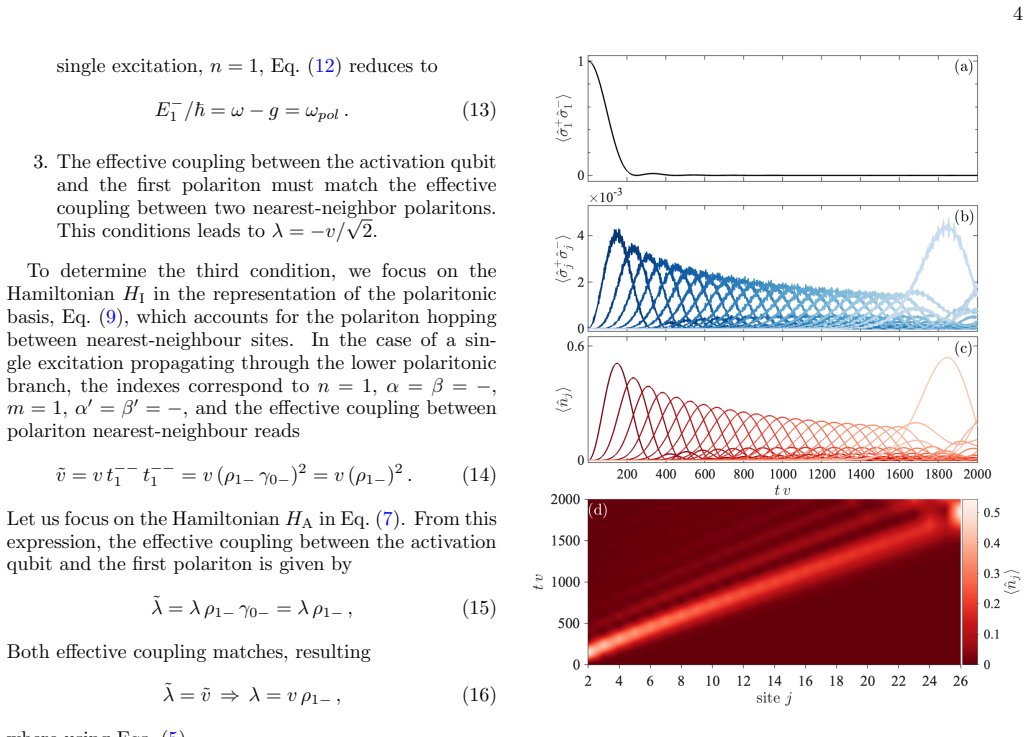
The effective coupling between the activation qubit and the first polariton must match the effective coupling between two nearest-neighbor polaritons, λ = v ρ1,− [see Eqs. (16) and (17)]. Single-photon propagation in the hybrid system is il- lustrated in Fig. 3. By tuning the system parameters to satisfy the last three conditions associated with this case...
-
[7]
The condition g ≫ |v/4| ensures the suppression of propagation through the upper polaritonic branch
-
[8]
The frequency of the activation qubit must be res- onant with the transition frequency of the TLSs in the hybrid lattice, i.e., ωA = ω0
-
[9]
The coupling between the activation qubit and the TLS in the first resonator unit must match the coupling strength between neighboring TLSs, i.e., λ = v. FIG. 4. Spin-wave propagation: (a) Time evolution of the average excitation number in the activation qubit. (b) Time evolution of the average excitation number in the jth TLS of the hybrid lattice, for 2...
-
[10]
Additional parameters of the numerical simulation are τ = 10−3v−1 ℓ , nmax = 2, and L = 31
In the right section, the parameter are ωr 0 = ωℓ pol, ωr = 50 ωr 0, ∆ r = ωr 0 − ωr, gr = gℓ, θ1 = arctan (2gr/∆r), vr = vℓ/2. Additional parameters of the numerical simulation are τ = 10−3v−1 ℓ , nmax = 2, and L = 31. Figure 7 shows the full dynamics of this process. Fig- ure 7(a) shows the average polariton number as a func- tion of time and site index...
-
[11]
Additional parameters of the numerical simulation are τ = 10−3v−1 ℓ , nmax = 2, and L = 31
In the right section, the parameter are ωr 0 = ωℓ pol = ωℓ − gℓ, ωr = 50 ωr 0, ∆ r = ωr 0 − ωr, gr = gℓ, θ1 = arctan (2gr/∆r), vr = vℓ/2. Additional parameters of the numerical simulation are τ = 10−3v−1 ℓ , nmax = 2, and L = 31. The ground state is identified as | ↓ , 0⟩ = |0, −⟩ and the non-physical state |0, +⟩ = |Ø⟩ is a ket with all en- tries equal t...
-
[12]
H. J. Kimble, The quantum internet, Nature 453, 1023 (2008)
work page 2008
-
[13]
Quantum internet: A vision for the road ahead,
S. Wehner, D. Elkouss, and R. Hanson, Quantum in- ternet: A vision for the road ahead, Science 362, 10.1126/science.aam9288 (2018)
-
[14]
A. A. Houck, H. E. T¨ ureci, and J. Koch, On-chip quan- tum simulation with superconducting circuits, Nature Physics 8, 292 (2012)
work page 2012
-
[15]
I. M. Georgescu, S. Ashhab, and F. Nori, Quantum sim- ulation, Reviews of Modern Physics 86, 153 (2014)
work page 2014
-
[16]
J. Feist and F. J. Garcia-Vidal, Extraordinary exciton conductance induced by strong coupling, Physical Re- view Letters 114, 196402 (2015)
work page 2015
-
[17]
B. X. K. Chng, E. Mondal, and P. Huo, Quantum dy- namics simulations of exciton polariton transport, Nano Letters 25, 1234 (2025)
work page 2025
-
[18]
J. I. Cirac, P. Zoller, H. J. Kimble, and H. Mabuchi, Quantum State Transfer and Entanglement Distribution among Distant Nodes in a Quantum Network, Phys. Rev. Lett. 78, 3221 (1997)
work page 1997
-
[19]
M. Christandl, N. Datta, A. Ekert, and A. J. Landahl, Perfect State Transfer in Quantum Spin Networks, Phys. Rev. Lett. 92, 187902 (2004)
work page 2004
-
[20]
T. Shi, Y. Li, Z. Song, and C.-P. Sun, Quantum-state transfer via the ferromagnetic chain in a spatially mod- ulated field, Phys. Rev. A 71, 032309 (2005)
work page 2005
-
[21]
D. Burgarth and S. Bose, Perfect quantum state transfer with randomly coupled quantum chains, New J. Phys. 7, 135 (2005)
work page 2005
-
[22]
D. Burgarth and S. Bose, Conclusive and arbitrarily 11 perfect quantum-state transfer using parallel spin-chain channels, Phys. Rev. A 71, 052315 (2005)
work page 2005
-
[23]
A. Perez-Leija, R. Keil, A. Kay, H. Moya-Cessa, S. Nolte, L.-C. Kwek, B. M. Rodr´ ıguez-Lara, A. Szameit, and D. N. Christodoulides, Coherent quantum transport in photonic lattices, Phys. Rev. A 87, 012309 (2013)
work page 2013
-
[24]
J. Ghosh, Emulating quantum state transfer through a spin-1 chain on a one-dimensional lattice of supercon- ducting qutrits, Phys. Rev. A 90, 062318 (2014)
work page 2014
-
[25]
Quantum State Transfer and Network Engineering (Springer, Berlin, Germany, 2014)
work page 2014
-
[26]
Ashhab, Quantum state transfer in a disordered one- dimensional lattice, Phys
S. Ashhab, Quantum state transfer in a disordered one- dimensional lattice, Phys. Rev. A 92, 062305 (2015)
work page 2015
-
[27]
L.-Y. Cheng, L.-N. Zheng, R. Wu, H.-F. Wang, and S. Zhang, Change-over switch for quantum states transfer with topological channels in a circuit-QED lattice, Chin. Phys. B 31, 020305 (2022)
work page 2022
-
[28]
G. F. Pe˜ nas, R. Puebla, and J. J. Garc´ ıa-Ripoll, Improv- ing quantum state transfer: correcting non-Markovian and distortion effects, Quantum Sci. Technol. 8, 045026 (2023)
work page 2023
-
[29]
G. F. Pe˜ nas, R. Puebla, and J. J. Garc´ ıa-Ripoll, Multi- plexed quantum state transfer in waveguides, Phys. Rev. Res. 6, 033294 (2024)
work page 2024
-
[30]
J. I. Cirac, A. K. Ekert, S. F. Huelga, and C. Mac- chiavello, Distributed quantum computation over noisy channels, Phys. Rev. A 59, 4249 (1999)
work page 1999
-
[31]
A. Serafini, S. Mancini, and S. Bose, Distributed Quan- tum Computation via Optical Fibers, Phys. Rev. Lett. 96, 010503 (2006)
work page 2006
-
[32]
Z.-q. Yin and F.-l. Li, Multiatom and resonant interac- tion scheme for quantum state transfer and logical gates between two remote cavities via an optical fiber, Phys. Rev. A 75, 012324 (2007)
work page 2007
-
[33]
C. J. Axline, L. D. Burkhart, W. Pfaff, M. Zhang, K. Chou, P. Campagne-Ibarcq, P. Reinhold, L. Frun- zio, S. M. Girvin, L. Jiang, M. H. Devoret, and R. J. Schoelkopf, On-demand quantum state transfer and en- tanglement between remote microwave cavity memories, Nat. Phys. 14, 705 (2018)
work page 2018
-
[34]
P. Kurpiers, P. Magnard, T. Walter, B. Royer, M. Pechal, J. Heinsoo, Y. Salath´ e, A. Akin, S. Storz, J.-C. Besse, S. Gasparinetti, A. Blais, and A. Wallraff, Deterministic quantum state transfer and remote entanglement using microwave photons, Nature 558, 264 (2018)
work page 2018
- [35]
-
[36]
G. F. Pe˜ nas, R. Puebla, T. Ramos, P. Rabl, and J. J. Garc´ ıa-Ripoll, Universal Deterministic Quantum Oper- ations in Microwave Quantum Links, Phys. Rev. Appl. 17, 054038 (2022)
work page 2022
-
[37]
C. Ciuti and I. Carusotto, Quantum fluid effects and parametric instabilities in microcavities, Phys. Status So- lidi B 242, 2224 (2005)
work page 2005
-
[38]
I. Carusotto and C. Ciuti, Quantum fluids of light, Re- views of Modern Physics 85, 299 (2013)
work page 2013
-
[39]
S. Bose, Quantum communication through an unmod- ulated spin chain, Physical Review Letters 91, 207901 (2003)
work page 2003
- [40]
-
[41]
S. Muralidharan and K. Toyoda, Site-dependent control of polaritons in the Jaynes–Cummings–Hubbard model with trapped ions, Appl. Phys. B 129, 1 (2023)
work page 2023
-
[42]
X. Li, Y. Ma, J. Han, T. Chen, Y. Xu, W. Cai, H. Wang, Y. P. Song, Z.-Y. Xue, Z.-q. Yin, and L. Sun, Perfect Quantum State Transfer in a Superconducting Qubit Chain with Parametrically Tunable Couplings, Phys. Rev. Appl. 10, 054009 (2018)
work page 2018
-
[43]
L. Xiang, J. Chen, Z. Zhu, Z. Song, Z. Bao, X. Zhu, F. Jin, K. Wang, S. Xu, Y. Zou, H. Li, Z. Wang, C. Song, A. Yue, J. Partridge, Q. Guo, R. Mondaini, H. Wang, and R. T. Scalettar, Enhanced quantum state transfer by circumventing quantum chaotic behavior, Nat. Commun. 15, 1 (2024)
work page 2024
-
[44]
F. A. Roy, J. H. Romeiro, L. Koch, I. Tsitsilin, J. Schirk, N. J. Glaser, N. Bruckmoser, M. Singh, F. X. Haslbeck, G. B. P. Huber, G. Krylov, A. Marx, F. Pfeiffer, C. M. F. Schneider, C. Schweizer, F. Wallner, D. Bunch, L. Richard, L. S¨ odergren, K. Liegener, M. Werninghaus, and S. Filipp, Parity-dependent state transfer for direct entanglement generatio...
work page 2025
-
[45]
A. D. Greentree, C. Tahan, J. H. Cole, and L. C. L. Hol- lenberg, Quantum phase transitions of light, Nat. Phys. 2, 856 (2006)
work page 2006
-
[46]
M. J. Hartmann, F. G. S. L. Brand˜ ao, and M. B. Ple- nio, Strongly interacting polaritons in coupled arrays of cavities, Nat. Phys. 2, 849 (2006)
work page 2006
-
[47]
D. G. Angelakis, M. F. Santos, and S. Bose, Photon- blockade-induced Mott transitions and XY spin models in coupled cavity arrays, Phys. Rev. A76, 031805 (2007)
work page 2007
-
[48]
J. Koch and K. Le Hur, Superfluid–Mott-insulator tran- sition of light in the Jaynes-Cummings lattice, Phys. Rev. A 80, 023811 (2009)
work page 2009
-
[49]
M. I. Makin, J. H. Cole, C. D. Hill, A. D. Green- tree, and L. C. L. Hollenberg, Time evolution of the one-dimensional Jaynes-Cummings-Hubbard Hamil- tonian, Phys. Rev. A 80, 043842 (2009)
work page 2009
-
[50]
C. Nietner and A. Pelster, Ginzburg-Landau theory for the Jaynes-Cummings-Hubbard model, Phys. Rev. A 85, 043831 (2012)
work page 2012
-
[51]
A. L. C. Hayward, A. M. Martin, and A. D. Greentree, Fractional Quantum Hall Physics in Jaynes-Cummings- Hubbard Lattices, Phys. Rev. Lett. 108, 223602 (2012)
work page 2012
-
[52]
B. Bujnowski, J. K. Corso, A. L. C. Hayward, J. H. Cole, and A. M. Martin, Supersolid phases of light in extended Jaynes-Cummings-Hubbard systems, Phys. Rev. A 90, 043801 (2014)
work page 2014
-
[53]
J. Xue, K. Seo, L. Tian, and T. Xiang, Quantum phase transition in a multiconnected Jaynes-Cummings lattice, Phys. Rev. B 96, 174502 (2017)
work page 2017
-
[54]
J. Figueroa, J. Rogan, J. A. Valdivia, M. Kiwi, G. Romero, and F. Torres, Nucleation of superfluid-light domains in a quenched dynamics, Sci. Rep. 8, 1 (2018)
work page 2018
-
[55]
S. B. Prasad and A. M. Martin, Effective Three-Body Interactions in Jaynes-Cummings-Hubbard Systems, Sci. Rep. 8, 1 (2018)
work page 2018
- [56]
- [57]
-
[58]
A. Norambuena, F. Torres, M. Di Ventra, and R. Coto, Polariton-based quantum memristors, Phys. Rev. Appl. 17, 024056 (2022)
work page 2022
-
[59]
J.-L. Ma, Q. Li, and L. Tan, Ergodic and nonergodic phases in a one-dimensional clean Jaynes-Cummings- Hubbard system with detuning, Phys. Rev. B 105, 165432 (2022)
work page 2022
- [60]
-
[61]
M. Tudorovskaya and D. Mu˜ noz Ramo, Quantum com- puting simulation of a mixed spin-boson Hamiltonian and its performance for a cavity quantum electrodynamics problem, Phys. Rev. A 109, 032612 (2024)
work page 2024
-
[62]
A. Karnieli, S. Tsesses, R. Yu, N. Rivera, A. Arie, I. Kaminer, and S. Fan, Universal and ultrafast quantum computation based on free-electron-polariton blockade, PRX Quantum 5, 010339 (2024)
work page 2024
-
[63]
E. Baum, A. Broman, T. Clarke, N. C. Costa, J. Mucciac- cio, A. Yue, Y. Zhang, V. Norman, J. Patton, M. Radu- laski, and R. T. Scalettar, Effect of emitters on quantum state transfer in coupled cavity arrays, Phys. Rev. B105, 195429 (2022)
work page 2022
-
[64]
A. Yue, R. Mondaini, Q. Guo, and R. T. Scalettar, Quan- tum state transfer in interacting multiple-excitation sys- tems, Phys. Rev. B 110, 195410 (2024)
work page 2024
-
[65]
G. Vidal, Efficient simulation of one-dimensional quan- tum many-body systems, Physical Review Letters 93, 040502 (2004)
work page 2004
-
[66]
A. J. Daley, C. Kollath, U. Schollw¨ ock, and G. Vidal, Time-dependent density-matrix renormalization-group using adaptive effective hilbert spaces, Journal of Statis- tical Mechanics: Theory and Experiment 2004, P04005 (2004)
work page 2004
-
[67]
U. Schollw¨ ock, The density-matrix renormalization group in the age of matrix product states, Annals of Physics 326, 96 (2011)
work page 2011
-
[68]
C. Barahona-Pascual, H. Jiang, A. C. Santos, and J. J. Garc´ ıa-Ripoll, Time-delayed collective dynamics in waveguide qed and bosonic quantum networks (2025), arXiv:2505.02642 [quant-ph]
-
[69]
C. Zha, V. M. Bastidas, M. Gong, Y. Wu, H. Rong, R. Yang, Y. Ye, S. Li, Q. Zhu, S. Wang, Y. Zhao, F. Liang, J. Lin, Y. Xu, C.-Z. Peng, J. Schmiedmayer, K. Nemoto, H. Deng, W. J. Munro, X. Zhu, and J.-W. Pan, Ergodic-localized junctions in a periodically driven spin chain, Physical Review Letters 125, 170503 (2020)
work page 2020
-
[70]
S. K. Zhao, Z.-Y. Ge, Z. Xiang, G. M. Xue, H. S. Yam, Z. T. Wang, Z. Wang, H. K. Xu, F. F. Su, Z. H. Yang, H. Zhang, Y.-R. Zhang, X.-Y. Guo, K. Xu, Y. Tian, H. F. Yu, D. N. Zheng, H. Fan, and S. P. Zhao, Probing opera- tor spreading via floquet engineering in a superconduct- ing circuit, Physical Review Letters 129, 160602 (2022)
work page 2022
-
[71]
P. Song, Z. Xiang, Y.-X. Zhang, Z. Wang, X. Guo, X. Ruan, X. Song, K. Xu, Y. Y. Gao, H. Fan, and D. Zheng, Coherent Control of Bloch Oscillations in a Su- perconducting Circuit, PRX Quantum 5, 020302 (2024)
work page 2024
-
[72]
E. T. Jaynes and F. W. Cummings, Comparison of quan- tum and semiclassical radiation theories with application to the beam maser, Proc. IEEE 51, 89 (1963)
work page 1963
- [73]
-
[74]
J. Larson and T. Mavrogordatos, The Jaynes–Cummings Model and its Descendants (Second Edition) – Modern research directions (IOP Publishing, Bristol, England, UK, 2024)
work page 2024
-
[75]
N. Hatano and M. Suzuki, Finding exponential prod- uct formulas of higher orders, in Quantum Annealing and Other Optimization Methods , edited by A. Das and B. K. Chakrabarti (Springer Berlin Heidelberg, Berlin, Heidelberg, 2005) pp. 37–68
work page 2005
-
[76]
J. Hauschild, J. Unfried, S. Anand, B. Andrews, M. Bintz, U. Borla, S. Divic, M. Drescher, J. Geiger, M. Hefel, K. H´ emery, W. Kadow, J. Kemp, N. Kirchner, V. S. Liu, G. M¨ oller, D. Parker, M. Rader, A. Romen, S. Scalet, L. Schoonderwoerd, M. Schulz, T. Soejima, P. Thoma, Y. Wu, P. Zechmann, L. Zweng, R. S. K. Mong, M. P. Zaletel, and F. Pollmann, Tenso...
work page 2024
discussion (0)
Sign in with ORCID, Apple, or X to comment. Anyone can read and Pith papers without signing in.