Power-law-graded Ising Interactions Stabilize Time Crystals Realizing Quantum Energy Storage and Sensing
Pith reviewed 2026-05-18 22:18 UTC · model grok-4.3
The pith
Power-law-graded Ising interactions stabilize discrete time crystals enabling superlinear energy storage and superextensive quantum sensing.
A machine-rendered reading of the paper's core claim, the machinery that carries it, and where it could break.
Core claim
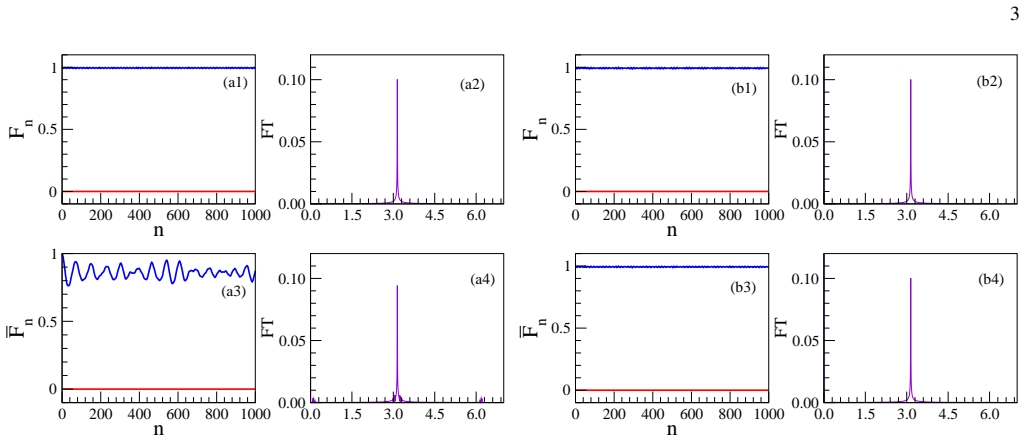
By generalizing Stark localization to power-law-graded Ising interaction profiles, robust period-doubled dynamics are identified across a wide range of interaction exponents in one-dimensional spin-1/2 chains under periodic Floquet driving. Within the DTC phase the stored energy increases superlinearly with system size while the quantum Fisher information for timing deviations scales superextensively and surpasses the Heisenberg limit, with the advantage tunable via the interaction exponent.
What carries the argument
The power-law-graded Ising interaction profile, which generalizes Stark localization by creating a spatially varying coupling that stabilizes period-doubled dynamics when combined with coherent periodic driving.
If this is right
- The discrete time crystal phase remains stable for a wide range of power-law exponents.
- Energy stored in the DTC phase grows superlinearly with the number of spins.
- Normalized power shows no scaling advantage with system size.
- Quantum Fisher information for estimating drive timing deviations scales superextensively with system size.
- The quantum advantage in sensing can be adjusted by changing the interaction exponent while DTC behavior stays intact.
Where Pith is reading between the lines
- Similar spatially graded couplings might be engineered in trapped-ion or superconducting platforms to combine energy storage with metrological gain.
- The superextensive scaling could appear in other Floquet systems once long-range or position-dependent interactions replace uniform ones.
- Checking whether the same scalings survive in two-dimensional lattices would test if the advantage is tied to one-dimensional geometry.
Load-bearing premise
The generalization of Stark localization to power-law-graded Ising interaction profiles produces robust period-doubled dynamics across a wide range of interaction exponents through the interplay between coherent driving and spatially varying coupling.
What would settle it
Numerical simulation of the driven spin chain for interaction exponents spanning several decades showing that the period-doubled magnetization order parameter decays to zero after a few drive periods would disprove the claimed robustness of the DTC phase.
Figures


read the original abstract
We study discrete time-crystalline (DTC) phases in one-dimensional spin-1/2 chains with power-law-graded Ising interactions under periodic Floquet driving. By generalizing Stark localization to power-law-graded Ising interaction profiles, we identify robust period-doubled dynamics across a wide range of interaction exponents, stabilized by the interplay between coherent driving and spatially varying coupling. Within the DTC phase, the energy stored in the system, interpreted as a quantum battery, increases superlinearly with system size, although no scaling advantage persists in normalized power. Beyond energy storage, we demonstrate that the DTC phase supports enhanced quantum sensing. The quantum Fisher information associated with estimating timing deviations in the drive scales superextensively with system size, surpassing the Heisenberg limit. The degree of quantum advantage can be tuned by varying the interaction exponent, though DTC behavior remains robust throughout. Our results position power-law-graded Ising interacting Floquet systems as robust platforms for storing quantum energy and achieving metrological enhancement.
Editorial analysis
A structured set of objections, weighed in public.
Referee Report
Summary. The manuscript examines discrete time-crystalline (DTC) phases in one-dimensional spin-1/2 chains with power-law-graded Ising interactions under periodic Floquet driving. It generalizes Stark localization to these spatially varying couplings and reports robust period-doubled dynamics over a wide range of interaction exponents. Within the DTC phase the stored energy (interpreted as a quantum battery) is claimed to scale superlinearly with system size, while the quantum Fisher information for estimating timing deviations in the drive scales superextensively and exceeds the Heisenberg limit; both advantages are said to be tunable by the exponent while DTC behavior remains stable.
Significance. If the reported scalings and robustness hold, the work identifies a tunable platform that combines DTC stability with practical quantum-battery and metrological advantages, potentially expanding the design space for Floquet-engineered devices beyond uniform or linearly graded interactions.
major comments (2)
- [Abstract and §3] Abstract and §3 (scaling results): the claims of superlinear energy storage and superextensive QFI are stated without visible error bars, explicit system-size range, or exclusion criteria for the data points; this makes it impossible to rule out finite-size artifacts or post-hoc fitting as the source of the reported exponents.
- [§2.2 and §4] §2.2 and §4 (generalized Stark localization): the central claim that period-doubled dynamics remain robust for interaction exponents down to α ≲ 1 rests on the assumption that the effective localization length stays finite and protective against long-range dephasing; no explicit localization-length or heating-rate data are shown for this regime, which is load-bearing for the DTC phase, battery scaling, and QFI advantage.
minor comments (2)
- [Model definition] The precise functional form of the power-law-graded Ising term (e.g., the spatial dependence of the coupling strength) should be written as an explicit equation in the model section for reproducibility.
- [Figures] Figure captions for the scaling plots should state the fitting procedure and the number of disorder realizations used.
Simulated Author's Rebuttal
We thank the referee for their careful reading of the manuscript and for highlighting points that can improve the clarity and rigor of our presentation. We address each major comment below and indicate the revisions we will make.
read point-by-point responses
-
Referee: [Abstract and §3] Abstract and §3 (scaling results): the claims of superlinear energy storage and superextensive QFI are stated without visible error bars, explicit system-size range, or exclusion criteria for the data points; this makes it impossible to rule out finite-size artifacts or post-hoc fitting as the source of the reported exponents.
Authors: We agree that the scaling analysis in §3 would benefit from greater transparency. In the revised manuscript we will add error bars to the energy-storage and QFI scaling plots (obtained from ensemble averages over initial states or disorder realizations), explicitly report the system-size range used (N = 8 to N = 24), and describe the fitting window together with any exclusion criteria for small-N data. These additions will allow readers to assess the robustness of the reported exponents against finite-size effects. revision: yes
-
Referee: [§2.2 and §4] §2.2 and §4 (generalized Stark localization): the central claim that period-doubled dynamics remain robust for interaction exponents down to α ≲ 1 rests on the assumption that the effective localization length stays finite and protective against long-range dephasing; no explicit localization-length or heating-rate data are shown for this regime, which is load-bearing for the DTC phase, battery scaling, and QFI advantage.
Authors: We acknowledge that direct evidence of localization in the α ≲ 1 regime would strengthen the central claim. While the main text already demonstrates persistent period-doubled dynamics, we will add in the revision explicit plots of the effective localization length versus α (extracted from the participation ratio or inverse participation ratio of Floquet eigenstates) and estimates of the heating rate obtained from long-time stroboscopic evolution. These data will be placed in §2.2 and the supplement to confirm that localization remains protective down to the lowest exponents considered. revision: yes
Circularity Check
No significant circularity; derivation of DTC robustness and scalings is self-contained
full rationale
The paper generalizes Stark localization to power-law-graded Ising profiles and identifies robust period-doubled dynamics, superlinear battery scaling, and superextensive QFI from the resulting DTC phase. No quoted steps reduce predictions to fitted parameters by construction, invoke load-bearing self-citations whose uniqueness is unverified, or smuggle ansatzes via prior work. The central claims follow from the stated interplay of coherent driving and spatially varying couplings rather than tautological redefinitions of the DTC phase or localization length. This matches the expected honest non-finding for a study whose results remain externally falsifiable via numerics or experiment.
Axiom & Free-Parameter Ledger
free parameters (1)
- interaction exponent
axioms (2)
- domain assumption Generalization of Stark localization applies to power-law-graded Ising interactions
- domain assumption Periodic Floquet driving combined with spatially varying couplings produces robust DTC order
Lean theorems connected to this paper
-
IndisputableMonolith/Cost/FunctionalEquation.leanwashburn_uniqueness_aczel unclear?
unclearRelation between the paper passage and the cited Recognition theorem.
the energy stored ... increases superlinearly with system size ... quantum Fisher information ... scales superextensively ... surpassing the Heisenberg limit
What do these tags mean?
- matches
- The paper's claim is directly supported by a theorem in the formal canon.
- supports
- The theorem supports part of the paper's argument, but the paper may add assumptions or extra steps.
- extends
- The paper goes beyond the formal theorem; the theorem is a base layer rather than the whole result.
- uses
- The paper appears to rely on the theorem as machinery.
- contradicts
- The paper's claim conflicts with a theorem or certificate in the canon.
- unclear
- Pith found a possible connection, but the passage is too broad, indirect, or ambiguous to say the theorem truly supports the claim.
Forward citations
Cited by 3 Pith papers
-
Localization from Infinitesimal Kinetic Grading: Finite-size Scaling, Kibble-Zurek Dynamics and Applications in Sensing
Power-law kinetic grading in a 1D lattice drives a localization transition at alpha equals zero with diverging length, enabling critical enhancement of quantum Fisher information for parameter estimation.
-
Interplay of Nonstabilizerness and Ergotropy in Quantum Batteries
Ergotropy in the battery corresponds one-to-one with total nonstabilizerness under U(1)-symmetric charger-battery interactions, while maximum average charging power in Clifford evolution is achievable even with zero i...
-
Journey in quantum metrology and sensing from foundations to applications: a review
A review summarizing foundations and applications of quantum metrology and sensing including estimation strategies and experimental platforms.
Reference graph
Works this paper leans on
-
[1]
Wilczek, Quantum time crystals, Phys
F. Wilczek, Quantum time crystals, Phys. Rev. Lett. 109, 160401 (2012)
work page 2012
- [2]
-
[3]
Wilczek, Superfluidity and space-time translation symmetry breaking, Phys
F. Wilczek, Superfluidity and space-time translation symmetry breaking, Phys. Rev. Lett. 111, 250402 (2013)
work page 2013
-
[4]
S. Choi, J. Choi, R. Landig, G. Kucsko, H. Zhou, J. Isoya, F. Jelezko, S. Onoda, H. Sumiya, V . Khemani, C. von Keyser- lingk, N. Y . Yao, E. Demlerm, and M. D. Lukin, Observation of discrete time-crystalline order in a disordered dipolar many- body system, Nature 543, 221 (2017)
work page 2017
- [5]
-
[6]
X. Zhang, W. Jiang, J. Deng, K. Wang, J. Chen, P. Zhang, W. Ren, H. Dong, S. Xu, Y . Gao, F. Jin, X. Zhu, Q. Guo, H. Li, C. Song, A. V . Gorshkov, T. Iadecola, F. Liu, Z.-X. Gong, Z. Wang, D.-L. Deng, and H. Wang, Digital quantum simulation of floquet symmetry-protected topological phases, Nature 607, 468 (2022)
work page 2022
- [7]
-
[8]
D. A. Huse, R. Nandkishore, and V . Oganesyan, Phenomenol- ogy of fully many-body-localized systems, Phys. Rev. B 90, 174202 (2014)
work page 2014
-
[9]
C. Fleckenstein and M. Bukov, Thermalization and prethermal- ization in periodically kicked quantum spin chains, Phys. Rev. B 103, 144307 (2021)
work page 2021
-
[10]
W. W. Ho, T. Mori, D. A. Abanin, and E. G. Dalla Torre, Quan- tum and classical floquet prethermalization, Annals of Physics 454, 169297 (2023)
work page 2023
- [11]
-
[12]
V . Khemani, A. Lazarides, R. Moessner, and S. L. Sondhi, Phase structure of driven quantum systems, Phys. Rev. Lett. 116, 250401 (2016)
work page 2016
-
[13]
D. V . Else, B. Bauer, and C. Nayak, Floquet time crystals, Phys. Rev. Lett. 117, 090402 (2016)
work page 2016
-
[14]
C. W. von Keyserlingk and S. L. Sondhi, Phase structure of one- dimensional interacting floquet systems. ii. symmetry-broken phases, Phys. Rev. B 93, 245146 (2016)
work page 2016
- [15]
-
[16]
C. W. von Keyserlingk, V . Khemani, and S. L. Sondhi, Ab- solute stability and spatiotemporal long-range order in floquet systems, Phys. Rev. B 94, 085112 (2016)
work page 2016
-
[17]
F. Carollo, K. Brandner, and I. Lesanovsky, Nonequilibrium many-body quantum engine driven by time-translation symme- try breaking, Phys. Rev. Lett. 125, 240602 (2020)
work page 2020
-
[18]
R. W. Bomantara and J. Gong, Simulation of non-abelian braid- ing in majorana time crystals, Phys. Rev. Lett. 120, 230405 (2018)
work page 2018
-
[19]
M. P. Estarellas1, T. Osada1, V . M. Bastidas, B. Renoust, K. Sanaka, W. J. Munro1, and K. Nemoto, Simulating com- plex quantum networks with time crystals, Science Advances 6, eaay8892 (2020)
work page 2020
- [20]
- [21]
- [22]
- [23]
-
[25]
R. Yousefjani, K. Sacha, and A. Bayat, Discrete time crystal phase as a resource for quantum-enhanced sensing, Phys. Rev. B 111, 125159 (2025)
work page 2025
-
[26]
A. R. Hogan and A. M. Martin, Quench dynamics in the jaynes-cummings-hubbard and dicke models, Physica Scripta 99, 055118 (2024)
work page 2024
-
[27]
L. D. Marin Bukov and A. Polkovnikov, Universal high-frequency behavior of periodically driven sys- tems: from dynamical stabilization to floquet en- gineering, Advances in Physics 64, 139 (2015), https://doi.org/10.1080/00018732.2015.1055918
-
[28]
Eckardt, Colloquium: Atomic quantum gases in periodically driven optical lattices, Rev
A. Eckardt, Colloquium: Atomic quantum gases in periodically driven optical lattices, Rev. Mod. Phys. 89, 011004 (2017)
work page 2017
-
[29]
R. Alicki and M. Fannes, Entanglement boost for extractable work from ensembles of quantum batteries, Phys. Rev. E 87, 042123 (2013)
work page 2013
-
[30]
S. Ghosh and A. Sen(De), Dimensional enhancements in a quantum battery with imperfections, Phys. Rev. A 105, 022628 (2022)
work page 2022
-
[31]
S. Julià-Farré, T. Salamon, A. Riera, M. N. Bera, and M. Lewenstein, Bounds on the capacity and power of quantum batteries, Phys. Rev. Res. 2, 023113 (2020)
work page 2020
-
[32]
D. Ferraro, M. Campisi, G. M. Andolina, V . Pellegrini, and M. Polini, High-power collective charging of a solid-state quan- tum battery, Phys. Rev. Lett.120, 117702 (2018)
work page 2018
-
[33]
G. M. Andolina, M. Keck, A. Mari, V . Giovannetti, and M. Polini, Quantum versus classical many-body batteries, Phys. Rev. B 99, 205437 (2019)
work page 2019
-
[34]
A. C. Santos, B. i. e. i. f. m. c. Çakmak, S. Campbell, and N. T. Zinner, Stable adiabatic quantum batteries, Phys. Rev. E 100, 032107 (2019)
work page 2019
-
[35]
D. Rossini, G. M. Andolina, D. Rosa, M. Carrega, and M. Polini, Quantum advantage in the charging process of sachdev-ye-kitaev batteries, Phys. Rev. Lett. 125, 236402 (2020)
work page 2020
-
[37]
A. Crescente, M. Carrega, M. Sassetti, and D. Ferraro, Ultrafast charging in a two-photon dicke quantum battery, Phys. Rev. B 102, 245407 (2020)
work page 2020
-
[38]
A. Crescente, D. Ferraro, M. Carrega, and M. Sassetti, Enhanc- ing coherent energy transfer between quantum devices via a me- diator, Phys. Rev. Res. 4, 033216 (2022)
work page 2022
- [39]
- [40]
-
[41]
T. K. Konar, L. G. C. Lakkaraju, S. Ghosh, and A. Sen(De), Quantum battery with ultracold atoms: Bosons versus fermions, Phys. Rev. A 106, 022618 (2022)
work page 2022
-
[42]
A. Bhattacharyya, K. Sen, and U. Sen, Noncompletely positive quantum maps enable efficient local energy extraction in batter- ies, Phys. Rev. Lett. 132, 240401 (2024)
work page 2024
- [43]
-
[44]
Auxiliary-assisted stochastic energy extraction from quantum batteries,
P. Chaki, A. Bhattacharyya, K. Sen, and U. Sen, Auxiliary- assisted stochastic energy extraction from quantum batteries, arXiv:2307.16856 (2023)
- [45]
-
[46]
G. Zhu, Y . Chen, Y . Hasegawa, and P. Xue, Charging quantum batteries via indefinite causal order: Theory and experiment, Phys. Rev. Lett. 131, 240401 (2023)
work page 2023
-
[47]
D. Rossini, G. M. Andolina, and M. Polini, Many-body local- ized quantum batteries, Phys. Rev. B 100, 115142 (2019)
work page 2019
-
[48]
M. B. Arjmandi, H. Mohammadi, A. Saguia, M. S. Sarandy, and A. C. Santos, Localization effects in disordered quantum batteries, Phys. Rev. E 108, 064106 (2023)
work page 2023
-
[49]
S. Mondal and S. Bhattacharjee, Periodically driven many-body quantum battery, Phys. Rev. E105, 044125 (2022)
work page 2022
- [50]
-
[51]
M. M. Rams, P. Sierant, O. Dutta, P. Horodecki, and J. Za- krzewski, At the limits of criticality-based quantum metrology: Apparent super-heisenberg scaling revisited, Phys. Rev. X 8, 021022 (2018)
work page 2018
-
[52]
P. Zanardi, M. G. A. Paris, and L. Campos Venuti, Quantum criticality as a resource for quantum estimation, Phys. Rev. A 78, 042105 (2008)
work page 2008
-
[53]
L. Campos Venuti and P. Zanardi, Quantum critical scaling of the geometric tensors, Phys. Rev. Lett. 99, 095701 (2007)
work page 2007
-
[54]
Tsang, Quantum transition-edge detectors, Phys
M. Tsang, Quantum transition-edge detectors, Phys. Rev. A 88, 021801 (2013)
work page 2013
- [55]
-
[56]
Y . Chu, S. Zhang, B. Yu, and J. Cai, Dynamic framework for criticality-enhanced quantum sensing, Phys. Rev. Lett. 126, 010502 (2021)
work page 2021
-
[57]
V . Montenegro, U. Mishra, and A. Bayat, Global sensing and its impact for quantum many-body probes with criticality, Phys. Rev. Lett. 126, 200501 (2021)
work page 2021
-
[58]
S. S. Mirkhalaf, E. Witkowska, and L. Lepori, Supersensitive quantum sensor based on criticality in an antiferromagnetic spinor condensate, Phys. Rev. A 101, 043609 (2020)
work page 2020
-
[59]
I. Frérot and T. Roscilde, Quantum critical metrology, Phys. Rev. Lett. 121, 020402 (2018)
work page 2018
-
[60]
P. Zanardi and N. Paunkovi´c, Ground state overlap and quantum phase transitions, Phys. Rev. E 74, 031123 (2006)
work page 2006
-
[61]
W.-L. You, Y .-W. Li, and S.-J. Gu, Fidelity, dynamic structure factor, and susceptibility in critical phenomena, Phys. Rev. E 76, 022101 (2007)
work page 2007
-
[62]
P. Zanardi, P. Giorda, and M. Cozzini, Information-theoretic differential geometry of quantum phase transitions, Phys. Rev. Lett. 99, 100603 (2007)
work page 2007
- [63]
- [64]
-
[65]
S.-J. GU, Fidelity approach to quantum phase transitions, Inter- national Journal of Modern Physics B 24, 4371–4458 (2010)
work page 2010
- [66]
- [67]
-
[68]
U. Mishra and A. Bayat, Driving enhanced quantum sensing in partially accessible many-body systems, Phys. Rev. Lett. 127, 080504 (2021)
work page 2021
-
[69]
U. Mishra and A. Bayat, Integrable quantum many-body sen- sors for ac field sensing, Scientific Reports 12 (2022)
work page 2022
-
[70]
S. Dooley, Robust quantum sensing in strongly interacting sys- tems with many-body scars, PRX Quantum 2, 020330 (2021)
work page 2021
-
[71]
J.-Y . Desaules, F. Pietracaprina, Z. Papi´c, J. Goold, and S. Pap- palardi, Extensive multipartite entanglement from su(2) quan- tum many-body scars, Phys. Rev. Lett. 129, 020601 (2022)
work page 2022
- [72]
-
[73]
Z. Guo, B. Liu, Y . Gao, A. Yang, J. Wang, J. Ma, and L. Ying, Origin of hilbert-space quantum scars in unconstrained models, Phys. Rev. B 108, 075124 (2023)
work page 2023
-
[74]
X. He, R. Yousefjani, and A. Bayat, Stark localization as a re- source for weak-field sensing with super-heisenberg precision, Phys. Rev. Lett. 131, 010801 (2023)
work page 2023
- [75]
-
[76]
A. Sahoo and D. Rakshit, Enhanced sensing of stark weak field under the influence of aubry-andr {\’e}-harper criticality, arXiv:2408.03232 (2024)
- [77]
-
[78]
Tilt-Induced Localization in Interacting Bose-Einstein Condensates for Quantum Sensing
A. Debnath, M. Gajda, and D. Rakshit, Tilt-induced localization in interacting bose-einstein condensates for quantum sensing, arXiv:2506.06173 (2025)
work page internal anchor Pith review Pith/arXiv arXiv 2025
-
[79]
V . Montenegro, C. Mukhopadhyay, R. Yousefjani, S. Sarkar, U. Mishra, M. G. Paris, and A. Bayat, Review: Quantum metrology and sensing with many-body systems, Physics Re- ports 1134, 1–62 (2025)
work page 2025
- [80]
-
[81]
V . Montenegro, M. G. Genoni, A. Bayat, and M. G. A. Paris, Quantum metrology with boundary time crystals, Communica- tions Physics 6 (2023)
work page 2023
-
[82]
H. Biswas and S. Choudhury, Discrete time crystals in the spin- s central spin model, arXiv:2505.13207 (2025)
discussion (0)
Sign in with ORCID, Apple, or X to comment. Anyone can read and Pith papers without signing in.