Comparing Minimal and Non-Minimal Quintessence Models to 2025 DESI Data
Pith reviewed 2026-05-18 15:42 UTC · model grok-4.3
The pith
Non-minimal quintessence can match DESI's evolving dark energy only for specially chosen narrow couplings.
A machine-rendered reading of the paper's core claim, the machinery that carries it, and where it could break.
Core claim
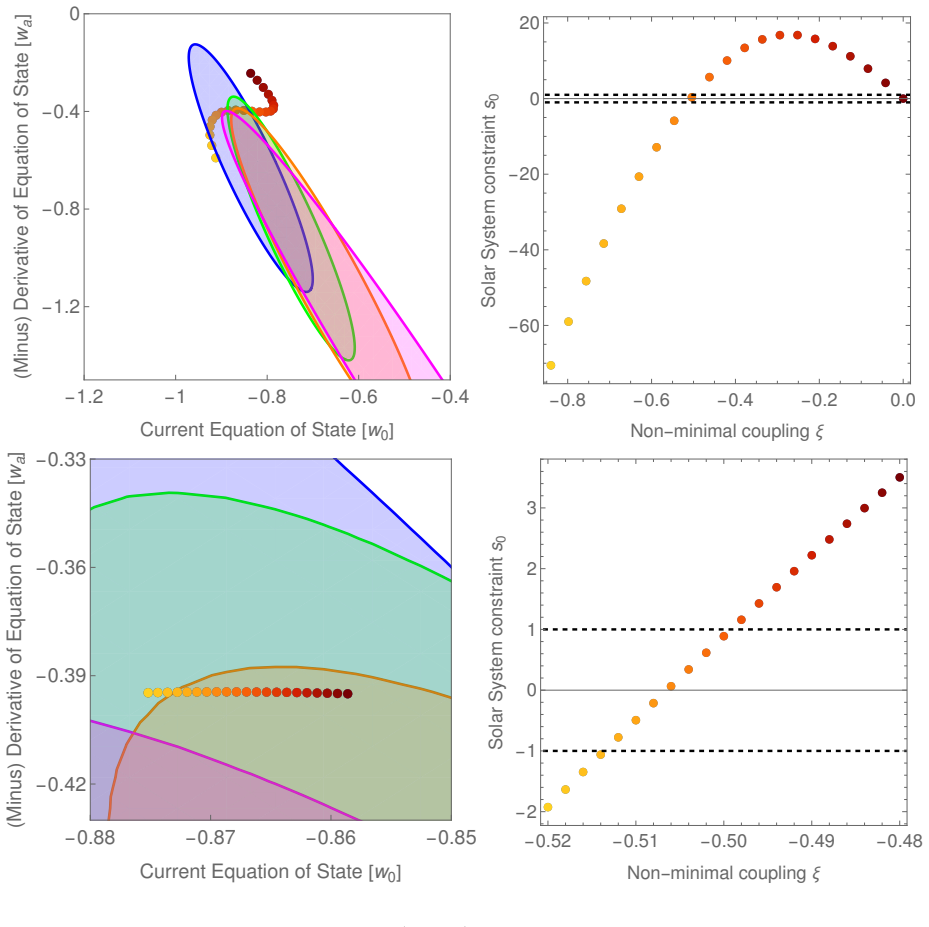
Various quintessence potentials provide modest fits to the DESI data, but non-minimally coupled scalars achieve better agreement by allowing an effective equation of state that temporarily obeys w < -1 and then relaxes to w > -1; since the scalar is very light, this induces a fifth force and time evolution in the effective gravitational strength, which are tightly constrained, and only a very narrow range of carefully selected non-minimal couplings evades these bounds.
What carries the argument
Non-minimal coupling between the quintessence scalar field and gravity, which alters the effective dark energy equation of state while introducing fifth-force interactions and time-dependent gravitational constant.
If this is right
- Some quintessence potentials improve the fit to DESI data modestly compared to a cosmological constant.
- Non-minimal coupling enables a transient phantom equation of state w < -1 that better matches the observed evolution.
- Light scalars in these models produce fifth forces and varying effective G that must satisfy existing gravity tests.
- Generic non-minimal couplings violate gravity constraints, while only narrow specially chosen values remain viable.
Where Pith is reading between the lines
- Future precision measurements of gravitational strength over cosmic time could directly test the allowed narrow coupling window.
- Such tuning might point to underlying symmetries or selection mechanisms in fundamental theory that pick out these specific values.
- Similar non-minimal effects could be explored in other dynamical dark energy scenarios beyond quintessence.
Load-bearing premise
The non-minimal coupling strength can be restricted to a very narrow, specially chosen range that simultaneously fits the DESI data and satisfies all existing fifth-force and time-varying-G constraints without introducing other unobserved effects.
What would settle it
Detection of a fifth force or variation in G at a level that rules out the narrow window of couplings needed to fit the DESI data while satisfying current bounds.
Figures




read the original abstract
In this work we examine the 2025 DESI analysis of dark energy, which suggests that dark energy is evolving in time with an increasing equation of state $w$. We explore a wide range of quintessence models, described by a potential function $V(\varphi)$, including: quadratic potentials, quartic hilltops, double wells, cosine functions, Gaussians, inverse powers. We find that while some provide improvement in fitting to the data, compared to a cosmological constant, the improvement is only modest. We then consider non-minimally coupled scalars which can help fit the data by providing an effective equation of state that temporarily obeys $w<-1$ and then relaxes to $w>-1$. Since the scalar is very light, this leads to a fifth force and to time evolution in the effective gravitational strength, which are both tightly constrained by tests of gravity. For a very narrow range of carefully selected non-minimal couplings we are able to evade these bounds, but not for generic values.
Editorial analysis
A structured set of objections, weighed in public.
Referee Report
Summary. The manuscript compares minimal and non-minimal quintessence models with potentials including quadratic, quartic hilltop, double-well, cosine, Gaussian, and inverse-power forms to the 2025 DESI data suggesting a time-evolving dark energy equation of state w that is increasing. Minimal models yield only modest improvements over a cosmological constant. Non-minimal couplings can produce a temporary effective w < -1 before relaxing to w > -1, but the very light scalar induces fifth forces and time-varying effective G that are tightly constrained by gravity tests; only a narrow, specially chosen range of couplings evades these bounds.
Significance. If the quantitative fit results hold, the work supplies useful constraints on quintessence parameter space in response to new DESI indications of evolving dark energy. The emphasis on the narrow viability window for non-minimal models usefully illustrates the tension between fitting w < -1 behavior and existing fifth-force/time-varying-G limits.
major comments (2)
- [Abstract / Results] Abstract and results section: the repeated claim of 'modest improvement' for certain minimal potentials is not accompanied by explicit quantitative fit statistics (e.g., Delta chi^2, AIC differences, or Bayesian evidence ratios relative to LambdaCDM), which are required to evaluate whether the improvement is statistically meaningful or merely marginal.
- [Non-minimal models] Non-minimal coupling discussion: the procedure for identifying the 'very narrow range of carefully selected non-minimal couplings' that simultaneously fit the DESI data and satisfy fifth-force and varying-G bounds is not described; the manuscript must specify the exact prior ranges, the numerical method used to isolate this window, and explicit verification that no additional unobserved effects (e.g., modified growth or screening failures) arise within it.
minor comments (2)
- [Methods] All potential functions V(phi) should be written explicitly with their parameter definitions and ranges in a dedicated methods subsection for reproducibility.
- [Figures] Figure captions and axis labels for any w(z) or likelihood plots should include the precise data points or DESI release version used.
Simulated Author's Rebuttal
We thank the referee for their thorough review and valuable feedback on our manuscript comparing quintessence models to the 2025 DESI data. We address each of the major comments below and have made revisions to the manuscript where necessary to improve clarity and completeness.
read point-by-point responses
-
Referee: [Abstract / Results] Abstract and results section: the repeated claim of 'modest improvement' for certain minimal potentials is not accompanied by explicit quantitative fit statistics (e.g., Delta chi^2, AIC differences, or Bayesian evidence ratios relative to LambdaCDM), which are required to evaluate whether the improvement is statistically meaningful or merely marginal.
Authors: We agree with the referee that explicit quantitative measures are important for assessing the significance of the improvements. In the revised manuscript, we will add Delta chi^2 values, AIC differences, and if feasible Bayesian evidence ratios comparing the best-fitting minimal quintessence models to LambdaCDM. This will be included in the results section and referenced in the abstract. revision: yes
-
Referee: [Non-minimal models] Non-minimal coupling discussion: the procedure for identifying the 'very narrow range of carefully selected non-minimal couplings' that simultaneously fit the DESI data and satisfy fifth-force and varying-G bounds is not described; the manuscript must specify the exact prior ranges, the numerical method used to isolate this window, and explicit verification that no additional unobserved effects (e.g., modified growth or screening failures) arise within it.
Authors: We acknowledge that the current manuscript does not provide a detailed description of how the narrow viable range for non-minimal couplings was determined. In the revision, we will expand the relevant section to include the exact prior ranges explored, the numerical approach (such as parameter scans or Monte Carlo methods) used to identify the window that fits the data while satisfying gravity constraints, and additional checks confirming the absence of issues like modified growth rates or failures in screening mechanisms within this parameter range. revision: yes
Circularity Check
No significant circularity in model comparisons to external data
full rationale
The paper compares a range of quintessence potentials (minimal and non-minimal) directly to 2025 DESI observations and pre-existing fifth-force/time-varying-G constraints from external tests of gravity. No central quantity such as an equation-of-state parameter, coupling strength, or fit improvement is defined in terms of itself or obtained by fitting a subset and then relabeling the same quantity as a prediction. The statement that only a narrow range of non-minimal couplings evades bounds is presented as a physical limitation drawn from independent gravity experiments, not as a result derived from the DESI fit itself. All load-bearing steps therefore remain anchored in external data and standard model-building assumptions rather than reducing to self-referential inputs.
Axiom & Free-Parameter Ledger
free parameters (2)
- potential parameters (mass, self-coupling, etc.)
- non-minimal coupling strength
axioms (2)
- domain assumption The background spacetime is described by the flat FLRW metric with a homogeneous scalar field.
- domain assumption Existing solar-system and laboratory tests tightly bound fifth forces and time variation of G.
Lean theorems connected to this paper
-
IndisputableMonolith/Cost/FunctionalEquationwashburn_uniqueness_aczel unclear?
unclearRelation between the paper passage and the cited Recognition theorem.
We explore a wide range of quintessence models, described by a potential function V(φ), including: quadratic potentials, quartic hilltops, double wells, cosine functions, Gaussians, inverse powers... non-minimally coupled scalars which can help fit the data by providing an effective equation of state that temporarily obeys w < −1
What do these tags mean?
- matches
- The paper's claim is directly supported by a theorem in the formal canon.
- supports
- The theorem supports part of the paper's argument, but the paper may add assumptions or extra steps.
- extends
- The paper goes beyond the formal theorem; the theorem is a base layer rather than the whole result.
- uses
- The paper appears to rely on the theorem as machinery.
- contradicts
- The paper's claim conflicts with a theorem or certificate in the canon.
- unclear
- Pith found a possible connection, but the passage is too broad, indirect, or ambiguous to say the theorem truly supports the claim.
Forward citations
Cited by 5 Pith papers
-
Post-Newtonian Constraints on Scalar-Tensor Gravity
Unified post-Newtonian analysis reveals that Palatini scalar-tensor theories often face weaker Solar System bounds than metric versions due to stronger Yukawa suppression, with Palatini f(R) reproducing GR limits for ...
-
Non-minimally coupled quintessence with sign-switching interaction
A new quintessence model with non-minimal coupling produces an effective sign-switching interaction that fits current data better than LambdaCDM or w0waCDM and accounts for late-time dark energy weakening without phan...
-
Evidence for deviation in gravitational light deflection from general relativity at cosmological scales with KiDS-Legacy and CMB lensing
KiDS-Legacy weak lensing plus CMB data yields a 3 sigma deviation in light deflection from GR in a Lambda CDM background, with the signal driven by large-scale CMB lensing amplitudes.
-
Joint Constraints on Neutrinos and Dynamical Dark Energy in Minimally Modified Gravity
The w†VCDM model shows a statistically significant preference for late-time quintessence-phantom crossing dark energy, raises the Hubble constant, and satisfies neutrino mass and Neff constraints from current cosmolog...
-
Thawing Quintessence: Priors, evidence, and likely trajectories
Bayesian evidence from DESI DR2 BAO, Planck+ACT CMB, and multiple supernova samples favors thawing quintessence over a cosmological constant.
Reference graph
Works this paper leans on
-
[1]
Hilltop Potentials 6
-
[2]
Monomial Potentials 9
-
[3]
Decaying Potentials 9 III. Statistical Analysis 12 IV. Non-Minimal Coupling 13 A. Fifth Force Constraints 14 B. Gravitational Coupling Constraints 15 C. Choice of Frame 15 D. Results 16 V. Discussion 21 VI. Acknowledgments 21 References 22 2 I. INTRODUCTION The accelerated expansion of the universe [1, 2] is attributed to the presence of dark energy, whic...
-
[4]
Hilltop Potentials In Ref. [46] there was a focus on models near a hilltop, in which the potential is a constant minus a quadratic. We will reexamine this here (eq. (6)) in light of the updated 2025 DESI data. Moreover, we will also consider a range of other hilltop potentials: a quartic hilltop (eq. (7)), as well as models with local minima (eqs. (8, 9))...
work page 2025
-
[5]
Monomial Potentials We also consider models which are a pure (positive) power law – a monomial. If the field starts near the minimum, then it just oscillates for even powers or becomes negative for odd powers, and does not act as dark energy at all. So there is a minimum value ofφ i here. For the linear potential it isφ min,i ≈0.85M p; for the quadratic m...
-
[6]
Decaying Potentials Another family of potentials we consider are those that decay asymptotically towards V→0 at largeφ. For smallφ, these are similar to the hilltop models considered earlier. However, for largeφ, there is a new type of behavior. In eq. (13) there is rapid decay from a Gaussian. In eq. (14) there is inverse power law decay. In eq. (15) the...
work page 2025
- [7]
-
[8]
Measurements of Omega and Lambda from 42 High-Redshift Supernovae
S. Perlmutteret al.(Supernova Cosmology Project), Measurements of Ω and Λ from 42 High Redshift Supernovae, Astrophys. J.517, 565 (1999), arXiv:astro-ph/9812133
work page internal anchor Pith review Pith/arXiv arXiv 1999
-
[9]
Weinberg, The cosmological constant problem, Rev
S. Weinberg, The cosmological constant problem, Rev. Mod. Phys.61, 1 (1989)
work page 1989
-
[10]
A. G. Adameet al.(DESI), DESI 2024 VI: cosmological constraints from the measurements of baryon acoustic oscillations, JCAP02, 021, arXiv:2404.03002 [astro-ph.CO]
work page internal anchor Pith review Pith/arXiv arXiv 2024
-
[11]
DESI DR2 Results II: Measurements of Baryon Acoustic Oscillations and Cosmological Constraints
M. Abdul Karimet al.(DESI), DESI DR2 Results II: Measurements of Baryon Acoustic Oscillations and Cosmological Constraints, (2025), arXiv:2503.14738 [astro-ph.CO]
work page internal anchor Pith review Pith/arXiv arXiv 2025
-
[12]
Accelerating Universes with Scaling Dark Matter
M. Chevallier and D. Polarski, Accelerating universes with scaling dark matter, Int. J. Mod. Phys. D10, 213 (2001), arXiv:gr-qc/0009008
work page internal anchor Pith review Pith/arXiv arXiv 2001
-
[13]
E. V. Linder, Exploring the expansion history of the universe, Phys. Rev. Lett.90, 091301 (2003), arXiv:astro-ph/0208512
work page internal anchor Pith review Pith/arXiv arXiv 2003
-
[14]
S. Dutta and R. J. Scherrer, Hilltop Quintessence, Phys. Rev. D78, 123525 (2008), arXiv:0809.4441 [astro-ph]
work page internal anchor Pith review Pith/arXiv arXiv 2008
-
[15]
Slow-Roll Thawing Quintessence
T. Chiba, Slow-Roll Thawing Quintessence, Phys. Rev. D79, 083517 (2009), [Erratum: Phys.Rev.D 80, 109902 (2009)], arXiv:0902.4037 [astro-ph.CO]
work page internal anchor Pith review Pith/arXiv arXiv 2009
-
[16]
S. Bhattacharya, G. Borghetto, A. Malhotra, S. Parameswaran, G. Tasinato, and I. Zavala, Cosmological constraints on curved quintessence, JCAP09, 073, arXiv:2405.17396 [astro- ph.CO]
-
[17]
S. Bhattacharya, G. Borghetto, A. Malhotra, S. Parameswaran, G. Tasinato, and I. Zavala, Cosmological tests of quintessence in quantum gravity, JCAP04, 086, arXiv:2410.21243 [astro- ph.CO]
-
[18]
S. Nesseris, Y. Akrami, and G. D. Starkman, To CPL, or not to CPL? What we have not learned about the dark energy equation of state, (2025), arXiv:2503.22529 [astro-ph.CO]
- [19]
-
[20]
E. ¨Oz¨ ulker, E. Di Valentino, and W. Giar` e, Dark Energy Crosses the Line: Quantifying and Testing the Evidence for Phantom Crossing, (2025), arXiv:2506.19053 [astro-ph.CO]
- [21]
-
[22]
S. Roy Choudhury and T. Okumura, Updated Cosmological Constraints in Extended Param- eter Space with Planck PR4, DESI Baryon Acoustic Oscillations, and Supernovae: Dynamical Dark Energy, Neutrino Masses, Lensing Anomaly, and the Hubble Tension, Astrophys. J. Lett. 976, L11 (2024), arXiv:2409.13022 [astro-ph.CO]
work page internal anchor Pith review arXiv 2024
-
[23]
S. Roy Choudhury, Cosmology in Extended Parameter Space with DESI Data Release 2 Baryon Acoustic Oscillations: A 2σ+ Detection of Nonzero Neutrino Masses with an Up- date on Dynamical Dark Energy and Lensing Anomaly, Astrophys. J. Lett.986, L31 (2025), arXiv:2504.15340 [astro-ph.CO]
- [24]
- [25]
- [26]
-
[27]
Resolving the Planck-DESI tension by nonminimally coupled quintessence
J.-Q. Wang, R.-G. Cai, Z.-K. Guo, and S.-J. Wang, Resolving the Planck-DESI tension by non-minimally coupled quintessence, (2025), arXiv:2508.01759 [astro-ph.CO]
work page internal anchor Pith review Pith/arXiv arXiv 2025
-
[28]
A. Giacomini, G. Leon, A. Paliathanasis, and S. Pan, Cosmological Evolution of Two-Scalar fields Cosmology in the Jordan frame, Eur. Phys. J. C80, 184 (2020), arXiv:2001.02414 [gr-qc]
-
[29]
Andriot, Phantom matters, Phys
D. Andriot, Phantom matters, Phys. Dark Univ.49, 102000 (2025), arXiv:2505.10410 [hep-th]
- [30]
- [31]
- [32]
-
[33]
A. Chakraborty, P. K. Chanda, S. Das, and K. Dutta, DESI results: Hint towards coupled dark matter and dark energy, (2025), arXiv:2503.10806 [astro-ph.CO]
-
[34]
M. van der Westhuizen, D. Figueruelo, R. Thubisi, S. Sahlu, A. Abebe, and A. Paliathanasis, Compartmentalization in the Dark Sector of the Universe after DESI DR2 BAO data, (2025), arXiv:2505.23306 [astro-ph.CO]. 23
- [35]
- [36]
- [37]
-
[38]
S. Goldstein, M. Celoria, and F. Schmidt, Monodromic Dark Energy and DESI, (2025), arXiv:2507.16970 [astro-ph.CO]
- [39]
-
[40]
N. Dimakis, K. J. Duffy, A. Giacomini, A. Y. Kamenshchik, G. Leon, and A. Paliathanasis, Mapping solutions in nonmetricity gravity: Investigating cosmological dynamics in conformal equivalent theories, Phys. Dark Univ.44, 101436 (2024), arXiv:2312.11208 [gr-qc]
- [41]
-
[42]
Paliathanasis, Testing non-coincident f(Q)-gravity with DESI DR2 BAO and GRBs, Phys
A. Paliathanasis, Testing non-coincident f(Q)-gravity with DESI DR2 BAO and GRBs, Phys. Dark Univ.49, 101993 (2025), arXiv:2504.11132 [gr-qc]
-
[43]
A. Paliathanasis, Observational Constraints on Scalar Field–Matter Interaction in Weyl Inte- grable Spacetime, (2025), arXiv:2506.16223 [gr-qc]
- [44]
-
[45]
M. H¨ og˚ as and E. M¨ ortsell, Bimetric gravity improves the fit to DESI BAO and eases the Hubble tension, (2025), arXiv:2507.03743 [astro-ph.CO]
- [46]
-
[47]
X. Chen and A. Loeb, Evolving dark energy or dark matter with an evolving equation-of- state?, JCAP07, 059, arXiv:2505.02645 [astro-ph.CO]
-
[48]
M. Braglia, X. Chen, and A. Loeb, Exotic Dark Matter and the DESI Anomaly, (2025), arXiv:2507.13925 [astro-ph.CO]
- [49]
-
[50]
A. Paliathanasis, Dark energy within the generalized uncertainty principle in light of DESI DR2, JCAP09, 067, arXiv:2503.20896 [astro-ph.CO]. 24
-
[51]
M. Scherer, M. A. Sabogal, R. C. Nunes, and A. De Felice, Challenging the ΛCDM model: 5σ evidence for a dynamical dark energy late-time transition, Phys. Rev. D112, 043513 (2025), arXiv:2504.20664 [astro-ph.CO]
-
[52]
Z. Bayat and M. P. Hertzberg, Examining quintessence models with DESI data, JCAP08, 065, arXiv:2505.18937 [astro-ph.CO]
-
[53]
M. Rossi, M. Ballardini, M. Braglia, F. Finelli, D. Paoletti, A. A. Starobinsky, and C. Umilt` a, Cosmological constraints on post-Newtonian parameters in effectively massless scalar-tensor theories of gravity, Phys. Rev. D100, 103524 (2019), arXiv:1906.10218 [astro-ph.CO]
-
[54]
M. Braglia, M. Ballardini, W. T. Emond, F. Finelli, A. E. Gumrukcuoglu, K. Koyama, and D. Paoletti, Larger value forH 0 by an evolving gravitational constant, Phys. Rev. D102, 023529 (2020), arXiv:2004.11161 [astro-ph.CO]
-
[55]
M. Braglia, M. Ballardini, F. Finelli, and K. Koyama, Early modified gravity in light of the H0 tension and LSS data, Phys. Rev. D103, 043528 (2021), arXiv:2011.12934 [astro-ph.CO]
-
[56]
G. Franco Abell´ an, M. Braglia, M. Ballardini, F. Finelli, and V. Poulin, Probing early modifi- cation of gravity with Planck, ACT and SPT, JCAP12, 017, arXiv:2308.12345 [astro-ph.CO]
-
[57]
T. Damour and K. Nordtvedt, General relativity as a cosmological attractor of tensor scalar theories, Phys. Rev. Lett.70, 2217 (1993)
work page 1993
-
[58]
T. Damour and K. Nordtvedt, Tensor - scalar cosmological models and their relaxation toward general relativity, Phys. Rev. D48, 3436 (1993)
work page 1993
-
[59]
J.-P. Uzan, Fundamental constants: from measurement to the universe, a window on gravita- tion and cosmology, (2024), arXiv:2410.07281 [astro-ph.CO]
-
[60]
Faraoni,Cosmology in scalar tensor gravity(2004)
V. Faraoni,Cosmology in scalar tensor gravity(2004)
work page 2004
-
[61]
V. Faraoni and S. Capozziello,Beyond Einstein Gravity: A Survey of Gravitational Theories for Cosmology and Astrophysics(Springer, Dordrecht, 2011)
work page 2011
-
[62]
Conformal-Frame (In)dependence of Cosmological Observations in Scalar-Tensor Theory
T. Chiba and M. Yamaguchi, Conformal-Frame (In)dependence of Cosmological Observations in Scalar-Tensor Theory, JCAP10, 040, arXiv:1308.1142 [gr-qc]
work page internal anchor Pith review Pith/arXiv arXiv
-
[63]
Planck 2018 results. X. Constraints on inflation
Y. Akramiet al.(Planck), Planck 2018 results. X. Constraints on inflation, Astron. Astrophys. 641, A10 (2020), arXiv:1807.06211 [astro-ph.CO]. 25 Model:V(φ) =V 0 1− k2 2M 2p φ2 Pan-Plus Union3 DESY5 CMB pnull Nσ pnull Nσ pnull Nσ pnull Nσ k=1 0.088 1.352 0.030 1.882 0.002 2.920 0.471 0.072 k=1.2 0.086 1.366 0.029 1.902 0.002 2.936 0.464 0.089 k=1.4 0.083 ...
work page internal anchor Pith review Pith/arXiv arXiv 2018
discussion (0)
Sign in with ORCID, Apple, or X to comment. Anyone can read and Pith papers without signing in.