On the Complexity of Decoded Quantum Interferometry
Pith reviewed 2026-05-18 15:30 UTC · model grok-4.3
The pith
Decoded Quantum Interferometry can be classically simulated inside the polynomial hierarchy
A machine-rendered reading of the paper's core claim, the machinery that carries it, and where it could break.
Core claim
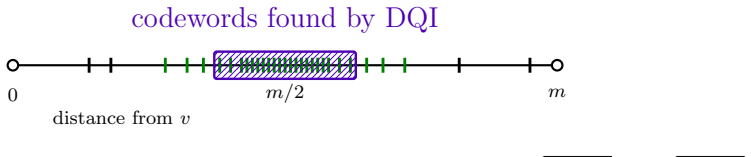
DQI resists classical simulation strategies based on locating outputs with large probabilities, yet it can be simulated at a low level of the polynomial hierarchy. This simulation challenges standard quantum supremacy arguments. DQI further provides a constructive solution to a classical coding-theoretic bound based on the MacWilliams identity. The algorithm admits an interpretation as preparing low-energy states of a quantum simple harmonic oscillator, which suggests a route to generalizations.
What carries the argument
Decoded Quantum Interferometry (DQI), the procedure of decoding a quantum state to induce interference patterns for approximate optimization
If this is right
- DQI resists classical simulation strategies based on locating outputs with large probabilities.
- DQI provides a constructive solution to a classical coding-theoretic bound based on the MacWilliams identity.
- DQI prepares low-energy states of a quantum simple harmonic oscillator.
- The polynomial-hierarchy simulation of DQI challenges standard quantum supremacy arguments that assume hardness for such interference algorithms.
Where Pith is reading between the lines
- Other quantum algorithms that combine decoding with interference may admit similar polynomial-hierarchy simulations.
- The MacWilliams identity link could be used to derive new classical bounds for optimization problems solved by DQI.
- Hardware experiments that realize the harmonic-oscillator viewpoint might reveal practical ways to extend DQI to larger problem sizes.
Load-bearing premise
The DQI output distribution and interference structure allow classical simulation inside the polynomial hierarchy while still resisting simpler probability-based classical strategies.
What would settle it
An explicit classical algorithm that approximates DQI output distributions without using polynomial-hierarchy techniques, or a hardness proof showing that no such polynomial-hierarchy simulation exists, would decide the claim.
Figures
read the original abstract
We study the complexity of Decoded Quantum Interferometry (DQI), a quantum algorithm for approximate optimization. First, we show that the algorithm resists classical simulation strategies based on locating outputs with large probabilities. We then prove that DQI can be simulated at a low level of the polynomial hierarchy, posing challenges to standard quantum supremacy arguments. We further show that DQI is a constructive solution to a classical coding-theoretic bound based on the MacWilliams identity. Lastly, we interpret DQI as preparing low-energy states of a quantum simple harmonic oscillator, a viewpoint we believe suggests a physics-motivated route to generalizing DQI.
Editorial analysis
A structured set of objections, weighed in public.
Referee Report
Summary. The manuscript analyzes the complexity of Decoded Quantum Interferometry (DQI), a quantum algorithm for approximate optimization. It first shows that DQI resists classical simulation strategies that locate high-probability outputs. It then proves that DQI can be simulated at a low level of the polynomial hierarchy, which challenges standard quantum supremacy arguments. The work further provides a constructive solution to a classical coding-theoretic bound derived from the MacWilliams identity and interprets DQI as preparing low-energy states of a quantum simple harmonic oscillator.
Significance. If the central claims are verified, the result is significant for quantum complexity theory: placing a quantum optimization algorithm in low PH while demonstrating resistance to certain classical sampling strategies offers a concrete counterexample to broad supremacy claims. The constructive coding-theoretic result and the SHO physical interpretation are additional strengths that bridge quantum algorithms with coding theory and physics.
major comments (2)
- [PH simulation section (following resistance argument)] The proof that DQI admits simulation at a low level of the PH (the section following the resistance-to-large-probability argument) is load-bearing for the challenge to quantum supremacy. The manuscript must explicitly derive how the post-decoding interference pattern, combined with the MacWilliams identity, permits deciding support or marginal properties of the output distribution via a constant number of NP or coNP queries without requiring enumeration or collapsing to simpler probability-based strategies. If decoding correlations are not efficiently characterizable, the reduction fails.
- [Resistance to large-probability simulation] The claim that DQI resists classical simulation based on locating large-probability outputs is stated in the abstract and early sections, but the error analysis and precise conditions under which this resistance holds (e.g., for the specific decoding map) need to be expanded to confirm it does not inadvertently allow efficient classical approximation of the same distribution properties used in the PH argument.
minor comments (2)
- [Abstract and main theorems] Clarify the precise level of the polynomial hierarchy (e.g., Σ₂ᵖ or Π₂ᵖ) in the statement of the simulation result and ensure consistent notation for the decoding map across the complexity and coding sections.
- [Physical interpretation] The SHO interpretation section would benefit from an explicit mapping between the DQI circuit parameters and the oscillator Hamiltonian to make the low-energy state claim more directly verifiable.
Simulated Author's Rebuttal
We thank the referee for their careful reading and constructive comments on our manuscript. We address each major comment below and have revised the manuscript to incorporate the requested clarifications and expansions.
read point-by-point responses
-
Referee: [PH simulation section (following resistance argument)] The proof that DQI admits simulation at a low level of the PH (the section following the resistance-to-large-probability argument) is load-bearing for the challenge to quantum supremacy. The manuscript must explicitly derive how the post-decoding interference pattern, combined with the MacWilliams identity, permits deciding support or marginal properties of the output distribution via a constant number of NP or coNP queries without requiring enumeration or collapsing to simpler probability-based strategies. If decoding correlations are not efficiently characterizable, the reduction fails.
Authors: We thank the referee for highlighting the need for greater explicitness in this load-bearing section. We agree that the derivation benefits from additional detail. In the revised manuscript we have inserted a new subsection that walks through the reduction: the post-decoding interference pattern is expressed via the MacWilliams identity as a linear combination of dual-code weight enumerators; deciding whether a given output has positive support or a given marginal exceeds a threshold then reduces to the existence of a low-weight vector in the dual code satisfying a constant number of linear constraints. These existence questions are NP (or coNP) and require only a constant number of adaptive oracle calls. Because the DQI decoding map is linear and the relevant error patterns lie in a polynomially bounded Hamming ball, the correlations among decoded bits are efficiently characterizable by the same weight-enumerator queries; the procedure therefore does not enumerate the output distribution and remains distinct from the direct probability-sampling strategies analyzed in the resistance section. revision: yes
-
Referee: [Resistance to large-probability simulation] The claim that DQI resists classical simulation based on locating large-probability outputs is stated in the abstract and early sections, but the error analysis and precise conditions under which this resistance holds (e.g., for the specific decoding map) need to be expanded to confirm it does not inadvertently allow efficient classical approximation of the same distribution properties used in the PH argument.
Authors: We appreciate the request for a more precise error analysis. In the revised manuscript we have expanded the relevant section to include explicit bounds: under the assumption that the underlying linear code has minimum distance linear in the block length, any classical algorithm that outputs a string whose probability under the DQI distribution exceeds an inverse-polynomial threshold must solve an instance of the bounded-distance decoding problem that is believed to be hard. We further show that the PH simulation decides only support and marginal properties via decision oracles and does not yield an efficient classical procedure for approximating the same high-probability outputs; the two results therefore remain consistent. The expanded analysis now states the precise parameter regime (code rate, distance, and decoding radius) under which the resistance claim holds. revision: yes
Circularity Check
No significant circularity; derivation is self-contained in complexity theory
full rationale
The paper's central claims—that DQI resists large-probability classical sampling yet admits simulation at a low level of the polynomial hierarchy—are derived from the MacWilliams identity (a standard coding-theoretic fact) applied to the DQI output distribution and interference structure. No step reduces by construction to a fitted parameter, self-definition, or load-bearing self-citation whose validity depends on the present work. The PH placement exploits the specific decoding map and interference pattern without collapsing to the very sampling resistance being proved separately. The argument is therefore independent of its own outputs and stands against external benchmarks in complexity theory and coding theory.
Axiom & Free-Parameter Ledger
axioms (2)
- standard math Standard properties of the polynomial hierarchy
- standard math MacWilliams identity from coding theory
Lean theorems connected to this paper
-
IndisputableMonolith/Cost/FunctionalEquation.leanwashburn_uniqueness_aczel (J-cost uniqueness) unclear?
unclearRelation between the paper passage and the cited Recognition theorem.
We first prove that one can simulate the DQI algorithm in BPP^NP... Theorem 1... relies on a classic theorem of Stockmeyer... MacWilliams identity... Kravchuk polynomials... discrete quantum harmonic oscillator Hs... eigenstates are Fourier transforms of Dicke states
-
IndisputableMonolith/Foundation/AlexanderDuality.leanalexander_duality_circle_linking (D=3) unclear?
unclearRelation between the paper passage and the cited Recognition theorem.
Fact 19 (MacWilliams)... W^⊥_k = 1/|C| ∑ Wi Kk(i)... Claim 20 (Tietavainen semicircle law)... Claim 29 (discrete HO with Kravchuk)
What do these tags mean?
- matches
- The paper's claim is directly supported by a theorem in the formal canon.
- supports
- The theorem supports part of the paper's argument, but the paper may add assumptions or extra steps.
- extends
- The paper goes beyond the formal theorem; the theorem is a base layer rather than the whole result.
- uses
- The paper appears to rely on the theorem as machinery.
- contradicts
- The paper's claim conflicts with a theorem or certificate in the canon.
- unclear
- Pith found a possible connection, but the passage is too broad, indirect, or ambiguous to say the theorem truly supports the claim.
Forward citations
Cited by 8 Pith papers
-
Multivariate Decoded Quantum Interferometry for Weighted Optimization
The work develops multivariate DQI states for weighted Max-LINSAT over prime fields, derives closed-form asymptotic expressions for expectation values and concentration, provides an explicit single-decoder preparation...
-
Multivariate Decoded Quantum Interferometry for Weighted Optimization
Multivariate DQI uses N-variable polynomials for weighted Max-LINSAT, derives closed-form asymptotics for expectation and concentration, provides a single-decoder preparation circuit, and shows outperformance over wei...
-
From Constraint to Code: DQI-Kit -- A Software Framework for Decoded Quantum Interferometry
DQI-Kit automates encoding of objectives and constraints into Max-LINSAT instances and estimates expected DQI performance on the resulting problems.
-
Regev's reduction as a candidate quantum algorithm for the discrete logarithm problem in finite abelian groups
Regev's reduction on Cheng-Wan DLOG instances does not yield an efficient quantum algorithm for discrete log because decoders fall short of the threshold and the Pretty Good Measurement is inefficient.
-
Hidden Quantum Advantage near the Decoding Threshold of Decoded Quantum Interferometry
A Master Theorem gives a strictly tighter lower bound on quantum advantage in DQI by replacing the worst-case error penalty with an eigenvector-weighted Rayleigh quotient penalty.
-
Mind the gaps: The fraught road to quantum advantage
The authors identify four transitions needed to reach fault-tolerant application-scale quantum computing from current NISQ devices.
-
Mind the gaps: The fraught road to quantum advantage
The paper identifies four key hurdles in the transition from NISQ to FASQ quantum computers and argues that targeting them will accelerate progress toward useful quantum advantage.
-
Quantum Decoding Algorithms: Quantum Speedups in Optimization
A review describing the Decoded Quantum Interferometry algorithm for quantum speedups in max-LINSAT optimization, with claimed superpolynomial advantage in the OPI problem.
Reference graph
Works this paper leans on
-
[1]
Quantum Algorithms for Variants of Average- Case Lattice Problems via Filtering
doi: 10.1051/m2an/2024001. [CHM23] Antares Chen, Neng Huang, and Kunal Marwaha. Local algorithms and the failure of log-depth quantum advantage on sparse random CSPs . 2023. arXiv: 2310.01563. [CLZ22] Yilei Chen, Qipeng Liu, and Mark Zhandry. “Quantum Algorithms for Variants of Average- Case Lattice Problems via Filtering”. In: Advances in Cryptology – EU...
-
[2]
Encoding a qubit in an oscillator
doi: 10.1145/73007.73010. [GKP01] Daniel Gottesman, Alexei Kitaev, and John Preskill. “Encoding a qubit in an oscillator”. In: Physical Review A 64.1 (June 2001). issn: 1094-1622. doi: 10.1103/physreva.64.012310. [Gur10] Venkatesan Guruswami. 15-859V: Introduction to Coding Theory . 2010. url: https://www. cs.cmu.edu/~venkatg/teaching/codingtheory/. [HW00...
-
[3]
Proceedings of the Forty-First Annual ACM Symposium on Theory of Computing , pages =
doi: 10.1145/1536414.1536461. [Reg09] Oded Regev. “On lattices, learning with errors, random linear codes, and cryptography”. In: Journal of the ACM (JACM) 56.6 (2009), pp. 1–40. doi: 10.1145/1568318.1568324. arXiv: 2401.03703. [Sam23] Alex Samorodnitsky. “One more proof of the first linear programming bound for binary codes and two conjectures”. In: Isra...
-
[4]
Efficient Quantum Algorithms for Estimating Gauss Sums
arXiv: quant-ph/0207131. [Vya03] Michael N. Vyalyi. Hardness of approximating the weight enumerator of a binary linear code
work page internal anchor Pith review Pith/arXiv arXiv
-
[5]
Hardness of approximating the weight enumerator of a binary linear code
arXiv: cs/0304044. [YZ24] Takashi Yamakawa and Mark Zhandry. “Verifiable quantum advantage without structure”. In: Journal of the ACM 71.3 (2024), pp. 1–50. doi: 10.1145/3658665. arXiv: 2204.02063. 30 A Deferred proofs Definition 38. The kth elementary symmetric polynomial P (k) on m inputs is defined as P (k)(a1, . . . , am) = X i1,...,ik distinct ai1 × ...
work page internal anchor Pith review Pith/arXiv arXiv doi:10.1145/3658665 2024
-
[6]
Given a basis state |s⟩ where s = BT y, we can use the DQI decoder to classically infer y. The state |ψ′ P ⟩ is supported on |s⟩ if and only if the decoder successfully infers some y where |y| ≤ ℓ. If the decoder fails, ⟨s|ψ′ P ⟩ = 0. Otherwise, ⟨s|ψ′ P ⟩ = w|y| 1q ( m |y|)(−1)v·y
-
[7]
| ⟨x|ψ′ P ⟩ |2}, we first sample k ∈ [0, 1,
To sample from the distribution {x w.p. | ⟨x|ψ′ P ⟩ |2}, we first sample k ∈ [0, 1, . . . , ℓ] according to probability distribution ( |w0|2, |w1|2, . . . ,|wℓ|2). Then, sample a uniformly random subset S ⊆ [m] of size |S| = k. Let y ∈ Fm 2 be the indicator vector of S; then return BT y. Corollary 43. Consider a DQI state |ψP ⟩ from Eq. (2) prepared with ...
discussion (0)
Sign in with ORCID, Apple, or X to comment. Anyone can read and Pith papers without signing in.