Open case for a closed universe
Pith reviewed 2026-05-18 06:47 UTC · model grok-4.3
The pith
Spatially flat and open universes cannot be simultaneously nonsingular, geodesically complete, and ANEC-consistent, while closed universes can.
A machine-rendered reading of the paper's core claim, the machinery that carries it, and where it could break.
Core claim
We establish a new no-go theorem for cosmology: spatially flat (k=0) and open (k=-1) Friedmann-Robertson-Walker (FRW) non-static spacetimes cannot be simultaneously nonsingular, geodesically complete, and consistent with the averaged null energy condition (ANEC). Equivalently, any dynamic flat or open universe that is complete must violate the ANEC. By contrast, closed universes (k=+1) uniquely admit nonsingular, geodesically complete, ANEC-consistent solutions, with global de Sitter space as the canonical realization that saturates the ANEC. Furthermore, we analytically demonstrate that positive spatial curvature naturally mimics the phenomenology of phantom dark energy (w<-1), biasing flat
What carries the argument
The no-go theorem derived from applying the averaged null energy condition to non-static FRW metrics distinguished by the sign of the spatial curvature parameter k.
If this is right
- Any dynamic flat or open universe that is geodesically complete must violate the ANEC.
- Closed universes admit nonsingular, geodesically complete solutions consistent with the ANEC, with global de Sitter space as the canonical case.
- Positive spatial curvature mimics the effects of phantom dark energy with equation of state w < -1.
- Flat-model reconstructions of the dark energy equation of state w(z) are biased at the ~1% level when positive curvature is present.
Where Pith is reading between the lines
- Observational evidence for positive curvature could remove the need for exotic matter to satisfy energy conditions in eternal cosmologies.
- This classification suggests testing curvature-dependent biases in current dark energy parameter fits from supernova or CMB data.
- The approach could be extended to ask whether similar no-go results hold in spacetimes with less symmetry than FRW.
Load-bearing premise
The spacetime is assumed to be a non-static Friedmann-Robertson-Walker metric to which the averaged null energy condition applies in the manner required for the no-go theorem to hold.
What would settle it
An explicit construction of a non-static, nonsingular, geodesically complete flat or open FRW spacetime that obeys the averaged null energy condition would falsify the central no-go result.
Figures

read the original abstract
We establish a new no-go theorem for cosmology: spatially flat ($k=0$) and open ($k=-1$) Friedmann--Robertson--Walker (FRW) non-static spacetimes cannot be simultaneously nonsingular, geodesically complete, and consistent with the averaged null energy condition (ANEC). Equivalently, any dynamic flat or open universe that is complete must violate the ANEC. By contrast, closed universes ($k=+1$) uniquely admit nonsingular, geodesically complete, ANEC-consistent solutions, with global de Sitter space as the canonical realization that saturates the ANEC. Furthermore, we analytically demonstrate that positive spatial curvature naturally mimics the phenomenology of phantom dark energy ($w<-1$), biasing flat-model reconstructions of $w(z)$ at the $\sim 1\%$ level. These results augment the classical singularity theorems, establish a new classification of eternal cosmologies, and motivate renewed scrutiny of spatial curvature in both theory and observation.
Editorial analysis
A structured set of objections, weighed in public.
Referee Report
Summary. The manuscript presents a no-go theorem asserting that non-static Friedmann-Robertson-Walker spacetimes with k=0 or k=-1 cannot be simultaneously nonsingular, geodesically complete, and ANEC-consistent. Closed (k=+1) universes are claimed to uniquely permit such solutions, with global de Sitter space as the canonical ANEC-saturating example. The paper also derives an analytic result that positive spatial curvature mimics phantom dark energy (w < -1), inducing a ~1% bias in flat-model w(z) reconstructions.
Significance. If the no-go theorem holds under the stated assumptions, the work augments classical singularity theorems by classifying eternal cosmologies according to spatial curvature and ANEC compliance. The analytic demonstration of curvature-induced bias in dark-energy parameter reconstruction is observationally relevant and provides a concrete, falsifiable prediction for analyses of supernova or BAO data. The manuscript's attempt at a parameter-free derivation of the bias and its focus on ANEC saturation in de Sitter are strengths that elevate its potential impact.
major comments (2)
- [No-go theorem derivation (around the statement that k=0 and k=-1 cannot satisfy all three conditions)] The no-go theorem for k=0 (likely §3 or the derivation following Eq. (X) where the ANEC integral is evaluated) appears to be in tension with the flat slicing of de Sitter space, ds² = −dt² + exp(2Ht)(dx²+dy²+dz²). This metric is nonsingular, geodesically complete (affine parameters extend to ±∞), and yields a vanishing ANEC integral because ρ + p = 0. The manuscript must explicitly state why this does not serve as a counter-example for the k=0 case, e.g., by identifying an additional assumption such as a strict ANEC inequality, matter-only stress tensor, or restriction on the allowed foliations.
- [Discussion of de Sitter realization and uniqueness claim] Because de Sitter space admits equivalent FRW foliations with k=+1, k=0, and k=-1, the uniqueness claim for closed universes requires clarification on whether the theorem is a statement about coordinate choice or intrinsic geometry. If the no-go is foliation-dependent, this should be stated in the theorem statement and in the discussion of the de Sitter example to avoid apparent inconsistency with the geometric invariance of geodesic completeness and ANEC.
minor comments (2)
- [Analytic demonstration of phantom-mimicry bias] In the analytic bias calculation (the section deriving the ~1% shift in w(z)), provide the explicit expansion or integral that produces the numerical coefficient so that the result can be reproduced without re-deriving the entire curvature term.
- [Preliminaries or ANEC definition] Ensure that the definition of ANEC used in the no-go (integral of T_ab k^a k^b along complete null geodesics) is stated with the precise normalization and range of integration in the main text, not only in an appendix.
Simulated Author's Rebuttal
Thank you for your review and constructive feedback on our manuscript. We appreciate the opportunity to clarify the assumptions underlying the no-go theorem and the discussion of de Sitter realizations. We will revise the paper to address the points raised regarding potential counterexamples and the uniqueness claim.
read point-by-point responses
-
Referee: [No-go theorem derivation (around the statement that k=0 and k=-1 cannot satisfy all three conditions)] The no-go theorem for k=0 (likely §3 or the derivation following Eq. (X) where the ANEC integral is evaluated) appears to be in tension with the flat slicing of de Sitter space, ds² = −dt² + exp(2Ht)(dx²+dy²+dz²). This metric is nonsingular, geodesically complete (affine parameters extend to ±∞), and yields a vanishing ANEC integral because ρ + p = 0. The manuscript must explicitly state why this does not serve as a counter-example for the k=0 case, e.g., by identifying an additional assumption such as a strict ANEC inequality, matter-only stress tensor, or restriction on the allowed foliations.
Authors: The flat slicing of de Sitter provides a coordinate patch that does not describe the full, globally geodesically complete de Sitter manifold; geodesics reach the edge of the coordinate chart in finite affine time when the global structure is considered. Our no-go theorem is derived for non-static FRW spacetimes under the assumption of a complete spacetime matching the given foliation, with the ANEC integral evaluated over the full null geodesics. Global de Sitter saturates ANEC only in its closed (k=+1) realization. We will add explicit clarification to the theorem statement and derivation section noting these assumptions, including the restriction to complete foliations and that vacuum energy cases like de Sitter are only fully consistent in the closed geometry. revision: yes
-
Referee: [Discussion of de Sitter realization and uniqueness claim] Because de Sitter space admits equivalent FRW foliations with k=+1, k=0, and k=-1, the uniqueness claim for closed universes requires clarification on whether the theorem is a statement about coordinate choice or intrinsic geometry. If the no-go is foliation-dependent, this should be stated in the theorem statement and in the discussion of the de Sitter example to avoid apparent inconsistency with the geometric invariance of geodesic completeness and ANEC.
Authors: The theorem concerns the intrinsic spatial geometry parameterized by k in the FRW metric and the resulting ability to maintain nonsingularity, geodesic completeness, and ANEC compliance over the full spacetime. While de Sitter admits multiple coordinate representations, only the k=+1 foliation yields a globally complete manifold without coordinate boundaries that would violate the conditions in the flat or open cases. The no-go is thus tied to the curvature parameter's geometric implications rather than arbitrary coordinate choice. We will revise the theorem statement, de Sitter discussion, and conclusions to explicitly address this distinction and confirm invariance of the physical conclusions. revision: yes
Circularity Check
No circularity: derivation relies on independent GR no-go analysis
full rationale
The paper derives a no-go theorem for non-static k=0 and k=-1 FRW spacetimes by applying the ANEC to the Friedmann equations and geodesic completeness conditions, then contrasts this with the k=+1 case where global de Sitter saturates ANEC. No step reduces a claimed result to a fitted parameter, self-definition, or load-bearing self-citation; the uniqueness statement follows from the theorem's assumptions rather than being presupposed. The additional claim that positive curvature mimics phantom dark energy is an analytic demonstration from the modified Friedmann equation, independent of the no-go. The derivation is self-contained against standard GR benchmarks with no evident reduction to inputs by construction.
Axiom & Free-Parameter Ledger
Lean theorems connected to this paper
-
IndisputableMonolith/Foundation/AlexanderDuality.leanalexander_duality_circle_linking unclear?
unclearRelation between the paper passage and the cited Recognition theorem.
non-static, spatially flat FRW spacetimes cannot be simultaneously nonsingular, geodesically complete, and consistent with the averaged null energy condition (ANEC)
-
IndisputableMonolith/Foundation/RealityFromDistinction.leanreality_from_one_distinction unclear?
unclearRelation between the paper passage and the cited Recognition theorem.
closed universes (k=+1) uniquely admit nonsingular, geodesically complete, ANEC-consistent solutions, with global de Sitter space as the canonical realization
What do these tags mean?
- matches
- The paper's claim is directly supported by a theorem in the formal canon.
- supports
- The theorem supports part of the paper's argument, but the paper may add assumptions or extra steps.
- extends
- The paper goes beyond the formal theorem; the theorem is a base layer rather than the whole result.
- uses
- The paper appears to rely on the theorem as machinery.
- contradicts
- The paper's claim conflicts with a theorem or certificate in the canon.
- unclear
- Pith found a possible connection, but the passage is too broad, indirect, or ambiguous to say the theorem truly supports the claim.
Forward citations
Cited by 2 Pith papers
-
Affine ANEC selects the closed FRW branch for geodesically complete cosmology
Affine ANEC obstructs non-static flat and open FRW from being null geodesically complete while ANEC-satisfying, but allows explicit scalar-field realizations for closed FRW with NEC-respecting matter.
-
Geodesically Complete Curvature-Bounce Inflation
A closed k=+1 FRW universe with curvature-driven bounce and canonical scalar inflation remains sub-Planckian, satisfies the null energy condition, and produces ns=0.9617-0.9650 and r=0.0037-0.0045 consistent with data.
Reference graph
Works this paper leans on
-
[1]
Closedcoshbounce.The same scale factor in ak= +1 FRW spacetime corresponds to global de Sitter
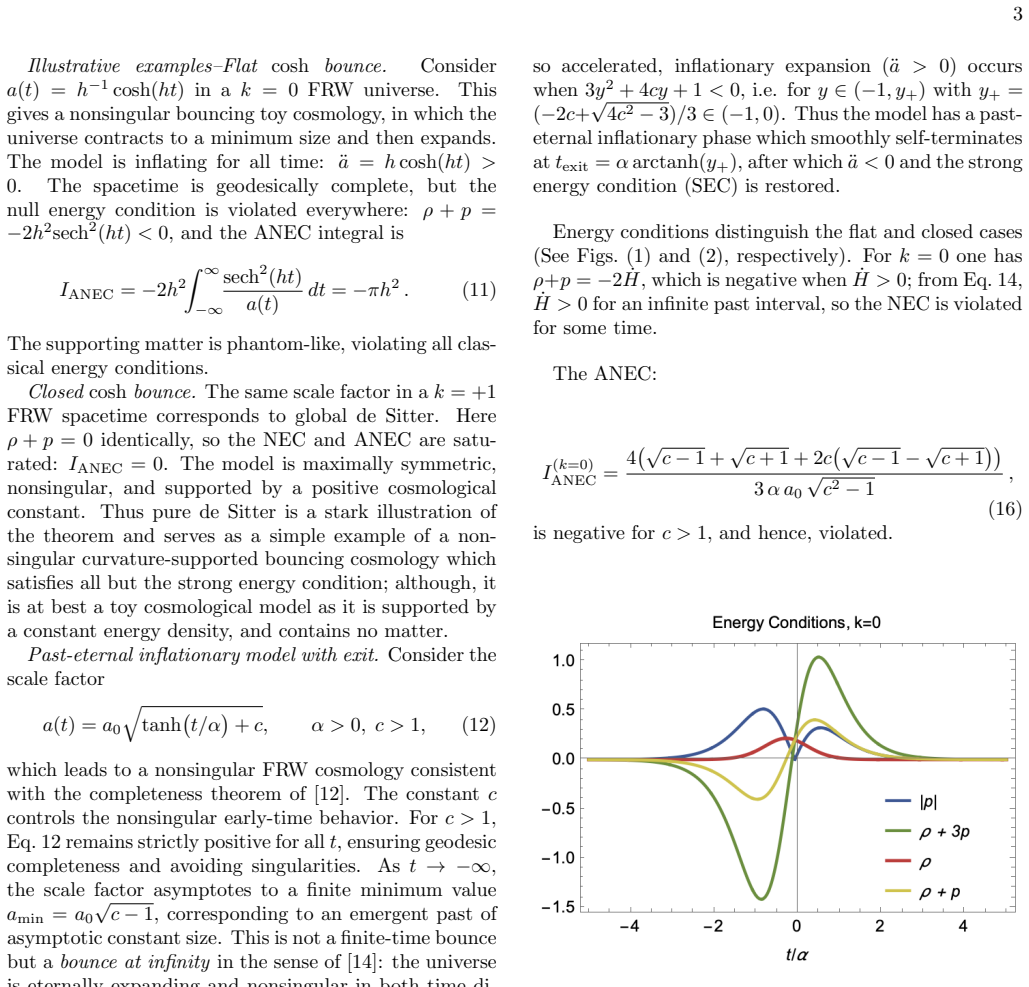
The spacetime is geodesically complete, but the null energy condition is violated everywhere:ρ+p= −2h2sech2(ht)<0, and the ANEC integral is IANEC =−2h 2 Z ∞ −∞ sech2(ht) a(t) dt=−πh 2 .(11) The supporting matter is phantom-like, violating all clas- sical energy conditions. Closedcoshbounce.The same scale factor in ak= +1 FRW spacetime corresponds to globa...
-
[2]
Penrose, Gravitational collapse and space-time singu- larities, Phys
R. Penrose, Gravitational collapse and space-time singu- larities, Phys. Rev. Lett.14, 57 (1965)
work page 1965
-
[3]
Hawking, The Occurrence of singularities in cosmol- ogy, Proc
S. Hawking, The Occurrence of singularities in cosmol- ogy, Proc. Roy. Soc. Lond. A294, 511 (1966)
work page 1966
-
[4]
Hawking, The Occurrence of singularities in cosmol- ogy
S. Hawking, The Occurrence of singularities in cosmol- ogy. II, Proc. Roy. Soc. Lond. A295, 490 (1966)
work page 1966
-
[5]
Hawking, The occurrence of singularities in cosmology
S. Hawking, The occurrence of singularities in cosmology. III. Causality and singularities, Proc. Roy. Soc. Lond. A 300, 187 (1967)
work page 1967
-
[6]
S. W. Hawking and R. Penrose, The Singularities of grav- itational collapse and cosmology, Proc. Roy. Soc. Lond. A314, 529 (1970)
work page 1970
-
[7]
S. W. Hawking and G. F. R. Ellis,The Large Scale Struc- ture of Space-Time, Cambridge Monographs on Mathe- matical Physics (Cambridge University Press, 2023)
work page 2023
-
[8]
Inflationary spacetimes are not past-complete
A. Borde, A. H. Guth, and A. Vilenkin, Inflationary space-times are incompletein past directions, Phys. Rev. Lett.90, 151301 (2003), arXiv:gr-qc/0110012
work page internal anchor Pith review Pith/arXiv arXiv 2003
- [9]
-
[10]
G. Geshnizjani, E. Ling, and J. Quintin, On the initial singularity and extendibility of flat quasi-de Sitter space- times, JHEP10, 182, arXiv:2305.01676 [gr-qc]
-
[11]
G. F. R. Ellis and R. Maartens, The emergent universe: Inflationary cosmology with no singularity, Class. Quant. Grav.21, 223 (2004), arXiv:gr-qc/0211082
work page internal anchor Pith review Pith/arXiv arXiv 2004
-
[12]
G. F. R. Ellis, J. Murugan, and C. G. Tsagas, The Emer- gent universe: An Explicit construction, Class. Quant. Grav.21, 233 (2004), arXiv:gr-qc/0307112
work page internal anchor Pith review Pith/arXiv arXiv 2004
- [13]
- [14]
- [15]
-
[16]
R. M. Wald and U. Yurtsever, General proof of the av- eraged null energy condition for a massless scalar field in two-dimensional curved space-time, Phys. Rev. D44, 403 (1991)
work page 1991
-
[17]
C. J. Fewster, K. D. Olum, and M. J. Pfenning, Aver- aged null energy condition in spacetimes with boundaries, Phys. Rev. D75, 025007 (2007), arXiv:gr-qc/0609007
work page internal anchor Pith review Pith/arXiv arXiv 2007
-
[18]
Achronal averaged null energy condition
N. Graham and K. D. Olum, Achronal averaged null energy condition, Phys. Rev. D76, 064001 (2007), arXiv:0705.3193 [gr-qc]
work page internal anchor Pith review Pith/arXiv arXiv 2007
-
[19]
A. C. Wall, Proving the Achronal Averaged Null Energy Condition from the Generalized Second Law, Phys. Rev. D81, 024038 (2010), arXiv:0910.5751 [gr-qc]
work page internal anchor Pith review Pith/arXiv arXiv 2010
-
[20]
Averaged Null Energy Condition from Causality
T. Hartman, S. Kundu, and A. Tajdini, Averaged Null Energy Condition from Causality, JHEP07, 066, arXiv:1610.05308 [hep-th]
work page internal anchor Pith review Pith/arXiv arXiv
- [21]
-
[22]
DESI DR2 Results II: Measurements of Baryon Acoustic Oscillations and Cosmological Constraints
M. Abdul Karimet al.(DESI), DESI DR2 results. II. Measurements of baryon acoustic oscillations and cos- mological constraints, Phys. Rev. D112, 083515 (2025), arXiv:2503.14738 [astro-ph.CO]
work page internal anchor Pith review Pith/arXiv arXiv 2025
-
[23]
Planck 2018 results. VI. Cosmological parameters
N. Aghanimet al.(Planck), Planck 2018 results. VI. Cosmological parameters, Astron. Astrophys.641, A6 (2020), [Erratum: Astron.Astrophys. 652, C4 (2021)], arXiv:1807.06209 [astro-ph.CO]
work page internal anchor Pith review Pith/arXiv arXiv 2018
-
[24]
R. R. Caldwell, A Phantom menace?, Phys. Lett. B545, 23 (2002), arXiv:astro-ph/9908168
work page internal anchor Pith review Pith/arXiv arXiv 2002
-
[25]
R. R. Caldwell, M. Kamionkowski, and N. N. Weinberg, Phantom energy and cosmic doomsday, Phys. Rev. Lett. 91, 071301 (2003), arXiv:astro-ph/0302506
work page internal anchor Pith review Pith/arXiv arXiv 2003
- [26]
-
[27]
Can dark energy evolve to the Phantom?
A. Vikman, Can dark energy evolve to the phantom?, Phys. Rev. D71, 023515 (2005), arXiv:astro-ph/0407107
work page internal anchor Pith review Pith/arXiv arXiv 2005
-
[28]
Dynamical Dark Energy or Simply Cosmic Curvature?
C. Clarkson, M. Cortes, and B. A. Bassett, Dynamical Dark Energy or Simply Cosmic Curvature?, JCAP08, 011, arXiv:astro-ph/0702670
work page internal anchor Pith review Pith/arXiv arXiv
discussion (0)
Sign in with ORCID, Apple, or X to comment. Anyone can read and Pith papers without signing in.