SpeechLLM-as-Judges: Towards General and Interpretable Speech Quality Evaluation
Pith reviewed 2026-05-18 06:21 UTC · model grok-4.3
The pith
Large language models can evaluate synthetic speech quality with structured explanations across tasks and languages when trained on a dedicated dataset.
A machine-rendered reading of the paper's core claim, the machinery that carries it, and where it could break.
Core claim
SQ-LLM is a speech-quality-aware large language model trained with chain-of-thought reasoning and reward optimization on the SpeechEval dataset; it performs structured evaluation with explanations on quality assessment, pairwise comparison, improvement suggestion, and deepfake detection, achieving strong performance across multiple tasks and languages.
What carries the argument
SQ-LLM, the speech-quality-aware LLM that uses chain-of-thought reasoning and reward optimization to produce explanation-based judgments from the SpeechEval training data.
If this is right
- Speech quality evaluation can shift from scalar scores to natural language explanations that include improvement suggestions.
- The same model handles quality assessment, pairwise comparison, improvement suggestion, and deepfake detection without separate systems.
- Evaluation generalizes across multiple languages using one trained model.
- Generative speech systems receive more actionable feedback during development.
Where Pith is reading between the lines
- This evaluation style could close the loop in speech synthesis pipelines by feeding explanations back into model training.
- Similar LLM-judge methods might apply to assessing music generation or other audio content beyond speech.
- Performance on entirely new speech synthesis techniques outside the current dataset remains an open test of generality.
Load-bearing premise
The human annotations collected for the SpeechEval dataset reliably capture perceptual quality judgments across the four tasks and multiple languages.
What would settle it
New human ratings on the same speech clips that consistently diverge from SQ-LLM outputs on a fresh set of languages or generation methods would show the performance does not generalize as claimed.
Figures




read the original abstract
Generative speech technologies are progressing rapidly, but evaluating the perceptual quality of synthetic speech remains a core challenge. Existing methods typically rely on scalar scores or binary decisions, which lack interpretability and generalization across tasks and languages. We present SpeechLLM-as-Judges, a new paradigm for enabling large language models (LLMs) to conduct structured and explanation-based speech quality evaluation. To support this direction, we introduce SpeechEval, a large-scale dataset containing 32,207 multilingual speech clips and 128,754 annotations spanning four tasks: quality assessment, pairwise comparison, improvement suggestion, and deepfake detection. Based on this resource, we develop SQ-LLM, a speech-quality-aware LLM trained with chain-of-thought reasoning and reward optimization to improve capability. Experimental results show that SQ-LLM delivers strong performance across tasks and languages, revealing the potential of this paradigm for advancing speech quality evaluation. The relevant code, models, and data are publicly available at https://github.com/NKU-HLT/SpeechLLM-as-Judges.
Editorial analysis
A structured set of objections, weighed in public.
Referee Report
Summary. The manuscript proposes the SpeechLLM-as-Judges paradigm for structured, explanation-based speech quality evaluation using LLMs. It introduces the SpeechEval dataset containing 32,207 multilingual speech clips and 128,754 annotations across four tasks (quality assessment, pairwise comparison, improvement suggestion, and deepfake detection), and develops SQ-LLM by adapting an LLM with chain-of-thought reasoning and reward optimization. The central claim is that SQ-LLM achieves strong performance across tasks and languages.
Significance. If the human annotations prove reliable, this work could advance interpretable alternatives to scalar metrics such as MOS or PESQ, especially for multilingual and multi-task speech evaluation. The public release of code, models, and data supports reproducibility and is a clear strength.
major comments (3)
- [§3] §3 (Dataset): No inter-annotator agreement statistics (e.g., Krippendorff’s alpha or pairwise agreement rates) are reported for the 128,754 annotations. This is load-bearing because the reliability of these labels directly determines the validity of both the reward optimization and the performance claims for SQ-LLM.
- [§5] §5 (Experiments): The results assert strong performance across tasks and languages but supply no quantitative metrics, baseline comparisons (e.g., against PESQ, MOS predictors, or prior LLM judges), statistical tests, or ablation studies isolating the contribution of chain-of-thought and reward optimization.
- [Methods] Methods: No details are given on annotation guidelines, rater screening procedures, or any post-hoc correlation of SpeechEval labels with established objective metrics (PESQ, STOI, or human MOS) to validate consistency across languages and tasks.
minor comments (1)
- [Abstract] Abstract: The phrase “strong performance” is used without any supporting numbers; adding one or two key quantitative highlights would improve the summary.
Simulated Author's Rebuttal
We thank the referee for their valuable comments, which help improve the clarity and rigor of our work. Below, we provide detailed responses to each major comment and indicate the revisions we will make to the manuscript.
read point-by-point responses
-
Referee: [§3] §3 (Dataset): No inter-annotator agreement statistics (e.g., Krippendorff’s alpha or pairwise agreement rates) are reported for the 128,754 annotations. This is load-bearing because the reliability of these labels directly determines the validity of both the reward optimization and the performance claims for SQ-LLM.
Authors: We fully agree that inter-annotator agreement is crucial for establishing the reliability of the SpeechEval dataset. Although not reported in the initial submission, we have since computed these statistics on the annotations. In the revised manuscript, we will report Krippendorff’s alpha values (which indicate substantial agreement) and pairwise agreement rates for each task. This addition will directly support the validity of our reward optimization and performance claims. revision: yes
-
Referee: [§5] §5 (Experiments): The results assert strong performance across tasks and languages but supply no quantitative metrics, baseline comparisons (e.g., against PESQ, MOS predictors, or prior LLM judges), statistical tests, or ablation studies isolating the contribution of chain-of-thought and reward optimization.
Authors: We appreciate this observation and acknowledge that the experimental section would benefit from greater detail. In the revision, we will include specific quantitative metrics such as accuracy and correlation coefficients for each task and language. We will add comparisons to relevant baselines including PESQ, traditional MOS predictors, and existing LLM judges. Additionally, we will report statistical tests (e.g., paired t-tests) and ablation studies demonstrating the impact of chain-of-thought reasoning and reward optimization on SQ-LLM's performance. revision: yes
-
Referee: [Methods] Methods: No details are given on annotation guidelines, rater screening procedures, or any post-hoc correlation of SpeechEval labels with established objective metrics (PESQ, STOI, or human MOS) to validate consistency across languages and tasks.
Authors: We agree that providing these details is essential for reproducibility and validation. We will expand the Methods section to include the full annotation guidelines used for each task, the criteria and procedures for screening and selecting raters (including any qualification tests), and post-hoc correlation analyses between SpeechEval annotations and objective metrics such as PESQ, STOI, as well as available human MOS scores. These correlations will be presented across languages and tasks to demonstrate consistency. revision: yes
Circularity Check
No significant circularity; derivation rests on new data and standard adaptation
full rationale
The paper collects a new multilingual dataset (SpeechEval) with 128,754 annotations across four tasks, then trains SQ-LLM via chain-of-thought and reward optimization on that resource. Experimental performance is reported on the resulting model without any quoted step that reduces a claimed prediction or uniqueness result to a fitted parameter, self-citation chain, or definitional tautology. No equations or load-bearing premises in the abstract or described structure equate outputs to inputs by construction; the central claim therefore remains independent of the patterns that would trigger a positive circularity finding.
Axiom & Free-Parameter Ledger
axioms (1)
- domain assumption Human annotations on speech quality can be collected at scale and used as reliable training signals for LLMs.
Lean theorems connected to this paper
-
IndisputableMonolith/Cost/FunctionalEquationwashburn_uniqueness_aczel unclear?
unclearRelation between the paper passage and the cited Recognition theorem.
We introduce SpeechEval, a large-scale dataset containing 32,207 multilingual speech clips and 128,754 annotations spanning four tasks: quality assessment, pairwise comparison, improvement suggestion, and deepfake detection.
-
IndisputableMonolith/Foundation/AlphaCoordinateFixationJ_uniquely_calibrated_via_higher_derivative unclear?
unclearRelation between the paper passage and the cited Recognition theorem.
We define a joint training objective that encourages the model to produce accurate intermediate scores and coherent explanations. Formally, the overall loss is defined as: L=λ ∑ L(i)_dim + L_ans
What do these tags mean?
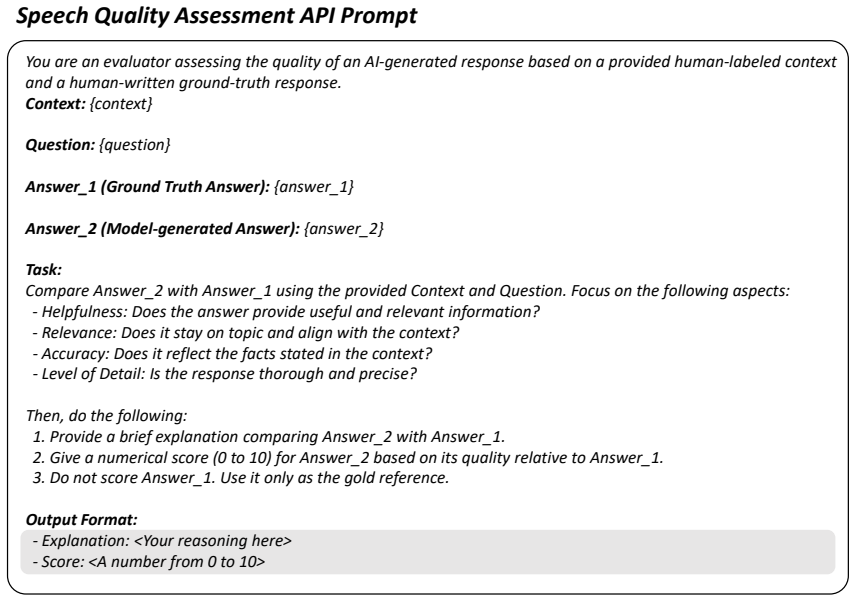
- matches
- The paper's claim is directly supported by a theorem in the formal canon.
- supports
- The theorem supports part of the paper's argument, but the paper may add assumptions or extra steps.
- extends
- The paper goes beyond the formal theorem; the theorem is a base layer rather than the whole result.
- uses
- The paper appears to rely on the theorem as machinery.
- contradicts
- The paper's claim conflicts with a theorem or certificate in the canon.
- unclear
- Pith found a possible connection, but the passage is too broad, indirect, or ambiguous to say the theorem truly supports the claim.
Forward citations
Cited by 3 Pith papers
-
NVBench: A Benchmark for Speech Synthesis with Non-Verbal Vocalizations
NVBench provides a standardized bilingual benchmark and evaluation protocol for assessing non-verbal vocalization generation, placement, and salience in text-to-speech systems.
-
JASTIN: Aligning LLMs for Zero-Shot Audio and Speech Evaluation via Natural Language Instructions
JASTIN is an instruction-driven audio evaluation system that achieves state-of-the-art correlation with human ratings on speech, sound, music, and out-of-domain tasks without task-specific retraining.
-
TTS-PRISM: A Perceptual Reasoning and Interpretable Speech Model for Fine-Grained Diagnosis
TTS-PRISM defines a 12-dimensional perceptual schema, builds a targeted diagnostic dataset via adversarial synthesis and expert labels, and tunes an end-to-end model that outperforms generalist LLMs in human alignment...
Reference graph
Works this paper leans on
-
[1]
Qwen2-audio technical report.arXiv preprint arXiv: 2407.10759. Erica Cooper and Junichi Yamagishi. 2021. How do voices from past speech synthesis challenges com- pare today?arXiv preprint arXiv:2105.02373. DeepSeek-AI. 2025. Deepseek-r1: Incentivizing rea- soning capability in llms via reinforcement learning. Preprint, arXiv:2501.12948. Michael Denkowski ...
work page internal anchor Pith review Pith/arXiv arXiv 2021
-
[2]
End-to-end anti-spoofing with rawnet2. InICASSP 2021-2021 IEEE International Confer- ence on Acoustics, Speech and Signal Processing (ICASSP), pages 6369–6373. IEEE. 10 Takaaki Saeki and Detai Xin and Wataru Nakata and Tomoki Koriyama and Shinnosuke Takamichi and Hi- roshi Saruwatari. 2022. UTMOS: UTokyo-SaruLab System for V oiceMOS Challenge 2022. InInte...
-
[3]
Uncertainty-Aware Mean Opinion Score Pre- diction. InInterspeech 2024, pages 1215–1219. Siyin Wang, Wenyi Yu, Xianzhao Chen, Xiaohai Tian, Jun Zhang, Lu Lu, Yu Tsao, Junichi Yamagishi, Yux- uan Wang, and Chao Zhang. 2025c. QualiSpeech: A speech quality assessment dataset with natural lan- guage reasoning and descriptions. InProceedings of the 63rd Annual ...
work page internal anchor Pith review Pith/arXiv arXiv 2024
-
[4]
Overall Quality Score: 2
-
[5]
Production Quality Intelligibility Score: 2 Distortion Score: 2 Distortion Type: background noise;timbre & quality Distortion Duration: appeared between 0 s - 5 s (across entire recording) Distortion Degree: Noticeable Distortion Description: rough and hissing Speech Rate: suitable Dynamic Range Score: 3
-
[6]
Content Enjoyment Emotional Impact Score: 2 Emotional Type: Neutral Artistic Expression Score:2 Subjective Experience Score:2 Gender: female Age: middle-aged Tone Description: The voice sounds rough and hissing
-
[7]
Detailed Description The speech has significant quality issues, falling short in clarity and naturalness. Objectively, intelligibility is poor, with noticeable background noise and timbre distortion throughout the 0-5 s duration, creating a rough, hissing effect. The speech rate is suitable, and dynamics are moderately consistent. Subjectively, the female...
-
[9]
The speech exhibits considerable quality shortcomings, primarily in clarity and natural delivery. From an objective standpoint, intelligibility is subpar, with audible background noise and timbre distortion spanning the 0-5 second range, producing a coarse, sibilant effect. The speech rate is well-paced, and dynamic consistency is moderate. Subjectively, ...
-
[10]
The speech has clear quality issues, struggling with both clarity and natural flow. Objectively, it’s hard to understand due toconstant background noise and a distorted tone (0-5s), which adds a rough, hissing quality. The speed is good, and the volume changes are fairly even. Subjectively, the middle-aged female voice sounds flat and unemotional, failing...
-
[11]
Objective Evaluation Score: 5
-
[12]
Production Quality Intelligibility Score: 5 Distortion Score:5 Distortion Type: None Distortion Duration: None Distortion Degree: None Distortion Description: None Speech Rate: suitable Dynamic Range Score: 4
-
[13]
Content Enjoyment Emotional Impact Score: 4 Emotional Type: Surprise Artistic Expression Score:4 Subjective Experience Score:5 Gender: male Age: middle-aged Tone Description: The voice sounds bright and full
-
[14]
Detailed Description The speech demonstrates excellent overall quality, delivering a highly polished performance. Objectively, it excels in intelligibility and lacks any distortion, with a suitable speech rate and smooth dynamics, though volume consistency could be slightly improved. From a subjective perspective, the male middle-aged speaker conveys a br...
-
[16]
The speech exhibits outstanding quality, presenting a refined and professional delivery. Objectively, it achieves high intelligibility with no distortion, maintaining an appropriate pace and fluid dynamics, though minor volume fluctuations could be addressed. Subjectively, the middle- aged male speaker projects a vibrant, resonant tone infused with a hint...
-
[17]
This speech is of exceptional quality, showcasing a polished and articulate performance. On a technical level, clarity is excellent, with no audible distortion, and the pacing and flow are well-managed, though slight volume adjustments could enhance consistency. From a listener’s perspective, the speaker— a middle-aged man— delivers a warm, rich tone with...
-
[18]
This speech demonstrates remarkable quality, featuring a highly professional and engaging delivery. Technically, it offers excellent intelligibility without distortion, with a well-modulated speech rate and smooth dynamics, though volume uniformity could be fine-tuned. From a subjective standpoint, the middle-aged male speaker’s lively, well-rounded tone,...
-
[19]
Overall Quality A is better than B
-
[20]
Speech Rate: A and B are similar in this aspect Dynamic Range: A and B are similar in this aspect
Production quality Intelligibility: A is better than B Distortion: A is better than B A Type: None Duration: None Degree: None Description: None B Type: timbre & quality Duration: 0 -3.7s (throughout the recording) Degree: extremely slight Description: Extremely slight rough. Speech Rate: A and B are similar in this aspect Dynamic Range: A and B are simil...
-
[21]
Content Enjoyment Emotional Impact: A and B are similar in this aspect A Type: Surprise B Type: Neutral Artistic Expression: A and B are similar in this aspect Subjective Experience: A and B are similar in this aspect A Gender: female Age: middle-aged Tone Description: crisp and bright B Gender: male Age: middle-aged Tone Description: mellow and full
-
[22]
Detailed Description Overall, Sample A demonstrates superior quality compared to Sample B. Objectively, Sample A excels in intelligibility, with clearer speech and no reported distortions, while Sample B exhibits an extremely slight timbre and quality distortion (0–3.7 s), perceived as a faint roughness. Both samples share similar speech rates and dynamic...
-
[24]
In this comparison, Sample A emerges as the stronger performer. From an objective standpoint, Sample A delivers clearer speech with no distortions, whereas Sample B has a subtle roughness in timbre (0– 3.7s). Both samples maintain similar speech rates and dynamic ranges. Subjectively, their emotional impact (Sample A: surprise; Sample B: neutral), artisti...
-
[25]
Overall Quality A and B are similar in this aspect
-
[26]
Production quality Intelligibility: A and B are similar in this aspect Distortion: A and B are similar in this aspect A Type: artifacts Duration: 0 -5s(throughout) Degree: slight Description: The sound is a little distorted. B Type: background noise Duration: 0 -5s(throughout) Degree: slight Description: The sound has a slight background noise. Speech Rat...
-
[27]
B Gender: female Age: 22s Tone Description: low and hollow
Content Enjoyment Emotional Impact: A is better than B A Type: Neutral B Type: Neutral Artistic Expression: A and B are similar in this aspect Subjective Experience: A is better than B A Gender: female Age: 25s Tone Description: clear and light. B Gender: female Age: 22s Tone Description: low and hollow
-
[28]
Detailed Description Overall, Samples A and B demonstrate comparable quality, though subtle differences exist in technical and subjective aspects. Objectively, both samples exhibit similar intelligibility and dynamic range, but Sample A has a slight artifact distortion (0-5 s, slight degree), slightly affecting clarity, while Sample B has faint background...
-
[30]
While Samples A and B share many technical similarities, subtle distinctions influence their overall quality. Both exhibit strong intelligibility and dynamic range, but Sample A has minimal artifact distortion (0-5 s), slightly reducing clarity, whereas Sample B contains faint background noise (0-5 s). Sample A’s well-paced speech enhances understanding. ...
-
[31]
A comparative analysis reveals that Samples A and B are closely matched in quality, differing only in subtle ways. Objectively, intelligibility and dynamic range are equivalent, though Sample A has faint artifact distortion (0-5 s), and Sample B contains minimal background noise (0-5 s). Sample A’s optimal speech rate improves listener comprehension. Subj...
-
[32]
Improvement Dimensions expressiveness;speech rate
-
[33]
Improve expressiveness by incorporating emotional variation and tonal dynamics
Detailed Description Adjust the speech rate to a more natural pace to enhance clarity. Improve expressiveness by incorporating emotional variation and tonal dynamics
-
[35]
Enhance expressiveness through varied intonation and emotional inflection
Moderate the speech rate for better naturalness and comprehension. Enhance expressiveness through varied intonation and emotional inflection. Minimize distortion to achieve cleaner, more lifelike speech output
-
[36]
Incorporate more dynamic vocal expression to enhance engagement
Fine-tune the speech rate to improve naturalness and listener comfort. Incorporate more dynamic vocal expression to enhance engagement. Eliminate distortion artifacts for a cleaner and more polished output
-
[37]
Enhance vocal expressiveness through varied pitch and emotional modulation
Adjust the speech rate to a more natural and listener-friendly tempo. Enhance vocal expressiveness through varied pitch and emotional modulation. Reduce distortion to ensure smoother and more intelligible speech
-
[38]
Improvement Dimensions expressiveness;emotional impact;noise reduction
-
[39]
Reduce background noise for cleaner audio quality
Detailed Description Enhance emotional expressiveness to make the delivery more engaging. Reduce background noise for cleaner audio quality. Adjust speech rate to a more natural pace while maintaining clarity
-
[41]
Eliminate background noise for improved clarity
Incorporate greater emotional variation to enhance engagement. Eliminate background noise for improved clarity. Slightly increase the speech rate for a more natural flow without sacrificing intelligibility
-
[42]
Clean up background noise for optimal audio clarity
Strengthen emotional expression to make the speech more captivating. Clean up background noise for optimal audio clarity. Adjust the speech rate to a more natural tempo while preserving intelligibility
-
[43]
Improvement Dimensions dynamic range;intelligibility
-
[44]
Improve dynamic range consistency for smoother volume transitions
Detailed Description Enhance intelligibility by reducing voice drops and missing segments. Improve dynamic range consistency for smoother volume transitions
-
[46]
Stabilize dynamic range for more uniform volume transitions
Minimize voice dropouts and missing segments to enhance intelligibility. Stabilize dynamic range for more uniform volume transitions. Refine distortion management to reduce speech interruptions
-
[47]
Adjust dynamic range for steadier volume levels
Address voice gaps and dropouts to improve intelligibility. Adjust dynamic range for steadier volume levels. Optimize distortion control to ensure smoother speech continuity
-
[48]
Fine-tune dynamic range to achieve smoother audio transitions
Reduce speech dropouts and missing segments for better intelligibility. Fine-tune dynamic range to achieve smoother audio transitions. Enhance distortion mitigation to prevent speech breaks. Figure 12: Suggestion example for improving a low-quality speech sample
-
[49]
Improvement Dimensions emotional impact;frequency balance;intelligibility
-
[50]
Adjust frequency balance to improve voice clarity
Detailed Description Enhance emotional expressiveness to engage listeners. Adjust frequency balance to improve voice clarity. Optimize intelligibility for better comprehension
-
[52]
Adjust tonal balance to refine voice clarity
Increase emotional variation to enhance engagement. Adjust tonal balance to refine voice clarity. Boost intelligibility for better listener comprehension
-
[53]
Optimize frequency distribution for improved clarity
Incorporate more expressive vocal modulation. Optimize frequency distribution for improved clarity. Strengthen intelligibility to aid listener perception
-
[54]
Modify frequency settings to enhance voice clarity
Add more dynamic vocal expression to engage the audience. Modify frequency settings to enhance voice clarity. Increase intelligibility for smoother listener comprehension
-
[55]
Improvement Dimensions None
-
[56]
Detailed Description No specific improvements are needed as the speech performs optimally across all evaluated dimensions
-
[58]
No immediate enhancements are required, as the speech excels in every assessed aspect
-
[59]
Improvement Dimensions Expressiveness
-
[60]
Detailed Description To enhance expressiveness: Incorporate subtle vocal inflections to add emotional depth adjust pacing slightly to emphasize key phrases for greater engagement
-
[61]
Alternative Description
-
[62]
Fine-tune pacing to highlight important phrases for better engagement
To improve expressiveness: Introduce gentle vocal modulations to enrich emotional tone. Fine-tune pacing to highlight important phrases for better engagement. Vary pitch subtly to prevent a monotonous effect
-
[63]
Adjust rhythm slightly to underscore key moments
To enhance expressiveness: Employ subtle pitch variations to inject emotional depth. Adjust rhythm slightly to underscore key moments. Experiment with tonal shifts to prevent a flat presentation
-
[64]
To refine expressiveness: Integrate delicate vocal inflections for emotional texture. Optimize pacing to draw attention to pivotal phrases. Vary tone slightly to avoid a monotonous effect. Figure 13: Suggestion example for refining a high-quality speech sample. 16 Sub-dimensions Annotation Criteria Overall Quality 1 point (Extremely Poor)Basic standard fo...
-
[65]
G ive a numerical score (0 to 10) for Answer_2 based on its quality relative to Answer_1
-
[66]
D o not score Answer_1. Use it only as the gold reference. Output Format: - Explanation: <Your reasoning here> - Score: <A number from 0 to 10> Speech Quality Assessment API Prompt Figure 18: Speech Quality Assessment API Prompt. Task: Evaluate the following synthesized speech based on the eight dimensions below. For each dimension, provide a score from 1...
discussion (0)
Sign in with ORCID, Apple, or X to comment. Anyone can read and Pith papers without signing in.