Control of dynamical phase transitions and non-ergodic relaxation via spinor phases
Pith reviewed 2026-05-18 00:48 UTC · model grok-4.3
The pith
Extracting spinor phase evolution from population dynamics defines an order parameter that identifies dynamical phase transitions.
A machine-rendered reading of the paper's core claim, the machinery that carries it, and where it could break.
Core claim
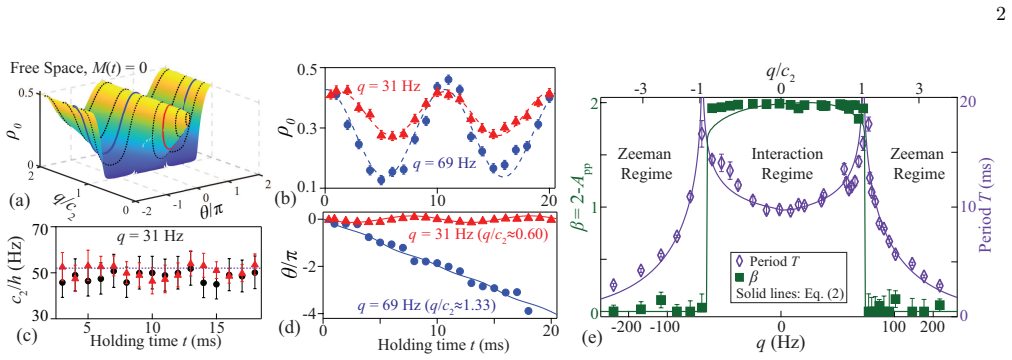
Utilizing ultracold spinor gases as large-scale many-body quantum simulation platforms, we establish a toolbox for the precise control, characterization, and detection of nonequilibrium dynamics via internal spinor phases. We develop a method to extract the phase evolution from the observed spin population dynamics, allowing us to define an order parameter that sharply identifies dynamical phase transitions over a wide range of conditions. This work also demonstrates a technique for inferring spin-dependent interactions from a single experimental time trace, in contrast to the standard approach that requires mapping a cross section of the phase diagram. Additionally, we demonstrate access to
What carries the argument
Method that extracts internal spinor phase evolution from observed spin population dynamics to define an order parameter for dynamical phase transitions.
Load-bearing premise
Spin population dynamics directly encode the internal spinor phase evolution without significant contributions from decoherence, higher-order interactions, or experimental imperfections.
What would settle it
Independent phase measurement that disagrees with the phase extracted from populations, or an order parameter that fails to mark known transitions when controlled decoherence is added.
Figures


read the original abstract
Utilizing ultracold spinor gases as large-scale, many-body quantum simulation platforms, we establish a toolbox for the precise control, characterization, and detection of nonequilibrium dynamics via internal spinor phases. We develop a method to extract the phase evolution from the observed spin population dynamics, allowing us to define an order parameter that sharply identifies dynamical phase transitions over a wide range of conditions. This work also demonstrates a technique for inferring spin-dependent interactions from a single experimental time trace, in contrast to the standard approach that requires mapping a cross section of the phase diagram, with immediate applications to systems experiencing complex time-dependent interactions. Additionally, we demonstrate experimental access to and control over non-ergodic relaxation dynamics, where states of similar energy in the (nominally) thermal region of the energy spectrum retain a dependence on the initial state, via the manipulation of spinor phases, enabling the study of non-ergodic thermalization dynamics connected to quantum scarring.
Editorial analysis
A structured set of objections, weighed in public.
Referee Report
Summary. The paper develops a method to extract the time evolution of internal spinor phases by inverting observed spin-population dynamics in ultracold spinor gases. This extracted phase is used to construct an order parameter that sharply locates dynamical phase transitions across a range of conditions. The work further shows that spin-dependent interaction strengths can be inferred from a single experimental time trace and demonstrates experimental control of non-ergodic relaxation dynamics by manipulating the initial spinor phases.
Significance. If the extraction procedure is robust, the approach supplies a practical toolbox for characterizing and controlling nonequilibrium many-body dynamics in quantum simulators. The single-trace inference of interactions is a clear practical advance over conventional cross-section mapping of the phase diagram. Experimental access to non-ergodic relaxation and its connection to quantum scarring is a notable strength that opens concrete routes to studying scarring and weak ergodicity breaking.
major comments (2)
- [Methods / phase-extraction section] The phase-extraction procedure (described in the methods and illustrated in the main figures) inverts population oscillations under the assumption that the dynamics are governed solely by the quadratic Zeeman shift and the spin-dependent contact interaction. No quantitative test is presented against simulated decoherence, magnetic-field fluctuations, or three-body losses that would produce additional population transfer; such unmodeled processes would be misattributed to phase winding and could shift or blur the reported order-parameter jumps at the dynamical transition points.
- [Results on dynamical phase transitions] The claim that the order parameter 'sharply identifies' dynamical phase transitions rests on the extracted phase being faithful to the underlying spinor evolution. The manuscript provides no error propagation, comparison to exact diagonalization for small systems, or robustness checks against the weakest assumption (closed-system dynamics), which is load-bearing for the central result.
minor comments (2)
- [Figure captions] Figure captions should explicitly state the fitting window, the functional form used for the phase inversion, and the experimental parameters (magnetic field, atom number, trap frequencies) for each time trace.
- [Notation] Notation for the relative phases between m_F components and the definition of the order parameter should be introduced once and used consistently in both text and equations.
Simulated Author's Rebuttal
We thank the referee for the careful reading and constructive feedback on our manuscript. The comments raise valid points about the robustness of the phase-extraction procedure and supporting evidence for the order parameter. We address each major comment below and will revise the manuscript to incorporate the suggested analyses.
read point-by-point responses
-
Referee: [Methods / phase-extraction section] The phase-extraction procedure (described in the methods and illustrated in the main figures) inverts population oscillations under the assumption that the dynamics are governed solely by the quadratic Zeeman shift and the spin-dependent contact interaction. No quantitative test is presented against simulated decoherence, magnetic-field fluctuations, or three-body losses that would produce additional population transfer; such unmodeled processes would be misattributed to phase winding and could shift or blur the reported order-parameter jumps at the dynamical transition points.
Authors: We agree that quantitative tests against unmodeled processes would strengthen the presentation of the phase-extraction method. Although the coherent dynamics in the reported experiments are dominated by the quadratic Zeeman shift and spin-dependent contact interactions, we will add a dedicated subsection to the Methods section containing numerical simulations that incorporate phenomenological decoherence, Gaussian magnetic-field fluctuations, and three-body loss rates calibrated to typical experimental values. These simulations will show that the extracted phases and order-parameter features remain stable for noise amplitudes below those present in the data, thereby addressing the concern that such effects could be misattributed to phase winding. revision: yes
-
Referee: [Results on dynamical phase transitions] The claim that the order parameter 'sharply identifies' dynamical phase transitions rests on the extracted phase being faithful to the underlying spinor evolution. The manuscript provides no error propagation, comparison to exact diagonalization for small systems, or robustness checks against the weakest assumption (closed-system dynamics), which is load-bearing for the central result.
Authors: We acknowledge that additional validation would make the central claim more robust. In the revised manuscript we will include a quantitative error-propagation analysis that propagates experimental uncertainties in the measured populations through the inversion procedure to the extracted phase and order parameter. We will also add comparisons of the phase-extraction method against exact diagonalization for small, few-mode spinor systems where such calculations are feasible, as well as robustness checks that introduce controlled violations of the closed-system assumption (e.g., weak loss channels) and demonstrate that the locations of the dynamical transitions remain identifiable. These results will be presented in the Results section and the Methods. revision: yes
Circularity Check
No significant circularity in phase extraction or order parameter definition
full rationale
The central method extracts phase evolution directly from observed spin population dynamics using the known spinor Hamiltonian terms (quadratic Zeeman and spin-dependent interactions) to define an order parameter for dynamical phase transitions. This is presented as a data-driven inversion grounded in experimental time traces, with no reduction by construction to fitted inputs, self-definitional loops, or load-bearing self-citations. The derivation chain remains self-contained against external benchmarks of ultracold spinor dynamics, consistent with the abstract's description of a toolbox for control and detection without invoking uniqueness theorems or ansatze from prior author work as the sole justification.
Axiom & Free-Parameter Ledger
Lean theorems connected to this paper
-
IndisputableMonolith/Cost/FunctionalEquation.leanwashburn_uniqueness_aczel unclear?
unclearRelation between the paper passage and the cited Recognition theorem.
We develop a method to extract the phase evolution from the observed spin population dynamics, allowing us to define an order parameter that sharply identifies dynamical phase transitions
-
IndisputableMonolith/Foundation/AbsoluteFloorClosure.leanreality_from_one_distinction unclear?
unclearRelation between the paper passage and the cited Recognition theorem.
the spin dynamics can be described by ρmF, the magnetization M, and a single relative phase θ by the mean-field Hamiltonian
What do these tags mean?
- matches
- The paper's claim is directly supported by a theorem in the formal canon.
- supports
- The theorem supports part of the paper's argument, but the paper may add assumptions or extra steps.
- extends
- The paper goes beyond the formal theorem; the theorem is a base layer rather than the whole result.
- uses
- The paper appears to rely on the theorem as machinery.
- contradicts
- The paper's claim conflicts with a theorem or certificate in the canon.
- unclear
- Pith found a possible connection, but the passage is too broad, indirect, or ambiguous to say the theorem truly supports the claim.
Forward citations
Cited by 3 Pith papers
-
Atomic Interferometry with Spin-Orbit-Coupled Spin-1 Condensates
Raman-dressed spin-orbit-coupled spin-1 condensates enable independent tuning of spin-mixing interactions for entanglement-enhanced interferometry and spatial density-stripe readout of phase.
-
Dynamics of spinor Bose-Einstein condensates close to spin-spatial resonances
A coupled-channel framework based on Bogoliubov modes efficiently describes spinor BEC dynamics near spin-spatial resonances, classifying resonant excitations and showing that beyond-quadratic terms are needed for lon...
-
Detection of Spin-Spatial-Coupling-Induced Dynamical Phase Transitions in Real Time
Real-time detection of dynamical phase transitions in spinor gases is achieved via temporal behaviors of system energy and spinor phases extracted from spin dynamics.
Reference graph
Works this paper leans on
-
[1]
D. M. Stamper-Kurn and M. Ueda, Spinor Bose gases: Symmetries, magnetism, and quantum dynamics, Rev. Mod. Phys. 85, 1191 (2013)
work page 2013
-
[2]
Y. Kawaguchi and M. Ueda, Spinor Bose–Einstein con- densates, Phys. Rep. 520, 253 (2012)
work page 2012
-
[3]
J. Kronj¨ ager, C. Becker, P. Navez, K. Bongs, and K. Seng- stock, Magnetically tuned spin dynamics resonance, Phys. Rev. Lett. 97, 110404 (2006)
work page 2006
-
[4]
Y. Liu, S. Jung, S. E. Maxwell, L. D. Turner, E. Tiesinga, and P. D. Lett, Quantum phase transitions and continuous observation of spinor dynamics in an antiferromagnetic condensate, Phys. Rev. Lett. 102, 125301 (2009)
work page 2009
-
[5]
H. K. Pechkis, J. P. Wrubel, A. Schwettmann, P. F. Griffin, R. Barnett, E. Tiesinga, and P. D. Lett, Spinor dynamics in an antiferromagnetic spin-1 thermal Bose gas, Phys. Rev. Lett. 111, 025301 (2013)
work page 2013
- [7]
-
[8]
J. O. Austin-Harris, Z. N. Hardesty-Shaw, Q. Guan, C. Binegar, D. Blume, R. J. Lewis-Swan, and Y. Liu, Engineering dynamical phase diagrams with driven lat- tices in spinor gases, Phys. Rev. A 109, 043309 (2024)
work page 2024
-
[9]
Z. N. Hardesty-Shaw, Q. Guan, J. O. Austin, D. Blume, R. J. Lewis-Swan, and Y. Liu, Quench-induced nonequi- librium dynamics of spinor gases in a moving lattice, Phys. Rev. A 107, 053311 (2023)
work page 2023
-
[10]
A. T. Black, E. Gomez, L. D. Turner, S. Jung, and P. D. Lett, Spinor dynamics in an antiferromagnetic spin-1 con- densate, Phys. Rev. Lett. 99, 070403 (2007)
work page 2007
-
[11]
L. Zhao, J. Jiang, T. Tang, M. Webb, and Y. Liu, Dynam- ics in spinor condensates tuned by a microwave dressing field, Phys. Rev. A 89, 023608 (2014)
work page 2014
-
[12]
L. Zhao, J. Jiang, T. Tang, M. Webb, and Y. Liu, An- tiferromagnetic spinor condensates in a two-dimensional optical lattice, Phys. Rev. Lett. 114, 225302 (2015)
work page 2015
- [13]
-
[14]
X. He, B. Zhu, X. Li, F. Wang, Z.-F. Xu, and D. Wang, Coherent spin-mixing dynamics in thermal 87Rb spin-1 and spin-2 gases, Phys. Rev. A 91, 033635 (2015)
work page 2015
- [15]
-
[16]
Z. N. Hardesty-Shaw, Q. Guan, J. O. Austin-Harris, D. Blume, R. J. Lewis-Swan, and Y. Liu, Nonlinear mul- tistate tunneling dynamics in a spinor Bose-Einstein con- densate, Phys. Rev. A 108, 053307 (2023)
work page 2023
-
[17]
Z. Chen, T. Tang, J. Austin, Z. Shaw, L. Zhao, and Y. Liu, Quantum quench and nonequilibrium dynamics in lattice-confined spinor condensates, Phys. Rev. Lett. 123, 113002 (2019)
work page 2019
-
[18]
J. O. Austin, Z. Chen, Z. N. Shaw, K. W. Mahmud, and Y. Liu, Quantum critical dynamics in a spinor Hubbard model quantum simulator, Commun. Phys. 4, 61 (2021)
work page 2021
-
[19]
J. O. Austin, Z. N. Shaw, Z. Chen, K. W. Mahmud, and Y. Liu, Manipulating atom-number distributions and detecting spatial distributions in lattice-confined spinor gases, Phys. Rev. A 104, L041304 (2021)
work page 2021
- [20]
-
[21]
J. O. Austin-Harris, I. Rana, S. E. Begg, C. Binegar, T. Bilitewski, and Y. Liu, Observation of ergodicity break- ing and quantum many-body scars in spinor gases, Phys. Rev. Lett. 134, 113401 (2025)
work page 2025
- [22]
-
[23]
Z. Lu, A. M. Graf, E. J. Heller, J. Keski-Rahkonen, and C. B. Dag, Antiscarring from eigenstate stacking in a chaotic spinor condensate, Phys. Rev. A 112, 043307 (2025)
work page 2025
-
[24]
Q. Guan and R. J. Lewis-Swan, Identifying and harness- ing dynamical phase transitions for quantum-enhanced sensing, Phys. Rev. Res. 3, 033199 (2021)
work page 2021
-
[25]
L. Zhou, J. Kong, Z. Lan, and W. Zhang, Dynamical quantum phase transitions in a spinor Bose-Einstein con- 6 densate and criticality enhanced quantum sensing, Phys. Rev. Res. 5, 013087 (2023)
work page 2023
- [26]
-
[27]
E. J. Heller, Bound-state eigenfunctions of classically chaotic Hamiltonian systems: Scars of periodic orbits, Phys. Rev. Lett. 53, 1515 (1984)
work page 1984
-
[28]
C. J. Turner, A. A. Michailidis, D. A. Abanin, M. Serbyn, and Z. Papi´ c, Weak ergodicity breaking from quantum many-body scars, Nature Phys. 14, 745 (2018)
work page 2018
-
[29]
S. Pilatowsky-Cameo, D. Villase˜ nor, M. A. Bastarrachea- Magnani, S. Lerma-Hern´ andez, L. F. Santos, and J. G. Hirsch, Ubiquitous quantum scarring does not prevent ergodicity, Nat. Commun. 12, 852 (2021)
work page 2021
- [30]
- [31]
-
[32]
G.-X. Su, H. Sun, A. Hudomal, J.-Y. Desaules, Z.-Y. Zhou, B. Yang, J. C. Halimeh, Z.-S. Yuan, Z. Papi´ c, and J.-W. Pan, Observation of many-body scarring in a bose- hubbard quantum simulator, Phys. Rev. Res. 5, 023010 (2023)
work page 2023
- [33]
- [34]
-
[35]
A. Pizzi, L.-H. Kwan, B. Evrard, C. B. Dag, and J. Knolle, Genuine quantum scars in many-body spin systems, Na- ture Communications 16, 10.1038/s41467-025-61765-3 (2025)
-
[36]
M. Heyl, A. Polkovnikov, and S. Kehrein, Dynamical quantum phase transitions in the transverse-field ising model, Phys. Rev. Lett. 110, 135704 (2013)
work page 2013
-
[37]
M. Heyl, Dynamical quantum phase transitions: a review, Reports on Progress in Physics 81, 054001 (2018)
work page 2018
-
[38]
S. De Nicola, A. A. Michailidis, and M. Serbyn, Entangle- ment view of dynamical quantum phase transitions, Phys. Rev. Lett. 126, 040602 (2021)
work page 2021
-
[39]
A. Polkovnikov, K. Sengupta, A. Silva, and M. Vengalat- tore, Colloquium: Nonequilibrium dynamics of closed interacting quantum systems, Rev. Mod. Phys. 83, 863 (2011)
work page 2011
-
[40]
L. D’Alessio, Y. Kafri, A. Polkovnikov, and M. Rigol, From quantum chaos and eigenstate thermalization to statistical mechanics and thermodynamics, Adv. Phys. 65, 239 (2016)
work page 2016
-
[41]
J. M. Deutsch, Eigenstate thermalization hypothesis, Rep. Prog. Phys. 81, 082001 (2018)
work page 2018
-
[42]
Ueda, Quantum equilibration, thermalization and prethermalization in ultracold atoms, Nat
M. Ueda, Quantum equilibration, thermalization and prethermalization in ultracold atoms, Nat. Rev. Phys. 2, 669 (2020)
work page 2020
- [43]
-
[44]
D. Bluvstein, H. Levine, G. Semeghini, T. T. Wang, S. Ebadi, M. Kalinowski, A. Keesling, N. Maskara, H. Pichler, M. Greiner, V. Vuleti´ c, and M. D. Lukin, A quantum processor based on coherent transport of en- tangled atom arrays, Nature 604, 451 (2022)
work page 2022
- [45]
-
[46]
J. Mur-Petit, M. Guilleumas, A. Polls, A. Sanpera, M. Lewenstein, K. Bongs, and K. Sengstock, Dynam- ics of F = 1 87Rb condensates at finite temperatures, Phys. Rev. A 73, 013629 (2006)
work page 2006
-
[47]
S. Yi, ¨O. E. M¨ ustecaplıo˘ glu, and L. You, Dynamics of quantum phases in a spinor condensate, Phys. Rev. A 68, 013613 (2003)
work page 2003
-
[48]
H.-X. Yang, T. Tian, Y.-B. Yang, L.-Y. Qiu, H.-Y. Liang, A.-J. Chu, C. B. Da˘ g, Y. Xu, Y. Liu, and L.-M. Duan, Observation of dynamical quantum phase transitions in a spinor condensate, Phys. Rev. A 100, 013622 (2019)
work page 2019
-
[49]
T. Tian, H.-X. Yang, L.-Y. Qiu, H.-Y. Liang, Y.-B. Yang, Y. Xu, and L.-M. Duan, Observation of dynamical quan- tum phase transitions with correspondence in an excited state phase diagram, Phys. Rev. Lett. 124, 043001 (2020)
work page 2020
-
[50]
P. Feldmann, C. Klempt, A. Smerzi, L. Santos, and M. Gessner, Interferometric order parameter for excited- state quantum phase transitions in Bose-Einstein conden- sates, Phys. Rev. Lett. 126, 230602 (2021)
work page 2021
-
[51]
Q. Guan, D. Blume, and R. J. Lewis-Swan, Controlling the dynamical phase diagram of a spinor Bose-Einstein condensate using time-dependent potentials, Phys. Rev. A 112, 023306 (2025)
work page 2025
-
[52]
See Supplemental Material, which also contains references [57–59], for additional details of our experimental proce- dures and theoretical models
-
[53]
Austin-Harris and et al., Manuscript in preparation
J. Austin-Harris and et al., Manuscript in preparation. [54] R. J. Lewis-Swan, S. R. Muleady, D. Barberena, J. J. Bollinger, and A. M. Rey, Characterizing the dynami- cal phase diagram of the Dicke model via classical and quantum probes, Phys. Rev. Res. 3, L022020 (2021)
work page 2021
-
[54]
J. M. Deutsch, Quantum statistical mechanics in a closed system, Phys. Rev. A 43, 2046 (1991)
work page 2046
-
[55]
Srednicki, Chaos and quantum thermalization, Phys
M. Srednicki, Chaos and quantum thermalization, Phys. Rev. E 50, 888 (1994)
work page 1994
- [56]
-
[57]
A. Eckardt and E. Anisimovas, High-frequency approx- imation for periodically driven quantum systems from a Floquet-space perspective, New J. Phys. 17, 093039 (2015)
work page 2015
-
[58]
Observation of phase memory and dynamical phase transitions in spinor gases
T. Kuwahara, T. Mori, and K. Saito, Floquet–Magnus theory and generic transient dynamics in periodically driven many-body quantum systems, Ann. Phys. 367, 96 (2016). Supplemental Material for “Observation of phase memory and dynamical phase transitions in spinor gases” J. O. Austin-Harris, 1 P. Sigdel, 1 C. Binegar, 1 S. E. Begg, 1, 2 T. Bilitewski, 1, ∗ ...
work page 2016
-
[59]
L. Zhao, J. Jiang, T. Tang, M. Webb, and Y. Liu, Dynamics in s pinor condensates tuned by a microwave dressing field, Phys. Rev. A 89, 023608 (2014)
work page 2014
-
[60]
J. O. Austin-Harris, Z. N. Hardesty-Shaw, Q. Guan, C. Binega r, D. Blume, R. J. Lewis-Swan, and Y. Liu, Engineering dynamical phase diagrams with driven lattices in spinor gases , Phys. Rev. A 109, 043309 (2024)
work page 2024
-
[61]
J. O. Austin-Harris, I. Rana, S. E. Begg, C. Binegar, T. Bilit ewski, and Y. Liu, Observation of ergodicity breaking and quantum many-body scars in spinor gases, Phys. Rev. Lett. 134, 113401 (2025)
work page 2025
- [62]
- [63]
-
[64]
D. M. Stamper-Kurn and M. Ueda, Spinor Bose gases: Symmetries , magnetism, and quantum dynamics, Rev. Mod. Phys. 85, 1191 (2013)
work page 2013
-
[65]
H. K. Pechkis, J. P. Wrubel, A. Schwettmann, P. F. Griffin, R. B arnett, E. Tiesinga, and P. D. Lett, Spinor dynamics in an antiferromagnetic spin-1 thermal Bose gas, Phys. Rev. Lett. 111, 025301 (2013)
work page 2013
-
[66]
J. Kronj¨ ager, C. Becker, P. Navez, K. Bongs, and K. Sengstock , Magnetically tuned spin dynamics resonance, Phys. Rev. Lett. 97, 110404 (2006) . S4
work page 2006
-
[67]
A. T. Black, E. Gomez, L. D. Turner, S. Jung, and P. D. Lett, Spin or dynamics in an antiferromagnetic spin-1 condensate, Phys. Rev. Lett. 99, 070403 (2007)
work page 2007
-
[68]
Y. Liu, S. Jung, S. E. Maxwell, L. D. Turner, E. Tiesinga, and P. D. Lett, Quantum phase transitions and continuous observation of spinor dynamics in an antiferromagnetic condens ate, Phys. Rev. Lett. 102, 125301 (2009)
work page 2009
- [69]
-
[70]
L. Zhao, J. Jiang, T. Tang, M. Webb, and Y. Liu, Antiferromag netic spinor condensates in a two-dimensional optical lattice, Phys. Rev. Lett. 114, 225302 (2015)
work page 2015
-
[71]
Z. N. Hardesty-Shaw, Q. Guan, J. O. Austin, D. Blume, R. J. L ewis-Swan, and Y. Liu, Quench-induced nonequilibrium dynamics of spinor gases in a moving lattice, Phys. Rev. A 107, 053311 (2023)
work page 2023
-
[72]
Y. Kawaguchi and M. Ueda, Spinor Bose–Einstein condens ates, Phys. Rep. 520, 253 (2012)
work page 2012
-
[73]
Austin-Harris and et al., Manuscript in preparation
J. Austin-Harris and et al., Manuscript in preparation
- [74]
-
[75]
A. Eckardt and E. Anisimovas, High-frequency approximatio n for periodically driven quantum systems from a Floquet- space perspective, New J. Phys. 17, 093039 (2015)
work page 2015
-
[76]
T. Kuwahara, T. Mori, and K. Saito, Floquet–Magnus theory a nd generic transient dynamics in periodically driven many- body quantum systems, Ann. Phys. 367, 96 (2016)
work page 2016
discussion (0)
Sign in with ORCID, Apple, or X to comment. Anyone can read and Pith papers without signing in.