Parallel matching-based AMG preconditioners for elliptic equations discretized by IgA
Pith reviewed 2026-05-17 05:09 UTC · model grok-4.3
The pith
AMG preconditioners using parallel matching deliver robust scalable solves for large IgA elliptic systems.
A machine-rendered reading of the paper's core claim, the machinery that carries it, and where it could break.
Core claim
The central claim is that parallel matching-based algebraic multigrid preconditioners, when paired with Krylov subspace methods and implemented for distributed-memory and GPU environments, achieve robust and scalable performance on the linear systems K u = F produced by isogeometric analysis of elliptic equations.
What carries the argument
Parallel matching-based algebraic multigrid (AMG) preconditioners constructed and applied through the Parallel Sparse Computation Toolkit.
If this is right
- Krylov iterations remain bounded independently of mesh size and spline degree when the matching-based AMG preconditioner is used.
- The same preconditioner construction supports both distributed-memory and GPU-accelerated execution with good parallel efficiency.
- The approach extends the practical range of IgA to three-dimensional engineering problems that were previously limited by solver cost.
- Robustness holds across the tested range of polynomial degrees and element counts per parametric direction.
Where Pith is reading between the lines
- Matching-based AMG construction may transfer to other high-continuity spline discretizations even outside the IgA setting.
- Adaptive or geometry-aware variants of the matching step could further improve performance on domains with singularities.
- The same framework could be reused for related tensor-product discretizations such as isogeometric collocation or mortar methods.
Load-bearing premise
The chosen benchmark tests are representative of the conditioning and scalability challenges that appear in realistic three-dimensional high-order IgA problems.
What would settle it
Demonstrating loss of robustness or failure to scale when the same AMG preconditioners are applied to a large three-dimensional IgA discretization on a complex geometry with high polynomial degree and millions of degrees of freedom would falsify the central claim.
Figures



read the original abstract
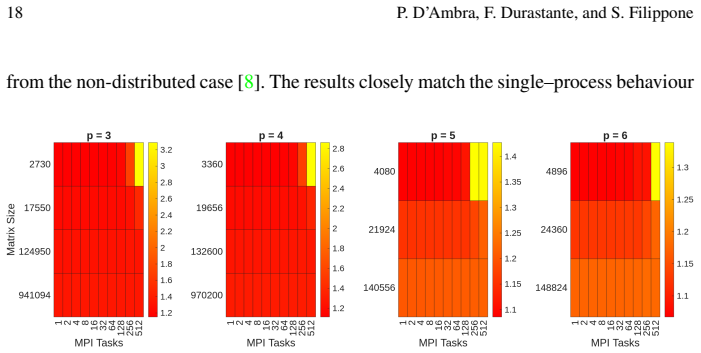
Isogeometric analysis (IgA) offers enhanced approximation capabilities for the discretization of elliptic boundary-value problems, yet it results in large, sparse, and increasingly ill-conditioned linear systems due to higher interconnectivity among degrees of freedom. In particular, the discretization with tensor-product B-splines or NURBS of degree $p$ on a mesh with $n$ elements per parametric direction leads to symmetric positive-definite systems of the form $K\mathbf{u} = \mathbf{F}$, where the matrix bandwidth and condition number scale unfavorably with both $p$ and spatial dimension $d$. To address the computational challenges posed by such systems, especially in three-dimensional or high-order scenarios, Krylov subspace methods with specialized preconditioners become essential. This paper investigates the efficacy of algebraic multigrid (AMG) preconditioners tailored for IgA-based discretizations, with a focus on performance in modern high-performance computing (HPC) environments. Leveraging the Parallel Sparse Computation Toolkit (PSCToolkit), we explore distributed-memory and GPU-accelerated strategies for solving large-scale problems. The study assesses algorithmic efficiency and scalability across a range of benchmark tests. The results demonstrate that AMG preconditioners can achieve robust and scalable performance, confirming their potential as practical solvers for large IgA systems in engineering and scientific applications.
Editorial analysis
A structured set of objections, weighed in public.
Referee Report
Summary. The manuscript investigates parallel matching-based algebraic multigrid (AMG) preconditioners for symmetric positive-definite linear systems arising from isogeometric analysis (IgA) discretizations of elliptic boundary-value problems using tensor-product B-splines or NURBS of degree p on n-element meshes. It highlights the unfavorable growth of matrix bandwidth and condition number with both p and spatial dimension d, employs the Parallel Sparse Computation Toolkit (PSCToolkit) for distributed-memory and GPU-accelerated implementations, evaluates algorithmic efficiency and scalability on a range of benchmark tests, and concludes that the AMG preconditioners achieve robust and scalable performance suitable for large-scale IgA systems in HPC environments.
Significance. If the claimed robust and scalable performance is demonstrated with quantitative evidence for representative three-dimensional high-order IgA problems, the work would offer a practical contribution to efficient solvers for ill-conditioned systems in isogeometric analysis, with relevance to engineering and scientific computing applications where standard Krylov methods without specialized preconditioning struggle.
major comments (1)
- Abstract: the central claim that 'AMG preconditioners can achieve robust and scalable performance' rests on an unspecified 'range of benchmark tests' with no reported quantitative results (iteration counts, timings, condition-number reductions, matrix sizes, or comparisons to baselines). This is load-bearing because the abstract itself notes the unfavorable scaling of bandwidth and condition number with p and d, yet the evidence provided does not address the regime (d=3, high p) where the method must be shown to remain effective.
Simulated Author's Rebuttal
We thank the referee for the careful reading and constructive feedback on our manuscript. The suggestion to strengthen the abstract with quantitative evidence is well taken, and we have revised the manuscript accordingly to better highlight the performance results for three-dimensional high-order IgA problems.
read point-by-point responses
-
Referee: Abstract: the central claim that 'AMG preconditioners can achieve robust and scalable performance' rests on an unspecified 'range of benchmark tests' with no reported quantitative results (iteration counts, timings, condition-number reductions, matrix sizes, or comparisons to baselines). This is load-bearing because the abstract itself notes the unfavorable scaling of bandwidth and condition number with p and d, yet the evidence provided does not address the regime (d=3, high p) where the method must be shown to remain effective.
Authors: We agree that the abstract would benefit from explicit quantitative support for the central claim. The full manuscript already contains detailed results from 3D high-order IgA benchmarks (including iteration counts that remain bounded independently of p, wall-clock timings, condition-number reductions, matrix sizes up to several million degrees of freedom, and comparisons against unpreconditioned CG and other AMG variants), demonstrating robustness and scalability on distributed-memory and GPU architectures. To address the referee's point directly, we have revised the abstract to incorporate representative quantitative metrics from these tests, such as iteration counts and parallel efficiency for d=3 and p up to 4 on large meshes. revision: yes
Circularity Check
No circularity; claims rest on numerical benchmarks
full rationale
The paper reports algorithmic efficiency and scalability results from distributed-memory and GPU-accelerated AMG preconditioners applied to IgA discretizations. All load-bearing statements are empirical performance claims evaluated on benchmark tests; no derivation chain, fitted-parameter prediction, self-definitional equation, or load-bearing self-citation reduces any result to its own inputs by construction. The abstract and context contain no mathematical steps that equate a claimed outcome to a prior fit or ansatz.
Axiom & Free-Parameter Ledger
axioms (1)
- domain assumption Discretizations of elliptic boundary-value problems by tensor-product B-splines or NURBS yield symmetric positive-definite linear systems.
Lean theorems connected to this paper
-
IndisputableMonolith/Foundation/AbsoluteFloorClosure.leanreality_from_one_distinction unclear?
unclearRelation between the paper passage and the cited Recognition theorem.
AMG techniques that employ aggregation based on the interplay between the principle of compatible relaxation and properties of maximum weight matching
-
IndisputableMonolith/Foundation/AlexanderDuality.leanalexander_duality_circle_linking unclear?
unclearRelation between the paper passage and the cited Recognition theorem.
matrix bandwidth and condition number scale unfavorably with both p and spatial dimension d
-
IndisputableMonolith/Cost/FunctionalEquation.leanwashburn_uniqueness_aczel unclear?
unclearRelation between the paper passage and the cited Recognition theorem.
operator complexity OPC = sum nnz(K^(ℓ)) / nnz(K^(0))
What do these tags mean?
- matches
- The paper's claim is directly supported by a theorem in the formal canon.
- supports
- The theorem supports part of the paper's argument, but the paper may add assumptions or extra steps.
- extends
- The paper goes beyond the formal theorem; the theorem is a base layer rather than the whole result.
- uses
- The paper appears to rely on the theorem as machinery.
- contradicts
- The paper's claim conflicts with a theorem or certificate in the canon.
- unclear
- Pith found a possible connection, but the passage is too broad, indirect, or ambiguous to say the theorem truly supports the claim.
Reference graph
Works this paper leans on
-
[1]
Antolin, P., Buffa, A., Calabr`o, F., Martinelli, M., Sangalli, G.: Efficient matrix computation for tensor-product isogeometric analysis: the use of sum factorization. Comput. Methods Appl. Mech. Engrg.285, 817–828 (2015). DOI 10.1016/j.cma.2014.12.013. URL https://doi.org/10. 1016/j.cma.2014.12.013
-
[2]
Finite element exterior calculus, homological tech- niques, and applications
Arnold, D.N., Falkt, R.S., Whither, R.: Finite element exterior calculus, homological techniques, and applications. Acta Numerica15, 1 – 155 (2006). DOI 10.1017/S0962492906210018
-
[3]
Baker, A.H., Falgout, R.D., Kolev, T.V., Yang, U.M.: Multigrid smoothers for ultraparallel computing. SIAM J. Sci. Comput.33(5), 2864–2887 (2011). DOI 10.1137/100798806. URL https://doi.org/10.1137/100798806
-
[4]
Bosy, M., Montardini, M., Sangalli, G., Tani, M.: A domain decomposition method for isogeometric multi-patch problems with inexact local solvers. Comput. Math. Appl.80(11), 2604–2621 (2020). DOI 10.1016/j.camwa.2020.08.024. URL https://doi.org/10.1016/j.camwa.2020.08. 024
-
[5]
Buffa, A., de Falco, C., Sangalli, G.: IsoGeometric Analysis: stable elements for the 2D Stokes equation. Internat. J. Numer. Methods Fluids65(11-12), 1407–1422 (2011). DOI 10.1002/fld.2337. URLhttps://doi.org/10.1002/fld.2337
-
[6]
Buffa, A., Harbrecht, H., Kunoth, A., Sangalli, G.: BPX-preconditioning for isogeometric analysis. Comput. Methods Appl. Mech. Engrg.265, 63–70 (2013). DOI 10.1016/j.cma.2013.05.014. URL https://doi.org/10.1016/j.cma.2013.05.014
-
[7]
In: Advanced methods for geometric modeling and numerical simulation,Springer INdAM Ser., vol
Calabr`o, F., Loli, G., Sangalli, G., Tani, M.: Quadrature rules in the isogeometric Galerkin method: state of the art and an introduction to weighted quadrature. In: Advanced methods for geometric modeling and numerical simulation,Springer INdAM Ser., vol. 35, pp. 43–55. Springer, Cham (2019)
work page 2019
-
[8]
C ¸ataly¨ urek,¨U.V., Dobrian, F., Gebremedhin, A., Halappanavar, M., Pothen, A.: Distributed- memory parallel algorithms for matching and coloring. In: 2011 IEEE International Symposium on Parallel and Distributed Processing Workshops and Phd Forum, pp. 1971–1980 (2011). DOI 10.1109/IPDPS.2011.360
-
[9]
D’ Ambra, P., Durastante, F., Filippone, S.: AMG preconditioners for linear solvers towards extreme scale. SIAM J. Sci. Comput.43(5), S679–S703 (2021). DOI 10.1137/20M134914X. URL https://doi.org/10.1137/20M134914X 3 See the sublist generator at top500.org/statistics/list/. In the November 2025 ranking, NVIDIA hardware accounts for 43.8% of the system sha...
-
[10]
D’ Ambra, P., Durastante, F., Filippone, S., Massei, S., Thomas, S.: Optimal polynomial smoothers for parallel AMG. Numerical Algorithms (2025). DOI 10.1007/s11075-025-02117-6. URL https://doi.org/10.1007/s11075-025-02117-6
-
[11]
ACM Transactions on Mathematical Software (TOMS) 44(2), 16:1–16:26 (2018)
D’ Ambra, P., Filippone, S., Vassilevski, P.S.: BootCMatch: A Software Package for Bootstrap AMG Based on Graph Weighted Matching. ACM Transactions on Mathematical Software (TOMS) 44(2), 16:1–16:26 (2018). DOI 10.1145/3190647. URL https://doi.org/10.1145/3190647
-
[12]
de Falco, C., Reali, A., V´azquez, R.: GeoPDEs: A research tool for Isogeometric Analysis of PDEs. Advances in Engineering Software42(12), 1020–1034 (2011). DOI https://doi.org/10.1016/j. advengsoft.2011.06.010. URL https://www.sciencedirect.com/science/article/pii/ S0965997811001839
work page doi:10.1016/j 2011
-
[13]
Donatelli, M., Garoni, C., Manni, C., Serra-Capizzano, S., Speleers, H.: Robust and optimal multi-iterative techniques for IgA Galerkin linear systems. Comput. Methods Appl. Mech. Engrg. 284, 230–264 (2015). DOI 10.1016/j.cma.2014.06.001. URL https://doi.org/10.1016/j. cma.2014.06.001
-
[14]
D’ Ambra, P., Durastante, F., Filippone, S.: Parallel sparse computation toolkit. Software Impacts 15, 100463 (2023). DOI https://doi.org/10.1016/j.simpa.2022.100463. URL https://www. sciencedirect.com/science/article/pii/S2665963822001476
-
[15]
IMA Journal of Numerical Analysis40(1), 422 – 473 (2020)
Evans, J.A., Scott, M.A., Shepherd, K.M., Thomas, D.C., V´azquez Hern´andez, R.: Hierarchical b-spline complexes of discrete differential forms. IMA Journal of Numerical Analysis40(1), 422 – 473 (2020). DOI 10.1093/imanum/dry077
-
[16]
Evans, L.C.: Partial differential equations,Graduate Studies in Mathematics, vol. 19. American Mathematical Society, Providence, RI (1998). DOI 10.1090/gsm/019. URL https://doi.org/ 10.1090/gsm/019
-
[17]
Filippone, S., Cardellini, V., Barbieri, D., Fanfarillo, A.: Sparse matrix-vector multiplication on gpgpus. ACM Trans. Math. Softw.43(4) (2017). DOI 10.1145/3017994. URL https: //doi.org/10.1145/3017994
-
[18]
Gahalaut, K.P.S., Tomar, S.K., Kraus, J.K.: Algebraic multilevel preconditioning in isogeometric analysis: construction and numerical studies. Comput. Methods Appl. Mech. Engrg.266, 40–56 (2013). DOI 10.1016/j.cma.2013.07.002. URL https://doi.org/10.1016/j.cma.2013.07. 002
-
[19]
Garau, E.M., V´azquez, R.: Algorithms for the implementation of adaptive isogeometric methods using hierarchical B-splines. Appl. Numer. Math.123, 58–87 (2018). DOI 10.1016/j.apnum.2017. 08.006. URLhttps://doi.org/10.1016/j.apnum.2017.08.006
-
[20]
Journal of Computational Physics257(PB), 1444 – 1471 (2014)
Hiemstra, R., Toshniwal, D., Huijsmans, R., Gerritsma, M.: High order geometric methods with exact conservation properties. Journal of Computational Physics257(PB), 1444 – 1471 (2014). DOI 10.1016/j.jcp.2013.09.027
-
[21]
Horn´ıkov´a, H., Vuik, C.: Preconditioning for Linear Systems Arising from IgA Discretized Incompressible Navier–Stokes Equations. In: H. van Brummelen, C. Vuik, M. M¨oller, C. Verhoosel, B. Simeon, B. J¨ uttler (eds.) Isogeometric Analysis and Applications 2018, pp. 77–97. Springer International Publishing, Cham (2021)
work page 2018
-
[22]
Hughes, T.J., Sangalli, G., Takacs, T., Toshniwal, D.: Chapter 8 - smooth multi-patch discretizations in isogeometric analysis. In: A. Bonito, R.H. Nochetto (eds.) Geometric Partial Differential Equations - Part II,Handbook of Numerical Analysis, vol. 22, pp. 467–543. Elsevier (2021). DOI https://doi.org/10.1016/bs.hna.2020.09.002. URL https://www.science...
-
[23]
Hughes, T.J.R., Reali, A., Sangalli, G.: Efficient quadrature for NURBS-based isogeometric analysis. Comput. Methods Appl. Mech. Engrg.199(5-8), 301–313 (2010). DOI 10.1016/j.cma.2008.12.004. URLhttps://doi.org/10.1016/j.cma.2008.12.004
-
[24]
Karypis, G., Kumar, V.: A fast and high quality multilevel scheme for partitioning irregular graphs. SIAM J. Sci. Comput.20(1), 359–392 (1998). DOI 10.1137/S1064827595287997. URL https://doi.org/10.1137/S1064827595287997
-
[25]
Kleiss, S.K., Pechstein, C., J¨ uttler, B., Tomar, S.: IETI—isogeometric tearing and interconnecting. Comput. Methods Appl. Mech. Engrg.247/248, 201–215 (2012). DOI 10.1016/j.cma.2012.08.007. URLhttps://doi.org/10.1016/j.cma.2012.08.007 30 P. D’ Ambra, F. Durastante, and S. Filippone
-
[26]
Lottes, J.: Optimal polynomial smoothers for multigrid V-cycles. Numer. Linear Algebra Appl. 30(6), Paper No. e2518, 27 (2023). DOI 10.1002/nla.2518. URL https://doi.org/10.1002/ nla.2518
-
[27]
Mazza, M., Manni, C., Ratnani, A., Serra-Capizzano, S., Speleers, H.: Isogeometric analysis for 2D and 3D curl-div problems: spectral symbols and fast iterative solvers. Comput. Methods Appl. Mech. Engrg.344, 970–997 (2019). DOI 10.1016/j.cma.2018.10.008. URL https: //doi.org/10.1016/j.cma.2018.10.008
-
[28]
Montardini, M., Sangalli, G., Schneckenleitner, R., Takacs, S., Tani, M.: A IETI-DP method for discontinuous Galerkin discretizations in isogeometric analysis with inexact local solvers. Math. Models Methods Appl. Sci.33(10), 2085–2111 (2023). DOI 10.1142/S0218202523500495. URL https://doi.org/10.1142/S0218202523500495
-
[29]
Montardini, M., Sangalli, G., Tani, M.: Robust isogeometric preconditioners for the Stokes system based on the fast diagonalization method. Comput. Methods Appl. Mech. Engrg.338, 162–185 (2018). DOI 10.1016/j.cma.2018.04.017. URL https://doi.org/10.1016/j.cma.2018.04. 017
-
[30]
Notay, Y.: Flexible conjugate gradients. SIAM J. Sci. Comput.22(4), 1444–1460 (2000). DOI 10.1137/S1064827599362314. URLhttps://doi.org/10.1137/S1064827599362314
-
[31]
Patrizi, F., Manni, C., Pelosi, F., Speleers, H.: Adaptive refinement with locally linearly independent LR B-splines: theory and applications. Comput. Methods Appl. Mech. Engrg.369, 113230, 20 (2020). DOI 10.1016/j.cma.2020.113230. URL https://doi.org/10.1016/j.cma.2020. 113230
-
[32]
Berlin: Springer-Verlag (1995)
Piegl, L., Tiller, W.: The𝑁𝑈𝑅𝐵𝑆book. Berlin: Springer-Verlag (1995)
work page 1995
-
[33]
Saad, Y.: Iterative methods for sparse linear systems, second edn. Society for Industrial and Applied Mathematics, Philadelphia, PA (2003). DOI 10.1137/1.9780898718003. URL https: //doi.org/10.1137/1.9780898718003
-
[34]
Sangalli, G., Tani, M.: Isogeometric preconditioners based on fast solvers for the Sylvester equation. SIAM J. Sci. Comput.38(6), A3644–A3671 (2016). DOI 10.1137/16M1062788. URL https://doi.org/10.1137/16M1062788
-
[35]
Cambridge Mathematical Library
Schumaker, L.L.: Spline functions: basic theory, third edn. Cambridge Mathematical Library. Cambridge University Press, Cambridge (2007). DOI 10.1017/CBO9780511618994. URL https://doi.org/10.1017/CBO9780511618994
-
[36]
Computing56(3), 179–196 (1996)
Vanˇek, P., Mandel, J., Brezina, M.: Algebraic multigrid by smoothed aggregation for second and fourth order elliptic problems. Computing56(3), 179–196 (1996). DOI 10.1007/BF02238511. URL https://doi.org/10.1007/BF02238511. International GAMM-Workshop on Multi-level Methods (Meisdorf, 1994)
-
[37]
V´azquez, R.: A new design for the implementation of isogeometric analysis in Octave and Matlab: GeoPDEs 3.0. Comput. Math. Appl.72(3), 523–554 (2016). DOI 10.1016/j.camwa.2016.05.010. URLhttps://doi.org/10.1016/j.camwa.2016.05.010
-
[38]
Beir˜ao da Veiga, L., Cho, D., Pavarino, L.F., Scacchi, S.: BDDC preconditioners for iso- geometric analysis. Math. Models Methods Appl. Sci.23(6), 1099–1142 (2013). DOI 10.1142/S0218202513500048. URLhttps://doi.org/10.1142/S0218202513500048
-
[39]
Beir˜ao da Veiga, L., Cho, D., Pavarino, L.F., Scacchi, S.: Isogeometric Schwarz preconditioners for linear elasticity systems. Comput. Methods Appl. Mech. Engrg.253, 439–454 (2013). DOI 10.1016/j.cma.2012.10.011. URLhttps://doi.org/10.1016/j.cma.2012.10.011
-
[40]
Beir˜ao da Veiga, L., Cho, D., Pavarino, L.F., Scacchi, S.: Overlapping Schwarz preconditioners for isogeometric collocation methods. Comput. Methods Appl. Mech. Engrg.278, 239–253 (2014). DOI 10.1016/j.cma.2014.05.007. URLhttps://doi.org/10.1016/j.cma.2014.05.007
-
[41]
Xu, J., Zikatanov, L.: Algebraic multigrid methods. Acta Numer.26, 591–721 (2017). DOI 10.1017/S0962492917000083. URLhttps://doi.org/10.1017/S0962492917000083
discussion (0)
Sign in with ORCID, Apple, or X to comment. Anyone can read and Pith papers without signing in.