From Cooperation to Hierarchy: A Study of Dynamics of Hierarchy Emergence in a Multi-Agent System
Pith reviewed 2026-05-15 19:23 UTC · model grok-4.3
The pith
Stable hierarchies emerge reliably in multi-agent systems only when mutation amplitude is high enough, with initial differences mattering mainly for early formation.
A machine-rendered reading of the paper's core claim, the machinery that carries it, and where it could break.
Core claim
In the agent-based model, hierarchical organisation quantified by the trophic incoherence metric emerges and persists across trials when mutation amplitude is sufficiently high; initial heterogeneity influences early formation but has little effect on long-term stability. Simple rules of reproduction, competition, and cooperation suffice to generate directional asymmetries in interaction networks from initially homogeneous populations.
What carries the argument
The trophic incoherence metric, which quantifies hierarchical organisation by measuring directional asymmetries in the agents' interaction networks.
If this is right
- Stable hierarchies form reliably only when mutation amplitude exceeds a sufficient threshold.
- Initial population heterogeneity accelerates early hierarchy formation but does not control long-term persistence.
- Structured inequality arises from initially homogeneous populations through repeated local interactions.
- Both the emergence and persistence of hierarchy follow from the same minimal set of reproduction, competition, and cooperation rules.
Where Pith is reading between the lines
- Similar interaction dynamics could help explain the spontaneous appearance of dominance orders in biological populations that start nearly identical.
- Adjusting mutation parameters in comparable models might simulate conditions that reduce or increase social stratification over generations.
- Incorporating spatial constraints or limited resources into the model could identify additional thresholds that alter hierarchy stability.
Load-bearing premise
The trophic incoherence metric validly quantifies hierarchical organisation via directional asymmetries in interaction networks, and the reproduction-competition-cooperation rules are minimal sufficient conditions for hierarchy emergence.
What would settle it
Simulations run at low mutation amplitude in which stable hierarchies fail to emerge in the majority of repeated trials would falsify the claim that mutation amplitude controls long-term hierarchy persistence.
Figures




read the original abstract
A central premise in evolutionary biology is that individual variation can generate information asymmetries that facilitate the emergence of hierarchical organisation. To examine this process, we develop an agent-based model (ABM) to identify the minimal conditions under which hierarchy arises in dynamic multi-agent systems, focusing on the roles of initial heterogeneity and mutation amplitude across generations. Hierarchical organisation is quantified using the Trophic Incoherence (TI) metric, which captures directional asymmetries in interaction networks. Our results show that even small individual differences can be amplified through repeated local interactions involving reproduction, competition, and cooperation, but that hierarchical order is markedly more sensitive to mutation amplitude than to initial heterogeneity. Across repeated trials, stable hierarchies reliably emerge only when mutation amplitude is sufficiently high, while initial heterogeneity primarily affects early formation rather than long-term persistence. Overall, these findings demonstrate how simple interaction rules can give rise to both the emergence and persistence of hierarchical organisation, providing a quantitative account of how structured inequality can develop from initially homogeneous populations.
Editorial analysis
A structured set of objections, weighed in public.
Referee Report
Summary. The paper presents an agent-based model (ABM) incorporating reproduction, competition, and cooperation rules to study the emergence of hierarchical organization in multi-agent systems. It claims that small initial individual differences are amplified by local interactions, but that stable hierarchies (quantified via the Trophic Incoherence metric on directed interaction networks) depend primarily on sufficiently high mutation amplitude rather than initial heterogeneity levels; the latter mainly affects early formation stages.
Significance. If the central claims hold after addressing metric validation and robustness, the work would offer a useful quantitative demonstration of how minimal local rules can generate persistent inequality from near-homogeneous populations, with potential relevance to evolutionary biology and multi-agent systems research. The simulation approach is direct and avoids circular mathematical derivations, but the absence of calibration for the key metric and missing statistical details currently weaken the evidential basis for the sensitivity conclusions.
major comments (3)
- [Methods (metric definition and application)] The Trophic Incoherence (TI) metric is applied to the directed interaction graph generated by the reproduction-competition-cooperation rules without any calibration or validation against known hierarchical versus non-hierarchical reference graphs produced under the identical edge-construction procedure. Because TI was developed for food-web trophic levels, it is unclear whether high TI scores reliably indicate transitive dominance chains or instead capture transient local biases or degree heterogeneity; this directly undermines the reported sensitivity of TI to mutation amplitude.
- [Results (sensitivity analysis)] The results on sensitivity to mutation amplitude versus initial heterogeneity report that stable hierarchies emerge reliably only above a threshold mutation amplitude, yet the manuscript provides no explicit parameter ranges, number of repeated trials, statistical tests, robustness checks, or exclusion criteria for the simulation outcomes. This absence makes it impossible to assess whether the central sensitivity claim is robust to reasonable changes in implementation details such as population size or interaction probabilities.
- [Discussion] The assertion that the chosen interaction rules constitute the minimal conditions sufficient for hierarchy emergence lacks supporting ablation studies or comparisons to alternative rule sets (e.g., removing cooperation or altering competition). Without such controls, the claim that these rules are minimal remains untested and load-bearing for the paper's broader interpretation.
minor comments (1)
- [Abstract and Results] The abstract and results sections would benefit from explicit statements of the exact ranges explored for mutation amplitude and initial heterogeneity, as well as the precise definition of 'stable hierarchy' used for the long-term persistence claim.
Simulated Author's Rebuttal
We thank the referee for the constructive and detailed review. We have revised the manuscript to address the concerns regarding metric validation, statistical reporting, and the minimality claim. Our point-by-point responses follow.
read point-by-point responses
-
Referee: [Methods (metric definition and application)] The Trophic Incoherence (TI) metric is applied to the directed interaction graph generated by the reproduction-competition-cooperation rules without any calibration or validation against known hierarchical versus non-hierarchical reference graphs produced under the identical edge-construction procedure. Because TI was developed for food-web trophic levels, it is unclear whether high TI scores reliably indicate transitive dominance chains or instead capture transient local biases or degree heterogeneity; this directly undermines the reported sensitivity of TI to mutation amplitude.
Authors: We agree that explicit validation strengthens the interpretation of TI in our setting. The revised manuscript adds a new Methods subsection that generates reference directed graphs with prescribed hierarchical and non-hierarchical topologies using the identical edge-construction procedure. We show that TI scores are statistically higher for the hierarchical references and remain insensitive to degree heterogeneity alone, confirming that the metric tracks transitive dominance chains under our interaction rules. revision: yes
-
Referee: [Results (sensitivity analysis)] The results on sensitivity to mutation amplitude versus initial heterogeneity report that stable hierarchies emerge reliably only above a threshold mutation amplitude, yet the manuscript provides no explicit parameter ranges, number of repeated trials, statistical tests, robustness checks, or exclusion criteria for the simulation outcomes. This absence makes it impossible to assess whether the central sensitivity claim is robust to reasonable changes in implementation details such as population size or interaction probabilities.
Authors: We have expanded both the Methods and Results sections to supply the missing details. The revised text now reports the full parameter ranges, 100 independent trials per condition, t-tests and linear regression for sensitivity, robustness sweeps over population sizes 50–200 and interaction probabilities, and explicit exclusion criteria (runs that fail to reach steady-state TI within 1000 generations). These additions make the robustness of the mutation-amplitude threshold directly verifiable. revision: yes
-
Referee: [Discussion] The assertion that the chosen interaction rules constitute the minimal conditions sufficient for hierarchy emergence lacks supporting ablation studies or comparisons to alternative rule sets (e.g., removing cooperation or altering competition). Without such controls, the claim that these rules are minimal remains untested and load-bearing for the paper's broader interpretation.
Authors: We accept that the original text did not include direct ablation experiments. The revised Discussion now contains a paragraph presenting targeted ablation results (removing cooperation while retaining reproduction and competition) that show a marked drop in stable TI, together with brief comparisons to related models in the literature. We label these as supporting rather than exhaustive evidence and flag comprehensive ablation as future work. revision: partial
Circularity Check
No circularity: results obtained from explicit ABM simulations with external metric
full rationale
The paper presents an agent-based model with explicitly stated rules for reproduction, competition, and cooperation among agents. Hierarchical organisation is quantified by applying the Trophic Incoherence metric (an external measure from food-web literature) to the directed interaction networks that emerge from those rules. All reported findings on the relative sensitivity of stable hierarchies to mutation amplitude versus initial heterogeneity are generated by running repeated simulation trials under controlled parameter variations. There are no mathematical derivations, fitted parameters, or self-citations that reduce the reported outcomes to quantities defined by the inputs themselves. The central claims rest on simulation outputs rather than on any self-definitional or construction-based equivalence.
Axiom & Free-Parameter Ledger
free parameters (2)
- mutation amplitude
- initial heterogeneity level
axioms (2)
- domain assumption Individual variation generates information asymmetries that facilitate hierarchical organisation
- domain assumption Local interactions of reproduction, competition, and cooperation amplify small differences into directional network asymmetries
Lean theorems connected to this paper
-
IndisputableMonolith/Cost/FunctionalEquation.leanwashburn_uniqueness_aczel unclear?
unclearRelation between the paper passage and the cited Recognition theorem.
Hierarchical organisation is quantified using the Trophic Incoherence (TI) metric... F(h) = 1/∑w_ij ∑ w_ij (h_j - h_i - 1)^2
-
IndisputableMonolith/Foundation/DimensionForcing.leanalexander_duality_circle_linking unclear?
unclearRelation between the paper passage and the cited Recognition theorem.
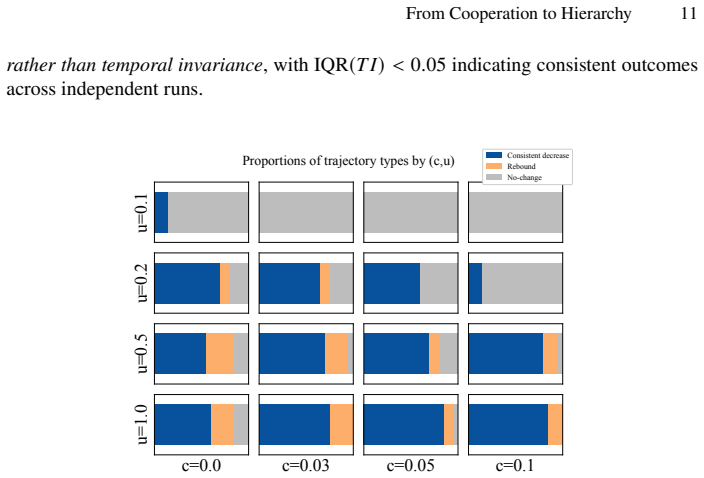
mutation amplitude u plays the dominant role... initial heterogeneity c mainly affects the early phase
What do these tags mean?
- matches
- The paper's claim is directly supported by a theorem in the formal canon.
- supports
- The theorem supports part of the paper's argument, but the paper may add assumptions or extra steps.
- extends
- The paper goes beyond the formal theorem; the theorem is a base layer rather than the whole result.
- uses
- The paper appears to rely on the theorem as machinery.
- contradicts
- The paper's claim conflicts with a theorem or certificate in the canon.
- unclear
- Pith found a possible connection, but the passage is too broad, indirect, or ambiguous to say the theorem truly supports the claim.
Reference graph
Works this paper leans on
-
[1]
Harvard Univer- sity Press (2009)
Boehm, C.: Hierarchy in the Forest: The Evolution of Egalitarian Behavior. Harvard Univer- sity Press (2009)
work page 2009
-
[2]
Trends in Cognitive Sciences13(1), 36–43 (2009)
Couzin, I.D.: Collective cognition in animal groups. Trends in Cognitive Sciences13(1), 36–43 (2009)
work page 2009
-
[3]
Scientific reports2(1), 812 (2012)
Cristelli, M., Batty, M., Pietronero, L.: There is more than a power law in zipf. Scientific reports2(1), 812 (2012)
work page 2012
-
[4]
In: Research handbook on complex project organizing, pp
Daniel, P.A., Daniel, E.: Multi-level project organizing: A complex adaptive systems per- spective. In: Research handbook on complex project organizing, pp. 138–147. Edward Elgar Publishing (2023)
work page 2023
-
[5]
Physical Review Research3(1), 013084 (2021)
De Marzo, G., Gabrielli, A., Zaccaria, A., Pietronero, L.: Dynamical approach to zipf’s law. Physical Review Research3(1), 013084 (2021)
work page 2021
-
[6]
Advances in Insect Physiology35, 123–173 (2008)
Detrain, C., Deneubourg, J.L.: Collective decision-making and foraging patterns in ants and honeybees. Advances in Insect Physiology35, 123–173 (2008)
work page 2008
-
[7]
The American Naturalist191(1), 58–73 (2018)
Dridi, S., Akçay, E.: Learning to cooperate: The evolution of social rewards in repeated interactions. The American Naturalist191(1), 58–73 (2018)
work page 2018
-
[8]
Foss,N.J.,Schmidt,J.,Teece,D.J.:Ecosystemleadershipasadynamiccapability.Longrange planning56(1), 102270 (2023)
work page 2023
-
[9]
Gagnon, S.A., Brunyé, T.T., Robin, C., Mahoney, C.R., Taylor, H.A.: High and mighty: Implicitassociationsbetweenspaceandsocialstatus.FrontiersinPsychology2, 259(2011)
work page 2011
-
[10]
Gotelli, N.J.: A Primer of Ecology. Sinauer Associates (2008)
work page 2008
-
[11]
Grimaldo, F., Lozano, M., Barber, F.: Madem: a multi-modal decision making for social mas. In: Proceedings of the 7th international joint conference on Autonomous agents and multiagent systems (AAMAS). vol. 1, pp. 183–190. IFAAMAS (2008)
work page 2008
-
[12]
European Journal of Personality 37(1), 72–94 (2023)
Haertel, T.M., Leckelt, M., Grosz, M.P., Kuefner, A.C., Geukes, K., Back, M.D.: Pathways from narcissism to leadership emergence in social groups. European Journal of Personality 37(1), 72–94 (2023)
work page 2023
-
[13]
Johnson,S.,Domínguez-García,V.,Donetti,L.,Muñoz,M.A.:Trophiccoherencedetermines food-webstability.ProceedingsoftheNationalAcademyofSciences111(50),17923–17928 (2014)
work page 2014
-
[14]
Chaos: An Interdisciplinary Journal of Nonlinear Science26(6), 065310 (2016)
Klaise,J.,Johnson,S.:Fromneuronstoepidemics:Howtrophiccoherenceaffectsspreading processes. Chaos: An Interdisciplinary Journal of Nonlinear Science26(6), 065310 (2016)
work page 2016
-
[15]
In: Hierarchy in natural and social sciences, pp
Lane, D.: Hierarchy, complexity, society. In: Hierarchy in natural and social sciences, pp. 81–119. Springer, Dordrecht (2006)
work page 2006
-
[16]
Macal,C.M.,North,M.J.:Tutorialonagent-basedmodelingandsimulation.In:Proceedings of the Winter Simulation Conference, 2005. pp. 14–pp. IEEE (2005)
work page 2005
-
[17]
Migliano, A.B., Vinicius, L.: The origins of human cumulative culture: from the foraging nichetocollectiveintelligence.PhilosophicalTransactionsoftheRoyalSocietyB377(1843), 20200317 (2022)
work page 2022
-
[18]
Papasimeon, M.: Modelling agent-environment interaction in multi-agent simulations with affordances. Citeseer (2009)
work page 2009
-
[19]
Perret,C.,Hart,E.,Powers,S.T.:Fromdisorganizedequalitytoefficienthierarchy:howgroup sizedrivestheevolutionofhierarchyinhumansocieties.ProceedingsoftheRoyalSocietyB 287(1928), 20200693 (2020)
work page 1928
-
[20]
In: Artificial Life Conference Proceedings
Perret, C., Powers, S.T., Hart, E.: Emergence of hierarchy from the evolution of individual influence in an agent-based model. In: Artificial Life Conference Proceedings. pp. 348–355. MIT Press (2017)
work page 2017
-
[21]
Scientific Reports10(1), 4388 (2020) 16 S
Pilgrim, C., Guo, W., Johnson, S.: Organisational social influence on directed hierarchical graphs, from tyranny to anarchy. Scientific Reports10(1), 4388 (2020) 16 S. Mao and P. Tino
work page 2020
-
[22]
Evolution and Human Behavior40(2), 222–234 (2019)
Redhead,D.,Cheng,J.T.,Driver,C.,Foulsham,T.,O’Gorman,R.:Onthedynamicsofsocial hierarchy: A longitudinal investigation of the rise and fall of prestige, dominance, and social rank in naturalistic task groups. Evolution and Human Behavior40(2), 222–234 (2019)
work page 2019
-
[23]
Philosophical Transactions of the Royal Society B377(1845), 20200440 (2022)
Redhead, D., Power, E.A.: Social hierarchies and social networks in humans. Philosophical Transactions of the Royal Society B377(1845), 20200440 (2022)
work page 2022
-
[24]
arXiv preprint arXiv:2405.02654 (2024)
Ren, T., Zeng, X.J.: Enhancing cooperation through selective interaction and long-term experiences in multi-agent reinforcement learning. arXiv preprint arXiv:2405.02654 (2024)
-
[25]
Physical Review E105(6), 064304 (2022)
Rodgers,N.,Tiňo,P.,Johnson,S.:Networkhierarchyandpatternrecoveryindirectedsparse hopfield networks. Physical Review E105(6), 064304 (2022)
work page 2022
-
[26]
Sayama, H.: Introduction to the modeling and analysis of complex systems. Open SUNY Textbooks (2015)
work page 2015
-
[27]
Philosophical Transactions of the Royal Society B377(1845), 20200450 (2022)
Tibbetts, E.A., Pardo-Sanchez, J., Weise, C.: The establishment and maintenance of domi- nance hierarchies. Philosophical Transactions of the Royal Society B377(1845), 20200450 (2022)
work page 2022
-
[28]
Au- tonomous Agents and Multi-Agent Systems25(1), 46–86 (2012)
de Weerdt, M.M., Zhang, Y., Klos, T.: Multiagent task allocation in social networks. Au- tonomous Agents and Multi-Agent Systems25(1), 46–86 (2012)
work page 2012
-
[29]
Scientific Reports13(1), 1160 (2023)
Zefferman, M.R.: Constraints on cooperation shape hierarchical versus distributed structure in human groups. Scientific Reports13(1), 1160 (2023)
work page 2023
-
[30]
Ecological Modelling115(2-3), 191–198 (1999)
Łomnicki, A.: Individual-based models and the individual-based approach to population ecology. Ecological Modelling115(2-3), 191–198 (1999)
work page 1999
discussion (0)
Sign in with ORCID, Apple, or X to comment. Anyone can read and Pith papers without signing in.