Nonlocal advantage of quantum imaginarity in Schwarzchild spacetime
Pith reviewed 2026-05-13 17:04 UTC · model grok-4.3
The pith
Hawking radiation suppresses the nonlocal advantage of quantum imaginarity in accessible Schwarzschild regions
A machine-rendered reading of the paper's core claim, the machinery that carries it, and where it could break.
Core claim
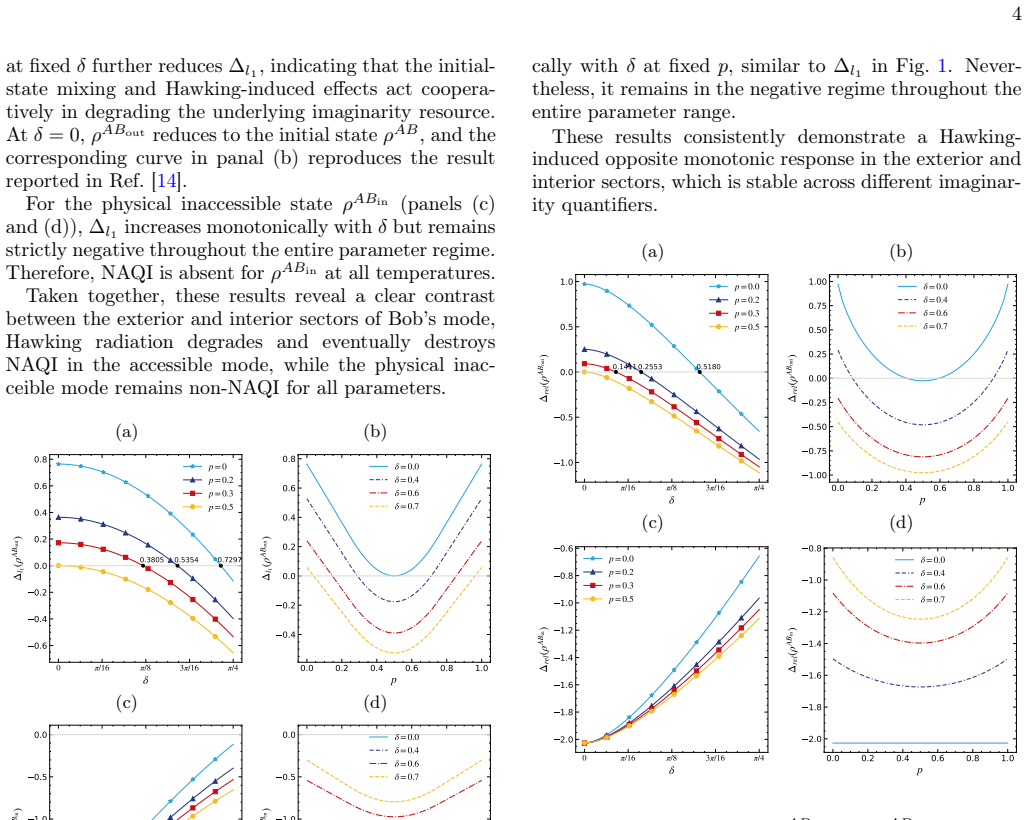
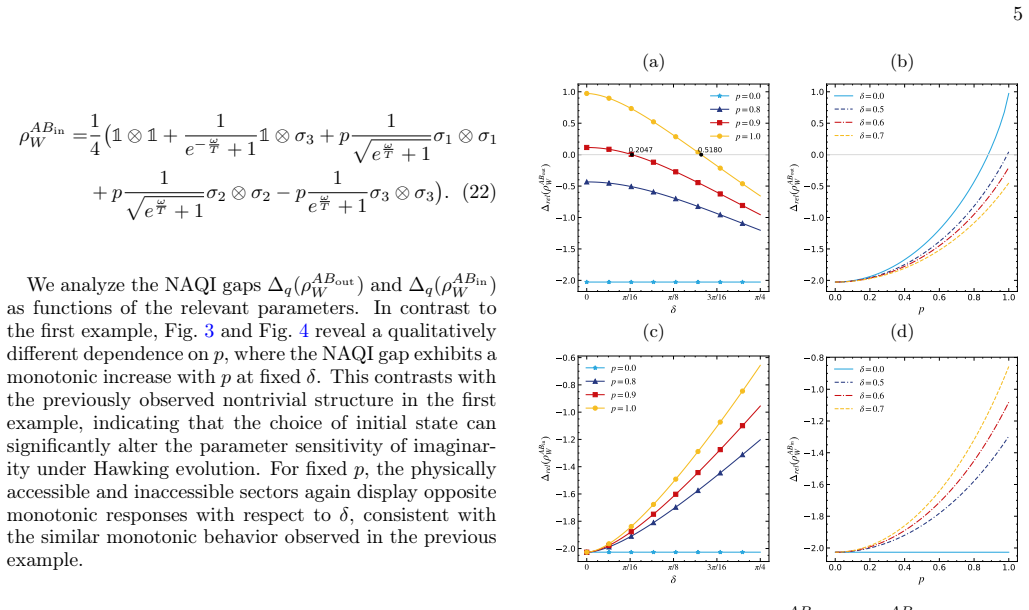
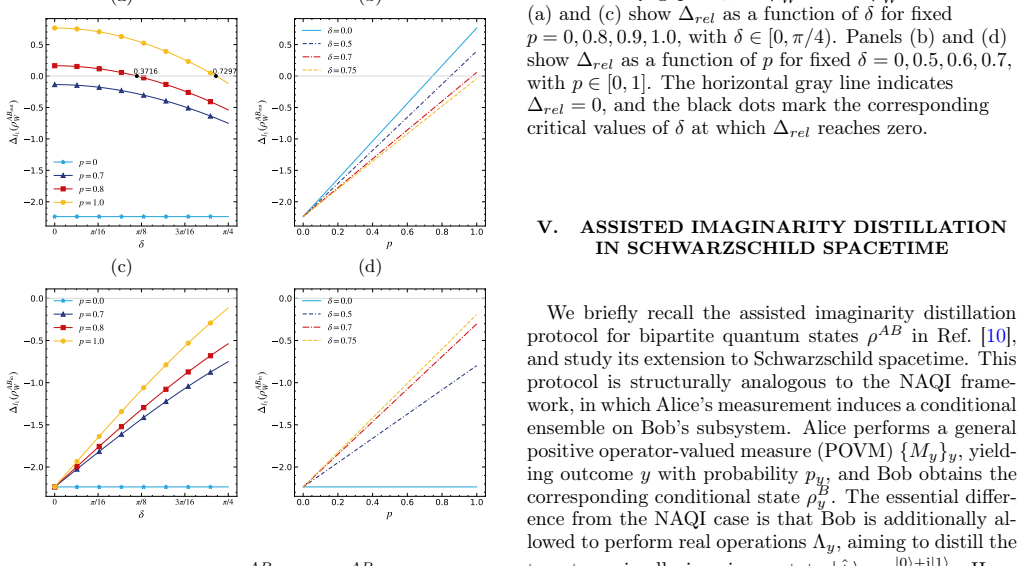
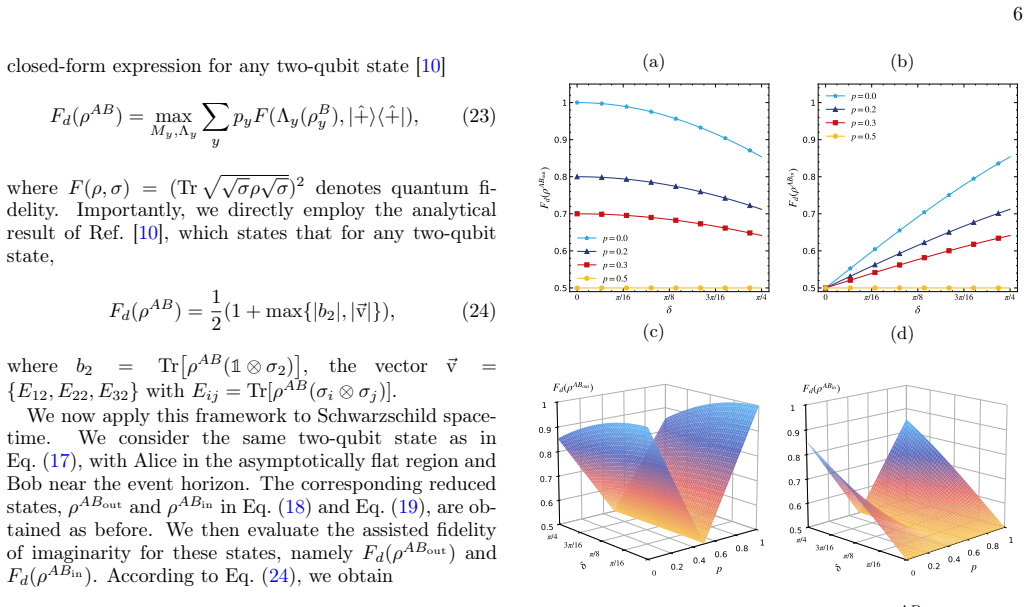
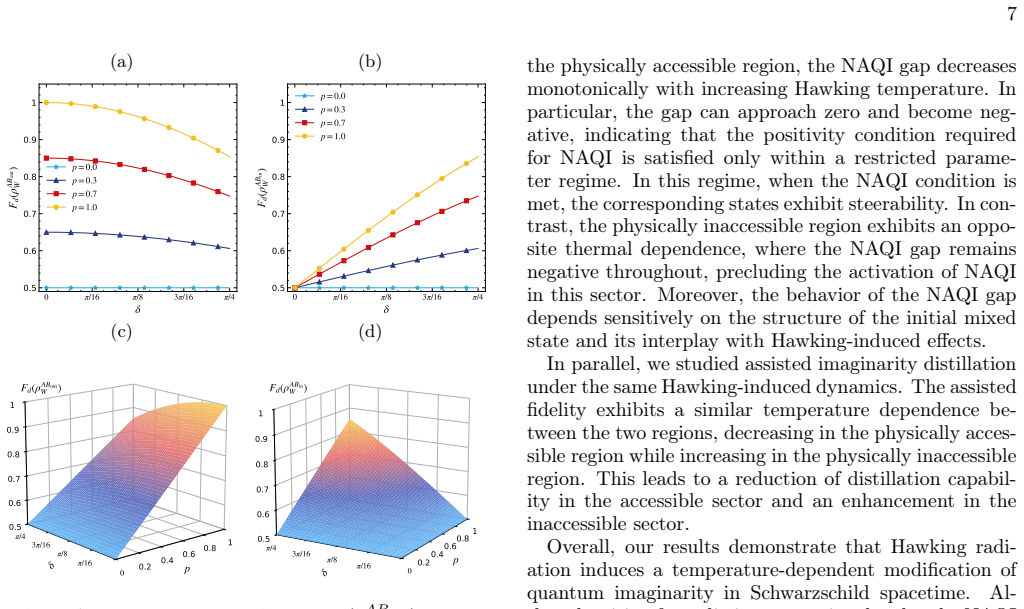
Hawking radiation significantly affects nonlocal advantage of quantum imaginarity by suppressing it in the physically accessible region with increasing temperature until it may vanish, while it is absent in the inaccessible region. For assisted imaginarity distillation the assisted fidelity decreases with temperature in the accessible region and increases in the inaccessible region, depending on the initial state.
What carries the argument
Nonlocal advantage of quantum imaginarity (NAQI) together with assisted imaginarity distillation, computed for quantum modes in Schwarzschild spacetime after separating them into physically accessible and inaccessible regions via the event horizon.
If this is right
- NAQI can be driven to zero by raising the Hawking temperature in accessible regions.
- Assisted distillation of imaginarity becomes more effective in inaccessible regions at higher temperatures.
- Quantum imaginarity resources display sharply different behavior across the event horizon under the Hawking effect.
- These temperature trends apply directly to quantum information processing near black holes.
Where Pith is reading between the lines
- Analog gravity experiments simulating horizons could test the temperature dependence of NAQI.
- Similar region-dependent responses may appear for other quantum resources such as coherence when studied in curved spacetime.
- Hawking temperature might act as a tunable control for imaginarity-based quantum tasks in strong gravitational fields.
Load-bearing premise
That the nonlocal advantage of quantum imaginarity and assisted imaginarity distillation remain well-defined and computable when standard quantum-information tools are applied to quantum fields in Schwarzschild spacetime.
What would settle it
A calculation showing that the nonlocal advantage of quantum imaginarity stays constant or increases with Hawking temperature in the accessible region would falsify the reported suppression.
Figures

read the original abstract
Black hole spacetimes provide a natural setting for quantum systems in curved spacetime, where effects such as Hawking radiation arise from event horizons. In this work, we investigate the impact of the Hawking effect on quantum imaginarity in Schwarzschild spacetime, focusing on nonlocal advantage of quantum imaginarity (NAQI) and assisted imaginarity distillation. For NAQI, it is significantly affected by Hawking radiation, exhibiting a pronounced difference between physically accessible and inaccessible regions. It is suppressed in the physically accessible region with increasing Hawking temperature and may vanish, while remaining absent in the physically inaccessible region across the parameter regime. For assisted imaginarity distillation, the Hawking effect modifies the assisted fidelity in a state-dependent manner. In the physically accessible region, the fidelity generally decreases with increasing temperature, indicating reduced distillation capability, whereas the physically inaccessible region exhibits the opposite monotonic trend, indicating enhanced distillation capability. These results highlight distinct operational behaviors of physically accessible and inaccessible regions under relativistic effects, providing insight into quantum imaginarity in curved spacetime.
Editorial analysis
A structured set of objections, weighed in public.
Referee Report
Summary. The paper studies the effects of Hawking radiation on quantum imaginarity in Schwarzschild spacetime, with emphasis on the nonlocal advantage of quantum imaginarity (NAQI) and assisted imaginarity distillation for two-qubit states. Using Bogoliubov transformations between Schwarzschild and Kruskal modes, it reports that NAQI is suppressed in the physically accessible region with rising Hawking temperature and can vanish, while remaining absent in the inaccessible region; assisted distillation fidelity decreases with temperature in the accessible region but increases in the inaccessible region.
Significance. If the calculations hold, the work extends quantum resource theories to curved spacetime by showing how Hawking effects produce qualitatively different behaviors for imaginarity in accessible versus inaccessible regions. The approach relies on standard mode-mixing techniques without introducing new ad-hoc parameters, and the state-dependent trends in distillation fidelity offer concrete, falsifiable predictions for relativistic quantum information.
major comments (2)
- [Results section (NAQI calculation)] The suppression of NAQI to zero in the accessible region is stated as possible but the manuscript does not identify the critical Hawking temperature or the explicit form of the NAQI witness (e.g., the imaginary-part-based measure) that reaches zero; this threshold should be derived from the reduced density matrix after tracing over the inaccessible modes.
- [Assisted distillation subsection] For assisted imaginarity distillation the opposite monotonic trends are reported, yet the fidelity expressions are not written out; without the explicit dependence on the thermal factor (1 + e^{-ω/T})^{-1} it is difficult to verify that the inaccessible-region increase is not an artifact of the chosen basis or the particular initial state.
minor comments (2)
- [Title and abstract] The title and abstract spell the metric as 'Schwarzchild' (missing 's'); correct to 'Schwarzschild' throughout.
- [Setup] The initial two-qubit state on which all numerics are performed should be stated explicitly (e.g., |Φ^+> or a parameterized family) rather than left implicit.
Simulated Author's Rebuttal
We thank the referee for the positive evaluation and the detailed comments, which help improve the clarity of our results. We address each point below and will revise the manuscript accordingly.
read point-by-point responses
-
Referee: [Results section (NAQI calculation)] The suppression of NAQI to zero in the accessible region is stated as possible but the manuscript does not identify the critical Hawking temperature or the explicit form of the NAQI witness (e.g., the imaginary-part-based measure) that reaches zero; this threshold should be derived from the reduced density matrix after tracing over the inaccessible modes.
Authors: We agree that an explicit derivation of the critical Hawking temperature is needed. In the revised manuscript we will compute the NAQI witness directly from the reduced density matrix obtained after tracing over the inaccessible modes and report the precise temperature value at which the witness vanishes in the accessible region. revision: yes
-
Referee: [Assisted distillation subsection] For assisted imaginarity distillation the opposite monotonic trends are reported, yet the fidelity expressions are not written out; without the explicit dependence on the thermal factor (1 + e^{-ω/T})^{-1} it is difficult to verify that the inaccessible-region increase is not an artifact of the chosen basis or the particular initial state.
Authors: We accept the suggestion to include the explicit expressions. The revised version will present the full assisted-distillation fidelity formulas, explicitly displaying their dependence on the thermal factor (1 + e^{-ω/T})^{-1}, thereby allowing direct verification that the reported monotonic trends hold independently of the chosen basis and initial state. revision: yes
Circularity Check
Derivation is self-contained with no circularity
full rationale
The paper applies standard Bogoliubov transformations between Schwarzschild and Kruskal modes to an initial two-qubit state, then computes reduced density matrices for accessible and inaccessible regions before directly evaluating the NAQI witness and assisted fidelity. These quantities are obtained from explicit matrix elements and thermal factors in the mode mixing, without any reduction to self-definitions, fitted parameters renamed as predictions, or load-bearing self-citations. The observed suppression in the accessible region and absence in the inaccessible region follow directly from the structure of the transformed states and the chosen basis, making the central claims independent of the inputs by construction.
Axiom & Free-Parameter Ledger
Lean theorems connected to this paper
-
IndisputableMonolith/Foundation/AlexanderDuality.leanalexander_duality_circle_linking unclear?
unclearRelation between the paper passage and the cited Recognition theorem.
We investigate the impact of the Hawking effect on quantum imaginarity in Schwarzschild spacetime, focusing on nonlocal advantage of quantum imaginarity (NAQI) and assisted imaginarity distillation.
-
IndisputableMonolith/Foundation/RealityFromDistinction.leanreality_from_one_distinction unclear?
unclearRelation between the paper passage and the cited Recognition theorem.
The metric of the Schwarzschild black hole is given by ds² = −(1−2M/r)dt² + …
What do these tags mean?
- matches
- The paper's claim is directly supported by a theorem in the formal canon.
- supports
- The theorem supports part of the paper's argument, but the paper may add assumptions or extra steps.
- extends
- The paper goes beyond the formal theorem; the theorem is a base layer rather than the whole result.
- uses
- The paper appears to rely on the theorem as machinery.
- contradicts
- The paper's claim conflicts with a theorem or certificate in the canon.
- unclear
- Pith found a possible connection, but the passage is too broad, indirect, or ambiguous to say the theorem truly supports the claim.
Reference graph
Works this paper leans on
-
[1]
A. Hickey and G. Gour, Quantifying the imaginarity of quantum mechanics, Journal of Physics A: Mathematical and Theoretical51, 414009 (2018)
work page 2018
-
[2]
K.-D. Wu, T. V. Kondra, S. Rana, C. M. Scandolo, G.-Y. Xiang, C.-F.Li, G.-C.Guo,andA.Streltsov,Operational resource theory of imaginarity, Physical Review Letters 126, 090401 (2021)
work page 2021
-
[3]
Q. Chen, T. Gao, and F. Yan, Measures of imaginarity and quantum state order, Science China Physics, Me- chanics & Astronomy66, 280312 (2023)
work page 2023
-
[4]
K.-D. Wu, T. V. Kondra, S. Rana, C. M. Scandolo, G.-Y. Xiang, C.-F. Li, G.-C. Guo, and A. Streltsov, Resource theory of imaginarity: Quantification and state conver- sion, Physical Review A103, 032401 (2021). 8
work page 2021
-
[5]
S. Xue, J. Guo, P. Li, M. Ye, and Y. Li, Quantification of resource theory of imaginarity, Quantum Information Processing20, 383 (2021)
work page 2021
-
[6]
J. Xu, Quantifying the imaginarity of quantum states via Tsallis relative entropy, Physics Letters A528, 130024 (2024)
work page 2024
-
[7]
Xu, Imaginarity of Gaussian states, Physical Review A108, 062203 (2023)
J. Xu, Imaginarity of Gaussian states, Physical Review A108, 062203 (2023)
work page 2023
-
[8]
T. Varun Kondra, C. Datta, and A. Streltsov, Real quan- tum operations and state transformations, New Journal of Physics25, 093043 (2023)
work page 2023
- [9]
-
[10]
K.-D. Wu, T. V. Kondra, C. M. Scandolo, S. Rana, G.-Y. Xiang, C.-F. Li, G.-C. Guo, and A. Streltsov, Resource theory of imaginarity in distributed scenarios, Commu- nications Physics7, 171 (2024)
work page 2024
-
[11]
Y. Sun, R. Ren, Y. Wang, and Y. Li, Analysis of the rela- tionship between imaginarity and entanglement, Physical Review A111, 032425 (2025)
work page 2025
-
[12]
Xu, Coherence and imaginarity of quantum states, Physica Scripta100, 025106 (2025)
J. Xu, Coherence and imaginarity of quantum states, Physica Scripta100, 025106 (2025)
work page 2025
- [13]
-
[14]
Z.-W. Wei and S.-M. Fei, Nonlocal advantages of quan- tum imaginarity, Physical Review A110, 052202 (2024)
work page 2024
-
[15]
J. Wang, Q. Pan, and J. Jing, Entanglement redistribu- tion in the Schwarzschild spacetime, Physics Letters B 692, 202 (2010)
work page 2010
-
[16]
E. Martín-Martínez, L. J. Garay, and J. León, Unveiling quantum entanglement degradation near a Schwarzschild black hole, Physical Review D—Particles, Fields, Gravi- tation, and Cosmology82, 064006 (2010)
work page 2010
-
[17]
J. Wang, Q. Pan, and J. Jing, Projective measure- ments and generation of entangled Dirac particles in Schwarzschild spacetime, Annals of Physics325, 1190 (2010)
work page 2010
-
[18]
J. Deng, J. Wang, and J. Jing, How the Hawking effect and prepared states affect entanglement distillability of Dirac fields, Physics Letters B695, 495 (2011)
work page 2011
- [19]
-
[20]
J. Shi, Z. Ding, J. He, L. Yu, T. Wu, S. Chen, D. Wang, C. Liu, W. Sun, and L. Ye, Quantum distinguishability andgeometricdiscordinthebackgroundofSchwarzschild space–time, Physica A: Statistical Mechanics and its Ap- plications510, 649 (2018)
work page 2018
-
[21]
E. Tjoa and R. B. Mann, Harvesting correlations in Schwarzschild and collapsing shell spacetimes, Journal of High Energy Physics2020, 155 (2020)
work page 2020
-
[22]
S.-M. Wu and H.-S. Zeng, Fermionic steering and its monogamy relations in Schwarzschild spacetime, The Eu- ropean Physical Journal C82, 716 (2022)
work page 2022
- [23]
- [24]
-
[25]
S. Haddadi, M. Yurischev, M. Abd-Rabbou, M. Azizi, M.Pourkarimi,andM.Ghominejad,Quantumnessneara Schwarzschildblackhole,TheEuropeanPhysicalJournal C84, 42 (2024)
work page 2024
- [26]
- [27]
-
[28]
S. Elghaayda, A. Ali, S. Al-Kuwari, and M. Mansour, Physically accessible and inaccessible quantum correla- tions of Dirac fields in Schwarzschild spacetime, Physics Letters A525, 129915 (2024)
work page 2024
-
[29]
X. Wang, X.-G. Fan, D. Wang, and L. Ye, Hawking effect on the universal relationship between quantum steering and the first-order coherence in Schwarzschild spacetime, Physics Letters B , 139808 (2025)
work page 2025
-
[30]
N. K. Dubey and S. Kolekar, Harvesting fermionic field entanglement in Schwarzschild spacetime, Physical Re- view D112, 025019 (2025)
work page 2025
-
[31]
G.-W. Mi, X. Huang, S.-M. Fei, and T. Zhang, Impact of the Hawking Effect on the Fully Entangled Fraction of Three-Qubit States in Schwarzschild Spacetime, Annalen der Physik537, 2400308 (2025)
work page 2025
- [32]
-
[33]
X. Liu, C. Zeng, and J. Wang, Generation of quantum entanglement in superposed diamond spacetime, The Eu- ropean Physical Journal C85, 539 (2025)
work page 2025
-
[34]
G.-W. Mi, X. Huang, and T. Zhang, Tripartite quan- tum steering in Schwarzschild spacetime, The European Physical Journal C86, 75 (2026)
work page 2026
-
[35]
J.-M.Li, L.Tong,andX.-L.Huang,Enhancedrobustness of non-maximal multipartite entanglement under Hawk- ing radiation, The European Physical Journal C86, 177 (2026)
work page 2026
- [36]
-
[37]
F. Ming, T.-T. Lu, Z.-Q. Xu, L. Dong, B.-L. Fang, X. Hu, Y. Yu, H. Yang, and D. Wang, Nonlocal advantage of quantum coherence in the black hole quantum atmo- sphere, Physics Letters B874, 140242 (2026)
work page 2026
- [38]
-
[39]
X. Liu, C. Wen, and J. Wang, Quantum coherence of con- tinuous variables in the black hole quantum atmosphere, Physics Letters B873, 140185 (2026)
work page 2026
-
[40]
D. R. Brill and J. A. Wheeler, Interaction of neutrinos and gravitational fields, Reviews of Modern Physics29, 465 (1957)
work page 1957
-
[41]
T. Damour and R. Ruffini, Black-hole evaporation in the Klein-Sauter-Heisenberg-Euler formalism, Physical Re- view D14, 332 (1976). 9
work page 1976
-
[42]
S. Barnett and P. M. Radmore,Methods in theoretical quantum optics, Vol. 15 (Oxford University Press, 2002). Appendix A: Projective Measurements and Mutually Unbiased Bases For a two-qubit stateρAB, Alice performs three binary projective measurementsP={P x}3 x=1, where each set- tingxis associated with projectors{P o|x}o=0,1 defined as Po|x =|ψ o|x⟩⟨ψo|x|...
work page 2002
discussion (0)
Sign in with ORCID, Apple, or X to comment. Anyone can read and Pith papers without signing in.