VectraFlow: Long-Horizon Semantic Processing over Data and Event Streams with LLMs
Pith reviewed 2026-05-13 16:41 UTC · model grok-4.3
The pith
VectraFlow extends relational streaming operators to free-text data using LLMs for continuous semantic processing and event pattern detection.
A machine-rendered reading of the paper's core claim, the machinery that carries it, and where it could break.
Core claim
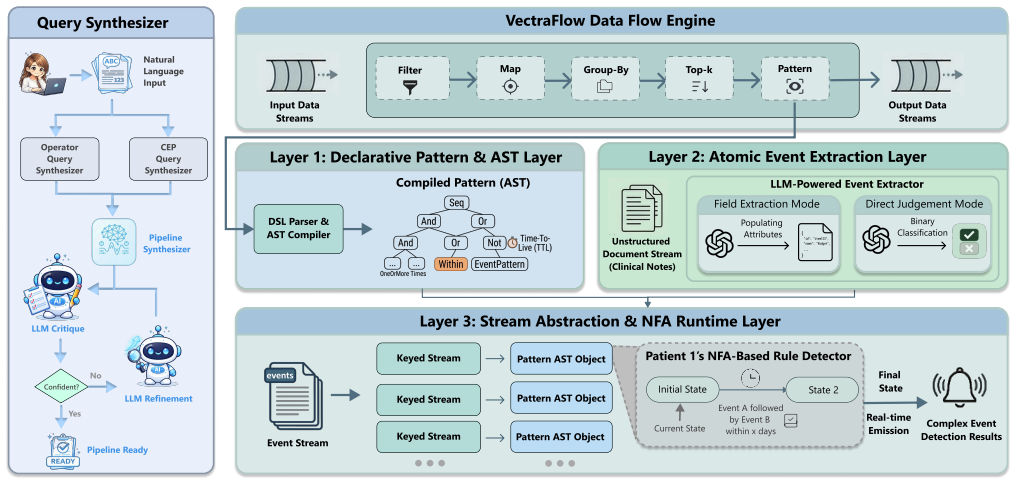
VectraFlow extends traditional relational operators with LLM-powered execution over free-text streams, offering a suite of continuous semantic operators -- filter, map, aggregate, join, group-by, and window -- each with configurable throughput-accuracy tradeoffs across LLM-based, embedding-based, and hybrid implementations. Building on this, a semantic event pattern operator lifts complex event processing to unstructured document streams, combining LLM-based event extraction with NFA-based temporal rule matching for stateful reasoning over sequences of semantic events.
What carries the argument
Continuous semantic operators executed through LLM, embedding, or hybrid paths, together with LLM event extraction followed by NFA-based temporal rule matching on the resulting semantic events.
If this is right
- Users can compile natural-language intents into executable graphs of semantic operators over live text streams.
- Stateful temporal patterns become detectable directly on sequences of events extracted from unstructured documents.
- Each operator can be tuned independently for higher throughput or higher accuracy depending on workload needs.
- End-to-end processing moves from raw text input to matched event cohorts without requiring prior data structuring.
Where Pith is reading between the lines
- The approach could be layered onto existing stream engines to add semantic capabilities to mixed structured and unstructured workloads.
- Real-time monitoring of logs, news, or sensor text might become feasible at scale if the tradeoff knobs prove stable under bursty input.
- Extending the NFA matching to include learned temporal models rather than hand-written rules would be a natural next test.
Load-bearing premise
LLM-based, embedding-based, and hybrid operator implementations can deliver practical throughput-accuracy tradeoffs on real unstructured streams without prohibitive latency or accuracy collapse under load.
What would settle it
A sustained high-volume run of clinical documents through the full operator graph where measured per-operator latency exceeds a target bound or accuracy on event extraction and pattern matching falls below a usable threshold.
Figures


read the original abstract
Monitoring continuous data for meaningful signals increasingly demands long-horizon, stateful reasoning over unstructured streams. However, today's LLM frameworks remain stateless and one-shot, and traditional Complex Event Processing (CEP) systems, while capable of temporal pattern detection, assume structured, typed event streams that leave unstructured text out of reach. We demonstrate VectraFlow, a semantic streaming dataflow engine, to address both gaps. VectraFlow extends traditional relational operators with LLM-powered execution over free-text streams, offering a suite of continuous semantic operators -- filter, map, aggregate, join, group-by, and window -- each with configurable throughput-accuracy tradeoffs across LLM-based, embedding-based, and hybrid implementations. Building on this, a semantic event pattern operator lifts complex event processing to unstructured document streams, combining LLM-based event extraction with NFA-based temporal rule matching for stateful reasoning over sequences of semantic events. In this demonstration, users will interact with VectraFlow's live query interface to compose semantic pipelines over clinical document streams. Attendees will compile natural language intents into executable operator graphs, inspect intermediate stateful outputs, and observe end-to-end temporal pattern detection, from raw text to matched event cohorts.
Editorial analysis
A structured set of objections, weighed in public.
Referee Report
Summary. VectraFlow is presented as a semantic streaming dataflow engine that extends relational operators with LLM-powered execution over free-text streams. It defines continuous semantic operators (filter, map, aggregate, join, group-by, window) each supporting LLM-based, embedding-based, and hybrid implementations with claimed configurable throughput-accuracy tradeoffs. A semantic event pattern operator combines LLM-based event extraction with NFA-based temporal rule matching to enable complex event processing on unstructured document streams. The work is demonstrated via a live query interface allowing natural-language compilation of pipelines over clinical document streams, with inspection of intermediate state and end-to-end pattern detection.
Significance. If the architectural claims hold and the operators deliver practical tradeoffs, VectraFlow would provide a concrete bridge between stateless LLM frameworks and stateful streaming systems, extending CEP to unstructured text. The demonstration of natural-language intent compilation and live state inspection could lower barriers for semantic stream processing in domains such as clinical monitoring. The absence of any quantitative results, however, leaves the practical significance as a hypothesis rather than a demonstrated advance.
major comments (2)
- [Abstract / operator suite description] Abstract and operator description: the central claim that each continuous semantic operator offers 'configurable throughput-accuracy tradeoffs across LLM-based, embedding-based, and hybrid implementations' is unsupported by any latency, throughput, accuracy, or scaling measurements. No tables, figures, or experimental sections report these quantities, so the configurability assertion remains an unverified architectural promise.
- [Semantic event pattern operator] Semantic event pattern operator: the combination of LLM-based event extraction with NFA-based temporal rule matching is described at a high level, but no details are given on state management for long-horizon streams, memory bounds, or how extraction errors propagate through the NFA. This is load-bearing for the claim of lifting CEP to unstructured streams.
minor comments (2)
- The manuscript would benefit from a short related-work paragraph contrasting VectraFlow with existing LLM streaming frameworks (e.g., LangChain streaming chains) and traditional CEP engines (e.g., Apache Flink CEP) to clarify the precise novelty of the hybrid operator implementations.
- Figure captions and the live-demo interface description should explicitly label which implementation mode (LLM, embedding, or hybrid) is active in each illustrated pipeline to make the configurability concrete for readers.
Simulated Author's Rebuttal
We thank the referee for the constructive review. As this is a demonstration paper focused on the live query interface and operator architecture, we address the concerns about empirical support and implementation details by clarifying the demo scope and committing to targeted expansions in the revision.
read point-by-point responses
-
Referee: Abstract and operator description: the central claim that each continuous semantic operator offers 'configurable throughput-accuracy tradeoffs across LLM-based, embedding-based, and hybrid implementations' is unsupported by any latency, throughput, accuracy, or scaling measurements. No tables, figures, or experimental sections report these quantities.
Authors: We acknowledge the absence of quantitative measurements in the current demonstration manuscript. The configurability is shown qualitatively via the live interface, where attendees select LLM/embedding/hybrid modes and observe differences in output quality and latency on clinical streams. To address the gap, the revised version will include a new 'Preliminary Evaluation' subsection with micro-benchmark results (throughput in docs/sec, accuracy via F1 on labeled subsets) for the core operators under varying configurations. revision: yes
-
Referee: Semantic event pattern operator: the combination of LLM-based event extraction with NFA-based temporal rule matching is described at a high level, but no details are given on state management for long-horizon streams, memory bounds, or how extraction errors propagate through the NFA.
Authors: We agree more detail is required for the long-horizon claim. The revision will expand this section with: (1) state management via bounded NFA with windowed history and confidence-based path pruning; (2) explicit memory bounds enforced by configurable max-state size and eviction policies; (3) error propagation modeled as weighted transitions where LLM extraction confidence modulates transition probabilities, allowing tolerance of noisy extractions without state explosion. We will add pseudocode and a state-transition diagram. revision: yes
Circularity Check
No circularity: purely descriptive system architecture without derivations or self-referential claims
full rationale
The manuscript describes VectraFlow's operator suite and event processing capabilities but provides no equations, parameter fittings, or derivation steps. Claims regarding throughput-accuracy tradeoffs are presented as design features rather than results derived from prior steps within the paper. No self-citations or uniqueness theorems are used to justify core components. The system is self-contained as an engineering demonstration, with no reduction of predictions to inputs by construction.
Axiom & Free-Parameter Ledger
Lean theorems connected to this paper
-
IndisputableMonolith/Cost/FunctionalEquation.leanwashburn_uniqueness_aczel unclear?
unclearRelation between the paper passage and the cited Recognition theorem.
VectraFlow extends traditional relational operators with LLM-powered execution over free-text streams, offering a suite of continuous semantic operators -- filter, map, aggregate, join, group-by, and window -- each with configurable throughput-accuracy tradeoffs across LLM-based, embedding-based, and hybrid implementations.
-
IndisputableMonolith/Foundation/ArithmeticFromLogic.leanLogicNat induction unclear?
unclearRelation between the paper passage and the cited Recognition theorem.
sem_pattern ... combining LLM-based event extraction with NFA-based temporal rule matching for stateful reasoning over sequences of semantic events.
What do these tags mean?
- matches
- The paper's claim is directly supported by a theorem in the formal canon.
- supports
- The theorem supports part of the paper's argument, but the paper may add assumptions or extra steps.
- extends
- The paper goes beyond the formal theorem; the theorem is a base layer rather than the whole result.
- uses
- The paper appears to rely on the theorem as machinery.
- contradicts
- The paper's claim conflicts with a theorem or certificate in the canon.
- unclear
- Pith found a possible connection, but the passage is too broad, indirect, or ambiguous to say the theorem truly supports the claim.
Reference graph
Works this paper leans on
-
[1]
Daniel J. Abadi, Don Carney, Uğur Çetintemel, Mitch Cherniack, Christian Con- vey, Sangdon Lee, Michael Stonebraker, Nesime Tatbul, and Stan Zdonik. 2003. Aurora: A New Model and Architecture for Data Stream Management.The VLDB Journal12, 2 (2003), 120–139
work page 2003
-
[2]
Josh Achiam, Scott Adler, Sandhini Agarwal, Liane Ahmad, Ilge Akkaya, Fe- lipe L. Aleman, Daniel Almeida, Johannes Altenschmidt, Sam Altman, Shan- tanu Anadkat, and Rafael Avila. 2023. GPT-4 Technical Report.arXiv preprint arXiv:2303.08774(2023)
work page internal anchor Pith review Pith/arXiv arXiv 2023
-
[3]
Jagrati Agrawal, Yanlei Diao, Daniel Gyllstrom, and Neil Immerman. 2008. Ef- ficient Pattern Matching over Event Streams. InProceedings of the 2008 ACM SIGMOD International Conference on Management of Data. 147–160
work page 2008
-
[4]
Mert Akdere, Uğur Çetintemel, and Nesime Tatbul. 2008. Plan-Based Complex Event Detection across Distributed Sources.PVLDB1, 1 (2008), 66–77
work page 2008
-
[5]
Apache Flink. 2024. FlinkCEP — Complex Event Processing. https://nightlies. apache.org/flink/flink-docs-release-1.20/docs/libs/cep/. Accessed: 2024
work page 2024
- [6]
-
[7]
EsperTech. 2023. Esper Reference Documentation — Event Pattern Oper- ators. http://esper.espertech.com/release-9.0.0/reference-esper/html/event_ patterns.html. Accessed: 2024
work page 2023
-
[8]
Alistair Johnson, Lucas Bulgarelli, Tom Pollard, Steven Horng, Leo Anthony Celi, and Roger Mark. 2020. MIMIC-IV. https://physionet.org/content/mimiciv/1.0/. Accessed: 2021-08-23
work page 2020
-
[9]
Chunwei Liu, Matthew Russo, Michael Cafarella, Lei Cao, Peter Baille Chen, Zui Chen, Michael Franklin, Tim Kraska, Samuel Madden, Rana Shahout, and Gerardo Vitagliano. 2025. Palimpzest: Optimizing AI-Powered Analytics with Declarative Query Processing. InProceedings of the 15th Conference on Innovative Data Systems Research (CIDR)
work page 2025
-
[10]
Duo Lu, Siming Feng, Jonathan Zhou, Franco Solleza, Malte Schwarzkopf, and Uğur Çetintemel. 2025. VectraFlow: Integrating Vectors into Stream Processing. InProceedings of the 15th Annual Conference on Innovative Data Systems Research
work page 2025
-
[11]
Liana Patel, Siddharth Jha, Melissa Pan, Harshit Gupta, Parth Asawa, Carlos Guestrin, and Matei Zaharia. 2025. Semantic operators and their optimization: Enabling LLM-powered analytics.Proceedings of the VLDB Endowment (PVLDB) 18, 3 (2025), 4171–4184. https://doi.org/10.14778/3749646.3749685
-
[12]
Shreya Shankar, Tristan Chambers, Tarak Shah, Aditya G. Parameswaran, and Eugene Wu. 2025. DocETL: Agentic query rewriting and evaluation for complex document processing.Proceedings of the VLDB Endowment18, 9 (2025). https: //doi.org/10.14778/3746405.3746426
-
[13]
Snowflake Inc. 2024. MATCH_RECOGNIZE: Snowflake Documentation. https: //docs.snowflake.com/en/sql-reference/constructs/match_recognize. Accessed: 2024
work page 2024
-
[14]
Cagri Toraman, Oguzhan Ozcelik, Furkan Sahinuç, and Fazli Can. 2024. MiDe22: An Annotated Multi-Event Tweet Dataset for Misinformation Detection. In Proceedings of the 2024 Joint International Conference on Computational Linguistics, Language Resources and Evaluation (LREC-COLING 2024). ELRA and ICCL, 11283– 11295. https://aclanthology.org/2024.lrec-main.986
work page 2024
-
[15]
Eugene Wu, Yanlei Diao, and Shariq Rizvi. 2006. High-Performance Complex Event Processing over Streams. InProceedings of the 2006 ACM SIGMOD Interna- tional Conference on Management of Data. 407–418
work page 2006
-
[16]
An Yang, Anfeng Li, Baosong Yang, Beichen Zhang, Binyuan Hui, Bo Zheng, Bowen Yu, Chao Gao, Cheng Huang, Chen Lv, Chen Zheng, and Zhenyu Qiu
-
[17]
Qwen3 Technical Report.arXiv preprint arXiv:2505.09388(2025). 4
work page internal anchor Pith review Pith/arXiv arXiv 2025
discussion (0)
Sign in with ORCID, Apple, or X to comment. Anyone can read and Pith papers without signing in.