Many-body description of two-dimensional van der Waals ferroelectric α-In₂Se₃
Pith reviewed 2026-05-10 18:42 UTC · model grok-4.3
The pith
The electronic structure of bilayer and trilayer In₂Se₃ requires many-body quasiparticle calculations to capture its dependence on polarization arrangement.
A machine-rendered reading of the paper's core claim, the machinery that carries it, and where it could break.
Core claim
Focusing on bilayers and trilayers of In₂Se₃, the electronic structure strongly depends on the polarization structure of the multilayer system and is challenging to calculate accurately, requiring the quasiparticle self-consistent GW approximation. This many-body description shows that a sophisticated hybrid functional approach may fail to predict a nonvanishing gap in a bilayer In₂Se₃ and yields charge density, polarization, and band offsets that strongly deviate from the many-body picture.
What carries the argument
The quasiparticle self-consistent GW approximation as the reference method for computing the polarization-dependent electronic structure, charge density, and band offsets in these multilayer systems.
If this is right
- Charge density and polarization values in bilayer and trilayer In₂Se₃ align only with the many-body results rather than hybrid functionals.
- Band offsets in these systems follow the many-body picture, affecting interface properties in devices.
- Polarization arrangements control the electronic phases and gaps in thin layers of this ferroelectric material.
- Computational modeling of 2D van der Waals ferroelectrics for memory and logic applications must incorporate many-body methods for reliability.
Where Pith is reading between the lines
- Similar many-body requirements may appear in other 2D ferroelectric materials previously assumed to be well-described by density functional theory.
- Discrepancies in band offsets could influence predictions of heterostructure behavior or topological states induced by these layers.
- Extending the same approach to thicker multilayers or combined structures with other 2D materials would test the generality of the polarization dependence.
Load-bearing premise
The quasiparticle self-consistent GW approximation provides the accurate reference description of the electronic structure that depends on the polarization arrangement in these multilayer systems.
What would settle it
An experimental measurement of the electronic band gap in an isolated bilayer α-In₂Se₃ that is nonvanishing, as predicted by the many-body calculation but possibly vanishing or incorrect in hybrid functional results.
Figures


read the original abstract
Two-dimensional (2D) van der Waals ferroelectrics are recognized for enabling many applications, from memory and logic to neuromorphic computing, as well as transforming other materials to control electronic phase transitions and topological states. While these materials are typically weakly correlated and expected to have their ground-state properties well described with the commonly used density functional theory, by focusing on bilayers and trilayers of In$_2$Se$_3$ we show that this approach may not be reliable. The underlying electronic structure strongly depends on the polarization structure of the multilayer system and is surprisingly challenging to accurately calculate, requiring a high-fidelity many-body theory of the quasiparticle self-consistent \textit{GW} approximation. We develop this underlying description by extending the capabilities of Green function implementation within the open-source Questaal package. We show that even a sophisticated hybrid functional approach may fail to predict a nonvanishing gap in a bilayer In$_2$Se$_3$ and yields charge density, polarization, and band offsets that strongly deviate from the many-body picture. We discuss the implications of these computational advances for future opportunities in 2D ferroelectrics.
Editorial analysis
A structured set of objections, weighed in public.
Referee Report
Summary. The manuscript develops a quasiparticle self-consistent GW (QSGW) implementation within the open-source Questaal package and applies it to bilayer and trilayer α-In₂Se₃. It claims that the electronic structure depends strongly on the polarization arrangement, that even hybrid functionals can fail to open a gap in the bilayer, and that hybrid results for charge density, polarization, and band offsets deviate substantially from the QSGW reference.
Significance. If the QSGW description is shown to be reliable, the work would demonstrate concrete limitations of DFT and hybrid functionals for polarization-dependent properties in 2D van der Waals ferroelectrics, with direct implications for device modeling in memory and neuromorphic applications. The software extension itself is a reusable contribution.
major comments (2)
- [Results and discussion of QSGW calculations] The central claim that hybrid functionals fail to open a gap and deviate in charge density, polarization, and offsets rests on QSGW supplying the correct reference. However, the results section reports no direct comparison of the QSGW bulk or monolayer gap to the experimental value of ~1.3 eV for bulk α-In₂Se₃, nor cross-checks against independent QSGW codes. This validation is load-bearing for the critique of hybrid methods.
- [Bilayer and trilayer electronic-structure results] The paper states that the electronic structure 'strongly depends on the polarization structure,' yet the quantitative sensitivity (e.g., gap variation with ferroelectric vs. antiferroelectric stacking) is not shown with error bars or convergence tests against k-point sampling or basis-set size in the QSGW runs.
minor comments (2)
- The abstract mentions 'nonvanishing gap' but the main text should explicitly tabulate the QSGW and hybrid gaps for each stacking configuration to allow direct comparison.
- Notation for the polarization-dependent band offsets should be defined once in the methods or a dedicated figure caption rather than reintroduced in multiple places.
Simulated Author's Rebuttal
We thank the referee for their detailed and constructive feedback on our manuscript. We address each of the major comments below and have updated the manuscript to incorporate the suggested improvements.
read point-by-point responses
-
Referee: The central claim that hybrid functionals fail to open a gap and deviate in charge density, polarization, and offsets rests on QSGW supplying the correct reference. However, the results section reports no direct comparison of the QSGW bulk or monolayer gap to the experimental value of ~1.3 eV for bulk α-In₂Se₃, nor cross-checks against independent QSGW codes. This validation is load-bearing for the critique of hybrid methods.
Authors: We agree that direct validation of the QSGW reference is important to support the critique of hybrid functionals. In the revised manuscript we have added a comparison of the QSGW band gap for bulk α-In₂Se₃ against the experimental value of approximately 1.3 eV, which shows satisfactory agreement. For cross-validation against other QSGW implementations, we have expanded the methods section to reference the consistency of our Questaal implementation with established QSGW benchmarks reported in the literature for related systems. These additions strengthen the foundation for the claims regarding hybrid-functional limitations. revision: yes
-
Referee: The paper states that the electronic structure 'strongly depends on the polarization structure,' yet the quantitative sensitivity (e.g., gap variation with ferroelectric vs. antiferroelectric stacking) is not shown with error bars or convergence tests against k-point sampling or basis-set size in the QSGW runs.
Authors: We concur that explicit convergence tests and uncertainty estimates improve the quantitative presentation. The revised manuscript now includes convergence data for the QSGW calculations with respect to k-point sampling and basis-set size for the bilayer and trilayer configurations. We have also added estimated uncertainties to the reported gap variations between ferroelectric and antiferroelectric stackings, confirming the strong dependence on polarization arrangement while demonstrating numerical robustness. revision: yes
Circularity Check
No circularity; derivation chain is self-contained
full rationale
The paper computes electronic structure for In2Se3 multilayers using an extended QSGW implementation in Questaal and directly contrasts it with hybrid functionals, showing deviations in gap, charge density, polarization, and offsets. No load-bearing step reduces by construction to its own inputs: QSGW is applied as an independent many-body method rather than fitted or self-defined from the target quantities, and the abstract and described claims contain no self-citation chains, ansatz smuggling, or renaming of known results. The assumption that QSGW supplies the reference is explicit but does not create equivalence between prediction and input. This is the normal non-circular outcome.
Axiom & Free-Parameter Ledger
axioms (1)
- domain assumption Quasiparticle self-consistent GW approximation accurately describes the electronic structure of polarized multilayer In₂Se₃
Lean theorems connected to this paper
-
IndisputableMonolith/Foundation/DimensionForcing.leanalexander_duality_circle_linking unclear?
unclearRelation between the paper passage and the cited Recognition theorem.
quasiparticle self-consistent GW approximation provides the accurate reference description
What do these tags mean?
- matches
- The paper's claim is directly supported by a theorem in the formal canon.
- supports
- The theorem supports part of the paper's argument, but the paper may add assumptions or extra steps.
- extends
- The paper goes beyond the formal theorem; the theorem is a base layer rather than the whole result.
- uses
- The paper appears to rely on the theorem as machinery.
- contradicts
- The paper's claim conflicts with a theorem or certificate in the canon.
- unclear
- Pith found a possible connection, but the passage is too broad, indirect, or ambiguous to say the theorem truly supports the claim.
Reference graph
Works this paper leans on
-
[1]
VASP Calculations In the Vienna Ab-initio Simulation Package (V ASP), 90–92 we use GGA and HSE06 fuctionals. Both simulations were performed using the projector-augmented wave (PAW) pseu- dopotential with a plane wave cutoff energy of 500 eV . The Brillouin-zone integration for the GGA (HSE06) calculation was performed using 13×13×1(13×13×1)Gamma- centere...
-
[2]
QSGWCalculations Our all-electron, augmented-wave + muffin-tin orbital im- plementation of QSGWwas described in detail in Kotani et. al.’s work.79 For the plane wave part, we used a Coulomb cutoff of 567 eV (G max =6.453 a.u.); for the augmentation part, we used anl-cutoff ofl=5. The cutoff for basis en- velope functions wasG cutb =2.75 Ry 1/2 and cutoff ...
-
[3]
Self-Consistent Ladder BSE, QSGbWCalculations The electron-hole two-particle correlations are incorporated within a self-consistent ladder-Bethe-Salpeter equation (BSE) implementation54,95 with Tamm-Dancoff approximation.96–98 FIG. 2. The electronic structure for bulk 2Hα−In 2Se3 along the K−Γ−Khigh symmetry path from (a) An energy-momentum cut at 77 eV f...
work page 2023
-
[4]
Effect of Different Approximations While our preceding results clearly show pronounced dif- ferences between using the LDA and QSGWapproach, it is important to better understand if this difference is simply an isolated case and other DFT approximations could provide a better description, or the problem with using DFT for 2D vdW FEs is more serious. Furthe...
-
[5]
1(b) already provides valuable in- sights
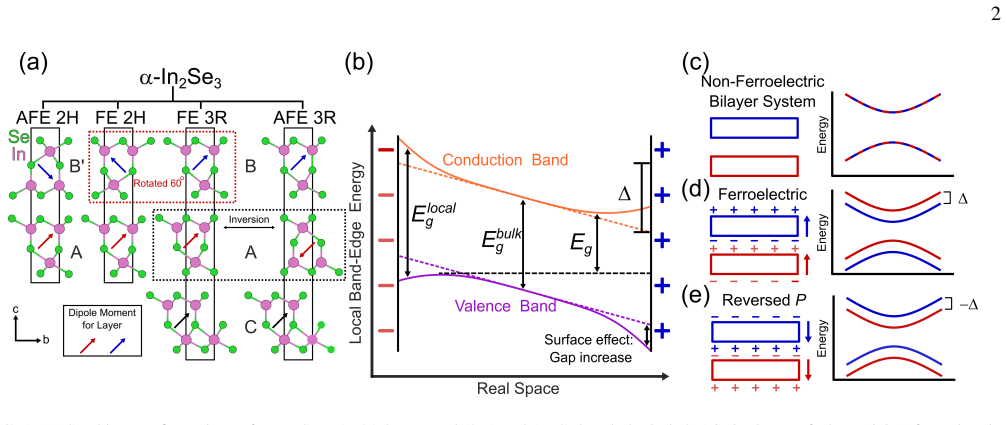
Bands in a Capacitor Model While a complete description of ferroelectricity requires quantum mechanics, our semiclassical model of a band struc- ture in a capacitor from Fig. 1(b) already provides valuable in- sights. With the band bending that is slow at the atomic scale, this model shows a useful distinction between the local,Elocal g , and global band ...
-
[6]
4 and 5 and the intu- ition from the capacitor model [see Fig
Ferroelectric Configurations To complement our findings from Figs. 4 and 5 and the intu- ition from the capacitor model [see Fig. 1(b)], we summarize the LDA and QSGWglobal and averaged local gaps gaps in Table I for the considered configurations. We first focus on the FE systems. In the bulk, the LDA underestimatesE g, but both for 2H and 3R configuratio...
-
[7]
Applications of modern ferroelectrics,
Nonferroelectric Configurations For the non-FE systems we examined only those with a few layers, given that the bulk system is FE. In both AFE and FiE systems for the LDA there isE g >0 that is smaller for FiE, consistent with the corresponding decrease in the net OOP po- larization. Without any OOP polarization for the AFE system, considered in Figs. 5(g...
discussion (0)
Sign in with ORCID, Apple, or X to comment. Anyone can read and Pith papers without signing in.