How Does Intercalation Reshape Layered Structures? A First-Principles Study of Sodium Insertion in Layered Potassium Birnessite
Pith reviewed 2026-05-10 16:39 UTC · model grok-4.3
The pith
Sodium intercalation in layered potassium birnessite can turn the material into a bipolar magnetic semiconductor whose band gap and magnetism are tunable by the intercalation level.
A machine-rendered reading of the paper's core claim, the machinery that carries it, and where it could break.
Core claim
Through hybrid DFT calculations, the authors show that sodium intercalation into potassium birnessite modifies Mn oxidation states and lattice symmetry, leading to tunable electronic properties where certain intercalated configurations behave as bipolar magnetic semiconductors with controllable band gaps and magnetic behavior.
What carries the argument
The sodium intercalation process, which induces changes in Mn oxidation states, lattice distortions, and symmetry, thereby reshaping the electronic structure of the layered δ-MnO2.
If this is right
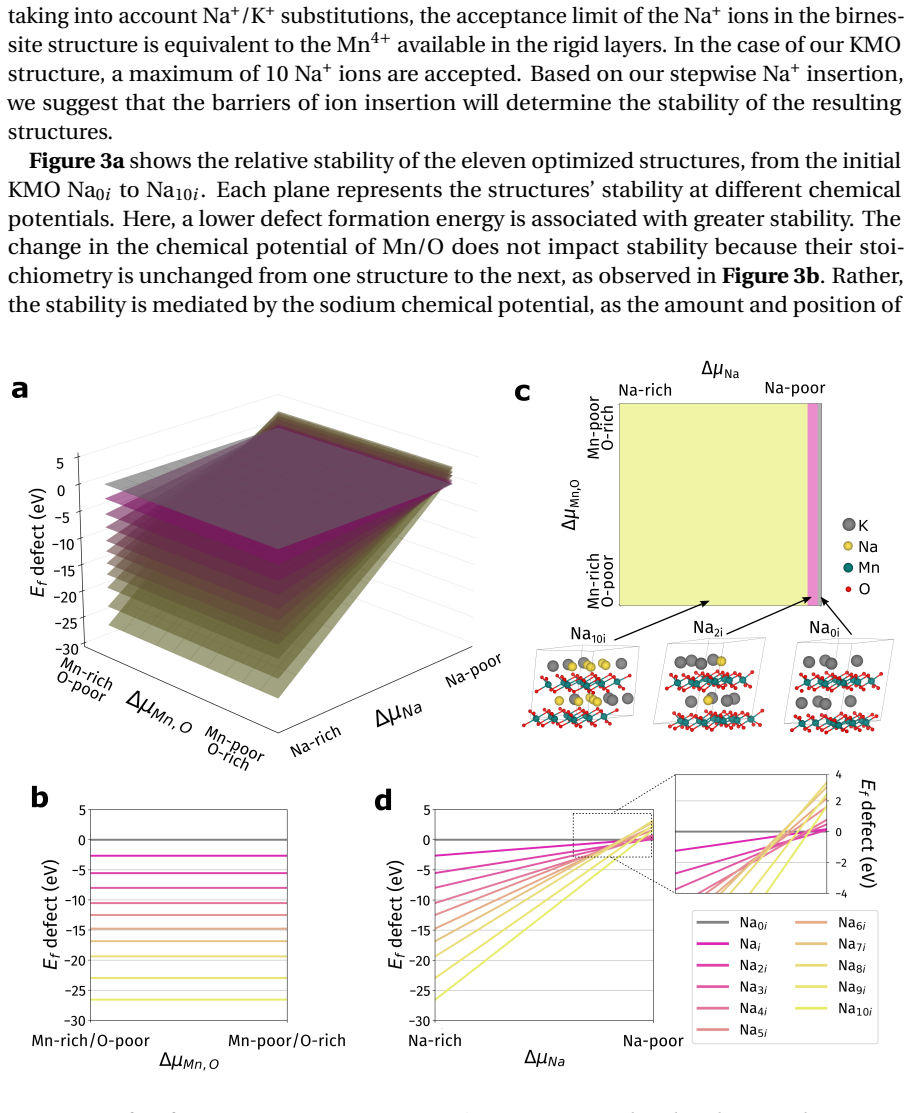
- Intercalated structures remain stable up to certain sodium concentrations as shown by formation energy calculations.
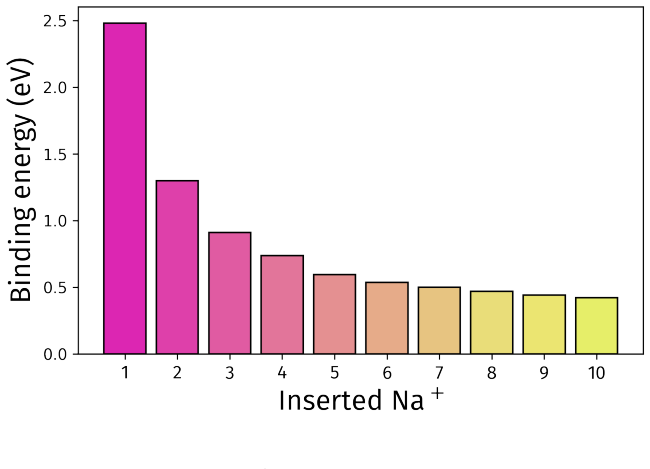
- Na+ ions exhibit lower binding energies near saturation, suggesting easier extraction for applications.
- Diffusion energy barriers for Na+ and K+ are determined, indicating feasible ion mobility in the interlayer.
- Some compositions display bipolar magnetic semiconducting behavior suitable for spintronics.
- Simulated spectra provide identifiable markers for experimental verification of structural changes.
Where Pith is reading between the lines
- These findings suggest birnessite could serve dual roles in energy storage and spintronic devices if the magnetic properties hold under real conditions.
- Controlling intercalation level might allow engineering of band gaps for specific electronic applications without changing the base material.
- Experimental synthesis of partially sodiated birnessite could test the predicted Raman shifts and magnetic transitions directly.
- Similar intercalation strategies might apply to other layered oxides for tunable magnetism.
Load-bearing premise
The hybrid DFT functional and chosen simulation parameters accurately represent the real intercalation energetics, diffusion, and electronic structure without major discrepancies from functional choice or system size.
What would settle it
Direct experimental measurement of the band gaps and magnetic ordering in sodium-intercalated birnessite samples that matches or deviates from the predicted bipolar semiconducting behavior at specific intercalation levels.
Figures




read the original abstract
This study presents a first-principles study at the level of hybrid-level density functional theory of the sodium intercalation process in a layered potassium birnessite (a layered manganese dioxide, {\delta}-MnO2). Understanding the intercalation processes of {\delta}-MnO2 is a vital step in advancing its potential innovative applications. Through a formation energy formalism, we analyze the stability of the structure as sodium ions (Na+) are intercalated between layers. Simulated Raman spectra allow us to find relationships between the vibrational and structural properties of the material, i.e. we identify the most important vibrational modes and related them to the structural/geometrical change. The diffusion of Na+ and K+ ions in birnessite is studied by transition state theory, determining the energy barriers to ion displacement in the interlayer. The symmetry and planar density of the system are characterized by simulated X-ray diffraction and geometrical analysis of the optimized structures. Through binding energy analysis, we also find that the Na+ ions are more loosely bound to the lattice as they reach the saturation limit. Finally, the electronic properties are studied via spin-polarized densities of states. As intercalants are added, the electronic properties are profoundly modified, resulting from modification of Mn oxidation states, lattice distortions, and symmetry effects. Moreover, some of the intercalated structures behave as bipolar magnetic semiconductors with potential applications in spintronics devices. In other words, the band gaps and magnetic behavior of the system can be controlled by intercalation. This work provides an overarching analysis of intercalated birnessite and describes the essential properties of potassium birnessite and co-intercalation with Sodium as a next-generation energy, electronic, and spintronic material.
Editorial analysis
A structured set of objections, weighed in public.
Referee Report
Summary. The manuscript reports a hybrid DFT investigation of Na+ intercalation into layered potassium birnessite (δ-MnO2). Using formation-energy calculations, the authors map the stability of intercalated structures as a function of Na concentration; transition-state searches yield diffusion barriers for Na+ and K+; simulated Raman spectra and XRD patterns are used to link vibrational modes and symmetry to structural changes; binding-energy trends indicate weakening Na binding near saturation; and spin-polarized DOS analysis reveals progressive modification of Mn oxidation states and the emergence of bipolar magnetic semiconductor character in selected compositions, with the claim that intercalation can thereby control band gaps and magnetic behavior for potential spintronics use.
Significance. If the computational results are robust, the work supplies a systematic first-principles map of how Na insertion simultaneously alters interlayer spacing, vibrational signatures, ion mobility, and spin-polarized electronic structure in a technologically relevant layered oxide. The identification of concentration-dependent bipolar magnetic semiconductor behavior constitutes a concrete, falsifiable prediction that could guide experimental efforts in energy-storage and spintronic materials. The study is strengthened by its use of standard, reproducible methods (formation energies, NEB-style barriers, DOS) without ad-hoc fitting parameters.
major comments (2)
- [Methods] Methods section: the hybrid functional, exact-exchange mixing parameter, plane-wave cutoff, k-point mesh, and convergence criteria for forces and energies are not specified. These choices directly affect the formation energies, diffusion barriers, and the precise location of spin-polarized band edges that underpin the bipolar-magnetic-semiconductor claim; without them the central electronic-structure results cannot be reproduced or benchmarked.
- [Electronic properties] Electronic properties / DOS subsection: the assertion that certain Na concentrations produce bipolar magnetic semiconductors is stated qualitatively via DOS plots, but no numerical band-gap values for each spin channel, no explicit demonstration that the Fermi level lies inside both gaps, and no comparison to the formal definition of a bipolar magnetic semiconductor are provided. This weakens the load-bearing claim that intercalation controllably tunes both band gaps and magnetism.
minor comments (3)
- [Abstract and Conclusions] The abstract and conclusion repeatedly use the phrase 'profoundly modified' without quantitative support; replace with specific statements about changes in Mn valence, interlayer distance, or gap size.
- [Results (Raman/XRD)] Simulated Raman and XRD figures lack direct overlay with experimental reference spectra or patterns from the literature, reducing the ability to assess structural fidelity.
- [Binding energy analysis] Binding-energy analysis near saturation would benefit from an explicit table listing Na concentration, binding energy per Na, and interlayer spacing for each relaxed structure.
Simulated Author's Rebuttal
We thank the referee for their positive assessment and constructive comments, which have helped us identify areas for improvement. We address each major comment below and will incorporate the requested details into the revised manuscript.
read point-by-point responses
-
Referee: [Methods] Methods section: the hybrid functional, exact-exchange mixing parameter, plane-wave cutoff, k-point mesh, and convergence criteria for forces and energies are not specified. These choices directly affect the formation energies, diffusion barriers, and the precise location of spin-polarized band edges that underpin the bipolar-magnetic-semiconductor claim; without them the central electronic-structure results cannot be reproduced or benchmarked.
Authors: We agree that these parameters are essential for reproducibility and were inadvertently omitted from the original Methods section. In the revised manuscript we will add a complete description specifying the hybrid functional (including the exact-exchange mixing parameter), plane-wave cutoff energy, k-point mesh, and convergence thresholds for total energy and forces. This addition will enable full reproduction of the formation energies, diffusion barriers, and spin-polarized electronic-structure results. revision: yes
-
Referee: [Electronic properties] Electronic properties / DOS subsection: the assertion that certain Na concentrations produce bipolar magnetic semiconductors is stated qualitatively via DOS plots, but no numerical band-gap values for each spin channel, no explicit demonstration that the Fermi level lies inside both gaps, and no comparison to the formal definition of a bipolar magnetic semiconductor are provided. This weakens the load-bearing claim that intercalation controllably tunes both band gaps and magnetism.
Authors: We acknowledge that the bipolar-magnetic-semiconductor claim would be strengthened by quantitative support. In the revised manuscript we will report numerical band-gap values for each spin channel at the relevant Na concentrations, explicitly verify that the Fermi level lies inside both gaps, and provide a direct comparison to the standard definition of a bipolar magnetic semiconductor (with appropriate literature citations). These additions will make the electronic-structure analysis more rigorous while preserving the original conclusions. revision: yes
Circularity Check
No significant circularity; results are direct DFT computations
full rationale
The paper conducts a standard first-principles hybrid DFT study computing formation energies, transition-state diffusion barriers, spin-polarized DOS, Raman spectra, and XRD patterns for Na-intercalated birnessite. All quantities are obtained by direct minimization of the DFT energy functional or by post-processing of the resulting wavefunctions and forces. No parameters are fitted to the target electronic or magnetic properties, no self-citations supply load-bearing uniqueness theorems, and no ansatz or renaming reduces the central claims (e.g., bipolar magnetic semiconductor behavior) to the input Hamiltonian by construction. The workflow is self-contained against external benchmarks and contains no self-definitional or fitted-input-called-prediction steps.
Axiom & Free-Parameter Ledger
axioms (1)
- domain assumption Hybrid density functional theory at the chosen level accurately describes the energetics, vibrations, and electronic structure of intercalated birnessite.
Lean theorems connected to this paper
-
IndisputableMonolith/Foundation/RealityFromDistinction.leanreality_from_one_distinction unclear?
unclearRelation between the paper passage and the cited Recognition theorem.
some of the intercalated structures behave as bipolar magnetic semiconductors... the band gaps and magnetic behavior of the system can be controlled by intercalation
-
IndisputableMonolith/Cost/FunctionalEquation.leanwashburn_uniqueness_aczel unclear?
unclearRelation between the paper passage and the cited Recognition theorem.
formation energy formalism... binding energy... diffusion... Raman... XRD... spin-polarized densities of states
What do these tags mean?
- matches
- The paper's claim is directly supported by a theorem in the formal canon.
- supports
- The theorem supports part of the paper's argument, but the paper may add assumptions or extra steps.
- extends
- The paper goes beyond the formal theorem; the theorem is a base layer rather than the whole result.
- uses
- The paper appears to rely on the theorem as machinery.
- contradicts
- The paper's claim conflicts with a theorem or certificate in the canon.
- unclear
- Pith found a possible connection, but the passage is too broad, indirect, or ambiguous to say the theorem truly supports the claim.
Reference graph
Works this paper leans on
-
[1]
X. Zhang, Z. Hou, X. Li, J. Liang, Y. Zhu, and Y. Qian, “Na-birnessite with high capacity and long cycle life for rechargeable aqueous sodium-ion battery cathode electrodes,” Journal of Materials Chemistry A, vol. 4, no. 3, pp. 856–860, 2016
work page 2016
-
[2]
Electrochemical insights into the energy storage mechanism of birnessite in aqueous solutions,
A. Alves, J. P . Correia, T . M. Silva, and M. Montemor, “Electrochemical insights into the energy storage mechanism of birnessite in aqueous solutions,”Electrochimica Acta, vol. 454, p. 142418, 2023
work page 2023
-
[3]
M. Aranda, R. Klee, P . Lavela, and J. L. Tirado, “Improving the performance of potassium birnessite cathodes for sodium-ion batteries by partial ion exchange,”Battery Energy, p. e20240065, 2024
work page 2024
-
[4]
The photocatalytic oxidation of As(III) on birnessite,
P . Li, Y. Wang, J. Wang, W . Wang, Z. Ding, J. Liang, and Q. Fan, “The photocatalytic oxidation of As(III) on birnessite,”npj Clean Water, vol. 7, no. 1, p. 19, 2024
work page 2024
-
[5]
Birnessite: A layered manganese oxide to capture sunlight for water-splitting catalysis,
K. P . Lucht and J. L. Mendoza-Cortes, “Birnessite: A layered manganese oxide to capture sunlight for water-splitting catalysis,”The Journal of Physical Chemistry C, vol. 119, no. 40, pp. 22838–22846, 2015
work page 2015
-
[7]
On the role ofMn(IV) vacancies in the photore- ductive dissolution of hexagonal birnessite,
K. D. Kwon, K. Refson, and G. Sposito, “On the role ofMn(IV) vacancies in the photore- ductive dissolution of hexagonal birnessite,”Geochimica et Cosmochimica Acta, vol. 73, no. 14, pp. 4142–4150, 2009
work page 2009
-
[8]
Zinc surface complexes on birnessite: A density functional theory study,
K. D. Kwon, K. Refson, and G. Sposito, “Zinc surface complexes on birnessite: A density functional theory study,”Geochimica et Cosmochimica Acta, vol. 73, no. 5, pp. 1273– 1284, 2009. 17
work page 2009
-
[9]
Understanding the trends in transition metal sorption by vacancy sites in birnessite,
K. D. Kwon, K. Refson, and G. Sposito, “Understanding the trends in transition metal sorption by vacancy sites in birnessite,”Geochimica et Cosmochimica Acta, vol. 101, pp. 222–232, 2013
work page 2013
-
[10]
W . Yang, Y. Zhu, F . You, L. Yan, Y. Ma, C. Lu, P . Gao, Q. Hao, and W . Li, “Insights into the surface-defect dependence of molecular oxygen activation over birnessite-type MnO2,” Applied Catalysis B: Environmental, vol. 233, pp. 184–193, 2018
work page 2018
-
[11]
Nature of high-and low-affinity metal surface sites on birnessite nanosheets,
A. Manceau and S. N. Steinmann, “Nature of high-and low-affinity metal surface sites on birnessite nanosheets,”ACS Earth and Space Chemistry, vol. 5, no. 1, pp. 66–76, 2021
work page 2021
-
[12]
H. Liu, W . Gu, B. Luo, P . Fan, L. Liao, E. Tian, Y. Niu, J. Fu, Z. Wang, Y. Wu, G. Lv, and L. Mei, “Influence of Fe doping on the crystal structure, electronic structure and supercapacitance performance of birnessite [(Na, K)x(Mn4+,Mn 3+)2O4 ·1.5H 2O] with high areal mass loading,”Electrochimica Acta, vol. 291, pp. 31–40, 2018
work page 2018
-
[13]
Density functional theory modeling of the oxidation mechanism of Co(II) by birnessite,
A. Manceau and S. N. Steinmann, “Density functional theory modeling of the oxidation mechanism of Co(II) by birnessite,”ACS Earth and Space Chemistry, vol. 6, no. 8, pp. 2063–2075, 2022
work page 2063
-
[14]
Density functional theory modeling of the oxidation mechanism of Tl(I) by birnessite,
A. Manceau and S. N. Steinmann, “Density functional theory modeling of the oxidation mechanism of Tl(I) by birnessite,”ACS Earth and Space Chemistry, vol. 7, no. 7, pp. 1459– 1466, 2023
work page 2023
-
[15]
P . Scheitenberger, H. Euchner, and M. Lindén, “The hidden impact of structural water– how interlayer water largely controls the raman spectroscopic response of birnessite- type manganese oxide,”Journal of Materials Chemistry A, vol. 9, no. 34, pp. 18466–18476, 2021
work page 2021
-
[16]
Q. Chu, X. Wang, X. Zhang, Q. Li, and X. Liu, “Buckled layers inK0.66Mn2O4 ·0.28 H2O and K0.99Mn3O6 ·1.25 H2O synthesized at high pressure: Implication for the mechanism of layer-to-tunnel transformation in manganese oxides,”Inorganic Chemistry, vol. 50, no. 6, pp. 2049–2051, 2011
work page 2049
-
[17]
Crystal23: A program for computational solid state physics and chemistry,
A. Erba, J. K. Desmarais, S. Casassa, B. Civalleri, L. Donà, I. J. Bush, B. Searle, L. Maschio, L. Edith-Daga, A. Cossard,et al., “Crystal23: A program for computational solid state physics and chemistry,”Journal of Chemical Theory and Computation, vol. 19, no. 20, pp. 6891–6932, 2022
work page 2022
-
[18]
S. Grimme, J. Antony, S. Ehrlich, and H. Krieg, “ A consistent and accurate ab initio parametrization of density functional dispersion correction (DFT-D) for the 94 ele- ments H-Pu,”The Journal of Chemical Physics, vol. 132, no. 15, p. 154104, 2010
work page 2010
-
[19]
A density-functional model of the dispersion interaction,
A. D. Becke and E. R. Johnson, “ A density-functional model of the dispersion interaction,” The Journal of chemical physics, vol. 123, no. 15, 2005. 18
work page 2005
-
[20]
D. Vilela Oliveira, J. Laun, M. F . Peintinger, and T . Bredow, “BSSE-correction scheme for consistent gaussian basis sets of double-and triple-zeta valence with polarization quality for solid-state calculations,”Journal of Computational Chemistry, vol. 40, no. 27, pp. 2364–2376, 2019
work page 2019
-
[21]
Vesta 3 for three-dimensional visualization of crystal, vol- umetric and morphology data,
K. Momma and F . Izumi, “Vesta 3 for three-dimensional visualization of crystal, vol- umetric and morphology data,”Journal of Applied Crystallography, vol. 44, no. 6, pp. 1272–1276, 2011
work page 2011
-
[22]
M. Ferrero, M. Rérat, R. Orlando, and R. Dovesi, “Coupled perturbed Hartree-Fock for periodic systems: The role of symmetry and related computational aspects,”The Journal of Chemical Physics, vol. 128, no. 1, p. 014110, 2008
work page 2008
-
[23]
M. Ferrero, M. Rérat, R. Orlando, and R. Dovesi, “The calculation of static polarizabili- ties of 1-3d periodic compounds. the implementation in the crystal code,”Journal of Computational Chemistry, vol. 29, no. 9, pp. 1450–1459, 2008
work page 2008
-
[24]
M. Ferrero, M. Rérat, B. Kirtman, and R. Dovesi, “Calculation of first and second static hyperpolarizabilities of one-to three-dimensional periodic compounds. implementa- tion in the crystal code.,”The Journal of Chemical Physics, vol. 129, no. 24, p. 244110, 2008
work page 2008
-
[25]
Reversible work transition state theory: application to dissociative adsorption of hydrogen,
G. Mills, H. Jónsson, and G. K. Schenter, “Reversible work transition state theory: application to dissociative adsorption of hydrogen,”Surface Science, vol. 324, no. 2-3, pp. 305–337, 1995
work page 1995
-
[26]
Nudged elastic band method for finding min- imum energy paths of transitions,
H. Jónsson, G. Mills, and K. W . Jacobsen, “Nudged elastic band method for finding min- imum energy paths of transitions,” inClassical and quantum dynamics in condensed phase simulations, pp. 385–404, World Scientific, 1998
work page 1998
-
[27]
Ab initio molecular dynamics for liquid metals,
G. Kresse and J. Hafner, “ Ab initio molecular dynamics for liquid metals,”Physical Review B, vol. 47, no. 1, p. 558, 1993
work page 1993
-
[28]
Efficient iterative schemes for ab initio total-energy calculations using a plane-wave basis set,
G. Kresse and J. Furthmüller, “Efficient iterative schemes for ab initio total-energy calculations using a plane-wave basis set,”Physical Review B, vol. 54, no. 16, p. 11169, 1996
work page 1996
-
[29]
Generalized gradient approximation made simple,
J. P . Perdew, K. Burke, and M. Ernzerhof, “Generalized gradient approximation made simple,”Physical Review Letters, vol. 77, no. 18, p. 3865, 1996
work page 1996
-
[30]
Projector augmented-wave method,
P . E. Blöchl, “Projector augmented-wave method,”Physical review B, vol. 50, no. 24, p. 17953, 1994
work page 1994
-
[31]
From ultrasoft pseudopotentials to the projector augmented- wave method,
G. Kresse and D. Joubert, “From ultrasoft pseudopotentials to the projector augmented- wave method,”Physical review b, vol. 59, no. 3, p. 1758, 1999. 19
work page 1999
-
[32]
Raman spectroscopy study of manganese oxides: Layer structures,
J. E. Post, D. A. McKeown, and P . J. Heaney, “Raman spectroscopy study of manganese oxides: Layer structures,”American Mineralogist: Journal of Earth and Planetary Mate- rials, vol. 106, no. 3, pp. 351–366, 2021
work page 2021
-
[33]
S. Zhao, K. Yan, P . Munroe, B. Sun, and G. Wang, “Construction of hierarchical K1.39Mn3O6 spheres via AlF3 coating for high-performance potassium-ion batteries,” Advanced Energy Materials, vol. 9, no. 10, p. 1803757, 2019
work page 2019
-
[34]
A computational framework for automation of point defect calculations,
A. Goyal, P . Gorai, H. Peng, S. Lany, and V . Stevanovi´ c, “ A computational framework for automation of point defect calculations,”Computational Materials Science, vol. 130, pp. 1–9, 2017
work page 2017
-
[35]
D. Maldonado-Lopez, J. R. Rodriguez, V . G. Pol, R. Syamsai, N. G. Andrews, S. Gutiérrez- Ojeda, R. Ponce-Perez, M. G. Moreno-Armenta, and J. Guerrero-Sanchez, “ Atomic-scale understanding of Li storage processes in the Ti4C3 and chemically ordered Ti2Ta2C3 mxenes: A theoretical and experimental assessment,”ACS Applied Energy Materials, vol. 5, no. 2, pp....
work page 2022
-
[36]
Raman spectra of birnessite manganese dioxides,
C. Julien, M. Massot, R. Baddour-Hadjean, S. Franger, S. Bach, and J. Pereira-Ramos, “Raman spectra of birnessite manganese dioxides,”Solid State Ionics, vol. 159, no. 3-4, pp. 345–356, 2003
work page 2003
-
[37]
P . Scheitenberger, S. Brimaud, and M. Lindén, “XRD/raman spectroscopy studies of the mechanism of (de)intercalation of Na+ from/into highly crystalline birnessite,” Materials Advances, vol. 2, no. 12, pp. 3940–3953, 2021
work page 2021
-
[38]
Raman spectroscopy study of k-birnessite single crystals,
D. H. Ha, G. Noh, H. Kim, D. H. Kim, J. Kim, S. Jung, C. Hwang, H. Y. Lee, Y. J. Yun, J. Y. Kwak,et al., “Raman spectroscopy study of k-birnessite single crystals,”Journal of Materials Chemistry A, vol. 13, no. 1, pp. 617–626, 2025
work page 2025
-
[39]
Redox properties of birnessite from a defect perspective,
H. Peng, I. G. McKendry, R. Ding, A. C. Thenuwara, Q. Kang, S. L. Shumlas, D. R. Strongin, M. J. Zdilla, and J. P . Perdew, “Redox properties of birnessite from a defect perspective,” Proceedings of the National Academy of Sciences, vol. 114, no. 36, pp. 9523–9528, 2017
work page 2017
-
[40]
First-principles design of spintronics materials,
X. Li and J. Yang, “First-principles design of spintronics materials,”National Science Review, vol. 3, no. 3, pp. 365–381, 2016
work page 2016
-
[41]
Bipolar magnetic materials for electrical manipulation of spin- polarization orientation,
X. Li and J. Yang, “Bipolar magnetic materials for electrical manipulation of spin- polarization orientation,”Physical Chemistry Chemical Physics, vol. 15, no. 38, pp. 15793–15801, 2013. 20 Supplementary Information for “How Does Intercalation Reshape Layered Structures? A First-Principles Study of Sodium Insertion in Layered Potassium Birnessite” Adriana...
work page 2013
discussion (0)
Sign in with ORCID, Apple, or X to comment. Anyone can read and Pith papers without signing in.