Fairness-aware Strategic Design of Station-based Electric Car-Sharing Systems
Pith reviewed 2026-05-10 15:44 UTC · model grok-4.3
The pith
A bi-objective optimization framework designs electric car-sharing systems that jointly maximize revenue and equitable service across user groups.
A machine-rendered reading of the paper's core claim, the machinery that carries it, and where it could break.
Core claim
The central claim is that a bi-objective trajectory-based integer program, which simultaneously optimizes revenue and two explicit fairness measures on realized group service rates, can generate station-location, charger-capacity, and fleet-size decisions that are both economically viable and socially inclusive for station-based electric car-sharing systems.
What carries the argument
The bi-objective trajectory-based formulation that embeds service-rate disparity and max-min fairness measured on realized group service rates over a multi-day demand horizon.
If this is right
- Station and charger capacities must be sized above pure revenue-maximizing levels to achieve meaningful equity gains.
- The Pareto frontier quantifies the precise revenue loss associated with each incremental improvement in service-rate parity.
- Multi-day demand instances are necessary to expose equity issues that single-day models conceal.
- The branch-and-price and diving-heuristic combination produces usable decision-support outputs for realistic city-scale instances.
Where Pith is reading between the lines
- The same modeling structure could be adapted to other shared-mobility modes such as e-bike or scooter fleets where equity across neighborhoods is a policy goal.
- Dynamic pricing levers, omitted here, might be added later to reduce the revenue cost of equity constraints.
- Validation against longitudinal user surveys would test whether the chosen service-rate metrics align with perceived fairness.
Load-bearing premise
That the two chosen fairness measures applied to realized group service rates in a multi-day representative-demand setting adequately capture equity for all relevant user groups.
What would settle it
A field deployment in which the actual service rates achieved by demographic user groups under the recommended designs deviate substantially from the rates predicted by the multi-day model.
Figures
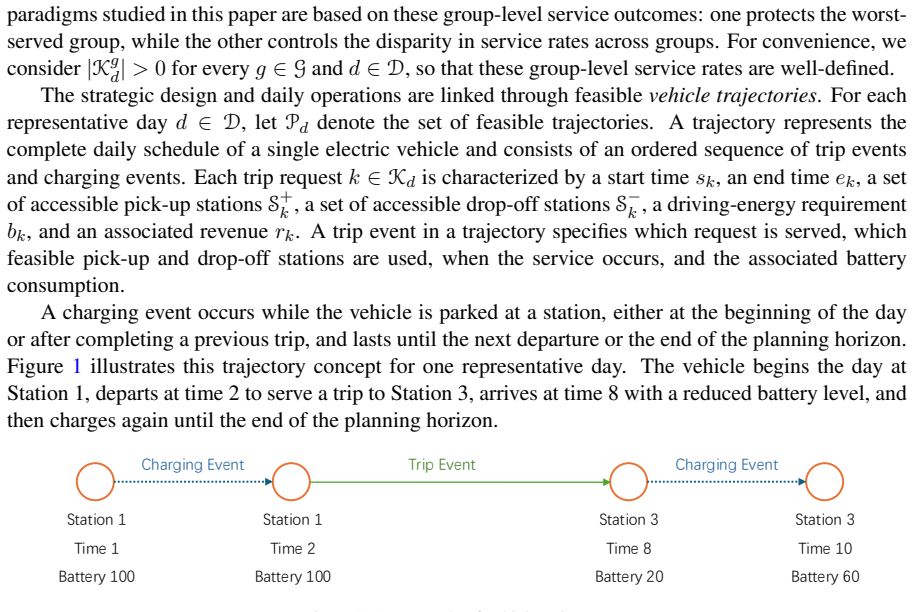


read the original abstract
Electric car-sharing systems are pivotal for sustainable urban mobility, but their strategic design is complicated by operational constraints, particularly those arising from the charging needs of electric vehicles. The success of these systems hinges on integrating long-term investment decisions (such as station locations, charger capacities, and fleet size) with daily operational realities, including vehicle routing to serve user trip requests and battery management. While existing integrated models address this strategic-operational link, they have prioritized economic efficiency, overlooking the critical dimension of service equity. This paper addresses this gap by making fairness a central design principle, operationalized through two distinct paradigms, namely, service-rate disparity and max-min fairness, measured explicitly via realized group service rates rather than static spatial accessibility. To capture demand heterogeneity, we adopt a multi-day representative-demand setting, and develop a bi-objective trajectory-based formulation that jointly optimizes revenue and service equity. We develop a solution framework in which a branch-and-price algorithm solves the single-objective variants of the models, embedded within an exact bi-objective procedure to generate the Pareto frontier and complemented by a diving-heuristic-based approach for obtaining high-quality frontier approximations for larger instances. Through extensive computational experiments, including a Vienna-based real-data case study, we provide key managerial insights into the fundamental trade-offs between revenue, equity, and system design, demonstrating that the proposed framework can serve as a useful decision-support tool for designing station-based electric car-sharing systems that are both economically viable and socially inclusive.
Editorial analysis
A structured set of objections, weighed in public.
Referee Report
Summary. The paper develops a bi-objective trajectory-based integer programming model for strategic design of station-based electric car-sharing systems. It jointly optimizes revenue (via fleet size, station locations, and charger capacities) and equity (operationalized as service-rate disparity and max-min fairness computed on realized group service rates over multi-day representative-demand instances), while enforcing daily vehicle routing and battery constraints. A branch-and-price algorithm solves the single-objective versions, embedded in an exact bi-objective procedure for the Pareto frontier, with a diving heuristic for larger instances; results and managerial insights are illustrated on a Vienna real-data case study.
Significance. If the model correctly couples strategic decisions to operational trajectories and the chosen fairness metrics prove representative, the framework supplies a practical decision-support tool for trading off economic performance against social inclusivity in EV car-sharing. The algorithmic machinery (branch-and-price plus exact Pareto procedure) and the multi-day demand setting constitute concrete strengths that could be adopted by operators and planners.
major comments (2)
- [Abstract and §3 (fairness paradigms)] The central claim that the framework yields socially inclusive designs rests on the adequacy of service-rate disparity and max-min fairness computed on realized group service rates (Abstract; §3). The manuscript does not provide a validation or sensitivity analysis showing that the chosen group partitions and multi-day instances capture the relevant equity dimensions (e.g., temporal or demographic heterogeneity beyond the selected demand patterns); if these proxies systematically under-represent certain user groups, the Pareto frontier and associated trade-off insights lose external validity.
- [§4 (model formulation)] §4 (trajectory-based formulation): the linking constraints between strategic decisions (station/charger/fleet) and daily routing/battery trajectories are described at a high level, but it is not shown that the multi-day representative-demand instances are free of systematic bias in trip-request or charging patterns. Without such a check, the bi-objective outputs may not reliably reflect the claimed revenue-equity trade-offs.
minor comments (2)
- [Notation and §3] Notation for group service rates and the exact definition of the disparity and max-min measures should be stated explicitly in a single table or subsection to improve readability.
- [Computational experiments / case study] The Vienna case-study section would benefit from a brief description of how the multi-day demand instances were generated and validated against real usage data.
Simulated Author's Rebuttal
We thank the referee for the constructive and detailed review. We address each major comment below and indicate the revisions planned for the next version of the manuscript.
read point-by-point responses
-
Referee: [Abstract and §3 (fairness paradigms)] The central claim that the framework yields socially inclusive designs rests on the adequacy of service-rate disparity and max-min fairness computed on realized group service rates (Abstract; §3). The manuscript does not provide a validation or sensitivity analysis showing that the chosen group partitions and multi-day instances capture the relevant equity dimensions (e.g., temporal or demographic heterogeneity beyond the selected demand patterns); if these proxies systematically under-represent certain user groups, the Pareto frontier and associated trade-off insights lose external validity.
Authors: We appreciate the referee drawing attention to the external validity of the fairness proxies. In the Vienna case study, group partitions are defined from the spatial zones present in the historical demand data (Section 5), which induce distinct realized service-rate patterns across the multi-day instances. The multi-day setting is explicitly chosen to incorporate temporal heterogeneity in trip requests and charging requirements. We acknowledge that these partitions do not exhaustively cover every conceivable demographic dimension and that a full external validation would require supplementary data sources beyond the operational dataset used. To address the concern directly, we will add a new sensitivity subsection in the computational experiments that varies both the number of representative days and alternative group definitions (e.g., time-of-day clustering), together with an explicit limitations paragraph in the conclusions discussing the scope of the chosen equity metrics. revision: yes
-
Referee: [§4 (model formulation)] §4 (trajectory-based formulation): the linking constraints between strategic decisions (station/charger/fleet) and daily routing/battery trajectories are described at a high level, but it is not shown that the multi-day representative-demand instances are free of systematic bias in trip-request or charging patterns. Without such a check, the bi-objective outputs may not reliably reflect the claimed revenue-equity trade-offs.
Authors: The trajectory-based model in §4 links strategic decisions to operational trajectories via the explicit set of feasible daily routes and battery-state transitions (constraints (4)–(10)), ensuring that station locations, charger capacities, and fleet size are evaluated only against realizable multi-day schedules. The representative-demand instances are constructed by stratified sampling from the full Vienna historical trip records so that the empirical distributions of request times, origins, destinations, and durations are preserved; battery consumption is then derived deterministically from these trips. Basic distributional checks against aggregate statistics are already reported in the data-preparation description (Section 5 and online supplement). We agree that a more prominent statement of these checks would strengthen the exposition. In the revision we will expand the instance-generation paragraph in §4 and §5 to include the exact sampling procedure and the statistical matching criteria employed, thereby clarifying that the revenue-equity trade-offs are evaluated on instances that faithfully reflect the observed demand patterns. revision: yes
Circularity Check
No circularity in model formulation or solution claims
full rationale
The paper formulates a standard bi-objective integer program (trajectory-based) that optimizes revenue and equity metrics (service-rate disparity, max-min fairness) on realized group service rates. These metrics are externally defined inputs to the model, not derived from or fitted to its own outputs. The branch-and-price algorithm and diving heuristic solve the model without any self-referential definitions or predictions that reduce to fitted parameters by construction. No self-citation chains or uniqueness theorems are invoked to justify core choices. The derivation chain is self-contained as a standard optimization framework applied to chosen fairness paradigms.
Axiom & Free-Parameter Ledger
Reference graph
Works this paper leans on
-
[1]
URL:https://go.invers.com/en/ resources/invers-mobility-barometer-european-car-sharing-2024. ac- cessed: 2025-10-31. Basciftci, B., Koca, E., Kosunda, S.E.,
work page 2024
-
[2]
Correia, G.H.D.A., Jorge, D.R., Antunes, D.M.,
doi:10.1016/j.trc.2026.105638. Correia, G.H.D.A., Jorge, D.R., Antunes, D.M.,
-
[3]
The bi-objective multimodal car-sharing problem. OR SPECTRUM 44, 307–348. doi:10.1007/s00291-021-00631-2. Giuffrida, N., Pilla, F., Carroll, P.,
-
[4]
URL:https://www.mordorintelligence.com/industry-reports/ car-sharing-market?utm_source=abnewswire
Car sharing market size & share analysis - growth trends & forecasts (2025 - 2030). URL:https://www.mordorintelligence.com/industry-reports/ car-sharing-market?utm_source=abnewswire. accessed: 2025-10-31. Jin, S., et al.,
work page 2025
-
[5]
Autonomous connected electric vehicle (acev)-based car- sharing system modeling and optimal planning: A unified two-stage multi-objective optimization methodology. ENERGY 169, 797–818. doi:10.1016/j.energy.2018.12.066. Negri, M., Bieker, G.,
-
[6]
URL:https://theicct.org/ wp-content/uploads/2025/07/ID-392-â˘A¸ S-Life-cycle-GHG_report_final
Life-cycle greenhouse gas emissions from passenger cars in the Eu- ropean Union: A 2025 update and key factors to consider. URL:https://theicct.org/ wp-content/uploads/2025/07/ID-392-â˘A¸ S-Life-cycle-GHG_report_final. pdf. Qian, X., Jaller, M., Circella, G.,
work page 2025
-
[7]
URL:https://www.statista.com/outlook/mmo/ shared-mobility/car-sharing/worldwide/
Car-sharing - worldwide. URL:https://www.statista.com/outlook/mmo/ shared-mobility/car-sharing/worldwide/. accessed: 2025-10-31. 28 Wang, C., Zhang, M.,
work page 2025
discussion (0)
Sign in with ORCID, Apple, or X to comment. Anyone can read and Pith papers without signing in.