The double Schwarzschild solution in bispherical coordinates
Pith reviewed 2026-05-10 07:58 UTC · model grok-4.3
The pith
An explicit elliptic-function map transforms the equal-mass double Schwarzschild solution into bispherical coordinates.
A machine-rendered reading of the paper's core claim, the machinery that carries it, and where it could break.
Core claim
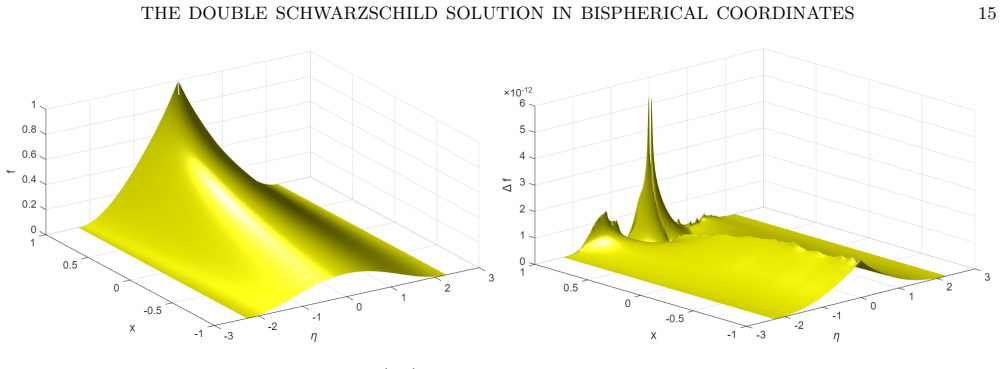
The equal-mass double Schwarzschild solution is studied in bispherical coordinates. An explicit conformal transformation from cylindrical Weyl coordinates to bispherical coordinates is given in terms of elliptic functions. A multi-domain spectral method for spacetimes in bispherical coordinates is presented to numerically reconstruct this solution.
What carries the argument
The conformal transformation from Weyl to bispherical coordinates expressed via elliptic functions, which carries the vacuum metric while adapting to the two-center geometry.
If this is right
- The vacuum Einstein equations remain satisfied after the coordinate change.
- The multi-domain spectral method produces a faithful numerical representation of the solution in the new coordinates.
- The bispherical system avoids artificial coordinate singularities that appear in Weyl coordinates for two separated sources.
Where Pith is reading between the lines
- The same elliptic-function technique may apply to other axisymmetric vacuum solutions written in Weyl form.
- Numerical evolution schemes could be built on this coordinate system to study time-dependent binary black hole dynamics.
- Comparison of the reconstructed metric against known asymptotic properties of the double Schwarzschild solution offers a direct test of the method's accuracy.
Load-bearing premise
The elliptic-function map is truly conformal and reproduces the original double Schwarzschild geometry exactly, without adding singularities or breaking the vacuum equations.
What would settle it
A pointwise check showing that the pulled-back metric fails to satisfy the vacuum Einstein equations at a regular point in the domain.
Figures




read the original abstract
The double Schwarzschild solution in the equal mass case is studied in bispherical coordinates. An explicit conformal transformation from cylindrical Weyl coordinates to bispherical coordinates is given in terms of elliptic functions. A multi-domain spectral method for spacetimes in bispherical coordinates is presented to numerically reconstruct this solution.
Editorial analysis
A structured set of objections, weighed in public.
Referee Report
Summary. The manuscript studies the equal-mass double Schwarzschild solution in bispherical coordinates. It claims to provide an explicit conformal transformation from cylindrical Weyl coordinates to bispherical coordinates expressed in terms of elliptic functions, and presents a multi-domain spectral method to numerically reconstruct the solution in the new coordinates.
Significance. If the elliptic-function map is confirmed to be conformal, to satisfy the vacuum Einstein equations exactly, and to map the rod singularities without introducing extraneous curvature or coordinate singularities, the work would supply a concrete coordinate representation of a known binary black-hole geometry that could facilitate analytic or numerical studies of equal-mass systems. The multi-domain spectral approach, if shown to converge, would also constitute a reusable numerical tool for other vacuum spacetimes in bispherical coordinates.
major comments (2)
- [the section presenting the coordinate transformation] The central claim that the elliptic-function transformation is conformal and exactly preserves the double-Schwarzschild geometry rests on an unverified assertion. The manuscript must demonstrate explicitly that the given map satisfies the two-dimensional Cauchy-Riemann conditions (or the equivalent Jacobian relation for conformality) throughout the domain excluding the axis and horizons, and that the branch structure maps the two rod singularities precisely onto the bispherical coordinate singularities without extra zeros, poles, or curvature.
- [the section describing the multi-domain spectral method] The numerical reconstruction via the multi-domain spectral method lacks reported error estimates, convergence tests with respect to the number of domains or spectral order, and direct comparison against the known Weyl-coordinate values of the metric functions. Without these, it is impossible to assess whether the numerical solution faithfully reproduces the analytic double-Schwarzschild geometry.
minor comments (2)
- [the coordinate transformation] The precise definition of the elliptic functions (including the choice of branch cuts and integration constants) should be stated with an explicit equation or reference so that the map can be reproduced independently.
- [introduction or coordinate section] Notation for the bispherical coordinates and the conformal factor should be introduced once and used consistently; currently the relation between the cylindrical (ρ,z) and bispherical variables is not summarized in a single equation.
Simulated Author's Rebuttal
We thank the referee for the careful reading and constructive comments on our manuscript. We address each major comment below and indicate the revisions we will make to strengthen the presentation.
read point-by-point responses
-
Referee: [the section presenting the coordinate transformation] The central claim that the elliptic-function transformation is conformal and exactly preserves the double-Schwarzschild geometry rests on an unverified assertion. The manuscript must demonstrate explicitly that the given map satisfies the two-dimensional Cauchy-Riemann conditions (or the equivalent Jacobian relation for conformality) throughout the domain excluding the axis and horizons, and that the branch structure maps the two rod singularities precisely onto the bispherical coordinate singularities without extra zeros, poles, or curvature.
Authors: We agree that an explicit verification strengthens the central claim. The transformation was constructed from the known conformal properties of the elliptic functions that solve the relevant Laplace equation, but the manuscript did not include a direct check of the Cauchy-Riemann conditions or the Jacobian determinant. In the revised manuscript we will add a short subsection that computes the Jacobian relation throughout the domain (away from the axis and horizons), verifies that it equals the required conformal factor, and analyzes the branch cuts to confirm that the two rod singularities map precisely onto the bispherical coordinate singularities without introducing extraneous zeros, poles, or curvature singularities. revision: yes
-
Referee: [the section describing the multi-domain spectral method] The numerical reconstruction via the multi-domain spectral method lacks reported error estimates, convergence tests with respect to the number of domains or spectral order, and direct comparison against the known Weyl-coordinate values of the metric functions. Without these, it is impossible to assess whether the numerical solution faithfully reproduces the analytic double-Schwarzschild geometry.
Authors: We accept that quantitative validation is required. The original manuscript described the multi-domain spectral method and showed representative solutions but did not report error norms, convergence studies, or direct comparisons with the Weyl-coordinate data. In the revised version we will add these diagnostics: L2 and maximum-norm errors for increasing spectral order and number of domains, together with pointwise comparisons of the metric functions against the known Weyl expressions at selected interior points. revision: yes
Circularity Check
No significant circularity detected in the derivation chain.
full rationale
The paper starts from the established Weyl form of the equal-mass double Schwarzschild solution in cylindrical coordinates and supplies an explicit conformal map to bispherical coordinates expressed via elliptic functions, followed by a multi-domain spectral reconstruction. This constitutes a direct coordinate transformation and numerical verification rather than any self-definitional loop, fitted parameter renamed as prediction, or load-bearing self-citation chain. The central claim remains independent of its own outputs, with the elliptic map asserted as a construction from known inputs and the spectral method serving as external reconstruction.
Axiom & Free-Parameter Ledger
axioms (2)
- domain assumption The equal-mass double Schwarzschild solution satisfies the vacuum Einstein equations in Weyl coordinates.
- standard math A conformal rescaling preserves the vacuum character of the metric.
Reference graph
Works this paper leans on
-
[1]
Observation of gravitational waves from a binary black hole merger,
B. P. A. et al., “Observation of gravitational waves from a binary black hole merger,” Physical Review Letters , vol. 116, p. 061102, 2016
work page 2016
-
[2]
Detweiler in Frontiers in Numerical Relativity (C
S. Detweiler in Frontiers in Numerical Relativity (C. R. Evans, L. S. Finn, and D. W. Hobill, eds.), p. 43, Cambridge, England: Cambridge University Press, 1989
work page 1989
-
[3]
J. Blackburn and S. Detweiler Physical Review D , vol. 46, p. 2318, 1992
work page 1992
-
[4]
Detweiler Physical Review D , vol
S. Detweiler Physical Review D , vol. 50, p. 4929, 1994
work page 1994
- [5]
- [6]
-
[7]
J. Friedman, K. Uryu, and M. Shibata Physical Review D , vol. 65, p. 064035, 2002
work page 2002
-
[8]
E. Gourgoulhon, P. Grandclément, and S. Bonazzola Physical Review D , vol. 65, p. 044020, 2002
work page 2002
-
[9]
P. Grandclément, E. Gourgoulhon, and S. Bonazzola Physical Review D , vol. 65, p. 044021, 2002
work page 2002
-
[10]
Z. Andrade, C. Beetle, A. Blinov, B. Bromley, L. Burko, M. Cranor, R. Owen, and R. Price Physical Review D, vol. 70, p. 064001, 2003
work page 2003
-
[11]
M. Caudill, G. B. Cook, J. D. Grigsby, and H. P. Pfeiffer Physical Review D , vol. 74, p. 064011, 2006
work page 2006
-
[12]
K. Uryu, F. Limousin, J. L. Friedman, E. Gourgoulhon, and M. Shibata Physical Review D , vol. 80, p. 124004, 2009
work page 2009
-
[13]
J. L. Friedman and K. Uryu Physical Review D , vol. 73, p. 104039, 2006
work page 2006
-
[14]
N. T. Bishop, R. Gómez, L. Lehner, M. Maharaj, and J. Winicour Physical Review D , vol. 72, p. 024002, 2005
work page 2005
-
[15]
K. Uryu, E. Gourgoulhon, and C. Markakis Physical Review D , vol. 82, p. 104054, 2010
work page 2010
-
[16]
S. Yoshida, B. C. Bromley, J. S. Read, K. Uryu, and J. L. Friedman Classical and Quantum Gravity , vol. 23, no. 16, 2006
work page 2006
- [17]
-
[18]
B. Bromley, R. Owen, and R. H. Price Physical Review D , vol. 71, p. 104017, 2005
work page 2005
- [19]
-
[20]
S. R. Lau and R. H. Price Journal of Computational Physics , vol. 227, no. 2, p. 1126, 2007
work page 2007
-
[21]
S. R. Lau and R. H. Price Journal of Computational Physics , vol. 231, no. 22, p. 7695, 2012
work page 2012
-
[22]
S. Bonazzola, J. L. Jaramillo, and J. Novak Classical and Quantum Gravity , vol. 24, no. 16, 2007
work page 2007
- [23]
-
[24]
J. Ehlers, Konstruktion und Charakterisierungen von Lösungen der Einstein ’schen Gravitationsgleichungen . PhD thesis, University of Hamburg, 1957. Dissertation (in German)
work page 1957
-
[25]
Geroch Journal of Mathematical Physics , vol
R. Geroch Journal of Mathematical Physics , vol. 12, p. 918, 1971
work page 1971
-
[26]
F. J. Ernst Physical Review, vol. 167, p. 1175, 1968
work page 1968
-
[27]
C. Klein and O. Richter, Ernst Equation and Riemann Surfaces , vol. 685 of Lecture Notes in Physics . Berlin: Springer, 2005
work page 2005
-
[28]
G. Gibbons and J. Stewart, “Absence of asymptotically flat solutions of einstein’s equations which are periodic and empty near infinity,” in Classical General Relativity (W. Bonnor, J. Islam, and M. MacCallum, eds.), p. 77, Cambridge, England: Cambridge University Press, 1984
work page 1984
-
[29]
A. Ashtekar and B. Xanthopoulos Journal of Mathematical Physics , vol. 19, p. 2216, 1978
work page 1978
-
[30]
S. Bai, G. Izquierdo, and C. Klein Physical Review D , vol. 93, p. 124001, 2016
work page 2016
- [31]
- [32]
- [33]
-
[34]
Grandclément Journal of Computational Physics , vol
P. Grandclément Journal of Computational Physics , vol. 220, p. 3334, 2010
work page 2010
-
[35]
V. S. Manko and E. Ruiz Physics Letters B , vol. 794, pp. 36–40, 2019
work page 2019
-
[36]
Parry Moon, Domina Eberle Spencer, Field theory handbook , pp. 110–112. Springer Verlag, 1961
work page 1961
-
[37]
Lawden, Elliptic functions and applications , vol
D. Lawden, Elliptic functions and applications , vol. 80 of Applied Mathematical Sciences. New York: Springer, 1989
work page 1989
-
[38]
L. N. Trefethen, Spectral Methods in MATLAB . Philadelphia, PA: SIAM, 2000
work page 2000
-
[39]
S. Crespo, M. Fasondini, C. Klein, N. Stoilov, and C. Vallée Numerical Algorithms, vol. 84(1), pp. 1–35, 2019. (C. Klein) Université Bourgogne Europe, CNRS, IMB UMR 5584, 21000 Dijon, France, Institut Universitaire de France Email address : christian.klein@u-bourgogne.fr (M. Zejly) Université Bourgogne Europe, CNRS, IMB UMR 5584, 21000 Dijon, France Email...
work page 2019
discussion (0)
Sign in with ORCID, Apple, or X to comment. Anyone can read and Pith papers without signing in.