Breakout-picker: Reducing false positives in deep learning-based borehole breakout characterization from acoustic image logs
Pith reviewed 2026-05-10 09:20 UTC · model grok-4.3
The pith
Breakout-picker cuts false positives in deep learning detection of borehole breakouts by training on confusing non-breakout features and applying symmetry validation.
A machine-rendered reading of the paper's core claim, the machinery that carries it, and where it could break.
Core claim
Breakout-picker reduces false positives in deep learning-based borehole breakout characterization through two strategies: training with negative samples of non-breakout features including natural fractures, keyseats, and logging artifacts, plus post-detection validation that excludes candidates failing azimuthal symmetry criteria.
What carries the argument
The dual mechanism of negative-sample training for discrimination between similar image features and azimuthal symmetry filtering to remove invalid detections.
If this is right
- Breakout-picker achieves higher accuracy than other automatic methods across three datasets from different regions.
- It produces substantially lower false positive rates while maintaining true breakout detections.
- The improved reliability directly benefits in-situ stress analysis that depends on accurate breakout orientations and dimensions.
- The approach demonstrates how targeted negative examples combined with a simple geometric rule can mitigate common misclassification problems in image-based geological feature detection.
Where Pith is reading between the lines
- The same negative-sample plus symmetry-filter pattern could be tested on other symmetric or paired feature detection tasks in noisy borehole or seismic imagery.
- Performance gains may increase if the negative sample library is expanded to cover additional artifact types encountered in field operations.
- The hybrid deep-learning-plus-rule-based design offers a practical route to higher trust in automated geological interpretation pipelines where pure deep learning alone produces too many errors.
Load-bearing premise
The selected negative samples of non-breakout features are representative enough across varied geological conditions and logging qualities that the symmetry filter will not exclude valid breakouts.
What would settle it
Evaluation on a new acoustic image log dataset from an unseen region or logging condition in which Breakout-picker either fails to lower the false positive rate below existing methods or misses a substantial number of confirmed breakouts due to the symmetry check.
Figures





read the original abstract
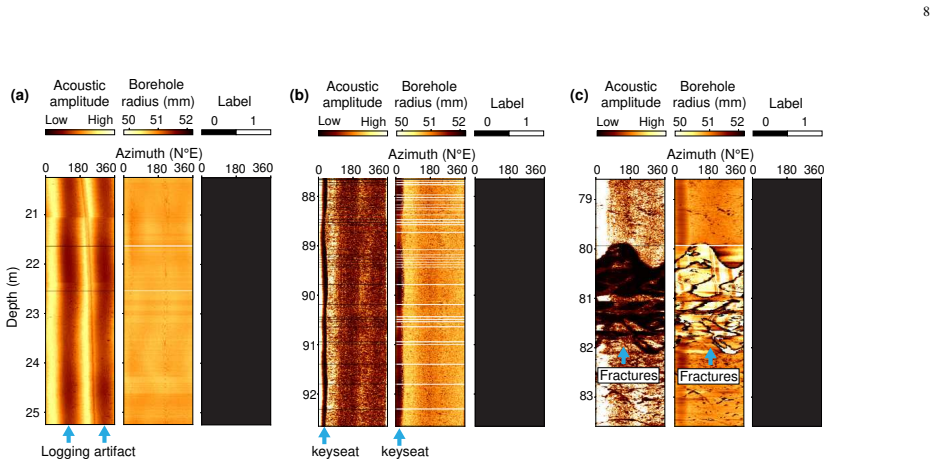
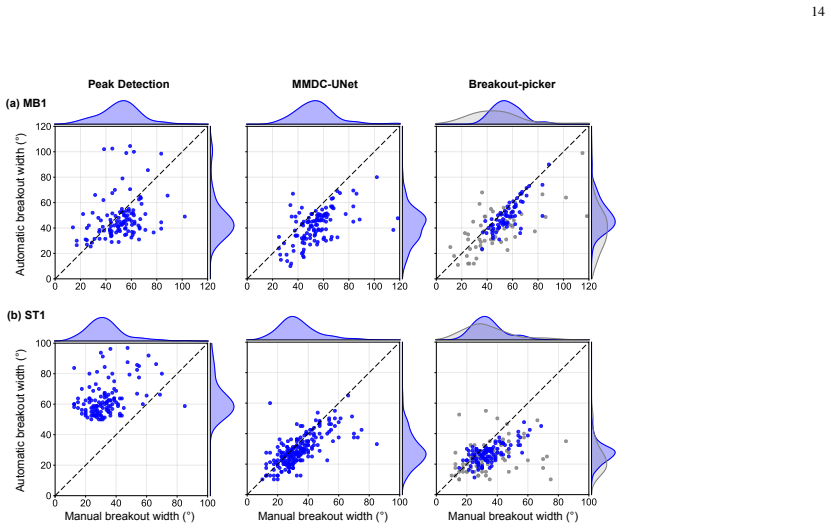
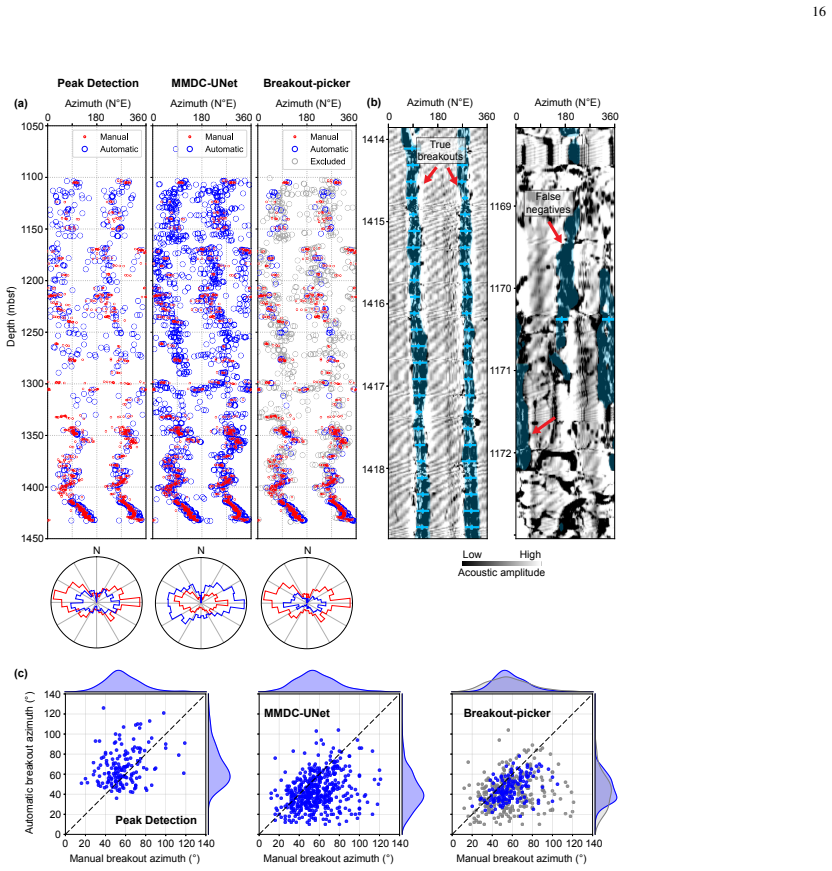
Borehole breakouts are stress-induced spalling on the borehole wall, which are identifiable in acoustic image logs as paired zones with near-symmetry azimuths, low acoustic amplitudes, and increased borehole radius. Accurate breakout characterization is crucial for in-situ stress analysis. In recent years, deep learning has been introduced to automate the time-consuming and labor-intensive breakout picking process. However, existing approaches often suffer from misclassification of non-breakout features, leading to high false positive rates. To address this limitation, this study develops a deep learning framework, termed Breakout-picker, with a specific focus on reducing false positives in automatic breakout characterization. Breakout-picker reduces false positives through two strategies. First, the training of Breakout-picker incorporates negative samples of non-breakout features, including natural fractures, keyseats, and logging artifacts. They share similar characteristics with breakouts, such as low acoustic amplitude or locally enlarged borehole radius. These negative training samples enables Breakout-picker to better discriminate true breakouts and similar non-breakout features. Second, candidate breakouts identified by Breakout-picker are further validated by azimuthal symmetry criteria, whereby detections that do not exhibit the near-symmetry characteristics of breakout azimuth are excluded. The performance of Breakout-picker is evaluated using three acoustic image log datasets from different regions. The results demonstrate that Breakout-picker outperforms other automatic methods with higher accuracy and substantially lower false positive rates. By reducing false positives, Breakout-picker enhances the reliability of automatic breakout characterization from acoustic image logs, which in turn benefits in-situ stress analysis based on borehole breakouts.
Editorial analysis
A structured set of objections, weighed in public.
Referee Report
Summary. The manuscript introduces Breakout-picker, a deep learning framework for automatic characterization of borehole breakouts from acoustic image logs. It addresses high false positive rates in existing methods by incorporating negative samples of non-breakout features (natural fractures, keyseats, logging artifacts) during training and applying an azimuthal symmetry filter to candidate detections. The authors claim that this dual strategy yields higher accuracy and substantially lower false positive rates than other automatic methods when evaluated on three acoustic image log datasets from different regions.
Significance. If the performance claims are substantiated with quantitative metrics and generalizability tests, the work would offer a practical improvement in automated breakout detection, reducing labor-intensive manual picking and enhancing the reliability of in-situ stress analysis derived from borehole breakouts in geomechanics and petroleum engineering applications.
major comments (3)
- Abstract: The central claim that Breakout-picker 'outperforms other automatic methods with higher accuracy and substantially lower false positive rates' is unsupported by any numerical metrics, error bars, dataset sizes, baseline comparisons, or implementation details, leaving the primary performance assertion without verifiable evidence in the text.
- Methods (negative sample and symmetry filter description): The selection and diversity of negative training samples (fractures, keyseats, artifacts) and the precise definition/thresholds of the azimuthal symmetry criteria are not specified with quantitative details, ablation results, or tests for representativeness across logging qualities and geologies; this directly bears on whether the claimed FP reduction generalizes.
- Results (evaluation on three regional datasets): No ablation studies isolating the contribution of negative sampling versus the symmetry filter, nor cross-validation or error analysis, are reported, making it impossible to confirm that the strategies are load-bearing for the accuracy and FP improvements asserted.
minor comments (1)
- The abstract would be strengthened by including at least one key quantitative result (e.g., accuracy or FP rate delta) to allow readers to gauge the magnitude of improvement without reading the full results section.
Simulated Author's Rebuttal
We thank the referee for their constructive feedback. We address each major comment point by point below, indicating revisions where the manuscript will be strengthened.
read point-by-point responses
-
Referee: Abstract: The central claim that Breakout-picker 'outperforms other automatic methods with higher accuracy and substantially lower false positive rates' is unsupported by any numerical metrics, error bars, dataset sizes, baseline comparisons, or implementation details, leaving the primary performance assertion without verifiable evidence in the text.
Authors: We agree that the abstract, being a concise summary, lacks the specific numerical support needed for immediate verification of the performance claims. The full manuscript contains quantitative evaluations on three datasets with accuracy and false-positive comparisons to baselines. We will revise the abstract to incorporate key metrics (accuracy, FP reductions), dataset sizes, and brief baseline references so the central claim is substantiated directly in the abstract. revision: yes
-
Referee: Methods (negative sample and symmetry filter description): The selection and diversity of negative training samples (fractures, keyseats, artifacts) and the precise definition/thresholds of the azimuthal symmetry criteria are not specified with quantitative details, ablation results, or tests for representativeness across logging qualities and geologies; this directly bears on whether the claimed FP reduction generalizes.
Authors: We acknowledge that the Methods section would benefit from greater quantitative specificity. We will expand it to detail the number and selection criteria for negative samples by category, their distribution across logging conditions, the exact azimuthal symmetry thresholds (e.g., azimuth deviation limit and symmetry score), and any representativeness checks using the three regional datasets. We will also add ablation results quantifying the contribution of negative sampling and the symmetry filter to FP reduction. revision: yes
-
Referee: Results (evaluation on three regional datasets): No ablation studies isolating the contribution of negative sampling versus the symmetry filter, nor cross-validation or error analysis, are reported, making it impossible to confirm that the strategies are load-bearing for the accuracy and FP improvements asserted.
Authors: We recognize that the Results section reports overall performance but omits ablations and supporting analyses. We will add ablation experiments isolating negative-sample training and the symmetry filter, together with cross-validation details and per-dataset error analysis, to demonstrate that these components drive the observed accuracy and FP improvements. revision: yes
Circularity Check
No circularity; standard supervised training plus domain-knowledge filter
full rationale
The paper presents a conventional deep-learning pipeline: a model is trained on labeled breakouts plus explicitly chosen negative examples (fractures, keyseats, artifacts) that share amplitude/radius traits, then a post-hoc filter discards detections lacking the azimuthal symmetry already stated in the problem definition. No equations, fitted parameters, or self-citations are shown to redefine the target quantity or force the reported accuracy gains. Evaluation is performed on three separate regional datasets, and the symmetry criterion is an independent physical property rather than a learned or self-referential construct. No load-bearing self-citation chains, ansatz smuggling, or renaming of known results appear in the provided text.
Axiom & Free-Parameter Ledger
axioms (2)
- domain assumption Negative samples of natural fractures, keyseats, and logging artifacts share low-amplitude or enlarged-radius traits with breakouts yet remain distinguishable by a trained model.
- domain assumption True breakouts exhibit near-symmetry in azimuth.
Reference graph
Works this paper leans on
-
[1]
Northeast-southwest compressive stress in alberta evidence from oil wells,
J. S. Bell and D. I. Gough, “Northeast-southwest compressive stress in alberta evidence from oil wells,”Earth and Planetary Science Letters, vol. 45, no. 2, pp. 475–482, 1979
work page 1979
-
[2]
Orientation of the stress field from breakouts in a crystalline well in a seismic active area,
P. Bl ¨umling, K. Fuchs, and T. Schneider, “Orientation of the stress field from breakouts in a crystalline well in a seismic active area,”Physics of the Earth and Planetary Interiors, vol. 33, no. 4, pp. 250–254, 1983
work page 1983
-
[3]
Well bore breakouts and in situ stress,
M. D. Zoback, D. Moos, L. Mastin, and R. N. Anderson, “Well bore breakouts and in situ stress,”Journal of Geophysical Research: Solid Earth, vol. 90, no. B7, pp. 5523–5530, 1985
work page 1985
-
[4]
D. Moos and M. D. Zoback, “Utilization of observations of well bore failure to constrain the orientation and magnitude of crustal stresses: application to continental, deep sea drilling project, and ocean drilling program boreholes,”Journal of Geophysical Research: Solid Earth, vol. 95, no. B6, pp. 9305–9325, 1990. 19
work page 1990
-
[5]
Determination of stress orientation and magnitude in deep wells,
M. D. Zoback, C. Barton, M. Brudy, D. Castillo, T. Finkbeiner, B. Grol- limund, D. Moos, P. Peska, C. Ward, and D. Wiprut, “Determination of stress orientation and magnitude in deep wells,”International Journal of Rock Mechanics and Mining Sciences, vol. 40, no. 7-8, pp. 1049–1076, 2003
work page 2003
-
[6]
W. Lin, E.-C. Yeh, J.-H. Hung, B. Haimson, and T. Hirono, “Localized rotation of principal stress around faults and fractures determined from borehole breakouts in hole b of the taiwan chelungpu-fault drilling project (tcdp),”Tectonophysics, vol. 482, no. 1-4, pp. 82–91, 2010
work page 2010
-
[7]
Stress magnitudes in the basel enhanced geothermal system,
B. Valley and K. F. Evans, “Stress magnitudes in the basel enhanced geothermal system,”International Journal of Rock Mechanics and Mining Sciences, vol. 118, pp. 1–20, 2019
work page 2019
-
[8]
N. Bashmagh, W. Lin, and K. Ishitsuka, “Application of supervised machine learning classification models to identify borehole breakouts in carbonate reservoirs based on conventional log data,”International Journal of the JSRM, vol. 20, no. 1, 2024
work page 2024
-
[9]
R. Plumb and S. Hickman, “Stress-induced borehole elongation: A comparison between the four-arm dipmeter and the borehole televiewer in the auburn geothermal well,”Journal of Geophysical Research, vol. 90, pp. 5513–5521, 1985
work page 1985
-
[10]
M. Rajabi, S. Sherkati, B. Bohloli, and M. Tingay, “Subsurface fracture analysis and determination of in-situ stress direction using fmi logs: An example from the santonian carbonates (ilam formation) in the abadan plain, iran,”Tectonophysics, vol. 492, no. 1, pp. 192–200, 2010
work page 2010
-
[11]
S. Wessling, T. Dahl, D. Pantic, and J. Pei, “Automated breakout detection current possibilities and their benefit for wellbore stability prediction,” inSPWLA 52nd Annual Logging Symposium, vol. All Days, SPWLA-2011-T, Conference Proceedings
work page 2011
-
[12]
W. Wang and D. Schmitt, “Automated borehole breakout interpretation from ultrasonic imaging: Application to a deep borehole drilled into the crystalline crust,” inARMA US Rock Mechanics/Geomechanics Symposium. ARMA, Conference Proceedings, pp. ARMA–2020–1270
work page 2020
-
[13]
L. O. Dias, C. R. Bom, E. L. Faria, M. B. Valent ´ın, M. D. Correia, M. P. de Albuquerque, M. P. de Albuquerque, and J. M. Coelho, “Automatic detection of fractures and breakouts patterns in acoustic borehole image logs using fast-region convolutional neural networks,” Journal of Petroleum Science and Engineering, vol. 191, p. 107099, 2020
work page 2020
-
[14]
Automatic detection of borehole breakout for image logs using yolo algorithm,
J. Yeom, H. Kim, C. Chang, Y . Jo, Z. Chen, and K. Lee, “Automatic detection of borehole breakout for image logs using yolo algorithm,” Geoenergy Science and Engineering, vol. 252, p. 213925, 2025
work page 2025
-
[15]
Automated extraction of bore- hole breakout properties from acoustic televiewer (atv) data,
J. Yang, S. Goodfellow, and J. Harrison, “Automated extraction of bore- hole breakout properties from acoustic televiewer (atv) data,” inARMA US Rock Mechanics/Geomechanics Symposium. ARMA, Conference Proceedings, pp. ARMA–2022–0408
work page 2022
-
[16]
A. D. Cunha, G. B. D. Anjos, R. Nascimento, C. M. de Jesus, and J. Jauregui, “A semi-supervised approach for borehole image log structures segmentation for small labeled datasets,” vol. 2025, no. 1, pp. 1–5, 2025
work page 2025
-
[17]
Encoder- decoder with atrous separable convolution for semantic image segmen- tation,
L.-C. Chen, Y . Zhu, G. Papandreou, F. Schroff, and H. Adam, “Encoder- decoder with atrous separable convolution for semantic image segmen- tation,” inProceedings of the European conference on computer vision (ECCV), 2018, Conference Proceedings, pp. 801–818
work page 2018
-
[18]
Stress concentration at the bottom of a borehole and its effect on borehole breakout formation,
T. Ito, K. Kurosawa, and K. Hayashi, “Stress concentration at the bottom of a borehole and its effect on borehole breakout formation,”Rock Mechanics and Rock Engineering, vol. 31, no. 3, pp. 153–168, 1998
work page 1998
-
[19]
Micromechanisms of borehole instability leading to break- outs in rocks,
B. Haimson, “Micromechanisms of borehole instability leading to break- outs in rocks,”International Journal of Rock Mechanics and Mining Sciences, vol. 44, no. 2, pp. 157–173, 2007
work page 2007
-
[20]
K. Duan and C. Y . Kwok, “Evolution of stress-induced borehole breakout in inherently anisotropic rock: Insights from discrete element modeling,”Journal of Geophysical Research: Solid Earth, vol. 121, no. 4, pp. 2361–2381, 2016
work page 2016
-
[21]
Impact of fracture networks on borehole breakout heterogeneities in crystalline rock,
D. P. Sahara, M. Schoenball, T. Kohl, and B. I. M ¨uller, “Impact of fracture networks on borehole breakout heterogeneities in crystalline rock,”International Journal of Rock Mechanics and Mining Sciences, vol. 71, pp. 301–309, 2014
work page 2014
-
[22]
X. Ma, M. Hertrich, F. Amann, K. Br ¨oker, N. Gholizadeh Doonechaly, V . Gischig, R. Hochreutener, P. K¨astli, H. Krietsch, M. Marti, B. N ¨ageli, M. Nejati, A. Obermann, K. Plenkers, A. P. Rinaldi, A. Shakas, L. Vil- liger, Q. Wenning, A. Zappone, F. Bethmann, R. Castilla, F. Seberto, P. Meier, T. Driesner, S. Loew, H. Maurer, M. O. Saar, S. Wiemer, and ...
work page 2022
-
[23]
S. Zhang, X. Ma, K. Br ¨oker, R. van Limborgh, Q. Wenning, M. Hertrich, and D. Giardini, “Fault zone spatial stress variations in a granitic rock mass: Revealed by breakouts within an array of boreholes,”Journal of Geophysical Research: Solid Earth, vol. 128, no. 8, p. e2023JB026477, 2023
work page 2023
-
[24]
Borehole image log and statistical analysis of foh-3d, fallon naval air station, nv,
K. Blake and N. C. Davatzes, “Borehole image log and statistical analysis of foh-3d, fallon naval air station, nv,” inProceedings of the thirty-seventh workshop on geothermal reservoir engineering, 2012, Conference Proceedings
work page 2012
-
[25]
Structural interpretation from televiewer surveys,
R. Thomas, J. Neilsen, H. Wilson, and P. Lamb, “Structural interpretation from televiewer surveys,” inFMGM 2015: Proceedings of the Ninth Symposium on Field Measurements in Geomechanics. Australian Centre for Geomechanics, 2015, pp. 729–741
work page 2015
-
[26]
C. A. Barton, M. D. Zoback, and K. L. Burns, “In-situ stress orientation and magnitude at the fenton geothermal site, new mexico, determined from wellbore breakouts,”Geophysical Research Letters, vol. 15, no. 5, pp. 467–470, 1988
work page 1988
-
[27]
L. Vernik and M. D. Zoback, “Estimation of maximum horizontal principal stress magnitude from stress-induced well bore breakouts in the cajon pass scientific research borehole,”Journal of Geophysical Research: Solid Earth, vol. 97, no. B4, pp. 5109–5119, 1992
work page 1992
-
[28]
J. S. Chan, “Subsurface geophysical characterization of the crystalline canadian shield in northeastern alberta: implications for geothermal development,” Ph.D. dissertation, University of Alberta, 2013
work page 2013
-
[29]
Iodp expeditions 309 and 312 drill an intact section of upper oceanic basement into gabbros,
J. C. Alt, D. A. H. Teagle, S. Umino, S. Miyashita, N. R. Banerjee, D. S. Wilson, I. E. the, Scientists, and O. D. P. L. S. P. the, “Iodp expeditions 309 and 312 drill an intact section of upper oceanic basement into gabbros,”Sci. Dril., vol. 4, pp. 4–10, 2007
work page 2007
-
[30]
W. Wang, D. R. Schmitt, and J. Chan, “Heterogeneity versus anisotropy and the state of stress in stable cratons: Observations from a deep bore- hole in northeastern alberta, canada,”Journal of Geophysical Research: Solid Earth, vol. 128, no. 3, p. e2022JB025287, 2023
work page 2023
-
[31]
Drilling to gabbro in intact ocean crust,
D. S. Wilson, D. A. H. Teagle, J. C. Alt, N. R. Banerjee, S. Umino, S. Miyashita, G. D. Acton, R. Anma, S. R. Barr, A. Belghoul, J. Carlut, D. M. Christie, R. M. Coggon, K. M. Cooper, C. Cordier, L. Crispini, S. R. Durand, F. Einaudi, L. Galli, Y . Gao, J. Geldmacher, L. A. Gilbert, N. W. Hayman, E. Herrero-Bervera, N. Hirano, S. Holter, S. Ingle, S. Jian...
work page 2006
-
[32]
Q. C. Wenning, T. Berthet, M. Ask, A. Zappone, J.-E. Rosberg, and B. S. G. Almqvist, “Image log analysis of in situ stress orientation, breakout growth, and natural geologic structures to 2.5 km depth in central scandinavian caledonides: Results from the cosc-1 borehole,” Journal of Geophysical Research: Solid Earth, vol. 122, no. 5, pp. 3999– 4019, 2017
work page 2017
-
[33]
Shallow tectonic stress magnitudes at the hikurangi subduction margin, new zealand,
E. Behboudi, D. D. McNamara, and I. Lokmer, “Shallow tectonic stress magnitudes at the hikurangi subduction margin, new zealand,”Geo- chemistry, Geophysics, Geosystems, vol. 24, no. 10, p. e2022GC010836, 2023
work page 2023
-
[34]
State of stress across major faults in the nankai subduction zone estimated from wellbore breakouts,
K. E. Schaible and D. M. Saffer, “State of stress across major faults in the nankai subduction zone estimated from wellbore breakouts,” Journal of Geophysical Research: Solid Earth, vol. 130, no. 7, p. e2024JB030242, 2025
work page 2025
-
[35]
Global crustal stress pattern based on the world stress map database release 2008,
O. Heidbach, M. Tingay, A. Barth, J. Reinecker, D. Kurfeß, and B. M ¨uller, “Global crustal stress pattern based on the world stress map database release 2008,”Tectonophysics, vol. 482, no. 1, pp. 3–15, 2010
work page 2008
-
[36]
Training region-based object detectors with online hard example mining,
A. Shrivastava, A. Gupta, and R. Girshick, “Training region-based object detectors with online hard example mining,” inProceedings of the IEEE conference on computer vision and pattern recognition, Conference Proceedings, pp. 761–769
-
[37]
Hard negative examples are hard, but useful,
H. Xuan, A. Stylianou, X. Liu, and R. Pless, “Hard negative examples are hard, but useful,” ser. Computer Vision – ECCV 2020. Springer International Publishing, Conference Proceedings, pp. 126–142
work page 2020
-
[38]
K. E. N. Br ¨oker, Q. Wenning, M. Hertrich, and X. Ma, “Borehole logging data (acoustic and optical televiewer) from boreholes in the bedretto lab [dataset],” 2023. [Online]. Available: https: //doi.org/10.3929/ethz-b-000616727
-
[39]
Geophysical logging and image data from the hunt well, ne alberta [dataset],
D. Schmitt, W. Wang, and J. Chan, “Geophysical logging and image data from the hunt well, ne alberta [dataset],” 2022. [Online]. Available: https://doi.org/10.5683/SP3/YYNVW8
-
[40]
G. Wang, “Acoustic image log borehole breakout dataset for advancing deep learning in automatic breakout characterization from image logs,” Feb. 2026. [Online]. Available: https://doi.org/10.5281/zenodo.18627151
discussion (0)
Sign in with ORCID, Apple, or X to comment. Anyone can read and Pith papers without signing in.