Strategic Bidding in 6G Spectrum Auctions with Large Language Models
Pith reviewed 2026-05-07 17:46 UTC · model grok-4.3
The pith
Large language models acting as bidders in repeated 6G spectrum auctions adapt to achieve higher utilities when budget constraints prevent standard truthful strategies.
A machine-rendered reading of the paper's core claim, the machinery that carries it, and where it could break.
Core claim
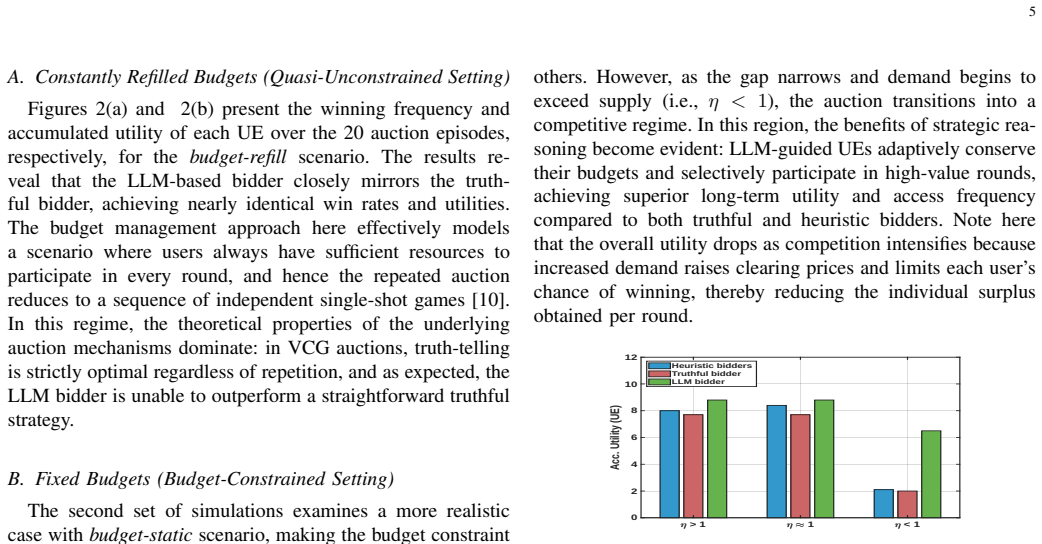
LLM bidders in these auctions recover near-equilibrium outcomes that align with VCG predictions whenever the assumptions ensuring truthfulness are met. Yet under static budget constraints that violate those assumptions, the LLMs maintain participation over more rounds and attain higher utilities by adapting bids through analysis of historical results and reasoning steps in prompts.
What carries the argument
The LLM bidder agent, which uses historical auction outcomes and prompt-based reasoning for dynamic adaptation in repeated interactions, benchmarked against the VCG mechanism.
If this is right
- When truthfulness assumptions hold, LLM outcomes match theoretical VCG equilibria.
- Under budget constraints, LLMs achieve superior utilities and longer participation compared to non-adaptive strategies.
- This adaptive capability allows approximation of equilibria in settings where static mechanism design falls short.
- In 6G networks, such AI bidding could alter how radio resources are allocated among competing users.
Where Pith is reading between the lines
- If LLMs can adapt this effectively, spectrum auction rules may require updates to prevent exploitation of budget limits by AI participants.
- The findings could inform designs for other AI-involved markets, such as those for computing resources or bandwidth in future networks.
- One could test whether increasing the detail in prompts further improves adaptation in multi-round auctions with varying user demands.
Load-bearing premise
The models can extract useful patterns from past auction results and incorporate them into prompt reasoning to modify future bids effectively despite unchanging budgets.
What would settle it
Observing that LLM bidders achieve utilities no higher than those from always-truthful bidding when budgets are fixed and limited, or that they drop out at similar rates.
Figures



read the original abstract
Efficient and fair spectrum allocation is a central challenge in 6G networks, where massive connectivity and heterogeneous services continuously compete for limited radio resources. We investigate the use of Large Language Models (LLMs) as bidding agents in repeated 6G spectrum auctions with budget constraints in vehicular networks. Each user equipment (UE) acts as a rational player optimizing its long-term utility through repeated interactions. Using the Vickrey-Clarke-Groves (VCG) mechanism as a benchmark for incentive-compatible, dominant-strategy truthfulness, we compare LLM-guided bidding against truthful and heuristic strategies. Unlike heuristics, LLMs leverage historical outcomes and prompt-based reasoning to adapt their bidding behavior dynamically. Results show that when the theoretical assumptions guaranteeing truthfulness hold, LLM bidders recover near-equilibrium outcomes consistent with VCG predictions. However, when these assumptions break -- such as under static budget constraints -- LLMs sustain longer participation and achieve higher utilities, revealing their ability to approximate adaptive equilibria beyond static mechanism design. This work provides the first systematic evaluation of LLM bidders in repeated spectrum auctions, offering new insights into how AI-driven agents can interact strategically and reshape market dynamics in future 6G networks.
Editorial analysis
A structured set of objections, weighed in public.
Referee Report
Summary. The paper investigates the use of Large Language Models (LLMs) as bidding agents in repeated 6G spectrum auctions with budget constraints in vehicular networks. Each UE optimizes long-term utility through repeated interactions. Using the VCG mechanism as a benchmark for incentive-compatible truthfulness, the work compares LLM-guided bidding against truthful and heuristic strategies, claiming that LLMs leverage historical outcomes and prompt-based reasoning to adapt dynamically. When VCG assumptions hold, LLMs recover near-equilibrium outcomes; when they break (e.g., static budgets), LLMs sustain longer participation and achieve higher utilities.
Significance. If the results hold after proper validation, this represents the first systematic evaluation of LLM bidders in repeated spectrum auctions and offers insights into how AI-driven agents can approximate adaptive equilibria in dynamic 6G settings where static mechanism design is insufficient. It could inform future work on strategic AI interactions in resource allocation markets.
major comments (3)
- [Abstract] The abstract reports comparative results between LLM bidders and baselines but provides no details on experimental setup, number of runs, statistical tests, prompt engineering, or budget modeling implementation. This leaves the central claims without visible derivation or validation steps.
- [LLM Agent Design and Prompting] The claim that LLMs leverage historical outcomes via prompt-based reasoning to adapt bidding behavior dynamically rests on an unexamined premise. No section describes the prompt template, history window, budget encoding, or how prior bids/payments/remaining budgets are fed into the LLM context. Observed differences versus heuristics could arise from prompt phrasing, temperature, or simulation artifacts rather than genuine adaptation.
- [Results and Discussion] The results section asserts that LLMs achieve higher utilities under static budget constraints, but without specifying how these constraints are modeled, the conditions under which VCG assumptions break, or any ablation on prompt sensitivity, the finding that LLMs approximate adaptive equilibria cannot be assessed for robustness.
minor comments (1)
- [Preliminaries] Notation for UE utilities, budget updates, and auction rounds should be defined more clearly with consistent symbols across sections.
Simulated Author's Rebuttal
We thank the referee for the detailed and constructive report. The comments correctly identify areas where greater methodological transparency is needed to support the central claims. We address each point below and commit to revisions that add the missing details without altering the core findings or experimental design.
read point-by-point responses
-
Referee: [Abstract] The abstract reports comparative results between LLM bidders and baselines but provides no details on experimental setup, number of runs, statistical tests, prompt engineering, or budget modeling implementation. This leaves the central claims without visible derivation or validation steps.
Authors: We agree that the abstract is too concise and omits key validation elements. In the revised version we will expand the abstract to state: (i) the number of independent Monte Carlo runs (100), (ii) use of paired t-tests with reported p-values for utility comparisons, (iii) a one-sentence description of the prompt template and history encoding, and (iv) the static budget constraint model (fixed per-UE budget renewed only at the start of each episode). These additions will make the reported performance differences traceable while respecting length limits. revision: yes
-
Referee: [LLM Agent Design and Prompting] The claim that LLMs leverage historical outcomes via prompt-based reasoning to adapt bidding behavior dynamically rests on an unexamined premise. No section describes the prompt template, history window, budget encoding, or how prior bids/payments/remaining budgets are fed into the LLM context. Observed differences versus heuristics could arise from prompt phrasing, temperature, or simulation artifacts rather than genuine adaptation.
Authors: The referee is correct that the submitted manuscript did not include a dedicated description of the prompt template or context construction. We will add a new subsection (Section 3.2) that provides: the exact prompt template (including system instructions and few-shot examples), the history window size (last 10 auctions), the JSON-style encoding of prior bids, payments, and remaining budget, and the fixed temperature (0.7) and model version used. We will also report an ablation on temperature and history length to show that performance gains persist across reasonable prompt variations, thereby addressing the possibility of artifacts. revision: yes
-
Referee: [Results and Discussion] The results section asserts that LLMs achieve higher utilities under static budget constraints, but without specifying how these constraints are modeled, the conditions under which VCG assumptions break, or any ablation on prompt sensitivity, the finding that LLMs approximate adaptive equilibria cannot be assessed for robustness.
Authors: We accept that the modeling of static budgets and the precise conditions under which VCG truthfulness fails were insufficiently explicit. The revision will: (1) add a formal definition of the static budget constraint (fixed initial budget B_i with no replenishment within an episode), (2) clarify that repeated interaction with non-replenishable budgets violates the single-shot dominant-strategy assumption of VCG, and (3) include new ablation tables varying prompt temperature, history length, and LLM model size. These additions will allow readers to evaluate the robustness of the reported utility gains. revision: yes
Circularity Check
No significant circularity; empirical comparisons to external VCG benchmark
full rationale
The paper presents simulation-based comparisons of LLM bidders against truthful, heuristic, and VCG strategies in repeated spectrum auctions. VCG is invoked as an independent external benchmark for truthfulness rather than a result derived within the paper. No equations, fitted parameters renamed as predictions, self-citations, or ansatzes appear in the provided text; claims about dynamic adaptation rest on empirical outcomes, not reductions to inputs by construction. The derivation chain is self-contained as an experimental evaluation.
Axiom & Free-Parameter Ledger
axioms (1)
- domain assumption VCG mechanism guarantees incentive-compatible, dominant-strategy truthfulness under stated conditions
Reference graph
Works this paper leans on
-
[1]
A vision of 6g wireless systems: Applications, trends, technologies, and open research problems,
W. Saad, M. Bennis, and M. Chen, “A vision of 6g wireless systems: Applications, trends, technologies, and open research problems,” IEEE Network, vol. 34, no. 3, pp. 134–142, 2020
work page 2020
-
[2]
Auction approaches for re- source allocation in wireless systems: A survey,
Y . Zhang, C. Lee, D. Niyato, and P. Wang, “Auction approaches for re- source allocation in wireless systems: A survey,” IEEE Communications Surveys & Tutorials, vol. 15, no. 3, pp. 1020–1041, 2013
work page 2013
-
[3]
Social welfare maxi- mization auction in joint radar communication systems for autonomous vehicles,
L. Ismail, D. Niyato, S. Sun, and D. I. Kim, “Social welfare maxi- mization auction in joint radar communication systems for autonomous vehicles,” in Proc. IEEE GLOBECOM , 2021, pp. 1–6
work page 2021
-
[4]
Z. Han, R. Zheng, and H. V . Poor, “Repeated auctions with bayesian nonparametric learning for spectrum access in cognitive radio networks,” IEEE Transactions on Wireless Communications, vol. 10, no. 3, pp. 890– 900, 2011
work page 2011
-
[5]
Auction-based spectrum management of cognitive radio networks,
H.-B. Chang and K.-C. Chen, “Auction-based spectrum management of cognitive radio networks,” IEEE Transactions on Vehicular Technology, vol. 59, no. 4, pp. 1923–1935, 2010
work page 1923
-
[6]
Artificial general intelligence (AGI)-native wireless systems: A journey beyond 6G,
W. Saad et al. , “Artificial general intelligence (AGI)-native wireless systems: A journey beyond 6G,” Proceedings of the IEEE , pp. 1–39, 2025
work page 2025
-
[7]
ALYMPICS: LLM agents meet game theory,
S. Mao et al. , “ALYMPICS: LLM agents meet game theory,” in Proceedings of the 31st International Conference on Computational Linguistics, 2025, pp. 2845–2866
work page 2025
-
[8]
T. Z. Oo et al. , “Offloading in hetnet: A coordination of interference mitigation, user association, and resource allocation,” IEEE Transactions on Mobile Computing , vol. 16, no. 8, pp. 2276–2291, 2017
work page 2017
-
[9]
Applying opponent modeling for automatic bidding in online repeated auctions,
Y . Hu, C. Han, T. Guo, and H. Xiao, “Applying opponent modeling for automatic bidding in online repeated auctions,” in Proceedings of the 23rd International Conference on Autonomous Agents and Multiagent Systems, 2024, p. 843–851
work page 2024
-
[10]
Learning to bid in repeated first-price auctions with budgets,
Q. Wang, Z. Yang, X. Deng, and Y . Kong, “Learning to bid in repeated first-price auctions with budgets,” in International Conference on Machine Learning . PMLR, 2023, pp. 36 494–36 513
work page 2023
- [11]
-
[12]
A survey on bid optimization in real-time bidding display advertising,
W. Ou et al., “A survey on bid optimization in real-time bidding display advertising,” ACM Transactions on Knowledge Discovery from Data , vol. 18, no. 3, p. 1–31, Dec. 2023
work page 2023
-
[13]
Auto-bidding and auctions in online advertising: A survey,
G. Aggarwal et al. , “Auto-bidding and auctions in online advertising: A survey,” ACM SIGecom Exchanges , vol. 22, no. 1, p. 159–183, Jun. 2024
work page 2024
-
[14]
AiAds: Automated and Intelligent Advertising System for Sponsored Search,
X. Yang et al., “AiAds: Automated and Intelligent Advertising System for Sponsored Search,” in Proceedings of the 25th ACM SIGKDD International Conference on Knowledge Discovery & Data Mining , Jul. 2019, p. 1881–1890
work page 2019
-
[15]
Reinforcement learning with sequential information cluster- ing in real-time bidding,
J. Lu et al., “Reinforcement learning with sequential information cluster- ing in real-time bidding,” in Proceedings of the 28th ACM International Conference on Information and Knowledge Management , Nov. 2019, p. 1633–1641
work page 2019
-
[16]
G. Aggarwal, A. B. Varadaraja, and A. Mehta, “Autobidding with constraints,” in Web and Internet Economics , 2019, p. 17–30
work page 2019
-
[17]
A unified solution to constrained bidding in online display advertising,
Y . He et al., “A unified solution to constrained bidding in online display advertising,” in Proceedings of the 27th ACM SIGKDD Conference on Knowledge Discovery & Data Mining , 2021, pp. 2993–3001
work page 2021
discussion (0)
Sign in with ORCID, Apple, or X to comment. Anyone can read and Pith papers without signing in.