Measuring Apsidal Clustering
Pith reviewed 2026-05-07 14:29 UTC · model grok-4.3
The pith
A new conditional-likelihood method lowers the significance of apsidal clustering in distant TNOs from 2.7 sigma to 1.9 sigma.
A machine-rendered reading of the paper's core claim, the machinery that carries it, and where it could break.
Core claim
The authors introduce a conditional-likelihood method for quantifying apsidal clustering that corrects for survey-footprint biases, then use long-term orbital stability integrations to identify an expanded sample of 25 stable distant TNOs. Application of the method to this sample shows that the statistical significance of the clustering has decreased from the previously reported 2.7 sigma to 1.9 sigma, while the direction of any alignment is no longer well constrained. The work positions this approach as suitable for the much larger TNO catalogs expected from LSST, where it can test whether apparent clustering is real or an artifact of small-sample statistics and selection effects.
What carries the argument
A conditional-likelihood formulation that quantifies apsidal clustering while remaining insensitive to uneven survey footprints, paired with long-term orbital stability simulations to select the relevant TNO sample.
If this is right
- The method can be reapplied without modification as new TNO discoveries accumulate from LSST.
- The direction of any apsidal alignment remains too poorly constrained to support strong claims about a distant perturber.
- Previous 2.7-sigma results relied on smaller samples and methods sensitive to survey geometry.
- Future data sets will decide whether the current 1.9-sigma level reflects insufficient statistics or the absence of clustering.
Where Pith is reading between the lines
- If the significance stays low after LSST observations, arguments for a Planet X based on apsidal alignment would lose much of their statistical support.
- The same conditional-likelihood approach could be adapted to test other proposed orbital alignments or correlations in the outer solar system.
- Re-analysis of earlier TNO catalogs with this method might reveal how much of the original 2.7-sigma signal was driven by survey bias rather than intrinsic clustering.
Load-bearing premise
The orbital stability simulations accurately identify the relevant TNOs without introducing new selection effects, and the conditional-likelihood method fully removes all survey-footprint biases.
What would settle it
Applying the identical method to a substantially larger sample of distant TNOs discovered by LSST and finding a clustering significance that remains above 3 sigma with a well-defined direction.
Figures


read the original abstract
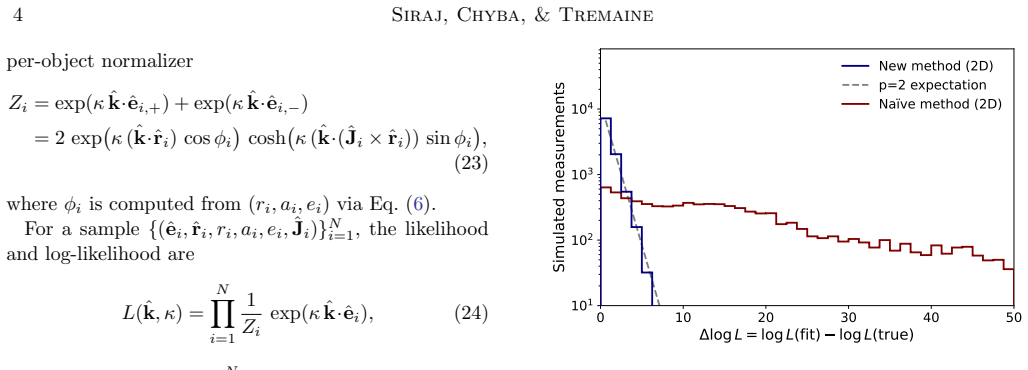
The decade-long debate over the existence of apsidal clustering in the outer solar system is poised for reignition given the plethora of distant trans-Neptunian object (TNO) discoveries expected from the forthcoming Vera C. Rubin Observatory's Legacy Survey of Space and Time (LSST). Here, we present a new conditional-likelihood method to measure apsidal clustering that is insensitive to uneven survey footprints. We calculate the long-term orbital stability of distant TNOs, which allows us to expand the known sample of relevant objects from 21 to 25. We apply our new method to this up-to-date sample, showing that the significance of the apsidal clustering in the outer solar system has fallen from $2.7\sigma$ to $1.9\sigma$, and that the direction of clustering is not well constrained. This new method is suitable for application to the growing sample of known TNOs, and the results will reveal whether the evidence for a hypothetical Planet X from apsidal clustering is real or spurious.
Editorial analysis
A structured set of objections, weighed in public.
Referee Report
Summary. The manuscript presents a conditional-likelihood method designed to measure apsidal clustering in distant trans-Neptunian objects while remaining insensitive to uneven survey footprints. Long-term orbital stability simulations are used to expand the sample of relevant objects from 21 to 25. Application of the method to this updated sample yields a reduction in the statistical significance of the clustering from 2.7σ to 1.9σ, with the preferred clustering direction found to be poorly constrained. The authors argue that the approach will be suitable for the larger samples expected from LSST and that the results bear on the reality of a hypothetical Planet X.
Significance. If the stability-based sample expansion introduces no apsidal-angle-dependent bias and the conditional likelihood is correctly formulated, the result would indicate that evidence for apsidal clustering is weaker than prior estimates, with implications for the Planet 9 hypothesis. The development of a footprint-insensitive likelihood is a constructive methodological contribution for future TNO analyses. No machine-checked proofs or fully open reproducible code are described in the manuscript, but the claim is in principle falsifiable with additional observations.
major comments (1)
- [§3] §3 (Stability Simulations): The central claim that significance has dropped to 1.9σ with the expanded sample of 25 objects requires that the long-term stability filter does not correlate with argument of perihelion or longitude of perihelion. Stability against Neptune encounters or secular effects can depend on perihelion direction; if the survival criterion preferentially retains aligned or anti-aligned objects, the new sample is biased and the reported drop is not a clean test. The conditional-likelihood formulation corrects for survey geometry but does not automatically correct for this dynamical pre-selection step. An explicit test (e.g., a figure showing stable vs. unstable objects in ω–ϖ space or a quantitative check that survival fraction is independent of apsidal angles) is needed to support the claim.
minor comments (3)
- [§2] §2: The precise numerical criteria used to classify an orbit as 'stable' (integration duration, removal thresholds for close encounters, etc.) should be stated explicitly rather than summarized.
- [Figure 2] Figure 2: The caption should clarify whether the plotted likelihood contours include the full posterior or only the maximum-likelihood direction, and should indicate the 1σ/2σ levels explicitly.
- References: Ensure that all prior works on TNO apsidal clustering and survey bias corrections (including those using different stability criteria) are cited for context.
Simulated Author's Rebuttal
We thank the referee for their constructive feedback. We address the major comment on the stability simulations as follows.
read point-by-point responses
-
Referee: [§3] §3 (Stability Simulations): The central claim that significance has dropped to 1.9σ with the expanded sample of 25 objects requires that the long-term stability filter does not correlate with argument of perihelion or longitude of perihelion. Stability against Neptune encounters or secular effects can depend on perihelion direction; if the survival criterion preferentially retains aligned or anti-aligned objects, the new sample is biased and the reported drop is not a clean test. The conditional-likelihood formulation corrects for survey geometry but does not automatically correct for this dynamical pre-selection step. An explicit test (e.g., a figure showing stable vs. unstable objects in ω–ϖ space or a quantitative check that survival fraction is independent of apsidal angles) is needed to support the claim.
Authors: We agree that an explicit verification is required to ensure the stability-based sample expansion does not introduce apsidal-angle-dependent bias. Although our stability criteria are derived from full N-body integrations that account for all dynamical interactions, we acknowledge that a direct test against the apsidal angles was not provided in the submitted manuscript. In the revised manuscript, we will include a new subsection or appendix with a figure displaying the distribution of stable versus unstable objects in the (ω, ϖ) plane, along with a quantitative check such as the survival probability as a function of these angles or a statistical independence test. This addition will directly address the referee's concern and support the validity of the reported 1.9σ significance. revision: yes
Circularity Check
No significant circularity in derivation of 1.9σ result
full rationale
The paper introduces an independent conditional-likelihood formulation to correct for survey geometry and applies long-term orbital stability simulations (external to the clustering statistic) to enlarge the TNO sample from 21 to 25 objects. The reported significance is obtained by direct application of the new likelihood to the filtered observed data; no equation or step reduces the 1.9σ value to a fitted parameter, self-citation chain, or input by construction. The derivation remains self-contained against the external TNO catalog.
Axiom & Free-Parameter Ledger
Reference graph
Works this paper leans on
-
[1]
Batygin, K., & Brown, M. E. 2016, AJ, 151, 22
work page 2016
-
[2]
Bernardinelli, P. H., Bernstein, G. M., Sako, M., et al. 2020, PSJ, 1, 28 —. 2022, ApJS, 258, 41
work page 2020
- [3]
- [4]
-
[5]
Chen, Y.-T., Lykawka, P. S., Huang, Y., et al. 2025, Nature Astronomy, 9, 1309
work page 2025
-
[6]
2025, arXiv e-prints, arXiv:2505.15806
Cheng, S., Li, J., & Yang, E. 2025, arXiv e-prints, arXiv:2505.15806
-
[7]
Holman, M. J., Bernardinelli, P. H., Schwamb, M. E., et al. 2025, AJ, 170, 97
work page 2025
-
[8]
Kurlander, J. A., Bernardinelli, P. H., Schwamb, M. E., et al. 2025, AJ, 170, 99
work page 2025
-
[9]
Merritt, S. R., Fedorets, G., Schwamb, M. E., et al. 2025, AJ, 170, 100
work page 2025
- [10]
-
[11]
Rein, H., & Liu, S. F. 2012, A&A, 537, A128
work page 2012
-
[12]
Rein, H., Hernandez, D. M., Tamayo, D., et al. 2019, MNRAS, 485, 5490
work page 2019
-
[13]
Shankman, C., Kavelaars, J. J., Bannister, M. T., et al. 2017, AJ, 154, 50
work page 2017
- [14]
-
[15]
Sheppard, S. S., Trujillo, C., Frissell, M. K., & Farrell, K. A. 2025, Minor Planet Electronic Circulars, 2025-M20, doi:10.48377/MPEC/2025-M20
-
[16]
S., Trujillo, C., Oldroyd, W., & Tholen, D
Sheppard, S. S., Trujillo, C., Oldroyd, W., & Tholen, D. J. 2022, Minor Planet Electronic Circulars, 2022-S118
work page 2022
- [17]
discussion (0)
Sign in with ORCID, Apple, or X to comment. Anyone can read and Pith papers without signing in.