Statistical Channel Fingerprint Construction for Massive MIMO: A Unified Tensor Learning Framework
Pith reviewed 2026-05-07 08:23 UTC · model grok-4.3
The pith
A tensor-based learning method restores incomplete statistical channel fingerprints for massive MIMO by modeling three practical construction scenarios as unified restoration tasks.
A machine-rendered reading of the paper's core claim, the machinery that carries it, and where it could break.
Core claim
The authors reveal a direct relationship between the channel spatial covariance matrix and the channel power angular spectrum that permits a low-dimensional tensor representation of the statistical channel fingerprint. They uniformly cast three realistic construction scenarios—under measurement-cost limits, privacy constraints, and security restrictions—as tensor restoration problems. To solve them, they introduce LPWTNet, which replaces conventional encoder-decoder structures with a closed-form Laplacian pyramid decomposition and reconstruction pipeline, adds shared mask learning to refine high-frequency components level by level, and employs wavelet-transform-based small-kernel convolves.
What carries the argument
LPWTNet, a tensor restoration architecture that uses closed-form Laplacian pyramid decomposition plus wavelet-decoupled convolutions to recover missing parts of the statistical channel fingerprint tensor while preserving multi-scale frequency structure.
If this is right
- Statistical channel fingerprints become feasible to construct under realistic measurement budgets, privacy rules, and security limits in massive MIMO deployments.
- The same tensor model and restoration pipeline can be reused across the three distinct construction scenarios without scenario-specific redesign.
- Dimension reduction via eigenvalue decomposition keeps essential angular-spectrum information intact, enabling accurate recovery at lower computational cost.
- Multi-scale Laplacian pyramid processing combined with wavelet convolutions delivers both competitive accuracy and reduced parameter count compared with conventional deep networks.
- The framework supports efficient inference suitable for repeated fingerprint updates in large-scale networks.
Where Pith is reading between the lines
- The same tensor representation might support online tracking of slowly varying statistical fingerprints when user locations or environments change over time.
- Integration with beamforming or localization algorithms could turn the restored fingerprints into direct inputs for predictive channel acquisition in future systems.
- Hardware implementations on edge devices could test whether the small-kernel wavelet convolutions translate into measurable power savings during real-time operation.
Load-bearing premise
The statistical channel fingerprint can be represented as a single tensor whose missing entries are recoverable by LPWTNet after dimension reduction via eigenvalue decomposition of the channel spatial covariance matrix and its correlation with the power angular spectrum.
What would settle it
If side-by-side simulations of the three scenarios show that LPWTNet produces higher normalized mean-square reconstruction error than standard tensor completion baselines on the same reduced-dimension tensors, or if its runtime does not remain lower for arrays with hundreds of antennas.
Figures




read the original abstract
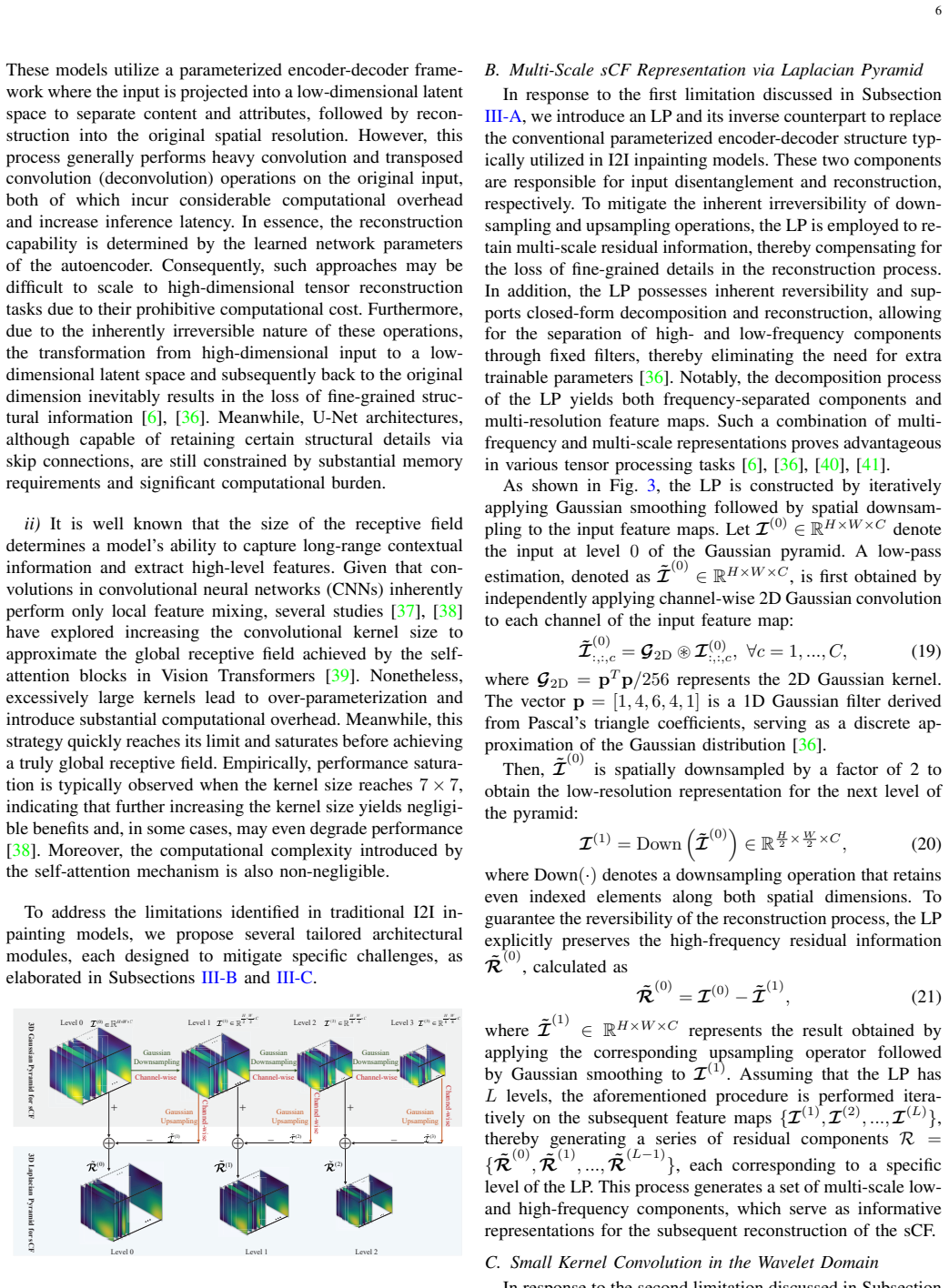
Channel fingerprint (CF) is considered a key enabler for facilitating the acquisition of channel state information (CSI) in massive multiple-input multiple-output (MIMO) communication systems. In this work, we investigate a novel type of CF that stores statistical CSI (sCSI) at each potential location, referred to as statistical CF (sCF). Specifically, we reveal the relationship between sCSI, namely the channel spatial covariance matrix (CSCM), and the channel power angular spectrum (CPAS). Building on this foundation, we construct a unified tensor representation of the sCF and further reduce its dimension by exploiting the eigenvalue decomposition of the CSCM and its correlation with the PAS. Considering the practical constraints imposed by measurement cost, privacy, and security, we focus on three representative scenarios and uniformly formulate them as tensor restoration tasks. To this end, we propose a unified tensor-based learning architecture, termed LPWTNet. The architecture incorporates a closed-form Laplacian pyramid (LP) decomposition and reconstruction framework that replaces the traditional encoder-decoder structure, enabling efficient inference while capturing multi-scale frequency subband characteristics of the sCF. Additionally, a shared mask learning strategy is introduced to adaptively refine high-frequency sCF components through level-wise adjustments. To achieve a larger receptive field without over-parameterization, we further propose a small-kernel convolution mechanism based on the wavelet transform (WT), which decouples convolution across different frequency components of the sCF and enhances feature extraction efficiency. Extensive experiments show that the proposed approach delivers competitive reconstruction accuracy and computational efficiency across various sCF construction scenarios when compared with state-of-the-art baselines.
Editorial analysis
A structured set of objections, weighed in public.
Referee Report
Summary. The paper proposes a unified tensor learning framework for statistical channel fingerprint (sCF) construction in massive MIMO. It links the channel spatial covariance matrix (CSCM) to the channel power angular spectrum (CPAS), forms a single tensor representation of sCF, applies eigenvalue decomposition of the CSCM together with PAS correlation for dimension reduction, and introduces the LPWTNet architecture (closed-form Laplacian pyramid decomposition plus wavelet-transform small-kernel convolutions and shared mask learning) to restore incomplete tensors. The three practical scenarios (measurement cost, privacy, security) are cast as tensor completion tasks, with experiments asserted to show competitive reconstruction accuracy and efficiency versus baselines.
Significance. If the central claims hold, the work offers a practical unified approach to sCF construction that directly addresses deployment constraints in massive MIMO CSI acquisition. The replacement of encoder-decoder structures by closed-form LP decomposition and the frequency-decoupled WT convolutions are technically attractive for efficiency. The tensor formulation and scenario unification could influence follow-on work on statistical CSI fingerprinting, provided the dimension-reduction step is shown to preserve location-specific angular information.
major comments (2)
- [§4.2] §4.2 (dimension reduction via EVD of CSCM correlated with PAS): the manuscript states that this step reduces the tensor while retaining essential statistical features for the three scenarios, yet supplies no error bound, retained-eigenvalue ablation, or reconstruction-error analysis when PAS correlation is imperfect or when missing entries are structured. This reduction is load-bearing for the unified claim; if discarded components carry spatially relevant angular power that LPWTNet cannot recover from Laplacian subbands, both accuracy and the “unified” formulation are undermined.
- [§6] §6 (experimental validation): the abstract and results section assert competitive accuracy and computational efficiency across scenarios, but the reported tables lack error bars, Monte-Carlo run counts, dataset statistics, or ablations isolating the shared mask learning and WT convolution contributions. Without these, it is impossible to confirm that LPWTNet’s gains are robust rather than scenario-specific.
minor comments (3)
- [§3.1] The tensor construction in §3.1 would benefit from an explicit definition of the three scenario-specific masking operators to clarify how the unified formulation maps to each constraint.
- [Figure 3] Figure 3 (LPWTNet diagram) uses small font for the wavelet-transform block labels; enlarging these would improve readability of the frequency-decoupling mechanism.
- [Eq. (2)] Notation for the CPAS–CSCM relationship (Eq. (2)) is introduced without a short proof sketch; adding one sentence would help readers verify the subsequent tensor construction.
Simulated Author's Rebuttal
We thank the referee for the constructive feedback on our manuscript. We address each major comment below and will incorporate the suggested analyses and experimental enhancements in the revised version to strengthen the claims.
read point-by-point responses
-
Referee: §4.2 (dimension reduction via EVD of CSCM correlated with PAS): the manuscript states that this step reduces the tensor while retaining essential statistical features for the three scenarios, yet supplies no error bound, retained-eigenvalue ablation, or reconstruction-error analysis when PAS correlation is imperfect or when missing entries are structured. This reduction is load-bearing for the unified claim.
Authors: We acknowledge that the dimension reduction is central to the unified tensor formulation. In the revision we will add a theoretical error bound on the approximation error incurred by retaining only the dominant eigenvalues correlated with the PAS. We will also include an ablation study varying the number of retained eigenvalues and report reconstruction error under both imperfect PAS correlation and structured missing entries. These additions will confirm that discarded components do not carry spatially relevant angular power that LPWTNet cannot recover from the Laplacian subbands. revision: yes
-
Referee: §6 (experimental validation): the abstract and results section assert competitive accuracy and computational efficiency across scenarios, but the reported tables lack error bars, Monte-Carlo run counts, dataset statistics, or ablations isolating the shared mask learning and WT convolution contributions. Without these, it is impossible to confirm that LPWTNet’s gains are robust rather than scenario-specific.
Authors: We agree that the experimental section requires additional statistical rigor and component ablations. In the revised manuscript we will augment all tables with error bars (standard deviation), explicitly state the number of Monte-Carlo runs, include detailed dataset statistics, and provide new ablation experiments that isolate the contributions of the shared mask learning strategy and the wavelet-transform convolutions. These changes will demonstrate that the reported gains are robust across the three scenarios. revision: yes
Circularity Check
No significant circularity in the derivation chain
full rationale
The paper reveals the CSCM-PAS relationship, builds a unified tensor representation of sCF, applies EVD-based dimension reduction using the stated correlation, formulates the three scenarios as tensor completion tasks, and introduces LPWTNet (with closed-form LP decomposition, shared mask learning, and WT-based small-kernel convolution) as a new architecture. All performance claims rest on empirical comparisons to external baselines rather than any fitted parameter being redefined as a prediction, any self-referential definition of the tensor or restoration target, or a load-bearing self-citation chain. The derivation therefore remains self-contained and does not reduce to its own inputs by construction.
Axiom & Free-Parameter Ledger
axioms (1)
- domain assumption The relationship between the channel spatial covariance matrix (CSCM) and the channel power angular spectrum (CPAS) can be exploited via eigenvalue decomposition to construct a reduced-dimension tensor representation of the statistical channel fingerprint.
Reference graph
Works this paper leans on
-
[1]
Frequency-aware tensor learning for statistical channel fingerprint construction in massive MIMO,
Z. Jin, L. You, X.-G. Xia, and X. Gao, “Frequency-aware tensor learning for statistical channel fingerprint construction in massive MIMO,” in Proc. IEEE Veh. Technol. Conf. (VTC-Spring), Nice, France, Jun. 2026, pp. 1–6
work page 2026
-
[2]
On the road to 6G: Visions, requirements, key technologies and testbeds,
C.-X. Wang, X. You, X. Q. Gao, X. Zhu, Z. Li, C. Zhang, H. Wang, Y . Huang, Y . Chen, H. Haas, J. S. Thompson, E. G. Larsson, M. D. Renzo, W. Tong, P. Zhu, X. Shen, H. V . Poor, and L. Hanzo, “On the road to 6G: Visions, requirements, key technologies and testbeds,”IEEE Commun. Surv. Tutor., vol. 25, no. 2, pp. 905–974, Feb. 2023
work page 2023
-
[3]
GDM4MMIMO: Generative diffusion models for massive MIMO communications,
Z. Jin, L. You, H. Zhou, Y . Wang, X. Liu, X. Gong, X. Gao, D. W. K. Ng, and X.-G. Xia, “GDM4MMIMO: Generative diffusion models for massive MIMO communications,”IEEE Commun. Mag., vol. 64, no. 4, pp. 50–56, Apr. 2026
work page 2026
-
[4]
The roadmap to 6G: AI empowered wireless networks,
K. B. Letaief, W. Chen, Y . Shi, J. Zhang, and Y .-J. A. Zhang, “The roadmap to 6G: AI empowered wireless networks,”IEEE Commun. Mag., vol. 57, no. 8, pp. 84–90, Aug. 2019
work page 2019
-
[5]
R. Zhang, L. Cheng, S. Wang, Y . Lou, Y . Gao, W. Wu, and D. W. K. Ng, “Integrated sensing and communication with massive MIMO: A unified tensor approach for channel and target parameter estimation,” IEEE Trans. Wirel. Commun., vol. 23, no. 8, pp. 8571–8587, Aug. 2024
work page 2024
-
[6]
An I2I inpainting approach for efficient channel knowledge map construction,
Z. Jin, L. You, J. Wang, X.-G. Xia, and X. Gao, “An I2I inpainting approach for efficient channel knowledge map construction,”IEEE Trans. Wirel. Commun., vol. 24, no. 2, pp. 1415–1429, Feb. 2025
work page 2025
-
[7]
Optimal bilinear equalizer for cell-free massive MIMO systems over correlated Rician channels,
Z. Wang, J. Zhang, E. Bj ¨ornson, D. Niyato, and B. Ai, “Optimal bilinear equalizer for cell-free massive MIMO systems over correlated Rician channels,”IEEE Trans. Signal Process., vol. 73, pp. 1501–1517, Mar. 2025
work page 2025
-
[8]
Pilot reuse for massive MIMO transmission over spatially correlated rayleigh fading channels,
L. You, X. Gao, X.-G. Xia, N. Ma, and Y . Peng, “Pilot reuse for massive MIMO transmission over spatially correlated rayleigh fading channels,” IEEE Trans. Wirel. Commun., vol. 14, no. 6, pp. 3352–3366, Jun. 2015
work page 2015
-
[9]
A tutorial on environment-aware communications via channel knowledge map for 6G,
Y . Zeng, J. Chen, J. Xu, D. Wu, X. Xu, S. Jin, X. Q. Gao, D. Gesbert, S. Cui, and R. Zhang, “A tutorial on environment-aware communications via channel knowledge map for 6G,”IEEE Commun. Surv. Tuts., vol. 26, no. 3, pp. 1478–1519, Feb. 2024
work page 2024
-
[10]
Channel fingerprint construction for massive MIMO: A deep conditional gener- ative approach,
Z. Jin, L. You, X. Li, Z. Gao, Y . Liu, X.-G. Xia, and X. Gao, “Channel fingerprint construction for massive MIMO: A deep conditional gener- ative approach,”IEEE Trans. Wirel. Commun., vol. 25, pp. 6096–6113, Oct. 2025
work page 2025
-
[11]
Environment-aware hybrid beamforming by leveraging channel knowledge map,
D. Wu, Y . Zeng, S. Jin, and R. Zhang, “Environment-aware hybrid beamforming by leveraging channel knowledge map,”IEEE Trans. Wirel. Commun., vol. 23, no. 5, pp. 4990–5005, May 2024
work page 2024
-
[12]
Channel knowledge map-assisted routing scheme for low-altitude economy,
J. Liu, G. Ding, Y . Xu, J. Gu, H. Wang, J. Wang, and X. Zhou, “Channel knowledge map-assisted routing scheme for low-altitude economy,” IEEE Trans. Veh. Technol., pp. 1–16, early access, Oct. 2025
work page 2025
-
[13]
Radio map-based 3D path planning for cellular- connected UA V,
S. Zhang and R. Zhang, “Radio map-based 3D path planning for cellular- connected UA V,”IEEE Trans. Wirel. Commun., vol. 20, no. 3, pp. 1975– 1989, Mar. 2021
work page 1975
-
[14]
Constructing radio maps for UA V communica- tions via dynamic resolution virtual obstacle maps,
B. Zhang and J. Chen, “Constructing radio maps for UA V communica- tions via dynamic resolution virtual obstacle maps,” inProc. IEEE Int. Workshop Signal Process. Adv. Wireless Commun. (SPAWC), Atlanta, GA, USA, May 2020, pp. 1–5
work page 2020
-
[15]
UA V-aided joint radio map and 3D environment reconstruction using deep learning approaches,
P. Zeng and J. Chen, “UA V-aided joint radio map and 3D environment reconstruction using deep learning approaches,” inProc. IEEE Int. Conf. Commun. (ICC), Seoul, Korea, Aug. 2022, pp. 5341–5346
work page 2022
-
[16]
From RSSI to CSI: Indoor localization via channel response,
Z. Yang, Z. Zhou, and Y . Liu, “From RSSI to CSI: Indoor localization via channel response,”ACM Comput. Surveys, vol. 46, no. 2, pp. 1–32, Dec. 2013
work page 2013
-
[17]
W. Yue, J. Li, C. Li, N. Cheng, and J. Wu, “A channel knowledge map- aided personalized resource allocation strategy in air-ground integrated mobility,”IEEE Trans. Intell. Transp. Syst., vol. 25, no. 11, pp. 18 734– 18 747, Nov. 2024
work page 2024
-
[18]
BDMA in multicell massive MIMO communications: Power allocation algorithms,
C. Sun, X. Gao, and Z. Ding, “BDMA in multicell massive MIMO communications: Power allocation algorithms,”IEEE Trans. Signal Process., vol. 65, no. 11, pp. 2962–2974, Mar. 2017
work page 2017
-
[19]
Downlink transmit design for massive MIMO LEO satellite communications,
K.-X. Li, L. You, J. Wang, X. Gao, C. G. Tsinos, S. Chatzinotas, and B. Ottersten, “Downlink transmit design for massive MIMO LEO satellite communications,”IEEE Trans. Commun., vol. 70, no. 2, pp. 1014–1028, Nov. 2021
work page 2021
-
[20]
How much data is needed for channel knowledge map construction?
X. Xu and Y . Zeng, “How much data is needed for channel knowledge map construction?”IEEE Trans. Wirel. Commun., vol. 23, no. 10, pp. 13 011–13 021, Oct. 2024
work page 2024
-
[21]
Adaptive Bayesian radio tomography,
D. Lee, D. Berberidis, and G. B. Giannakis, “Adaptive Bayesian radio tomography,”IEEE Trans. Signal Process., vol. 67, no. 8, pp. 1964– 1977, Apr. 2019
work page 1964
-
[22]
Integrated interpolation and block-term tensor decomposition for spectrum map construction,
H. Sun and J. Chen, “Integrated interpolation and block-term tensor decomposition for spectrum map construction,”IEEE Trans. Signal Process., vol. 72, pp. 3896–3911, Aug. 2024
work page 2024
-
[23]
Radiomap inpainting for restricted areas based on propagation priority and depth map,
S. Zhang, T. Yu, B. Choi, F. Ouyang, and Z. Ding, “Radiomap inpainting for restricted areas based on propagation priority and depth map,”IEEE Trans. Wirel. Commun., vol. 23, no. 8, pp. 9330–9344, Feb. 2024
work page 2024
-
[24]
RadioUnet: Fast radio map estimation with convolutional neural networks,
R. Levie, C ¸ . Yapar, G. Kutyniok, and G. Caire, “RadioUnet: Fast radio map estimation with convolutional neural networks,”IEEE Trans. Wirel. Commun., vol. 20, no. 6, pp. 4001–4015, Jun. 2021
work page 2021
-
[25]
EM DeepRay: An expedient, generalizable, and realistic data-driven indoor propagation model,
S. Bakirtzis, J. Chen, K. Qiu, J. Zhang, and I. Wassell, “EM DeepRay: An expedient, generalizable, and realistic data-driven indoor propagation model,”IEEE Trans. Antennas Propag., vol. 70, no. 6, pp. 4140–4154, Jun. 2022
work page 2022
-
[26]
Z. Jin, L. You, X.-G. Xia, and X. Gao, “EnvCDiff: Joint refinement of environmental information and channel fingerprints via conditional generative diffusion model,”IEEE Trans. Veh. Technol., vol. 75, no. 4, pp. 6846–6851, Apr. 2026
work page 2026
-
[27]
Joint spatial division and multiplexing—The large-scale array regime,
A. Adhikary, J. Nam, J.-Y . Ahn, and G. Caire, “Joint spatial division and multiplexing—The large-scale array regime,”IEEE Trans. Inf. Theory, vol. 59, no. 10, pp. 6441–6463, Oct. 2013
work page 2013
-
[28]
Statistical eigenmode transmission over jointly correlated MIMO channels,
X. Gao, B. Jiang, X. Li, A. B. Gershman, and M. R. McKay, “Statistical eigenmode transmission over jointly correlated MIMO channels,”IEEE Trans. Inf. Theory, vol. 55, no. 8, pp. 3735–3750, Jul. 2009
work page 2009
-
[29]
Characterizing outage rates for space- time communication over wideband channels,
G. Barriac and U. Madhow, “Characterizing outage rates for space- time communication over wideband channels,”IEEE Trans. Commun., vol. 52, no. 12, pp. 2198–2208, Dec. 2004
work page 2004
-
[30]
K. Pedersen, P. Mogensen, and B. Fleury, “A stochastic model of the temporal and azimuthal dispersion seen at the base station in outdoor propagation environments,”IEEE Trans. Veh. Technol., vol. 49, no. 2, pp. 437–447, Mar. 2000
work page 2000
-
[31]
A coordinated approach to channel estimation in large-scale multiple-antenna systems,
H. Yin, D. Gesbert, M. Filippou, and Y . Liu, “A coordinated approach to channel estimation in large-scale multiple-antenna systems,”IEEE J. Sel. Areas Commun., vol. 31, no. 2, pp. 264–273, Feb. 2013
work page 2013
-
[32]
Joint spatial division and diversity for massive MIMO systems,
K.-W. Huang, H.-M. Wang, J. Hou, and S. Jin, “Joint spatial division and diversity for massive MIMO systems,”IEEE Trans. Commun., vol. 67, no. 1, pp. 258–272, Jan. 2018
work page 2018
-
[33]
Beam division multiple access transmission for massive MIMO communica- tions,
C. Sun, X. Q. Gao, S. Jin, M. Matthaiou, Z. Ding, and C. Xiao, “Beam division multiple access transmission for massive MIMO communica- tions,”IEEE Trans. Commun., vol. 63, no. 6, pp. 2170–2184, Jun. 2015
work page 2015
-
[34]
Aggregated contextual transfor- mations for high-resolution image inpainting,
Y . Zeng, J. Fu, H. Chao, and B. Guo, “Aggregated contextual transfor- mations for high-resolution image inpainting,”IEEE Trans. Vis. Comput. Graph., vol. 29, no. 7, pp. 3266–3280, Jul. 2023. 15
work page 2023
-
[35]
J. Liang, H. Zeng, and L. Zhang, “High-resolution photorealistic image translation in real-time: A Laplacian pyramid translation network,” in Proc. IEEE Conf. Comput. Vis. Pattern Recognit. (CVPR), Nashville, TN, USA, Jun. 2021, pp. 9392–9400
work page 2021
-
[36]
The Laplacian pyramid as a compact image code,
P. Burt and E. Adelson, “The Laplacian pyramid as a compact image code,”IEEE Trans. Commun., vol. 31, no. 4, pp. 532–540, Apr. 1983
work page 1983
-
[37]
Swin transformer: Hierarchical vision transformer using shifted windows,
Z. Liu, Y . Lin, Y . Cao, H. Hu, Y . Wei, Z. Zhang, S. Lin, and B. Guo, “Swin transformer: Hierarchical vision transformer using shifted windows,” inProc. IEEE Int. Conf. Comput. Vis. (ICCV), Oct. 2021, pp. 10 012–10 022
work page 2021
-
[38]
Z. Liu, H. Mao, C.-Y . Wu, C. Feichtenhofer, T. Darrell, and S. Xie, “A convnet for the 2020s,” inProc. IEEE Conf. Comput. Vis. Pattern Recognit. (CVPR), New Orleans, LA, USA, Jun. 2022, pp. 11 976– 11 986
work page 2022
-
[39]
An image is worth 16x16 words: Transformers for image recognition at scale,
A. Dosovitskiy, L. Beyer, A. Kolesnikov, D. Weissenborn, X. Zhai, T. Unterthiner, M. Dehghani, M. Minderer, G. Heigold, S. Gellyet al., “An image is worth 16x16 words: Transformers for image recognition at scale,” inProc. Int. Conf. Learn. Represent. (ICLR), May 2021, pp. 1–21
work page 2021
-
[40]
Y . Chen, H. Fan, B. Xu, Z. Yan, Y . Kalantidis, M. Rohrbach, S. Yan, and J. Feng, “Drop an octave: Reducing spatial redundancy in convolutional neural networks with octave convolution,” inProc. IEEE Int. Conf. Comput. Vis. (ICCV), Seoul, South Korea, Oct. 2019, pp. 3435–3444
work page 2019
-
[41]
Multi-level wavelet- CNN for image restoration,
P. Liu, H. Zhang, K. Zhang, L. Lin, and W. Zuo, “Multi-level wavelet- CNN for image restoration,” inProc. IEEE Conf. Comput. Vis. Pattern Recognit. (CVPR), Salt Lake City, UT, USA, Jun. 2018, pp. 773–782
work page 2018
-
[42]
Wavelet feature maps compression for image-to-image CNNs,
S. E. Finder, Y . Zohav, M. Ashkenazi, and E. Treister, “Wavelet feature maps compression for image-to-image CNNs,” inProc. Adv. Neural Inf. Process. Syst. (NeurIPS), New Orleans, LA, USA, Dec. 2022, pp. 20 592–20 606
work page 2022
-
[43]
QuaDRiGa: A 3- D multi-cell channel model with time evolution for enabling virtual field trials,
S. Jaeckel, L. Raschkowski, K. B ¨orner, and L. Thiele, “QuaDRiGa: A 3- D multi-cell channel model with time evolution for enabling virtual field trials,”IEEE Trans. Antennas Propag., vol. 62, no. 6, pp. 3242–3256, Jun. 2014
work page 2014
-
[44]
Structured hybrid message passing based channel estimation for massive MIMO- OFDM systems,
X. Liu, W. Wang, X. Gong, X. Fu, X. Gao, and X.-G. Xia, “Structured hybrid message passing based channel estimation for massive MIMO- OFDM systems,”IEEE Trans. Veh. Technol., vol. 72, no. 6, pp. 7491– 7507, Jun. 2023
work page 2023
-
[45]
A. Vaswani, N. Shazeer, N. Parmar, J. Uszkoreit, L. Jones, A. N. Gomez, Ł. Kaiser, and I. Polosukhin, “Attention is all you need,” inProc. Adv. Neural Inf. Process. Syst. (NeurIPS), Long Beach, CA, USA, Jun. 2017, pp. 6000–6010
work page 2017
-
[46]
Photo-realistic single image super-resolution using a generative adversarial network,
C. Ledig, L. Theis, F. Husz ´ar, J. Caballero, A. Cunningham, A. Acosta, A. Aitken, A. Tejani, J. Totz, Z. Wanget al., “Photo-realistic single image super-resolution using a generative adversarial network,” inProc. IEEE Conf. Comput. Vis. Pattern Recognit. (CVPR), Jul. 2017, pp. 4681– 4690
work page 2017
-
[47]
Auto-encoding variational Bayes,
D. P. Kingma and M. Welling, “Auto-encoding variational Bayes,” in Proc. Int. Conf. Learn. Represent. (ICLR), Banff, AB, Canada, Apr. 2014, pp. 1–14
work page 2014
-
[48]
Image super-resolution via deep recursive residual network,
Y . Tai, J. Yang, and X. Liu, “Image super-resolution via deep recursive residual network,” inProc. IEEE Conf. Comput. Vis. Pattern Recognit. (CVPR), Jul. 2017, pp. 3147–3155
work page 2017
-
[49]
Efficient joint optimization of layer-adaptive weight pruning in deep neural networks,
K. Xu, Z. Wang, X. Geng, M. Wu, X. Li, and W. Lin, “Efficient joint optimization of layer-adaptive weight pruning in deep neural networks,” inProc. IEEE Int. Conf. Comput. Vis. (ICCV), Paris, France, Oct. 2023, pp. 17 447–17 457
work page 2023
-
[50]
Shortened llama: A simple depth pruning for large language models,
B.-K. Kim, G. Kim, T.-H. Kim, T. Castells, S. Choi, J. Shin, and H.- K. Song, “Shortened llama: A simple depth pruning for large language models,” inProc. Int. Conf. Learn. Represent. (ICLR), Vienna, Austria, May 2024, pp. 1001–1018
work page 2024
-
[51]
A survey on generative diffusion models,
H. Cao, C. Tan, Z. Gao, Y . Xu, G. Chen, P.-A. Heng, and S. Z. Li, “A survey on generative diffusion models,”IEEE Trans. Knowl. Data Eng., vol. 36, no. 7, pp. 2814–2830, Jul. 2024
work page 2024
discussion (0)
Sign in with ORCID, Apple, or X to comment. Anyone can read and Pith papers without signing in.