Feasible Stellar Interiors Beyond Einstein Gravity: Insights from Non-Metricity-Matter Coupled Gravitational Theory
Pith reviewed 2026-05-09 18:34 UTC · model grok-4.3
The pith
Compact stars with anisotropic pressure are viable and stable in non-metricity-matter gravity
A machine-rendered reading of the paper's core claim, the machinery that carries it, and where it could break.
Core claim
Using the f(Q, L_m) gravity with a chosen functional form, the paper demonstrates that two non-singular interior solutions for static spherically symmetric anisotropic compact objects satisfy the necessary physical conditions for viability and remain stable under the sound speed criterion after applying junction conditions.
What carries the argument
The f(Q, L_m) gravitational theory, where Q denotes non-metricity and L_m the matter Lagrangian, which alters the field equations to permit new anisotropic stellar configurations.
Load-bearing premise
The viability and stability conclusions depend on adopting one particular functional form for f(Q, L_m) together with two specific non-singular interior metric solutions.
What would settle it
A precise measurement of the mass, radius, and moment of inertia for a known compact star that falls outside the parameter range allowed by the derived field equations in this model would challenge the claim.
Figures


read the original abstract
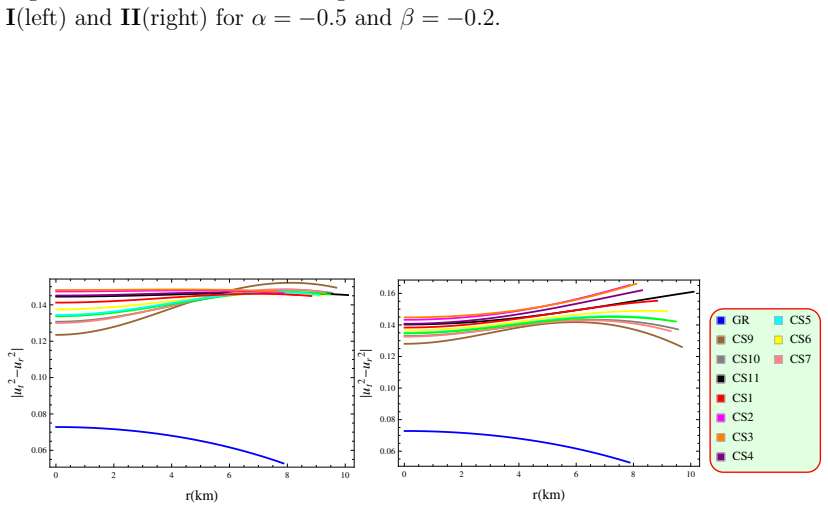
This manuscript examines viability and stability of anisotropic compact objects in the framework of $f(Q,L_m)$ gravity ($Q$ is the non-metricity and $L_m$ is the matter Lagrangian). We assume a particular functional form of this theory to get explicit expressions for the field equations which govern the behavior of matter and geometry in this context. The configuration of static spherically symmetric structures is evaluated using the two innovative non-singular solutions. We use smooth matching conditions to evaluate the values of unknown constants in the metric coefficients. The viability of considered compact stars is assessed using a graphic analysis of various important physical characteristics. We also investigate stability of the considered stellar objects through sound speed method. It is found that these stellar objects are viable and stable, as all the required conditions are satisfied.
Editorial analysis
A structured set of objections, weighed in public.
Referee Report
Summary. The paper examines the viability and stability of anisotropic compact objects in f(Q, L_m) gravity by assuming a particular functional form for the theory. It uses two non-singular interior solutions for static spherically symmetric spacetimes, matches them to the exterior using smooth conditions to fix constants, and concludes based on graphic analysis that the objects satisfy energy conditions, causality, and sound speed stability criteria, hence are viable and stable.
Significance. If the results hold, the paper shows that f(Q, L_m) gravity can support stable anisotropic stellar models, offering insights into modified gravity effects on compact objects. Credit is given for the use of non-singular solutions and the systematic check of physical conditions. The significance is limited because the functional form and solutions are chosen specifically, turning the analysis into a consistency check rather than a broad prediction.
major comments (2)
- [§3] The functional form of f(Q, L_m) is selected ad hoc to derive explicit field equations; the viability is then verified for this choice and the fixed constants from matching, without exploring whether the stability holds for other forms or is a general feature.
- [§5] The graphic analysis confirming the satisfaction of energy conditions, causality, and sound-speed stability provides no quantitative details such as explicit parameter ranges, minimum/maximum values of the quantities, or error estimates, which undermines the strength of the claim that all conditions are satisfied.
minor comments (3)
- [Abstract] The abstract could specify the two non-singular solutions used and the exact functional form assumed for f(Q, L_m).
- [Figures] Figure captions should explicitly state the values of the metric constants and model parameters used in the plots for reproducibility.
- [References] Additional references to prior work on compact stars in f(Q) or similar modified gravity theories would provide better context.
Simulated Author's Rebuttal
We thank the referee for the careful reading of our manuscript and the constructive comments. We address each major comment below and indicate where revisions will be made.
read point-by-point responses
-
Referee: [§3] The functional form of f(Q, L_m) is selected ad hoc to derive explicit field equations; the viability is then verified for this choice and the fixed constants from matching, without exploring whether the stability holds for other forms or is a general feature.
Authors: We selected the specific functional form of f(Q, L_m) to obtain explicit field equations that permit analytical interior solutions and direct matching to the exterior geometry. This is a standard methodological choice in modified gravity literature when the goal is to construct and test concrete stellar models rather than to derive general theorems. The manuscript demonstrates the existence of viable, stable anisotropic configurations for this choice and the adopted non-singular solutions; it does not assert that the same conclusions hold for arbitrary forms of f(Q, L_m). We will add explicit statements in the introduction and concluding section clarifying the scope of the analysis and noting that the generality of the results across other functional forms is left for future investigation. revision: partial
-
Referee: [§5] The graphic analysis confirming the satisfaction of energy conditions, causality, and sound-speed stability provides no quantitative details such as explicit parameter ranges, minimum/maximum values of the quantities, or error estimates, which undermines the strength of the claim that all conditions are satisfied.
Authors: We agree that the purely graphical presentation would benefit from quantitative support. In the revised manuscript we will insert tables that list, for each stellar model, the minimum and maximum values attained by the energy density, radial and tangential pressures, and the two sound-speed components over the interior. We will also state the intervals of the free parameters for which all energy conditions, causality, and stability criteria remain satisfied. These additions will complement the figures and strengthen the quantitative basis of our conclusions. revision: yes
Circularity Check
No significant circularity detected
full rationale
The paper assumes a specific functional form for f(Q, L_m) and adopts two chosen non-singular interior solutions, determines metric constants via matching conditions, and then verifies that the resulting quantities satisfy energy conditions, causality, and sound-speed stability via direct graphical and analytical checks. This is a standard consistency verification within an explicitly constructed model rather than any derivation in which a claimed prediction or first-principles result reduces by construction to the inputs. No load-bearing self-citation, self-definitional step, or fitted parameter renamed as an independent prediction is present; the viability conclusion is supported by the explicit post-construction checks on the selected configurations.
Axiom & Free-Parameter Ledger
free parameters (2)
- parameters inside chosen f(Q, L_m)
- integration constants in metric coefficients
axioms (2)
- domain assumption Static spherically symmetric spacetime
- domain assumption Smooth matching conditions at the stellar surface
Reference graph
Works this paper leans on
-
[1]
et al.: Phys
Shapiro, I.I. et al.: Phys. Rev. Lett. 36(1976)555
1976
-
[2]
and Starobinsky, A.A.: Int
Sahni, V. and Starobinsky, A.A.: Int. J. Mod. Phys. D 9(2000)373
2000
-
[3]
Carroll, S.M.: Living Rev. Rel. 4(2001)56
2001
-
[4]
and Ratra, B.: Rev
Peebles, P.J.E. and Ratra, B.: Rev. Mod. Phys. 75(2003)559
2003
-
[5]
Padmanabhan, T.: Phys. Rep. 380(2003)235. 41
2003
-
[6]
et al.: Int
Copeland, E.J. et al.: Int. J. Mod. Phys. D 15(2006)175
2006
-
[7]
and Odintsov, S.D.: Int
Nojiri, S.I. and Odintsov, S.D.: Int. J. Geom. Methods Mod. Phys. 4(2007)115; Sotiriou, T.P. and Faraoni, V.: Rev. Mod. Phys. 82(2010)451
2007
-
[8]
and Koivisto, T.: Eur
Conroy, A. and Koivisto, T.: Eur. Phys. J. C 78(2018)923
2018
-
[9]
et al.: Mod
Adeel, M. et al.: Mod. Phys. Lett. A 38(2023)2350152
2023
-
[10]
et al.: Eur
Sharif, M. et al.: Eur. Phys. J. C 84(2024)1065
2024
-
[11]
et al.: Int
Rani, S. et al.: Int. J. Geom. Methods Mod. Phys. 21(2024)2450033
2024
-
[12]
et al.: Eur
Gul, M.Z. et al.: Eur. Phys. J. C 84(2024)8
2024
-
[13]
et al.: Phys
Maurya, S.K. et al.: Phys. Dark Universe 46(2024)101619
2024
-
[14]
et al.: Chin
Sharif, M. et al.: Chin. J. Phys. 91(2024)66
2024
-
[15]
Heisenberg, L.: Phys. Rep. 1066(2024)78
2024
-
[16]
et al.: Nucl
Nusrat, F. et al.: Nucl. Phys. B 1016(2025)116923
2025
-
[17]
et al.: Phys
Rani, S. et al.: Phys. Dark Universe 47(2025)101754
2025
-
[18]
et al.: Phys
Sharif, M. et al.: Phys. Dark Universe 47(2025)101760
2025
-
[19]
and Xia, T.: Chin
Mustafa, G., Abbas, G. and Xia, T.: Chin. J. Phys. 60(2019)362
2019
-
[20]
Mustafa, G., X Tie-Cheng and Shamir, M.F..: Phys. Scr. 96(2021)105008
2021
-
[21]
et al.: Eur
Ditta, A. et al.: Eur. Phys. J. C 81(2021)880
2021
-
[22]
et al.: Eur
Waseem, A. et al.: Eur. Phys. J. C 83(2023)1088
2023
-
[23]
et al.: Phys
Sharif, M. et al.: Phys. Dark Universe 46(2024)101606
2024
-
[24]
et al.: Phys
Nan G. et al.: Phys. Dark Universe 46(2024)101635
2024
-
[25]
and Gul, M.Z.: Ann
Sharif, M. and Gul, M.Z.: Ann. Phys. 465(2024)169674
2024
-
[26]
et al.: Eur
Gul, M.Z. et al.: Eur. Phys. J. C 84(2024)775. 42
2024
-
[27]
et al.: Eur
Nasir, M.M.M. et al.: Eur. Phys. J. C 85(2025)159
2025
-
[28]
et al.: Phys
Sharif, M. et al.: Phys. Dark Universe 48(2025)101839
2025
-
[29]
et al.: Nucl
Javed, F. et al.: Nucl. Phys. B 1018(2025)117001
2025
-
[30]
et al.: Ann
Javed, F. et al.: Ann. Phys. 476(2025)169956
2025
-
[31]
et al.: High Energy Density Phys
Hashim, I. et al.: High Energy Density Phys. 57(2025)101223
2025
-
[32]
et al.: Ann
Javed, F. et al.: Ann. Phys. 482(2025)170189
2025
-
[33]
et al.: Int
Hashim, I. et al.: Int. J. Geom. Methods Mod. Phys. 22(2025)2540049
2025
-
[34]
et al.: Phys
Malik, A. et al.: Phys. Dark Universe 50(2025)102114
2025
-
[35]
Dark Universe 47(2025)101763; Yousaf, M.: Chin
Donmez, O.: Phys. Dark Universe 47(2025)101763; Yousaf, M.: Chin. J. Phys. 95(2025)1278; Chin. J. Phys. 97(2025)1284
2025
-
[36]
et al.: Phys
Hazarika, A. et al.: Phys. Dark Universe 50(2025)102092
2025
-
[37]
and Singh, S.S.: Nucl
Samaddar, A. and Singh, S.S.: Nucl. Phys. B 1012(2025)116834
2025
-
[38]
et al.: Eur
Gul, M.Z. et al.: Eur. Phys. J. Plus 140(2025)15; Astron. Comp. 52(2025)100956
2025
-
[39]
et al.: Phys
Myrzakulov, Y. et al.: Phys. Dark Universe 48(2024)01614
2024
-
[40]
et al.: Eur
Myrzakulov, Y. et al.: Eur. Phys. J. C 85(2025)376
2025
-
[41]
et al.: J
Myrzakulov, Y. et al.: J. High Energy Astrophys. 44(2024)164
2024
-
[42]
Longair, M.S.: High Energy Astrophysics (Cambridge Univeristy Press, 1994)
1994
-
[43]
and Gleiser, M.: Gen
Dev, K. and Gleiser, M.: Gen. Relativ. Gravit. 35(2003)1435
2003
-
[44]
and Harko, T.: Int
Mak, M.K. and Harko, T.: Int. J. Mod. Phys. D 13(2004)156
2004
-
[46]
et al.: Gen
Rahaman, F. et al.: Gen. Relativ. Gravit. 44(2012)107; Eur. Phys. J. C 72(2012)2071. 43
2012
-
[48]
and Santos, N.O.: Phys
Herrera, L. and Santos, N.O.: Phys. Rep. 286(1997)53
1997
-
[49]
et al.: Int
Hossein, S.K.M. et al.: Int. J. Mod. Phys. D 21(2012)1250088
2012
-
[50]
and Deb, R.: Astrophys
Paul, B.C. and Deb, R.: Astrophys. Space Sci. 354(2014)421
2014
-
[51]
and Zwicky, F.: Phys
Baade, W. and Zwicky, F.: Phys. Rev. 46(1934)76
1934
-
[52]
and Liang, E.P.T.: Astrophys
Bowers, R.L. and Liang, E.P.T.: Astrophys. J. 188(1974)657
1974
-
[53]
et al.: Eur
Kalam, M. et al.: Eur. Phys. J. C 72(2012)2248
2012
-
[54]
and Rashid, A.: Int
Shamir, M.F. and Rashid, A.: Int. J. Geom. Methods Mod. Phys. 20(2023)2350026
2023
-
[55]
et al.: Int
Athar, A.R. et al.: Int. J. Geom. Methods Mod. Phys. 20(2023)2350003
2023
-
[56]
et al.: New Astron
Majeed, A. et al.: New Astron. 102(2023)102039
2023
-
[57]
et al.: Phys
Maurya, S.K. et al.: Phys. Dark Universe 30(2020)100640
2020
-
[58]
and Tello-Ortiz, F.: Phys
Maurya, S.K. and Tello-Ortiz, F.: Phys. Dark Universe 27(2020)100442
2020
-
[59]
et al.: Eur
Bamba, K. et al.: Eur. Phys. J. C 83(2023)1033
2023
-
[60]
et al.: Phys
Jasim, M.K. et al.: Phys. Scr. 98(2023)045305
2023
-
[61]
et al.: Eur
Sohail, H. et al.: Eur. Phys. J. Plus 139(2024)16
2024
-
[62]
et al.: Eur
Albalahi, A. et al.: Eur. Phys. J. C 84(2024)9
2024
-
[63]
and Sharif, M.: Eur
Naseer, T. and Sharif, M.: Eur. Phys. J. C 84(2024)21
2024
-
[64]
et al.: Fortschr
Pradhan, S. et al.: Fortschr. Phys. 72(2024)2400092
2024
-
[65]
et al.: Eur
Maurya, S.K. et al.: Eur. Phys. J. C 84(2024)296
2024
-
[66]
Weyl, H.: Sitzungsber. Preuss. Akad. Wiss. 26(1918)465
1918
-
[67]
and Sahoo, P.K.: Phys
Moraes, P.H.R.S. and Sahoo, P.K.: Phys. Rev. D 97(2018)024007
2018
-
[68]
and Skea, J.E.F.: Class
Finch, M.R. and Skea, J.E.F.: Class. Quantum Grav. 6(1989)467. 44
1989
-
[69]
et al.: Astrophys
Rawls, M.L. et al.: Astrophys. J. 730(2011)25
2011
-
[70]
et al.: Mon
Elebert, P. et al.: Mon. Not. R. Astron. Soc. 395(2009)884
2009
-
[71]
et al.: Astron
Abubekerov, M.K. et al.: Astron. Rep. 52(2008)379
2008
-
[72]
et al.: Astrophys
Guver, T. et al.: Astrophys. J. 712(2010)964
2010
-
[73]
Guver, T.: Astrophys. J. 719(2010)1807
2010
-
[74]
Freire, P.C.C.: Mon. Not. R. Astron. Soc. 412(2011)2763
2011
-
[75]
Demorest, P.B.: Nature 467(2010)1081
2010
-
[76]
Ozel, F.: Astrophys. J. 693(2009)1775
2009
-
[77]
Indian Acad
Karmarkar, K.R.: Proc. Indian Acad. Sci. A 27(1948)56
1948
-
[78]
et al: Eur
Bhar, P. et al: Eur. Phys. J. C 77(2017)596
2017
-
[81]
Buchdahl, A.H.: Phys. Rev. D 116(1959)1027
1959
-
[82]
Ivanov, B.V.: Phys. Rev. D 65(2002)104011
2002
-
[83]
et al.: Class
Abreu, H. et al.: Class. Quantum Grav. 24(2007)4631
2007
-
[84]
Herrera, L.: Phys. Lett. A 165(1992)206
1992
discussion (0)
Sign in with ORCID, Apple, or X to comment. Anyone can read and Pith papers without signing in.