Galaxy clusters in the LoTSS-DR3: Catalogues and detection pipeline for diffuse radio emission
Pith reviewed 2026-05-08 05:33 UTC · model grok-4.3
The pith
A convolutional neural network pipeline automatically detects diffuse radio emission in 3822 galaxy clusters from the LoTSS-DR3 survey.
A machine-rendered reading of the paper's core claim, the machinery that carries it, and where it could break.
Core claim
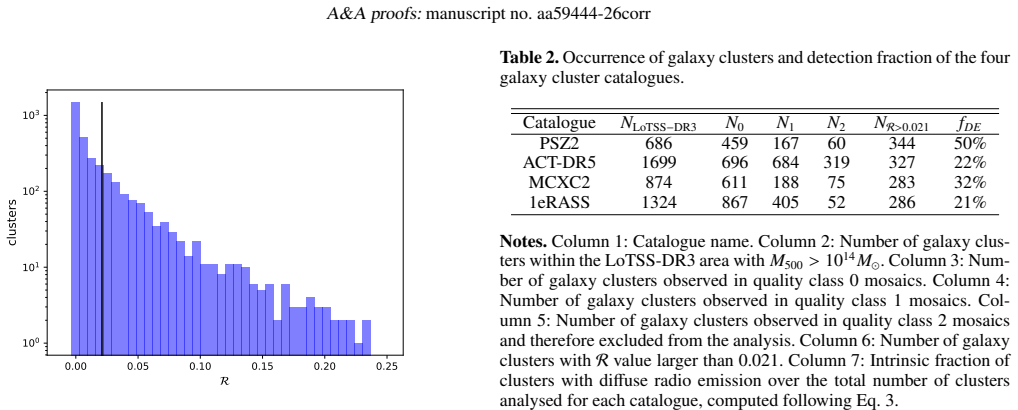
We employed Radio U-Net, a convolutional neural network optimised for image segmentation of diffuse radio emission. To associate detected emission with individual clusters, we combined the network output with positional, mass, and redshift information from four X-ray- and Sunyaev-Zeldovich-selected cluster catalogues, resulting in a merged sample of 3822 clusters covered by the LoTSS-DR3. We produced a pixel-level segmentation map of the full LoTSS-DR3 and a quantitative indicator for the presence of diffuse emission in each cluster. As a demonstration, we identified a sub-sample of 357 clusters selected at the highest network accuracy (76 percent) and verified that the detection fraction of
What carries the argument
Radio U-Net, a convolutional neural network for pixel-level segmentation of diffuse radio emission in 144 MHz images, which generates maps that are then cross-matched with cluster catalogues to yield detection probabilities and morphological information.
Load-bearing premise
The neural network trained on a labeled subset of images accurately identifies genuine diffuse radio emission across the full survey without significant contamination from noise, artifacts, or unrelated sources.
What would settle it
If visual inspection or targeted follow-up of the 357 highest-accuracy candidates reveals that more than about 20 percent are false positives from non-cluster sources, the pipeline's claimed reliability would not hold.
Figures



read the original abstract
The third data release of the LOFAR Two-metre Sky Survey provides an unprecedented view of the northern sky at 144 MHz. While compact sources can be efficiently identified with automated software packages, the detection of diffuse radio emission associated with galaxy clusters still requires dedicated processing and visual inspection. Given the scale of current and forthcoming radio surveys, automated approaches based on artificial intelligence are becoming essential to the identification of the most interesting targets. We aim to develop an automated pipeline to construct a catalogue of galaxy clusters hosting diffuse radio emission from LoTSS-DR3 20arcsec images. The pipeline is designed to provide both the probability that a cluster hosts diffuse radio emission and an interpretable image of its shape and morphology. We employed Radio U-Net, a convolutional neural network optimised for image segmentation (i.e. pixel-level identification) of diffuse radio emission. To associate detected emission with individual clusters, we combined the network output with positional, mass, and redshift information from four X-ray- and Sunyaev-Zeldovich-selected cluster catalogues, resulting in a merged sample of 3822 clusters covered by the LoTSS-DR3. We produced a pixel-level segmentation map of the full LoTSS-DR3 and a quantitative indicator for the presence of diffuse emission in each cluster. This enables the selection of sub-samples with specific properties for targeted follow-up or statistical studies. As a demonstration of the first application, we identified a sub-sample of 357 clusters selected at the highest network accuracy (76%), and we showed some examples of newly detected systems. For the second, using a larger statistical sample, we verified that the detection fraction of diffuse radio sources in the four catalogues increases with the mass and redshift of the clusters. [Abridged]
Editorial analysis
A structured set of objections, weighed in public.
Referee Report
Summary. The paper introduces Radio U-Net, a convolutional neural network for pixel-level segmentation of diffuse radio emission in LoTSS-DR3 20-arcsec images. It combines network outputs with positional, mass, and redshift data from four X-ray- and SZ-selected cluster catalogues to produce a merged sample of 3822 clusters, selects a high-accuracy sub-sample of 357 clusters (reported 76% accuracy), provides examples of new detections, and verifies that the detection fraction of diffuse sources increases with cluster mass and redshift.
Significance. If the network generalizes reliably, this pipeline offers a scalable, interpretable tool for identifying diffuse radio emission in large surveys, reducing dependence on visual inspection and enabling targeted follow-up and statistical analyses of cluster radio halos and relics. The alignment of results with expected astrophysical trends (higher detection at higher mass and redshift) provides supporting evidence for the method's utility.
major comments (3)
- Abstract: The central claim of 76% network accuracy for the 357-cluster sub-sample is not supported by details on training set size/composition, train/validation/test splits, the precise accuracy metric (pixel accuracy, IoU, or precision at threshold), or false-positive rates measured on real survey data containing noise, artifacts, and unrelated extended sources. This information is required to bound contamination in the parent 3822-cluster sample.
- Methods/Results: No quantitative comparison of network outputs to independent human visual inspection is reported for a held-out test set or the selected sub-sample, leaving the generalization performance and equivalence to traditional methods unquantified.
- Results: The reported increase in detection fraction with mass and redshift relies on network-derived selections, yet lacks completeness/contamination corrections or error bars derived from the network's validation metrics, weakening the physical interpretation.
minor comments (3)
- Abstract: '20arcsec' should be written as '20-arcsec' for standard formatting.
- Consider adding a dedicated table or subsection summarizing Radio U-Net hyperparameters, dataset splits, and all performance metrics (including precision, recall, and IoU) to improve reproducibility.
- The catalogue-merging procedure would benefit from explicit discussion of overlaps, duplicate handling, and selection biases between the four input catalogues.
Simulated Author's Rebuttal
We thank the referee for their constructive and detailed report. We address each major comment below and indicate where revisions will be made to strengthen the manuscript.
read point-by-point responses
-
Referee: Abstract: The central claim of 76% network accuracy for the 357-cluster sub-sample is not supported by details on training set size/composition, train/validation/test splits, the precise accuracy metric (pixel accuracy, IoU, or precision at threshold), or false-positive rates measured on real survey data containing noise, artifacts, and unrelated extended sources. This information is required to bound contamination in the parent 3822-cluster sample.
Authors: We agree that additional methodological details are required to support the accuracy claim and to allow readers to assess contamination. In the revised manuscript we will expand the Methods section with the training set size and composition (number of images and labeling procedure), the train/validation/test split ratios, and the exact definition of the 76% accuracy metric (pixel-level agreement with human labels on the validation set). We will also report the false-positive rate measured on the validation data and discuss its implications for the parent sample, including a qualitative estimate of contamination. revision: yes
-
Referee: Methods/Results: No quantitative comparison of network outputs to independent human visual inspection is reported for a held-out test set or the selected sub-sample, leaving the generalization performance and equivalence to traditional methods unquantified.
Authors: The 76% figure already reflects quantitative agreement with human visual inspection on the validation set. However, we acknowledge the value of an explicit held-out test-set evaluation and of metrics for the high-confidence sub-sample. We will add a dedicated subsection reporting precision, recall and IoU on the test set, together with the level of agreement between network predictions and independent visual inspection for the 357-cluster sub-sample. revision: yes
-
Referee: Results: The reported increase in detection fraction with mass and redshift relies on network-derived selections, yet lacks completeness/contamination corrections or error bars derived from the network's validation metrics, weakening the physical interpretation.
Authors: We agree that error bars and a discussion of selection biases would improve the robustness of the trend. In the revision we will add binomial or bootstrap error bars to the detection-fraction plots, derived from the network validation metrics. We will also include a short discussion of completeness and contamination, noting that the observed trends are consistent with prior expectations but that full statistical corrections would require a larger labeled dataset; this limitation will be stated explicitly. revision: partial
Circularity Check
No circularity: application of trained segmentation network to independent survey data
full rationale
The paper trains Radio U-Net on a labeled subset of images for pixel-level segmentation of diffuse emission, then applies the fixed model to the full LoTSS-DR3 20-arcsec images and merges outputs with four external X-ray/SZ cluster catalogues (yielding 3822 clusters). The 357-cluster high-accuracy subsample and the mass/redshift trend verification are downstream empirical results, not quantities defined by or fitted to the final catalogue itself. No equation or claim reduces by construction to its own inputs; the network output is an independent forward pass, and accuracy is reported as a measured performance figure rather than a self-referential definition. The derivation chain is therefore self-contained against external benchmarks.
Axiom & Free-Parameter Ledger
axioms (2)
- domain assumption The Radio U-Net model trained on a subset of data generalizes to the full LoTSS-DR3 survey without significant domain shift or false detections.
- domain assumption The four X-ray and SZ-selected cluster catalogues provide accurate positions, masses, and redshifts for reliable association with detected emission.
Reference graph
Works this paper leans on
-
[1]
Abadi, M., Agarwal, A., Barham, P., et al. 2015, TensorFlow: Large-Scale Ma- chine Learning on Heterogeneous Systems, paper and Software available from https://www.tensorflow.org/
work page 2015
-
[2]
Agarap, A. F. 2018, arXiv e-prints, arXiv:1803.08375
work page internal anchor Pith review Pith/arXiv arXiv 2018
-
[3]
Aguado-Barahona, A., Barrena, R., Streblyanska, A., et al. 2019, A&A, 631, A148
work page 2019
-
[4]
Bahk, H. & Hwang, H. S. 2024, ApJS, 272, 7 Baron Perez, N., Brüggen, M., Kasieczka, G., & Lucie-Smith, L. 2025, A&A, 699, A302
work page 2024
-
[5]
Barrena, R., Streblyanska, A., Ferragamo, A., et al. 2018, A&A, 616, A42
work page 2018
-
[6]
Beck, R., Dobos, L., Budavári, T., Szalay, A. S., & Csabai, I. 2016, Monthly Notices of the Royal Astronomical Society, 460, 1371
work page 2016
-
[7]
Boada, S., Hughes, J. P., Menanteau, F., et al. 2019, ApJ, 871, 188 Böhringer, H., Chon, G., Collins, C. A., et al. 2013, A&A, 555, A30
work page 2019
-
[8]
Botteon, A., Shimwell, T. W., Cassano, R., et al. 2022, A&A, 660, A78
work page 2022
-
[9]
Botteon, A., van Weeren, R. J., Brunetti, G., et al. 2020, MNRAS, 499, L11 Brüggen, M., Bykov, A., Ryu, D., & Röttgering, H. 2012, Space Sci. Rev., 166, 187
work page 2020
-
[10]
2011, Journal of Astrophysics and Astronomy, 32, 437
Brunetti, G. 2011, Journal of Astrophysics and Astronomy, 32, 437
work page 2011
-
[11]
Brunetti, G. & Jones, T. W. 2014, International Journal of Modern Physics D, 23, 1430007
work page 2014
- [12]
-
[13]
Bruno, L., Botteon, A., Dallacasa, D., et al. 2025, A&A, 704, A245
work page 2025
- [14]
- [15]
- [16]
-
[17]
Burenin, R. A. 2017, Astronomy Letters, 43, 507
work page 2017
-
[18]
Burenin, R. A., Bikmaev, I. F., Khamitov, I. M., et al. 2018, Astronomy Letters, 44, 297
work page 2018
-
[19]
2015, in Advancing Astrophysics with the Square Kilometre Array (AASKA14), 73
Cassano, R., Bernardi, G., Brunetti, G., et al. 2015, in Advancing Astrophysics with the Square Kilometre Array (AASKA14), 73
work page 2015
-
[20]
Cassano, R., Brunetti, G., Setti, G., Govoni, F., & Dolag, K. 2007, MNRAS, 378, 1565
work page 2007
-
[21]
Cassano, R., Cuciti, V ., Brunetti, G., et al. 2023, A&A, 672, A43
work page 2023
-
[22]
Chollet, F. et al. 2015, Keras, https://keras.io
work page 2015
- [23]
-
[24]
2022, Foundations and Trends in Com- puter Graphics and Vision, 14, 1
Csurka, G., V olpi, R., & Chidlovskii, B. 2022, Foundations and Trends in Com- puter Graphics and Vision, 14, 1
work page 2022
-
[25]
Cuciti, V ., Cassano, R., Brunetti, G., et al. 2015, A&A, 580, A97
work page 2015
- [26]
-
[27]
Dewdney, P. E., Hall, P. J., Schilizzi, R. T., & Lazio, T. J. L. W. 2009, IEEE Proceedings, 97, 1482 Di Gennaro, G., Brüggen, M., Moravec, E., et al. 2025, A&A, 695, A215 Di Gennaro, G., Timmerman, R., Hoeft, M., et al. 2026, arXiv pre-print, accepted by A&A, arXiv:2602.23046 Di Gennaro, G., van Weeren, R. J., Brunetti, G., et al. 2021, Nature Astronomy, 5, 268
work page internal anchor Pith review arXiv 2009
-
[28]
W., Botteon, A., Koribalski, B
Duchesne, S. W., Botteon, A., Koribalski, B. S., et al. 2024, PASA, 41, e026
work page 2024
-
[29]
2026, arXiv e-prints, submitted to RAS Techniques and Instruments, arXiv:2602.15930
Etsebeth, V ., Lochner, M., Kolokythas, K., Knowles, K., & Tolley, E. 2026, arXiv e-prints, submitted to RAS Techniques and Instruments, arXiv:2602.15930
-
[30]
Feretti, L., Giovannini, G., Govoni, F., & Murgia, M. 2012, A&A Rev., 20, 54
work page 2012
-
[31]
Fernique, P., Allen, M. G., Boch, T., et al. 2015, A&A, 578, A114
work page 2015
- [32]
- [33]
-
[34]
Giovannini, G., Cau, M., Bonafede, A., et al. 2020, A&A, 640, A108
work page 2020
-
[35]
2016, Deep Learning (Cambridge, MA: MIT Press)
Goodfellow, I., Bengio, Y ., & Courville, A. 2016, Deep Learning (Cambridge, MA: MIT Press)
work page 2016
-
[36]
Govoni, F. & Feretti, L. 2004, International Journal of Modern Physics D, 13, 1549
work page 2004
-
[37]
Govoni, F., Orrù, E., Bonafede, A., et al. 2019, Science, 364, 981
work page 2019
-
[38]
Gupta, N., Hayder, Z., Norris, R. P., Huynh, M., & Petersson, L. 2024, PASA, 41, e001
work page 2024
- [39]
-
[40]
HLavacek-Larrondo, J., Timmerman, R., Pfrommer, C., et al. 2025, ApJ, 987, L40
work page 2025
-
[41]
N., Brüggen, M., Botteon, A., et al
Hoang, D. N., Brüggen, M., Botteon, A., et al. 2022, A&A, 665, A60
work page 2022
-
[42]
Hotan, A. W., Bunton, J. D., Chippendale, A. P., et al. 2021, PASA, 38, e009
work page 2021
-
[43]
Jonas, J. & MeerKAT Team. 2016, in MeerKAT Science: On the Pathway to the SKA, 1
work page 2016
-
[44]
Jones, A., de Gasperin, F., Cuciti, V ., et al. 2023, A&A, 680, A31
work page 2023
-
[45]
Knowles, K., Cotton, W. D., Rudnick, L., et al. 2022, A&A, 657, A56
work page 2022
-
[46]
Kolokythas, K., Venturi, T., Knowles, K., et al. 2025, MNRAS, 543, 1638
work page 2025
-
[47]
Kosiba, M., Lieu, M., Altieri, B., et al. 2020, MNRAS, 496, 4141
work page 2020
- [48]
- [49]
- [50]
-
[51]
Mann, A. W. & Ebeling, H. 2012, MNRAS, 420, 2120
work page 2012
-
[52]
Mishra, A. K., Tolley, E., Krishna, S. P., & Kneib, J.-P. 2025, MNRAS, 538, 2905
work page 2025
-
[53]
Mostert, R. I. J., Duncan, K. J., Röttgering, H. J. A., et al. 2021, A&A, 645, A89
work page 2021
-
[54]
Mostert, R. I. J., Morganti, R., Brienza, M., et al. 2023, A&A, 674, A208
work page 2023
-
[55]
Nuza, S. E., Hoeft, M., van Weeren, R. J., Gottlöber, S., & Yepes, G. 2012, MNRAS, 420, 2006
work page 2012
-
[56]
W., Pointecouteau, E., & Melin, J
Piffaretti, R., Arnaud, M., Pratt, G. W., Pointecouteau, E., & Melin, J. B. 2011, A&A, 534, A109 Planck Collaboration, Ade, P. A. R., Aghanim, N., et al. 2016, A&A, 594, A27
work page 2011
- [57]
-
[58]
Riggi, S., Cecconello, T., Palazzo, S., et al. 2024, PASA, 41, e085
work page 2024
-
[59]
2023, Astronomy and Computing, 42, 100682
Riggi, S., Magro, D., Sortino, R., et al. 2023, Astronomy and Computing, 42, 100682
work page 2023
-
[60]
2015, in Lecture Notes in Computer
Ronneberger, O., Fischer, P., & Brox, T. 2015, in Lecture Notes in Computer
work page 2015
-
[61]
9351, Medical Image Computing and Computer-Assisted Inter- vention – MICCAI 2015 (Springer), 234–241
Science, V ol. 9351, Medical Image Computing and Computer-Assisted Inter- vention – MICCAI 2015 (Springer), 234–241
work page 2015
-
[62]
Sadibekova, T., Arnaud, M., Pratt, G. W., Tarrío, P., & Melin, J. B. 2024, A&A, 688, A187
work page 2024
-
[63]
Sadikov, M., Hlavacek-Larrondo, J., Perreault-Levasseur, L., et al. 2025, ApJ, 986, 24
work page 2025
-
[64]
Sanvitale, N., Gheller, C., Vazza, F., et al. 2025, MNRAS, 541, 3479
work page 2025
-
[65]
Shimwell, T. W., Hardcastle, M. J., Tasse, C., et al. 2022, A&A, 659, A1
work page 2022
-
[66]
Shimwell, T. W., Hardcastle, M. J., Tasse, C., et al. 2026, A&A, 707, A198
work page 2026
-
[67]
Shimwell, T. W., Röttgering, H. J. A., Best, P. N., et al. 2017, A&A, 598, A104
work page 2017
-
[68]
Shimwell, T. W., Tasse, C., Hardcastle, M. J., et al. 2019, A&A, 622, A1
work page 2019
-
[69]
Slijepcevic, I. V ., Scaife, A. M. M., Walmsley, M., et al. 2024, RAS Techniques and Instruments, 3, 19
work page 2024
-
[70]
2023, Experimental Astronomy, 56, 293
Sortino, R., Magro, D., Fiameni, G., et al. 2023, Experimental Astronomy, 56, 293
work page 2023
-
[71]
Streblyanska, A., Aguado-Barahona, A., Ferragamo, A., et al. 2019, A&A, 628, A13
work page 2019
- [72]
- [73]
-
[74]
Stuardi, C., Gheller, C., Vazza, F., & Botteon, A. 2024, MNRAS, 533, 3194
work page 2024
-
[75]
Tieleman, T. & Hinton, G. 2012, Lecture 6.5 — RMSProp: Divide the Gradient by a Running Average of its Recent Magnitude, Coursera: Neural Networks for Machine Learning, lecture notes
work page 2012
-
[76]
Tingay, S. J., Goeke, R., Bowman, J. D., et al. 2013, PASA, 30, e007 van Haarlem, M. P., Wise, M. W., Gunst, A. W., et al. 2013, A&A, 556, A2 van Weeren, R. J., de Gasperin, F., Akamatsu, H., et al. 2019, Space Sci. Rev., 215, 16 van Weeren, R. J., Shimwell, T. W., Botteon, A., et al. 2021, A&A, 651, A115
work page 2013
- [77]
-
[78]
Wen, Z. L. & Han, J. L. 2024, ApJS, 272, 39
work page 2024
-
[79]
Xu, W., Ramos-Ceja, M. E., Pacaud, F., Reiprich, T. H., & Erben, T. 2022, A&A, 658, A59
work page 2022
- [80]
discussion (0)
Sign in with ORCID, Apple, or X to comment. Anyone can read and Pith papers without signing in.