DFT-s-OFDM with Chirping for Integrated Sensing and Communications in 6G and Beyond
Pith reviewed 2026-05-20 22:37 UTC · model grok-4.3
The pith
DFT-s-OFDM with chirping combines sensing and communication in one waveform for 6G systems.
A machine-rendered reading of the paper's core claim, the machinery that carries it, and where it could break.
Core claim
DFT-s-OFDM with chirping preserves the low peak-to-average power ratio and other communication benefits of standard DFT-s-OFDM while adding chirp features that improve sensing functions such as range and velocity estimation. The paper evaluates these combined properties and shows advantages for ISAC applications in 6G and beyond, including compatibility with diverse terminal types.
What carries the argument
The chirping modification applied to DFT-s-OFDM, which introduces a frequency sweep to the spread signal to strengthen autocorrelation for sensing while keeping the DFT spreading and OFDM structure for communications.
If this is right
- The waveform maintains efficient power amplification due to retained low PAPR from DFT spreading.
- Sensing gains improved autocorrelation properties useful for radar-like target detection.
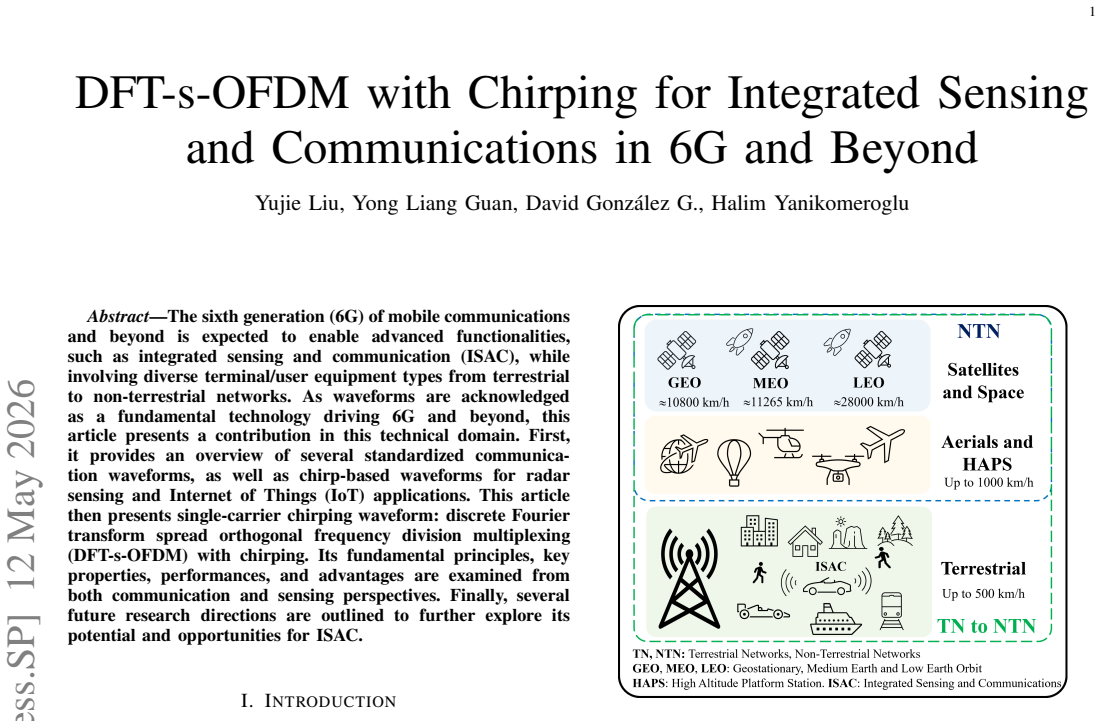
- It supports operation across terrestrial, non-terrestrial, and IoT terminals without separate waveforms.
- The design remains compatible with existing DFT-s-OFDM implementations in 5G and 6G standards.
Where Pith is reading between the lines
- A single waveform for both functions could reduce the need for separate sensing hardware in user devices.
- Chirping may offer better performance in high-mobility scenarios typical of 6G vehicular or drone applications.
- Tuning the chirp rate could allow scenario-specific optimization for different sensing ranges or data rates.
Load-bearing premise
Adding chirping to DFT-s-OFDM preserves its core communication advantages without major performance penalties in realistic 6G channels and hardware.
What would settle it
A side-by-side test in a 6G multipath channel model that measures bit error rate for communications and range resolution for sensing, comparing the chirped version directly against standard DFT-s-OFDM.
Figures


read the original abstract
The sixth generation (6G) of mobile communications and beyond is expected to enable advanced functionalities, such as integrated sensing and communication (ISAC), while involving diverse terminal/user equipment types from terrestrial to non-terrestrial networks. As waveforms are acknowledged as a fundamental technology driving 6G and beyond, this article presents a contribution in this technical domain. First, it provides an overview of several standardized communication waveforms, as well as chirp-based waveforms for radar sensing and Internet of Things (IoT) applications. This article then presents single-carrier chirping waveform: discrete Fourier transform spread orthogonal frequency division multiplexing (DFT-s-OFDM) with chirping. Its fundamental principles, key properties, performances, and advantages are examined from both communication and sensing perspectives. Finally, several future research directions are outlined to further explore its potential and opportunities for ISAC.
Editorial analysis
A structured set of objections, weighed in public.
Referee Report
Summary. The manuscript reviews several standardized communication waveforms and chirp-based waveforms for radar and IoT, then introduces DFT-s-OFDM with chirping as a single-carrier waveform for integrated sensing and communications (ISAC) in 6G and beyond. It examines the fundamental principles, key properties, performances, and advantages of the proposed waveform from both communication and sensing perspectives before outlining future research directions.
Significance. If the performance claims hold under realistic conditions, the work could contribute to 6G waveform design by offering a candidate that potentially retains the low-PAPR and frequency-domain equalization benefits of DFT-s-OFDM while adding usable radar-like autocorrelation for sensing. The overview of existing standardized and chirp waveforms provides helpful context for the proposal.
major comments (2)
- The central claim that the chirping modification preserves the core communication advantages of DFT-s-OFDM (low PAPR, frequency-domain equalization) while adding sensing functionality requires explicit support. In the performance examination section, provide PAPR CCDF curves and BER results versus chirp rate under high-mobility Doppler and PA nonlinearity; without these, the joint ISAC advantage remains conditional on untested assumptions about residual inter-carrier interference after IDFT.
- Section on key properties: clarify the exact mechanism by which the linear frequency sweep is superimposed on the DFT-spread symbols and quantify any impact on the single-carrier nature or orthogonality, including whether the modification introduces amplitude peaks that undermine uplink coverage advantages in 6G scenarios.
minor comments (2)
- Abstract: the statement that performances and advantages are examined would be strengthened by a brief reference to the main quantitative findings or metrics reported in the manuscript.
- Notation: ensure consistent use of symbols for chirp rate and DFT spreading parameters across the waveform description and performance sections to avoid ambiguity for readers.
Simulated Author's Rebuttal
We thank the referee for the constructive and detailed comments, which help strengthen the presentation of DFT-s-OFDM with chirping as a candidate ISAC waveform. We address each major comment below and commit to revisions that provide the requested clarifications and supporting results.
read point-by-point responses
-
Referee: The central claim that the chirping modification preserves the core communication advantages of DFT-s-OFDM (low PAPR, frequency-domain equalization) while adding sensing functionality requires explicit support. In the performance examination section, provide PAPR CCDF curves and BER results versus chirp rate under high-mobility Doppler and PA nonlinearity; without these, the joint ISAC advantage remains conditional on untested assumptions about residual inter-carrier interference after IDFT.
Authors: We agree that explicit empirical support is required to substantiate the preservation of communication advantages. In the revised manuscript, the performance examination section will be expanded to include PAPR CCDF curves and BER results plotted against chirp rate. These will incorporate high-mobility Doppler scenarios and power-amplifier nonlinearity models. The new results will demonstrate that the chirping modification maintains the low-PAPR characteristic and permits effective frequency-domain equalization, with only negligible residual inter-carrier interference after the IDFT. This directly addresses the conditional nature of the joint ISAC advantage. revision: yes
-
Referee: Section on key properties: clarify the exact mechanism by which the linear frequency sweep is superimposed on the DFT-spread symbols and quantify any impact on the single-carrier nature or orthogonality, including whether the modification introduces amplitude peaks that undermine uplink coverage advantages in 6G scenarios.
Authors: We will revise the key properties section to provide a precise description of the mechanism: the linear frequency sweep is applied in the time domain directly to the output of the IDFT on the DFT-spread symbols, resulting in a chirped single-carrier waveform. Mathematical analysis will be added to show that this operation preserves the single-carrier envelope properties and does not destroy subcarrier orthogonality within the communication resource grid, as the chirp is a common multiplicative factor. Quantitative evaluation of amplitude statistics will be included to confirm that any additional peaks remain limited and do not compromise the uplink coverage advantages of DFT-s-OFDM in 6G deployments. revision: yes
Circularity Check
No significant circularity detected; derivation relies on external waveform standards
full rationale
The paper opens with an overview of standardized communication waveforms and existing chirp-based waveforms drawn from prior literature, then defines and examines DFT-s-OFDM with chirping as a single-carrier modification. No equations, performance claims, or key properties are shown to reduce by construction to fitted parameters or self-referential definitions internal to the paper; the analysis of communication and sensing advantages proceeds from the explicit waveform construction and its comparison to established baselines. This keeps the central contribution self-contained against external benchmarks rather than tautological.
Axiom & Free-Parameter Ledger
Lean theorems connected to this paper
-
IndisputableMonolith/Cost/FunctionalEquation.leanwashburn_uniqueness_aczel unclear?
unclearRelation between the paper passage and the cited Recognition theorem.
DFT-s-OFDM with chirping is formed by multiplying a DFT-s-OFDM signal with a modulated/unmodulated chirp signal... preserves the single-carrier characteristic... low PAPR... analog mixer to generate a beat frequency
-
IndisputableMonolith/Foundation/DimensionForcing.leanalexander_duality_circle_linking unclear?
unclearRelation between the paper passage and the cited Recognition theorem.
chirped DFT-s-OFDM achieves full frequency diversity... PMSR... range-velocity ambiguity functions
What do these tags mean?
- matches
- The paper's claim is directly supported by a theorem in the formal canon.
- supports
- The theorem supports part of the paper's argument, but the paper may add assumptions or extra steps.
- extends
- The paper goes beyond the formal theorem; the theorem is a base layer rather than the whole result.
- uses
- The paper appears to rely on the theorem as machinery.
- contradicts
- The paper's claim conflicts with a theorem or certificate in the canon.
- unclear
- Pith found a possible connection, but the passage is too broad, indirect, or ambiguous to say the theorem truly supports the claim.
Reference graph
Works this paper leans on
-
[1]
V . Koivunen, M. F. Keskin, H. Wymeersch, M. V alkama, and N. Gonz´ alez-Prelcic, “Multicarrier ISAC: Advances in wav eform de- sign, signal processing, and learning under nonidealities ,” IEEE Signal Process. Mag., vol. 41, no. 5, pp. 17–30, 2024
work page 2024
-
[2]
Joint radar-communication systems: Modulation schemes and system design,
L. Giroto de Oliveira, B. Nuss, M. B. Alabd, A. Diewald, M. Pauli, and T. Zwick, “Joint radar-communication systems: Modulation schemes and system design,” IEEE Tran. Micro. Theory Techn. , vol. 70, no. 3, pp. 1521–1551, 2022
work page 2022
-
[3]
H. S. Rou and et al., “From orthogonal time-frequency spa ce to affine frequency-division multiplexing: A comparative stu dy of next- generation waveforms for integrated sensing and communica tions in doubly dispersive channels,” IEEE Sig. Process. Mag. , vol. 41, no. 5, pp. 71–86, 2024
work page 2024
-
[4]
Cross-layer integrated sensin g and commu- nication: A joint industrial and academic perspective,
H. Wymeersch and et al., “Cross-layer integrated sensin g and commu- nication: A joint industrial and academic perspective,” IEEE Open J. Commun. Soc. , vol. 6, pp. 6966–7015, 2025
work page 2025
-
[5]
Chirped DFT-s-OFDM: A new single-carrier waveform with enhanced LM MSE noise suppression,
Y . Liu, Y . L. Guan, D. Gonz´ alez G., and H. Y anikomeroglu, “Chirped DFT-s-OFDM: A new single-carrier waveform with enhanced LM MSE noise suppression,” IEEE Tran. V eh. Technol., vol. 74, no. 7, pp. 11 501– 11 506, 2025
work page 2025
-
[6]
DFT-s-OFDM with chirp modulation,
——, “DFT-s-OFDM with chirp modulation,” in Proc. IEEE 36th Int. Symp. Pers., Indoor Mobile Radio Commun. (PIMRC) , 2025, pp. 1–6
work page 2025
-
[7]
ITU-R, “Report M.2516-0: Future technology trends of te rrestrial International Mobile Telecommunications systems towards 2030 and beyond,” Nov. 2022, Available online at: https://www.itu. int/dms pub/ itu-r/opb/rep/R-REP-M.2516-2022-PDF-E.pdf
work page 2030
-
[8]
R1-2508043: Feature Lead summary #3 on 6G waveform (Source: Nokia),
3GPP TSG RAN, “ R1-2508043: Feature Lead summary #3 on 6G waveform (Source: Nokia),” Oct. 2025, RAN1 Meeting #122bis
work page 2025
-
[9]
G. Hakobyan and B. Y ang, “High-performance automotive r adar: A review of signal processing algorithms and modulation sche mes,” IEEE Signal Process. Mag. , vol. 36, no. 5, pp. 32–44, 2019
work page 2019
-
[10]
Rethinking LoRa for the IoT: An informationcentric approa ch,
P . Kietzmann, J. Alamos, D. Kutscher, T. C. Schmidt, and M. W¨ ahlisch, “Rethinking LoRa for the IoT: An informationcentric approa ch,” IEEE Commun. Mag. , vol. 62, no. 1, pp. 34–39, 2024
work page 2024
-
[11]
X. Ouyang, O. A. Dobre, Y . L. Guan, and P . Townsend, “Chan nel estimation for multiple-input multiple-output orthogona l chirp-division multiplexing systems,” IEEE Trans. Wireless Commun. , vol. 23, no. 1, pp. 436–449, 2024
work page 2024
-
[12]
Affine frequen cy division multiplexing for next generation wireless communications ,
A. Bemani, N. Ksairi, and M. Kountouris, “Affine frequen cy division multiplexing for next generation wireless communications ,” IEEE Trans. Wireless Commun., vol. 22, no. 11, pp. 8214–8229, 2023
work page 2023
-
[13]
Orthogonal delay scale space m odulation: A new technique for wideband time-varying channels,
A. K. P . and C. R. Murthy, “Orthogonal delay scale space m odulation: A new technique for wideband time-varying channels,” IEEE Trans. Signal Process., vol. 70, pp. 2625–2638, 2022
work page 2022
-
[14]
Flexible subcarrier allocation for interleaved frequency division multiple access,
Y . Shao and S. C. Liew, “Flexible subcarrier allocation for interleaved frequency division multiple access,” IEEE Trans. Wireless Commun. , vol. 19, no. 11, pp. 7139–7152, 2020
work page 2020
-
[15]
Monostati c sensing with OFDM under phase noise: From mitigation to exploitatio n,
M. F. Keskin, H. Wymeersch, and V . Koivunen, “Monostati c sensing with OFDM under phase noise: From mitigation to exploitatio n,” IEEE Trans. Signal Process. , vol. 71, pp. 1363–1378, 2023. Yujie Liu [M] (yujie.liu@ieee.org) is a Senior Research Fellow at the AUMOVIO-NTU (formerly Continental-NTU) Corporate Resear ch Lab, Nanyang Technological University...
work page 2023
discussion (0)
Sign in with ORCID, Apple, or X to comment. Anyone can read and Pith papers without signing in.