Elemental Stoichiometry as an Ecological Biosignature with Applications to Life Detection
Pith reviewed 2026-05-20 02:48 UTC · model grok-4.3
The pith
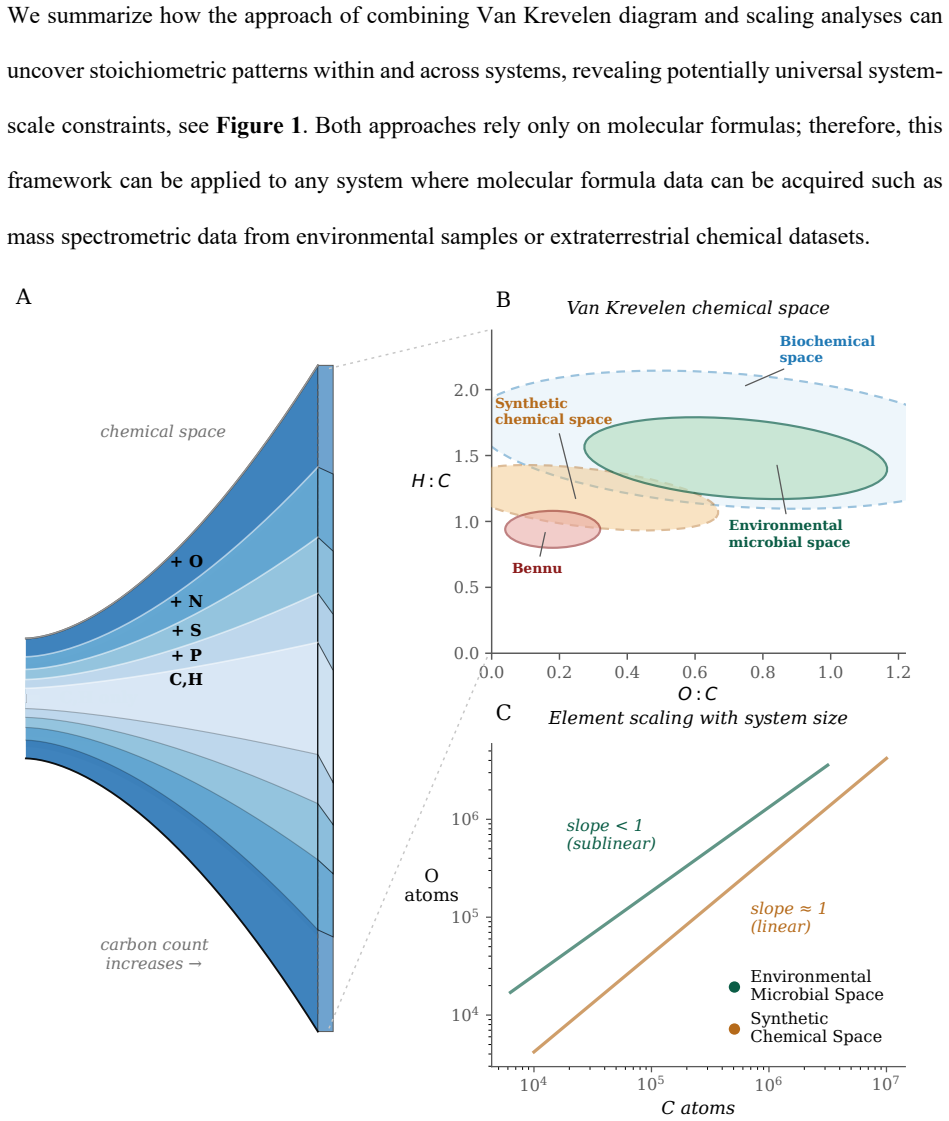
Microbial metabolisms occupy a region of chemical space enriched in heteroatoms like P, S, N, and O relative to C and shifted toward higher O:C and H:C ratios, patterns that stand apart from synthetic compounds and planetary mission data.
A machine-rendered reading of the paper's core claim, the machinery that carries it, and where it could break.
Core claim
The central claim is that microbial metabolisms occupy a statistically distinct region of chemical space defined by elemental stoichiometry: enriched in heteroatoms such as P, S, N, and O relative to C and shifted toward higher O:C and H:C ratios. Analysis of 11,834 microbial metagenomic samples using Van Krevelen diagrams and sublinear element scaling laws reveals these patterns, which remain distinguishable from both an 18,000-compound sample drawn from the Reaxys synthetic database and from molecules detected in planetary science mission datasets. With consistent data collection methods, the same approach supplies a new class of ecological biosignatures for discriminating biotic from abi-
What carries the argument
Van Krevelen diagrams paired with element scaling laws, which plot atomic ratios such as O:C and H:C across many molecules and track how element counts grow with system size to define the occupied region of chemical space.
If this is right
- Standardized small-molecule mass-spectrometry data from future planetary missions could be tested against the microbial and Reaxys distributions to search for biosignatures.
- Sublinear scaling of heteroatom counts with system size constrains how biological systems expand within chemical space.
- The framework supplies an ecological biosignature that does not require identification of any particular compound or Earth-specific biochemistry.
- Datasets from abiotic sources such as meteorites or prebiotic simulations occupy statistically different regions under the same analysis.
Where Pith is reading between the lines
- The same metrics could be applied to Earth-based samples from extreme or ancient environments to test whether the pattern persists outside modern microbes.
- Instrument design for missions to Mars or icy moons might prioritize broad elemental coverage over targeted compound searches.
- If the pattern generalizes, it raises the possibility of using similar statistical tests on data from future sample-return missions without presupposing carbon-based life.
Load-bearing premise
The elemental composition patterns measured in terrestrial microbial metagenomes represent general features of biological systems that remain distinguishable from abiotic chemistry even when data collection methods differ on other planets.
What would settle it
A planetary-mission dataset, processed with the same elemental-ratio and scaling metrics, that falls inside the microbial cluster rather than outside it would undermine the claim that the pattern is a reliable discriminator.
Figures
read the original abstract
The vast chemical space of possible small molecules, estimated at 10^60 compounds for molecules composed of just C, N, O, and S, is only sparsely occupied by biology. We propose that where life selects molecules within this space constitutes a detectable ecological signature: a fingerprint not of specific compounds, but of the statistical structure of elemental composition across molecules sam-pled from ecological systems. Here we introduce a framework combining Van Krevelen diagrams and element scaling laws to characterize the elemental composition of regions of chemical space occupied by biological systems and contrast them with other chemical systems. Applying this framework to 11,834 microbial metagenomic samples, we show that microbial metabolisms occupy a region of chemical space, which is enriched in heteroatoms such as P, S, N, and O relative to C, shifted toward higher O:C and H:C ratios. We observe sublinear element scaling with system size, yielding insights into how elemental constraints dictate how biological systems occupy chemical space. These patterns are distinct from a sample of 18,000 compounds from the comprehensive Reaxys synthetic chemical database. Critically, datasets from molecules detected in planetary science mission data occupy statistically distinct regions from both terrestrial biological and Reaxys distributions, demonstrating that with standardized methods for data collection, the approach could be developed to discriminate biotic from abiotic chemical signatures in small molecule data from planetary science missions. Our work shows how a combination of Van Krevelen fingerprinting and elemental scaling laws can provide a new class of ecological biosignatures for life detection leveraging mass spectrometric data from planetary missions, which could generalize beyond Earth's specific biochemistry.
Editorial analysis
A structured set of objections, weighed in public.
Referee Report
Summary. The paper proposes that the statistical structure of elemental composition in biological systems—specifically enrichment in heteroatoms (P, S, N, O) relative to C, elevated O:C and H:C ratios, and sublinear element scaling—constitutes an ecological biosignature detectable via Van Krevelen diagrams and scaling laws. Analysis of 11,834 microbial metagenomic samples shows these patterns occupy a distinct region of chemical space compared to 18,000 compounds from the Reaxys database and planetary science mission datasets, with potential application to life detection in mass spectrometric data from extraterrestrial missions.
Significance. If the observed distinctions hold under rigorous statistical validation and prove generalizable, the framework could provide a new class of falsifiable, method-agnostic biosignatures for planetary missions that leverages existing mass spectrometry capabilities without relying on specific molecular identifications. The combination of Van Krevelen fingerprinting with element scaling laws offers a quantitative, data-driven approach grounded in ecological constraints.
major comments (2)
- [Results (analysis of metagenomic samples and database comparisons)] The central claim that microbial metabolisms occupy statistically distinct regions from Reaxys and planetary datasets rests on comparisons across 11,834 samples, yet the manuscript provides no details on statistical quantification, error bars, data exclusion criteria, or the specific tests (e.g., Kolmogorov-Smirnov, permutation tests) used to establish significance of the distinctions in elemental ratios and scaling. This directly undermines confidence in the reported separation of distributions.
- [Discussion (generalizability to non-terrestrial systems)] The life-detection application assumes that terrestrial metagenome patterns reflect general ecological/elemental constraints rather than Earth-specific biochemistry or database biases; however, no tests or simulations are presented against alternative biochemistries (different solvents, element priorities, or genetic codes), which is load-bearing for the claim that the signature would remain distinguishable in extraterrestrial contexts with different data collection methods.
minor comments (2)
- [Abstract] The abstract states that planetary datasets 'occupy statistically distinct regions' but does not specify the sample sizes, compound counts, or measurement techniques for the planetary mission data, which would aid reproducibility.
- [Methods/Introduction] Notation for element scaling laws (e.g., how sublinear scaling is quantified as a function of system size) should be defined explicitly with an equation or reference to prior ecological stoichiometry literature.
Simulated Author's Rebuttal
We thank the referee for their constructive and detailed feedback, which has helped clarify key aspects of our analysis. We have revised the manuscript to address the statistical documentation concerns and expanded the discussion on generalizability while remaining within the scope of the current observational study.
read point-by-point responses
-
Referee: [Results (analysis of metagenomic samples and database comparisons)] The central claim that microbial metabolisms occupy statistically distinct regions from Reaxys and planetary datasets rests on comparisons across 11,834 samples, yet the manuscript provides no details on statistical quantification, error bars, data exclusion criteria, or the specific tests (e.g., Kolmogorov-Smirnov, permutation tests) used to establish significance of the distinctions in elemental ratios and scaling. This directly undermines confidence in the reported separation of distributions.
Authors: We agree that explicit documentation of statistical methods is essential for supporting the reported distinctions. In the revised manuscript, we have added a dedicated 'Statistical Methods' subsection. This describes: (i) two-sample Kolmogorov-Smirnov tests applied to compare distributions of O:C, H:C, N:C, P:C, and S:C ratios across the 11,834 microbial samples, 18,000 Reaxys compounds, and planetary datasets, with all p-values now reported; (ii) permutation tests (10,000 iterations) to assess significance of differences in scaling exponents; and (iii) bootstrap resampling (1,000 iterations) to compute 95% confidence intervals shown as error bars in figures. Data exclusion criteria are now stated: samples with fewer than 100 unique molecular formulas were excluded to ensure robust statistics, yielding the final 11,834 samples. These additions directly remedy the omission. revision: yes
-
Referee: [Discussion (generalizability to non-terrestrial systems)] The life-detection application assumes that terrestrial metagenome patterns reflect general ecological/elemental constraints rather than Earth-specific biochemistry or database biases; however, no tests or simulations are presented against alternative biochemistries (different solvents, element priorities, or genetic codes), which is load-bearing for the claim that the signature would remain distinguishable in extraterrestrial contexts with different data collection methods.
Authors: We recognize that the generalizability claim is central and that direct simulations of alternative biochemistries are absent. Such simulations would require constructing speculative chemical spaces without supporting data and therefore lie outside the scope of this study. In the revised Discussion we have added a paragraph grounding the patterns in universal principles: heteroatom enrichment and sublinear scaling follow from thermodynamic constraints on molecular stability and stoichiometric efficiency that apply to any carbon-based system using similar elemental inventories. We also discuss how standardized mass-spectrometric acquisition mitigates database-specific biases. We explicitly note the limitation and identify theoretical modeling of hypothetical biochemistries as a priority for future work. revision: partial
Circularity Check
No significant circularity; empirical distributions derived from direct metagenome analysis and external database contrasts
full rationale
The paper's central results consist of statistical characterizations (Van Krevelen diagrams, element scaling laws, heteroatom enrichments, O:C and H:C shifts, sublinear scaling) computed directly from 11,834 microbial metagenomic samples. These are then contrasted against independent external datasets (Reaxys synthetic compounds and planetary mission data). No parameters are fitted to a subset and then relabeled as predictions of the same quantities; no self-definitional loops appear in the described framework; and the load-bearing distinctions rely on observable differences across datasets rather than reducing to self-citations or prior ansatzes by construction. The derivation chain is therefore self-contained against the supplied data sources.
Axiom & Free-Parameter Ledger
axioms (1)
- domain assumption Biological systems occupy statistically distinct regions of chemical space defined by elemental ratios and scaling behaviors.
Lean theorems connected to this paper
-
IndisputableMonolith/Cost/FunctionalEquation.leanwashburn_uniqueness_aczel unclear?
unclearRelation between the paper passage and the cited Recognition theorem.
We use two different statistical approaches... Van Krevelen diagrams... and element scaling laws... power-law fit (y = axb)
-
IndisputableMonolith/Foundation/AlphaCoordinateFixation.leanJ_uniquely_calibrated_via_higher_derivative unclear?
unclearRelation between the paper passage and the cited Recognition theorem.
sublinear element scaling with system size... heteroatom enrichment
What do these tags mean?
- matches
- The paper's claim is directly supported by a theorem in the formal canon.
- supports
- The theorem supports part of the paper's argument, but the paper may add assumptions or extra steps.
- extends
- The paper goes beyond the formal theorem; the theorem is a base layer rather than the whole result.
- uses
- The paper appears to rely on the theorem as machinery.
- contradicts
- The paper's claim conflicts with a theorem or certificate in the canon.
- unclear
- Pith found a possible connection, but the passage is too broad, indirect, or ambiguous to say the theorem truly supports the claim.
Reference graph
Works this paper leans on
-
[1]
Chapter One - The elements of life: A biocentric tour of the periodic table
G. M. Weiss, et al., Operational considerations for approximating molecular assembly by Fou-rier transform mass spectrometry. Front. Astron. Space Sci. 11 (2024). 12. L. A. Rutter, et al., Exploring molecular assembly as a biosignature using mass spectrometry and machine learning. [Preprint] (2025). Available at: http://arxiv.org/abs/2507.19057 [Ac-cessed...
-
[2]
The Making of Reaxys—Towards Un-obstructed Access to Relevant Chemistry Information
D. Van Krevelen, Graphical-statistical method for the study of structure and reaction processes of coal. Fuel 29, 269–284 (1950). 27. A. Rivas-Ubach, et al., Moving beyond the van Krevelen Diagram: A New Stoichiometric Approach for Compound Classification in Organisms. Anal. Chem. 90, 6152–6160 (2018). 28. C. P. Kempes, et al., Generalized Stoichiometry a...
work page 1950
-
[3]
C. L. Heald, et al., A simplified description of the evolution of organic aerosol composition in the atmosphere. Geophys. Res. Lett. 37 (2010). 42. H.-Y. Li, et al., The chemodiversity of paddy soil dissolved organic matter correlates with microbial community at continental scales. Microbiome 6, 187 (2018). 43. P. Virtanen, et al., SciPy 1.0: fundamental ...
work page 2010
-
[4]
M. C. Weiss, M. Preiner, J. C. Xavier, V. Zimorski, W. F. Martin, The last universal common ancestor between ancient Earth chemistry and the onset of genetics. PLOS Genet. 14, e1007518 (2018). 57. J. E. Goldford, H. Hartman, R. Marsland, D. Segrè, Environmental boundary conditions for the origin of life converge to an organo-sulfur metabolism. Nat. Ecol. ...
-
[5]
D. Muratore, S. I. Walker, H. Graham, C. H. House, C. P. Kempes, “Observations of Elemental Composition of Enceladus Consistent with Generalized Models of Theoretical Ecosystems” (Microbiology, 2023)
work page 2023
discussion (0)
Sign in with ORCID, Apple, or X to comment. Anyone can read and Pith papers without signing in.