Controlling gain with loss: Bounds on localizable entanglement in multi-qubit systems
Pith reviewed 2026-05-24 12:08 UTC · model grok-4.3
The pith
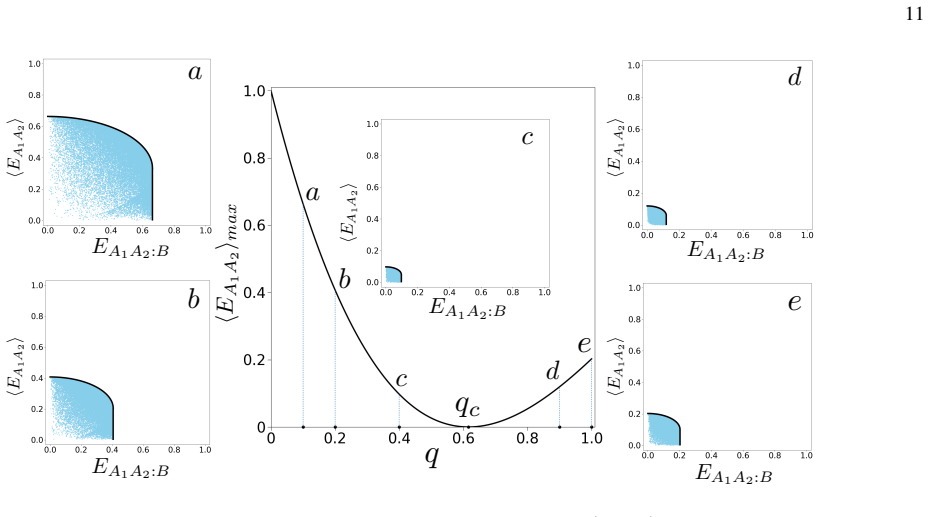
Localizable entanglement on a qubit subsystem is bounded by the bipartite entanglement lost when measuring the rest of the system.
A machine-rendered reading of the paper's core claim, the machinery that carries it, and where it could break.
Core claim
For generalized GHZ and W states, localizable entanglement is analytically bounded by functions of the bipartite entanglement present before measurement; for Dicke states the two quantities become equal in the large-system limit; in one-dimensional spin models the localized entanglement scales cubically with the lost entanglement.
What carries the argument
Localizable entanglement obtained by local projective measurements performed on all qubits outside a chosen subsystem, quantified relative to the bipartite entanglement across the cut in the pre-measurement pure state.
If this is right
- For any generalized GHZ or W state the localized entanglement cannot exceed the derived functions of the lost bipartite entanglement.
- In the thermodynamic limit of Dicke states the localizable entanglement equals the pre-measurement bipartite entanglement across the chosen cut.
- In the transverse XY and XXZ chains the localized entanglement grows as the cube of the lost entanglement.
- The cubic relation remains unchanged when single-qubit phase-flip noise acts on every qubit or when the external field strength is disordered.
Where Pith is reading between the lines
- The same loss-localization trade-off may appear in other one-dimensional critical systems whose ground states are well approximated by matrix-product states.
- The bounds could be used to design measurement protocols that concentrate entanglement onto a small register while minimizing the information sacrificed.
- Numerical checks on random pure states suggest the cubic scaling is not limited to translation-invariant models.
Load-bearing premise
The multi-qubit states remain pure before measurement and local projective measurements on the complement alone are sufficient to realize the localization without extra optimization or post-selection.
What would settle it
An explicit computation for a three-qubit generalized GHZ state in which the localizable entanglement after measuring one qubit exceeds the stated analytical upper bound in terms of the initial bipartite entanglement.
Figures




read the original abstract
We investigate the relation between the amount of entanglement localized on a chosen subsystem of a multi-qubit system via local measurements on the rest of the system, and the bipartite entanglement that is lost during this measurement process. We study a number of paradigmatic pure states, including the generalized GHZ, the generalized W, Dicke, and the generalized Dicke states. For the generalized GHZ and W states, we analytically derive bounds on localizable entanglement in terms of the entanglement present in the system prior to the measurement. Also, for the Dicke and the generalized Dicke states, we demonstrate that with increasing system size, localizable entanglement tends to be equal to the bipartite entanglement present in the system over a specific partition before measurement. We extend the investigation numerically in the case of arbitrary multi-qubit pure states. We also analytically determine the modification of these results, including the proposed bounds, in situations where these pure states are subjected to single-qubit phase-flip noise on all qubits. Additionally, we study one-dimensional paradigmatic quantum spin models, namely the transverse-field XY model and the XXZ model in an external field, and numerically demonstrate a cubic dependence of the localized entanglement on the lost entanglement. We show that this relation is robust even in the presence of disorder in the strength of the external field.
Editorial analysis
A structured set of objections, weighed in public.
Referee Report
Summary. The paper investigates the relation between localizable entanglement (LE) localized on a subsystem via measurements on the complement and the bipartite entanglement lost in the process. It analytically derives bounds relating LE to pre-measurement bipartite entanglement for generalized GHZ and W states, shows that LE approaches the pre-measurement bipartite entanglement for large Dicke and generalized Dicke states, extends the analysis to phase-flip noise, and numerically demonstrates a cubic dependence of localized on lost entanglement in the transverse-field XY and XXZ spin models (robust to disorder).
Significance. If the central relations hold for the optimized definition of LE, the analytical bounds for GHZ/W states and the cubic scaling in spin models would provide concrete, falsifiable connections between entanglement gain and loss, useful for designing measurement-based entanglement distribution protocols. The noise robustness and size-scaling results add practical value. The work ships explicit analytical expressions for paradigmatic states, which is a strength.
major comments (2)
- [§§3–4] §§3–4 (GHZ and W derivations): the reported bounds are derived using specific projective measurements (computational basis or fixed angles) on the complement; the manuscript does not demonstrate that these measurements achieve the maximization required by the standard definition of localizable entanglement. If the bounds are not for the optimized quantity, they do not constrain true LE and the central claim is affected.
- [§6] §6 (XY/XXZ models): the cubic dependence is obtained numerically for the chosen partitions and measurement strategies; it is unclear whether the relation survives maximization over all local measurements on the complement or is an artifact of the specific protocol used. A concrete test (e.g., comparison with optimized LE for small N) is needed to support the scaling claim.
minor comments (2)
- [§2] The definition of LE (maximization step) should be stated explicitly in §2 with a reference to the original literature (e.g., Verstraete et al.).
- [Figure 5] Figure captions for the spin-model plots should specify the exact measurement basis and partition used to generate the data points.
Simulated Author's Rebuttal
We thank the referee for the careful reading and constructive comments on our manuscript. We address the major comments point-by-point below and commit to revisions that strengthen the connection to the optimized definition of localizable entanglement.
read point-by-point responses
-
Referee: [§§3–4] §§3–4 (GHZ and W derivations): the reported bounds are derived using specific projective measurements (computational basis or fixed angles) on the complement; the manuscript does not demonstrate that these measurements achieve the maximization required by the standard definition of localizable entanglement. If the bounds are not for the optimized quantity, they do not constrain true LE and the central claim is affected.
Authors: We acknowledge that the standard definition of localizable entanglement (LE) requires maximization over all possible local measurements. In §§3–4 we employed specific projective measurements that are optimal for the generalized GHZ and W states (computational-basis measurements for GHZ by symmetry, and fixed-angle measurements for W that saturate the concurrence), but the manuscript does not contain an explicit optimality proof. In the revised version we will add a short argument (or appendix) showing that these choices achieve the maximum, thereby ensuring the derived bounds apply directly to the optimized LE. revision: yes
-
Referee: [§6] §6 (XY/XXZ models): the cubic dependence is obtained numerically for the chosen partitions and measurement strategies; it is unclear whether the relation survives maximization over all local measurements on the complement or is an artifact of the specific protocol used. A concrete test (e.g., comparison with optimized LE for small N) is needed to support the scaling claim.
Authors: The cubic scaling was observed for the specific measurement protocols and partitions used in the numerical simulations of the XY and XXZ models. To address the concern, we will add a concrete test in the revision: for small system sizes (N ≤ 6) we will numerically optimize the measurement angles on the complement and compare the resulting LE versus lost entanglement with the non-optimized protocol. The outcome of this comparison will be reported to confirm whether the cubic relation persists under maximization. revision: yes
Circularity Check
No significant circularity detected
full rationale
The paper derives bounds analytically from the algebraic structure of generalized GHZ and W states and demonstrates numerical relations for Dicke states and spin models without any reduction of predictions to fitted inputs or self-citations by construction. All load-bearing steps are direct calculations or simulations on the states themselves, with no evidence of self-definitional loops, ansatzes smuggled via citation, or uniqueness theorems imported from prior author work. The derivation chain remains self-contained against external benchmarks.
Axiom & Free-Parameter Ledger
axioms (1)
- standard math Standard definitions and properties of localizable entanglement via local projective measurements and bipartite entanglement quantifiers hold for the studied pure states.
Lean theorems connected to this paper
-
IndisputableMonolith/Cost/FunctionalEquation.leanwashburn_uniqueness_aczel unclear?
unclearRelation between the paper passage and the cited Recognition theorem.
We investigate the relation between the amount of entanglement localized on a chosen subsystem ... via local measurements on the rest of the system, and the bipartite entanglement that is lost during this measurement process.
-
IndisputableMonolith/Foundation/RealityFromDistinction.leanreality_from_one_distinction unclear?
unclearRelation between the paper passage and the cited Recognition theorem.
For the generalized GHZ and W states, we analytically derive bounds on localizable entanglement in terms of the entanglement present in the system prior to the measurement.
What do these tags mean?
- matches
- The paper's claim is directly supported by a theorem in the formal canon.
- supports
- The theorem supports part of the paper's argument, but the paper may add assumptions or extra steps.
- extends
- The paper goes beyond the formal theorem; the theorem is a base layer rather than the whole result.
- uses
- The paper appears to rely on the theorem as machinery.
- contradicts
- The paper's claim conflicts with a theorem or certificate in the canon.
- unclear
- Pith found a possible connection, but the passage is too broad, indirect, or ambiguous to say the theorem truly supports the claim.
Forward citations
Cited by 1 Pith paper
-
Localizing genuine multiparty entanglement in noisy stabilizer states
Lower bounds on localizable genuine multiparty entanglement are computed for graph states and toric codes under single-qubit Pauli noise, revealing critical noise strengths beyond which post-measurement states are bis...
Reference graph
Works this paper leans on
-
[1]
For a fixed a3 and a0,⟨E23⟩ is mini- mum if a2 is minimum, leading to a2 = a3, and subsequently ⟨E23⟩≥ 2a2
-
[2]
Eliminating a3 from E3:12 and the minimum of⟨E23⟩, we obtain ⟨E23⟩2 + E2 3:12− 2⟨E23⟩(1− a2
On the other hand, exploiting normalization of the W-class state, E3:12 = 2 ⏐⏐⏐a3 √ 1− a2 0− a2 3 ⏐⏐⏐. Eliminating a3 from E3:12 and the minimum of⟨E23⟩, we obtain ⟨E23⟩2 + E2 3:12− 2⟨E23⟩(1− a2
-
[3]
= 0. (58) Similar to Proposition V , it can be shown that⟨E23⟩ attains a minimum for a0 = 0, leading to Eq. (57). Note 3. Similar to the case of N-qubit gW states, in this case also, we numerically verify that the Propositions IV and V re- main valid in the case of generic three-qubit states from W class with complex coefficients. The bounds in the case of...
-
[4]
cos2 θ 2 , p1 = ⏐⏐⏐⏐a0 sin θ 2− a1e−iφ cos θ 2 ⏐⏐⏐⏐ 2 + (a2 2 + a2
-
[5]
sin2 θ 2 . (B9) Appendix C: Specific examples In this section, we demonstrate a number of results dis- cussed in Secs. II and III using specific examples. a. Upper bound for gW states. Consider the cases of N = 3 , 4, for which the family of states providing the upper bound of⟨EA1A2⟩ in the case of gW states with real coeffi- cients can be written as |Ψ3⟩ = ...
-
[6]
Ryszard Horodecki, Paweł Horodecki, Michał Horodecki, and Karol Horodecki, “Quantum entanglement,” Rev. Mod. Phys. 81, 865–942 (2009)
work page 2009
-
[7]
Otfried G ¨uhne and G´eza T´oth, “Entanglement detection,” Phys. Rep. 474, 1–75 (2009)
work page 2009
-
[8]
Teleporting an unknown quantum state via dual classical and einstein- podolsky-rosen channels,
Charles H. Bennett, Gilles Brassard, Claude Cr ´epeau, Richard Jozsa, Asher Peres, and William K. Wootters, “Teleporting an unknown quantum state via dual classical and einstein- podolsky-rosen channels,” Phys. Rev. Lett. 70, 1895–1899 (1993)
work page 1993
-
[9]
Experimental quan- tum teleportation,
Dik Bouwmeester, Jian-Wei Pan, Klaus Mattle, Manfred Eibl, Harald Weinfurter, and Anton Zeilinger, “Experimental quan- tum teleportation,” Nature 390, 575–579 (1997)
work page 1997
-
[10]
Communication via one- and two-particle operators on einstein-podolsky-rosen states,
Charles H. Bennett and Stephen J. Wiesner, “Communication via one- and two-particle operators on einstein-podolsky-rosen states,” Phys. Rev. Lett. 69, 2881–2884 (1992)
work page 1992
-
[11]
Dense coding in experimental quantum communica- tion,
Klaus Mattle, Harald Weinfurter, Paul G. Kwiat, and Anton Zeilinger, “Dense coding in experimental quantum communica- tion,” Phys. Rev. Lett. 76, 4656–4659 (1996)
work page 1996
-
[12]
Quantum Advantage in Communication Networks
Aditi Sen(De) and Ujjwal Sen, “Quantum advantage in communication networks,” Phys. News 40, 17–32 (2011), arXiv:1105.2412
work page internal anchor Pith review Pith/arXiv arXiv 2011
-
[13]
Quantum cryptography based on bell’s theo- rem,
Artur K. Ekert, “Quantum cryptography based on bell’s theo- rem,” Phys. Rev. Lett. 67, 661–663 (1991)
work page 1991
-
[14]
Quantum cryptography with entangled photons,
Thomas Jennewein, Christoph Simon, Gregor Weihs, Harald Weinfurter, and Anton Zeilinger, “Quantum cryptography with entangled photons,” Phys. Rev. Lett. 84, 4729–4732 (2000)
work page 2000
-
[15]
Veronika E Hubeny, “The AdS/CFT correspondence,” Classical Quant. Grav. 32, 124010 (2015)
work page 2015
-
[16]
Holographic quantum error-correcting codes: toy models for the bulk/boundary correspondence,
Fernando Pastawski, Beni Yoshida, Daniel Harlow, and John Preskill, “Holographic quantum error-correcting codes: toy models for the bulk/boundary correspondence,” J. High. Energy Phys. 2015, 149 (2015)
work page 2015
-
[17]
Bulk locality and quantum error correction in ads/cft,
Ahmed Almheiri, Xi Dong, and Daniel Harlow, “Bulk locality and quantum error correction in ads/cft,” J. High Energy Phys. 4, 163 (2015)
work page 2015
-
[18]
Holography and criticality in matchgate tensor networks,
A. Jahn, M. Gluza, F. Pastawski, and J. Eisert, “Holography and criticality in matchgate tensor networks,” arXiv:1711.03109 (2017)
-
[19]
Evolution without evo- lution: Dynamics described by stationary observables,
Don N. Page and William K. Wootters, “Evolution without evo- lution: Dynamics described by stationary observables,” Phys. Rev. D 27, 2885–2892 (1983)
work page 1983
-
[20]
Conditional probabilities with dirac observables and the problem of time in quantum gravity,
Rodolfo Gambini, Rafael A. Porto, Jorge Pullin, and Sebasti ´an Torterolo, “Conditional probabilities with dirac observables and the problem of time in quantum gravity,” Phys. Rev. D 79, 041501 (2009)
work page 2009
-
[21]
Time from quantum entanglement: An experimental illustration,
Ekaterina Moreva, Giorgio Brida, Marco Gramegna, Vittorio Giovannetti, Lorenzo Maccone, and Marco Genovese, “Time from quantum entanglement: An experimental illustration,” Phys. Rev. A 89, 052122 (2014)
work page 2014
-
[22]
Neill Lambert, Yueh-Nan Chen, Yuan Chung Cheng, Che-Ming Li, Guang Yin Chen, and Franco Nori, “Quantum biology,” Nat. Phys. 9, 10–18 (2013)
work page 2013
-
[23]
Manipulating quan- tum entanglement with atoms and photons in a cavity,
J. M. Raimond, M. Brune, and S. Haroche, “Manipulating quan- tum entanglement with atoms and photons in a cavity,” Rev. Mod. Phys. 73, 565–582 (2001)
work page 2001
-
[24]
Experimental real- ization of dicke states of up to six qubits for multiparty quantum networking,
R. Prevedel, G. Cronenberg, M. S. Tame, M. Paternostro, P. Walther, M. S. Kim, and A. Zeilinger, “Experimental real- ization of dicke states of up to six qubits for multiparty quantum networking,” Phys. Rev. Lett. 103, 020503 (2009)
work page 2009
-
[25]
Stefanie Barz, “Quantum computing with photons: introduction to the circuit model, the one-way quantum computer, and the fundamental principles of photonic experiments,” J. Phys. B 48, 083001 (2015)
work page 2015
-
[26]
Quantum dynamics of single trapped ions,
D. Leibfried, R. Blatt, C. Monroe, and D. Wineland, “Quantum dynamics of single trapped ions,” Rev. Mod. Phys. 75, 281–324 (2003)
work page 2003
-
[27]
Creation of a six- atom ’schr¨odinger cat’ state,
D. Leibfried, E. Knill, S. Seidelin, J. Britton, R. B. Blakestad, J. Chiaverini, D. B. Hume, W. M. Itano, J. D. Jost, C. Langer, R. Ozeri, R. Reichle, and D. J. Wineland, “Creation of a six- atom ’schr¨odinger cat’ state,” Nature 438, 639–642 (2005)
work page 2005
-
[28]
Co-designing a scalable quantum computer with trapped atomic ions,
Kenneth R. Brown, Jungsang Kim, and Christopher Mon- roe, “Co-designing a scalable quantum computer with trapped atomic ions,” Nature Phys. J. Quant. Inf. 2, 16034 EP – (2016)
work page 2016
-
[29]
Controlled col- lisions for multi-particle entanglement of optically trapped atoms,
Olaf Mandel, Markus Greiner, Artur Widera, Tim Rom, Theodor W. Hansch, and Immanuel Bloch, “Controlled col- lisions for multi-particle entanglement of optically trapped atoms,” Nature 425, 937–940 (2003)
work page 2003
-
[30]
Exploring quantum matter with ultracold atoms in optical lattices,
Immanuel Bloch, “Exploring quantum matter with ultracold atoms in optical lattices,” J. Phys. B: At. Mol. Opt. Phys. 38, S629–S643 (2005)
work page 2005
-
[31]
Many- body physics with ultracold gases,
Immanuel Bloch, Jean Dalibard, and Wilhelm Zwerger, “Many- body physics with ultracold gases,” Rev. Mod. Phys. 80, 885– 964 (2008)
work page 2008
-
[32]
John Clarke and Frank K. Wilhelm, “Superconducting quantum bits,” Nature 453, 1031–1042 (2008)
work page 2008
-
[33]
Superconducting quantum cir- cuits at the surface code threshold for fault tolerance,
R. Barends, J. Kelly, A. Megrant, A. Veitia, D. Sank, E. Jeffrey, T. C. White, J. Mutus, A. G. Fowler, B. Campbell, Y . Chen, Z. Chen, B. Chiaro, A. Dunsworth, C. Neill, P. O’Malley, P. Roushan, A. Vainsencher, J. Wenner, A. N. Korotkov, A. N. Cleland, and John M. Martinis, “Superconducting quantum cir- cuits at the surface code threshold for fault tolera...
work page 2014
-
[34]
Benchmarking quantum control methods on a 12-qubit system,
C. Negrevergne, T. S. Mahesh, C. A. Ryan, M. Ditty, F. Cyr- Racine, W. Power, N. Boulant, T. Havel, D. G. Cory, and R. Laflamme, “Benchmarking quantum control methods on a 12-qubit system,” Phys. Rev. Lett. 96, 170501 (2006)
work page 2006
-
[35]
Many- body physics from a quantum information perspective,
R. Augusiak, F. M. Cucchietti, and M. Lewenstein, “Many- body physics from a quantum information perspective,” inMod- ern Theories of Many-Particle Systems in Condensed Matter Physics, edited by Daniel C. Cabra, Andreas Honecker, and Pierre Pujol (Springer Berlin Heidelberg, Berlin, Heidelberg,
-
[36]
Entanglement in many-body systems,
Luigi Amico, Rosario Fazio, Andreas Osterloh, and Vlatko Ve- dral, “Entanglement in many-body systems,” Rev. Mod. Phys. 80, 517–576 (2008)
work page 2008
-
[37]
Gabriele De Chiara and Anna Sanpera, Reports on Progress in Physics 81, 074002 (2018)
work page 2018
-
[38]
Michał Horodecki, “Entanglement measures,” Quantum Inf. Comput. 1, 3–26 (2001)
work page 2001
-
[39]
D. M. Greenberger, M. A. Horne, and A. Zeilinger, Bell’s the- orem, quantum theory and conceptions of the universe (Kluwer, Netherlands, 1989)
work page 1989
-
[40]
Entanglement in Graph States and its Applications
M Hein, W D ¨ur, Jens Eisert, Robert Raussendorf, M Van den Nest, and H J. Briegel, “Entanglement in graph states and its applications,” arXiv:quant-ph/0602096 (2006)
work page internal anchor Pith review Pith/arXiv arXiv 2006
-
[41]
Measurement-based quantum computation on cluster states,
Robert Raussendorf, Daniel E. Browne, and Hans J. Briegel, “Measurement-based quantum computation on cluster states,” Phys. Rev. A 68, 022312 (2003)
work page 2003
-
[42]
Quantum Computation with Topological Codes: from qubit to topological fault-tolerance
Keisuke Fujii, “Quantum computation with topological codes: from qubit to topological fault-tolerance,” arXiv:1504.01444 (2015)
work page internal anchor Pith review Pith/arXiv arXiv 2015
-
[43]
D. P. DiVincenzo, C. A. Fuchs, H. Mabuchi, J. A. Smolin, A. Thapliyal, and A. Uhlmann, “Entanglement of assistance,” 18 arXiv:quant-ph/9803033 (1998)
work page internal anchor Pith review Pith/arXiv arXiv 1998
-
[44]
Entanglement ver- sus correlations in spin systems,
F. Verstraete, M. Popp, and J. I. Cirac, “Entanglement ver- sus correlations in spin systems,” Phys. Rev. Lett. 92, 027901 (2004)
work page 2004
-
[45]
Diverging entanglement length in gapped quantum spin systems,
F. Verstraete, M. A. Mart´ın-Delgado, and J. I. Cirac, “Diverging entanglement length in gapped quantum spin systems,” Phys. Rev. Lett. 92, 087201 (2004)
work page 2004
-
[46]
M. Popp, F. Verstraete, M. A. Mart ´ın-Delgado, and J. I. Cirac, “Localizable entanglement,” Phys. Rev. A 71, 042306 (2005)
work page 2005
-
[47]
Debasis Sadhukhan, Sudipto Singha Roy, Amit Kumar Pal, De- braj Rakshit, Aditi Sen(De), and Ujjwal Sen, “Multipartite en- tanglement accumulation in quantum states: Localizable gener- alized geometric measure,” Phys. Rev. A 95, 022301 (2017)
work page 2017
-
[48]
Estimat- ing localizable entanglement from witnesses,
David Amaro, Markus M ¨uller, and Amit Kumar Pal, “Estimat- ing localizable entanglement from witnesses,” New J. Phys. 20, 063017 (2018)
work page 2018
-
[49]
Scalable characterization of localizable entanglement in noisy topologi- cal quantum codes,
David Amaro, Markus M ¨uller, and Amit Kumar Pal, “Scalable characterization of localizable entanglement in noisy topologi- cal quantum codes,” New Journal of Physics 22, 053038 (2020)
work page 2020
-
[50]
Localizable entanglement in anti- ferromagnetic spin chains,
B.-Q. Jin and V . E. Korepin, “Localizable entanglement in anti- ferromagnetic spin chains,” Phys. Rev. A 69, 062314 (2004)
work page 2004
-
[51]
Stein Olav Skrøvseth and Stephen D. Bartlett, “Phase transi- tions and localizable entanglement in cluster-state spin chains with ising couplings and local fields,” Phys. Rev. A 80, 022316 (2009)
work page 2009
-
[52]
Sta- tistical mechanics of the cluster ising model,
Pietro Smacchia, Luigi Amico, Paolo Facchi, Rosario Fazio, Giuseppe Florio, Saverio Pascazio, and Vlatko Vedral, “Sta- tistical mechanics of the cluster ising model,” Phys. Rev. A 84, 022304 (2011)
work page 2011
-
[53]
Phase diagram and quench dynamics of the cluster-xy spin chain,
Sebasti ´an Montes and Alioscia Hamma, “Phase diagram and quench dynamics of the cluster-xy spin chain,” Phys. Rev. E 86, 021101 (2012)
work page 2012
-
[54]
En- tanglement percolation in quantum networks,
Antonio Ac ´ın, J. Ignacio Cirac, and Maciej Lewenstein, “En- tanglement percolation in quantum networks,” Nat. Phys. 3, 256 (2007)
work page 2007
-
[55]
Thermodynamics and the measure of entanglement,
Sandu Popescu and Daniel Rohrlich, “Thermodynamics and the measure of entanglement,” Phys. Rev. A 56, R3319–R3321 (1997)
work page 1997
-
[56]
Entanglement measures and purifi- cation procedures,
V . Vedral and M. B. Plenio, “Entanglement measures and purifi- cation procedures,” Phys. Rev. A 57, 1619–1633 (1998)
work page 1998
-
[57]
Guifr ´e Vidal, “Entanglement monotones,” Journal of Modern Optics 47, 355–376 (2000)
work page 2000
-
[58]
Entan- glement of assistance and multipartite state distillation,
John A. Smolin, Frank Verstraete, and Andreas Winter, “Entan- glement of assistance and multipartite state distillation,” Phys. Rev. A 72, 052317 (2005)
work page 2005
-
[59]
Dong Yang and Jens Eisert, “Entanglement combing,” Phys. Rev. Lett. 103, 220501 (2009)
work page 2009
-
[60]
Entanglement of assistance in three-qubit systems,
Kl ´ee Pollock, Ge Wang, and Eric Chitambar, “Entanglement of assistance in three-qubit systems,” Phys. Rev. A 103, 032428 (2021)
work page 2021
-
[61]
Separability criterion for density matrices,
Asher Peres, “Separability criterion for density matrices,” Phys. Rev. Lett. 77, 1413–1415 (1996)
work page 1996
-
[62]
Separability of mixed states: necessary and sufficient condi- tions,
Michal Horodecki, Pawel Horodecki, and Ryszard Horodecki, “Separability of mixed states: necessary and sufficient condi- tions,” Phys. Lett. A 223, 1 – 8 (1996)
work page 1996
-
[63]
Computable measure of entangle- ment,
G. Vidal and R. F. Werner, “Computable measure of entangle- ment,” Phys. Rev. A 65, 032314 (2002)
work page 2002
-
[64]
V olume of the set of separable states,
Karol ˙Zyczkowski, Paweł Horodecki, Anna Sanpera, and Ma- ciej Lewenstein, “V olume of the set of separable states,” Phys. Rev. A 58, 883–892 (1998)
work page 1998
-
[65]
Partial tele- portation of entanglement in a noisy environment,
Jinhyoung Lee, M. S. Kim, Y . J. Park, and S. Lee, “Partial tele- portation of entanglement in a noisy environment,” Journal of Modern Optics 47, 2151–2164 (2000)
work page 2000
-
[66]
Three qubits can be entangled in two inequivalent ways,
W. D ¨ur, G. Vidal, and J. I. Cirac, “Three qubits can be entangled in two inequivalent ways,” Phys. Rev. A 62, 062314 (2000)
work page 2000
-
[67]
Multiqubit w states lead to stronger nonclassicality than greenberger-horne-zeilinger states,
Aditi Sen(De), Ujjwal Sen, Marcin Wie ´sniak, Dagomir Kas- zlikowski, and Marek ˙Zukowski, “Multiqubit w states lead to stronger nonclassicality than greenberger-horne-zeilinger states,” Phys. Rev. A 68, 062306 (2003)
work page 2003
-
[68]
Coherence in spontaneous radiation processes,
R. H. Dicke, “Coherence in spontaneous radiation processes,” Phys. Rev. 93, 99–110 (1954)
work page 1954
-
[69]
Entanglement criteria for dicke states,
Marcel Bergmann and Otfried G ¨uhne, “Entanglement criteria for dicke states,” Journal of Physics A: Mathematical and Theo- retical 46, 385304 (2013)
work page 2013
-
[70]
Detecting multiparti- cle entanglement of dicke states,
Bernd L ¨ucke, Jan Peise, Giuseppe Vitagliano, Jan Arlt, Luis Santos, G´eza T´oth, and Carsten Klempt, “Detecting multiparti- cle entanglement of dicke states,” Phys. Rev. Lett. 112, 155304 (2014)
work page 2014
-
[71]
Asutosh Kumar, Himadri Shekhar Dhar, R. Prabhu, Aditi Sen(De), and Ujjwal Sen, “Forbidden regimes in the distribu- tion of bipartite quantum correlations due to multiparty entan- glement,” Physics Letters A 381, 1701–1709 (2017)
work page 2017
-
[72]
M. A. Nielsen and I. L. Chuang, Quantum Computation and Quantum Information (Cambridge University Press, 2010)
work page 2010
-
[73]
Quantum channels and their entropic characteristics,
A. S. Holevo and V . Giovannetti, “Quantum channels and their entropic characteristics,” Rep. Prog. Phys. 75, 046001 (2012)
work page 2012
-
[74]
Ting Yu and J. H. Eberly, “Sudden death of entanglement,” Science 323, 598–601 (2009), https://science.sciencemag.org/content/323/5914/598.full.pdf
work page 2009
-
[75]
Depolarizing channel as a completely positive map with memory,
Sonja Daffer, Krzysztof W ´odkiewicz, James D. Cresser, and John K. McIver, “Depolarizing channel as a completely positive map with memory,” Phys. Rev. A 70, 010304 (2004)
work page 2004
-
[76]
Non- markovian dephasing and depolarizing channels,
U. Shrikant, R. Srikanth, and Subhashish Banerjee, “Non- markovian dephasing and depolarizing channels,” Phys. Rev. A 98, 032328 (2018)
work page 2018
-
[77]
Constructive feedback of non-markovianity on resources in random quantum states,
Ribhu Gupta, Shashank Gupta, Shiladitya Mal, Aditi Sen(De), and Ujjwal Sen, “Constructive feedback of non-markovianity on resources in random quantum states,” arXiv:2005.04009 (2020)
-
[78]
Cirano De Dominicis and Irene Giardina, Random Fields and Spin Glasses: A Field Theory Approach (Cambridge University Press, 2006)
work page 2006
-
[79]
Two soluble models of an antiferromagnetic chain,
E. Lieb, T. Schultz, and D. Mattis, “Two soluble models of an antiferromagnetic chain,” Annals of Physics 16, 407–466 (1961)
work page 1961
-
[80]
Statistical me- chanics of the XY model. I,
E. Barouch, B. M. McCoy, and M. Dresden, “Statistical me- chanics of the XY model. I,” Phys. Rev. A2, 1075–1092 (1970)
work page 1970
discussion (0)
Sign in with ORCID, Apple, or X to comment. Anyone can read and Pith papers without signing in.