Separability and entanglement of resonating valence-bond states
Pith reviewed 2026-05-24 10:28 UTC · model grok-4.3
The pith
Dimer RK states on tileable graphs have exactly separable reduced density matrices for disconnected subsystems, proving no entanglement between them.
A machine-rendered reading of the paper's core claim, the machinery that carries it, and where it could break.
Core claim
For dimer RK states on arbitrary tileable graphs, the reduced density matrix of k disconnected subsystems is exactly separable, implying the absence of both bipartite and multipartite entanglement between the subsystems. For more general RK states with local constraints, separability holds in the thermodynamic limit and any local RK state has zero logarithmic negativity. For RVB states, separability holds for disconnected subsystems up to exponentially small terms in the distance d, with the logarithmic negativity also exponentially suppressed with d; separability is argued to hold in the scaling limit even for arbitrarily small d/L.
What carries the argument
The local dimer or valence-bond constraints on tileable graphs, which permit exact mappings of the reduced density matrix to products of partition functions of the underlying statistical model.
If this is right
- Any measurement performed on one disconnected subsystem leaves the state of the others unchanged.
- The logarithmic negativity between disconnected regions vanishes exactly for dimer RK states and is zero or exponentially small otherwise.
- These states can realize gapped quantum spin liquids in which entanglement does not extend across spatial gaps.
- In the scaling limit the separability persists even when the ratio of separation to subsystem size approaches zero.
Where Pith is reading between the lines
- Entanglement in these models is effectively localized to connected clusters or boundaries rather than propagating across the full system.
- Observables that factor across disconnected regions can be computed from independent classical partition functions without quantum corrections.
- The same separability arguments may apply to other locally constrained models, such as certain quantum loop or ice-rule states on different lattices.
Load-bearing premise
The states must obey the local dimer or valence-bond constraints exactly on graphs that admit perfect dimer tilings, and the subsystems must be spatially disconnected.
What would settle it
On a small periodic tileable graph such as the 4-by-4 square lattice, compute the reduced density matrix for two opposite disconnected plaquettes and test whether its eigenvalues match those of the product of the individual subsystem density matrices.
Figures


read the original abstract
We investigate separability and entanglement of Rokhsar-Kivelson (RK) states and resonating valence-bond (RVB) states. These states play a prominent role in condensed matter physics, as they can describe quantum spin liquids and quantum critical states of matter, depending on their underlying lattices. For dimer RK states on arbitrary tileable graphs, we prove the exact separability of the reduced density matrix of $k$ disconnected subsystems, implying the absence of bipartite and multipartite entanglement between the subsystems. For more general RK states with local constraints, we argue separability in the thermodynamic limit, and show that any local RK state has zero logarithmic negativity, even if the density matrix is not exactly separable. In the case of adjacent subsystems, we find an exact expression for the logarithmic negativity in terms of partition functions of the underlying statistical model. For RVB states, we show separability for disconnected subsystems up to exponentially small terms in the distance $d$ between the subsystems, and that the logarithmic negativity is exponentially suppressed with $d$. We argue that separability does hold in the scaling limit, even for arbitrarily small ratio $d/L$, where $L$ is the characteristic size of the subsystems. Our results hold for arbitrary lattices, and encompass a large class of RK and RVB states, which include certain gapped quantum spin liquids and gapless quantum critical systems.
Editorial analysis
A structured set of objections, weighed in public.
Referee Report
Summary. The paper claims to prove exact separability of the reduced density matrix for k disconnected subsystems in dimer Rokhsar-Kivelson (RK) states on arbitrary tileable graphs, implying absence of bipartite and multipartite entanglement. It further argues separability in the thermodynamic limit for general local-constraint RK states, shows zero logarithmic negativity for any local RK state, provides an exact expression for negativity between adjacent subsystems in terms of partition functions, and demonstrates exponential suppression of negativity (and separability up to exp(-d) corrections) for resonating valence-bond (RVB) states, with separability holding in the scaling limit even for small d/L.
Significance. If the central proofs hold, the results would supply exact, non-perturbative characterizations of entanglement structure in a wide class of RK and RVB states relevant to gapped quantum spin liquids and gapless critical points. The mapping to classical partition functions and the zero-negativity result for local RK states are particularly useful for constraining possible entanglement in these models.
major comments (2)
- [Abstract / dimer-RK proof section] Abstract and the dimer-RK separability claim: the asserted exact factorization of the joint matching number N(M1,M2,…,Mk)=f1(M1)f2(M2)…f k(Mk) for disconnected subsystems does not hold in general. Fixing local dimer configurations on each Si removes vertices and imposes joint boundary conditions on the shared complement graph; the resulting Kasteleyn determinant (or permanent) on the complement depends on the combined boundaries and fails to factor. This directly undermines the claimed separability of ρ_{S1…Sk} on arbitrary tileable graphs.
- [Thermodynamic-limit section] Thermodynamic-limit argument for general RK states: the claim that separability emerges in the L→∞ limit requires showing that boundary-induced correlations between the subsystems decay faster than any power of 1/L. No explicit bound or scaling analysis of the complement-graph matching number is supplied to justify this.
minor comments (2)
- Notation for the reduced density matrix and the matching numbers N(M1,…,Mk) should be introduced with an explicit equation early in the text.
- The statement that 'any local RK state has zero logarithmic negativity' needs a precise definition of 'local' (range of the constraint) and a reference to the relevant equation.
Simulated Author's Rebuttal
We thank the referee for the careful and constructive review of our manuscript. The comments highlight important subtleties in the separability arguments that we address point by point below, with planned revisions to strengthen the presentation.
read point-by-point responses
-
Referee: [Abstract / dimer-RK proof section] Abstract and the dimer-RK separability claim: the asserted exact factorization of the joint matching number N(M1,M2,…,Mk)=f1(M1)f2(M2)…f k(Mk) for disconnected subsystems does not hold in general. Fixing local dimer configurations on each Si removes vertices and imposes joint boundary conditions on the shared complement graph; the resulting Kasteleyn determinant (or permanent) on the complement depends on the combined boundaries and fails to factor. This directly undermines the claimed separability of ρ_{S1…Sk} on arbitrary tileable graphs.
Authors: We acknowledge that the referee has identified a genuine subtlety: when multiple subsystems have fixed dimer configurations, the complement graph receives coupled boundary conditions, so the number of completing matchings N(M1,...,Mk) does not in general factorize as a product. Consequently the reduced density matrix does not factorize exactly on arbitrary tileable graphs. We will revise the abstract and the relevant section to remove the unqualified claim of exact separability for arbitrary graphs, restrict the statement to cases where the complement graph is disconnected or the subsystems are isolated, and add an explicit counter-example or qualification. This constitutes a major correction to that part of the manuscript. revision: yes
-
Referee: [Thermodynamic-limit section] Thermodynamic-limit argument for general RK states: the claim that separability emerges in the L→∞ limit requires showing that boundary-induced correlations between the subsystems decay faster than any power of 1/L. No explicit bound or scaling analysis of the complement-graph matching number is supplied to justify this.
Authors: We agree that an explicit scaling bound would make the thermodynamic-limit argument more rigorous. In the revised version we will supply a scaling analysis of the difference between the joint and product matching numbers on the complement graph, using standard bounds on Kasteleyn determinants and known correlation decay results for dimer models (exponential decay when the underlying classical model is gapped, power-law when critical). We will show that the relative error vanishes as L→∞ for fixed subsystem separation, thereby justifying the separability claim in the thermodynamic limit. This will be added as a new subsection. revision: partial
Circularity Check
No circularity detected; derivation self-contained from definitions
full rationale
The paper presents a mathematical proof of separability for dimer RK states based on the definitions of the states (equal-weight superpositions over dimer coverings on tileable graphs) and the standard mapping of reduced density matrices to ratios of classical dimer partition functions (matching numbers) on the complement. No load-bearing steps reduce the claimed separability to fitted parameters, self-citations, ansatze, or self-definitional loops. The central claim follows directly from local constraints and spatial disconnectedness of subsystems without invoking the enumerated circularity patterns. This is the most common honest finding for a self-contained proof paper.
Axiom & Free-Parameter Ledger
axioms (2)
- standard math Standard quantum mechanics and reduced-density-matrix formalism
- domain assumption Mapping of RK wavefunctions to classical statistical models via local constraints
Forward citations
Cited by 1 Pith paper
-
Genuine multientropy, dihedral invariants and Lifshitz theory
Authors derive genuine multientropy for Lifshitz states as mutual information plus negativity, obtain its non-integer Rényi continuation, and prove dihedral invariants equal Rényi reflected entropies for general tripa...
Reference graph
Works this paper leans on
-
[1]
We only impose that the two regions A1 and A2 are disconnected
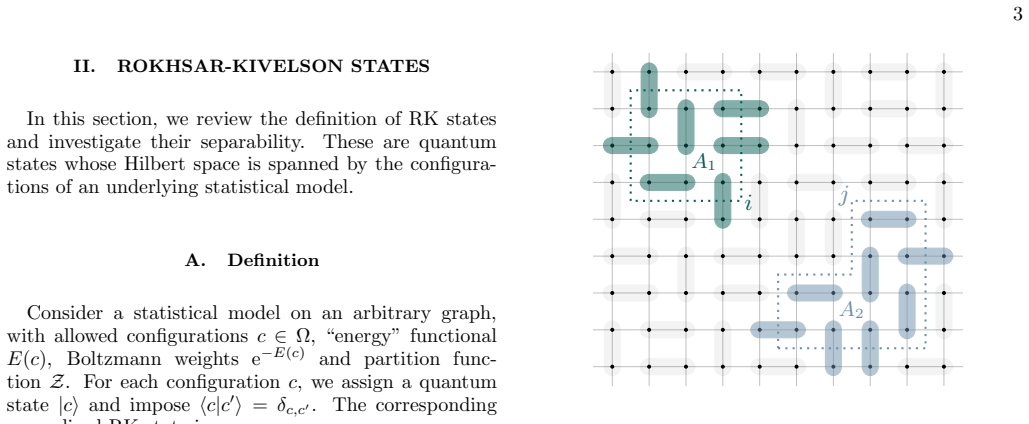
Arbitrary graphs Let us consider an RK state defined on an arbitrary graph. We only impose that the two regions A1 and A2 are disconnected. In general, there might be vertices connected to edges in B and to more than one edge in A1 or A2. This is for example the case for the square lattice in the case where the boundaries have concave angles, or the trian...
-
[2]
In that case, the calculation of the reduced density matrix simplifies greatly
Square lattice and no concave angles Let us assume that the graph is the two-dimensional square lattice, and the subsystems A1 and A2 do not have any concave angles (they can be rectangles, strips, cylin- ders, etc). In that case, the calculation of the reduced density matrix simplifies greatly. If a configuration b of B is compatible with a boundary conf...
-
[3]
Dimer states We first focus on RK states whose underlying statisti- cal model is the dimer model. An allowed configuration of dimers on a graph, or tiling, is such that each vertex is covered by exactly one dimer, and allowed configurations have the same Boltzmann weight. Dimer states are thus particular types of RK states, where E(c) = 0 for allowed dime...
-
[4]
Rokhsar-Kivelson states with local constraints Taking a generic underlying statistical model (still sat- isfying local constraints), we have Ω ij B = Ω i′j′ B for i ∼ i′ and j ∼ j′. However, in general we cannot absorb the sums over i′ and j′ separately to define reduced density matrices for A1 and A2, as in (16). This issue arises be- cause of the term Z...
-
[5]
Using (9) and (17), one may read- ily verify that Pij,i′j′ = Pi′j,ij′, hence ρA1∪A2 = ρT1 A1∪A2
Disjoint subsystems The reduced density matrix ρA1∪A2 for disjoint subsys- tems is given in (10). Using (9) and (17), one may read- ily verify that Pij,i′j′ = Pi′j,ij′, hence ρA1∪A2 = ρT1 A1∪A2. 6 This implies Tr|ρT1 A1∪A2 | = TrρA1∪A2 = 1 and thus a van- ishing logarithmic negativity, E(A1 : A2) = 0 . (22) We conclude that any RK state with local constra...
-
[6]
Comment on the mutual information Commonly used as a measure of entanglement and cor- relations between separate subsystems, the mutual infor- mation is defined as I(A1 : A2) = S(A1) + S(A1) − S(A1 ∪ A2) , (23) where S(A) = lim n→1 Sn(A) is the celebrated entangle- ment entropy. With our results from the previous sec- tions and that of [74], one can expre...
-
[7]
Adjacent subsystems For two adjacent subsystems A1 and A2, the corre- sponding reduced density matrix ρA1∪A2 is in general not separable. Below, we derive an explicit expression for the logarithmic negativity in terms of partition func- tions of the underlying statistical model, similarly as for the R´ enyi entropies, see [74]. As for the disjoint case, t...
-
[8]
≡ G (e1, e2; e′ 1, e′ 2; σbd), but one should keep in mind that G(e1, e2; e′ 1, e′
-
[9]
We will use the same notation for F(e1, e2; e′ 1, e′ 2)
does not only depend on the boundary singlet configurations, but also on the corresponding boundary spin configuration σbd. We will use the same notation for F(e1, e2; e′ 1, e′ 2). The overlap in G(e1, e2; e′ 1, e′
-
[10]
involves a double sum over configurations γB and γ′ B, see (42). First, we isolate one term in the double sum, and focus on the overlap ⟨γ′ B ⊗ σe′ 1 ⊗ σe′ 2 |γB ⊗ σe1 ⊗ σe2 ⟩. One draws the fixed boundary spins σbd, and the singlets of the configura- tions γB and γ′ B on the same graph. In the resulting transition graph, fixed spins are connected by stri...
-
[11]
is G(e1, e2; e′ 1, e′
-
[12]
= X γB ∈Ωe1 ,e2 B X γ′ B ∈Ω e′ 1 ,e′ 2 B 2nℓ(Γ,Γ′)−(NB −ns(Γ,Γ′))/2. (54) E. Separability for disconnected subsystems In this section, we show that the reduced density ma- trix (49) is separable, up to exponentially small terms in the distance d between A1 and A2. Our argument is twofold. First, we show that the reduced density matrix satisfies ρT1 A1∪A2 ...
-
[13]
Symmetry under partial transpose In what follows, we show F(e1, e2; e′ 1, e′
-
[14]
= F(e′ 1, e2; e1, e′
-
[15]
Crucially, we note that G(e1, e2; e′ 1, e′
+ O(2−d/2) , (55) implying that ρA1∪A2 in (49) is symmetric under partial transposition, up to exponentially small terms in d. Crucially, we note that G(e1, e2; e′ 1, e′
-
[16]
(and thus F(e1, e2; e′ 1, e′ 2)) vanishes, unless m(e1) + m(e2) = m(e′
-
[17]
, (56) where m(e) ≡P j∈e σj is the total magnetisation of the fixed boundary spins in B occupied by boundary singlets in the configuration e. This holds because |Ψe1,e2 B ⟩ and |Ψe′ 1,e′ 2 B ⟩ are states with zero magnetisation and the over- lap (51) is zero, unless the magnetisation in the bra and the ket are equal. This is exactly condition (56). 11 The...
-
[18]
̸= 0 but G(e′ 1, e2; e1, e′
-
[19]
This happens if (56) holds, but m(e′
= 0, can break the invariance under the exchange e1 ↔ e′ 1. This happens if (56) holds, but m(e′
-
[20]
+ m(e2) ̸= m(e1) + m(e′
-
[21]
In that case, with the rules for the connectivity of fixed spins described in Sec
, (57) namely if m(e1) ̸= m(e′ 1). In that case, with the rules for the connectivity of fixed spins described in Sec. III D, one can show that each transition graph that appears in the normalized overlap G(e1, e2; e′ 1, e′
-
[22]
contains at least one string of singlets that stretches across B and connects boundary sites adjacent to A1 and A2. We recall that, by definition, the minimal distance be- tween two boundary points in B pertaining to differ- ent boundaries is d, and hence nD(Γ, Γ′) ⩾ d. More- over, the total number of strings satisfies ns(Γ, Γ′) = |{e1, e2, e′ 1, e′ 2}|/2...
-
[23]
First, we note that Z e1 A1 Z e2 A2 Z e1,e2 B Z ⩽ 1 , (59) and hence F(e1, e2; e′ 1, e′
in (50) is negligible for m(e1) ̸= m(e′ 1). First, we note that Z e1 A1 Z e2 A2 Z e1,e2 B Z ⩽ 1 , (59) and hence F(e1, e2; e′ 1, e′
-
[24]
(60) The numerator G(e1, e2; e′ 1, e′
⩽ G(e1, e2; e′ 1, e′ 2) (Z e1,e2 B Z e′ 1,e′ 2 B )1/2 . (60) The numerator G(e1, e2; e′ 1, e′
-
[25]
For each choice of γB, γ′ B, the tran- sition graph has at least one string of length d or larger
is a sum over γB ∈ Ωe1,e2 B and γ′ B ∈ Ωe′ 1,e′ 2 B . For each choice of γB, γ′ B, the tran- sition graph has at least one string of length d or larger. The total weight of the strings thus satisfies ws(γB, γ′ B) = O(2−d/2), and the weight of the rest of the transition graph from which the strings are excluded is wr(γB, γ′ B) ⩽ 1. We thus have G(e1,e2; e′...
-
[26]
has at least one string of length d or larger, and the rest of the configu- ration has weight wr. For each such transition graph, there is a transition graph in Z e1,e2 B and Z e′ 1,e′ 2 B where the string is replaced by overlapping singlets with weight one, and the whole configuration has weight wr. Second, we turn to the investigation of the denom- inat...
-
[27]
= O(2−d/2) and hence (55) holds for m(e1) ̸= m(e′ 1). The case m(e1) = m(e′ 1). To show separability up to exponentially small corrections, it remains to show that (55) holds when m(e1) + m(e2) = m(e′
-
[28]
+ m(e2) = m(e1) + m(e′
-
[29]
In that case, both G(e1, e2; e′ 1, e′
, (64) that is if m(e1) = m(e′ 1). In that case, both G(e1, e2; e′ 1, e′
-
[30]
and G(e′ 1, e2; e1, e′
-
[31]
Again, our arguments use the fact that G(e1, e2; e′ 1, e′ 2) 12 is a sum over transition graphs
are non-vanishing. Again, our arguments use the fact that G(e1, e2; e′ 1, e′ 2) 12 is a sum over transition graphs. In the sum, there are two distinct types of transition graphs: (I) those without strings that connect different boundaries, and (II) those with at least one string that stretches acrossB to connect different boundaries. For graphs of type I,...
-
[32]
We illustrate this in the top panel of Fig
where each string attached to the boundary between A1 and B is drawn in opposite colors. We illustrate this in the top panel of Fig. 8. If it were not for type-II graphs, we would thus have a perfect equality between G(e1, e2; e′ 1, e′
-
[33]
For graphs of type II, the above pictorial argument does not work
and G(e′ 1, e2; e1, e′ 2). For graphs of type II, the above pictorial argument does not work. Since we consider partial transposition with respect to A1, we draw the boundary spins along A1 in a different color in G(e1, e2; e′ 1, e′
-
[34]
and G(e′ 1, e2; e1, e′ 2), whereas those at the boundary with A2 are identical in both overlaps. Hence, if a string connects boundary spins from different boundaries in G(e1, e2; e′ 1, e′ 2), the configu- ration where a spin along the boundary of A1 is drawn in opposite color is forbidden and has weight zero. We illus- trate this in the bottom panel of Fi...
-
[35]
However, each such transition graph has at least one string of length greater than d, with weight ws = O(2−d/2). Using sim- ilar arguments as for the case m(e1) ̸= m(e′ 1), we can argue that the correction due to type-II graphs is expo- nentially small in d. We thus conclude that (55) holds for m(e1) = m(e′ 1), and in general
-
[36]
Separable form of the reduced density matrix In the previous section, we have established that the reduced density matrix ρA1∪A2 takes the form ρA1∪A2 = ρs A1∪A2 + ˜ρA1∪A2 , (65) where ρs A1∪A2 is the symmetric part of the matrix sat- isfying ( ρs A1∪A2)T1 = ρs A1∪A2. The second term ˜ ρA1∪A2 breaks the invariance under partial transposition, but its matr...
-
[37]
only contains terms and transition graphs that are invariant under e1 ↔ e′ 1 (and e2 ↔ e′ 2). e11 e1 Gpe1, e2;e11, e12q Ò Ò e11 e1 Gpe11, e2;e1, e12q Ò Ò Gpe1, e2;e11, e12q ÒÒe1 e12 ÒÒe11 e2 Gpe11, e2;e1, e12q Ò Òe11 e2ˆ e1 e12ˆÒ Ò FIG. 8. Top panels: For each transition graphs in G(e1, e2; e′ 1, e′
-
[38]
where no singlet strings connect both bound- aries, there is a transition graph in G(e′ 1, e2; e1, e′
-
[39]
Bottom panels: For each transition graphs in G(e1, e2; e′ 1, e′
with the same weight, where the singlet strings pertaining to the boundary between A1 and B have opposite colors. Bottom panels: For each transition graphs in G(e1, e2; e′ 1, e′
-
[40]
where at least one singlet string connects both boundaries, there is no counterpart in G(e′ 1, e2; e1, e′
-
[41]
However, these configurations are exponentially suppressed, as discussed in the previous paragraphs
because of coloring arguments. However, these configurations are exponentially suppressed, as discussed in the previous paragraphs. In particular, every term in the sum satisfies m(e1) = m(e′
-
[42]
and m(e2) = m(e′ 2). We recast (66) as ρs A1∪A2 = X e1,e′ 1∈Ω1 bd X e2,e′ 2∈Ω2 bd X σj=↑,↓ j∈{e1,e′ 1,e2,e′ 2} Fs(e1, e2; e′ 1, e′ 2) × Z e1,e′ 1 A1 Z e2,e′ 2 A2 ρe1,e′ 1 A1 ⊗ ρe2,e′ 2 A2 , (67a) with ρek,e′ k Ak = 1 2Z ek,e′ k Ak |Ψek Ak ⊗ ¯σek ⟩⟨Ψe′ k Ak ⊗ ¯σe′ k | + |Ψe′ k Ak ⊗ ¯σe′ k ⟩⟨Ψek Ak ⊗ ¯σek | (67b) and Z ek,e′ k Ak = ⟨Ψe′ k Ak ⊗ ¯σe′ k |Ψek A...
-
[43]
Can quantum-mechanical description of physical reality be considered complete?,
A. Einstein, B. Podolsky, and N. Rosen, “Can quantum-mechanical description of physical reality be considered complete?,” Phys. Rev. 47, 777 (1935)
work page 1935
-
[44]
Die gegenw¨ artige Situation in der Quantenmechanik,
E. Schr¨ odinger, “Die gegenw¨ artige Situation in der Quantenmechanik,” Naturwissenschaften 23, 807 (1935)
work page 1935
-
[45]
M. A. Nielsen and I. L. Chuang, Quantum Computation and Quantum Information . Cambridge Univ. Press, 2010
work page 2010
-
[46]
Quantum cryptography based on Bell’s theorem,
A. K. Ekert, “Quantum cryptography based on Bell’s theorem,” Phys. Rev. Lett. 67, 661 (1991)
work page 1991
-
[47]
Teleporting an unknown quantum state via dual classical and Einstein-Podolsky-Rosen channels,
C. H. Bennett, G. Brassard, C. Cr´ epeau, R. Jozsa, A. Peres, and W. K. Wootters, “Teleporting an unknown quantum state via dual classical and Einstein-Podolsky-Rosen channels,” Phys. Rev. Lett. 70, 1895 (1993)
work page 1993
-
[48]
Entanglement in Many-Body Systems
L. Amico, R. Fazio, A. Osterloh, and V. Vedral, “Entanglement in many-body systems,” Rev. Mod. Phys. 80, 517 (2008), arXiv:quant-ph/0703044
work page internal anchor Pith review Pith/arXiv arXiv 2008
-
[49]
Entanglement entropy and conformal field theory
P. Calabrese and J. Cardy, “Entanglement entropy and conformal field theory,” J. Phys. A 42, 504005 (2009), arXiv:0905.4013
work page internal anchor Pith review Pith/arXiv arXiv 2009
-
[50]
Quantum entanglement in condensed matter systems
N. Laflorencie, “Quantum entanglement in condensed matter systems,” Phys. Rept. 646, 1 (2016), arXiv:1512.03388
work page internal anchor Pith review Pith/arXiv arXiv 2016
-
[51]
Entanglement in quantum critical phenomena
G. Vidal, J. I. Latorre, E. Rico, and A. Kitaev, “Entanglement in quantum critical phenomena,” Phys. Rev. Lett. 90, 227902 (2003), arXiv:quant-ph/0211074
work page internal anchor Pith review Pith/arXiv arXiv 2003
-
[52]
Entanglement Entropy and Quantum Field Theory
P. Calabrese and J. L. Cardy, “Entanglement entropy and quantum field theory,” J. Stat. Mech. 0406, P06002 (2004), arXiv:hep-th/0405152
work page internal anchor Pith review Pith/arXiv arXiv 2004
-
[53]
Area laws for the entanglement entropy - a review
J. Eisert, M. Cramer, and M. B. Plenio, “Area laws for the entanglement entropy - a review,” Rev. Mod. Phys. 82, 277 (2010), arXiv:0808.3773
work page internal anchor Pith review Pith/arXiv arXiv 2010
-
[54]
Topological entanglement entropy
A. Kitaev and J. Preskill, “Topological entanglement entropy,” Phys. Rev. Lett. 96, 110404 (2006), arXiv:hep-th/0510092
work page internal anchor Pith review Pith/arXiv arXiv 2006
-
[55]
Detecting topological order in a ground state wave function
M. Levin and X.-G. Wen, “Detecting topological order in a ground state wave function,” Phys. Rev. Lett. 96, 110405 (2006), arXiv:cond-mat/0510613
work page internal anchor Pith review Pith/arXiv arXiv 2006
-
[56]
An introduction to entanglement measures
M. B. Plenio and S. Virmani, “An Introduction to entanglement measures,” Quant. Inf. Comput. 7, 1 (2007), arXiv:quant-ph/0504163
work page internal anchor Pith review Pith/arXiv arXiv 2007
-
[59]
Quantum states with Einstein-Podolsky- Rosen correlations admitting a hidden-variable model,
R. F. Werner, “Quantum states with Einstein-Podolsky- Rosen correlations admitting a hidden-variable model,” Phys. Rev. A 40, 4277 (1989)
work page 1989
-
[60]
Separability criterion and inseparable mixed states with positive partial transposition
P. Horodecki, “Separability criterion and inseparable mixed states with positive partial transposition,” Phys. Lett. A 232, 333 (1997), arXiv:quant-ph/9703004
work page internal anchor Pith review Pith/arXiv arXiv 1997
-
[61]
On the volume of the set of mixed entangled states
K. ˙Zyczkowski, P. Horodecki, A. Sanpera, and M. Lewenstein, “Volume of the set of separable states,” Phys. Rev. A 58, 883 (1998), arXiv:quant-ph/9804024
work page internal anchor Pith review Pith/arXiv arXiv 1998
-
[62]
A Comparison of entanglement measures,
J. Eisert and M. B. Plenio, “A Comparison of entanglement measures,” J. Mod. Opt. 46, 145 (1999), arXiv:quant-ph/9807034
-
[63]
A computable measure of entanglement
G. Vidal and R. F. Werner, “Computable measure of entanglement,” Phys. Rev. A65, 032314 (2002), arXiv:quant-ph/0102117
work page internal anchor Pith review Pith/arXiv arXiv 2002
-
[64]
Separability Criterion for Density Matrices
A. Peres, “Separability criterion for density matrices,” Phys. Rev. Lett. 77, 1413 (1996), arXiv:quant-ph/9604005
work page internal anchor Pith review Pith/arXiv arXiv 1996
-
[65]
Separability of Mixed States: Necessary and Sufficient Conditions
M. Horodecki, P. Horodecki, and R. Horodecki, “Separability of mixed states: necessary and sufficient conditions,” Phys. Lett. A 223, 1 (1996), arXiv:quant-ph/9605038
work page internal anchor Pith review Pith/arXiv arXiv 1996
-
[66]
R. Horodecki, P. Horodecki, M. Horodecki, and K. Horodecki, “Quantum entanglement,” Rev. Mod. Phys. 81, 865 (2009), arXiv:quant-ph/0702225
work page internal anchor Pith review Pith/arXiv arXiv 2009
-
[67]
O. G¨ uhne and G. T´ oth, “Entanglement detection,” Phys. Rep. 474, 1 (2009), arXiv:0811.2803
work page internal anchor Pith review Pith/arXiv arXiv 2009
-
[68]
Entanglement Wedge Cross Sections Require Tripartite Entanglement,
C. Akers and P. Rath, “Entanglement Wedge Cross Sections Require Tripartite Entanglement,” JHEP 04, 208 (2020), arXiv:1911.07852
-
[69]
Topological reflected entropy in Chern-Simons theories,
C. Berthiere, H. Chen, Y. Liu, and B. Chen, “Topological reflected entropy in Chern-Simons theories,” Phys. Rev. B 103, 035149 (2021), arXiv:2008.07950
-
[70]
Universal tripartite entanglement in one-dimensional many-body systems,
Y. Zou, K. Siva, T. Soejima, R. S. K. Mong, and M. P. Zaletel, “Universal tripartite entanglement in one-dimensional many-body systems,” Phys. Rev. Lett. 126, 120501 (2021), arXiv:2011.11864
-
[71]
The Markov gap for geometric reflected entropy,
P. Hayden, O. Parrikar, and J. Sorce, “The Markov gap for geometric reflected entropy,” JHEP 10, 047 (2021), arXiv:2107.00009
-
[72]
Multipartitioning topological phases by vertex states and quantum entanglement,
Y. Liu, R. Sohal, J. Kudler-Flam, and S. Ryu, “Multipartitioning topological phases by vertex states and quantum entanglement,” Phys. Rev. B 105, 115107 (2022), arXiv:2110.11980
-
[73]
Topological multipartite entanglement in a Fermi liquid,
P. M. Tam, M. Claassen, and C. L. Kane, “Topological multipartite entanglement in a Fermi liquid,” Phys. Rev. X 12, 031022 (2022), arXiv:2204.06559
-
[74]
Multipartite information of free fermions on hamming graphs,
G. Parez, P.-A. Bernard, N. Cramp´ e, and L. Vinet, “Multipartite information of free fermions on hamming graphs,” arXiv:2212.09158
-
[75]
Multipartite entanglement in two-dimensional chiral topological liquids,
Y. Liu, Y. Kusuki, J. Kudler-Flam, R. Sohal, and S. Ryu, “Multipartite entanglement in two-dimensional chiral topological liquids,” arXiv:2301.07130
-
[76]
F. Carollo and V. Alba, “Entangled multiplets and unusual spreading of quantum correlations in a continuously monitored tight-binding chain,” Phys. Rev. B 106, L220304 (2022), arXiv:2206.07806
-
[77]
Analytical results for the entanglement dynamics of disjoint blocks in the XY spin chain,
G. Parez and R. Bonsignori, “Analytical results for the entanglement dynamics of disjoint blocks in the XY spin chain,” J. Phys. A: Math. Theor. 55, 505005 (2022), arXiv:2210.03637
-
[78]
Universality in the tripartite information after global quenches,
V. Mari´ c and M. Fagotti, “Universality in the tripartite information after global quenches,” arXiv:2209.14253
-
[79]
Resonating valence bonds: A new kind of insulator?,
P. W. Anderson, “Resonating valence bonds: A new kind of insulator?,” Mater. Res. Bull. 8, 153 (1973)
work page 1973
-
[80]
On the ground state properties of the anisotropic triangular antiferromagnet,
P. Fazekas and P. W. Anderson, “On the ground state properties of the anisotropic triangular antiferromagnet,” Philos. Mag. 30, 423 (1974)
work page 1974
-
[81]
X. G. Wen, Quantum field theory of many-body systems. Oxford University Press, 2007. 17
work page 2007
-
[82]
Mean-field theory of spin-liquid states with finite energy gap and topological orders,
X. G. Wen, “Mean-field theory of spin-liquid states with finite energy gap and topological orders,” Phys. Rev. B 44, 2664 (1991)
work page 1991
discussion (0)
Sign in with ORCID, Apple, or X to comment. Anyone can read and Pith papers without signing in.