Hierarchical Bayesian inference for community detection and connectivity of functional brain networks
Pith reviewed 2026-05-24 09:45 UTC · model grok-4.3
The pith
A Bayesian latent block model detects community structures in functional brain networks at both individual and group levels while preserving subject variability.
A machine-rendered reading of the paper's core claim, the machinery that carries it, and where it could break.
Core claim
The central claim is that the proposed hierarchical Bayesian method based on the latent block model can robustly detect the community structure of weighted functional networks with an unknown number of communities at both individual and group levels, retaining individual network variability, and is more accurate than commonly used modularity models as shown in synthetic and real fMRI data analyses.
What carries the argument
Bayesian latent block model (LBM) applied hierarchically for multilayer community detection in weighted networks.
If this is right
- The method handles unknown number of communities without prior specification.
- Individual subject variability is preserved in the estimates.
- Consistency with predefined communities in simulated data based on the generative model.
- Improved split-half reproducibility in task fMRI data from 100 subjects.
Where Pith is reading between the lines
- This approach could enable better tracking of cognitive and behavioral changes through more reliable network estimates across subjects.
- The generative model offers a way to benchmark other community detection algorithms for fMRI signals.
- Direct inclusion of connectivity parameters in the model might link detected communities to integration properties of brain networks.
Load-bearing premise
The community structure-based multivariate Gaussian generative model accurately represents the statistical properties of real fMRI signals.
What would settle it
If applying the method to synthetic data generated from the model fails to recover the exact predefined community memberships, or if split-half reproducibility on real data is not superior to modularity methods.
Figures



read the original abstract
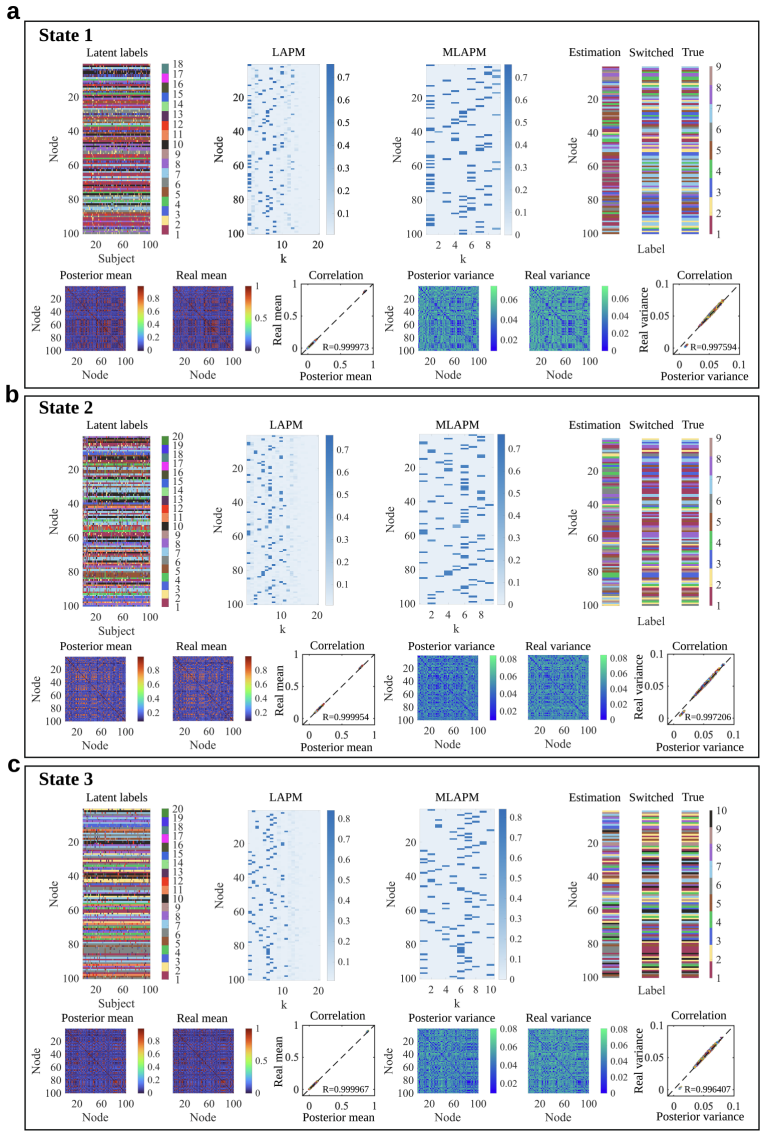
Most functional magnetic resonance imaging studies rely on estimates of hierarchically organized functional brain networks whose segregation and integration reflect the cognitive and behavioral changes in humans. However, most existing methods for estimating the community structure of networks from both individual and group-level analysis methods do not account for the variability between subjects. In this paper, we develop a new multilayer community detection method based on Bayesian latent block model (LBM). The method can robustly detect the community structure of weighted functional networks with an unknown number of communities at both individual and group levels and retain the variability of the individual networks. For validation, we propose a new community structure-based multivariate Gaussian generative model to simulate synthetic signal. Our simulation study shows that the community memberships estimated by hierarchical Bayesian inference are consistent with the predefined node labels in the generative model. The method is also tested via split-half reproducibility using working memory task fMRI data of 100 unrelated healthy subjects from the Human Connectome Project. Analyses using both synthetic and real data show that our proposed method is more accurate and reliable compared with the commonly used (multilayer) modularity models.
Editorial analysis
A structured set of objections, weighed in public.
Referee Report
Summary. The manuscript introduces a hierarchical Bayesian latent block model (LBM) for multilayer community detection in weighted functional brain networks from fMRI data. The method detects community structure at individual and group levels with unknown numbers of communities while retaining inter-subject variability. Validation uses a newly proposed community structure-based multivariate Gaussian generative model showing consistency of estimated memberships with predefined labels, plus split-half reproducibility on HCP working memory task data from 100 subjects; the authors claim superior accuracy and reliability versus (multilayer) modularity models.
Significance. If validated independently, the approach could improve estimation of hierarchically organized functional networks by explicitly modeling subject variability and unknown community counts via Bayesian inference. The split-half test on real HCP data supplies external grounding for reliability, and the method's ability to operate on weighted networks is a potential strength over standard modularity.
major comments (3)
- [Abstract] Abstract: the central accuracy claim rests on synthetic experiments generated from the authors' own community structure-based multivariate Gaussian model, which explicitly encodes the block/community structure that the LBM is designed to recover; this creates circularity and does not constitute an independent stress test against modularity baselines that optimize a different objective.
- [Abstract] Abstract: the simulation reports only qualitative consistency with predefined labels and provides no quantitative metrics (accuracy, error rates, or statistical comparisons) against the modularity baselines, preventing assessment of the claimed superiority.
- [Abstract] Abstract / generative model description: the manuscript does not report validation of the proposed multivariate Gaussian generative model against empirical fMRI statistics (heavy tails, temporal autocorrelation, non-Gaussianity), which is required before using it to benchmark detection performance.
minor comments (1)
- The split-half reproducibility test on HCP data is a positive external check, but the manuscript should clarify how community labels are aligned across halves and subjects for quantitative comparison.
Simulated Author's Rebuttal
We thank the referee for the constructive comments on our manuscript. We address each major comment point by point below, indicating where revisions will be made.
read point-by-point responses
-
Referee: [Abstract] Abstract: the central accuracy claim rests on synthetic experiments generated from the authors' own community structure-based multivariate Gaussian model, which explicitly encodes the block/community structure that the LBM is designed to recover; this creates circularity and does not constitute an independent stress test against modularity baselines that optimize a different objective.
Authors: The synthetic experiments are designed to test recovery of known structure under the model's assumptions, which is a standard validation approach for inference methods. The primary comparison to modularity relies on the independent split-half reproducibility analysis of real HCP data. We will revise the abstract and discussion to clarify the distinct roles of the two evaluations and reduce emphasis on synthetic accuracy claims relative to modularity. revision: partial
-
Referee: [Abstract] Abstract: the simulation reports only qualitative consistency with predefined labels and provides no quantitative metrics (accuracy, error rates, or statistical comparisons) against the modularity baselines, preventing assessment of the claimed superiority.
Authors: We agree that quantitative metrics are needed to support the superiority claim on synthetic data. In the revision we will add accuracy, adjusted Rand index, and statistical comparisons against the modularity baselines. revision: yes
-
Referee: [Abstract] Abstract / generative model description: the manuscript does not report validation of the proposed multivariate Gaussian generative model against empirical fMRI statistics (heavy tails, temporal autocorrelation, non-Gaussianity), which is required before using it to benchmark detection performance.
Authors: The generative model serves as a controlled simulation tool rather than a full statistical model of fMRI time series. We will add an explicit limitations paragraph discussing its simplifying assumptions, but a comprehensive match to all empirical fMRI properties lies outside the scope of the current work focused on the detection method. revision: partial
Circularity Check
Synthetic validation circular: data generated from author-proposed model whose block structure matches LBM by construction
specific steps
-
self definitional
[Abstract]
"For validation, we propose a new community structure-based multivariate Gaussian generative model to simulate synthetic signal. Our simulation study shows that the community memberships estimated by hierarchical Bayesian inference are consistent with the predefined node labels in the generative model."
The generative model is defined to contain the exact community structure that the hierarchical Bayesian LBM is designed to recover; therefore the reported consistency is true by construction of the simulation rather than an independent verification of the method's superiority.
full rationale
The paper's accuracy claim against modularity baselines rests primarily on synthetic recovery experiments. The authors introduce both the LBM inference method and a 'community structure-based multivariate Gaussian generative model' whose node labels are then recovered by the LBM. Because the generative process explicitly encodes the same community/block structure the LBM is built to infer, successful recovery is guaranteed under the model's own assumptions and does not constitute an independent test. The real-data split-half test addresses only reproducibility, not accuracy. No external validation of the generative model's match to empirical fMRI statistics is provided in the abstract or described validation chain.
Axiom & Free-Parameter Ledger
free parameters (1)
- number of communities
axioms (1)
- domain assumption Functional brain networks can be represented as weighted graphs whose community structure follows the assumptions of a latent block model.
invented entities (1)
-
community structure-based multivariate Gaussian generative model
no independent evidence
Reference graph
Works this paper leans on
-
[1]
Achard, S., Salvador, R., Whitcher, B., Suckling, J., and Bullmore, E. (2006). A resilient, low-frequency, small-world human brain functional network with highly connected association cortical hubs.Journal of Neuroscience, 26(1):63–72
work page 2006
-
[2]
Allen, E. A., Damaraju, E., Plis, S. M., Erhardt, E. B., Eichele, T., and Calhoun, V. D. (2014). Tracking whole-brain connectivity dynamics in the resting state.Cerebral Cortex, 24:663–676
work page 2014
-
[3]
Aquino, K. M., Fulcher, B. D., Parkes, L., Sabaroedin, K., and Fornito, A. (2020). Identifying and removing widespread signal deflections from fMRI data: Rethinking the global signal regression problem. NeuroImage, 212(February):116614
work page 2020
-
[4]
M., Poldrack, R., Smith, S., Johnsen-Berg, H., Snyder, A
Bjork, J. M., Poldrack, R., Smith, S., Johnsen-Berg, H., Snyder, A. Z., Van Essen, D. C., and for the WU-Minn HCP Consortium (2013). Function in the human connectome: Task-fMRI and individual differences in behavior.NeuroImage, 80:169–189
work page 2013
-
[5]
Bassett, D. S., Porter, M. A., Wymbs, N. F., Grafton, S. T., Carlson, J. M., and Mucha, P. J. (2013). Robust detection of dynamic community structure in networks.CHAOS, 23:13142
work page 2013
-
[6]
Bassett, D. S., Wymbs, N. F., Porter, M. A., Mucha, P. J., Carlson, J. M., and Grafton, S. T. (2011). Dynamic reconfiguration of human brain networks during learning. PNAS, 108(18):7641–7646
work page 2011
-
[7]
Betzel, R. F., Bertolero, M. A., Gordon, E. M., Gratton, C., Dosenbach, N. U., and Bassett, D. S. (2019). The community structure of functional brain networks exhibits scale-specific patterns of inter- and intra-subject variability.NeuroImage, 202(September 2018):115990
work page 2019
-
[8]
Betzel, R. F., Medaglia, J. D., and Bassett, D. S. (2018). Diversity of meso-scale architecture in human and non-human connectomes.Nature Communications, 9(1)
work page 2018
-
[9]
Bian, L., Cui, T., Sofronov, G., and Keith, J. (2020). Network structure change point detection by posterior predictive discrepancy. InMonte Carlo and Quasi-Monte Carlo Methods, MC- QMC 2018, Rennes, France, July 1–6, pages 107–123. Springer proceedings in Mathematics & Statistics
work page 2020
-
[10]
Bian, L., Cui, T., Thomas Yeo, B., Fornito, A., Razi, A., and Keith, J. (2021). Identification of community structure-based brain states and transitions using functional MRI.NeuroImage, 244(September):118635
work page 2021
-
[11]
D., Miller, R., Pearlson, G., and Adali, T
Calhoun, V. D., Miller, R., Pearlson, G., and Adali, T. (2014). The chronnectome: Time-varying connectivity networks as the next frontier in fMRI data discovery.Neuron, 84(2):262–274. 33
work page 2014
-
[12]
Carpaneto, G. and Toth, P. (1980). Algorithm 548: Solution of the assignment problem [H]. ACM Transactions on Mathematical Software (TOMS), 6(1):104–111
work page 1980
-
[13]
Cribben, I., Haraldsdottir, R., Atlas, L. Y., Wager, T. D., and Lindquist, M. A. (2012). Dynamic connectivity regression: determining state-related changes in brain connectivity.NeuroImage, 61:720–907
work page 2012
- [14]
-
[15]
Friston, K. J., Fagerholm, E. D., Zarghami, T. S., Parr, T., Hipólito, I., Magrou, L., and Razi, A. (2021). Parcels and particles: Markov blankets in the brain.Network Neuroscience, 0(ja):1–76
work page 2021
-
[16]
J., Kahan, J., Biswal, B., and Razi, A
Friston, K. J., Kahan, J., Biswal, B., and Razi, A. (2014). A DCM for resting state fMRI. NeuroImage, 94:396–407
work page 2014
-
[17]
Gonzalez-Castillo, J. and Bandettini, P. A. (2018). Task-based dynamic functional connectivity: Recent findings and open questions.NeuroImage, 180(August 2017):526–533
work page 2018
-
[18]
Hastings, W. (1970). Monte Carlo sampling methods using Markov chains and their applications. Biometrika, 57(1):97–109
work page 1970
-
[19]
Hoffmann, T., Peel, L., Lambiotte, R., and Jones, N. S. (2020). Community detection in networks without observing edges.Science Advances, 6(4):1–12
work page 2020
-
[20]
Penna, S. D., Duyn, J. H., Glover, G. H., Gonzalez-castillo, J., Handwerker, D. A., Keilholz, S., Kiviniemi, V., Leopold, D. A., Pasquale, F. D., Sporns, O., Walter, M., and Chang, C. (2013). Dynamic functional connectivity : Promise , issues , and interpretations.NeuroImage, 80:360–378
work page 2013
-
[21]
Kringelbach, M. L. and Deco, G. (2020). Brain states and transitions: Insights from computa- tional neuroscience. Cell Reports, 32(10):108128
work page 2020
-
[22]
Lehmann, B. C., Henson, R. N., Geerligs, L., Cam-CAN, and White, S. R. (2021). Characterising group-levelbrainconnectivity: AframeworkusingBayesianexponentialrandomgraphmodels. NeuroImage, 225:117480
work page 2021
-
[23]
Razi, A., Vidaurre, D., Xie, H., and Calhoun, V. D. (2020). Questions and controversies in the study of time-varying functional connectivity in resting fMRI.Network Neuroscience, 4(1):30–69. 34
work page 2020
-
[24]
MacDaid, A., Murphy, T. B., Friel, N., and Hurley, N. (2012). Improved Bayesian inference for the stochastic block model with application to large networks.Computational Statistics and Data Analysis, 60:12–31
work page 2012
-
[25]
Metropolis, N., Rosenbluth, A. W., Rosenbluth, M. N., Teller, A. H., and Teller, E. (1953). Equation of state calculations by fast computing machines.The Journal of Chemical Physics, 21(6):1087–1092
work page 1953
-
[26]
Monti, R. P., Lorenz, R., Braga, R. M., Anagnostopoulos, C., Leech, R., and Montana, G. (2017). Real-time estimation of dynamic functional connectivity networks.Human Brain Mapping, 38(1):202–220
work page 2017
-
[27]
Nobile, A. and Fearnside, A. T. (2007). Bayesian finite mixtures with an unknown number of components: The allocation sampler.Statistics and Computing, 17:147–162
work page 2007
-
[28]
Park, H.-J. and Friston, K. (2013). Structural and functional brain networks: From connections to cognition. Science, 342(6158)
work page 2013
-
[29]
Parkes, L., Fulcher, B., Yücel, M., andFornito, A.(2018). Anevaluationoftheefficacy, reliability, and sensitivity of motion correction strategies for resting-state functional MRI.NeuroImage, 171(December 2017):415–436. Pavlović, D. M., Guillaume, B. R., Towlson, E. K., Kuek, N. M., Afyouni, S., Vértes, P. E., Thomas Yeo, B., Bullmore, E. T., and Nichols, ...
work page 2018
-
[30]
Peel, L., Larremore, D. B., and Clauset, A. (2017). The ground truth about metadata and community detection in networks.Science Advances, 3(5):1–9
work page 2017
-
[31]
Power, J. D., Plitt, M., Laumann, T. O., and Martin, A. (2017). Sources and implications of whole-brain fMRI signals in humans.NeuroImage, 146(September 2016):609–625
work page 2017
-
[32]
Razi, A. and Friston, K. J. (2016). The connected brain: Causality, models, and intrinsic dynamics. IEEE Signal Processing Magazine, 26(5):340–343
work page 2016
-
[33]
Razi, A., Kahan, J., Rees, G., and Friston, K. J. (2015). Construct validation of a DCM for resting state fMRI.NeuroImage, 106:1–14
work page 2015
-
[34]
L., Zhou, Y., McColgan, P., Zeidman, P., Park, H.-J., Sporns, O., Rees, G., and Friston, K
Razi, A., Seghier, M. L., Zhou, Y., McColgan, P., Zeidman, P., Park, H.-J., Sporns, O., Rees, G., and Friston, K. J. (2017). Large-scale DCMs for resting-state fMRI.Network Neuroscience, 1(4):381–414. 35
work page 2017
-
[35]
Robinson, L. F., Atlas, L. Y., and Wager, T. D. (2015). Dynamic functional connectivity us- ing state-based dynamic community structure: Method and application to opioid analgesia. NeuroImage, 108:274–291
work page 2015
-
[36]
Schaefer, A., Kong, R., Gordon, E. M., Laumann, T. O., Zuo, X.-N., Holmes, A. J., Eickhoff, S. B., and Yeo, B. T. T. (2018). Local-Global Parcellation of the Human Cerebral Cortex from Intrinsic Functional Connectivity MRI.Cerebral Cortex, 28(9):3095–3114
work page 2018
-
[37]
Vickers, J., Zhang, Y., Stefano, N. D., Brady, J. M., and Matthews, P. M. (2004). Advances in functional and structural MR image analysis and implementation as FSL.NeuroImage, 23:S208–S219
work page 2004
-
[38]
Stephens, M. (2000). Dealing with label switching in mixture models. Journal of the Royal Statistical Society. Series B (Statistical Methodology), 62(4):795–809
work page 2000
-
[39]
Taghia, J., Cai, W., Ryali, S., Kochalka, J., Nicholas, J., Chen, T., and Menon, V. (2018). Uncoveringhiddenbrainstatedynamicsthatregulateperformanceanddecision-makingduring cognition. Nature Communications, 9(1)
work page 2018
-
[40]
Ting, C. M., Samdin, S. B., Tang, M., and Ombao, H. (2021). Detecting dynamic commu- nity structure in functional brain networks across individuals: A multilayer approach.IEEE Transactions on Medical Imaging, 40(2):468–480. Van Essen, D. C., Smith, S. M., Barch, D. M., Behrens, T. E., Yacoub, E., and Ugurbil, K. (2013). The WU-Minn Human Connectome Projec...
work page 2021
-
[41]
Woolrich, M. W. (2018). Discovering dynamic brain networks from big data in rest and task. NeuroImage, 180(June 2017):646–656
work page 2018
-
[42]
Wyse, J. and Friel, N. (2012). Block clustering with collapsed latent block models.Statistics and Computing, 22:415–428
work page 2012
-
[43]
Xia, M., Wang, J., and He, Y. (2013). BrainNet viewer: A network visualization tool for human brain connectomics. PLoS ONE, 8(7). 36
work page 2013
discussion (0)
Sign in with ORCID, Apple, or X to comment. Anyone can read and Pith papers without signing in.