Privacy Against Agnostic Inference Attacks in Vertical Federated Learning
Pith reviewed 2026-05-24 09:15 UTC · model grok-4.3
The pith
The active party in vertical federated learning can perform agnostic inference attacks on the passive party's samples by using an independently trained model on its own features.
A machine-rendered reading of the paper's core claim, the machinery that carries it, and where it could break.
Core claim
The active party can carry out inference attacks on both training and prediction phase samples by acquiring an ML model independently trained on the training samples available to them. This type of inference attack does not require the active party to be aware of the score of a specific sample. Privacy-preserving schemes are proposed that systematically distort the VFL parameters corresponding to the passive party's features, with an adjustable level that trades off privacy and interpretability.
What carries the argument
The agnostic inference attack, carried out via an independently trained model by the active party on its available features, combined with adjustable parameter distortion as a countermeasure.
If this is right
- The attack succeeds without needing the joint model's confidence scores for specific samples.
- Using observed confidence scores from the prediction phase can improve the attack performance.
- The proposed distortion schemes allow tuning the balance between passive party privacy and active party interpretability.
- Experimental results confirm the attack works and the countermeasures reduce it while keeping utility.
Where Pith is reading between the lines
- If the attack generalizes beyond logistic regression, similar risks may exist in other VFL models.
- Parties may need to negotiate distortion levels based on their specific privacy and utility needs.
- Future defenses could focus on preventing the active party from training effective independent models.
Load-bearing premise
The active party's independently trained model can still capture relevant patterns about the samples even without the passive party's features.
What would settle it
An experiment showing that the inference accuracy of the active party's independent model is equivalent to random chance on the passive party's feature values.
Figures


read the original abstract
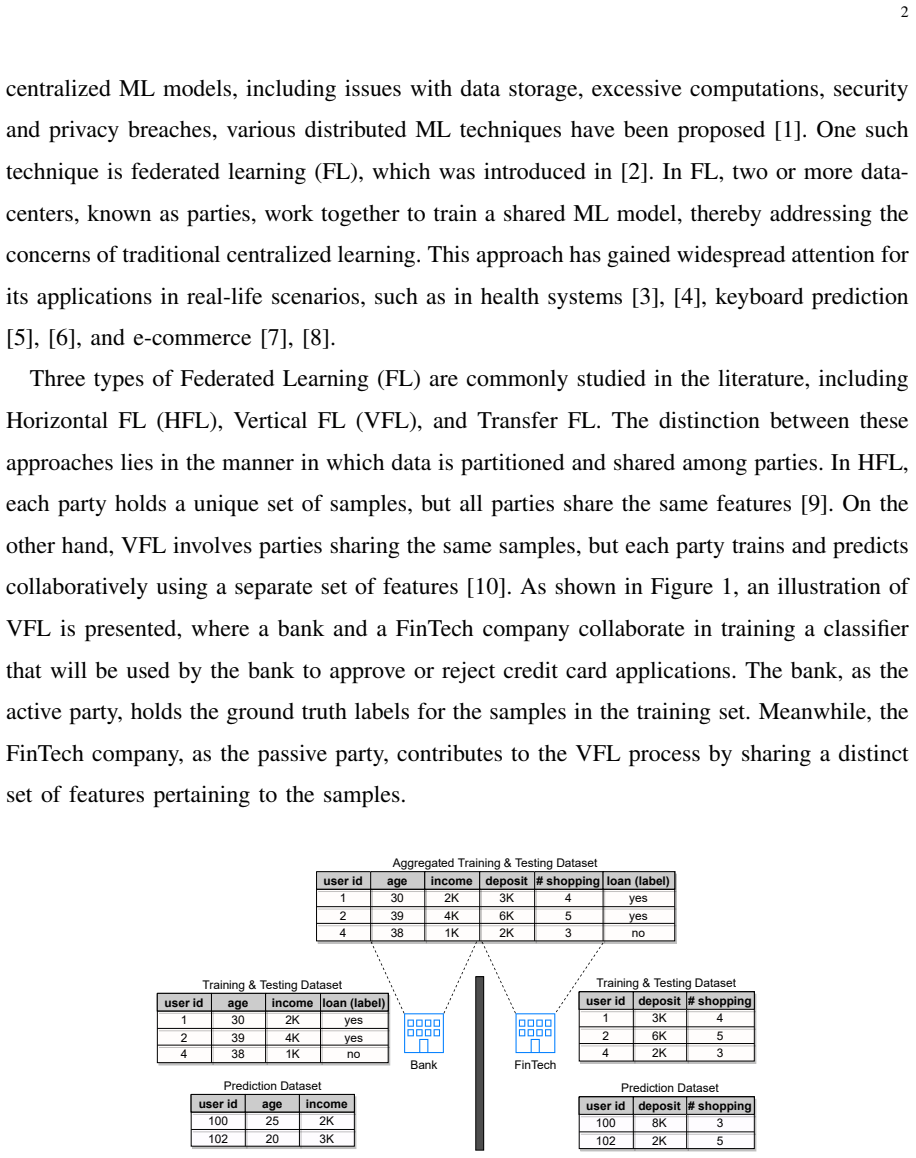
A novel form of inference attack in vertical federated learning (VFL) is proposed, where two parties collaborate in training a machine learning (ML) model. Logistic regression is considered for the VFL model. One party, referred to as the active party, possesses the ground truth labels of the samples in the training phase, while the other, referred to as the passive party, only shares a separate set of features corresponding to these samples. It is shown that the active party can carry out inference attacks on both training and prediction phase samples by acquiring an ML model independently trained on the training samples available to them. This type of inference attack does not require the active party to be aware of the score of a specific sample, hence it is referred to as an agnostic inference attack. It is shown that utilizing the observed confidence scores during the prediction phase, before the time of the attack, can improve the performance of the active party's autonomous ML model, and thus improve the quality of the agnostic inference attack. As a countermeasure, privacy-preserving schemes (PPSs) are proposed. While the proposed schemes preserve the utility of the VFL model, they systematically distort the VFL parameters corresponding to the passive party's features. The level of the distortion imposed on the passive party's parameters is adjustable, giving rise to a trade-off between privacy of the passive party and interpretabiliy of the VFL outcomes by the active party. The distortion level of the passive party's parameters could be chosen carefully according to the privacy and interpretabiliy concerns of the passive and active parties, respectively, with the hope of keeping both parties (partially) satisfied. Finally, experimental results demonstrate the effectiveness of the proposed attack and the PPSs.
Editorial analysis
A structured set of objections, weighed in public.
Referee Report
Summary. The paper claims that in vertical federated learning using logistic regression, an active party holding labels can mount agnostic inference attacks on both training and prediction-phase samples by training an independent model solely on its own features and labels. It further proposes adjustable privacy-preserving schemes that distort the passive party's parameters to reduce attack effectiveness while preserving VFL utility, with a tunable trade-off between passive-party privacy and active-party interpretability. Experiments are presented to show attack success and PPS effectiveness.
Significance. If the attack premise and defense efficacy hold under standard VFL conditions, the work identifies a new inference vector that does not require score access and supplies practical, tunable countermeasures. This would be relevant for VFL deployments where feature asymmetry is the norm.
major comments (2)
- [§4] §4 (attack construction): the agnostic attack requires that an independent model trained on active-party features alone recovers enough signal to infer labels or properties despite the systematic absence of passive features. No condition, bound, or ablation is supplied for the regime in which passive features carry substantial predictive power—the usual justification for VFL—leaving the central effectiveness claim without support when the autonomous model is weak.
- [§6] §6 (experimental evaluation): the reported attack results omit baselines for conventional inference attacks, data-exclusion rules, and error analysis or statistical significance tests. Without these, it is not possible to determine whether the observed attack performance is attributable to the agnostic mechanism or to experimental artifacts, directly affecting assessment of the central claim.
minor comments (2)
- [Abstract] Abstract: 'interpretabiliy' is misspelled.
- [§3] Notation for the independent model and the VFL model should be distinguished more clearly to avoid reader confusion between the two training processes.
Simulated Author's Rebuttal
We thank the referee for the constructive feedback. We address the major comments below and commit to revisions that strengthen the manuscript without altering its core claims.
read point-by-point responses
-
Referee: [§4] §4 (attack construction): the agnostic attack requires that an independent model trained on active-party features alone recovers enough signal to infer labels or properties despite the systematic absence of passive features. No condition, bound, or ablation is supplied for the regime in which passive features carry substantial predictive power—the usual justification for VFL—leaving the central effectiveness claim without support when the autonomous model is weak.
Authors: We agree that attack effectiveness depends on signal in the active party's features. The manuscript demonstrates the attack in realistic VFL partitions where the active party achieves non-trivial independent accuracy, consistent with the paper's focus on agnostic attacks that require no score access. To address the concern, we will add a dedicated subsection in §4 with discussion of applicability conditions, including when passive features dominate, plus ablations varying feature predictive power. revision: yes
-
Referee: [§6] §6 (experimental evaluation): the reported attack results omit baselines for conventional inference attacks, data-exclusion rules, and error analysis or statistical significance tests. Without these, it is not possible to determine whether the observed attack performance is attributable to the agnostic mechanism or to experimental artifacts, directly affecting assessment of the central claim.
Authors: We accept that additional experimental rigor is needed. The revised version will incorporate baselines against conventional inference attacks, explicit data-exclusion rules, error bars, and statistical significance tests (e.g., paired t-tests with p-values) on attack success rates to isolate the agnostic mechanism's contribution. revision: yes
Circularity Check
No significant circularity; attack and defenses defined independently of VFL outputs
full rationale
The paper's central construction defines the agnostic inference attack via an autonomous ML model trained solely on the active party's own features and labels (explicitly independent of VFL training). PPSs are then introduced as adjustable distortions applied to passive-party parameters after VFL training. No equation reduces a claimed prediction or uniqueness result to a fitted parameter or self-citation by construction. No self-citation is invoked as load-bearing for the attack premise or defense. The derivation chain remains self-contained against external benchmarks and does not exhibit any of the enumerated circularity patterns.
Axiom & Free-Parameter Ledger
Reference graph
Works this paper leans on
-
[1]
Federated learning with differential privacy: Algorithms and performance analysis,
K. Wei, J. Li, M. Ding, C. Ma, H. H. Yang, F. Farokhi, S. Jin, T. Q. S. Quek, and H. V . Poor, “Federated learning with differential privacy: Algorithms and performance analysis,” IEEE Transactions on Information Forensics and Security, vol. 15, pp. 3454–3469, 2020
work page 2020
-
[2]
Communication-Efficient Learning of Deep Networks from Decentralized Data,
B. McMahan, E. Moore, D. Ramage, S. Hampson, and B. A. y. Arcas, “Communication-Efficient Learning of Deep Networks from Decentralized Data,” in Proceedings of the 20th International Conference on Artificial Intelligence 42 and Statistics , ser. Proceedings of Machine Learning Research, A. Singh and J. Zhu, Eds., vol. 54. PMLR, 20–22 Apr 2017, pp. 1273–1282...
work page 2017
-
[3]
Decentralized federated learning for electronic health records,
S. Lu, Y . Zhang, and Y . Wang, “Decentralized federated learning for electronic health records,” in 2020 54th Annual Conference on Information Sciences and Systems (CISS) , 2020, pp. 1–5
work page 2020
-
[4]
Privacy-preserving federated brain tumour segmentation,
W. Li, F. Milletari, D. Xu, N. Rieke, J. Hancox, W. Zhu, M. Baust, Y . Cheng, S. Ourselin, M. J. Cardoso, and A. Feng, “Privacy-preserving federated brain tumour segmentation,” CoRR, vol. abs/1910.00962, 2019. [Online]. Available: http://arxiv.org/abs/1910.00962
-
[5]
Federated Learning for Emoji Prediction in a Mobile Keyboard
F. Beaufays, K. Rao, R. Mathews, and S. Ramaswamy, “Federated learning for emoji prediction in a mobile keyboard,” 2019. [Online]. Available: https://arxiv.org/abs/1906.04329
work page internal anchor Pith review Pith/arXiv arXiv 2019
-
[6]
Federated Learning for Mobile Keyboard Prediction
A. Hard, K. Rao, R. Mathews, F. Beaufays, S. Augenstein, H. Eichner, C. Kiddon, and D. Ramage, “Federated learning for mobile keyboard prediction,” CoRR, vol. abs/1811.03604, 2018. [Online]. Available: http://arxiv.org/abs/1811.03604
work page internal anchor Pith review Pith/arXiv arXiv 2018
-
[7]
A quasi-newton method based vertical federated learning framework for logistic regression,
K. Yang, T. Fan, T. Chen, Y . Shi, and Q. Yang, “A quasi-newton method based vertical federated learning framework for logistic regression,” CoRR, vol. abs/1912.00513, 2019. [Online]. Available: http://arxiv.org/abs/1912.00513
-
[8]
A trusted recommendation scheme for privacy protection based on federated learning,
Y . Wang, Y . Tian, X. Yin, and X. Hei, “A trusted recommendation scheme for privacy protection based on federated learning,” CCF Transactions on Networking , vol. 3, pp. 218–228, 12 2020
work page 2020
-
[9]
Toward resource-efficient federated learning in mobile edge computing,
R. Yu and P. Li, “Toward resource-efficient federated learning in mobile edge computing,” IEEE Network , vol. 35, no. 1, pp. 148–155, 2021
work page 2021
-
[10]
Federated learning for privacy-preserving ai,
Y . Cheng, Y . Liu, T. Chen, and Q. Yang, “Federated learning for privacy-preserving ai,” Commun. ACM , vol. 63, no. 12, p. 33–36, nov 2020. [Online]. Available: https://doi.org/10.1145/3387107
-
[11]
Feature inference attack on model predictions in vertical federated learning,
X. Luo, Y . Wu, X. Xiao, and B. C. Ooi, “Feature inference attack on model predictions in vertical federated learning,” CoRR, vol. abs/2010.10152, 2020. [Online]. Available: https://arxiv.org/abs/2010.10152
-
[12]
Privacy against inference attacks in vertical federated learning,
B. Rassouli, M. Varasteh, and D. Gunduz, “Privacy against inference attacks in vertical federated learning,” 2022. [Online]. Available: https://arxiv.org/abs/2207.11788
-
[13]
Protocols for secure computations,
A. C. Yao, “Protocols for secure computations,” in 23rd Annual Symposium on Foundations of Computer Science (sfcs 1982), 1982, pp. 160–164
work page 1982
-
[14]
I. Damg ˚ard and M. Jurik, “A generalisation, a simplification and some applications of paillier’s probabilistic public- key system,” in Public Key Cryptography , K. Kim, Ed. Berlin, Heidelberg: Springer Berlin Heidelberg, 2001, pp. 119–136
work page 2001
-
[15]
UCI machine learning repository,
D. Dua and C. Graff, “UCI machine learning repository,” 2017. [Online]. Available: http://archive.ics.uci.edu/ml
work page 2017
-
[16]
Data-Snooping Biases in Tests of Financial Asset Pricing Models,
A. W. Lo and A. C. MacKinlay, “Data-Snooping Biases in Tests of Financial Asset Pricing Models,” The Review of Financial Studies, vol. 3, no. 3, pp. 431–467, 04 2015. [Online]. Available: https://doi.org/10.1093/rfs/3.3.431
- [17]
-
[18]
Comprehensive analysis of privacy leakage in vertical federated learning during prediction,
X. Jiang, X. Zhou, and J. Grossklags, “Comprehensive analysis of privacy leakage in vertical federated learning during prediction,” Proceedings on Privacy Enhancing Technologies , vol. 2022, pp. 263–281, 04 2022
work page 2022
-
[19]
A generalized inverse for matrices,
R. Penrose, “A generalized inverse for matrices,” Mathematical Proceedings of the Cambridge Philosophical Society , vol. 51, no. 3, p. 406–413, 1955
work page 1955
-
[20]
The geometry of algorithms with orthogonality constraints,
A. Edelman, T. A. Arias, and S. T. Smith, “The geometry of algorithms with orthogonality constraints,” SIAM Journal on Matrix Analysis and Applications , vol. 20, no. 2, pp. 303–353, 1998. [Online]. Available: https://doi.org/10.1137/S0895479895290954
-
[21]
N. Xiao, X. Liu, and Y .-x. Yuan, “A penalty-free infeasible approach for a class of nonsmooth optimization problems over the stiefel manifold,” 2021. [Online]. Available: https://arxiv.org/abs/2103.03514
-
[22]
N. Xiao, X. Liu, and Y . xiang Yuan, “A class of smooth exact penalty function methods for optimization problems 43 with orthogonality constraints,” Optimization Methods and Software , vol. 37, no. 4, pp. 1205–1241, 2022. [Online]. Available: https://doi.org/10.1080/10556788.2020.1852236
-
[23]
Note on the generalized inverse of a matrix product,
T. N. E. Greville, “Note on the generalized inverse of a matrix product,” SIAM Review, vol. 8, no. 4, pp. 518–521,
-
[24]
Available: https://doi.org/10.1137/1008107
[Online]. Available: https://doi.org/10.1137/1008107
-
[25]
K. B. Petersen and M. S. Pedersen, “The matrix cookbook,” Oct. 2008, version 20081110. [Online]. Available: http://www2.imm.dtu.dk/pubdb/p.php?3274
work page 2008
discussion (0)
Sign in with ORCID, Apple, or X to comment. Anyone can read and Pith papers without signing in.