Anomalous Relativistic Emission from Self-Modulated Plasma Mirrors
Pith reviewed 2026-05-24 09:57 UTC · model grok-4.3
The pith
Loss of coherence in reflected plasma mirror harmonics triggers efficient XUV emission parallel to the surface from oscillating nanobunches
A machine-rendered reading of the paper's core claim, the machinery that carries it, and where it could break.
Core claim
The radiation emission is due to laser-driven oscillations of relativistic electron nanobunches which originate from a plasma surface instability induced by collisionless absorption of the laser, producing coherent XUV that propagates parallel to the mirror surface once the reflected high-harmonics lose spatio-temporal coherence.
What carries the argument
Relativistic electron nanobunches formed by plasma-surface instability and driven into oscillation by the laser field
If this is right
- The reflected radiation reaches high efficiency in the XUV spectral range
- The emission direction becomes parallel to the mirror surface rather than specular
- The process constitutes a distinct regime separate from conventional high-order harmonic generation
- The nanobunch mechanism supplies a concrete source term for the observed anomalous propagation
Where Pith is reading between the lines
- Measuring the angular distribution of XUV output in experiments could directly test the predicted transition threshold
- Varying laser intensity or plasma density in simulations would map the onset condition for the surface instability
- The directional anomaly may offer a new diagnostic signature for collisionless absorption processes at solid-density interfaces
Load-bearing premise
Loss of spatio-temporal coherence in the reflected high-harmonics directly enables the transition to the new regime of highly efficient coherent XUV generation with anomalous directional propagation.
What would settle it
A particle-in-cell simulation or experiment in which the plasma-surface instability is suppressed yet the parallel-propagating XUV emission still appears at high efficiency would falsify the claimed causal chain.
Figures



read the original abstract
The interaction of intense laser pulses with plasma mirrors has demonstrated the ability to generate high-order harmonics, producing a bright source of extreme ultraviolet (XUV) radiation and attosecond pulses. Here, we report an unexpected transition in this process. We show that the loss of spatio-temporal coherence in the reflected high-harmonics can lead to a new regime of highly-efficient coherent XUV generation, with an extraordinary property where the radiation is directionally anomalous, propagating parallel to the mirror surface. With analytical calculations and numerical particle-in-cell simulations, we discover that the radiation emission is due to laser-driven oscillations of relativistic electron nanobunches which originate from a plasma surface instability induced by collisionless absorption of the laser.
Editorial analysis
A structured set of objections, weighed in public.
Referee Report
Summary. The manuscript reports an unexpected transition during intense laser interaction with plasma mirrors: loss of spatio-temporal coherence in the reflected high-order harmonics enables a new regime of highly efficient coherent XUV generation whose radiation propagates parallel to the mirror surface rather than in the usual specular direction. The emission is attributed to laser-driven oscillations of relativistic electron nanobunches that form via a plasma-surface instability triggered by collisionless absorption; the claim is supported by analytical calculations and particle-in-cell simulations.
Significance. If the reported mechanism and its directional anomaly hold, the work identifies a previously unrecognized channel for bright, anomalously directed XUV sources from plasma mirrors that could complement existing attosecond-pulse techniques. The explicit combination of analytical modeling with PIC simulations is a positive feature that, if fully documented, would aid reproducibility.
major comments (2)
- [Abstract] Abstract: The central claim states that 'the loss of spatio-temporal coherence in the reflected high-harmonics can lead to a new regime'. However, the described mechanism attributes the anomalous emission directly to oscillations of nanobunches formed by the surface instability; both the coherence loss and the nanobunch formation are presented as simultaneous consequences of the same instability. No argument or simulation isolating decoherence as the independent enabling factor (rather than a correlated byproduct) is supplied.
- [Abstract] Abstract: The manuscript asserts that 'analytical calculations and numerical particle-in-cell simulations' support the mechanism, yet the provided text contains neither explicit derivations, governing equations, nor quantitative simulation diagnostics (e.g., bunch density, oscillation amplitude, or radiated power spectra). Without these, the load-bearing causal link between instability, nanobunches, and anomalous propagation cannot be verified.
Simulated Author's Rebuttal
Thank you for the referee's thorough review and constructive comments on our manuscript. We address each major comment below and indicate the revisions planned.
read point-by-point responses
-
Referee: [Abstract] Abstract: The central claim states that 'the loss of spatio-temporal coherence in the reflected high-harmonics can lead to a new regime'. However, the described mechanism attributes the anomalous emission directly to oscillations of nanobunches formed by the surface instability; both the coherence loss and the nanobunch formation are presented as simultaneous consequences of the same instability. No argument or simulation isolating decoherence as the independent enabling factor (rather than a correlated byproduct) is supplied.
Authors: We agree that the abstract phrasing risks implying decoherence as an independent causal driver. The manuscript presents the surface instability (triggered by collisionless absorption) as simultaneously producing the relativistic electron nanobunches and the loss of spatio-temporal coherence in the specular harmonics. The anomalous directional emission arises from the laser-driven oscillations of those nanobunches; the coherence loss in the usual specular channel simply renders the new emission prominent. We will revise the abstract to state the causal sequence more precisely and avoid any suggestion that decoherence was isolated as an independent factor. A short clarifying paragraph will also be added in the main text. revision: yes
-
Referee: [Abstract] Abstract: The manuscript asserts that 'analytical calculations and numerical particle-in-cell simulations' support the mechanism, yet the provided text contains neither explicit derivations, governing equations, nor quantitative simulation diagnostics (e.g., bunch density, oscillation amplitude, or radiated power spectra). Without these, the load-bearing causal link between instability, nanobunches, and anomalous propagation cannot be verified.
Authors: The referee correctly notes that the submitted text does not contain the explicit derivations, governing equations, or quantitative diagnostics. Although the work rests on such calculations and simulations, these supporting elements were omitted from the manuscript. In the revised version we will insert the key analytical expressions for the surface instability growth and the radiation from the oscillating nanobunches, together with simulation diagnostics (electron density profiles within the bunches, oscillation amplitudes, and radiated power spectra in the anomalous direction versus the specular direction) to make the causal chain verifiable. revision: yes
Circularity Check
No circularity: claims rest on independent simulations and calculations
full rationale
The provided abstract and context describe results obtained via analytical calculations and particle-in-cell simulations that identify the nanobunch mechanism. No equations, parameters, or premises are shown to reduce by construction to fitted inputs, self-definitions, or self-citation chains. The derivation chain is presented as externally falsifiable via simulation outputs rather than tautological.
Axiom & Free-Parameter Ledger
Lean theorems connected to this paper
-
IndisputableMonolith/Cost/FunctionalEquation.leanwashburn_uniqueness_aczel unclear?
unclearRelation between the paper passage and the cited Recognition theorem.
radiation emission is due to laser-driven oscillations of relativistic electron nanobunches which originate from a plasma surface instability induced by collisionless absorption of the laser
-
IndisputableMonolith/Foundation/DimensionForcing.leanalexander_duality_circle_linking unclear?
unclearRelation between the paper passage and the cited Recognition theorem.
Buneman instability dispersion relation ... Γ_m = ω_pe √3/2 (Z² m_e / 2 m_i)^{1/3}
What do these tags mean?
- matches
- The paper's claim is directly supported by a theorem in the formal canon.
- supports
- The theorem supports part of the paper's argument, but the paper may add assumptions or extra steps.
- extends
- The paper goes beyond the formal theorem; the theorem is a base layer rather than the whole result.
- uses
- The paper appears to rely on the theorem as machinery.
- contradicts
- The paper's claim conflicts with a theorem or certificate in the canon.
- unclear
- Pith found a possible connection, but the passage is too broad, indirect, or ambiguous to say the theorem truly supports the claim.
Reference graph
Works this paper leans on
-
[1]
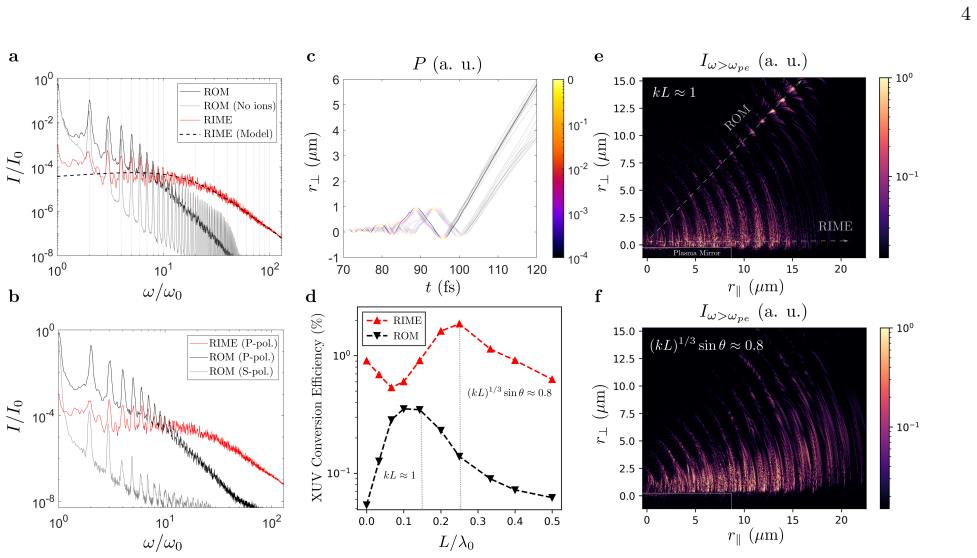
Trajectories of two characteristic electron bunches with γ ≈ a0 are presented in Fig. 4c. Calculated ra- diation power confirms multiple bursts emitted along the 4 FIG. 4. Radiation properties of RIME. a) Intensity spectra with the analytical model given by Eq. 1. b) Intensity spectra for S and P laser polarizations. c) Instantaneous power of radiation em...
-
[2]
W. Mori, C. Decker, and W. Leemans, Relativistic har- monic content of nonlinear electromagnetic waves in un- derdense plasmas, IEEE transactions on plasma science 21, 110 (1993)
work page 1993
-
[3]
U. Teubner and P. Gibbon, High-order harmonics from laser-irradiated plasma surfaces, Reviews of Modern Physics 81, 445 (2009)
work page 2009
-
[4]
S. V. Bulanov, N. Naumova, and F. Pegoraro, Interaction of an ultrashort, relativistically strong laser pulse with an overdense plasma, Physics of Plasmas 1, 745 (1994)
work page 1994
-
[5]
H. Vincenti, S. Monchoc´ e, S. Kahaly, G. Bonnaud, P. Martin, and F. Qu´ er´ e, Optical properties of relativistic plasma mirrors, Nature communications 5, 3403 (2014)
work page 2014
-
[6]
A. Pirozhkov, M. Kando, T. Z. Esirkepov, P. Galle- gos, H. Ahmed, E. Ragozin, A. Y. Faenov, T. Pikuz, T. Kawachi, A. Sagisaka, et al. , Soft-x-ray harmonic comb from relativistic electron spikes, Physical Review Letters 108, 135004 (2012)
work page 2012
- [7]
-
[8]
M. Yeung, B. Dromey, S. Cousens, T. Dzelzainis, D. Kiefer, J. Schreiber, J. Bin, W. Ma, C. Kreuzer, J. Meyer-ter Vehn, et al., Dependence of laser-driven co- herent synchrotron emission efficiency on pulse ellipticity and implications for polarization gating, Physical Review Letters 112, 123902 (2014)
work page 2014
-
[9]
P. Heissler, R. H¨ orlein, J. M. Mikhailova, L. Waldecker, P. Tzallas, A. Buck, K. Schmid, C. Sears, F. Krausz, L. Veisz, et al., Few-cycle driven relativistically oscillat- ing plasma mirrors: a source of intense isolated attosec- ond pulses, Physical Review Letters 108, 235003 (2012)
work page 2012
-
[10]
N. Naumova, J. Nees, I. Sokolov, B. Hou, and G. Mourou, Relativistic generation of isolated attosecond pulses in a λ 3 focal volume, Physical Review Letters 92, 063902 (2004)
work page 2004
-
[11]
J. A. Wheeler, A. Borot, S. Monchoc´ e, H. Vincenti, A. Ricci, A. Malvache, R. Lopez-Martens, and F. Qu´ er´ e, Attosecond lighthouses from plasma mirrors, Nature Photonics 6, 829 (2012)
work page 2012
-
[12]
O. Smirnova, Y. Mairesse, S. Patchkovskii, N. Dudovich, D. Villeneuve, P. Corkum, and M. Y. Ivanov, High harmonic interferometry of multi-electron dynamics in molecules, Nature 460, 972 (2009)
work page 2009
- [13]
-
[14]
F. Krausz and M. Ivanov, Attosecond physics, Reviews of modern physics 81, 163 (2009)
work page 2009
-
[15]
V. Nefedova, M. Albrecht, M. Kozlov´ a, and J. Nejdl, De- velopment of a high-flux xuv source based on high-order harmonic generation, Journal of Electron Spectroscopy and Related Phenomena 220, 9 (2017)
work page 2017
-
[16]
C. M. Heyl, H. Coudert-Alteirac, M. Miranda, M. Louisy, K. Kov´ acs, V. Tosa, E. Balogh, K. Varj´ u, A. L’Huillier, A. Couairon, et al. , Scale-invariant nonlinear optics in gases, Optica 3, 75 (2016)
work page 2016
-
[17]
G. A. Mourou, T. Tajima, and S. V. Bulanov, Optics in the relativistic regime, Reviews of modern physics 78, 309 (2006)
work page 2006
- [18]
-
[19]
T. Z. Esirkepov, Y. Sentoku, K. Mima, K. Nishihara, F. Califano, F. Pegoraro, N. Naumova, S. Bulanov, Y. Ueshima, T. Liseikina, et al., Ion acceleration by su- perintense laser pulses in plasmas, Journal of Experimen- tal and Theoretical Physics Letters 70, 82 (1999)
work page 1999
-
[20]
Brunel, Not-so-resonant, resonant absorption, Physi- cal Review Letters 59, 52 (1987)
F. Brunel, Not-so-resonant, resonant absorption, Physi- cal Review Letters 59, 52 (1987)
work page 1987
-
[21]
Gibbon, Short pulse laser interactions with matter: an introduction (World Scientific, 2005)
P. Gibbon, Short pulse laser interactions with matter: an introduction (World Scientific, 2005)
work page 2005
-
[22]
T. Nakamura, S. Kato, H. Nagatomo, and K. Mima, Surface-magnetic-field and fast-electron current-layer for- mation by ultraintense laser irradiation, Physical review letters 93, 265002 (2004)
work page 2004
-
[23]
Buneman, Dissipation of currents in ionized media, Physical Review 115, 503 (1959)
O. Buneman, Dissipation of currents in ionized media, Physical Review 115, 503 (1959)
work page 1959
-
[24]
S. Bulanov and P. Sasorov, Tearing of a current sheet and reconnection of magnetic lines of force, Soviet Journal of Plasma Physics 4, 418 (1978)
work page 1978
-
[25]
See Supplemental material for more details
- [26]
- [27]
-
[28]
V. L. Ginzburg, The Propagation of Electromagnetic Waves in Plasma (Pergamon, 1964)
work page 1964
-
[29]
N. G. Denisov, On a singularity of the field of an electro- magnetic wave propagated in an inhomogeneous plasma, Sov. Phys. - JETP 4 4, 544 (1957)
work page 1957
- [30]
-
[31]
J. D. Jackson, Classical electrodynamics (John Wiley & Sons, 1999)
work page 1999
-
[32]
C. J. Hirschmugl, M. Sagurton, and G. P. Williams, Multiparticle coherence calculations for synchrotron- radiation emission, Physical Review A 44, 1316 (1991)
work page 1991
discussion (0)
Sign in with ORCID, Apple, or X to comment. Anyone can read and Pith papers without signing in.