Order-by-disorder and emergent Kosterlitz-Thouless phase in triangular Rydberg array
Pith reviewed 2026-05-24 09:51 UTC · model grok-4.3
The pith
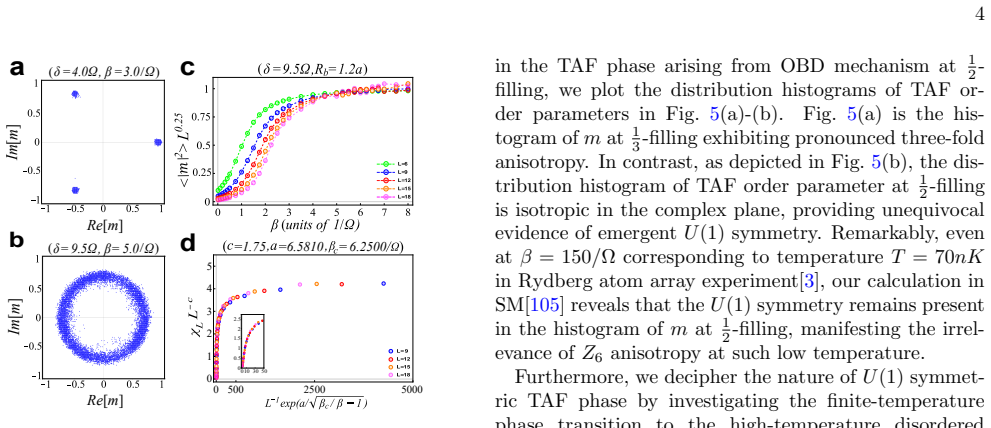
At 1/2 filling, order-by-disorder selects √3×√3 long-range antiferromagnetic order in the triangular Rydberg array model.
A machine-rendered reading of the paper's core claim, the machinery that carries it, and where it could break.
Core claim
The √3×√3 triangular antiferromagnetic order at 1/3 and 2/3 Rydberg fillings is reproduced by the simulations. At 1/2 filling the order-by-disorder mechanism lifts the degeneracy and stabilizes the same √3×√3 long-range order. At finite temperature an emergent U(1) symmetry appears at 1/2 filling and is broken by a Kosterlitz-Thouless transition as temperature is increased.
What carries the argument
Order-by-disorder mechanism that selects the √3×√3 state from the degenerate manifold of the effective Rydberg Hamiltonian at 1/2 filling.
If this is right
- The √3×√3 order at 1/2 filling is stable at low temperature and should be directly detectable by site-resolved imaging.
- An emergent U(1) symmetry appears only at 1/2 filling, producing a Kosterlitz-Thouless transition at a finite critical temperature.
- The same Rydberg platform can therefore realize both conventional magnetic order and a finite-temperature topological transition by simple filling control.
- These phases remain accessible to programmable Rydberg arrays without additional fine-tuning of the interaction range.
Where Pith is reading between the lines
- Similar order-by-disorder selection may occur on other frustrated lattices once the interaction range is tuned to produce comparable degeneracy.
- The KT transition line could be mapped experimentally by varying temperature while monitoring the decay of correlations, providing a direct test of emergent continuous symmetry.
- If the transition survives weak disorder, the Rydberg array could serve as a tunable platform for studying the interplay between order-by-disorder and topological melting.
Load-bearing premise
The effective Rydberg Hamiltonian with the interaction terms and filling fractions studied is an accurate description of the experimental triangular-lattice Rydberg array.
What would settle it
Absence of √3×√3 long-range order in larger-scale quantum Monte Carlo runs or in future Rydberg-atom experiments performed at 1/2 filling would falsify the order-by-disorder claim.
Figures


read the original abstract
Programmable quantum simulator using Rydberg-atom array provides a promising route to demystifying quantum many-body physics in strongly correlated systems. Motivated by recent realization of various quantum magnetic phases on frustrated Rydberg-atom array, we perform numerically exact quantum Monte-Carlo simulation to investigate the exotic states of matter emerging in the model describing Rydberg atom on triangular lattice. Our state-of-the-art simulation unveils the $\sqrt{3}\times\sqrt{3}$ triangular anti-ferromagnetic(TAF) order exists at $\frac{1}{3}$/$\frac{2}{3}$-Rydbreg filling, consistent with the observation in experiments. More fantastically, $\sqrt{3}\times\sqrt{3}$ long-range order arising from order-by-disorder mechanism emerges at $\frac{1}{2}$-filling. At finite temperature, $U(1)$ symmetry is emergent at $\frac{1}{2}$-filling and a Kosterlitz-Thouless(KT) phase transition occurs with increasing temperature. These intriguing phenomena are potentially detected in future Rydberg-atom experiments.
Editorial analysis
A structured set of objections, weighed in public.
Referee Report
Summary. The manuscript reports quantum Monte Carlo simulations of the effective Rydberg Hamiltonian on the triangular lattice. It claims observation of √3×√3 triangular antiferromagnetic (TAF) order at 1/3 and 2/3 Rydberg fillings, consistent with experiments, and emergence of the same long-range order at 1/2 filling via an order-by-disorder mechanism. At finite temperature, an emergent U(1) symmetry is reported at 1/2 filling, accompanied by a Kosterlitz-Thouless transition.
Significance. If the numerical evidence holds, the work would demonstrate order-by-disorder selection of √3×√3 order in a frustrated Rydberg model and the appearance of an emergent KT phase at finite temperature. These results are potentially relevant to ongoing Rydberg-atom experiments. The use of sign-problem-free QMC on a stoquastic model is a methodological strength that enables direct simulation without uncontrolled approximations.
major comments (2)
- [Abstract] Abstract: The assertion of 'numerically exact' QMC results is not accompanied by any information on lattice sizes, statistical error bars, the precise definition or measurement protocol for the order parameters, or finite-size scaling analysis. These details are load-bearing for the central claims of long-range √3×√3 order at 1/2 filling and the identification of a KT transition.
- [Abstract] Abstract: The statement that 'U(1) symmetry is emergent at 1/2-filling' and that a KT transition occurs requires supporting evidence such as the behavior of the superfluid stiffness, correlation functions, or Binder ratios across system sizes; none of these diagnostics are described.
minor comments (2)
- [Abstract] Abstract: 'Rydbreg' is a typographical error and should read 'Rydberg'.
- [Abstract] Abstract: The phrase 'More fantastically' is informal and should be replaced with more neutral scientific language.
Simulated Author's Rebuttal
We thank the referee for the positive assessment of our work's significance and for the detailed comments on the abstract. We agree that the abstract is concise and will revise it to better highlight the numerical details and diagnostics supporting our claims, while noting that the full manuscript already contains the requested information on system sizes, error analysis, order-parameter definitions, and finite-size scaling.
read point-by-point responses
-
Referee: [Abstract] Abstract: The assertion of 'numerically exact' QMC results is not accompanied by any information on lattice sizes, statistical error bars, the precise definition or measurement protocol for the order parameters, or finite-size scaling analysis. These details are load-bearing for the central claims of long-range √3×√3 order at 1/2 filling and the identification of a KT transition.
Authors: The main text reports QMC simulations on lattices up to 24×24 sites (with details in Sec. II), statistical error bars obtained from independent runs and shown in all figures, the structure-factor definition of the √3×√3 order parameter, and finite-size scaling analysis in Figs. 3–5 that establishes long-range order at 1/2 filling. The abstract is brief by design, but we will revise it to mention the system-size range and direct readers to the main text for the full methodological and scaling details. revision: yes
-
Referee: [Abstract] Abstract: The statement that 'U(1) symmetry is emergent at 1/2-filling' and that a KT transition occurs requires supporting evidence such as the behavior of the superfluid stiffness, correlation functions, or Binder ratios across system sizes; none of these diagnostics are described.
Authors: The manuscript presents the emergent U(1) symmetry and KT transition via the superfluid stiffness, algebraic decay of correlation functions, and Binder-ratio crossings across system sizes (detailed in Sec. IV and Figs. 6–8). These standard diagnostics are described in the main text. We will revise the abstract to explicitly reference that the KT phase is identified through these quantities, which are analyzed in the results section. revision: yes
Circularity Check
No significant circularity; results from direct QMC on externally defined Hamiltonian
full rationale
The paper reports quantum Monte Carlo results on a Rydberg-atom Hamiltonian for the triangular lattice at specified fillings. The central claims (√3×√3 order at 1/2 filling via order-by-disorder, emergent U(1) symmetry, and KT transition) are direct numerical outputs. No parameters are fitted to the target observables, no self-definitional relations appear in the equations, and no load-bearing self-citation chain reduces the claims to prior author work by construction. The Hamiltonian is taken as given from experiment and prior literature; the simulation itself is independent and sign-problem-free. This matches the default expectation of a non-circular numerical study.
Axiom & Free-Parameter Ledger
axioms (1)
- domain assumption The effective model Hamiltonian for Rydberg atoms on the triangular lattice accurately captures the experimental physics at the fillings studied.
Lean theorems connected to this paper
-
IndisputableMonolith/Foundation/AlexanderDuality.leanalexander_duality_circle_linking unclear?
unclearRelation between the paper passage and the cited Recognition theorem.
We perform numerically exact quantum Monte-Carlo simulation... √3×√3 long-range order arising from order-by-disorder mechanism emerges at 1/2-filling... KT phase transition
-
IndisputableMonolith/Cost/FunctionalEquation.leanwashburn_uniqueness_aczel unclear?
unclearRelation between the paper passage and the cited Recognition theorem.
Hamiltonian... Uij ni nj + Ω/2 (b†i + bi) − δ ni
What do these tags mean?
- matches
- The paper's claim is directly supported by a theorem in the formal canon.
- supports
- The theorem supports part of the paper's argument, but the paper may add assumptions or extra steps.
- extends
- The paper goes beyond the formal theorem; the theorem is a base layer rather than the whole result.
- uses
- The paper appears to rely on the theorem as machinery.
- contradicts
- The paper's claim conflicts with a theorem or certificate in the canon.
- unclear
- Pith found a possible connection, but the passage is too broad, indirect, or ambiguous to say the theorem truly supports the claim.
Reference graph
Works this paper leans on
- [1]
-
[2]
Y. Zhou, K. Kanoda, and T.-K. Ng, Rev. Mod. Phys. 89, 025003 (2017)
work page 2017
- [3]
- [4]
-
[5]
G. Semeghini, H. Levine, A. Keesling, S. Ebadi, T. T. Wang, D. Bluvstein, R. Verresen, H. Pichler, M. Kali- nowski, R. Samajdar, A. Omran, S. Sachdev, A. Vish- wanath, M. Greiner, V. Vuletic, and M. D. Lukin, Sci- ence 374, 1242 (2021)
work page 2021
-
[6]
D. Barredo, S. de L´ es´ eleuc, V. Lienhard, T. Lahaye, and A. Browaeys, Science 354, 1021 (2016)
work page 2016
-
[7]
D. Barredo, V. Lienhard, S. de L´ es´ eleuc, T. Lahaye, and A. Browaeys, Nature 56, 79 (2018)
work page 2018
- [8]
- [9]
-
[10]
A. Ga¨ etan, Y. Miroshnychenko, T. Wilk, A. Chotia, M. Viteau, D. Compara, P. Pillet, A. Browaeys, and P. Grangier, Nature Physics 5, 115 (2009)
work page 2009
- [11]
- [12]
- [13]
-
[14]
K.-N. Schymik, V. Lienhard, D. Barredo, P. Scholl, H. Williams, A. Browaeys, and T. Lahaye, Physical Review A 102, 063107 (2020)
work page 2020
- [15]
-
[16]
S. Hollerith, K. Srakaew, D. Wei, A. Rubio-Abadal, D. Adler, P. Weckesser, A. Kruckenhauser, V. Walther, R. van Bijnen, J. Rui, C. Gross, I. Bloch, and J. Zeiher, PHYSICAL REVIEW LETTERS 128, 113602 (2022)
work page 2022
- [17]
-
[18]
K. Srakaew, P. Weckesser, S. Hollerith, D. Wei, D. Adler, I. Bloch, and J. Zeiher, arXiv , 2207.09383 (2022)
- [19]
- [20]
-
[21]
D. Barredo, H. Labuhn, S. Ravets, T. Lahaye, A. Browaeys, and C. S. Adams, Phys Rev Lett 114, 113002 (2015)
work page 2015
- [22]
-
[23]
H. Bernien, S. Schwartz, A. Keesling, H. Levine, A. Om- ran, H. Pichler, S. Choi, A. S. Zibrov, M. Endres, M. Greiner, V. Vuletic, and M. D. Lukin, Nature 551, 579 (2017)
work page 2017
-
[24]
V. Lienhard, S. de L´ es´ eleuc, D. Barredo, T. Lahaye, A. Browaeys, M. Schuler, L.-P. Henry, and A. M. L¨ auchli, Physical Review X8, 021070 (2018)
work page 2018
-
[25]
E. Guardado-Sanchez, P. T. Brown, D. Mitra, T. De- vakul, D. A. Huse, P. Schauß, and W. S. Bakr, Physical Review X 8, 021069 (2018)
work page 2018
- [27]
-
[28]
S. de L´ es´ eleuc, V. Lienhard, P. Scholl, D. Barredo, S. Weber, N. Lang, H. Peter B¨ uchler, T. Lahaye, and A. Browaeys, Science 365, 775 (2019)
work page 2019
-
[29]
Y. Song, M. Kim, H. Hwang, W. Lee, and J. Ahn, Physical Review Research 3, 013286 (2021)
work page 2021
-
[30]
R. Verresen, M. D. Lukin, and A. Vishwanath, Phys. Rev. X 11, 031005 (2021)
work page 2021
-
[31]
M. Kornjaˇ ca, R. Samajdar, T. Macr` ı, N. Gemelke, S.- T. Wang, and F. Liu, arXiv preprint arXiv:2211.00653 (2022)
-
[32]
M. Kalinowski, R. Samajdar, R. G. Melko, M. D. Lukin, S. Sachdev, and S. Choi, Phys. Rev. B 105, 174417 (2022)
work page 2022
- [33]
-
[34]
R. Samajdar, W. W. Ho, H. Pichler, M. D. Lukin, and S. Sachdev, Phys Rev Lett 124, 103601 (2020)
work page 2020
-
[35]
R. Samajdar, W. W. Ho, H. Pichler, M. D. Lukin, and S. Sachdev, Proceedings of the National Academy of Sciences 118, e2015785118 (2021)
work page 2021
-
[36]
S. Fey, S. C. Kapfer, and K. P. Schmidt, Physical Re- view Letters 122, 017203 (2019)
work page 2019
-
[37]
H. Kim, Y. Park, K. Kim, H. S. Sim, and J. Ahn, Phys Rev Lett 120, 180502 (2018)
work page 2018
-
[38]
B. Yan, S. A. Moses, B. Gadway, J. P. Covey, K. R. A. Hazzard, A. M. Rey, D. S. Jin, and J. Ye, Nature 501, 521 (2013)
work page 2013
-
[39]
Y. L. Zhou, M. Ortner, and P. Rabl, Physical Review A 84, 052332 (2011)
work page 2011
-
[40]
D. Bluvstein, A. Omran, H. Levine, A. Keesling, G. Se- meghini, S. Ebadi, T. T. Wang, A. A. Michailidis, N. Maskara, W. W. Ho, S. Choi, M. Serbyn, M. Greiner, V. Vuletic/acute.ts1, and M. D. Lukin, Science 371, 1355–1359 (2021)
work page 2021
-
[41]
A. Mazurenko, C. S. Chiu, G. Ji, M. F. Parsons, M. Kanasz-Nagy, R. Schmidt, F. Grusdt, E. Demler, D. Greif, and M. Greiner, Nature 545, 462 (2017)
work page 2017
- [42]
-
[43]
J. Zeiher, J.-y. Choi, A. Rubio-Abadal, T. Pohl, R. van Bijnen, I. Bloch, and C. Gross, Physical Review X 7, 041063 (2017)
work page 2017
-
[44]
J. Zeriher, R. van Bijnen, P. Schauß, S. Hild, J.-y. Choi, T. Pohl, I. Bloch, and C. Gross, Nature Physics 12, 1095 (2016)
work page 2016
- [45]
-
[46]
A. F. Tzortzakakis, D. Petrosyan, M. Fleischhauer, and K. Mølmer, PHYSICAL REVIEW A 106, 063302 (2022)
work page 2022
- [47]
-
[48]
A. F. Tzortzakakis, D. Petrosyan, M. Fleischhauer, and K. Mølmer, Physical Review A 106, 063302 (2022)
work page 2022
-
[49]
A. Kruckenhauser, R. van Bijnen, T. V. Zache, M. D. Liberto, and P. Zoller, arXiv , 2206.01108 (2022)
- [50]
-
[51]
J. A. S. Louren¸ co, G. Higgins, C. Zhang, M. Hennrich, and T. Macr` ı, Physical Review A106, 023309 (2022)
work page 2022
- [52]
- [53]
-
[54]
X. Wu, F. Yang, S. Yang, K. Mølmer, T. Pohl, M. K. Tey, and L. You, Physical Review Research 4, L032046 (2022)
work page 2022
- [55]
- [56]
-
[57]
A. Keesling, A. Omran, H. Levine, H. Bernien, H. Pich- ler, S. Choi, R. Samajdar, S. Schwartz, P. Silvi, S. Sachdev, P. Zoller, M. Endres, M. Greiner, V. Vuletic, and M. D. Lukin, Nature 568, 207 (2019)
work page 2019
-
[58]
S. de L´ es´ eleuc, V. Lienhard, P. Scholl, D. Barredo, S. Weber, N. Lang, H. P. B¨ uchler, T. Lahaye, and A. Browaeys, Science 365, 775 (2019), https://www.science.org/doi/pdf/10.1126/science.aav9105
-
[59]
C. J. Turner, A. A. Michailidis, D. A. Abanin, M. Ser- byn, and Z. Papi´ c, Nature Physics14, 745 (2018)
work page 2018
-
[60]
N. E. Myerson-Jain, S. Yan, D. Weld, and C. Xu, Phys. Rev. Lett. 128, 017601 (2022)
work page 2022
-
[61]
V. Lienhard, P. Scholl, S. Weber, D. Barredo, S. de L´ es´ eleuc, R. Bai, N. Lang, M. Fleischhauer, H. P. B¨ uchler, T. Lahaye, and A. Browaeys, Phys. Rev. X 10, 021031 (2020)
work page 2020
- [62]
-
[63]
E. Guardado-Sanchez, B. M. Spar, P. Schauss, R. Belyansky, J. T. Young, P. Bienias, A. V. Gorshkov, T. Iadecola, and W. S. Bakr, Phys. Rev. X 11, 021036 (2021)
work page 2021
- [64]
- [65]
-
[66]
C. J. Turner, J.-Y. Desaules, K. Bull, and Z. Papi´ c, Phys. Rev. X 11, 021021 (2021)
work page 2021
-
[67]
T.-H. Yang, B.-Z. Wang, X.-C. Zhou, and X.-J. Liu, arXiv preprint arXiv:2204.07086 (2022)
-
[68]
A. Celi, B. Vermersch, O. Viyuela, H. Pichler, D. L. Mikhasai, and P. Zoller, Physical Review X 10, 021057 (2020)
work page 2020
-
[69]
M. Barbier, H. L¨ utjeharms, and W. Hofstetter, Physical Review A 105, 013326 (2022)
work page 2022
-
[70]
P. Fromholz, M. Tsitsishvili, M. Votto, M. Dalmonte, A. Nersesyan, and T. Chanda, arXiv , 2207.00385 (2022)
-
[71]
G. Giudice, F. M. Surace, H. Pichler, and G. Giudici, Physical Review B 106, 195155 (2022)
work page 2022
-
[72]
M. Kalinowski, N. Maskara, and M. D. Lukin, arXiv , 2211.00017 (2022)
- [73]
-
[74]
R. Samajdar, D. G. Joshi, Y. Teng, and S. Sachdev, arXiv , 2204.00632 (2022)
- [75]
-
[76]
M. Tsitsishvili, T. Chanda, M. Votto, P. Fromholz, M. Dalmonte, and A. Nersesyan, arXiv , 2112.10421 7 (2022)
-
[77]
X.-J. Yu, S. Yang, J.-B. Xu, and L. Xu, Physical Review B 106, 165124 (2022)
work page 2022
-
[78]
C. L. Henley, Phys. Rev. Lett. 62, 2056 (1989)
work page 2056
-
[79]
A. V. Chubukov and T. Jolicoeur, Phys. Rev. B 46, 11137 (1992)
work page 1992
- [80]
-
[81]
R. Moessner, S. L. Sondhi, and P. Chandra, Phys. Rev. Lett. 84, 4457 (2000)
work page 2000
discussion (0)
Sign in with ORCID, Apple, or X to comment. Anyone can read and Pith papers without signing in.