Double-loop randomized quasi-Monte Carlo estimator for nested integration
Pith reviewed 2026-05-24 09:31 UTC · model grok-4.3
The pith
A double-loop randomized quasi-Monte Carlo estimator yields asymptotic bounds on bias and variance for nested integrals.
A machine-rendered reading of the paper's core claim, the machinery that carries it, and where it could break.
Core claim
The central claim is that the proposed double-loop rQMC estimator admits asymptotic error bounds for both bias and variance, attainable once the integrands meet the stated regularity conditions, including the conditions that permit Owen scrambling for functions of infinite Hardy-Krause variation.
What carries the argument
The double-loop randomized quasi-Monte Carlo estimator that couples rQMC sampling across the inner and outer integrals of a nested problem.
If this is right
- Bias and variance of the estimator obey explicit asymptotic rates once the regularity conditions are met.
- Owen scrambling extends the error analysis to integrands whose Hardy-Krause variation is infinite.
- A truncation scheme produces a practical estimator for expected information gain.
- The method improves computational efficiency relative to standard nested Monte Carlo sampling.
Where Pith is reading between the lines
- If the derived rates are observed in practice, the number of inner-loop samples needed for a target accuracy could drop substantially compared with plain Monte Carlo.
- The same double-loop structure might be reused for other nonlinear nested expectations that appear in stochastic optimization or Bayesian experimental design.
Load-bearing premise
The integrands must satisfy the regularity conditions, including those that allow Owen scrambling, that are required for the asymptotic error bounds to hold.
What would settle it
A concrete numerical experiment in which the observed decay rates of bias or variance fail to match the predicted asymptotic rates when the integrands are known to obey the stated regularity conditions.
Figures



read the original abstract
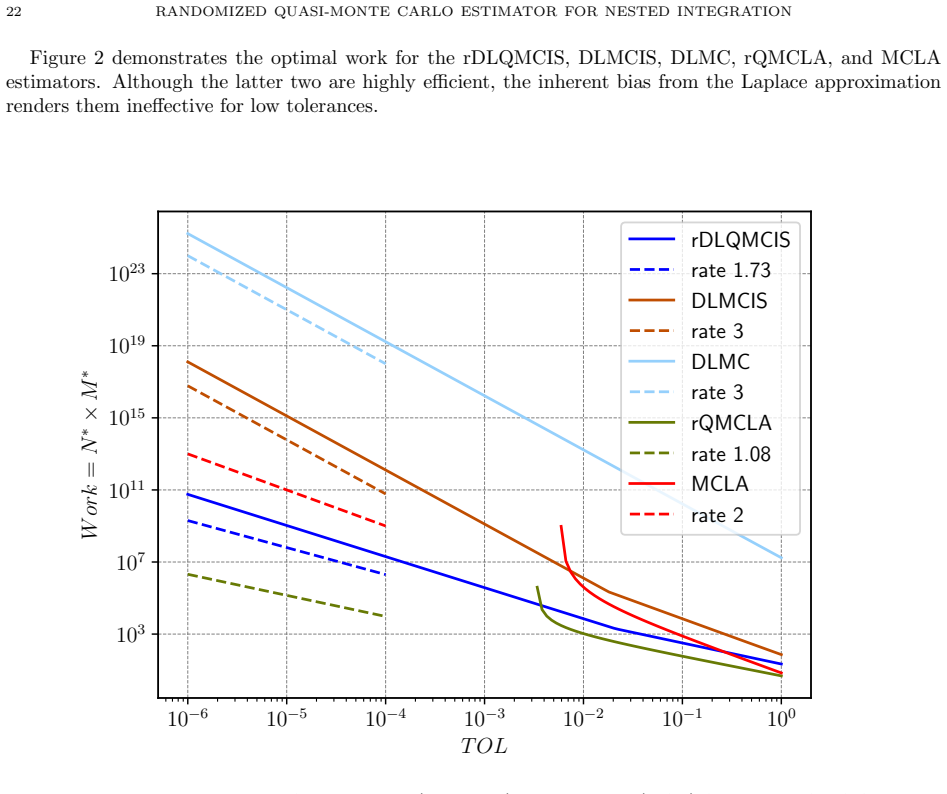
Nested integration of the form $\int f\left(\int g(\bs{y},\bs{x})\di{}\bs{x}\right)\di{}\bs{y}$, characterized by an outer integral connected to an inner integral through a nonlinear function $f$, is a challenging problem in various fields, such as engineering and mathematical finance. The available numerical methods for nested integration based on Monte Carlo (MC) methods can be prohibitively expensive owing to the error propagating from the inner to the outer integral. Attempts to enhance the efficiency of these approximations using the quasi-MC (QMC) or randomized QMC (rQMC) method have focused on either the inner or outer integral approximation. This work introduces a novel nested rQMC method that simultaneously addresses the approximation of the inner and outer integrals. The method leverages the unique nested integral structure to offer a more efficient approximation mechanism. As the primary contribution, we derive asymptotic error bounds for the bias and variance of our estimator, along with the regularity conditions under which these bounds can be attained. Incorporating Owen's scrambling techniques, we address integrands exhibiting infinite variation in the Hardy--Krause sense, enabling theoretically sound error estimates. Moreover, we derive a truncation scheme for applications in the context of expected information gain estimation. We verify the estimator quality through numerical experiments by comparing the computational efficiency of the nested rQMC method against standard nested MC estimation to highlight the computational savings and enhanced applicability of the proposed approach.
Editorial analysis
A structured set of objections, weighed in public.
Referee Report
Summary. The manuscript introduces a double-loop randomized quasi-Monte Carlo (rQMC) estimator for nested integrals of the form ∫ f(∫ g(y,x) dx) dy. The central contribution is the derivation of asymptotic bounds on the bias and variance of the estimator together with the precise regularity conditions (including Owen scrambling to accommodate infinite Hardy-Krause variation) under which the bounds are attained. A truncation scheme for expected information gain estimation is also derived, and numerical experiments compare the computational efficiency of the new estimator against standard nested Monte Carlo.
Significance. If the derived asymptotic bounds hold under the stated regularity conditions, the work supplies a theoretically justified and more efficient alternative to nested Monte Carlo for a class of integrals that arise in engineering and mathematical finance. The explicit treatment of infinite-variation integrands via Owen scrambling and the truncation scheme for information-gain applications are concrete strengths that enhance both the theoretical scope and practical utility of the estimator.
minor comments (3)
- [§3] §3 (or the theorem stating the main bounds): the precise rates (e.g., O(N^{-1+ε}) or similar) for bias and variance should be written explicitly rather than left as “asymptotic error bounds.”
- [Numerical experiments] The numerical experiments section would benefit from a table or plot that isolates the contribution of the inner-loop rQMC versus the outer-loop rQMC to the observed error reduction.
- A short remark clarifying whether the truncation scheme for expected information gain preserves the same asymptotic rates as the untruncated estimator would remove ambiguity for readers applying the method in that setting.
Simulated Author's Rebuttal
We thank the referee for the constructive and positive report, which correctly identifies the main contributions of the paper: the derivation of asymptotic bias and variance bounds for the double-loop rQMC estimator under the stated regularity conditions (including Owen scrambling for infinite Hardy-Krause variation) and the truncation scheme for expected information gain. We are pleased that the referee views the work as supplying a theoretically justified and more efficient alternative to nested Monte Carlo. Since the report contains no specific major comments, we address the recommendation of minor revision below and will incorporate any editorial or minor clarifications in the revised manuscript.
Circularity Check
No significant circularity
full rationale
The paper derives asymptotic bias and variance bounds for its double-loop rQMC estimator directly from the estimator definition together with stated regularity conditions on the integrands (including the extension of Owen scrambling to infinite Hardy-Krause variation). These bounds are obtained by standard QMC error analysis and are not obtained by fitting parameters to data subsets, by renaming an input quantity as a prediction, or by any self-referential definition. The truncation scheme for expected information gain is presented as a separate, independent contribution. No load-bearing step reduces to a self-citation chain, an imported uniqueness theorem, or an ansatz smuggled via prior work by the same authors. The derivation chain is therefore self-contained against external mathematical benchmarks and the paper's own assumptions.
Axiom & Free-Parameter Ledger
axioms (1)
- domain assumption Integrands satisfy the regularity conditions required for the asymptotic error bounds and for Owen's scrambling to apply to infinite-variation cases.
Forward citations
Cited by 1 Pith paper
-
Optimal Experimental Design for Reliable Learning of History-Dependent Constitutive Laws
A Bayesian optimal experimental design framework with Gaussian approximation of expected information gain and surrogate Fisher information enables optimized uniaxial tests that significantly improve identifiability of...
Reference graph
Works this paper leans on
-
[1]
Ryan KJ. Estimating expected information gains for experimental designs with application to the random fatigue-limit model. Journal of Computational and Graphical Statistics , 12:585–603, 2003
work page 2003
-
[2]
Beck J, Dia BM, Espath LF, Long Q, and Tempone R. Fast Bayesian experimental design: Laplace-based importance sampling for the expected information gain. Computer Methods in Applied Mechanics and Engineering , 334:523–553, 2018
work page 2018
-
[3]
Beck J, Dia BM, Espath LF, and Tempone R. Multilevel double loop Monte Carlo and stochastic collocation methods with importance sampling for Bayesian optimal experimental design. International Journal for Numerical Methods in Engineering, 121:3482–3503, 2020
work page 2020
-
[4]
Carlon AG, Dia BM, Espath LF, Lopez RH, and Tempone R. Nesterov-aided stochastic gradient methods using Laplace approximation for Bayesian design optimization. Computer Methods in Applied Mechanics and Engineering , 363:112909, 2020
work page 2020
-
[5]
A mathematical theory of communication
Shannon CE. A mathematical theory of communication. Bell System Technical Journal , 27:379–423, 1948
work page 1948
-
[6]
Information theory and statistics
Kullback S. Information theory and statistics . Wiley, 1959. RANDOMIZED QUASI-MONTE CARLO ESTIMATOR FOR NESTED INTEGRATION 39
work page 1959
-
[7]
Long Q, Scavino M, Tempone R, and Wang S. Fast estimation of expected information gains for Bayesian experimental designs based on Laplace approximations. Computer Methods in Applied Mechanics and Engineering , 259:24–39, 2013
work page 2013
-
[8]
Multimodal information gain in Bayesian design of experiments
Long Q. Multimodal information gain in Bayesian design of experiments. arXiv preprint arXiv:2108.07224 , 2021
-
[9]
Schillings C, Sprungk B, and Wacker P. On the convergence of the Laplace approximation and noise-level-robustness of Laplace-based Monte Carlo methods for Bayesian inverse problems. Numerische Mathematik, 145:915–971, 2020
work page 2020
-
[10]
Laplace's method in Bayesian inverse problems
Wacker P. Laplace’s method in Bayesian inverse problems. arXiv preprint arXiv:1701.07989 , 2017
work page internal anchor Pith review Pith/arXiv arXiv 2017
-
[11]
Bayesian experimental design: a review
Chaloner K and Verdinelli I. Bayesian experimental design: a review. Statistical Sciences, 10:273–304, 1995
work page 1995
-
[12]
On information and sufficiency
Kullback S and Leibler RA. On information and sufficiency. Annals of Mathematical Statistics , 22:79–86, 1951
work page 1951
-
[13]
Laplace’s 1774 memoir on inverse probability
Stigler SM. Laplace’s 1774 memoir on inverse probability. Statistical Science, 1:359–378, 1986
work page 1986
-
[14]
On a measure of information provided by an experiment
Lindley DV. On a measure of information provided by an experiment. Annals of Mathematical Statistics , 27:986–1005, 1956
work page 1956
-
[15]
Tierney L and Kadane JB. Accurate approximations for posterior moments and marginal densities.Journal of the American Statistical Association, 81:82–86, 1986
work page 1986
-
[16]
Fully exponential Laplace approximations to expectations and variances of nonpositive functions
Tierney L, Kass RE, and Kadane JB. Fully exponential Laplace approximations to expectations and variances of nonpositive functions. Journal of the American Statistical Association , 84:710–716, 1989
work page 1989
-
[17]
The validity of posterior expansions based on Laplace’s method
Kass RE, Tierney L, and Kadane JB. The validity of posterior expansions based on Laplace’s method. in: Geisser S, Hodges JS, Press SJ, and Zellner A (Eds.), Essays in Honor of George Barnard , 473–488, 1990
work page 1990
-
[18]
A Laplace method for under-determined Bayesian optimal experimental designs
Long Q, Scavino M, Tempone R, and Wang S. A Laplace method for under-determined Bayesian optimal experimental designs. Computer Methods in Applied Mechanics and Engineering , 285:849–876, 2015
work page 2015
-
[19]
Multilevel Monte Carlo path simulation
Giles MB. Multilevel Monte Carlo path simulation. Operations Research, 56(3):607–617, 2008
work page 2008
-
[20]
Efficient Bayesian experimentation using an expected information gain lower bound
Tsilifis P, Ghanem RG, and Hajali P. Efficient Bayesian experimentation using an expected information gain lower bound. SIAM/ASA Journal on Uncertainty Quantification , 5:30–62, 2017
work page 2017
-
[21]
Goda T, Daisuke M, Kei T, and Kozo S. Decision-theoretic sensitivity analysis for reservoir development under uncertainty using multilevel quasi-Monte Carlo methods. Computational Geosciences, 22:1009–1020, 2018
work page 2018
-
[22]
Efficient risk estimation via nested multilevel quasi-Monte Carlo simulation
Xu Z, He Z, and Wang X. Efficient risk estimation via nested multilevel quasi-Monte Carlo simulation. Journal of Com- putational and Applied Mathematics , 443:115745, 2024
work page 2024
-
[23]
Fang W, Wang Z, Giles MB, Jackson CH, Welton NJ, Andrieu C, and Thom H. Multilevel and quasi Monte Carlo methods for the calculation of the expected value of partial perfect information. Medical Decision Making, 42(2):168–181, 2022
work page 2022
-
[24]
Monte Carlo and quasi-Monte Carlo methods
Caflisch RE. Monte Carlo and quasi-Monte Carlo methods. Acta Numerica, 1–49, 1998
work page 1998
-
[25]
Lattice rules: How well do they measure up? In: Hellekalek P and Larcher G (Eds.)
Hickernell FJ. Lattice rules: How well do they measure up? In: Hellekalek P and Larcher G (Eds.). Random and Quasi- Random Point Sets. Lecture Notes in Statistics 138 , New York, Springer, 109–166, 1998
work page 1998
-
[26]
Random number generation and quasi-Monte Carlo methods
Niederreiter H. Random number generation and quasi-Monte Carlo methods. SIAM, Philadelphia, 1992
work page 1992
-
[27]
Owen AB. Quasi-Monte Carlo sampling. In: Monte Carlo Ray Tracing: SIGGRAPH , 69–88, 2003
work page 2003
-
[28]
Randomization of quasi-Monte Carlo methods for error estimation: survey and normal approximation
Tuffin B. Randomization of quasi-Monte Carlo methods for error estimation: survey and normal approximation. In: Monte Carlo Methods and Applications , De Gruyter, 10(3-4):617–628, 2004
work page 2004
-
[29]
Probability: Theory and examples
Durrett R. Probability: Theory and examples. Cambridge University Press , 2019
work page 2019
-
[30]
Dick J and Pillichshammer F. Digital nets and sequences: discrepancy theory and quasi-Monte Carlo integration.Cambridge University Press, 2010
work page 2010
-
[31]
High-dimensional integration: the quasi-Monte Carlo way
Dick J, Kuo FY, and Sloan IH. High-dimensional integration: the quasi-Monte Carlo way. Acta Numerica, 133–288, 2013
work page 2013
-
[32]
Distribution of points in a cube and approximate evaluation of integrals
Sobol’ IM. Distribution of points in a cube and approximate evaluation of integrals. ˇZ. Vyˇ cisl. Mat. i Mat. Fiz. (in Russian), 7:784–802, 1967
work page 1967
-
[33]
Drovandi CC and Tran M-N. Improving the efficiency of fully Bayesian optimal design of experiments using randomised Quasi-Monte Carlo. Bayesian Analysis, 13(1):139–162, 2018
work page 2018
-
[34]
On the distribution of integration error by randomly-shifted lattice rules
L’Ecuyer P, Munger D, and Tuffin B. On the distribution of integration error by randomly-shifted lattice rules. Electronic Journal of Statistics , 4:950–993, 2010
work page 2010
-
[35]
Mean estimation for randomized Quasi Monte Carlo method
Gobet E, Lerasle M, and M´ etivier D. Mean estimation for randomized Quasi Monte Carlo method. Hal preprint hal- 03631879v2, 2022
work page 2022
-
[36]
Non-asymptotic error estimates for the Laplace approximation in Bayesian inverse problems
Helin T and Kretschmann R. Non-asymptotic error estimates for the Laplace approximation in Bayesian inverse problems. Numerische Mathematik, 150:521–549, 2022
work page 2022
-
[37]
Randomized Quasi-Monte Carlo: An introduction for practitioners
L’Ecuyer P. Randomized Quasi-Monte Carlo: An introduction for practitioners. In: Owen A and Glynn P (Eds.). Monte Carlo and Quasi-Monte Carlo Methods. MCQMC 2016. Springer Proceedings in Mathematics & Statistics , Cham, Springer 241:29–52, 2018
work page 2016
-
[38]
Funktionen von beschr¨ ankter Variation in der Theorie der Gleichverteilung
Hlawka E. Funktionen von beschr¨ ankter Variation in der Theorie der Gleichverteilung. Annali di Matematica Pura ed Applicata, 54:325–333, 1961
work page 1961
-
[39]
Local antithetic sampling with scrambled nets
Owen AB. Local antithetic sampling with scrambled nets. The Annals of Statistics , 36(5):2319–2343, 2008
work page 2008
-
[40]
Farhat C, Park KC, and Dubois-Pelerin Y. An unconditionally stable staggered algorithm for transient finite element analysis of coupled thermoelastic problems. Computer Methods in Applied Mechanics and Engineering , 85(3):349–365, 1991
work page 1991
-
[41]
Multi-index stochastic collocation convergence rates for random PDEs with parametric regularity
Haji-Ali A-L, Nobile F, Tamellini, L, and Tempone R. Multi-index stochastic collocation convergence rates for random PDEs with parametric regularity. Foundations of Computational Mathematics , 16:1555–1605, 2016
work page 2016
-
[42]
Halton sequences avoid the origin
Owen AB. Halton sequences avoid the origin. SIAM Review, 48:487–503, 2006
work page 2006
-
[43]
Liu Y and Tempone R. Nonasymptotic convergence rate of quasi-Monte Carlo: applications to linear elliptic PDEs with lognormal coefficients and importance samplings. arXiv preprint arXiv:2310.14351 , 2023
-
[44]
Quasi-Monte Carlo finite element methods for elliptic PDEs with lognormal random coefficients
Graham IG, Kuo FY, Nichols JA, Scheichl R, Schwab C, and Sloan IH. Quasi-Monte Carlo finite element methods for elliptic PDEs with lognormal random coefficients. Numerische Mathematik, 131:329–368, 2015. 40 RANDOMIZED QUASI-MONTE CARLO ESTIMATOR FOR NESTED INTEGRATION
work page 2015
-
[45]
On the error rate of importance sampling with randomized quasi-Monte Carlo
He Z, Zheng Z, and Wang X. On the error rate of importance sampling with randomized quasi-Monte Carlo. SIAM Journal on Numerical Analysis, 61(2):10.1137/22M1510121, 2023
-
[46]
Quasi-Monte Carlo for unbounded integrands with importance sampling
Ouyang D, Wang X, and He Z. Quasi-Monte Carlo for unbounded integrands with importance sampling. arXiv preprint arXiv:2310.00650, 2023
-
[47]
Randomly permuted (t,m,s)-nets and (t,s)-sequences
Owen AB. Randomly permuted (t,m,s)-nets and (t,s)-sequences. in: Niederreiter H and Shiue PJS (Eds.), Monte Carlo and Quasi-Monte Carlo methods in Scientific Computing. Lecture Notes in Statistics 106 , New York, Springer, 1995
work page 1995
-
[48]
On nesting Monte Carlo estimators
Rainforth T, Cornish R, Yang H, Warrington A, and Wood F. On nesting Monte Carlo estimators. Proceedings of the 35th International Conference on Machine Learning, PLMR 80 Stockholm, 2008
work page 2008
-
[49]
Estimating the mean of a non-linear function of conditional expectation
Hong LJ, and Juneja S. Estimating the mean of a non-linear function of conditional expectation. in: Rossetti MD, Hill RR, Johansson B, Dunkin A and Ingalls RG (Eds.), Proceedings of the 2009 Winter Simulation Conference (WSC) Austin, 1223–1236, 2009
work page 2009
-
[50]
Confidence intervals for randomized quasi-Monte Carlo estimators
L’Ecuyer P, Nakayama MK, Owen AB, and Tuffin B. Confidence intervals for randomized quasi-Monte Carlo estimators. Winter Simulation Conference, San Antonio, US , 2023
work page 2023
-
[51]
MCMC design-based non-parametric regression for rare event
Fort G, Gobet E, and Moulines E. MCMC design-based non-parametric regression for rare event. Application to nested risk computations. Monte Carlo Methods and Applications , 23(1):21–42, 2017
work page 2017
-
[52]
Variational Bayesian optimal experimental design
Foster A, Jankowiak M, Bingham E, Horsfall P, Teh YW, Rainforth T, and Goodman N. Variational Bayesian optimal experimental design. Advances in Neural Information Processing Systems 32 , 2019
work page 2019
-
[53]
Goda T, Hironaka T, and Iwamoto T. Multilevel Monte Carlo estimation of expected information gains.Stochastic Analysis and Applications, 38(4):581–600, 2020
work page 2020
-
[54]
Unbiased MLMC stochastic gradient-based optimization of Bayesian experimental designs
Goda T, Hironaka T, Kitade W, and Foster A. Unbiased MLMC stochastic gradient-based optimization of Bayesian experimental designs. SIAM Journal on Scientific Computing , 44(1):A286–A311, 2022
work page 2022
-
[55]
Kuo FY, Schwab C, and Sloan IH. Quasi-Monte Carlo finite element methods for a class of elliptic partial differential equations with random coefficients. SIAM Journal on Numerical Analysis , 50(6):3351–3374, 2012
work page 2012
-
[56]
Kuo FY, Schwab C, and Sloan IH. Multi-level quasi-Monte Carlo finite element methods for a class of elliptic PDEs with random coefficients. Foundations of Computational Mathematics , 15:411–449, 2015
work page 2015
-
[57]
Ryan EG, Drovandi CC, Thompson MH and Pettitt AN. Towards Bayesian experimental design for nonlinear models that require a large number of sampling times. Computational Statistics and Data Analysis , 70:45–60, 2014
work page 2014
-
[58]
Scrambled net variance for integrals of smooth functions
Owen AB. Scrambled net variance for integrals of smooth functions. The Annals of Statistics , 25:1541–1562, 1997
work page 1997
-
[59]
Randomization of number theoretic methods for multiple integration
Cranley R, and Patterson TNL. Randomization of number theoretic methods for multiple integration. SIAM Journal on Numerical Analysis, 13(6):904–914, 1976
work page 1976
-
[60]
The nonzero gain coefficients of Sobol’s sequences are always powers of two
Pan Z, and Owen AB. The nonzero gain coefficients of Sobol’s sequences are always powers of two. Journal of Complexity , 75:101700, 2023
work page 2023
-
[61]
Approximating probability densities by iterated Laplace approximations
Bornkamp B. Approximating probability densities by iterated Laplace approximations. Journal of Computational and Graphical Statistics, 20(3):656–669, 2011
work page 2011
-
[62]
Bisetti F, Kim D, Knio O, Long Q, and Tempone R. Optimal Bayesian experimental design for priors of compact sup- port with application to shock-tube experiments for combustion kinetics. International Journal for Numerical Methods in Engineering, 108:136–155, 2016
work page 2016
-
[63]
Quasi-Monte Carlo for Bayesian design of experiment problems governed by parametric PDEs
Kaarnioja V, and Schillings C. Quasi-Monte Carlo for Bayesian design of experiment problems governed by parametric PDEs. arXiv preprint arXiv:2405.03529 [v2] , 2024
-
[64]
Multimodal information gain in Bayesian design of experiments
Long Q. Multimodal information gain in Bayesian design of experiments. Computational Statistics, 37(2):865–885 2022
work page 2022
-
[65]
Handbook of the normal distribution
Patel JK, and Read CB. Handbook of the normal distribution. 2nd ed., New York, Marcel Dekker, 1996
work page 1996
discussion (0)
Sign in with ORCID, Apple, or X to comment. Anyone can read and Pith papers without signing in.