Privacy-preserving Blockchain-enabled Parametric Insurance via Remote Sensing and IoT
Pith reviewed 2026-05-24 08:59 UTC · model grok-4.3
The pith
Zero-knowledge proofs let users submit parametric insurance claims on blockchain without revealing private remote-sensing or IoT data.
A machine-rendered reading of the paper's core claim, the machinery that carries it, and where it could break.
Core claim
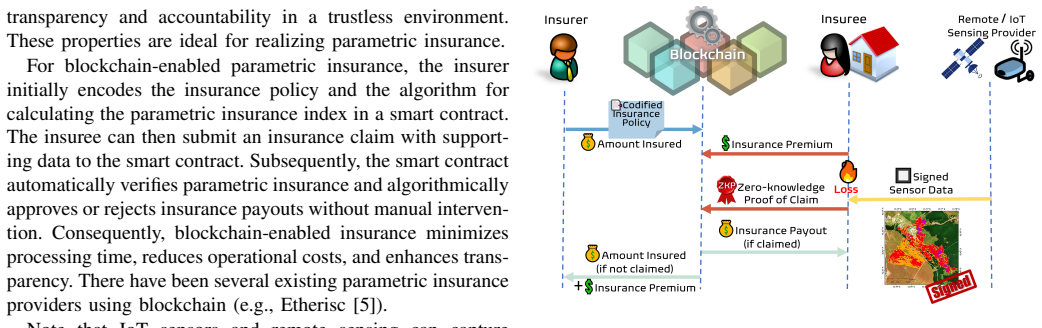
We propose a privacy-preserving parametric insurance framework based on succinct zero-knowledge proofs, whereby an insuree submits a zero-knowledge proof for the validity of an insurance claim and the authenticity of its data sources to a blockchain for transparent verification. We extend recent zk-SNARKs to support robust privacy protection for multiple heterogeneous data sources and improve efficiency to cut the incurred gas cost by 80 percent.
What carries the argument
An extension of zk-SNARKs that accepts multiple heterogeneous data sources in one proof while preserving zero-knowledge privacy and lowering on-chain verification cost.
If this is right
- Parametric policies for events such as bushfire can be settled automatically on-chain once the proof is posted.
- Verification becomes fully public and repeatable without any party needing to trust a central data custodian.
- The same proof template can be reused for other sensor-driven products once the multi-source extension is in place.
- Operational overhead drops because manual claim review and data disclosure steps are replaced by a single on-chain check.
Where Pith is reading between the lines
- The same pattern could be applied to other domains that combine public ledgers with private sensor streams, such as supply-chain compliance or environmental monitoring.
- If the cost reduction holds across varying numbers of inputs, the technique might make blockchain-based insurance practical for lower-value policies where gas fees currently dominate.
- Further work could test whether the same extension preserves soundness when data sources have different sampling rates or error characteristics.
Load-bearing premise
The extended proof system can combine several different remote-sensing and IoT inputs into a single proof that stays private and still delivers the stated gas-cost reduction on a live blockchain.
What would settle it
A deployed Ethereum transaction for a multi-source claim whose gas cost is more than 20 percent of the baseline non-extended proof, or whose published proof allows an observer to extract any original sensor value.
Figures


read the original abstract
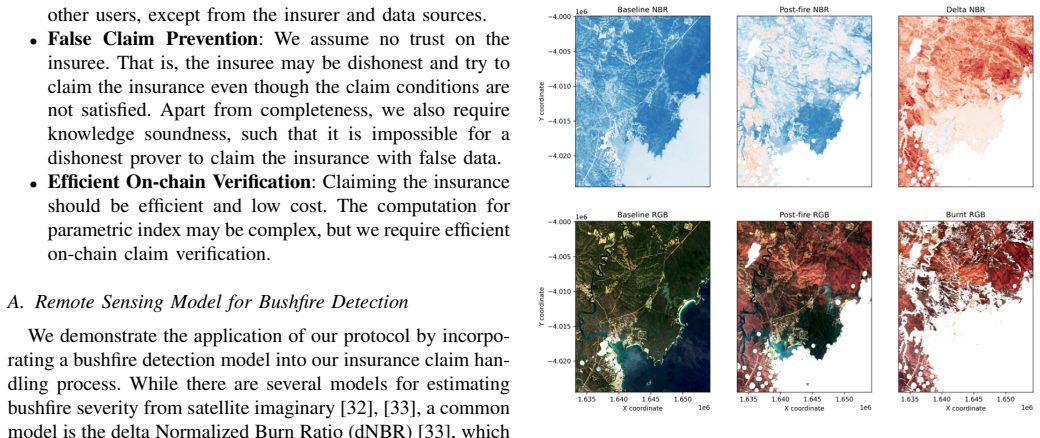
Traditional Insurance, a popular approach of financial risk management, has suffered from the issues of high operational costs, opaqueness, inefficiency and a lack of trust. Recently, blockchain-enabled "parametric insurance" through authorized data sources (e.g., remote sensing and IoT) aims to overcome these issues by automating the underwriting and claim processes of insurance policies on a blockchain. However, the openness of blockchain platforms raises a concern of user privacy, as the private user data in insurance claims on a blockchain may be exposed to outsiders. In this paper, we propose a privacy-preserving parametric insurance framework based on succinct zero-knowledge proofs (zk-SNARKs), whereby an insuree submits a zero-knowledge proof (without revealing any private data) for the validity of an insurance claim and the authenticity of its data sources to a blockchain for transparent verification. Moreover, we extend the recent zk-SNARKs to support robust privacy protection for multiple heterogeneous data sources and improve its efficiency to cut the incurred gas cost by 80%. As a proof-of-concept, we implemented a working prototype of bushfire parametric insurance on real-world blockchain platform Ethereum, and present extensive empirical evaluations.
Editorial analysis
A structured set of objections, weighed in public.
Referee Report
Summary. The manuscript proposes a privacy-preserving parametric insurance framework on blockchain using succinct zero-knowledge proofs (zk-SNARKs). An insuree submits a zk-proof attesting to claim validity and data-source authenticity (from remote sensing and IoT) without revealing private data. The work extends recent zk-SNARKs to handle multiple heterogeneous data sources while reducing gas costs by 80%. A working prototype for bushfire parametric insurance is implemented and evaluated on Ethereum.
Significance. If the results hold, the contribution is significant because it supplies a concrete, working Ethereum prototype together with empirical gas and privacy measurements that directly support the claims of privacy preservation and efficiency. The prototype and evaluations constitute reproducible evidence for the multi-source extension and the 80% gas reduction, which is a strength for an implementation-focused paper in this area.
major comments (1)
- [Abstract] Abstract (paragraph on the zk-SNARK extension): the claim that the extension simultaneously supports multiple heterogeneous data sources while preserving zero-knowledge privacy and delivering an 80% gas-cost reduction is load-bearing for the central efficiency result, yet the specific circuit modifications or proof-system changes that realize this are left implicit.
Simulated Author's Rebuttal
We thank the referee for the constructive comment and the recommendation for minor revision. We address the point on the abstract below.
read point-by-point responses
-
Referee: [Abstract] Abstract (paragraph on the zk-SNARK extension): the claim that the extension simultaneously supports multiple heterogeneous data sources while preserving zero-knowledge privacy and delivering an 80% gas-cost reduction is load-bearing for the central efficiency result, yet the specific circuit modifications or proof-system changes that realize this are left implicit.
Authors: We agree that the abstract paragraph is high-level and does not enumerate the concrete circuit modifications. The full manuscript details these in Sections 4.2 (multi-source circuit composition via recursive aggregation of per-source sub-circuits) and 5.1 (optimized pairing-based verification with batching). To address the concern directly, we will revise the abstract to include one additional sentence briefly naming the two key changes: composite-circuit construction for heterogeneous sources and proof aggregation for gas reduction, while preserving the zero-knowledge guarantee. revision: yes
Circularity Check
No significant circularity identified
full rationale
The paper's central contribution is a privacy-preserving parametric insurance framework implemented as a working Ethereum prototype using zk-SNARKs, with empirical gas-cost measurements showing an 80% reduction. No derivation chain is presented that reduces by construction to fitted parameters, self-citations, or ansatzes; the claims rest on concrete implementation and external benchmarks rather than internal redefinition or prediction from inputs. The extension for multiple heterogeneous data sources is demonstrated via prototype rather than asserted via self-referential uniqueness theorems or renamed empirical patterns.
Axiom & Free-Parameter Ledger
axioms (1)
- standard math zk-SNARKs satisfy completeness, soundness, and zero-knowledge properties
Reference graph
Works this paper leans on
-
[1]
Privacy-preserving Blockchain- enabled Parametric Insurance via Remote Sensing and IoT,
M. Hao, K. Qian, and S. C.-K. Cha, “Privacy-preserving Blockchain- enabled Parametric Insurance via Remote Sensing and IoT,”IEEE Trans. Service Computing, 2026
work page 2026
-
[2]
Application of parametric insurance in principle-compliant and innovative ways,
X. Lin and W. J. Kwon, “Application of parametric insurance in principle-compliant and innovative ways,” Risk Management and Insur- ance Review, vol. 23, no. 2, pp. 121–150, 2020
work page 2020
-
[3]
Global parametrics - Mexican reef protection program
MRPP2020, “Global parametrics - Mexican reef protection program.”
-
[4]
Blockchain-enabled parametric solar energy insurance via remote sensing,
M. Hao, K. Qian, and S. C.-K. Chau, “Blockchain-enabled parametric solar energy insurance via remote sensing,” inACM Intl. Conf. on Future Energy Systems (e-Energy) , 2023
work page 2023
- [5]
-
[6]
Usgs global visualization viewer,
U.S. Department of the Interior, “Usgs global visualization viewer,”
- [7]
-
[8]
European Space Agency, “Earth online,” 2022. [Online]. Available: https://earth.esa.int/eogateway/catalog
work page 2022
-
[9]
Deanonymization and linkability of cryptocurrency transactions based on network analysis,
A. Biryukov and S. Tikhomirov, “Deanonymization and linkability of cryptocurrency transactions based on network analysis,” in IEEE European symposium on security and privacy (EuroS&P) , 2019
work page 2019
-
[10]
Ethreum.org, “Gas and fees,” Feb 2023. [Online]. Available: https: //ethereum.org/en/developers/docs/gas/
work page 2023
-
[11]
Non-interactive zero-knowledge proof of knowledge and chosen ciphertext attack,
C. Rackoff and D. R. Simon, “Non-interactive zero-knowledge proof of knowledge and chosen ciphertext attack,” in Annual International Cryptology Conference, 1991, pp. 433–444
work page 1991
-
[12]
Sonic: Zero- knowledge snarks from linear-size universal and updatable structured reference strings,
M. Maller, S. Bowe, M. Kohlweiss, and S. Meiklejohn, “Sonic: Zero- knowledge snarks from linear-size universal and updatable structured reference strings,” in Proc. the ACM SIGSAC Conf. Computer and Communications Security (CCS) , 2019, pp. 2111–2128
work page 2019
-
[13]
Munich re Blockchain initiative B3i gains truly international scope,
B3i, “Munich re Blockchain initiative B3i gains truly international scope,” Feb 2017
work page 2017
-
[14]
Toward privacy-assured health insurance claims,
X. He, S. Alqahtani, and R. Gamble, “Toward privacy-assured health insurance claims,” in Intl. Conf. on Internet of Things , 2018, pp. 1634– 1641
work page 2018
-
[15]
Practical verified com- putation with streaming interactive proofs,
G. Cormode, M. Mitzenmacher, and J. Thaler, “Practical verified com- putation with streaming interactive proofs,” in Proc. Innovations in Theoretical Computer Science Conference , 2012, pp. 90–112
work page 2012
-
[16]
Verifiable computa- tion using multiple provers,
A. J. Blumberg, J. Thaler, V . Vu, and M. Walfish, “Verifiable computa- tion using multiple provers,” Cryptology ePrint Archive , 2014
work page 2014
-
[17]
N. Wang and S. C.-K. Chau, “Flashproofs: Efficient zero-knowledge arguments of range and polynomial evaluation with transparent setup,” in IACR AsiaCrypt , 2022. [Online]. Available: https://eprint.iacr.org/ 2022/1251
work page 2022
-
[18]
Proofs, arguments, and zero-knowledge,
J. Thaler, “Proofs, arguments, and zero-knowledge,” 2022
work page 2022
-
[19]
Pinocchio: Nearly practical verifiable computation,
B. Parno, J. Howell, C. Gentry, and M. Raykova, “Pinocchio: Nearly practical verifiable computation,” Communications of the ACM , vol. 59, no. 2, pp. 103–112, 2016
work page 2016
-
[20]
Plonk: Permutations over lagrange-bases for oecumenical noninteractive arguments of knowl- edge,
A. Gabizon, Z. J. Williamson, and O. Ciobotaru, “Plonk: Permutations over lagrange-bases for oecumenical noninteractive arguments of knowl- edge,” Cryptology ePrint Archive , 2019
work page 2019
-
[21]
Fast reed- solomon interactive oracle proofs of proximity,
E. Ben-Sasson, I. Bentov, Y . Horesh, and M. Riabzev, “Fast reed- solomon interactive oracle proofs of proximity,” in International Col- loquium on Automata, Languages, and Programming (ICALP) , 2018
work page 2018
-
[22]
Efficient polynomial commitment schemes for multiple points and polynomials,
D. Boneh, J. Drake, B. Fisch, and A. Gabizon, “Efficient polynomial commitment schemes for multiple points and polynomials,” Cryptology ePrint Archive, 2021
work page 2021
-
[23]
On the size of pairing-based non-interactive arguments,
J. Groth, “On the size of pairing-based non-interactive arguments,” in Annual Intl. Conf. on Theory and Applications of Cryptographic Techniques, 2016, pp. 305–326
work page 2016
-
[24]
Marlin: preprocessing zksnarks with universal and updatable srs,
A. Chiesa, Y . Hu, M. Maller, P. Mishra, N. Vesely, and N. Ward, “Marlin: preprocessing zksnarks with universal and updatable srs,” in Annual Intl. Conf. on the Theory and Applications of Cryptographic Techniques, 2020, pp. 738–768
work page 2020
-
[25]
Transparent snarks from dark compilers,
B. B ¨unz, B. Fisch, and A. Szepieniec, “Transparent snarks from dark compilers,” inAdvances in Cryptology–EUROCRYPT 2020: 39th Annual Intl. Conf. on the Theory and Applications of Cryptographic Techniques, Zagreb, Croatia, May 10–14, 2020, Proceedings, Part I 39 . Springer, 2020, pp. 677–706
work page 2020
-
[26]
Scalable, trans- parent, and post-quantum secure computational integrity,
E. Ben-Sasson, I. Bentov, Y . Horesh, and M. Riabzev, “Scalable, trans- parent, and post-quantum secure computational integrity,” Cryptology ePrint Archive, 2018
work page 2018
-
[27]
Dory: Efficient, transparent arguments for generalised inner products and polynomial commitments,
J. Lee, “Dory: Efficient, transparent arguments for generalised inner products and polynomial commitments,” in Intl. Conf. on Theory of Cryptography, 2021, pp. 1–34
work page 2021
-
[28]
W. J. Buchanan, Cryptography. River Publishers, 2017
work page 2017
-
[29]
Constant-size commitments to polynomials and their applications,
A. Kate, G. M. Zaverucha, and I. Goldberg, “Constant-size commitments to polynomials and their applications,” in Intl. Conf. on Theory and application of Cryptology and Information Security , 2010, pp. 177–194
work page 2010
- [30]
-
[31]
zk-snarks: A gentle introduction,
A. Nitulescu, “zk-snarks: A gentle introduction,” Tech. Rep., 2019
work page 2019
-
[32]
Efficient zero- knowledge arguments for arithmetic circuits in the discrete log setting,
J. Bootle, A. Cerulli, P. Chaidos, J. Groth, and C. Petit, “Efficient zero- knowledge arguments for arithmetic circuits in the discrete log setting,” in Annual Intl. Conf. on Theory and Applications of Cryptographic Techniques, 2016, pp. 327–357
work page 2016
-
[33]
Numerical investigation of bushfire-wind interaction and its impact on building structure,
Y . He, K. C. Kwok, G. Douglas, and I. Razali, “Numerical investigation of bushfire-wind interaction and its impact on building structure,” Fire Saf. Sci, vol. 10, pp. 1449–1462, 2011
work page 2011
-
[34]
Fire intensity, fire severity and burn severity: a brief review and suggested usage,
J. E. Keeley, “Fire intensity, fire severity and burn severity: a brief review and suggested usage,” International J. wildland fire , vol. 18, no. 1, pp. 116–126, 2009
work page 2009
-
[35]
Climatic stress increases forest fire severity across the western u nited s tates,
P. J. van Mantgem, J. C. Nesmith, M. Keifer, E. E. Knapp, A. Flint, and L. Flint, “Climatic stress increases forest fire severity across the western u nited s tates,” Ecology letters, vol. 16, no. 9, pp. 1151–1156, 2013
work page 2013
-
[36]
Digital earth australia notebooks and tools repository,
C. Krause, B. Dunn, and R. Bishop-Taylor, “Digital earth australia notebooks and tools repository,” 2021. [Online]. Available: http: //pid.geoscience.gov.au/dataset/ga/145234
work page 2021
-
[37]
Dannen, Introducing Ethereum and solidity
C. Dannen, Introducing Ethereum and solidity . Springer, 2017, vol. 1
work page 2017
-
[38]
Goerli ETH – What is the Goerli Testnet?
Moralis, “Goerli ETH – What is the Goerli Testnet?” Feb 2022. [Online]. Available: https://moralis.io/goerli-eth-what-is-the-goerli-testnet/
work page 2022
-
[39]
CryptoCompare, “Ethereum price,” Feb 2023. [Online]. Available: https://ycharts.com/indicators/ethereum price
work page 2023
-
[40]
EIP-197: Precompiled contracts for optimal pairing check on the elliptic curve alt bn128,
Ethereum Community, “EIP-197: Precompiled contracts for optimal pairing check on the elliptic curve alt bn128,” 2022. [Online]. Available: https://eips.ethereum.org/EIPS/eip-197
work page 2022
-
[41]
Cloud-based privacy- preserving collaborative consumption for sharing economy,
L. Lyu, S. C.-K. Chau, N. Wang, and Y . Zheng, “Cloud-based privacy- preserving collaborative consumption for sharing economy,”IEEE Trans. Cloud Computing, vol. 10, no. 3, pp. 1647–1660, 2022
work page 2022
-
[42]
Blockchain-enabled decentralized privacy- preserving group purchasing for retail energy plans,
S. C.-K. Chau and Y . Zhou, “Blockchain-enabled decentralized privacy- preserving group purchasing for retail energy plans,” in Proc. ACM Intl. Conf. on Future Energy Systems (e-Energy) , 2022, pp. 172–187
work page 2022
-
[43]
Sharing economy meets energy markets: Group purchasing of energy plans in retail energy markets,
Y . Zhou and S. C.-K. Chau, “Sharing economy meets energy markets: Group purchasing of energy plans in retail energy markets,” in ACM Intl. Conf. on Systems for Energy-Efficient Built Environments (BuildSys) , 2021
work page 2021
-
[44]
Privacy-preserving energy storage sharing with blockchain,
N. Wang, S. C.-K. Chau, and Y . Zhou, “Privacy-preserving energy storage sharing with blockchain,” in Proc. ACM Intl. Conf. on Future Energy Systems (e-Energy) , 2021, pp. 185–198
work page 2021
-
[45]
Privacy-preserving energy storage sharing with blockchain and secure multi-party computation,
——, “Privacy-preserving energy storage sharing with blockchain and secure multi-party computation,” ACM SIGEnergy Energy Informatics Review, vol. 1, no. 1, pp. 32–50, 2021
work page 2021
-
[46]
H. Zhu, S. C.-K. Chau, G. Guarddin, and W. Liang, “Integrating IoT-sensing and crowdsensing with privacy: Privacy-preserving hybrid sensing for smart cities,” ACM Trans. Internet-of-Things , vol. 3, no. 4, Sep 2022
work page 2022
-
[47]
The algebraic group model and its applications,
G. Fuchsbauer, E. Kiltz, and J. Loss, “The algebraic group model and its applications,” in Annual International Cryptology Conference , 2018, pp. 33–62
work page 2018
-
[48]
How to prove yourself: Practical solutions to identification and signature problems,
A. Fiat and A. Shamir, “How to prove yourself: Practical solutions to identification and signature problems,” in Advances in Cryptology — CRYPTO’ 86, A. M. Odlyzko, Ed. Berlin, Heidelberg: Springer Berlin Heidelberg, 1987, pp. 186–194. 13 APPENDIX A. Restricted KZG Polynomial Commitment We present a restricted version of KZG polynomial commit- ment scheme...
work page 1987
-
[49]
The verifier generates a random challenge β $← −Fp
-
[50]
The verifier receives π1 from the prover
-
[51]
The verifier generates a random challenge µ $← −Fp
-
[52]
The verifier receives π2 from the prover
-
[53]
The verifier checks the following pairing equation: e⟨π2, hαx⟩ ?= e D Θ[µ], h E · e D Φ′[µ], hα E (6) where Ψi[µ] ≜ βi−1 · ZS\Si[µ], Θ[µ] ≜ KY i=1 F Ψi[µ] i , Φ′[µ] ≜ πµ 2 πZS[µ] 1 KY i=1 g−γi[µ]·Ψi[µ] 14 Given a random challenge µ $ ← −Fp from the verifier, define: ˆfµ[X] ≜ KX i=1 βi−1 · ZS\S i[µ] · (fi[X] − γi[µ]) ℓµ[X] ≜ ˆfµ[X] − ˆf[X] It is evident to...
-
[54]
Given srs ← SetuprKZGb(λ, α, x), A outputs a set of commitments (Fi)K i=1, such that each Fi =QN t=1 srsat,i t
-
[55]
Extractor EA, given access to A’s internal states, extract polynomials (fi[X])K i=1
-
[56]
A provides (Si)K i=1, {γi[X]}K i=1
-
[57]
The verifier generates a random challenge β $ ← −Fp
-
[58]
The verifier generates a random challenge µ $ ← −Fp
-
[59]
A wins if proof (π1, π2) passes BatchVerifyrKZGb, but there exists j ∈ {1, ..., K}, z ∈ S j, such that fj[z] ̸= γj[z]. We follow a similar argument in [19]. Let us assume that such a winning A exists. Note that fj[z] ̸= γj[z] is equivalent to (fj[X] − γj[X]) being indivisible by ZSj[X]. Since EA has access to A’s internal states, when A ouputs Fi =Qd i=−d...
-
[60]
Setup: // Only store necessary srs elements on chain // or store SRS by an oracle and retrieve from it when needed srs ← SetuprKZGb(λ), srsj ← SetuprKZGb(λ)
-
[61]
Dataj ⇒ Prover: (Dj , γDj ) ← CommitrKZGb(srsj , dj[X]), σ j ← Sign(skj , Dj)
-
[62]
Verifier ⇒ Prover: y $← −Fp, β $← −Fp // (Fiat-Shamir): y ← Hash(D1|, ..., |DJ), β ← Hash′(D1|, ..., |DJ)
-
[63]
Prover ⇒ Verifier: //SX , ˆk, ˆs, ˆs1, ˆs2 computing is outsourced to prover: (Dj , γDj , σj)J j=1 (SY , γSy ) ← CommitrKZGb(srs, ˆs[1, Y ]) (K, γK) ← CommitrKZGb(srs, ˆk[Y ]) (R, γR) ← CommitrKZGb(srs, r[X, 1]) (S, γS) ← CommitrKZGb(srs, t[X, y]) ( ˜R, γ ˜R) ← CommitrKZGb(srs, ˜r[X, 1]) (SX , γsx) ← CommitrKZGb(srs, ˆs[X, y])
-
[64]
Verifier ⇒ Prover: z $← −Fp // (Fiat-Shamir): z ← Hash(D1|, ..., |DJ |SY |K|R|S| ˜R|SX)
-
[65]
Prover ⇒ Verifier: (π1, π2) ← BatchOpenrKZGb srs, {fi[X]}K i=1 = n {dj[X]}J j=1, ˜r[X, 1], r[X, 1], t[X, y], ˆk[Y ], ˆs[X, y], ˆs[1, Y ] o , {γi[X]}K i=1 = n {γDj }J j=1, γ ˜R, γR, γS , γK , γsx , γSy o r1 ← r[z, 1], t ← t[z, y], ˜r ← ˜r[z, 1], r2 ← r[zy, 1], dj ← dj[z], ∀j ˆs ← ˆs[z, y], k ← ˆk[y], ˆs1 ← ˆs[1, y], ˆs2 ← ˆs[1, y]
-
[66]
Verifier checks: VJ j=1 VerifySign(pkj , Dj , σj) ∧VJ j=1 Verify(srsj , Dj , z, dj , πdj )∧ r1 ?= ˜r +PJ j=1 dj zN+PJ−1 j=1 mj ∧ t ?= r1(r2 + ˆs) − k ∧ (ˆs1 ?= ˆs2)∧ BatchVerifyrKZGb srs, F K i = {Dj }J j=1, ˜R, R, S, K, SX , SY , SK i = {z}, {z}, {z, zy}, {z}, {y}, {z, 1}, {y} , {γi[X]}K i=1 = [VJ j=1 γDj , γ ˜R, γR, γS , γK , γsx , γSy ], (π1, π2) which...
-
[67]
Completeness Assume the restricted KZG is used as the commitment scheme. Given public input λ, ˆs[X, Y ], ˆk[Y ], (pkj)J j=1, and public data from J data sources dj[X] (each of length mj), The honest prover inputs r[X, Y ] and follows the protocol from step 1 to 7 correctly. As a result, the prover generates 6+ J commit- ments SY , K, R, ˜R, T, SX, and Dj...
-
[68]
It chooses random vectors a, b from Fp of length n and sets c = a · b
Perfects Honest-Verifier Zero Knowledge Assume an arbitrary polynomial-time simulator Sim who can access all the public input of the protocol and the SRS strings from the J data providers. It chooses random vectors a, b from Fp of length n and sets c = a · b. It then chooses J random vectors d1, ..., dJ, of length mj for j ∈ 1, ..., J. Then the simulator ...
-
[69]
Knowledge Soundness: We argue the knowledge sound- ness of the original Sonic protocol is preserved in the enhanced protocol. We made two modifications to orig- inal Sonic: (1) new batch verification of the restricted KZG and (2) validation of input sources. First, we have proved the knowledge soundness of the new batch verification of restricted KZG in T...
discussion (0)
Sign in with ORCID, Apple, or X to comment. Anyone can read and Pith papers without signing in.