FPGA-Based Data Acquisition System for Muon Scattering Tomography
Pith reviewed 2026-05-24 09:14 UTC · model grok-4.3
The pith
A scalable FPGA-based DAQ acquires LVDS signals at 500 MHz to track muons for scattering tomography.
A machine-rendered reading of the paper's core claim, the machinery that carries it, and where it could break.
Core claim
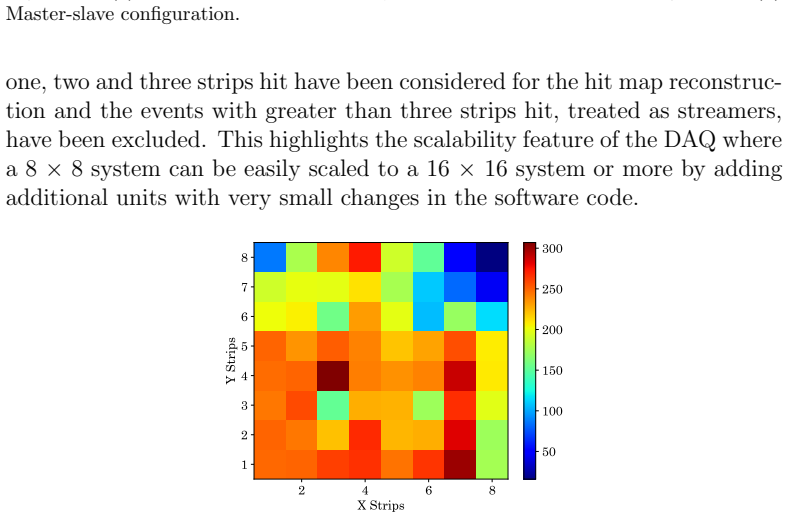
The authors construct and test a DAQ system that directly acquires and processes LVDS signals at 500 MHz sampling frequency with an FPGA backend, demonstrating accurate acquisition of two-dimensional muon event positions from an RPC prototype and positioning the system as an effective solution for large-scale muon tracking in scattering tomography setups.
What carries the argument
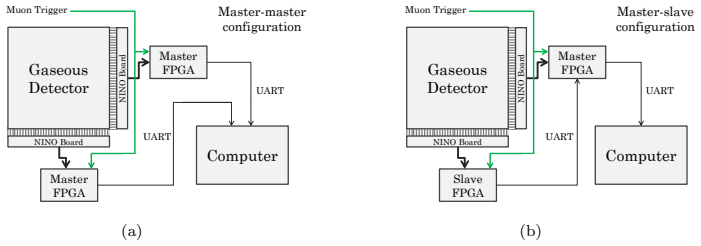
The multi-channel DAQ system built around the NINO ASIC front-end electronics and Altera MAX-10 FPGA back-end for LVDS signal processing and UART data transmission.
If this is right
- Enables non-destructive internal imaging for material identification and civil structure assessment.
- Supports geological surveys and archaeological investigations through muon-based tomography.
- Facilitates industrial inspections with scalable muon tracking hardware.
- Provides a modular platform that can expand to larger detector arrays.
Where Pith is reading between the lines
- The UART transmission step may limit throughput in very high-rate environments, suggesting a need for alternative data links in scaled versions.
- Similar front-end and FPGA architectures could apply to other gaseous detectors requiring fast position readout.
- Cost and power benefits relative to commercial DAQ systems remain unquantified but could be tested in follow-up work.
Load-bearing premise
The event rate, signal amplitude, and noise conditions in the RPC prototype test match those expected in a full multi-plane muon tomography setup.
What would settle it
Performance measurements of position accuracy, maximum event rate, and noise levels in a complete multi-plane detector array under realistic muon flux.
Figures



read the original abstract
Muon scattering tomography is a non-destructive imaging technique that utilizes the penetrating properties and multiple Coulomb scattering of muons to produce detailed internal images of objects. This information is crucial for various applications, including material identification, civil structure investigation, geological surveys, archaeological investigations, and industrial inspections. In this work, we present the development of a multi-channel DAQ for muon tracking in a muon scattering tomography setup. The salient features of the proposed DAQ system include the direct acquisition and processing of LVDS signals, a 500MHz sampling frequency, and scalability. It consists of a front-end electronics stage built around the NINO ASIC, while the back-end electronics are configured with an Intel Altera MAX-10 FPGA development board, which transmits data to storage following the UART protocol. The performance of the DAQ system is tested with an RPC prototype to demonstrate its capability to accurately acquire two-dimensional position information of muon events. The proposed system provides an effective solution for large-scale muon tracking applications in non-destructive evaluation techniques such as muon scattering tomography.
Editorial analysis
A structured set of objections, weighed in public.
Referee Report
Summary. The manuscript describes the design of a multi-channel DAQ system for muon scattering tomography, using a NINO ASIC front-end for LVDS signal processing and an Intel Altera MAX-10 FPGA back-end for 500 MHz sampling and UART data transmission to storage. The system is tested with a single RPC prototype to demonstrate acquisition of 2D muon position information, and the authors conclude that it offers an effective, scalable solution for large-scale muon tracking applications in non-destructive evaluation.
Significance. If the reported hardware functions as described and scales as claimed, the work would provide a practical, relatively low-cost DAQ architecture for RPC-based muon tomography systems. The use of commercial FPGA hardware and direct LVDS handling could reduce development overhead for multi-plane setups. However, the absence of any quantitative performance data in the reported prototype test substantially limits the ability to evaluate whether these benefits are realized.
major comments (2)
- [Abstract / prototype test description] Abstract and results description: the central claim that the DAQ 'provides an effective solution for large-scale muon tracking applications' rests on a single-RPC prototype test that acquires 2D positions, yet no numerical results are supplied for position resolution, detection efficiency, maximum sustainable event rate, UART throughput under load, channel-to-channel crosstalk, or inter-plane timing alignment. These metrics are required to assess whether the NINO+MAX-10 architecture remains viable when channel count and sustained rate increase to the levels needed for a full tomography array.
- [Prototype test description] Prototype validation section: the weakest assumption—that the single-plane test conditions (event rate, signal amplitude, noise environment) are representative of a multi-plane muon scattering tomography setup—is not addressed by any scaling test or simulation, leaving the scalability assertion unsupported.
minor comments (2)
- The manuscript should include a block diagram or timing diagram of the NINO-to-FPGA interface and the UART packet format to clarify data flow.
- Clarify whether the 500 MHz sampling is performed on the FPGA fabric or via an external ADC, and state the effective time resolution achieved.
Simulated Author's Rebuttal
Thank you for the opportunity to respond to the referee's comments. We have carefully considered the points raised regarding the lack of quantitative performance data and the unsupported scalability claims. We agree that these aspects need clarification and have made revisions to the manuscript to address them honestly, including toning down claims and adding discussion. However, some aspects cannot be addressed without additional experimental work.
read point-by-point responses
-
Referee: [Abstract / prototype test description] Abstract and results description: the central claim that the DAQ 'provides an effective solution for large-scale muon tracking applications' rests on a single-RPC prototype test that acquires 2D positions, yet no numerical results are supplied for position resolution, detection efficiency, maximum sustainable event rate, UART throughput under load, channel-to-channel crosstalk, or inter-plane timing alignment. These metrics are required to assess whether the NINO+MAX-10 architecture remains viable when channel count and sustained rate increase to the levels needed for a full tomography array.
Authors: We agree with this assessment. The prototype demonstration was limited to showing that 2D position information could be acquired using the DAQ system on a single RPC. No quantitative metrics were measured or reported because the test setup did not include the necessary calibration or multi-detector configuration for such measurements. In the revised manuscript, we have modified the abstract and conclusion to state that the system 'demonstrates the capability for 2D muon position acquisition and offers a scalable architecture for future large-scale applications' rather than claiming it 'provides an effective solution'. We have also added a paragraph in the discussion section outlining the planned measurements for these metrics in subsequent work. revision: yes
-
Referee: [Prototype test description] Prototype validation section: the weakest assumption—that the single-plane test conditions (event rate, signal amplitude, noise environment) are representative of a multi-plane muon scattering tomography setup—is not addressed by any scaling test or simulation, leaving the scalability assertion unsupported.
Authors: We acknowledge that the single-plane test does not fully validate scalability to multi-plane systems. The design choices, such as 500 MHz sampling and direct LVDS handling, are intended to support higher rates and more channels, but we did not perform dedicated scaling tests or simulations. In the revision, we have expanded the prototype validation section to discuss the assumptions and potential challenges in scaling, including how the FPGA's resources and UART transmission might be affected by increased channel counts. We have removed the unsupported scalability assertion from the abstract. revision: partial
- Specific numerical performance metrics (position resolution, detection efficiency, event rate, UART throughput, crosstalk, timing alignment) from the reported single-RPC prototype
- Results from scaling tests or simulations for multi-plane muon scattering tomography setups
Circularity Check
No circularity: hardware description with no derivations or self-referential predictions
full rationale
The paper describes the design and prototype testing of an FPGA-based DAQ system using NINO ASIC and MAX-10 FPGA for RPC muon tracking. No equations, fitted parameters, predictions, or derivation chains are present in the abstract or described content. The central claim of effectiveness for large-scale applications is an engineering assertion supported by single-prototype tests, not a mathematical result that reduces to its inputs by construction. No self-citations, ansatzes, or uniqueness theorems are invoked. This matches the default case of a self-contained hardware report with no load-bearing circular steps.
Axiom & Free-Parameter Ledger
Reference graph
Works this paper leans on
-
[1]
Pesente et al., First results on material identification and imaging with a large-volume muon tomography prototype, Nuclear Instruments and Methods A 604 (2009) 738
work page 2009
- [2]
-
[3]
D. F. Mahon et al., A prototype scintillating-fibre tracker for the cosmic- ray muon tomography of legacy nuclear waste containers, Nuclear In- struments and Methods A 732 (2013) 408
work page 2013
-
[4]
V. Anghel et al., A plastic scintillator-based muon tomography system with an integrated muon spectrometer, Nuclear Instruments and Meth ods A 798 (2015) 12
work page 2015
- [5]
-
[6]
S. Tripathy, J. Datta, N. Majumdar, S. Mukhopadhyay, Material dis- crimination in cosmic muon imaging using pattern recognition method, Journal of Instrumentation 15 (2020) P06029
work page 2020
-
[7]
V. L. Highland, Some practical remarks on multiple scattering, Nuclear Instruments and Methods in Physics Research 129 (1975) 497
work page 1975
-
[8]
G. R. Lynch, O. I. Dahl, Approximations to multiple coulomb scattering, Nuclear Instruments and Methods in Physics Research B 58 (1991) 6
work page 1991
-
[9]
J. e. a. P. D. G. Beringer, A study of time over threshold (tot) technique for plastic scintillator counter, Physical Review D 86 (2012) 010001
work page 2012
- [10]
-
[11]
L. Shi, Y. Wang, X. Huang, X. Wang, W. Zhu, Y. Li, J. Cheng, A high time and spatial resolution mrpc designed for muon tomography, Nuclear Instruments and Methods in Physics Research A 652 (2011) 16
work page 2011
- [12]
-
[13]
S. Tripathy, J. Datta, N. Majumdar, S. Mukhopadhyay, Numerical eval- uation of a muon tomography system for imaging defects in concrete structures, The European Physical Journal Plus 136:824 (2021). 16
work page 2021
-
[14]
S. Das, S. Tripathy, P. Jagga, P. Bhattacharya, N. Majumdar, S. Mukhopadhyay, Muography for civil inspection, Instruments 6 (2022) 77
work page 2022
-
[15]
S. Das, J. Datta, N. Majumdar, S. Mukhopadhyay, Studies on electrical properties of resistive plate chamber (rpc), Journal of Instrumentation 17 (2022) P09041
work page 2022
-
[16]
S. Tripathy, S. Das, J. Datta, N. Majumdar, S. Mukhopadhyay, Precise tracking of cosmic muons using the time-over-threshold property of nino asics, Journal of Instrumentation 15 (2020) C11013
work page 2020
-
[17]
F. Anghinolfi, P. Jarron, A. Martemiyanov, E. Usenko, H. Wenninger, M. Williams, A. Zichichi, Nino: an ultra-fast and low-power front- end amplifierdiscriminator asic designed for the multigap resistive plate chamber, Nuclear Instruments and Methods in Physics Research A 533 (2004) 183
work page 2004
-
[18]
F. Anghinolfi, P. Jarron, F. Krummenacher, E. Usenko, M. Williams, Nino: An ultrafast low-power front-end amplifier discriminator for the time-of-flight detector in the alice experiment, IEEE Transactions On Nuclear Science 51 (2004) 1974
work page 2004
-
[19]
P. K. Kaur, Pathaleswar, M. Saraf, B. Satyanarayana, R. Shinde, Devel- opment of fast, low power 8-channel amplifier-discriminator board for the rpcs, Springer Proceedings in Physics 203 (2018) 571. 17
work page 2018
discussion (0)
Sign in with ORCID, Apple, or X to comment. Anyone can read and Pith papers without signing in.