The First and Second-Order Asymptotics of Covert Communication over AWGN Channels
Pith reviewed 2026-05-24 09:11 UTC · model grok-4.3
The pith
The maximal throughput for covert communication over AWGN channels scales as sqrt(n delta log e) to first order and with an additional (n delta)^{1/4} term to second order.
A machine-rendered reading of the paper's core claim, the machinery that carries it, and where it could break.
Core claim
The maximal throughput of communication over AWGN channels under a covert constraint given by an upper bound delta on KL divergence is asymptotically sqrt(n delta log e) in the first order and sqrt(2) (n delta)^{1/4} (log e)^{3/4} Q^{-1}(epsilon) in the second order.
What carries the argument
Quasi-epsilon-neighborhood from information geometry, used to select a family of truncated Gaussian distributions with decreasing variances for achievability, together with the optimality of the Gaussian for minimizing KL divergence under a second-moment constraint extended to n dimensions for the converse.
Load-bearing premise
The Gaussian distribution minimizes KL divergence under a second-moment constraint when the optimality proven in one dimension is extended to n dimensions.
What would settle it
A direct computation of the maximal throughput for moderate and increasing n that deviates from the combined sqrt(n) plus n to the 1/4 scaling by more than the o(n^{1/4}) remainder term.
Figures
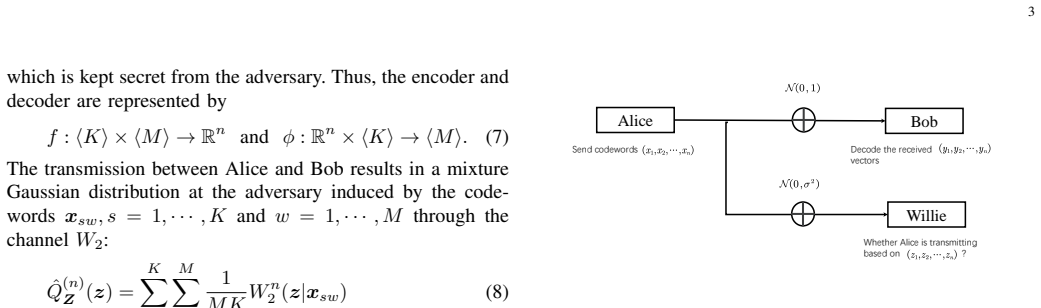


read the original abstract
This paper investigates the asymptotics of the maximal throughput of communication over AWGN channels by $n$ channel uses under a covert constraint in terms of an upper bound $\delta$ of Kullback-Leibler divergence (KL divergence). It is shown that the first and second order asymptotics of the maximal throughput are $\sqrt{n\delta \log e}$ and $(2)^{1/2}(n\delta)^{1/4}(\log e)^{3/4}\cdot Q^{-1}(\epsilon)$, respectively. The technique we use in the achievability is quasi-$\varepsilon$-neighborhood notion from information geometry. For finite blocklength $n$, the generating distributions are chosen to be a family of truncated Gaussian distributions with decreasing variances. The law of decreasing is carefully designed so that it maximizes the throughput at the main channel in the asymptotic sense under the condition that the output distributions satisfy the covert constraint. For the converse, the optimality of Gaussian distribution for minimizing KL divergence under the second order moment constraint is extended from dimension $1$ to dimension $n$. Based on that, we establish an upper bound on the average power of the code to satisfy the covert constraint, which further leads to the direct converse bound in terms of covert metric.
Editorial analysis
A structured set of objections, weighed in public.
Referee Report
Summary. The paper derives the first- and second-order asymptotics of the maximal throughput for covert communication over AWGN channels under a KL-divergence covertness constraint δ. It claims the leading term is √(nδ log e) and the second-order term is √2 (nδ)^{1/4} (log e)^{3/4} Q^{-1}(ε). Achievability employs quasi-ε-neighborhoods from information geometry together with a family of truncated Gaussian input distributions whose variances decrease according to a specific law; the converse extends the one-dimensional Gaussian optimality result for minimizing KL divergence under a second-moment constraint to n dimensions and uses the resulting power bound to obtain the direct converse.
Significance. If the central claims hold, the work supplies a precise second-order characterization of covert throughput on AWGN channels, extending earlier first-order results and providing an explicit construction that achieves the claimed scaling. The information-geometric technique and the carefully tuned truncated-Gaussian family constitute a concrete technical contribution. The converse, however, rests on an extension whose justification is load-bearing for the second-order term.
major comments (1)
- [Converse] Converse (extension of Gaussian optimality): the manuscript invokes an extension of the one-dimensional fact that the Gaussian minimizes D(P_Y || P_Z) subject to a second-moment constraint, asserting that the isotropic Gaussian remains optimal in n dimensions under the total-power constraint E[||X||^2] ≤ V. No explicit argument (convexity of the KL functional, data-processing inequality, or reduction to the product case) is referenced in the abstract or the described technique. If a non-product or anisotropic distribution can achieve strictly smaller KL, the implied upper bound on average code power fails and the second-order converse does not follow. This step is load-bearing for the claimed second-order term.
minor comments (1)
- [Theorem statement] The precise statement of the o(n^{1/4}) remainder term and the range of ε for which the second-order expansion holds should be stated explicitly in the main theorem.
Simulated Author's Rebuttal
We thank the referee for the careful review and for highlighting the need for an explicit justification of the n-dimensional extension in the converse. We address the comment below.
read point-by-point responses
-
Referee: [Converse] Converse (extension of Gaussian optimality): the manuscript invokes an extension of the one-dimensional fact that the Gaussian minimizes D(P_Y || P_Z) subject to a second-moment constraint, asserting that the isotropic Gaussian remains optimal in n dimensions under the total-power constraint E[||X||^2] ≤ V. No explicit argument (convexity of the KL functional, data-processing inequality, or reduction to the product case) is referenced in the abstract or the described technique. If a non-product or anisotropic distribution can achieve strictly smaller KL, the implied upper bound on average code power fails and the second-order converse does not follow. This step is load-bearing for the claimed second-order term.
Authors: We agree that an explicit argument for the extension must be included. The claim holds: under E[||X||^2] = V the distribution minimizing D(P_Y || P_Z) is the isotropic Gaussian. For any fixed covariance K of X with tr(K) = V, D(N(0,I+K) || N(0,I)) = ½(tr(K) − log det(I+K)) is minimized by maximizing log det(I+K). This occurs when the eigenvalues of K are equal (K = (V/n)I) because log(1+λ) is concave, so Jensen’s inequality yields the maximum at equal λ_i. For non-Gaussian P_Y the differential entropy is at most that of the Gaussian with the same covariance, again minimizing the KL. We will insert a self-contained proof of this fact (including the entropy-maximization step) into the revised manuscript. revision: yes
Circularity Check
No significant circularity; derivation self-contained
full rationale
The paper derives the first- and second-order asymptotics using quasi-ε-neighborhood techniques from information geometry for achievability (with truncated Gaussians) and an explicit extension of the 1D Gaussian optimality result to n dimensions for the converse power bound. No step reduces the claimed asymptotics √(nδ log e) or the second-order term to fitted parameters, self-citations, or prior ansatzes by construction. The extension is presented as part of the current proof rather than imported from overlapping prior work, and the overall chain remains independent of the target result.
Axiom & Free-Parameter Ledger
axioms (1)
- domain assumption Gaussian distributions minimize KL divergence to a fixed output distribution under a second-moment constraint (extended from 1D to nD)
Reference graph
Works this paper leans on
-
[1]
The Third-Order Term in the Normal Approximation for the AWGN Channel,
Vincent. Y . F. Tan and M. Tomamichel, “The Third-Order Term in the Normal Approximation for the AWGN Channel,” IEEE Trans. Inf. Theory, V ol. 61, No. 5, pp. 2430 - 2438, May. 2015
work page 2015
-
[2]
Channel Coding Rate in the Finite Blocklength Regime,
Y . Polyanskiy, H. V . Poor and S. Verd´u, “Channel Coding Rate in the Finite Blocklength Regime,” IEEE Trans. Inf. Theory , V ol. 56, No. 5, pp. 2307-2358, Apr. 2010
work page 2010
-
[3]
X. Yu, S. Wei and Y . Luo, “One-shot achievability and converse bounds of Gaussian random coding in AWGN channels under covert constraint,” in Proc. 57th Annu. Allerton Conf. Commun., Control Comput., Monti- cello, IL., USA, Sep. 24-27, 2019
work page 2019
-
[4]
Covert Communication Over Ad- versarially Jammed Channels,
Q. Zhang, M. Bakshi and S. Jaggi, “Covert Communication Over Ad- versarially Jammed Channels,” IEEE Trans. Inf. Theory , V ol. 67, No. 9, pp. 6096 - 6121, Sep. 2021
work page 2021
-
[5]
Covert Best Arm Identification of Stochas- tic Bandits,
M. Chang and M. R. Bloch, “Covert Best Arm Identification of Stochas- tic Bandits,”in Proc. IEEE Int. Symp. on Info. Theory (ISIT),Espoo, Finland, Jun. 2022, pp. 324-329
work page 2022
-
[6]
Covert Communication in the Presence of an Uninformed, Informed, and Coordinated Jammer,
H. ZivariFard, M. R. Bloch and A. Nosratinia, “Covert Communication in the Presence of an Uninformed, Informed, and Coordinated Jammer,” in Proc. IEEE Int. Symp. on Info. Theory (ISIT),Espoo, Finland, Jun. 2022, pp. 306-311
work page 2022
-
[7]
Keyless covert communi- cation via channel state information,
H. ZivariFard, M. R. Bloch and A. Nosratinia,“Keyless covert communi- cation via channel state information,” IEEE Trans. Inf. Theory , V ol. 68, No. 8, pp. 5440 - 5474, Dec 2021
work page 2021
-
[8]
UA V-Relayed Covert Communication Towards a Flying Warden,
X. Chen, M. Shen, N. Zhao, W. Xu and D. Niyato, ,“UA V-Relayed Covert Communication Towards a Flying Warden,”IEEE Transactions on Com- munications, V ol. 69, No. 11, pp. 7659 - 7672, Nov. 2021
work page 2021
-
[9]
Optimal Transmit Power and Flying Location for UA V Covert Wireless Communications,
S, Yan and S. V . Hanly and I. B. Collings, “Optimal Transmit Power and Flying Location for UA V Covert Wireless Communications, ” IEEE Journal on Selected Areas in Communications, V ol. 39, No. 11, pp. 3321 - 3333, Nov. 2021
work page 2021
-
[10]
Throughput Scaling of Covert Communication Over Wireless Adhoc Networks,
K. H. Cho, S. H. Lee and V . Y . F. Tan, “Throughput Scaling of Covert Communication Over Wireless Adhoc Networks,” IEEE Trans. Inf. Theory, V ol. 66, No. 12, pp. 7684 - 7701, Dec. 2020
work page 2020
-
[11]
Bounds for Low probability of Detection for Underwater Acoustic Communication,
R. Diamant, L. Lampe and E. Gamroth, “Bounds for Low probability of Detection for Underwater Acoustic Communication,” IEEE Journal of Oceanic Engineering , V ol. 42, No. 1, pp. 143-155, Jan. 2017
work page 2017
-
[12]
Covert Communication Over Noisy Channels: A Resolv- ability Perspective,
M. R. Bloch, “Covert Communication Over Noisy Channels: A Resolv- ability Perspective,” IEEE Trans. Inf. Theory , V ol. 62, No. 5, pp. 2334- 2354, May 2016
work page 2016
-
[13]
Limits of Reliable Communi- cation with Low Probability of Detection on AWGN Channels,
B. A. Bash, D. Goeckel and D. Towsley, “Limits of Reliable Communi- cation with Low Probability of Detection on AWGN Channels,” IEEE Journal on Selected Areas in Communications , V ol. 31, No. 9, pp. 1921- 1930, Sep. 2013
work page 1921
-
[14]
Fundamental Limits of Commu- nication With Low Probability of Detection ,
L. Wang, G. W. Wornell and L. Zheng, “Fundamental Limits of Commu- nication With Low Probability of Detection ,” IEEE Trans. Inf. Theory , V ol. 62, No. 6, pp. 3493-3503, May 2016
work page 2016
-
[15]
Reliable Deniable Communication: Hiding Messages in Noise,
P. H. Che, M. Bakshi, S. Jaggi, “Reliable Deniable Communication: Hiding Messages in Noise,” IEEE int. Symp. Inf. Theory (ISIT2013), Istanbul, Turkey, pp. 2945-2949, Jul. 2013
work page 2013
-
[16]
Fundamental limits of covert com- munication over MIMO AWGN channel,
A. Abdelaziz and C. E. Koksal,“Fundamental limits of covert com- munication over MIMO AWGN channel,” 2017 IEEE Conference on Communications and Network Security (CNS) , pp. 1-9, Las Vegas, NV , 2017
work page 2017
-
[17]
Achieving Positive Covert Capacity over MIMO AWGN Channels,
A. Bendary, A. Abdelaziz and C. E. Koksal, “Achieving Positive Covert Capacity over MIMO AWGN Channels,” IEEE Journal on Selected Areas in Information Theory , V ol. 2, No. 1, pp. 149 - 162, Mar. 2021
work page 2021
-
[18]
Covert MIMO Communications un- der Variational Distance Constraint,
S. Y . Wang and M. R. Bloch, “Covert MIMO Communications un- der Variational Distance Constraint,” in IEEE int. Symp. Inf. Theory (ISIT2020), Los Angeles, CA, USA, pp. 828-833, 21-26 Jun. 2020
work page 2020
-
[19]
Covert Capacity of Non-Coherent Rayleigh-Fading Channels,
M. Tahmasbi and M. R. Bloch, “Covert Capacity of Non-Coherent Rayleigh-Fading Channels,” IEEE Trans. Inf. Theory , V ol. 66, No. 4, pp. 1979-2005, Apr. 2020
work page 1979
-
[20]
Covert Communication Over the Poisson Channel,
L. Wang, “Covert Communication Over the Poisson Channel,” IEEE Journal on Selected Areas in Information Theory , V ol. 2, No. 1, pp. 23 - 31, Mar. 2021
work page 2021
-
[21]
On Covert Quantum Sensing and the Benefits of Entanglement,
M. Tahmasbi and M. R. Bloch, “On Covert Quantum Sensing and the Benefits of Entanglement,” IEEE Journal on Selected Areas in Information Theory, V ol. 2, No. 1, pp. 352 - 365, Mar. 2021
work page 2021
-
[22]
Second-Order Asymptotics of Covert Communications over Noisy Channels,
M. Tahmasbi and M. R. Bloch, “Second-Order Asymptotics of Covert Communications over Noisy Channels,” in IEEE int. Symp. Inf. Theory (ISIT2016), Barcelona, Spain, pp. 2224-2228, Jul. 2016
work page 2016
-
[23]
First and Second Order Asymptotics in Covert Communications,
M. Tahmasbi and M. R. Bloch, “First and Second Order Asymptotics in Covert Communications,” IEEE Trans. Inf. Theory , V ol. 65, No. 4, pp. 2190-2212, Apr. 2019
work page 2019
-
[24]
Finite Blocklength Analysis of Gaussian Random Coding in AWGN Channels under Covert Constraints,
X. Yu, S. Wei and Y . Luo, “Finite Blocklength Analysis of Gaussian Random Coding in AWGN Channels under Covert Constraints,” IEEE Transactions on Information Forensics & Security . V ol 16, 2021, pp. 1261-1274
work page 2021
-
[25]
S. Amari, “Information geometry,” Jpn. J. Math., V ol. 16 (2021), no. 1, 1–48
work page 2021
-
[26]
Amari, Information geometry and its applications , Applied Mathe- matical Sciences, vol
S. Amari, Information geometry and its applications , Applied Mathe- matical Sciences, vol. 194, Springer, Tokyo, 2016
work page 2016
-
[27]
An Information Geometry of Statistical Manifold Learning,
K. Sun, S. M. Maillet, “ An Information Geometry of Statistical Manifold Learning,” in Proceedings of the 31st International Conference on Machine Learning, PMLR 32(2):1-9, 2014
work page 2014
-
[28]
On universal fea- tures for high-dimensional learning and inference,
S-L. Huang, A. Makur, G. W. Wornell and L. Zheng, “On universal fea- tures for high-dimensional learning and inference,” arXiv preprint arXiv:1911.09105, 2019
-
[29]
E. ˙Lehmann and J. ˙Romano, Testing Statistical Hypotheses, 3rd ed. New York; Springer, 2005
work page 2005
-
[30]
Gaussian Source Coding with Spherical Codes,
J. Hamkins and K. Zeger, “Gaussian Source Coding with Spherical Codes,”IEEE Trans. Inf. Theory , V ol. 48, No. 11, pp. 2980-2989, Nov. 2002
work page 2002
-
[31]
A. N. Shiryaev, Probability, Graduate texts in mathematics Springer series in Soviet mathematics 95, Springer, 1996
work page 1996
-
[32]
Feller, An Introduction to Probability Theory and Its Applications , V ol
W. Feller, An Introduction to Probability Theory and Its Applications , V ol. II, John Wiley & Sons, Inc. New York, 1966
work page 1966
-
[33]
Informational divergence approximations to product distributions,
J. Hou and G. Kramer, “Informational divergence approximations to product distributions,” in Proc. Can. Workshop Inf. Theory , Toronto, ON, Canada, Jun. 2013, pp. 76-81
work page 2013
-
[34]
T. M. Cover and J. A. Thomas, Elements of Information Theory, 2rd ed. John Wiley & Sons, Inc. 2006
work page 2006
-
[35]
L. Pardo, Statistical Inference Based on Divergence Measures , volume 185 of Statistics: Textbooks and Monographs. Chapman & Hall/CRC, Boca Raton, FL, 2006. 23
work page 2006
-
[36]
L. Le Cam and G. L. Yang, Asymptotics in Statistics: Some Basic Con- cepts. Springer Series in Statistics , Springer New York, second edition, 2000
work page 2000
-
[37]
S. Borade and L. Zheng, “Euclidean information theory,” in 2008 IEEE International Zurich Seminar on Communications, 2008
work page 2008
-
[38]
Euclidean information theory of networks,
S. Huang, C. Suh, and L. Zheng, “Euclidean information theory of networks,” IEEE Trans. Inf. Theory , vol. 61, no. 12, pp. 6795–6814, 2015
work page 2015
-
[39]
On Improved Bounds for Probability Metrics and f- Divergence,
I. Sason, “On Improved Bounds for Probability Metrics and f- Divergence,” Center For Communication and Information Technologies Report, #855, Mar. 2014
work page 2014
-
[40]
Approximation Theory of Output Statistics,
T. S. Han and S. Verd ´u, “Approximation Theory of Output Statistics, ”IEEE Trans. Inf. Theory , V ol. 39, pp. 752-772, 1993
work page 1993
-
[41]
M. Hayashi, “General non-asymptotic and asymptotic formulas in chan- nel resolvability and identification capacity and their application to wire- tap channel, ”IEEE Trans. Inf. Theory, V ol. 52, Issue. 4, pp. 1562 - 1575, Apr 2006
work page 2006
discussion (0)
Sign in with ORCID, Apple, or X to comment. Anyone can read and Pith papers without signing in.