pith. sign in

arxiv: 2306.12501 · v6 · submitted 2023-06-21 · 🧮 math.CO · math.QA· math.RT

Rotation-invariant web bases from hourglass plabic graphs

Pith reviewed 2026-05-24 07:36 UTC · model grok-4.3

classification 🧮 math.CO math.QAmath.RT
keywords web basesplabic graphsrotation invarianceU_q(sl_4)six-vertex modelskein relationscrystal basestensor invariants
0
0 comments X

The pith

Hourglass plabic graphs supply the first rotation-invariant basis for the U_q(sl_4) web space.

A machine-rendered reading of the paper's core claim, the machinery that carries it, and where it could break.

The paper introduces hourglass plabic graphs as a new combinatorial model for webs and uses them to construct a basis for the space of U_q(sl_4) tensor invariants that stays fixed under cyclic rotation. A sympathetic reader would care because rotation invariance has long been missing from web bases for this quantum group, even though it would simplify many calculations involving cyclic symmetries. The characterization of which graphs belong to the basis rests on their internal combinatorics together with configurations of a symmetrized six-vertex model. Growth rules derived from crystal theory generate the basis elements starting from tableaux, and skein relations supply an algorithm that rewrites any given web as a combination of basis elements. The same graphs recover and unify all earlier examples of rotation-invariant bases.

Core claim

Hourglass plabic graphs serve as a new avatar of webs whose combinatorics, when paired with symmetrized six-vertex model configurations, exactly select a basis of rotation-invariant U_q(sl_4) webs; these basis elements are generated from tableaux by novel crystal-theoretic growth rules and any web can be reduced to the basis via skein relations.

What carries the argument

Hourglass plabic graphs, which encode webs so that rotation invariance is built into the allowed configurations of the associated symmetrized six-vertex model.

If this is right

  • Any web can be rewritten uniquely in the basis by repeated application of the skein relations.
  • All basis elements arise from standard Young tableaux by the given crystal-theoretic growth rules.
  • Every previously constructed rotation-invariant web basis appears as a special case inside the hourglass framework.
  • The basis supplies a diagrammatic calculus for U_q(sl_4) tensor invariants that is compatible with cyclic rotation.

Where Pith is reading between the lines

These are editorial extensions of the paper, not claims the author makes directly.

  • The same hourglass construction may produce rotation-invariant bases for other rank-two or rank-three quantum groups once the appropriate six-vertex symmetrization is identified.
  • The explicit link to the six-vertex model opens the possibility of transferring integrability techniques from statistical mechanics directly to questions about web spaces.
  • Growth rules based on crystal operators could be adapted to produce bases with other symmetries, such as reflection or dihedral invariance.

Load-bearing premise

The combinatorics of hourglass plabic graphs together with symmetrized six-vertex model configurations correctly pick out precisely the rotation-invariant basis webs.

What would settle it

An explicit web that is invariant under rotation yet lies outside the linear span of the proposed basis elements, or a linear dependence among the proposed basis elements that breaks rotation invariance.

Figures

Figures reproduced from arXiv: 2306.12501 by Christian Gaetz, Jessica Striker, Joshua P. Swanson, Oliver Pechenik, Stephan Pfannerer.

Figure 1
Figure 1. Figure 1: A top fully reduced hourglass plabic graph G and its corresponding 4- row rectangular standard tableau T (G). The purple (■) trip1 -, orange (■) trip2 -, and green (■) trip3 -strands are drawn, showing that tripi (G)(1) = 5, 10, and 13 for i = 1, 2, and 3, respectively. Associated to each tableau T is a lattice word, which can be thought of as a highest weight element in a Kashiwara crystal of words [BS17,… view at source ↗
Figure 2
Figure 2. Figure 2: A benzene move (leftmost) and the square moves for hourglass plabic graphs. The color reversals of these moves are also allowed. When r = 4, we may transform hourglass plabic graphs into directed graphs that we call sym￾metrized six-vertex configurations (see Section 3.3) and we move back and forth between these real￾izations as convenient. These configurations appeared independently in Hagemeyer’s thesis … view at source ↗
Figure 3
Figure 3. Figure 3: Building blocks of CKM-style webs for Uq(slr) corresponding to prod￾ucts, coproducts, duals, etc. Multiplicities are in [r], and multiplicities on the rightmost diagrams are omitted. Upward arrows indicate duals. The middle two diagrams in [PITH_FULL_IMAGE:figures/full_fig_p008_3.png] view at source ↗
Figure 4
Figure 4. Figure 4: Translations between Uq(slr)-webs and CKM-style webs. Since 0-edges in CKM-style webs correspond to the unit object C(q), they are typically unwritten. As noted above, the positions of tags around an internal vertex only affect the sign of the corre￾sponding tensor invariant. More precisely, we have the following. Lemma 2.5. The relations in [PITH_FULL_IMAGE:figures/full_fig_p010_4.png] view at source ↗
Figure 5
Figure 5. Figure 5: Tag sign relations for CKM-style webs and Uq(slr)-webs. 2.2. Polynomial invariants and proper labelings. A Uq(slr)-web W of type c may be considered as a C(q)-multilinear map ^c1 q Vq × · · · × ^cn q Vq → C(q). Write elements in Vc q Vq as P |S|=|c| xSvS for scalars xS with S ∈ Ar. Thus we may interpret the invariant [W]q as a polynomial [W]q ∈ C(q)[xS,i] [PITH_FULL_IMAGE:figures/full_fig_p010_5.png] view at source ↗
Figure 6
Figure 6. Figure 6: The moves for plabic graphs. (R1) −→ [PITH_FULL_IMAGE:figures/full_fig_p013_6.png] view at source ↗
Figure 8
Figure 8. Figure 8: Left, an hourglass plabic graph G, with purple (■) trip1 -, orange (■) trip2 -, and green (■) trip3 -strands drawn, showing that tripi (G)(1) = 5, 10, and 13 for i = 1, 2, and 3, respectively. Right, the corresponding six-vertex configuration, as constructed in Definition 3.22. hourglass plabic graphs of type c. Note that a contracted hourglass plabic graph of oscillating type only contains simple and 2-ho… view at source ↗
Figure 9
Figure 9. Figure 9: The contraction moves for hourglass plabic graphs. The parameter a runs over 0, . . . , r; we have r = 4 except in Section 9. The color reversals of these moves are also allowed. Proposition 3.7. Let G ∼ G′ be move-equivalent hourglass plabic graphs. Then: (a) trip• (G) = trip• (G′ ), and (b) the underlying plabic graphs Gb and Gc′ are move-equivalent. Proof. Part (a) is easily checked by observing that th… view at source ↗
Figure 10
Figure 10. Figure 10: The behavior of trip1 -strands in the symmetrized six-vertex model. As with (hourglass) plabic graphs, we consider an equivalence relation on symmetrized six-vertex configurations generated by moves. These are the Yang–Baxter and ASM moves shown in [PITH_FULL_IMAGE:figures/full_fig_p017_10.png] view at source ↗
Figure 11
Figure 11. Figure 11: The Yang–Baxter move (leftmost) and the ASM moves for sym￾metrized six-vertex configurations. The edge reversals of these ASM moves are also allowed. Theorem 3.25 shows that well-oriented symmetrized six-vertex configurations are in bijection with contracted fully reduced hourglass plabic graphs. The conditions of Definition 3.19 parallel those for full-reducedness. However, Proposition 3.21 gives an effe… view at source ↗
Figure 12
Figure 12. Figure 12: Left: a 3-cycle adjacent to the face F in D and in D′ from the proof of Proposition 3.21. Right: the 3-cycles potentially created by a Yang–Baxter move applied to D [PITH_FULL_IMAGE:figures/full_fig_p018_12.png] view at source ↗
Figure 13
Figure 13. Figure 13: The diagram described in the final paragraph of the proof of Proposition 3.21. The numbers o = (o1, . . . , on) where oi = 1 (resp. oi = −1) if the edge incident to bi is directed inwards (resp. outwards) form the boundary conditions of a symmetrized six-vertex configuration. We write SSV(o) (and WSSV(o)) for the (well-oriented) symmetrized six-vertex configurations with boundary conditions o. We now defi… view at source ↗
Figure 14
Figure 14. Figure 14: Left: the drawing of M˜ for m = (1 6)(2 9)(3 7)(4 11)(5 10)(8 12). Right: the violation of the abc-property discussed in the proof of Proposition 3.26. 3.5. Well-oriented configurations and monotonicity. We now establish a key trip• -theoretic property, called monotonicity, of well-oriented configurations and fully reduced hourglass plabic graphs. Our goal is to show that monotonicity is equivalent to bei… view at source ↗
Figure 15
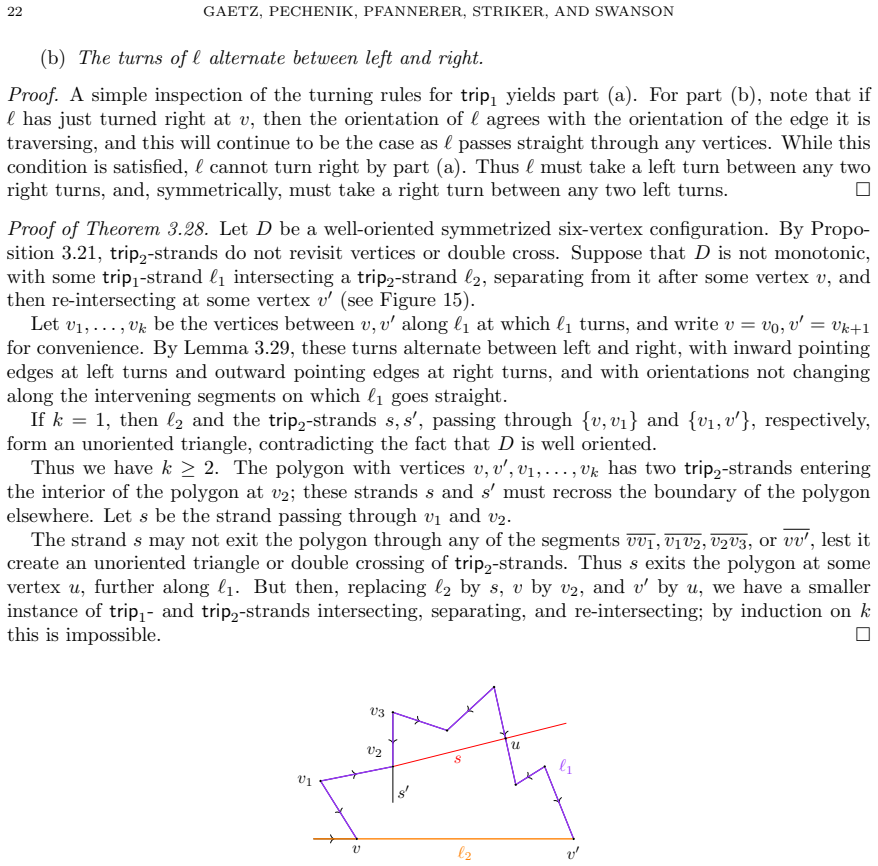
Figure 15. Figure 15: The strands discussed in the proof of Theorem 3.28. Definition 3.30 (cf. Definition 3.27). An hourglass plabic graph G is monotonic if trip2 -strands do not revisit vertices or double cross, and if for every trip1 -strand ℓ1, passing through vertices U1, and every trip2 -strand ℓ2, passing through vertices U2, the vertices in the intersection U1 ∩ U2 are consecutive along both ℓ1 and ℓ2. Note that we coul… view at source ↗
Figure 16
Figure 16. Figure 16: The 4-cycles forbidden in a fully reduced hourglass plabic graph. The trip2 -strands, drawn in orange (■), and trip1 -strands, drawn in purple (■), demon￾strate the failure of monotonicity in each case. 3.6. Move equivalence and trip permutations. We now give some final trip• -theoretic lemmas and the proofs of Proposition 3.12 and Theorem 3.13. Lemma 3.34. Let G ∈ RG(c), let ℓ be a trip1 -strand in G, an… view at source ↗
Figure 17
Figure 17. Figure 17: The possibilities for the local configuration of a pair of crossing trip1 - strands ℓ1 (light purple ■) and ℓ ′ 1 (dark purple ■). In each case a pair ℓ2 (orange ■) and ℓ ′ 2 (yellow ■) of trip2 -strands prevents ℓ1 and ℓ ′ 1 from crossing again, by monotonicity. Lemma 3.36. Let G1, G2 ∈ RG(o), and suppose Gc1 = Gc2 = P and that the symmetrized six-vertex configurations φ(G1) and φ(G2) have the same under… view at source ↗
Figure 18
Figure 18. Figure 18: Consecutive boundary vertices with a common neighbor in a matching diagram M (left) and the three possible corresponding configurations in the plabic graph P (right). See the proof of Lemma 3.36. Proof of Theorem 3.13. Let G1, G2 ∈ RG(c). If G1 ∼ G2, then trip• (G1) = trip• (G2) by Proposi￾tion 3.7(a). Conversely, suppose trip• (G1) = trip• (G2). Since any hourglass plabic graph is move-equivalent to a un… view at source ↗
Figure 6
Figure 6. Figure 6: Consider a sequence of moves transforming [PITH_FULL_IMAGE:figures/full_fig_p025_6.png] view at source ↗
Figure 19
Figure 19. Figure 19: An example visual depiction of a rectangular fluctuating tableau T with n = 7 and c = (2, 1, 2, 1, 2, 2, 1), together with its oscillization. We now define promotion on fluctuating tableaux; see [GPPSS24a, §4.2, §4.4] for detailed ex￾amples and further discussion. We use the visual representation of fluctuating tableaux from Re￾mark 4.2. Definition 4.5. Fix 1 ≤ i ≤ n−1. Let T ∈ FT(c) be a fluctuating tabl… view at source ↗
Figure 20
Figure 20. Figure 20: Let S = osc(T) be as in [PITH_FULL_IMAGE:figures/full_fig_p029_20.png] view at source ↗
Figure 21
Figure 21. Figure 21: The trip1 / trip3 -strands ℓi and trip2 -strands si passing through the simple edges surrounding an hourglass (left) or a simple vertex (right). See the proof of Proposition 4.19. Proposition 4.19. Let G ∈ CRG(c). Then the separation labeling is well defined and proper. Proof. The separation labeling is clearly well defined on simple edges, so it suffices to show that (4.3) does not depend on the choice o… view at source ↗
Figure 21
Figure 21. Figure 21: It is easy to see that F2 and F0 are separated by s2, ℓ2 and that F4 and F0 are separated by s1, ℓ3. Furthermore, exactly one of F2, F4 is separated from F0 by ℓ4. Similarly, exactly one of F1, F3 is separated from F0 by ℓ1. Thus {sep(e1), . . . ,sep(e4)} = {1, 2, 3, 4} and sep is a proper labeling. □ 4.3. From labelings to lattice words. We now show that the separation labeling of a contracted fully redu… view at source ↗
Figure 22
Figure 22. Figure 22: Left: the contours discussed in the proof of Theorem 4.23. Right: the separation labeling of the same graph, where the labels on 2-hourglass edges are omitted for visual clarity. Lemma 4.24. Suppose G ∈ CRG(o) is a backbone (as in the proof of Theorem 4.23). Then w(G) is a lattice word [PITH_FULL_IMAGE:figures/full_fig_p033_22.png] view at source ↗
Figure 23
Figure 23. Figure 23: The contours discussed in the proof of Theorem 4.26. For the corre￾sponding separation labeling, see [PITH_FULL_IMAGE:figures/full_fig_p034_23.png] view at source ↗
Figure 24
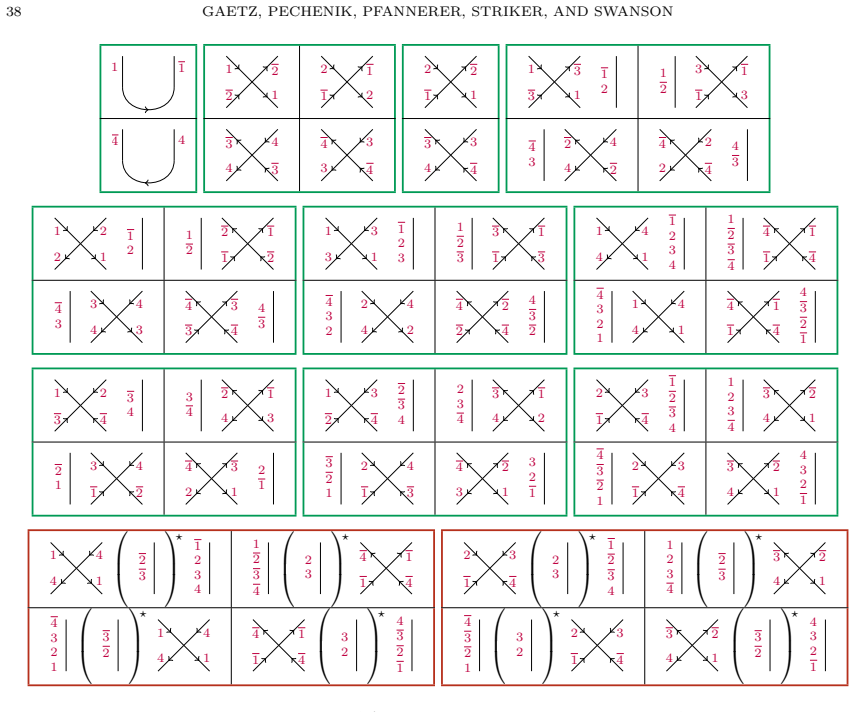
Figure 24. Figure 24: The growth rules of Algorithm 5.1. The 88 short rules of length 2 or 3 are boxed in green (■) and fall into 10 families. Vertical lines with multiple labels indicate that a witness with one of these labels must be present. Two additional families of long rules extend two of the short families and are boxed in red (■). Each of these long rules includes a witness in parentheses with a ⋆ beside it; this mean… view at source ↗
Figure 25
Figure 25. Figure 25: An example of the growth algorithm, Algorithm 5.1. The top diagram illustrates the process of applying the growth rules of [PITH_FULL_IMAGE:figures/full_fig_p039_25.png] view at source ↗
Figure 26
Figure 26. Figure 26: (Left) A problematic realization of the H plumbing used in Lemma 5.22(i). (Right) A problematic realization L of the identity plumbing [PITH_FULL_IMAGE:figures/full_fig_p040_26.png] view at source ↗
Figure 27
Figure 27. Figure 27: On the left is a bijection σs of the plumbing σ• from B′′ to B′ con￾catenated to a bijection πs of the plumbing π• from B′ to B, concatenated to a function gs of the appliance g•. In the middle is an equivalent network, where the two plumbings have been composed. On the right is the result of composing the plumbings with the appliance. called virtual. There are natural notions of the identity plumbing id … view at source ↗
Figure 28
Figure 28. Figure 28: Phases corresponding to v when repeatedly applying the crystal raising algorithm to compute M(uvw). Example 5.15. The promotion-evacuation diagram of w = 1443243421 is below. Letters where a raising or lowering operator has been applied when using the crystal raising algorithm to compute promotion powers have been noted. Locations where ei or fi have been applied correspond to the locations of 1’s in the … view at source ↗
Figure 29
Figure 29. Figure 29: (Left) The result of applying the growth rules in [PITH_FULL_IMAGE:figures/full_fig_p049_29.png] view at source ↗
Figure 30
Figure 30. Figure 30: Some realized and virtual plumbings needed to establish the long growth rules of [PITH_FULL_IMAGE:figures/full_fig_p050_30.png] view at source ↗
Figure 31
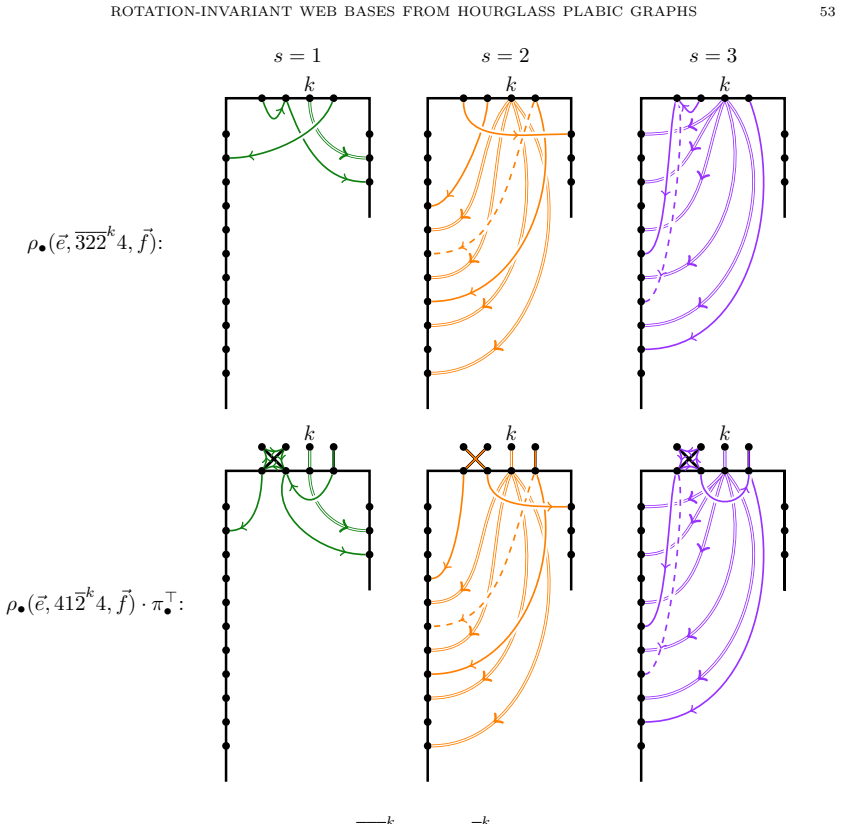
Figure 31. Figure 31: Finite state machines for 322 k 4. Here α + β + γ + δ = k. Theorem 5.25. The growth rules in [PITH_FULL_IMAGE:figures/full_fig_p051_31.png] view at source ↗
Figure 32
Figure 32. Figure 32: Finite state machines for 412 k 4. The x = 3 and x = 1 cases are extremely similar and are omitted. Now suppose x = 4. If w = · · · 3, the above argument again applies, so take w = · · · 2. If w contains no 3, the result is Lemma 5.24(ii). Otherwise, w = · · · 322 k for some k ∈ Z≥0. Now apply the substitutions 14 · · · 322 k 4 → 14 · · · 412 k 4 → 41 · · · 412 k 4 → 41 · · · 322 k 4, where the first and … view at source ↗
Figure 33
Figure 33. Figure 33: Crystal appliances for 322 k 4 and 412 k 4. The plumbing in this case is π• = X −− ++ × idk+1 . Lemma 5.26. At least one of the short growth rules in [PITH_FULL_IMAGE:figures/full_fig_p053_33.png] view at source ↗
Figure 34
Figure 34. Figure 34: Finite state machines for 232 k 4, where we assume α+β+γ+δ = k > 0. Here the superscript (1) on a state means that β > 0. 4434 k−1 3 343 β 4 γ 3 (1) 343 β 4 (1) 242 α 3 β 4 γ 3 (1) 242 α 3 β 4 142 α 3 β 4 γ 3 (1) 142 α 3 β 4 141 δ 2 α 4 e1 β > 0 (γ = 0) e3 e1 β > 0 (γ = 0) α = 0 e2 e3 e2 β > 0 α = 0 β = 1 e3 e3 (γ = 0) e3 β > 1 β 7→ β − 1 γ 7→ γ + 1 e3 β > 1 β 7→ β − 1 γ 7→ γ + 1 e3 β > 1 β 7→ β − 1 γ 7→ … view at source ↗
Figure 35
Figure 35. Figure 35: Finite state machines for 142 k 4, where we assume α+β+γ+δ = k > 0. Here the superscript (1) on a state means that β > 0 [PITH_FULL_IMAGE:figures/full_fig_p054_35.png] view at source ↗
Figure 25
Figure 25. Figure 25: Definition 5.29. A linearized diagram is a symmetrized six-vertex configuration obtained by be￾ginning with a row of directed dangling strands and at each step either (i) combining an adjacent pair of strands in an X, or (ii) combining an adjacent pair in a ∪, with all other strands extended directly down in either case, until there are no more dangling strands. A signed proper labeling ϕ of a linearized … view at source ↗
Figure 36
Figure 36. Figure 36: The additional directed X label configurations allowed in nice labelings [PITH_FULL_IMAGE:figures/full_fig_p055_36.png] view at source ↗
Figure 37
Figure 37. Figure 37: Configurations of oriented triangles in linearized diagrams. Those configurations obtained by reflecting through the vertical axis, reversing arrows, or both are also allowed, as are configurations obtained by shifting X’s while preserving the linearized structure and ∪’s. with these boundary conditions. Hence in order to apply a Yang–Baxter move while staying within the set of linearized diagrams with ni… view at source ↗
Figure 38
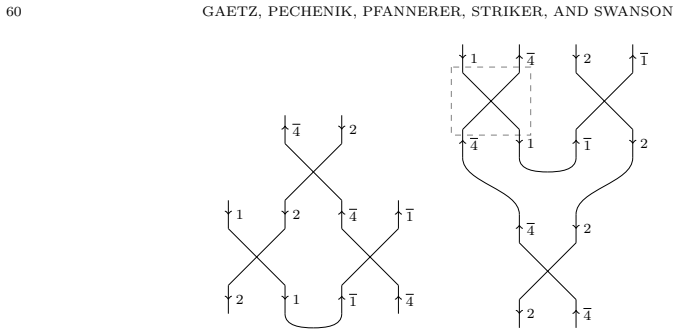
Figure 38. Figure 38: Linearized diagrams of oriented triangles with nice labelings and boundary conditions 1421 → 24. The highlighted X involves the additional nice labeling from [PITH_FULL_IMAGE:figures/full_fig_p060_38.png] view at source ↗
Figure 39
Figure 39. Figure 39: Appending end caps to oriented triangles in linearized diagrams. 5.7. Growth rules and descents. Here, we define descents of fluctuating tableaux and show how they appear in the growth algorithm. Definition 5.41. Let w be a lattice word on Ar. Say osc(w) = w1 · · · wn. The descent set of w is Des(w) = {i ∈ [n − 1] : 0 < wi < wi+1 or wi < wi+1 < 0}. Lemma 5.42. Let G be an hourglass plabic graph obtained b… view at source ↗
Figure 40
Figure 40. Figure 40: The finite state machine, from Lemma 5.49, for describing the part of C(w) reachable from w ∈ 41⟨2, 3⟩4 by applying raising operators [PITH_FULL_IMAGE:figures/full_fig_p063_40.png] view at source ↗
Figure 41
Figure 41. Figure 41: Forbidden configurations in the proof of the claim in Lemma 5.48 illustrating conditions (A) [left] and (B) [right]. We now return to the proof of the lemma. By using the τ, ϖ, ϵ involutions and Lemma 5.13, it suffices to check the conditions in the claim for growth rules such that π• is of the form in (A) or (B). Note that under the conditions of the claim, G′ is monotonic. The conditions (A) or (B) may … view at source ↗
Figure 42
Figure 42. Figure 42: The uncrossing relations for invariants of Uq(sl4)-tensor diagrams. Let [k]q := (q k − q −k )/(q − q −1 ). Algorithm 7.1 (Reduction algorithm). Let X be any Uq(sl4)-tensor diagram. (1) Apply uncrossing relations ( [PITH_FULL_IMAGE:figures/full_fig_p070_42.png] view at source ↗
Figure 43
Figure 43. Figure 43: Relations decomposing the forbidden 4-cycles of Uq(sl4)-webs. Here, [k]q := (q k − q −k )/(q − q −1 ). Tags are drawn in red (■) for clarity. = [4]q = [4]q[3]q [2]q [PITH_FULL_IMAGE:figures/full_fig_p071_43.png] view at source ↗
Figure 44
Figure 44. Figure 44: The loop deletion relations for Uq(sl4)-webs. Theorem 7.2. For X a tensor diagram of type c, Algorithm 7.1 expresses [X]q in the basis B c q [PITH_FULL_IMAGE:figures/full_fig_p071_44.png] view at source ↗
Figure 45
Figure 45. Figure 45: The benzene relation on invariants of Uq(sl4)-webs. Proof. If X is a tensor diagram, then the uncrossing relations unambiguously express [X]q as a combination of web invariants. By Definition 3.9, each web that is not fully reduced is modified by one of the Steps (2–4). If a web is modified only by a benzene move in Step (4), then it will also be modified by Step (2) on the subsequent iteration. Since the… view at source ↗
Figure 46
Figure 46. Figure 46: The 7 elements of ASM3 together with the corresponding symmetrized six-vertex configurations in the move-equivalence class of φ(G(T)). Here T is the standard tableau with lattice word L = 111222333444. ASM moves going up (resp. down) in the poset are marked with • (resp. ×). 8.3. Plane partitions and benzene moves. The set PP(a×b×c) of plane partitions in the a×b×c box consists of the a×b matrices of nonn… view at source ↗
Figure 47
Figure 47. Figure 47: The large hexagon associated to PP(3 × 2 × 4) as in Proposition 8.3. A sample hourglass plabic graph in the move-equivalence class of G(T) has been drawn, together with the dual plane partition and the trip strands from a boundary vertex. Here T is the oscillating tableau with lattice word L = 111442221222441111, which corresponds to the separation labels of each boundary edge, as shown [PITH_FULL_IMAGE:… view at source ↗
Figure 48
Figure 48. Figure 48: The 5 elements in the first three ranks of PP(2 × 2 × 2) drawn as rhombus tilings, together with the corresponding hourglass plabic graphs in the move-equivalence class of G(T). Here T is the oscillating tableau with lattice word L = 114422224411. 9. Hourglass plabic graphs recover known web bases In this section, we discuss how all known rotation-invariant web bases fit within our framework of hourglass … view at source ↗
Figure 49
Figure 49. Figure 49: The SL9-web from [Fra23, [PITH_FULL_IMAGE:figures/full_fig_p078_49.png] view at source ↗
read the original abstract

Webs give a diagrammatic calculus for spaces of tensor invariants. We introduce hourglass plabic graphs as a new avatar of webs, and use these to give the first rotation-invariant $U_q(\mathfrak{sl}_4)$-web basis, a long-sought object. The characterization of our basis webs relies on the combinatorics of these new plabic graphs and associated configurations of a symmetrized six-vertex model. We give growth rules, based on a novel crystal-theoretic technique, for generating our basis webs from tableaux and we use skein relations to give an algorithm for expressing arbitrary webs in the basis. We also discuss how previously known rotation-invariant web bases can be unified in our framework of hourglass plabic graphs.

Editorial analysis

A structured set of objections, weighed in public.

Desk editor's note, referee report, simulated authors' rebuttal, and a circularity audit. Tearing a paper down is the easy half of reading it; the pith above is the substance, this is the friction.

Referee Report

0 major / 2 minor

Summary. The manuscript introduces hourglass plabic graphs as a new combinatorial avatar of webs and claims to construct the first rotation-invariant U_q(sl_4)-web basis via these graphs together with symmetrized six-vertex model configurations. It further asserts growth rules derived from a crystal-theoretic technique to generate the basis webs from tableaux, a skein-relation algorithm to express arbitrary webs in the basis, and a unification of previously known rotation-invariant web bases within the same framework.

Significance. If the central construction is correct and the claimed basis is indeed rotation-invariant and spans the space of invariants, the result would be a notable contribution to the theory of web bases and diagrammatic calculus for tensor invariants of quantum groups. The unification of earlier bases and the provision of explicit generation and reduction algorithms could streamline computations in representation theory and combinatorics.

minor comments (2)
  1. The abstract refers to 'hourglass plabic graphs' and 'symmetrized six-vertex model configurations' without defining these objects or indicating how they differ from standard plabic graphs; a brief clarifying sentence would help readers assess novelty.
  2. The claim of providing 'the first' rotation-invariant basis is stated without reference to the specific prior attempts that fell short; adding one or two citations in the abstract would strengthen the positioning.

Simulated Author's Rebuttal

0 responses · 0 unresolved

We thank the referee for their summary of our manuscript on hourglass plabic graphs and the construction of a rotation-invariant U_q(sl_4)-web basis. The report notes the potential significance if the claims hold but gives an 'uncertain' recommendation with no specific major comments listed. Only the abstract appears to have been available for review, which may account for this. We are prepared to supply the full manuscript and respond to any detailed questions.

Circularity Check

0 steps flagged

No significant circularity identified

full rationale

Only the abstract is available, which introduces hourglass plabic graphs as a new construction for a rotation-invariant web basis and describes growth rules and skein relations without any equations, fitted parameters, or self-citations that could be inspected for reduction to inputs by construction. No load-bearing steps matching the enumerated circularity patterns are present or verifiable in the provided text, so the derivation cannot be shown to collapse into self-definition or prior results from the same authors.

Axiom & Free-Parameter Ledger

0 free parameters · 1 axioms · 1 invented entities

Abstract-only review; ledger is necessarily incomplete. The main addition is the newly defined hourglass plabic graphs.

axioms (1)
  • domain assumption Standard combinatorial properties of plabic graphs and webs from prior literature on tensor invariants
    Invoked implicitly when treating webs as avatars of invariants.
invented entities (1)
  • hourglass plabic graphs no independent evidence
    purpose: New combinatorial avatar of webs that enforces rotation invariance
    Explicitly introduced as a new object in the abstract.

pith-pipeline@v0.9.0 · 5635 in / 1163 out tokens · 35968 ms · 2026-05-24T07:36:55.288591+00:00 · methodology

discussion (0)

Sign in with ORCID, Apple, or X to comment. Anyone can read and Pith papers without signing in.

Forward citations

Cited by 1 Pith paper

Reviewed papers in the Pith corpus that reference this work. Sorted by Pith novelty score.

  1. Monomial web basis for the SL(N) skein algebra of the twice punctured sphere

    math.GT 2024-07 unverdicted novelty 5.0

    SL(n) skein algebra of the twice punctured sphere is a commutative polynomial algebra in n-1 explicit crossing-free web generators for generic q.

Reference graph

Works this paper leans on

12 extracted references · 12 canonical work pages · cited by 1 Pith paper · 2 internal anchors

  1. [1]

    Andrews, MacMahon’s conjecture on symmetric plane partitions, Proc

    [And77] George E. Andrews, MacMahon’s conjecture on symmetric plane partitions, Proc. Nat. Acad. Sci. U.S.A. 74 (1977), no. 2, 426–429. [And79] George E. Andrews, Plane partitions. III. The weak Macdonald conjecture , Invent. Math. 53 (1979), no. 3, 193–225. [Bax89] Rodney J. Baxter, Exactly solved models in statistical mechanics , Academic Press, Inc. [H...

  2. [2]

    [BDG+22] V´ eronique Bazier-Matte, Guillaume Douville, Alexander Garver, Rebecca Patrias, Hugh Thomas, and Emine Yıldırım, Leading terms of SL3 web invariants, Int. Math. Res. Not. IMRN (2022), no. 3, 1714–

  3. [3]

    [BZ08] Arkady Berenstein and Sebastian Zwicknagl, Braided symmetric and exterior algebras , Trans. Amer. Math. Soc. 360 (2008), no. 7, 3429–3472. [CIM98] E. B. Curtis, D. Ingerman, and J. A. Morrow, Circular planar graphs and resistor networks , Linear Algebra Appl. 283 (1998), no. 1-3, 115–150. [CKM14] Sabin Cautis, Joel Kamnitzer, and Scott Morrison, We...

  4. [4]

    (N.S.) 28 (2022), no

    [HR22] Sam Hopkins and Martin Rubey, Promotion of Kreweras words, Selecta Math. (N.S.) 28 (2022), no. 1, Paper No. 10, 38 pages. [IZ22] Mee Seong Im and Jieru Zhu, Transitioning between tableaux and spider bases for Specht modules , Algebr. Represent. Theory 25 (2022), no. 2, 387–399. [Jon85] Vaughan F. R. Jones, A polynomial invariant for knots via von N...

  5. [5]

    a dimer? , Notices Amer

    [KO05] Richard Kenyon and Andrei Okounkov, What is . . . a dimer? , Notices Amer. Math. Soc. 52 (2005), no. 3, 342–343. [KR84] Joseph P. S. Kung and Gian-Carlo Rota, The invariant theory of binary forms , Bull. Amer. Math. Soc. (N.S.) 10 (1984), no. 1, 27–85. [Kup96a] Greg Kuperberg, Another proof of the alternating-sign matrix conjecture , Internat. Math...

  6. [6]

    Lusztig, Canonical bases arising from quantized enveloping algebras , J

    [Lus90] G. Lusztig, Canonical bases arising from quantized enveloping algebras , J. Amer. Math. Soc. 3 (1990), no. 2, 447–498. [Lus92] G. Lusztig, Affine quivers and canonical bases , Inst. Hautes ´Etudes Sci. Publ. Math. (1992), no. 76, 111–163. [Lus93] George Lusztig, Introduction to quantum groups, Progress in Mathematics, vol. 110, Birkh¨ auser Boston...

  7. [7]

    Lusztig, Semicanonical bases arising from enveloping algebras , Adv

    [Lus00] G. Lusztig, Semicanonical bases arising from enveloping algebras , Adv. Math. 151 (2000), no. 2, 129–

  8. [8]

    Total positivity, Grassmannians, and networks

    [MN08] Scott Morrison and Ari Nieh, On Khovanov’s cobordism theory for su3 knot homology, J. Knot Theory Ramifications 17 (2008), no. 9, 1121–1173. 82 GAETZ, PECHENIK, PF ANNERER, STRIKER, AND SW ANSON [Mor07] Scott Edward Morrison, A diagrammatic category for the representation theory of Uq(sln), ProQuest LLC, Ann Arbor, MI, 2007, Thesis (Ph.D.)–Universi...

  9. [9]

    Vol. IV. Invited lectures, World Sci. Publ., Hackensack, NJ, 2018, pp. 3181–3211. [Pou25] Anup Poudel, A comparison between SLn spider categories, Canad. J. Math. (to appear) (2025), 25 pages, arXiv:2210.09289. [PP20] Rebecca Patrias and Oliver Pechenik, Dynamics of plane partitions: proof of the Cameron–Fon-Der- Flaass conjecture, Forum Math. Sigma 8 (20...

  10. [10]

    percolation

    [Sik05] Adam S. Sikora, Skein theory for SU(n)-quantum invariants, Algebr. Geom. Topol. 5 (2005), 865–897. [Spr74] T. A. Springer, Regular elements of finite reflection groups , Invent. Math. 25 (1974), 159–198. [Sta99] Richard P. Stanley, Enumerative combinatorics. Vol. 2 , Cambridge Studies in Advanced Mathematics, vol. 62, Cambridge University Press, C...

  11. [11]

    Algebraic Combin

    [Tym12] Julianna Tymoczko, A simple bijection between standard 3 × n tableaux and irreducible webs for sl3, J. Algebraic Combin. 35 (2012), no. 4, 611–632. [Wei21] Anna Weigandt, Bumpless pipe dreams and alternating sign matrices , J. Combin. Theory Ser. A 182 (2021), Paper No. 105470, 52 pages. [Wes12] Bruce W. Westbury, Web bases for the general linear ...

  12. [12]

    [Wie00] Benjamin Wieland, A large dihedral symmetry of the set of alternating sign matrices , Electron. J. Combin. 7 (2000), Research Paper 37, 13 pages. [Zei96] Doron Zeilberger, Proof of the alternating sign matrix conjecture , Electron. J. Combin. 3 (1996), no. 2, Research Paper 13, 84 pages, the Foata Festschrift. [Zhu17] Xinwen Zhu, An introduction t...