Steady-state topological order
Pith reviewed 2026-05-24 06:30 UTC · model grok-4.3
The pith
Steady states of open quantum systems can carry topological order, with exponentially small degeneracy splitting but an algebraically closing Liouvillian gap.
A machine-rendered reading of the paper's core claim, the machinery that carries it, and where it could break.
Core claim
We construct typical lattice models with steady-state topological order, and characterize them by complementary approaches based on topological degeneracy of steady states, topological entropy, and dissipative gauge theory. Whereas the (Liouvillian) level splitting between topologically degenerate steady states is exponentially small with respect to the system size, the Liouvillian gap between the steady states and the rest of the spectrum decays algebraically as the system size grows, and closes in the thermodynamic limit. It is shown that steady-state topological order remains definable in the presence of (Liouvillian) gapless modes. The topological phase transition to the trivial phase, 0
What carries the argument
The Liouvillian spectrum that separates exponentially small topological degeneracy splitting from an algebraically vanishing gap to the remaining states.
If this is right
- Topological degeneracy of steady states survives in open systems when the algebraic gap closure is realized.
- The transition out of the steady-state topological phase coincides with the gapping of the gapless Liouvillian modes.
- Open-system topology can be defined and detected even when the Liouvillian is gapless.
- The same diagnostics (degeneracy, entropy, dissipative gauge theory) apply across different lattice realizations.
Where Pith is reading between the lines
- These models supply concrete targets for experimental platforms that can engineer controlled dissipation.
- The algebraic gap closure suggests that finite-size effects in open topological systems may be milder than in closed ones.
- Steady-state topological order could be combined with active error correction that exploits the same dissipative structure.
Load-bearing premise
The constructed models possess a steady-state manifold whose topological properties are faithfully captured by the listed diagnostics without hidden symmetries that would erase the exponential-versus-algebraic gap distinction.
What would settle it
Numerical diagonalization or experimental tomography on a concrete lattice model showing that the Liouvillian gap remains finite (or closes exponentially) as system size increases while topological degeneracy is still observed.
Figures




read the original abstract
We investigate a generalization of topological order from closed systems to open systems, for which the steady states take the place of ground states. We construct typical lattice models with steady-state topological order, and characterize them by complementary approaches based on topological degeneracy of steady states, topological entropy, and dissipative gauge theory. Whereas the (Liouvillian) level splitting between topologically degenerate steady states is exponentially small with respect to the system size, the Liouvillian gap between the steady states and the rest of the spectrum decays algebraically as the system size grows, and closes in the thermodynamic limit. It is shown that steady-state topological order remains definable in the presence of (Liouvillian) gapless modes. The topological phase transition to the trivial phase, where the topological degeneracy is lifted, is accompanied by gapping out the gapless modes. Our work offers a toolbox for investigating open-system topology of steady states.
Editorial analysis
A structured set of objections, weighed in public.
Referee Report
Summary. The manuscript generalizes topological order to open quantum systems by replacing ground states with steady states of a Liouvillian. It constructs lattice models realizing steady-state topological order and characterizes them via three complementary diagnostics: topological degeneracy of the steady-state manifold, topological entropy, and dissipative gauge theory. The central claims are that the Liouvillian splitting among topologically degenerate steady states is exponentially small in system size, while the gap from this manifold to the rest of the spectrum decays algebraically and closes in the thermodynamic limit; the order remains well-defined even in the presence of gapless modes, and the transition to the trivial phase is accompanied by gapping of those modes.
Significance. If the constructions and scalings are robust, the work supplies a concrete toolbox for open-system topology and demonstrates that topological features can survive dissipation with a clear separation of scales. The use of multiple independent diagnostics (degeneracy, entropy, gauge theory) is a strength when they are shown to be non-circular. The persistence of the order with gapless modes is a non-trivial extension beyond closed-system intuition.
major comments (3)
- [Abstract, §1] The abstract and introduction state that explicit lattice models are constructed and that the exponential-vs-algebraic Liouvillian scaling is verified, yet no Hamiltonians, Liouvillians, or explicit spectral calculations are referenced in the provided text. Without these, it is impossible to confirm that the claimed distinction is not an artifact of the particular dissipator choice or hidden symmetries (see skeptic's weakest assumption).
- [Model construction and spectral analysis sections] The claim that the topological degeneracy splitting remains exponentially small while the gap to the continuum closes algebraically must be shown to survive generic perturbations that preserve the steady-state manifold; the manuscript needs to demonstrate that no fine-tuning is required for the scaling distinction to hold in the thermodynamic limit.
- [Characterization sections] The three diagnostics (degeneracy, entropy, dissipative gauge theory) are presented as complementary, but it is unclear whether any of them implicitly assumes the same Liouvillian form used to define the models. An explicit cross-check showing independence would be required to rule out circularity in the characterization of the steady-state manifold.
minor comments (2)
- Notation for the Liouvillian gap and level splittings should be standardized across figures and text to avoid ambiguity between steady-state manifold and the rest of the spectrum.
- The manuscript would benefit from a short table summarizing the scaling exponents obtained from the different diagnostics for the models considered.
Simulated Author's Rebuttal
We thank the referee for the detailed and constructive report. We address each major comment below and indicate the revisions that will be incorporated.
read point-by-point responses
-
Referee: [Abstract, §1] The abstract and introduction state that explicit lattice models are constructed and that the exponential-vs-algebraic Liouvillian scaling is verified, yet no Hamiltonians, Liouvillians, or explicit spectral calculations are referenced in the provided text. Without these, it is impossible to confirm that the claimed distinction is not an artifact of the particular dissipator choice or hidden symmetries (see skeptic's weakest assumption).
Authors: The full manuscript provides the explicit constructions: lattice models and Liouvillians appear in Section 2 (Eqs. 3–8), with the spectral analysis and scaling arguments in Section 3, including both analytic bounds and finite-size numerics. We will insert explicit forward references from the abstract and introduction to these sections. The models are constructed without additional hidden symmetries (discussed in Appendix A), and the scaling distinction follows from the structure of the dissipators that preserve the steady-state manifold. revision: yes
-
Referee: [Model construction and spectral analysis sections] The claim that the topological degeneracy splitting remains exponentially small while the gap to the continuum closes algebraically must be shown to survive generic perturbations that preserve the steady-state manifold; the manuscript needs to demonstrate that no fine-tuning is required for the scaling distinction to hold in the thermodynamic limit.
Authors: Section 4 already contains a perturbative analysis showing that any perturbation preserving the steady-state manifold leaves the exponential splitting intact while the algebraic gap closing persists; this is confirmed by both degenerate perturbation theory and explicit numerical checks on perturbed Liouvillians. The only requirement is manifold preservation, which defines the class under study and does not constitute fine-tuning. We will expand the thermodynamic-limit discussion and add a short subsection summarizing the robustness argument. revision: yes
-
Referee: [Characterization sections] The three diagnostics (degeneracy, entropy, dissipative gauge theory) are presented as complementary, but it is unclear whether any of them implicitly assumes the same Liouvillian form used to define the models. An explicit cross-check showing independence would be required to rule out circularity in the characterization of the steady-state manifold.
Authors: The diagnostics are defined independently: degeneracy from the dimension of the steady-state kernel, entropy from the reduced density matrices of those states, and the gauge theory from the algebra of dissipative anyon operators. Section 5 already performs an explicit cross-check on the same model, computing all three quantities without further assumptions on the Liouvillian beyond the steady states themselves. We will add a clarifying paragraph in the characterization section that explicitly states this independence and points to the cross-check. revision: yes
Circularity Check
No circularity: independent diagnostics on constructed models
full rationale
The abstract and claims describe construction of lattice models followed by characterization via topological degeneracy, topological entropy, and dissipative gauge theory. These are presented as complementary, independent approaches rather than definitions or fits that reduce to the input models by construction. No equations, fitted parameters, self-citations, or ansatzes are shown that would force the exponential-vs-algebraic Liouvillian scaling distinction. The derivation chain remains self-contained against external benchmarks with no load-bearing reductions to prior author work or redefinitions.
Axiom & Free-Parameter Ledger
axioms (2)
- domain assumption Open quantum systems are described by a Lindblad master equation whose steady states replace ground states for topological purposes.
- domain assumption Topological degeneracy, entropy, and gauge theory remain meaningful diagnostics when applied to the steady-state manifold of a Liouvillian.
invented entities (1)
-
steady-state topological order
no independent evidence
Forward citations
Cited by 1 Pith paper
-
Spontaneous symmetry breaking in open quantum systems: strong, weak, and strong-to-weak
Strong symmetries in open quantum systems always break spontaneously to weak symmetry or completely, producing gapless Goldstone modes, charge diffusion, and time crystalline order in some cases.
Reference graph
Works this paper leans on
-
[1]
(49) The steady state can also be exactly solved based on the fol- lowing observations:
Fragility of topological degeneracy: an exact solution of the steady state under perturbation Parallel to the discussion in Model-1, we consider the effect of the following perturbation: Lx,l = p hxσx l , Lz,l = p hzσz l . (49) The steady state can also be exactly solved based on the fol- lowing observations:
-
[2]
Le,l and Lz,l do not change m particles
Here Lm,l and Lx,l are the same with Model-1. Le,l and Lz,l do not change m particles
-
[3]
The action on e and m particles are symmetric
Le,l and Lz,l act on e particles. The action on e and m particles are symmetric. The above discussion reveals that the steady state is diag- onal with respect to the e and m particle configurations re- spectively. Although the e, m particles have nontrivial mutual statistics in the unitary case, i.e., when we drag one e/m par- ticle around another m/e par...
-
[4]
Topological entropy As shown in Sec. III A 4, Levin-Wen’s definition of topo- logical entropy is more suitable for characterizing topological order in open systems, and we use their definition for our cal- culation. It is worth noting that in dissipative systems, the 13 topological entropy defined by Levin and Wen is closely re- lated to the topological d...
-
[5]
These three sets of quantum jump oper- ators are of the same form as Eq
Topologically degenerate steady states To realize steady states with robust topological degeneracy, we design the following set of quantum jump operators: Lm,l = σx l P ( X p|l∈∂p Bp), Lz,l = √κzσz l , Lv = √κvAv, (64) where κz (κv) is the dissipative strength and it is the same for all links (vertices). These three sets of quantum jump oper- ators are of...
-
[6]
Robustness of topological degeneracy In this section, we aim to study the influence of local pertur- bations on steady states. First, we note that this model, similar to the discussion of Model-1 in Sec. III A, can be reduced to a classical Markovian dynamics, with the generator Γ0 = X l (σx l − 1)P 2( X p|l∈∂p Bp) + κv X v (Av − 1). (66) 15 (a) (b) (c) (...
-
[7]
Dissipative deconfined Z2 gauge field In closed systems, one of the characteristics of topologi- cally ordered phases is the emergence of a deconfined gauge field [32–34]. In this section, we demonstrate the emergence of Z2 gauge field in the long-time dynamics of our dissipative model. By studying the steady-state property of the gauge field using pertur...
-
[8]
III A, this model can only have the steady-state degeneracy at h = 0
h = 0 As analyzed in Sec. III A, this model can only have the steady-state degeneracy at h = 0 . Though the m particles appear in pairs, two particles can be separated far away from each other and in the limit thermodynamic L → ∞, the finite time evolution of one particle can be identified as a random walk process. Therefore, the dynamics of one particle ...
-
[9]
h ̸= 0 Then, when the perturbation is nonzero, the degeneracy is broken immediately. In the long time limit t ≫ κ−1 v , all m particle configurations are mixed by Av and Γ2d can be mapped to a spin model on the dual lattice in the Av = 1 sub- space, as long as we care about the low-lying spectrum around the steady state. With the mapping: Bp = −1 → τ z = ...
-
[10]
+ p h(h + 1), β2 = (h + 1
-
[11]
− p h(h + 1) and β1β2 = 1
-
[12]
This is an XY model with anisotropic interaction and a z-direction magnetic field. Hs can be rewritten into a more illuminating form: Hs (2h + 1) = − X ⟨i,j⟩ 1 2(1 + η)τ x i τ x j + 1 2(1 − η)τ y i τ y j + hz X i τ z i . (96) where η = 2 √ h(h+1) 2h+1 and hz = 2 2h+1. This model has been analyzed in Ref. [36] and we find that our model is just in a specia...
-
[13]
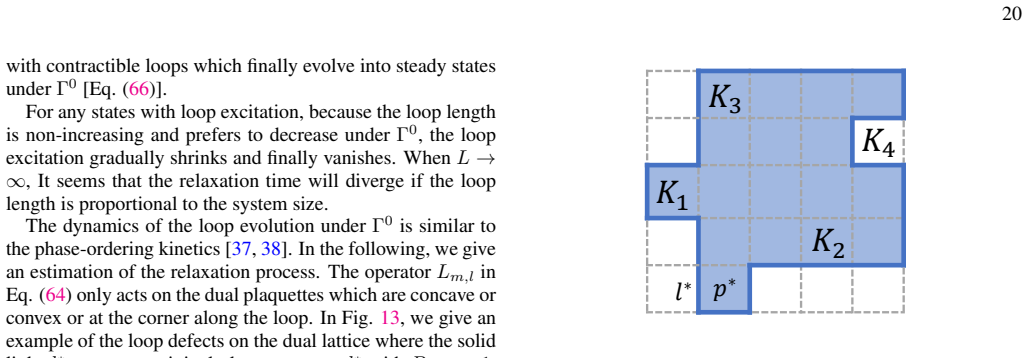
h = 0 When h = 0, type-A and type-B states are all steady states. In this part, we study the relaxation process of those states 20 with contractible loops which finally evolve into steady states under Γ0 [Eq. (66)]. For any states with loop excitation, because the loop length is non-increasing and prefers to decrease under Γ0, the loop excitation graduall...
-
[14]
The numerical verifi- cation of this result can be found in a related paper [20], where the result fits the above estimation really well. When h = 0 , type-A and type-B states are steady states, and those contractible loops (contractible open membranes on the dual lattice) contribute to the low-lying spectrums: ∆ ∼ L−2
-
[15]
h ̸= 0 For the trivial contractible loop states, we expect that a sim- ilar relaxation process also happens in other regimes of the topologically ordered phase ( 0 < h < h c), where the loop defects do not proliferate in the steady state. The shrinking process of a large open membrane would still happen slowly (diffusively) and dominate the long-time dyna...
-
[16]
+ 𝐿𝑥,𝑙(ℎ) (a) 𝑚 𝐿𝑚,𝑙( 1
-
[17]
+ 𝐿𝑥,𝑙(ℎ) 在此处键入公式。 𝑙 𝐿𝑥,𝑙(ℎ) (b) 𝑙 𝐿𝑚,𝑙(1) + 𝐿𝑥,𝑙(ℎ) FIG. 16. The action of Lm,l and Lx,l on m particles (represented by blue solid circles). Links with σz = −1 are labeled by green solid lines and other spins are σz = 1. (a) Both Lm,l and Lx,l can move one m particle to a neighbor plaquette with no m particle. (b) Both Lm,l and Lx,l can annihilate a pair...
-
[18]
+ 𝐿𝑥,𝑙3(ℎ) 2𝑘2𝑘 − 2 2𝑘 + 2 2𝑘 FIG. 17. Transition from |m2k−2⟩⟨m2k−2|, |m2k⟩⟨m2k| and |m2k+2⟩⟨m2k+2| to |m2k⟩⟨m2k|. Inside the bracket, we mark the transition rate associated with the corresponding process. c(h + 1)β2k+2 + ((a − b − 2n)h − b)β2k + bhβ2k−2 = 0 (B3) Set β2k = β2k, then this equation can be simplified as follows: c(h + 1)β4 − (ch + b(h + 1))...
-
[19]
¯A is path-connected In this part, we give the details of the calculation of entanglement entropySA when ¯A is path-connected ( ¯A has only one piece of connected area. See Fig. 5). For the eigenvalues λj and degeneracy Dj have already been listed in Eq. (28), we have SA = −TrρA log ρA = − X j Djλj log λj = − mAX j=0 mA j |G| T ⌊ n−mA+j 2 ⌋X k=⌈ j 2 ⌉ β2k...
-
[20]
¯A is not path-connected In this part, we give the details of the calculation ofρA and SA in partition-1 where ¯A has two disjointed areas [See Fig. 7(1)]. There are four different states in ρA and we can label these states with the particle number in different regions. For convenience, we give the following definition: j ≡# of m particles totally inside ...
-
[21]
hx = hz = 0 For nonperturbed case hx = hz = 0, we choose one of the steady states ρss = 1 |G| P g∈G P ˜g∈G g| ⇑⟩⟨⇑ | g˜g, and calculate the reduced density matrix, ρA = Tr ¯Aρss = 1 |G| X g∈G X ˜g∈GA gA| ⇑⟩⟨⇑ | gA˜gA = |G ¯A| |G| X g∈G/G ¯A X ˜g∈GA gA| ⇑⟩⟨⇑ | gA˜gA. (D4) Following the standard procedure and with the condition that Tr(ρA) = 1, we have ρn A...
-
[22]
hz = 0, hx ̸= 0 Similar to the calculation of Model-1 in Sec. C, we only need to arbitrarily take one of the degenerate steady states, ρss = 1 T ′m X g∈G′ X g′∈G′ g( X k,{r} β2k m |m2k({r})⟩⟨m2k({r})|)g′, (D8) and the form of ρA = Tr ¯Aρss would depend on whether ¯A is connected. We first discuss the situation when there is only one connected piece of ¯A,...
-
[23]
We learn that the topological entropy is vulnerable to the fluctuation of m particles
This result again shows the rationality of generalizing the topological entropy defined by Levin and Wen to steady states of open systems. We learn that the topological entropy is vulnerable to the fluctuation of m particles. The remaining topological entropy as well as the topological degeneracy is due to the fact that the e particles remain unaffected. ...
-
[24]
(D16) Here {re} and {pm} give the positions of e and m particles
hx ̸= 0, h z ̸= 0 For hx, hz ̸= 0, remind the steady state: ρem = 1 T ′em X µ,ν X ke,{re} β2ke e keY j=1 Sz tj X g,g ′∈G g X km,{pm} β2km m W µ x Wy ν kmY i=1 Sx ˜ti | ⇑⟩⟨⇑ | kmY i=1 Sx ˜ti W µ x W ν y g′ keY j=1 Sz tj . (D16) Here {re} and {pm} give the positions of e and m particles. To calculate the reduced density matrix, we should simplify th...
-
[25]
Topological orders in rigid states
Xiao-Gang Wen. Topological orders in rigid states. Interna- tional Journal of Modern Physics B, 4(02):239–271, 1990
work page 1990
-
[26]
Xiao-Gang Wen and Qian Niu. Ground-state degeneracy of the fractional quantum hall states in the presence of a random po- tential and on high-genus riemann surfaces. Physical Review B, 41(13):9377, 1990
work page 1990
-
[27]
Colloquium: Zoo of quantum-topological phases of matter
Xiao-Gang Wen. Colloquium: Zoo of quantum-topological phases of matter. Reviews of Modern Physics , 89(4):041004, 2017
work page 2017
-
[28]
Breakdown of a topological phase: Quan- tum phase transition in a loop gas model with tension
Simon Trebst, Philipp Werner, Matthias Troyer, Kirill Shtengel, and Chetan Nayak. Breakdown of a topological phase: Quan- tum phase transition in a loop gas model with tension. Physical review letters, 98(7):070602, 2007
work page 2007
-
[29]
Adiabatic preparation of topological order
Alioscia Hamma and Daniel A Lidar. Adiabatic preparation of topological order. Physical review letters , 100(3):030502, 2008
work page 2008
-
[30]
IS Tupitsyn, Alexei Kitaev, NV Prokof’Ev, and PCE Stamp. Topological multicritical point in the phase diagram of the toric code model and three-dimensional lattice gauge higgs model. Physical Review B, 82(8):085114, 2010
work page 2010
-
[31]
Topological entanglement en- tropy
Alexei Kitaev and John Preskill. Topological entanglement en- tropy. Physical review letters, 96(11):110404, 2006
work page 2006
-
[32]
Detecting topological or- der in a ground state wave function
Michael Levin and Xiao-Gang Wen. Detecting topological or- der in a ground state wave function. Physical review letters , 96(11):110405, 2006
work page 2006
-
[33]
Fault-tolerant quantum computation by anyons
A Yu Kitaev. Fault-tolerant quantum computation by anyons. Annals of Physics, 303(1):2–30, 2003
work page 2003
-
[34]
Eric Dennis, Alexei Kitaev, Andrew Landahl, and John Preskill. Topological quantum memory. Journal of Mathematical Physics, 43(9):4452–4505, 2002
work page 2002
-
[35]
Diagnostics of mixed-state topological order and breakdown of quantum memory
Ruihua Fan, Yimu Bao, Ehud Altman, and Ashvin Vishwanath. Diagnostics of mixed-state topological order and breakdown of quantum memory. arXiv preprint arXiv:2301.05689, 2023
-
[36]
Yimu Bao, Ruihua Fan, Ashvin Vishwanath, and Ehud Alt- man. Mixed-state topological order and the errorfield double formulation of decoherence-induced transitions. arXiv preprint arXiv:2301.05687, 2023
work page internal anchor Pith review Pith/arXiv arXiv 2023
-
[37]
Quantum criti- cality under decoherence or weak measurement
Jong Yeon Lee, Chao-Ming Jian, and Cenke Xu. Quantum criti- cality under decoherence or weak measurement. arXiv preprint arXiv:2301.05238, 2023
-
[38]
Intrinsic mixed-state topological order without quantum memory
Zijian Wang, Zhengzhi Wu, and Zhong Wang. Intrinsic mixed-state topological order without quantum memory. arXiv preprint arXiv:2307.13758, 2023
-
[39]
Preparation of entan- gled states by quantum markov processes
Barbara Kraus, Hans P B ¨uchler, Sebastian Diehl, Adrian Kan- tian, Andrea Micheli, and Peter Zoller. Preparation of entan- gled states by quantum markov processes. Physical Review A, 78(4):042307, 2008
work page 2008
-
[40]
Dissipation- induced d-wave pairing of fermionic atoms in an optical lattice
Sebastian Diehl, W Yi, AJ Daley, and P Zoller. Dissipation- induced d-wave pairing of fermionic atoms in an optical lattice. Physical review letters, 105(22):227001, 2010
work page 2010
-
[41]
Topology by dissipation in atomic quantum wires
Sebastian Diehl, Enrique Rico, Mikhail A Baranov, and Peter Zoller. Topology by dissipation in atomic quantum wires. Na- ture Physics, 7(12):971–977, 2011
work page 2011
-
[42]
Michael James Kastoryano, Florentin Reiter, and An- ders Søndberg Sørensen. Dissipative preparation of entangle- ment in optical cavities.Physical review letters, 106(9):090502, 2011
work page 2011
-
[43]
Scalable dissipative preparation of many-body entanglement
Florentin Reiter, David Reeb, and Anders S Sørensen. Scalable dissipative preparation of many-body entanglement. Physical review letters, 117(4):040501, 2016
work page 2016
-
[44]
Topologically Ordered Steady States in Open Quantum Systems
Zijian Wang, Xu-Dong Dai, He-Ran Wang, and Zhong Wang. Topologically ordered steady states in open quantum systems. arXiv preprint arXiv:2306.12482, 2023
work page internal anchor Pith review Pith/arXiv arXiv 2023
-
[45]
In other words, α in Fig.1 can be zero in such special cases
Here we make the implicit assumption that that the system has translation symmetry, which excludes special cases with non- Hermitian skin effect, where there can be a finite Liouvillian gap even if the relaxation time is divergent. In other words, α in Fig.1 can be zero in such special cases
-
[46]
Ground state entanglement and geometric entropy in the kitaev model
Alioscia Hamma, Radu Ionicioiu, and Paolo Zanardi. Ground state entanglement and geometric entropy in the kitaev model. Physics Letters A, 337(1-2):22–28, 2005
work page 2005
-
[47]
String and membrane condensation on three-dimensional lattices
Alioscia Hamma, Paolo Zanardi, and Xiao-Gang Wen. String and membrane condensation on three-dimensional lattices. Physical Review B, 72(3):035307, 2005
work page 2005
-
[48]
Autocorrelations and ther- mal fragility of anyonic loops in topologically quantum ordered systems
Zohar Nussinov and Gerardo Ortiz. Autocorrelations and ther- mal fragility of anyonic loops in topologically quantum ordered systems. Physical Review B, 77(6):064302, 2008
work page 2008
-
[49]
David A Reiss and Kai P Schmidt. Quantum robustness and phase transitions of the 3d toric code in a field.SciPost Physics, 6(6):078, 2019
work page 2019
-
[50]
On the generators of quantum dynami- cal semigroups
Goran Lindblad. On the generators of quantum dynami- cal semigroups. Communications in Mathematical Physics , 48(2):119–130, 1976
work page 1976
-
[51]
Time-dependent statistics of the ising model
Roy J Glauber. Time-dependent statistics of the ising model. Journal of mathematical physics, 4(2):294–307, 1963
work page 1963
-
[52]
Claudio Castelnovo and Claudio Chamon. Entanglement and 33 topological entropy of the toric code at finite temperature.Phys- ical Review B, 76(18):184442, 2007
work page 2007
-
[53]
Topological order and topological entropy in classical systems
Claudio Castelnovo and Claudio Chamon. Topological order and topological entropy in classical systems. Physical Review B, 76(17):174416, 2007
work page 2007
-
[54]
⌊x⌋ = max{z ∈ Z|z ≤ x} and ⌈x⌉ = min{z ∈ Z|z ≥ x}
-
[55]
Quan- tum computation and quantum-state engineering driven by dis- sipation
Frank Verstraete, Michael M Wolf, and J Ignacio Cirac. Quan- tum computation and quantum-state engineering driven by dis- sipation. Nature physics, 5(9):633–636, 2009
work page 2009
-
[56]
An introduction to lattice gauge theory and spin systems
John B Kogut. An introduction to lattice gauge theory and spin systems. Reviews of Modern Physics, 51(4):659, 1979
work page 1979
-
[57]
Quantum spin liquids: a re- view
Lucile Savary and Leon Balents. Quantum spin liquids: a re- view. Reports on Progress in Physics, 80(1):016502, 2016
work page 2016
-
[58]
Diagnosing deconfinement and topological order
K Gregor, David A Huse, R Moessner, and Shivaji Lal Sondhi. Diagnosing deconfinement and topological order. New Journal of Physics, 13(2):025009, 2011
work page 2011
-
[59]
Here we implicitly make the assumption that that the system has translation symmetry, which excludes special cases such as systems with boundary dissipation or skin effect
-
[60]
Malte Henkel. Statistical mechanics of the 2d quantum xy model in a transverse field.Journal of Physics A: Mathematical and General, 17(14):L795, 1984
work page 1984
-
[61]
Theory of phase-ordering kinetics
Alan J Bray. Theory of phase-ordering kinetics. Advances in Physics, 51(2):481–587, 2002
work page 2002
-
[62]
Freezing in ising ferro- magnets
V Spirin, PL Krapivsky, and S Redner. Freezing in ising ferro- magnets. Physical Review E, 65(1):016119, 2001
work page 2001
-
[63]
Algebraic versus exponential deco- herence in dissipative many-particle systems
Zi Cai and Thomas Barthel. Algebraic versus exponential deco- herence in dissipative many-particle systems. Phys. Rev. Lett., 111:150403, Oct 2013
work page 2013
discussion (0)
Sign in with ORCID, Apple, or X to comment. Anyone can read and Pith papers without signing in.