Emergent magnetic order in the antiferromagnetic Kitaev model with a [111] field
Pith reviewed 2026-05-24 05:44 UTC · model grok-4.3
The pith
The antiferromagnetic Kitaev model in a [111] field has the spin liquid transit through stripe then chiral ordered phases before the polarized phase.
A machine-rendered reading of the paper's core claim, the machinery that carries it, and where it could break.
Core claim
By employing hierarchical mean-field theory with symmetry-preserving 24-site clusters, the Kitaev spin liquid transits through two intermediate phases characterized by stripe and chiral order, respectively, before entering the trivial partially polarized phase. The authors assess this result by performing exact diagonalization and computing the scaling of different observables, including the many-body Chern number and other topological quantities.
What carries the argument
Hierarchical mean-field theory on symmetry-preserving clusters of 24 sites, which retains short-range quantum correlations and permits direct computation of topological invariants such as the many-body Chern number.
If this is right
- The phase diagram contains two distinct magnetically ordered intermediate states separating the Kitaev spin liquid from the polarized phase.
- The many-body Chern number changes across the transitions, allowing topological characterization of each phase.
- Exact diagonalization on smaller clusters produces consistent trends with the hierarchical mean-field results.
- The same cluster-based approach can be applied to other field directions or related spin-liquid models.
Where Pith is reading between the lines
- Signatures of stripe and chiral order could appear in neutron scattering or thermodynamic measurements on Kitaev candidate materials.
- The chiral phase may support additional edge modes or response functions not computed in the present work.
- Similar cluster sizes applied to the ferromagnetic Kitaev model might produce an analogous sequence of phases.
Load-bearing premise
The 24-site cluster ansatz is large enough and symmetry-preserving enough to capture the correct sequence of quantum phase transitions without substantial finite-size artifacts.
What would settle it
Exact diagonalization or other unbiased calculations on clusters substantially larger than 24 sites that recover only a single intermediate phase would falsify the reported two-phase sequence.
Figures




read the original abstract
The Kitaev spin liquid, stabilized as the ground state of the Kitaev honeycomb model, is a paradigmatic example of a topological $\mathbb{Z}_2$ quantum spin liquid. The fate of the Kitaev spin liquid in presence of an external magnetic field is a topic of current interest due to experiments, which apparently unveil a $\mathbb{Z}_2$ topological phase in the so-called Kitaev materials, and theoretical studies predicting the emergence of an intermediate quantum phase of debated nature before the appearance of a trivial partially polarized phase. In this work, we employ hierarchical mean-field theory, an algebraic and numerical method based on the use of clusters preserving relevant symmetries and short-range quantum correlations, to investigate the quantum phase diagram of the antiferromagnetic Kitaev's model in a [111] field. By using clusters of 24 sites, we predict that the Kitaev spin liquid transits through two intermediate phases characterized by stripe and chiral order, respectively, before entering the trivial partially polarized phase, differing from previous studies. We assess our results by performing exact diagonalization and computing the scaling of different observables, including the many-body Chern number and other topological quantities, thus establishing hierarchical mean-field theory as a method to study topological quantum spin liquids.
Editorial analysis
A structured set of objections, weighed in public.
Referee Report
Summary. The paper investigates the quantum phase diagram of the antiferromagnetic Kitaev honeycomb model in a [111] magnetic field using hierarchical mean-field theory (HMFT) on symmetry-preserving 24-site clusters. It claims that the Kitaev spin liquid undergoes two intermediate phases—one with stripe order and one with chiral order—before transitioning to the trivial partially polarized phase, in contrast to prior studies. These findings are assessed via comparisons to exact diagonalization (ED) on smaller clusters and computations of the many-body Chern number along with other topological quantities.
Significance. If the central claim holds, the work would clarify the sequence and character of field-induced phases in the Kitaev model, offering concrete predictions for stripe and chiral orders that differ from existing literature and supporting the use of HMFT for topological spin liquids. A strength is the combination of algebraic cluster methods with independent ED diagnostics and explicit many-body Chern-number calculations to characterize the intermediate states.
major comments (2)
- [numerical results on 24-site clusters] The central claim that two intermediate phases exist rests on the 24-site HMFT ansatz being free of substantial finite-size artifacts. However, the manuscript provides no quantitative convergence data, error bars on order parameters, or explicit scaling of transition points with cluster size within the HMFT framework itself (the ED comparisons are performed on the same or smaller sizes and do not constitute an independent test of HMFT convergence).
- [comparison to prior work and phase diagram] The reported discrepancy with previous studies on the number and nature of intermediate phases is presented without additional controls that would rule out mean-field artifacts from the inter-cluster coupling treatment or symmetry constraints in the 24-site clusters near the putative transitions.
minor comments (2)
- [topological diagnostics] Clarify the precise definition and numerical implementation of the many-body Chern number used to diagnose the chiral phase, including any regularization or boundary conditions applied.
- [abstract and results] The abstract states that results are assessed by 'computing the scaling of different observables'; this scaling analysis should be shown explicitly with data points rather than summarized.
Simulated Author's Rebuttal
We thank the referee for the careful reading and constructive comments. We respond point-by-point to the major comments below.
read point-by-point responses
-
Referee: [numerical results on 24-site clusters] The central claim that two intermediate phases exist rests on the 24-site HMFT ansatz being free of substantial finite-size artifacts. However, the manuscript provides no quantitative convergence data, error bars on order parameters, or explicit scaling of transition points with cluster size within the HMFT framework itself (the ED comparisons are performed on the same or smaller sizes and do not constitute an independent test of HMFT convergence).
Authors: We acknowledge that explicit finite-size scaling studies within HMFT on clusters larger than 24 sites would provide stronger evidence against artifacts. The 24-site cluster was specifically chosen to preserve all relevant symmetries of the model while incorporating short-range quantum correlations. Larger clusters are computationally intensive within the current HMFT implementation. We will revise the manuscript to include a dedicated discussion of possible finite-size effects, add error estimates on the order parameters where feasible, and clarify the role of the ED comparisons as validation rather than direct convergence tests for HMFT. revision: partial
-
Referee: [comparison to prior work and phase diagram] The reported discrepancy with previous studies on the number and nature of intermediate phases is presented without additional controls that would rule out mean-field artifacts from the inter-cluster coupling treatment or symmetry constraints in the 24-site clusters near the putative transitions.
Authors: The discrepancy with prior work stems from our use of symmetry-preserving clusters that enforce the full point-group symmetries, which we believe reduces certain mean-field biases. To strengthen the case, we will add in the revised manuscript an explicit analysis of the inter-cluster mean-field decoupling scheme, including its sensitivity near the transition points, and further details on how the symmetry constraints are implemented. The many-body Chern number and other topological diagnostics computed on the HMFT states provide an independent check that is less sensitive to the mean-field approximation details. revision: yes
Circularity Check
No circularity: direct numerical application of HMFT to microscopic Hamiltonian
full rationale
The paper computes the phase diagram by applying hierarchical mean-field theory on 24-site symmetry-preserving clusters directly to the antiferromagnetic Kitaev Hamiltonian in a [111] field. Results are obtained from solving the cluster equations and cross-checked with exact diagonalization plus scaling of observables including the many-body Chern number. No parameters are fitted to the reported phases or topological quantities, no self-referential definitions appear, and no load-bearing uniqueness theorems or ansatzes are imported via self-citation. The derivation chain remains self-contained as a numerical approximation whose outputs are not forced by construction to match its inputs.
Axiom & Free-Parameter Ledger
axioms (1)
- domain assumption Hierarchical mean-field theory on symmetry-preserving clusters of 24 sites captures the essential short-range quantum correlations and the correct ordering tendencies of the antiferromagnetic Kitaev model.
Lean theorems connected to this paper
-
IndisputableMonolith/Foundation/RealityFromDistinction.leanreality_from_one_distinction unclear?
unclearRelation between the paper passage and the cited Recognition theorem.
By using clusters of 24 sites, we predict that the Kitaev spin liquid transits through two intermediate phases characterized by stripe and chiral order, respectively, before entering the trivial partially polarized phase
-
IndisputableMonolith/Cost/FunctionalEquation.leanwashburn_uniqueness_aczel unclear?
unclearRelation between the paper passage and the cited Recognition theorem.
computing the many-body Chern number and other topological quantities
What do these tags mean?
- matches
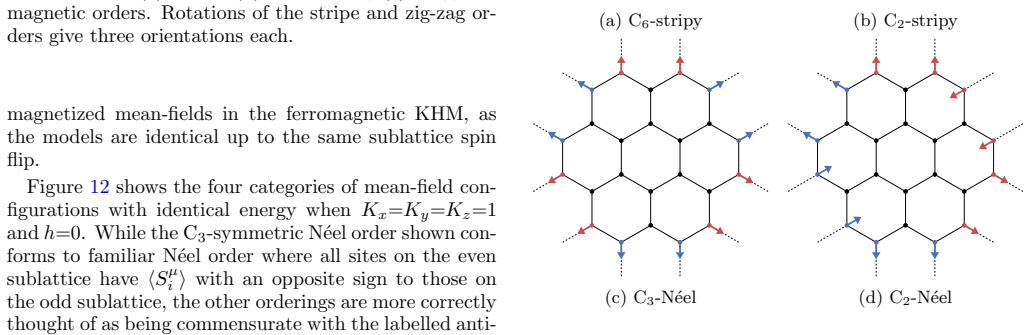
- The paper's claim is directly supported by a theorem in the formal canon.
- supports
- The theorem supports part of the paper's argument, but the paper may add assumptions or extra steps.
- extends
- The paper goes beyond the formal theorem; the theorem is a base layer rather than the whole result.
- uses
- The paper appears to rely on the theorem as machinery.
- contradicts
- The paper's claim conflicts with a theorem or certificate in the canon.
- unclear
- Pith found a possible connection, but the passage is too broad, indirect, or ambiguous to say the theorem truly supports the claim.
Reference graph
Works this paper leans on
-
[1]
Intermediate phase As mentioned previously, we find that the intermediate phase originates from a mean-field orientation with self- consistent fields that spontaneously break the C 6×CS 3 symmetry of the Hamiltonian in favor of a reduced C2×CS 1 symmetry. In order to characterize the spon- taneous symmetry breaking (SSB) found in the interme- diate phase,...
-
[2]
Chiral partially-polarized phase The combined use of spatially symmetric clusters, to- gether with the self-consistent mean-field embedding pro- viding information from the thermodynamic limit and explicitly allowing for the breakdown of continuous sym- metries, permits HMFT to discover phase transitions that may escape other methods. That is the case of ...
-
[3]
and has motivated the search for its material realiza- tion since its proposal [7, 54], including extensive theo- retical studies of the resulting extended Kitaev models [11–16]. In this work, we have approached the antiferromag- netic KHM by means of hierarchical mean-field theory (HMFT) supplemented with exact diagonalization (ED), finding that a magnet...
-
[4]
A Field Guide to Spin Liquids,
J. Knolle and R. Moessner, “A Field Guide to Spin Liquids,” Annual Review of Condensed Matter Physics , vol. 10, no. 1, pp. 451–472, 2019
work page 2019
-
[5]
Quantum spin liquids: a re- view,
L. Savary and L. Balents, “Quantum spin liquids: a re- view,” Reports on Progress in Physics , vol. 80, p. 016502, nov 2016
work page 2016
-
[6]
Anyons in an exactly solved model and be- yond,
A. Kitaev, “Anyons in an exactly solved model and be- yond,” Annals of Physics, vol. 321, no. 1, pp. 2–111, 2006. January Special Issue
work page 2006
-
[7]
α − RuCl3: A spin-orbit assisted Mott insulator on a honeycomb lattice,
K. W. Plumb, J. P. Clancy, L. J. Sandilands, V. V. Shankar, Y. F. Hu, K. S. Burch, H.-Y. Kee, and Y.-J. Kim, “ α − RuCl3: A spin-orbit assisted Mott insulator on a honeycomb lattice,” Phys. Rev. B, vol. 90, p. 041112, Jul 2014
work page 2014
-
[8]
Mag- netic order in α − RuCl3: A honeycomb-lattice quantum magnet with strong spin-orbit coupling,
J. A. Sears, M. Songvilay, K. W. Plumb, J. P. Clancy, Y. Qiu, Y. Zhao, D. Parshall, and Y.-J. Kim, “Mag- netic order in α − RuCl3: A honeycomb-lattice quantum magnet with strong spin-orbit coupling,” Phys. Rev. B , vol. 91, p. 144420, Apr 2015
work page 2015
-
[9]
Scattering Continuum and Possible Frac- tionalized Excitations in α−RuCl3,
L. J. Sandilands, Y. Tian, K. W. Plumb, Y.-J. Kim, and K. S. Burch, “Scattering Continuum and Possible Frac- tionalized Excitations in α−RuCl3,” Phys. Rev. Lett. , vol. 114, p. 147201, Apr 2015
work page 2015
-
[10]
Kitaev-Heisenberg Model on a Honeycomb Lattice: Pos- sible Exotic Phases in Iridium Oxides A2IrO3,
J. c. v. Chaloupka, G. Jackeli, and G. Khaliullin, “Kitaev-Heisenberg Model on a Honeycomb Lattice: Pos- sible Exotic Phases in Iridium Oxides A2IrO3,” Phys. Rev. Lett., vol. 105, p. 027204, Jul 2010
work page 2010
-
[11]
Crystal structure and mag- netism in α − RuCl3: An ab initio study,
H.-S. Kim and H.-Y. Kee, “Crystal structure and mag- netism in α − RuCl3: An ab initio study,” Phys. Rev. B , vol. 93, p. 155143, Apr 2016
work page 2016
-
[12]
L. Janssen, E. C. Andrade, and M. Vojta, “Magneti- zation processes of zigzag states on the honeycomb lat- tice: Identifying spin models for α−RuCl3 and Na2IrO3,” Phys. Rev. B , vol. 96, p. 064430, Aug 2017
work page 2017
-
[13]
S. Trebst and C. Hickey, “Kitaev materials,” Physics Re- ports, vol. 950, pp. 1–37, 2022. Kitaev materials
work page 2022
-
[14]
L. Janssen, E. C. Andrade, and M. Vojta, “Honeycomb- Lattice Heisenberg-Kitaev Model in a Magnetic Field: Spin Canting, Metamagnetism, and Vortex Crystals,” Phys. Rev. Lett. , vol. 117, p. 277202, Dec 2016
work page 2016
-
[15]
Theory of the field-revealed Kitaev spin liquid,
J. S. Gordon, A. Catuneanu, E. S. Sørensen, and H.-Y. Kee, “Theory of the field-revealed Kitaev spin liquid,” Nature Communications, vol. 10, Jun 2019
work page 2019
-
[16]
Phase Diagram of the Spin-1 /2 Kitaev-Gamma Chain and Emergent SU(2) Symmetry,
W. Yang, A. Nocera, T. Tummuru, H.-Y. Kee, and I. Af- fleck, “Phase Diagram of the Spin-1 /2 Kitaev-Gamma Chain and Emergent SU(2) Symmetry,”Phys. Rev. Lett., vol. 124, p. 147205, Apr 2020
work page 2020
-
[17]
E. S. Sørensen, A. Catuneanu, J. S. Gordon, and H.- Y. Kee, “Heart of Entanglement: Chiral, Nematic, and Incommensurate Phases in the Kitaev-Gamma Ladder in a Field,” Phys. Rev. X , vol. 11, p. 011013, Jan 2021
work page 2021
-
[18]
Classical spin order near the antiferromag- netic Kitaev point in the spin- 1 2 Kitaev-Gamma chain,
W. Yang, A. Nocera, E. S. Sørensen, H.-Y. Kee, and I. Affleck, “Classical spin order near the antiferromag- netic Kitaev point in the spin- 1 2 Kitaev-Gamma chain,” Phys. Rev. B , vol. 103, p. 054437, Feb 2021
work page 2021
-
[19]
Variational study of the Kitaev-Heisenberg-Gamma model,
S.-S. Zhang, G. B. Hal´ asz, W. Zhu, and C. D. Batista, “Variational study of the Kitaev-Heisenberg-Gamma model,” Phys. Rev. B , vol. 104, p. 014411, Jul 2021
work page 2021
-
[20]
Z. Zhu, I. Kimchi, D. N. Sheng, and L. Fu, “Robust non- Abelian spin liquid and a possible intermediate phase in the antiferromagnetic Kitaev model with magnetic field,” Phys. Rev. B , vol. 97, p. 241110, Jun 2018
work page 2018
-
[21]
Dynamical and topological properties of the Kitaev model in a [111] magnetic field,
M. Gohlke, R. Moessner, and F. Pollmann, “Dynamical and topological properties of the Kitaev model in a [111] magnetic field,” Phys. Rev. B , vol. 98, p. 014418, Jul 2018
work page 2018
-
[22]
Emergence of a field-driven U(1) spin liquid in the Kitaev honeycomb model,
C. Hickey and S. Trebst, “Emergence of a field-driven U(1) spin liquid in the Kitaev honeycomb model,”Nature 10 Communications, vol. 10, Jan 2019
work page 2019
-
[23]
D. C. Ronquillo, A. Vengal, and N. Trivedi, “Signatures of magnetic-field-driven quantum phase transitions in the entanglement entropy and spin dynamics of the Kitaev honeycomb model,” Phys. Rev. B , vol. 99, Apr 2019
work page 2019
-
[24]
Two-magnon bound states in the Kitaev model in a [111] field,
S. Pradhan, N. D. Patel, and N. Trivedi, “Two-magnon bound states in the Kitaev model in a [111] field,” Phys. Rev. B, vol. 101, p. 180401, May 2020
work page 2020
-
[25]
Magnetic field-induced in- termediate quantum spin liquid with a spinon Fermi sur- face,
N. D. Patel and N. Trivedi, “Magnetic field-induced in- termediate quantum spin liquid with a spinon Fermi sur- face,” Proceedings of the National Academy of Sciences , vol. 116, pp. 12199–12203, March 2019
work page 2019
-
[26]
Theory of the Kitaev model in a [111] magnetic field,
S.-S. Zhang, G. B. Hal´ asz, and C. D. Batista, “Theory of the Kitaev model in a [111] magnetic field,” Nature Communications, vol. 13, p. 399, Jan. 2022
work page 2022
-
[27]
Tuning Topological Orders by a Conical Magnetic Field in the Kitaev Model,
M.-H. Jiang, S. Liang, W. Chen, Y. Qi, J.-X. Li, and Q.-H. Wang, “Tuning Topological Orders by a Conical Magnetic Field in the Kitaev Model,” Phys. Rev. Lett. , vol. 125, p. 177203, Oct 2020
work page 2020
-
[28]
Hierarchical mean-field the- ory in quantum statistical mechanics: A bosonic exam- ple,
G. Ortiz and C. D. Batista, “Hierarchical mean-field the- ory in quantum statistical mechanics: A bosonic exam- ple,” Phys. Rev. B , vol. 67, p. 134301, Apr 2003
work page 2003
-
[29]
Hierarchical Mean-Field Theories,
G. Ortiz and C. D. Batista, “Hierarchical Mean-Field Theories,” arXiv e-prints , pp. cond–mat/0403222, Mar. 2004
-
[30]
Hierarchical mean- field approach to the J1 − J2 Heisenberg model on a square lattice,
L. Isaev, G. Ortiz, and J. Dukelsky, “Hierarchical mean- field approach to the J1 − J2 Heisenberg model on a square lattice,” Phys. Rev. B , vol. 79, p. 024409, Jan. 2009
work page 2009
-
[31]
Local Physics of Magnetization Plateaux in the Shastry-Sutherland Model,
L. Isaev, G. Ortiz, and J. Dukelsky, “Local Physics of Magnetization Plateaux in the Shastry-Sutherland Model,” Phys. Rev. Lett. , vol. 103, p. 177201, 10 2009
work page 2009
-
[32]
Stair- case of crystal phases of hard-core bosons on the kagome lattice,
D. Huerga, S. Capponi, J. Dukelsky, and G. Ortiz, “Stair- case of crystal phases of hard-core bosons on the kagome lattice,” Phys. Rev. B , vol. 94, p. 165124, Oct. 2016
work page 2016
-
[33]
A series of magnon crystals appearing under ultrahigh magnetic fields in a kagom´ e antiferromagnet,
R. Okuma, D. Nakamura, T. Okubo, A. Miyake, A. Matsuo, K. Kindo, M. Tokunaga, N. Kawashima, S. Takeyama, and Z. Hiroi, “A series of magnon crystals appearing under ultrahigh magnetic fields in a kagom´ e antiferromagnet,” Nature Communications , vol. 10, no. 1, p. 1229, 2019
work page 2019
-
[34]
Bond algebras and exact solv- ability of Hamiltonians: Spin S = 1 2 multilayer systems,
Z. Nussinov and G. Ortiz, “Bond algebras and exact solv- ability of Hamiltonians: Spin S = 1 2 multilayer systems,” Phys. Rev. B , vol. 79, p. 214440, Jun 2009
work page 2009
-
[35]
D. C. Ronquillo, Magnetic-Field-Driven Quantum Phase Transitions of the Kitaev Honeycomb Model . PhD thesis, Ohio State University, 2020
work page 2020
-
[36]
Algebraic approach to inter- acting quantum systems,
C. D. Batista and G. Ortiz, “Algebraic approach to inter- acting quantum systems,” Advances in Physics , vol. 53, pp. 1–82, Feb. 2004
work page 2004
-
[37]
Algorithms for entanglement renormalization,
G. Evenbly and G. Vidal, “Algorithms for entanglement renormalization,” Phys. Rev. B , vol. 79, p. 144108, Apr 2009
work page 2009
-
[38]
L. Tagliacozzo, G. Evenbly, and G. Vidal, “Simulation of two-dimensional quantum systems using a tree tensor network that exploits the entropic area law,” Phys. Rev. B, vol. 80, p. 235127, Dec 2009
work page 2009
-
[39]
C. Lacroix, P. Mendels, and F. Mila, Introduction to Frustrated Magnetism: Materials, Experiments, Theory . Springer Series in Solid-State Sciences, Springer Berlin Heidelberg, 2011
work page 2011
-
[40]
Sign problem in Monte Carlo simulations of frustrated quantum spin systems,
P. Henelius and A. W. Sandvik, “Sign problem in Monte Carlo simulations of frustrated quantum spin systems,” Phys. Rev. B , vol. 62, pp. 1102–1113, Jul 2000
work page 2000
-
[41]
On the compu- tational complexity of curing non-stoquastic Hamiltoni- ans,
M. Marvian, D. A. Lidar, and I. Hen, “On the compu- tational complexity of curing non-stoquastic Hamiltoni- ans,” Nat. Commun. , vol. 10, no. 1, p. 1571, 2019
work page 2019
-
[42]
Chiral phases of two-dimensional hard-core bosons with frustrated ring exchange,
D. Huerga, J. Dukelsky, N. Laflorencie, and G. Or- tiz, “Chiral phases of two-dimensional hard-core bosons with frustrated ring exchange,” Phys. Rev. B , vol. 89, p. 094401, Mar 2014
work page 2014
-
[43]
Density-dependent synthetic magnetism for ultra- cold atoms in optical lattices,
S. Greschner, D. Huerga, G. Sun, D. Poletti, and L. San- tos, “Density-dependent synthetic magnetism for ultra- cold atoms in optical lattices,” Phys. Rev. B , vol. 92, p. 115120, Sep 2015
work page 2015
-
[44]
Composite Boson Mapping for Lattice Boson Systems,
D. Huerga, J. Dukelsky, and G. E. Scuseria, “Composite Boson Mapping for Lattice Boson Systems,” Phys. Rev. Lett., vol. 111, p. 045701, Jul 2013
work page 2013
-
[45]
Frustrated magnets and quantum paramagnetic phases at finite temperature,
L. Isaev and G. Ortiz, “Frustrated magnets and quantum paramagnetic phases at finite temperature,” Phys. Rev. B, vol. 86, p. 100402, Sep 2012
work page 2012
-
[46]
Translation-Invariant Parent Hamiltonians of Valence Bond Crystals,
D. Huerga, A. Greco, C. Gazza, and A. Muramatsu, “Translation-Invariant Parent Hamiltonians of Valence Bond Crystals,” Phys. Rev. Lett. , vol. 118, p. 167202, Apr 2017
work page 2017
-
[47]
Topological Entanglement Entropy,
A. Kitaev and J. Preskill, “Topological Entanglement Entropy,” Phys. Rev. Lett. , vol. 96, p. 110404, Mar 2006
work page 2006
-
[48]
P. Weinberg and M. Bukov, “QuSpin: a Python package for dynamics and exact diagonalisation of quantum many body systems part I: spin chains,” SciPost Phys. , vol. 2, p. 003, 2017
work page 2017
-
[49]
Macroscopic polarization as a geometric quantum phase: Many-body formulation,
G. Ortiz and R. M. Martin, “Macroscopic polarization as a geometric quantum phase: Many-body formulation,” Phys. Rev. B , vol. 49, pp. 14202–14210, May 1994
work page 1994
-
[50]
Quantized spin currents in two-dimensional chiral magnets,
F. D. M. Haldane and D. P. Arovas, “Quantized spin currents in two-dimensional chiral magnets,” Phys. Rev. B, vol. 52, pp. 4223–4225, Aug 1995
work page 1995
-
[51]
Quantum phase transitions involving a change in po- larization,
G. Ortiz, P. Ordej´ on, R. M. Martin, and G. Chiappe, “Quantum phase transitions involving a change in po- larization,” Phys. Rev. B , vol. 54, pp. 13515–13528, Nov 1996
work page 1996
-
[52]
T. Fukui, Y. Hatsugai, and H. Suzuki, “Chern Numbers in Discretized Brillouin Zone: Efficient Method of Com- puting (Spin) Hall Conductances,” Journal of the Physi- cal Society of Japan , vol. 74, no. 6, pp. 1674–1677, 2005
work page 2005
-
[53]
Topo- logical phase transitions for interacting finite systems,
C. N. Varney, K. Sun, M. Rigol, and V. Galitski, “Topo- logical phase transitions for interacting finite systems,” Phys. Rev. B , vol. 84, p. 241105, Dec 2011
work page 2011
-
[54]
Quasiparticle statistics and braiding from ground-state entanglement,
Y. Zhang, T. Grover, A. Turner, M. Oshikawa, and A. Vishwanath, “Quasiparticle statistics and braiding from ground-state entanglement,” Phys. Rev. B , vol. 85, p. 235151, Jun 2012
work page 2012
-
[55]
Physics of the Kitaev Model: Fractionalization, Dynamic Correlations, and Material Connections,
M. Hermanns, I. Kimchi, and J. Knolle, “Physics of the Kitaev Model: Fractionalization, Dynamic Correlations, and Material Connections,” Annual Review of Condensed Matter Physics , vol. 9, no. 1, pp. 17–33, 2018
work page 2018
-
[56]
Quantum critical scaling of fidelity susceptibility,
A. F. Albuquerque, F. Alet, C. Sire, and S. Cap- poni, “Quantum critical scaling of fidelity susceptibility,” Phys. Rev. B , vol. 81, p. 064418, Feb 2010
work page 2010
-
[57]
G. Jackeli and G. Khaliullin, “Mott Insulators in the Strong Spin-Orbit Coupling Limit: From Heisenberg to a Quantum Compass and Kitaev Models,” Phys. Rev. Lett., vol. 102, p. 017205, Jan 2009
work page 2009
-
[58]
First ex- citations of the spin 1/2 Heisenberg antiferromagnet on the kagom´ e lattice,
C. Waldtmann, H. U. Everts, B. Bernu, C. Lhuillier, P. Sindzingre, P. Lecheminant, and L. Pierre, “First ex- citations of the spin 1/2 Heisenberg antiferromagnet on the kagom´ e lattice,”European Physical Journal B, vol. 2, Apr. 1998. 11
work page 1998
-
[59]
G. Vidal, “Entanglement Renormalization,” Phys. Rev. Lett., vol. 99, p. 220405, Nov 2007
work page 2007
-
[60]
A. Honecker, S. Wessel, R. Kerkdyk, T. Pruschke, F. Mila, and B. Normand, “Thermodynamic properties of highly frustrated quantum spin ladders: Influence of many-particle bound states,” Phys. Rev. B , vol. 93, p. 054408, Feb 2016
work page 2016
-
[61]
Sign-Problem-Free Monte Carlo Simulation of Certain Frustrated Quantum Magnets,
F. Alet, K. Damle, and S. Pujari, “Sign-Problem-Free Monte Carlo Simulation of Certain Frustrated Quantum Magnets,” Phys. Rev. Lett. , vol. 117, p. 197203, Nov 2016
work page 2016
-
[62]
Variational Quantum Simulation of Valence- Bond Solids,
D. Huerga, “Variational Quantum Simulation of Valence- Bond Solids,” Quantum, vol. 6, p. 874, Dec. 2022. 12 Appendix A: h = 0 HMFT results To determine the HMFT phase boundaries of the Ki- taev honeycomb model (KHM) at h=0, we performed HMFT calculations iteratively (reusing the previous iter- ation’s mean-fields as starting parameters) moving along paths...
work page 2022
-
[63]
The y and z-bond mean-fields are consistent with other stripe orientations. As such, these mean-field or- ders represent overlayed staggered magnetizations with a different ordering for each component of spin. Order parameters for the staggered magnetizations shown in Fig. 11 can be constructed as M µ staggered = 1 Nc X i∈ red sites ⟨Sµ i ⟩ − X i∈ blue si...
-
[64]
Topological entanglement entropy To find topological entanglement entropy Stopo, we take inspiration from previous work [20] in using the Kitaev-Preskill (KP) construction [44]: First, we parti- tion our system into four mutually connected subsystems A, B, C, and D. Then, the topological entanglement en- tropy is given by Stopo = SA+SB +SC −SAB −SBC −SAC ...
-
[65]
Topological S-matrix The topological S-matrix may be calculated in ED sys- tems using an approach inspired by the KP topological entropy. By choosing partitions that bifurcate the cluster into disconnected regions and then finding linear combi- nations of the quasi-degenerate ground states to extrem- ize entanglement entropies along these partitions, the ...
-
[66]
Many-body Chern number To calculate the many-body Chern number, twisted boundary conditions (TBC) are implemented on the 6H and 24H cluster. For spin degrees of freedom, these boundary conditions are defined as S+ r+Li = eiϕS+ r , S − r+Li = e−iϕS− r , S z r+Li = Sz r , (D2) where L1, L2 are vectors wrapping around the torus in PBC and ϕ1, ϕ2 are phases c...
-
[67]
formulation designed to cancel out any arbitrary phases present in the wavefunctions [49, 50]: on an L×L grid of discrete phases ϕ1,2 ∈ { 0, 2π L , . . . , 2π(L−1) L } with ⃗ϕ = {ϕ1, ϕ2}, eC = 1 2πi X ⃗ϕ ln U1 ⃗ϕ U2 ⃗ϕ + ˆ1 U1 ⃗ϕ + ˆ2 U2 ⃗ϕ , (D3) where ˆ1 = 2π L (1, 0), ˆ2 = 2π L (0, 1). The variables Uµ = ⟨⃗ϕ|ϕ + ˆµ⟩ | ⟨⃗ϕ|ϕ + ˆµ⟩ | (D4) are defined at ...
discussion (0)
Sign in with ORCID, Apple, or X to comment. Anyone can read and Pith papers without signing in.