An Operational Framework for Nonclassicality in Quantum Communication Networks
Pith reviewed 2026-05-24 03:31 UTC · model grok-4.3
The pith
Entanglement is necessary for nonclassicality when a single sender broadcasts to multiple receivers.
A machine-rendered reading of the paper's core claim, the machinery that carries it, and where it could break.
Core claim
The framework computes linear bounds for classical strategies and maximizes their violation using tailored variational quantum optimization. Applying it shows entanglement between communication-constrained parties is sufficient for nonclassicality, quantum communication suffices without entanglement in multi-sender networks, and thus entanglement is necessary for nonclassicality in single-sender broadcast to multiple receivers.
What carries the argument
Linear bounds on input/output probabilities of classical networks with limited communication and globally shared randomness, maximized via variational quantum optimization tailored to the network.
If this is right
- Entanglement between communication-constrained parties suffices for nonclassicality.
- In networks with multiple senders, quantum communication with no entanglement-assistance suffices for nonclassicality.
- The framework can be scaled on quantum computers to optimize noisy quantum networks for communication advantages.
- The framework can be deployed in the field to certify nonclassicality under realistic constraints.
Where Pith is reading between the lines
- Designers could use the same bounding technique to compare the cost of distributing entanglement versus adding quantum channels in larger topologies.
- The framework might be adapted to certify nonclassicality from other resources such as quantum discord when entanglement is unavailable.
- Running the optimization on small experimental networks could identify the minimal entanglement or channel resources needed for a target advantage.
Load-bearing premise
The linear bounds computed by the framework are the tightest possible over all classical strategies with the stated communication constraints and globally shared randomness.
What would settle it
A classical strategy that matches or exceeds the quantum-optimized probability in the single-sender broadcast scenario without using entanglement would falsify the necessity claim.
Figures






read the original abstract
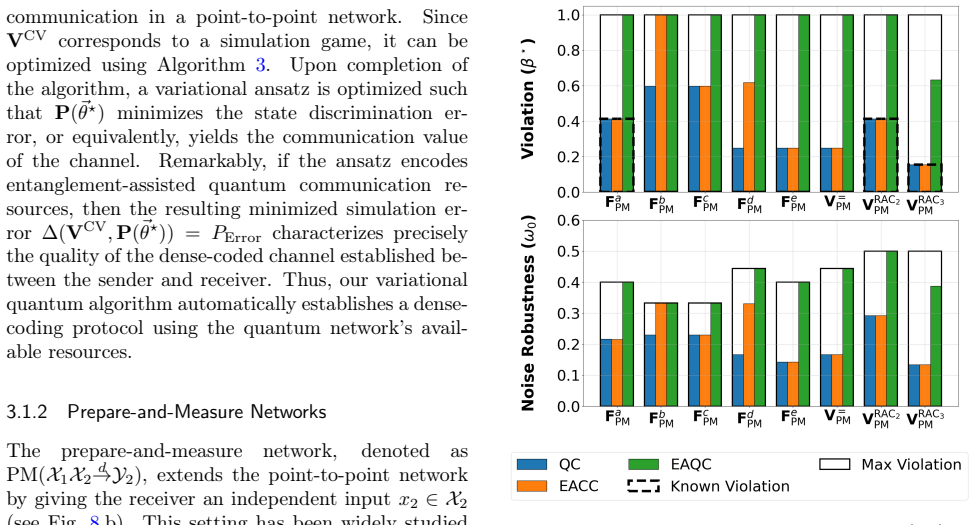
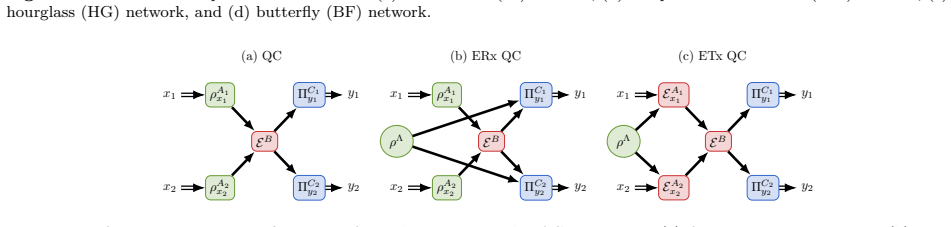
Quantum resources, such as entanglement or quantum communication, offer significant communication advantages in information processing. We develop an operational framework for realizing these communication advantages in resource-constrained quantum networks. The framework computes linear bounds on the input/output probabilities of classical networks with limited communication and globally shared randomness. Since the violation of these classical bounds witnesses nonclassicality, a measurable communication advantage, the framework maximizes the violation of the classical bound using variational quantum optimization methods tailored to the communication network and quantum resources. This operational framework for nonclassicality can be scaled on quantum computers or deployed in the field to optimize noisy quantum networks for communication advantages. Applying this framework, we investigate the nonclassicality of communication networks that are assisted by quantum resources. We find that entanglement between communication-constrained parties is sufficient for nonclassicality to be found, whereas in networks with multiple senders, quantum communication with no entanglement-assistance is sufficient for nonclassicality to be found. As a result, entanglement is necessary for nonclassicality when a single sender broadcasts to multiple receivers.
Editorial analysis
A structured set of objections, weighed in public.
Referee Report
Summary. The paper develops an operational framework that derives linear bounds on input/output probabilities for classical communication networks under limited communication and globally shared randomness; violations of these bounds certify nonclassicality. It then employs variational quantum optimization, tailored to the network topology and available quantum resources, to maximize such violations. Applying the framework to several assisted networks, the authors report that entanglement suffices for nonclassicality in some topologies, while quantum communication without entanglement suffices in others, leading to the conclusion that entanglement is necessary for nonclassicality in the single-sender broadcast-to-multiple-receivers case.
Significance. If the necessity result can be placed on rigorous footing, the framework would supply a concrete, scalable method for certifying and optimizing measurable communication advantages in resource-constrained quantum networks, with direct relevance to near-term devices. The separation of entanglement-assisted versus unassisted quantum communication advantages across topologies would also sharpen resource requirements for quantum network design.
major comments (2)
- [Abstract] Abstract (final sentence) and the single-sender broadcast results: the necessity claim that entanglement is required rests on the observation that variational quantum optimization finds no violation of the classical bound when entanglement is withheld. Because variational methods supply no global-optimality certificate, a reported violation of zero only shows that the chosen ansatz and optimizer did not locate a violating strategy; it does not establish that none exists under the stated classical constraints and shared randomness.
- [Framework and results] Framework description and results sections: the classical linear bounds are obtained from an exact method (linear programming over the communication constraints), while the quantum search is performed variationally. This asymmetry means the 'no nonclassicality without entanglement' statement for the broadcast network is not a rigorous non-existence result and is therefore not load-bearing for the necessity conclusion in its current form.
minor comments (2)
- [Abstract] The abstract and introduction could more explicitly separate the sufficient conditions (entanglement or quantum communication) from the necessity claim, which currently appears only in the final sentence.
- Notation for the classical bound (e.g., the linear functional being optimized) and the variational objective should be unified between the main text and any figures or tables that report numerical values.
Simulated Author's Rebuttal
We thank the referee for their detailed review and valuable feedback on our manuscript. We address the concerns regarding the rigor of the necessity claim for entanglement in the single-sender broadcast case. We agree that the variational optimization does not provide a global optimality guarantee, and we will revise the manuscript to clarify this limitation and adjust our conclusions accordingly.
read point-by-point responses
-
Referee: [Abstract] Abstract (final sentence) and the single-sender broadcast results: the necessity claim that entanglement is required rests on the observation that variational quantum optimization finds no violation of the classical bound when entanglement is withheld. Because variational methods supply no global-optimality certificate, a reported violation of zero only shows that the chosen ansatz and optimizer did not locate a violating strategy; it does not establish that none exists under the stated classical constraints and shared randomness.
Authors: We concur with the referee's assessment. The variational quantum optimization employed in our work does not certify global optimality, meaning that the absence of a detected violation without entanglement does not rigorously demonstrate that no violating strategy exists. In the revised manuscript, we will modify the abstract's final sentence and the discussion in the results section to present this as a numerical finding from our optimization procedure rather than a proof of necessity. We will explicitly note the limitations of variational methods in establishing non-existence. revision: yes
-
Referee: [Framework and results] Framework description and results sections: the classical linear bounds are obtained from an exact method (linear programming over the communication constraints), while the quantum search is performed variationally. This asymmetry means the 'no nonclassicality without entanglement' statement for the broadcast network is not a rigorous non-existence result and is therefore not load-bearing for the necessity conclusion in its current form.
Authors: We acknowledge this important point about the methodological asymmetry. The classical bounds are indeed computed exactly via linear programming, whereas the quantum strategies are explored variationally. Consequently, we will revise the framework description and results sections to avoid claiming a rigorous non-existence result. The text will be updated to highlight that our conclusions on the necessity of entanglement are supported by numerical evidence but require further analytical confirmation for rigor. This revision will ensure the claims are appropriately qualified. revision: yes
Circularity Check
No circularity: classical bounds derived directly from network model; quantum search is independent
full rationale
The framework first computes linear bounds on input/output probabilities from the explicit classical network model (limited communication + globally shared randomness). These bounds are then used as fixed targets for a separate variational quantum optimization step that searches for violations. The reported sufficiency/necessity statements are conclusions drawn from the presence or absence of detected violations, not reductions of the bounds themselves to fitted parameters or self-citations. No self-definitional steps, fitted-input-as-prediction, or load-bearing self-citation chains appear in the derivation. The chain is self-contained against the stated model assumptions.
Axiom & Free-Parameter Ledger
axioms (1)
- domain assumption Classical networks achieve at most the linear bounds computed from communication constraints and shared randomness
Reference graph
Works this paper leans on
-
[1]
H. J. Kimble. “The quantum internet”. Nature 453, 1023–1030 (2008). arXiv:0806.4195
work page internal anchor Pith review Pith/arXiv arXiv 2008
-
[2]
Quantum networking and internetworking
Rodney Van Meter. “Quantum networking and internetworking”. IEEE Network26, 59– 64 (2012)
work page 2012
-
[3]
Quantum internet: A vision for the road ahead
Stephanie Wehner, David Elkouss, and Ronald Hanson. “Quantum internet: A vision for the road ahead”. Science362 (2018)
work page 2018
-
[4]
Amoldeep Singh, Kapal Dev, Harun Siljak, Hem Dutt Joshi, and Maurizio Magarini. “Quan- tum internet—applications, functionalities, en- abling technologies, challenges, and research di- rections”. IEEE Communications Surveys & Tu- torials 23, 2218–2247 (2021). arXiv:2101.04427
-
[5]
Quantum Communication Complexity (A Survey)
Gilles Brassard. “Quantum communication complexity”. Foundations of Physics 33, 1593–1616 (2003). arXiv:quant-ph/0101005. 26
work page internal anchor Pith review Pith/arXiv arXiv 2003
-
[6]
Non-locality and Communication Complexity
Harry Buhrman, Richard Cleve, Serge Massar, and Ronald de Wolf. “Nonlocality and commu- nication complexity”. Rev. Mod. Phys.82, 665– 698 (2010). arXiv:0907.3584
work page internal anchor Pith review Pith/arXiv arXiv 2010
-
[7]
Entanglement-assisted capacity of a quantum channel and the reverse Shannon theorem
C.H. Bennett, P.W. Shor, J.A. Smolin, and A.V. Thapliyal. “Entanglement-assisted capacity of a quantum channel and the reverse shannon theo- rem”. IEEE Transactions on Information Theory 48, 2637–2655 (2002). arXiv:quant-ph/0106052
work page internal anchor Pith review Pith/arXiv arXiv 2002
-
[8]
Compression of sources of probability distributions and density operators
Andreas Winter. “Compression of sources of probability distributions and density opera- tors” (2002). arXiv:quant-ph/0208131
work page internal anchor Pith review Pith/arXiv arXiv 2002
-
[9]
Quantum Reverse Shannon Theorem
Charles H. Bennett, Igor Devetak, Aram W. Harrow, Peter W. Shor, and Andreas Winter. “The quantum reverse shannon theorem and re- source tradeoffs for simulating quantum chan- nels”. IEEE Transactions on Information Theory 60, 2926–2959 (2014). arXiv:0912.5537
work page internal anchor Pith review Pith/arXiv arXiv 2014
-
[10]
Zero-error channel capacity and simulation assisted by non-local correlations
Toby S. Cubitt, Debbie Leung, William Matthews, and Andreas Winter. “Zero-error channel capacity and simulation assisted by non-local correlations”. IEEE Transactions on Information Theory 57, 5509–5523 (2011). arXiv:1003.3195
work page internal anchor Pith review Pith/arXiv arXiv 2011
-
[11]
Bounds for the quantity of information transmitted by a quantum communication channel
Alexander Semenovich Holevo. “Bounds for the quantity of information transmitted by a quantum communication channel”. Prob- lemy Peredachi Informatsii 9, 3–11 (1973). url: www.mathnet.ru/eng/ppi903
work page 1973
-
[12]
Classical information storage in an $n$-level quantum system
Péter E. Frenkel and Mihály Weiner. “Classical information storage in an n-level quantum sys- tem”. Communications in Mathematical Physics 340, 563–574 (2015). arXiv:1304.5723
work page internal anchor Pith review Pith/arXiv arXiv 2015
-
[13]
Testing dimension and non-classicality in communication networks
Joseph Bowles, Nicolas Brunner, and Marcin Pawłowski. “Testing dimension and nonclassical- ity in communication networks”. Phys. Rev. A 92, 022351 (2015). arXiv:1505.01736
work page internal anchor Pith review Pith/arXiv arXiv 2015
-
[14]
On the Einstein Podolsky Rosen paradox
John S Bell. “On the Einstein Podolsky Rosen paradox”. Physics Physique Fizika1, 195 (1964)
work page 1964
-
[15]
Nicolas Brunner, Daniel Cavalcanti, Stefano Pironio, Valerio Scarani, and Stephanie Wehner. “Bell nonlocality”. Rev. Mod. Phys.86, 419– 478 (2014). arXiv:1303.2849
work page internal anchor Pith review Pith/arXiv arXiv 2014
-
[16]
Classical simulation of quantum entanglement without local hidden variables
Serge Massar, Dave Bacon, Nicolas J. Cerf, and Richard Cleve. “Classical simulation of quantum entanglement without local hidden variables”. Phys. Rev. A63, 052305 (2001). arXiv:quant- ph/0009088
-
[17]
Bell Inequalities with Auxiliary Communication
D. Bacon and B. F. Toner. “Bell inequalities with auxiliary communication”. Phys. Rev. Lett.90, 157904 (2003). arXiv:quant-ph/0208057
work page internal anchor Pith review Pith/arXiv arXiv 2003
-
[18]
The Communication Cost of Simulating Bell Correlations
B. F. Toner and D. Bacon. “Communication cost of simulating bell correlations”. Phys. Rev. Lett. 91, 187904 (2003). arXiv:quant-ph/0304076
work page internal anchor Pith review Pith/arXiv arXiv 2003
-
[19]
Simulating Quantum Correlations with Finite Communication
Oded Regev and Ben Toner. “Simulating quantum correlations with finite communica- tion”. SIAM Journal on Computing39, 1562– 1580 (2010). arXiv:0708.0827
work page internal anchor Pith review Pith/arXiv arXiv 2010
-
[20]
Bell Inequalities with Communication Assistance
Katherine Maxwell and Eric Chitambar. “Bell in- equalities with communication assistance”. Phys. Rev. A89, 042108 (2014). arXiv:1405.3211
work page internal anchor Pith review Pith/arXiv arXiv 2014
-
[21]
Bell scenarios with communication
J B Brask and R Chaves. “Bell scenarios with communication”. Journal of Physics A: Math- ematical and Theoretical 50, 094001 (2017). arXiv:1607.08182
work page internal anchor Pith review Pith/arXiv arXiv 2017
-
[22]
Bell inequalities with one bit of communication
Emmanuel Zambrini Cruzeiro and Nicolas Gisin. “Bell inequalities with one bit of communication”. Entropy21, 171 (2019). arXiv:1812.05107
work page internal anchor Pith review Pith/arXiv arXiv 2019
-
[23]
Advantage of hardy’s nonlocal correlation in reverse zero-error channel coding
Mir Alimuddin, Ananya Chakraborty, Govind Lal Sidhardh, Ram Krishna Patra, Samrat Sen, Snehasish Roy Chowdhury, Sahil Gopalkrishna Naik, and Manik Banik. “Advantage of hardy’s nonlocal correlation in reverse zero-error channel coding”. Phys. Rev. A 108, 052430 (2023). arXiv:2303.06848
-
[24]
On entan- glement assistance to a noiseless classical chan- nel
Péter E. Frenkel and Mihály Weiner. “On entan- glement assistance to a noiseless classical chan- nel”. Quantum6, 662 (2022). arXiv:2103.08567
-
[25]
Michele Dall’Arno, Sarah Brandsen, Alessandro Tosini, Francesco Buscemi, and Vlatko Vedral. “No-hypersignaling principle”. Phys. Rev. Lett. 119, 020401 (2017). arXiv:1609.09237
work page internal anchor Pith review Pith/arXiv arXiv 2017
-
[26]
Communi- cation of partial ignorance with qubits
Teiko Heinosaari and Oskari Kerppo. “Communi- cation of partial ignorance with qubits”. Journal of Physics A: Mathematical and Theoretical52, 395301 (2019). arXiv:1903.04899
-
[27]
Communication tasks in opera- tional theories
Teiko Heinosaari, Oskari Kerppo, and Leevi Leppäjärvi. “Communication tasks in opera- tional theories”. Journal of Physics A: Math- ematical and Theoretical 53, 435302 (2020). arXiv:2003.05264
-
[28]
Criteria for nonclassicality in the prepare-and-measure sce- nario
Davide Poderini, Samuraí Brito, Ranieri Nery, Fabio Sciarrino, and Rafael Chaves. “Criteria for nonclassicality in the prepare-and-measure sce- nario”. Phys. Rev. Res.2, 043106 (2020)
work page 2020
-
[29]
Certify- ing the classical simulation cost of a quantum channel
Brian Doolittle and Eric Chitambar. “Certify- ing the classical simulation cost of a quantum channel”. Phys. Rev. Res. 3, 043073 (2021). arXiv:2102.12543
-
[30]
Correlations in entanglement-assisted prepare-and-measure sce- narios
Armin Tavakoli, Jef Pauwels, Erik Wood- head, and Stefano Pironio. “Correlations in entanglement-assisted prepare-and-measure sce- narios”. PRX Quantum 2, 040357 (2021). arXiv:2103.10748
-
[31]
Classical cost of trans- mitting a qubit
Martin J. Renner, Armin Tavakoli, and Marco Túlio Quintino. “Classical cost of trans- mitting a qubit”. Phys. Rev. Lett. 130, 120801 (2023). arXiv:2207.02244. 27
-
[32]
Nonsignaling quantum random access code boxes
Andrzej Grudka, Michał Horodecki, Ryszard Horodecki, and Antoni Wójcik. “Nonsignaling quantum random access-code boxes”. Phys. Rev. A 92, 052312 (2015). arXiv:1403.1295
work page internal anchor Pith review Pith/arXiv arXiv 2015
-
[33]
Quantum Random Access Codes using Single $d$-level Systems
Armin Tavakoli, Alley Hameedi, Breno Marques, and Mohamed Bourennane. “Quantum random access codes using singled-level systems”. Phys. Rev.Lett. 114, 170502(2015). arXiv:1504.08105
work page internal anchor Pith review Pith/arXiv arXiv 2015
-
[34]
Random access test as an identifier of nonclassicality
TeikoHeinosaariandLeeviLeppäjärvi. “Random access test as an identifier of nonclassicality”. Journal of Physics A: Mathematical and Theo- retical 55, 174003 (2022). arXiv:2112.03781
-
[35]
Entanglement-assisted quantum communication with simple measure- ments
Amélie Piveteau, Jef Pauwels, Emil Håkans- son, Sadiq Muhammad, Mohamed Bourennane, and Armin Tavakoli. “Entanglement-assisted quantum communication with simple measure- ments”. Nature Communications 13 (2022). arXiv:2205.09602
-
[36]
Two instances of random access code in the quantum regime
Nitica Sakharwade, Michał Studziński, Michał Eckstein, and Paweł Horodecki. “Two instances of random access code in the quantum regime”. New Journal of Physics 25, 053038 (2023). arXiv:2208.14422
-
[37]
Witnessing nonclassical- ity in a causal structure with three observable variables
Pedro Lauand, Davide Poderini, Ranieri Nery, George Moreno, Lucas Pollyceno, Rafael Rabelo, and Rafael Chaves. “Witnessing nonclassical- ity in a causal structure with three observable variables”. PRX Quantum 4, 020311 (2023). arXiv:2211.13349
-
[38]
Varia- tional quantum optimization of nonlocality in noisy quantum networks
Brian Doolittle, Thomas R. Bromley, Nathan Killoran, and Eric Chitambar. “Varia- tional quantum optimization of nonlocality in noisy quantum networks”. IEEE Transactions on Quantum EngineeringPages 1–28 (2023). arXiv:2205.02891
-
[39]
qnetvo: the quantum network variational optimizer
Brian Doolittle and Tom Bromley. “qnetvo: the quantum network variational optimizer” (2022). url: github.com/ChitambarLab/qNetVO
work page 2022
-
[40]
Nonclassicality in noisy quantum networks
Brian Doolittle. “Nonclassicality in noisy quantum networks”. Phd thesis. Univer- sity of Illinois Urbana-Champaign. (2023). url: hdl.handle.net/2142/121945
work page 2023
-
[41]
Adaptive circuit learn- ing for quantum metrology
Ziqi Ma, Pranav Gokhale, Tian-Xing Zheng, Sisi Zhou, Xiaofei Yu, Liang Jiang, Peter Maurer, and Frederic T. Chong. “Adaptive circuit learn- ing for quantum metrology”. In 2021 IEEE In- ternational Conference on Quantum Computing and Engineering (QCE). Pages 419–430. (2021). arXiv:2010.08702
-
[42]
Infer- ring quantum network topology using local mea- surements
Daniel T. Chen, Brian Doolittle, Jeffrey Larson, Zain H. Saleem, and Eric Chitambar. “Infer- ring quantum network topology using local mea- surements”. PRX Quantum4, 040347 (2023). arXiv:2212.07987
-
[43]
Simple information-processing tasks with unbounded quantum advantage
Teiko Heinosaari, Oskari Kerppo, Leevi Leppäjärvi, and Martin Plávala. “Simple information-processing tasks with unbounded quantum advantage”. Phys. Rev. A 109, 032627 (2024)
work page 2024
-
[44]
Armin Tavakoli, Alejandro Pozas-Kerstjens, Ming-Xing Luo, and Marc-Olivier Renou. “Bell nonlocality in networks”. Reports on Progress in Physics 85, 056001 (2022). arXiv:2104.10700
-
[45]
Quantifying Bell non-locality with the trace distance
S. G. A. Brito, B. Amaral, and R. Chaves. “Quantifying bell nonlocality with the trace distance”. Phys. Rev. A 97, 022111 (2018). arXiv:1709.04260
work page internal anchor Pith review Pith/arXiv arXiv 2018
-
[46]
G.M. Ziegler. “Lectures on polytopes”. Grad- uate Texts in Mathematics. Springer New York (2012)
work page 2012
-
[47]
Classifying 50 years of Bell inequalities
Denis Rosset, Jean-Daniel Bancal, and Nicolas Gisin. “Classifying 50 years of bell inequalities”. Journal of Physics A: Mathematical and Theo- retical 47, 424022 (2014). arXiv:1404.1306
work page internal anchor Pith review Pith/arXiv arXiv 2014
-
[48]
Thomas Christof and Andreas Löbel. “Porta” (1997). url: http://porta.zib.de/
work page 1997
-
[49]
Supplementary code for operational nonclassicality in quan- tum communication networks
Brian Doolittle. “Supplementary code for operational nonclassicality in quan- tum communication networks” (2024). url: github.com/ChitambarLab/nonclassicality- in-quantum-communication-networks- supplemental-code
work page 2024
-
[50]
Non-locality breaking qubit channels
Rajarshi Pal and Sibasish Ghosh. “Non-locality breaking qubit channels: the case for chsh inequality”. Journal of Physics A: Mathe- matical and Theoretical 48, 155302 (2015). arXiv:1306.3151
work page internal anchor Pith review Pith/arXiv arXiv 2015
-
[51]
Channel activation of chsh nonlocality
Yujie Zhang, Rodrigo Araiza Bravo, Virginia O Lorenz, and Eric Chitambar. “Channel activation of chsh nonlocality”. New Journal of Physics22, 043003 (2020). arXiv:1911.06349
-
[52]
PennyLane: Automatic differentiation of hybrid quantum-classical computations
Ville Bergholm, Josh Izaac, Maria Schuld, Christian Gogolin, Shahnawaz Ahmed, Vishnu Ajith, M Sohaib Alam, Guillermo Alonso- Linaje, B AkashNarayanan, Ali Asadi, et al. “Pennylane: Automatic differentiation of hy- brid quantum-classical computations” (2018). arXiv:1811.04968
work page internal anchor Pith review Pith/arXiv arXiv 2018
-
[53]
Quan- tum computation and quantum information
Michael A. Nielsen and Isaac L. Chuang. “Quan- tum computation and quantum information”. Cambridge University Press (2009)
work page 2009
-
[54]
Learning representations by back-propagating errors
David E Rumelhart, Geoffrey E Hinton, and Ronald J Williams. “Learning representations by back-propagating errors”. Nature323, 533– 536 (1986)
work page 1986
-
[55]
Evaluating analytic gradients on quantum hardware
Maria Schuld, Ville Bergholm, Christian Gogolin, Josh Izaac, and Nathan Killoran. “Evaluating analytic gradients on quantum 28 hardware”. Phys. Rev. A 99, 032331 (2019). arXiv:1811.11184
work page internal anchor Pith review Pith/arXiv arXiv 2019
-
[56]
Estimating the gradient and higher- order derivatives on quantum hardware
Andrea Mari, Thomas R. Bromley, and Nathan Killoran. “Estimating the gradient and higher- order derivatives on quantum hardware”. Phys. Rev. A103, 012405 (2021). arXiv:2008.06517
-
[57]
General parameter-shift rules for quantum gradients
David Wierichs, Josh Izaac, Cody Wang, and Cedric Yen-Yu Lin. “General parameter-shift rules for quantum gradients”. Quantum 6, 677 (2022). arXiv:2107.12390
-
[58]
Generalized quantum circuit differentia- tion rules
Oleksandr Kyriienko and Vincent E. Elfv- ing. “Generalized quantum circuit differentia- tion rules”. Phys. Rev. A104, 052417 (2021). arXiv:2108.01218
-
[59]
An overview of gradient descent optimization algorithms
Sebastian Ruder. “An overview of gradi- ent descent optimization algorithms” (2016). arXiv:1609.04747
work page internal anchor Pith review Pith/arXiv arXiv 2016
-
[60]
Adam: A Method for Stochastic Optimization
Diederik P Kingma and Jimmy Ba. “Adam: A method for stochastic optimization” (2014). arXiv:1412.6980
work page internal anchor Pith review Pith/arXiv arXiv 2014
-
[61]
Variational quantum algorithms
M. Cerezo, Andrew Arrasmith, Ryan Babbush, Simon C. Benjamin, Suguru Endo, Keisuke Fujii, Jarrod R. McClean, Kosuke Mitarai, Xiao Yuan, Lukasz Cincio, and Patrick J. Coles. “Variational quantum algorithms”. Nature Reviews Physics3, 625–644 (2021). arXiv:2012.09265
-
[62]
The communication value of a quantum channel
Eric Chitambar, Ian George, Brian Doolittle, and Marius Junge. “The communication value of a quantum channel”. IEEE Transactions on Information Theory 69, 1660–1679 (2023). arXiv:2109.11144
-
[63]
Communication via one- and two-particle oper- ators on einstein-podolsky-rosen states
Charles H. Bennett and Stephen J. Wiesner. “Communication via one- and two-particle oper- ators on einstein-podolsky-rosen states”. Phys. Rev. Lett.69, 2881–2884 (1992)
work page 1992
-
[64]
Device-independent tests of classical and quantum dimensions
Rodrigo Gallego, Nicolas Brunner, Christopher Hadley, and Antonio Acín. “Device-independent tests of classical and quantum dimensions”. Phys. Rev. Lett.105, 230501 (2010). arXiv:1010.5064
work page internal anchor Pith review Pith/arXiv arXiv 2010
-
[65]
Quantum Random Access Codes with Shared Randomness
Andris Ambainis, Debbie Leung, Laura Mancin- ska, and Maris Ozols. “Quantum random ac- cess codes with shared randomness” (2008). arXiv:0810.2937
work page internal anchor Pith review Pith/arXiv arXiv 2008
-
[66]
Semi-device-independent security of one-way quantum key distribution
Marcin Pawłowski and Nicolas Brunner. “Semi- device-independent security of one-way quan- tum key distribution”. Phys. Rev. A 84, 010302 (2011). arXiv:1103.4105
work page internal anchor Pith review Pith/arXiv arXiv 2011
-
[67]
Semi-device independent random number expansion without entanglement
Hong-Wei Li, Zhen-Qiang Yin, Yu-Chun Wu, Xu-Bo Zou, Shuang Wang, Wei Chen, Guang- Can Guo, and Zheng-Fu Han. “Semi-device- independent random-number expansion without entanglement”. Phys. Rev. A84, 034301 (2011). arXiv:1108.1480
work page internal anchor Pith review Pith/arXiv arXiv 2011
-
[68]
Semi- device-independent certification of entanglement in superdense coding
George Moreno, Ranieri Nery, Carlos de Gois, Rafael Rabelo, and Rafael Chaves. “Semi- device-independent certification of entanglement in superdense coding”. Phys. Rev. A 103, 022426 (2021). arXiv:2102.02709
-
[69]
Self-testing quantum states and measurements in the prepare-and-measure scenario
Armin Tavakoli, J ędrzej Kaniewski, Tamás Vértesi, Denis Rosset, and Nicolas Brunner. “Self-testing quantum states and measurements in the prepare-and-measure scenario”. Phys. Rev. A 98, 062307 (2018). arXiv:1801.08520
work page internal anchor Pith review Pith/arXiv arXiv 2018
-
[70]
Marcin Pawłowski and Andreas Winter. ““hy- perbits”: The information quasiparticles”. Phys. Rev. A85, 022331 (2012). arXiv:1106.2409
-
[71]
Adaptive advantage in entanglement-assisted communica- tions
Jef Pauwels, Stefano Pironio, Emmanuel Zam- brini Cruzeiro, and Armin Tavakoli. “Adaptive advantage in entanglement-assisted communica- tions”. Phys. Rev. Lett. 129, 120504 (2022). arXiv:2203.05372
-
[72]
Quantum nonlocality as an axiom
Sandu Popescu and Daniel Rohrlich. “Quantum nonlocality as an axiom”. Foundations of Physics 24, 379–385 (1994)
work page 1994
-
[73]
Proposed ex- periment to test local hidden-variable theories
John F. Clauser, Michael A. Horne, Abner Shi- mony, and Richard A. Holt. “Proposed ex- periment to test local hidden-variable theories”. Phys. Rev. Lett.23, 880–884 (1969)
work page 1969
-
[74]
Train- ing variational quantum algorithms is np- hard
Lennart Bittel and Martin Kliesch. “Train- ing variational quantum algorithms is np- hard”. Phys. Rev. Lett. 127, 120502 (2021). arXiv:2101.07267
-
[75]
Brian Doolittle. “Bellscenario.jl” (2020). url: github.com/ChitambarLab/BellScenario.jl
work page 2020
- [76]
-
[77]
Benoît Legat, Robin Deits, Gustavo Goretkin, Twan Koolen, Joey Huchette, Daisuke Oyama, and Marcelo Forets. “Polyhedra.jl” (2021). url: github.com/JuliaPolyhedra/Polyhedra.jl
work page 2021
-
[78]
Parallelizing the dual revised simplex method
Qi Huangfu and JA Julian Hall. “Parallelizing the dual revised simplex method”. Mathematical Programming Computation10, 119–142 (2018). arXiv:1503.01889
work page internal anchor Pith review Pith/arXiv arXiv 2018
-
[79]
JuMP: A Modeling Language for Mathematical Optimization
Iain Dunning, Joey Huchette, and Miles Lubin. “Jump: A modeling language for mathematical optimization”. SIAM Review59, 295–320 (2017). arXiv:1508.01982. 29 A Linear Nonclassicality Witnesses for Bipartite Scenarios 2≥= Fa3→4 1 0 0 1 0 0 0 1 0 0 0 1 3≥Fc4→4 = 1 1 0 0 1 0 1 0 0 1 1 0 0 0 0 1 4≥Fe4→4 = 2 0 0 0 0 2 0 0 0 0 ...
work page internal anchor Pith review Pith/arXiv arXiv 2017
-
[80]
(Bottom) Complete set of six facet inequalities for the multiaccess network polytopeCMA(3,3 → {2,3}
[13]. (Bottom) Complete set of six facet inequalities for the multiaccess network polytopeCMA(3,3 → {2,3}
discussion (0)
Sign in with ORCID, Apple, or X to comment. Anyone can read and Pith papers without signing in.