Energetic Spectral-Element Time Marching Methods for Phase-Field Nonlinear Gradient Systems
Pith reviewed 2026-05-23 23:41 UTC · model grok-4.3
The pith
Energetic variational Galerkin spectral-element methods preserve mass conservation and energy dissipation while achieving superconvergence for phase-field systems.
A machine-rendered reading of the paper's core claim, the machinery that carries it, and where it could break.
Core claim
The central claim is that an energetic variational Galerkin formulation inside spectral-element time discretization exactly inherits the mass conservation and energy dissipation properties of the underlying continuous dynamical system, yields superconvergence, and delivers better practical performance than established fourth-order integrators when the polynomial degree is three.
What carries the argument
The energetic variational Galerkin form, which enforces discrete-level inheritance of continuous conservation and dissipation through the chosen polynomial spaces and quadrature.
If this is right
- The methods apply directly to general large-scale nonlinear dynamical systems beyond phase-field models.
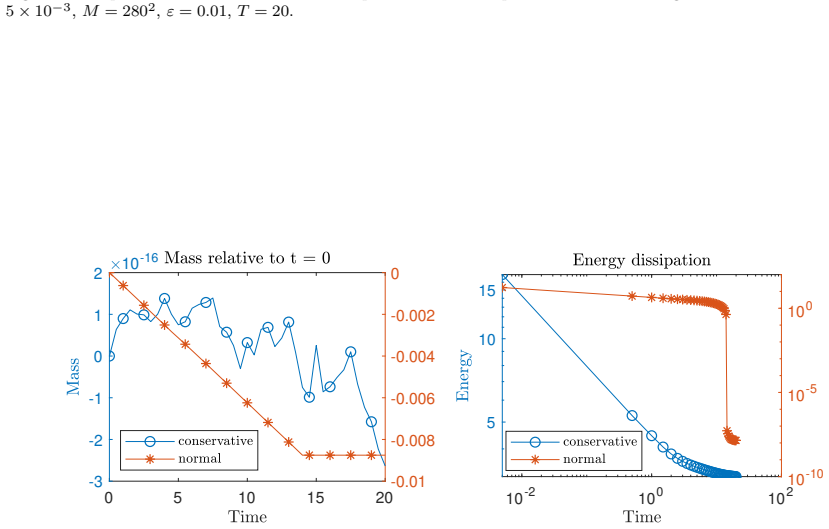
- Discrete total mass remains conserved when the scheme is applied to conservative Allen-Cahn equations.
- A few Picard-like iterations suffice to restore superconvergence in the semi-implicit version.
- The approach is not limited to Allen-Cahn equations and works for other nonlinear gradient systems.
Where Pith is reading between the lines
- The preservation property could support stable long-time integration of phase-separation models without artificial drift.
- Similar energetic variational constructions might improve structure preservation in other high-order time discretizations for gradient flows.
- The observed advantage of degree three over fourth-order multistep and exponential integrators may depend on spatial dimension or the specific form of the nonlinearity.
- pith_inferences
Load-bearing premise
The energetic variational Galerkin discretization exactly inherits the continuous system's conservation laws at the discrete level for the selected polynomial spaces and quadrature rules.
What would settle it
A simulation run in which the discrete energy increases over multiple time steps or total mass drifts away from its initial value would falsify the claimed inheritance of conservation properties.
Figures


read the original abstract
We propose two efficient energetic spectral-element methods in time for marching nonlinear gradient systems with the phase-field Allen--Cahn equation as an example: one fully implicit nonlinear method and one semi-implicit linear method. Different from other spectral methods in time using spectral Petrov-Galerkin or weighted Galerkin approximations, the presented implicit method employs an energetic variational Galerkin form that can maintain the mass conservation and energy dissipation property of the continuous dynamical system. Another advantage of this method is its superconvergence. A high-order extrapolation is adopted for the nonlinear term to get the semi-implicit method. The semi-implicit method does not have superconvergence, but can be improved by a few Picard-like iterations to recover the superconvergence of the implicit method. Numerical experiments verify that the method using Legendre elements of degree three outperforms the 4th-order implicit-explicit backward differentiation formula and the 4th-order exponential time difference Runge-Kutta method, which were known to have best performances in solving phase-field equations. In addition to the standard Allen--Cahn equation, we also apply the method to a conservative Allen--Cahn equation, in which the conservation of discrete total mass is verified. The applications of the proposed methods are not limited to phase-field Allen--Cahn equations. They are suitable for solving general, large-scale nonlinear dynamical systems.
Editorial analysis
A structured set of objections, weighed in public.
Referee Report
Summary. The manuscript proposes two energetic spectral-element time-marching methods for nonlinear gradient systems, using the Allen-Cahn equation as example. The fully implicit method employs an energetic variational Galerkin formulation claimed to preserve mass conservation and energy dissipation of the continuous system while achieving superconvergence. The semi-implicit variant uses high-order extrapolation for linearity and recovers superconvergence via Picard iterations. Numerical experiments indicate that the degree-3 Legendre version outperforms 4th-order IMEX-BDF and ETDRK schemes; the approach is also applied to a conservative Allen-Cahn equation to verify discrete mass conservation and is positioned for general nonlinear dynamical systems.
Significance. If the energetic variational Galerkin discretization rigorously inherits the continuous energy-dissipation identity and mass conservation at the algebraic level for the chosen spaces and quadrature, and if superconvergence is established, the methods would supply efficient, structure-preserving high-order integrators for phase-field models. The reported numerical outperformance and extension to conservative variants provide practical value; the variational derivation without ad-hoc parameters is a positive feature.
major comments (1)
- [Abstract and method formulation] Abstract and method formulation: the central claim that the energetic variational Galerkin form 'can maintain the mass conservation and energy dissipation property of the continuous dynamical system' is load-bearing for the paper's contribution, yet the manuscript must supply the explicit algebraic steps demonstrating that the discrete inner product, test-function space, and quadrature exactly reproduce the integration-by-parts identity and nonlinear potential without remainder; for the cubic nonlinearity of Allen-Cahn this is not automatic and requires verification that no quadrature error appears in the energy law.
minor comments (2)
- [Numerical experiments] Numerical experiments section: the claim that the degree-3 version 'outperforms' the 4th-order IMEX-BDF and ETDRK methods should include tabulated error values, observed convergence rates, and precise problem parameters (mesh size, time-step range, tolerance) to allow direct comparison.
- [Abstract] Abstract: the term 'superconvergence' is invoked without stating the observed temporal order or referencing the supporting analysis or tables.
Simulated Author's Rebuttal
We thank the referee for the careful reading and constructive feedback. The major comment on providing explicit algebraic verification of the discrete energy law is addressed below.
read point-by-point responses
-
Referee: [Abstract and method formulation] Abstract and method formulation: the central claim that the energetic variational Galerkin form 'can maintain the mass conservation and energy dissipation property of the continuous dynamical system' is load-bearing for the paper's contribution, yet the manuscript must supply the explicit algebraic steps demonstrating that the discrete inner product, test-function space, and quadrature exactly reproduce the integration-by-parts identity and nonlinear potential without remainder; for the cubic nonlinearity of Allen-Cahn this is not automatic and requires verification that no quadrature error appears in the energy law.
Authors: We agree that an explicit algebraic verification is required to substantiate the central claim, particularly for the cubic nonlinearity where quadrature effects are not automatic. The current manuscript presents the energetic variational formulation and states the preservation properties but does not include the full step-by-step algebraic expansion showing exact reproduction of the integration-by-parts identity and nonlinear potential without remainder. In the revised version we will insert a dedicated subsection that carries out this derivation for the chosen spectral-element spaces and quadrature rules, confirming that the discrete energy dissipation law holds exactly. revision: yes
Circularity Check
No circularity: derivation rests on independent variational construction and external numerical benchmarks.
full rationale
The paper constructs the energetic variational Galerkin form from first-principles variational principles applied to the continuous gradient system, then discretizes in a spectral-element time basis. The claimed discrete mass conservation and energy dissipation follow directly from the algebraic structure of the chosen test spaces and quadrature (stated as an exact inheritance), without any reduction to fitted parameters, self-referential definitions, or load-bearing self-citations. Performance claims are supported by direct comparison to independent fourth-order IMEX-BDF and ETDRK schemes on Allen-Cahn problems, which are external benchmarks. No step in the provided derivation chain collapses to an input by construction.
Axiom & Free-Parameter Ledger
axioms (2)
- domain assumption The energetic variational Galerkin form inherits the continuous system's mass conservation and energy dissipation exactly at the discrete level.
- standard math Standard spectral-element approximation theory and quadrature rules apply without additional consistency errors that would violate conservation.
Lean theorems connected to this paper
-
IndisputableMonolith/Cost/FunctionalEquation.leanwashburn_uniqueness_aczel echoes?
echoesECHOES: this paper passage has the same mathematical shape or conceptual pattern as the Recognition theorem, but is not a direct formal dependency.
the presented implicit method employs an energetic variational Galerkin form that can maintain the mass conservation and energy dissipation property of the continuous dynamical system
-
IndisputableMonolith/Foundation/RealityFromDistinction.leanreality_from_one_distinction unclear?
unclearRelation between the paper passage and the cited Recognition theorem.
By setting v = h in (8), we immediately obtain the discrete energy law: E[h(x,T)]-E[h(x,0)]=-∫(h_t,h_t)dt≤0
What do these tags mean?
- matches
- The paper's claim is directly supported by a theorem in the formal canon.
- supports
- The theorem supports part of the paper's argument, but the paper may add assumptions or extra steps.
- extends
- The paper goes beyond the formal theorem; the theorem is a base layer rather than the whole result.
- uses
- The paper appears to rely on the theorem as machinery.
- contradicts
- The paper's claim conflicts with a theorem or certificate in the canon.
- unclear
- Pith found a possible connection, but the passage is too broad, indirect, or ambiguous to say the theorem truly supports the claim.
Reference graph
Works this paper leans on
-
[1]
J. W. Cahn, J. E. Hilliard, Free energy of a nonuniform system. I. Interfacial free energy, J. Chem. Phys. 28 (2) (1958) 258–267. doi:10.1063/1.1744102
-
[2]
S. M. Allen, J. W. Cahn, A microscopic theory for antiphase boundary motion and its appli- cation to antiphase domain coarsening, Acta Met. Mater 27 (1979) 1085–1095. doi:10.1016/ 0001-6160(79)90196-2
work page 1979
-
[3]
Chen, Phase-field models for microstructure evolution, Annu
L.-Q. Chen, Phase-field models for microstructure evolution, Annu. Rev. Mater. Res. 32 (1) (2002) 113–140. doi:10.1146/annurev.matsci.32.112001.132041
-
[4]
M. Greenwood, N. Provatas, J. Rottler, Free energy functionals for efficient phase field crystal modeling of structural phase transformations, Phys. Rev. Lett. 105 (4) (2010). doi:10.1103/ PhysRevLett.105.045702
work page 2010
-
[5]
D. M. Anderson, G. B. McFadden, A. A. Wheeler, Diffuse-interface methods in fluid mechanics, Annu. Rev. Fluid Mech. 30 (1) (1998) 139–165. doi:10.1146/annurev.fluid.30.1.139
-
[6]
J. Lowengrub, L. Truskinovsky, Quasi-incompressible Cahn–Hilliard fluids and topological tran- sitions, Proceedings: Mathematical, Physical and Engineering Sciences 454 (1978) (1998) 2617–
work page 1978
-
[7]
arXiv:53238, doi:10.1098/rspa.1998.0273. 24
-
[8]
P. Yue, J. J. Feng, C. Liu, J. Shen, A diffuse-interface method for simulating two-phase flows of complex fluids, J. Fluid Mech. 515 (2004) 293–317. doi:10.1017/S0022112004000370
-
[9]
T. Qian, X.-P. Wang, P. Sheng, A variational approach to moving contact line hydrodynamics, J. Fluid Mech. 564 (2006) 333–360. doi:10.1017/S0022112006001935
-
[11]
J. T. Oden, A. Hawkins, S. Prudhomme, General diffuse-interface theories and an approach to predictive tumor growth modeling, Math. Models Methods Appl. Sci. 20 (03) (2010) 477–517. doi:10.1142/S0218202510004313
-
[12]
S. M. Wise, J. S. Lowengrub, H. B. Frieboes, V. Cristini, Three-dimensional multispecies non- linear tumor growth I: Model and numerical method, J. Theor. Biol. 253 (3) (2008) 524–543. doi:10.1016/j.jtbi.2008.03.027
-
[13]
A. Miranville, E. Rocca, G. Schimperna, On the long time behavior of a tumor growth model, J. Differ. Equations 267 (4) (2019) 2616–2642. doi:10.1016/j.jde.2019.03.028
-
[14]
C. Liu, J. Shen, A phase field model for the mixture of two incompressible fluids and its approximation by a Fourier-spectral method, Physica D 179 (3-4) (2003) 211–228. doi: 10.1016/S0167-2789(03)00030-7
-
[15]
Q. Du, R. A. Nicolaides, Numerical analysis of a continuum model of phase transition, SIAM J. Numer. Anal. 28 (5) (1991) 1310–1322. doi:10.1137/0728069
-
[16]
C. M. Elliott, A. M. Stuart, The global dynamics of discrete semilinear parabolic equations, SIAM J. Numer. Anal. 30 (6) (1993) 1622–1663. doi:10.1137/0730084
-
[17]
D. J. Eyre, Unconditionally gradient stable time marching the Cahn–Hilliard equation, MRS Proc. 529 (1998) 39. doi:10.1557/PROC-529-39
-
[18]
C. Wang, S. M. Wise, An energy stable and convergent finite-difference scheme for the modi- fied phase field crystal equation, SIAM J. Numer. Anal. 49 (3) (2011) 945–969. doi:10.1137/ 090752675
work page 2011
-
[19]
J. Shen, C. Wang, X. Wang, S. M. Wise, Second-order convex splitting schemes for gradient flows with Ehrlich–Schwoebel type energy: Application to thin film epitaxy, SIAM J. Numer. Anal. 50 (1) (2012) 105–125. doi:10.1137/110822839
-
[20]
L. Chen, J. Shen, Applications of semi-implicit Fourier-spectral method to phase field equations, Comput. Phys. Commun. 108 (2-3) (1998) 147–158. doi:10.1016/S0010-4655(97)00115-X
-
[21]
J. Zhu, L.-Q. Chen, J. Shen, V. Tikare, Coarsening kinetics from a variable-mobility Cahn– Hilliard equation: Application of a semi-implicit Fourier spectral method, Phys. Rev. E 60 (4) (1999) 3564–3572. doi:10.1103/PhysRevE.60.3564
-
[22]
C. Xu, T. Tang, Stability analysis of large time-stepping methods for epitaxial growth models, SIAM J. Numer. Anal. 44 (4) (2006) 1759–1779. doi:10.1137/050628143
-
[23]
J. Shen, X. Yang, Numerical approximations of Allen–Cahn and Cahn–Hilliard equations, Dis- crete Cont. Dyn. A 28 (4) (2010) 1669–1691. doi:10.3934/dcds.2010.28.1669
-
[24]
L. Wang, H. Yu, On efficient second order stabilized semi-implicit schemes for the Cahn– Hilliard phase-field equation, J. Sci. Comput. 77 (2) (2018) 1185–1209. doi:10.1007/ s10915-018-0746-2 . 25
work page 2018
-
[25]
L. Wang, H. Yu, An energy stable linear diffusive Crank–Nicolson scheme for the Cahn–Hilliard gradient flow, J. Comput. Appl. Math. 377 (2020) 112880. doi:10.1016/j.cam.2020.112880
-
[26]
X. Li, Z. Qiao, C. Wang, Double stabilizations and convergence analysis of a second-order linear numerical scheme for the nonlocal Cahn–Hilliard equation, Sci. China Math. (2023). doi:10. 1007/s11425-022-2036-8
work page 2023
-
[27]
R. Guo, F. Filbet, Y. Xu, Efficient high order semi-implicit time discretization and local discon- tinuous Galerkin methods for highly nonlinear PDEs, J. Sci. Comput. 68 (3) (2016) 1029–1054. doi:10.1007/s10915-016-0170-4
-
[28]
X. Wang, L. Ju, Q. Du, Efficient and stable exponential time differencing Runge–Kutta methods for phase field elastic bending energy models, J. Comput. Phys. 316 (2016) 21–38. doi:10.1016/ j.jcp.2016.04.004
work page 2016
-
[29]
L. Zhu, L. Ju, W. Zhao, Fast high-order compact exponential time differencing Runge–Kutta methods for second-order semilinear parabolic equations, J. Sci. Comput. 67 (3) (2016) 1043–
work page 2016
-
[30]
doi:10.1007/s10915-015-0117-1
-
[32]
H. Zhang, J. Yan, X. Qian, X. Chen, S. Song, Explicit third-order unconditionally structure- preserving schemes for conservative Allen–Cahn equations, J. Sci. Comput. 90 (1) (2021) 8. doi:10.1007/s10915-021-01691-w
-
[33]
L. Ju, X. Li, Z. Qiao, J. Yang, Maximum bound principle preserving integrating factor Runge– Kutta methods for semilinear parabolic equations, J. Comput. Phys. 439 (2021) 110405. arXiv: 2010.12165, doi:10.1016/j.jcp.2021.110405
- [34]
-
[35]
X. Yang, J. Zhao, X. He, Linear, second order and unconditionally energy stable schemes for the viscous Cahn–Hilliard equation with hyperbolic relaxation using the invariant energy quadrati- zation method, J. Comput. Appl. Math. 343 (2018) 80–97. doi:10.1016/j.cam.2018.04.027
-
[36]
X. Yang, H. Yu, Efficient second order unconditionally stable schemes for a phase field moving contact line model using an invariant energy quadratization approach, SIAM J. Sci. Comput. 40 (3) (2018) B889–B914. doi:10.1137/17M1125005
-
[37]
X. Yang, G.-D. Zhang, Convergence analysis for the invariant energy quadratization (IEQ) schemes for solving the Cahn–Hilliard and Allen–Cahn equations with general nonlinear po- tential, J. Sci. Comput. 82 (3) (2020) 55. doi:10.1007/s10915-020-01151-x
-
[38]
F. Guill´ en-Gonz´ alez, G. Tierra, On linear schemes for a Cahn–Hilliard diffuse interface model, J. Comput. Phys. 234 (2013) 140–171. doi:10.1016/j.jcp.2012.09.020
-
[39]
F. Guill´ en-Gonz´ alez, G. Tierra, Second order schemes and time-step adaptivity for Allen–Cahn and Cahn–Hilliard models, Comput. Math. Appl. 68 (8) (2014) 821–846. doi:10.1016/j.camwa. 2014.07.014
-
[40]
J. Shen, J. Xu, J. Yang, A new class of efficient and robust energy stable schemes for gradient flows, SIAM Rev. 61 (3) (2019) 474–506. doi:10.1137/17M1150153. 26
-
[41]
J. Shen, J. Xu, J. Yang, The scalar auxiliary variable (SAV) approach for gradient flows, J. Comput. Phys. 353 (2018) 407–416. doi:10.1016/j.jcp.2017.10.021
-
[42]
J. Shen, J. Xu, Convergence and error analysis for the scalar auxiliary variable (SAV) schemes to gradient flows, SIAM J. Numer. Anal. 56 (5) (2018) 2895–2912. doi:10.1137/17M1159968
-
[43]
X. Feng, A. Prohl, Numerical analysis of the Allen–Cahn equation and approximation for mean curvature flows, Numer. Math. 94 (1) (2003) 33–65. doi:10.1007/s00211-002-0413-1
-
[44]
L. Wang, H. Yu, Energy-stable second-order linear schemes for the Allen–Cahn phase-field equa- tion, Commun. Math. Sci. 17 (3) (2019) 609–635. doi:20190830152653
work page 2019
-
[45]
J.-g. Tang, H.-p. Ma, Single and multi-interval Legendre spectral methods in time for parabolic equations, Numer. Meth. Part. D. E. 22 (5) (2006) 1007–1034. doi:10.1002/num.20135
-
[46]
J. Shen, L.-L. Wang, Fourierization of the Legendre–Galerkin method and a new space-time spectral method, Appl. Numer. Math. 57 (5) (2007) 710–720. doi:10.1016/j.apnum.2006.07. 012
-
[47]
D. Kessler, R. H. Nochetto, A. Schmidt, A posteriori error control for the Allen–Cahn problem: Circumventing Gronwall’s inequality, ESAIM Math. Model. Numer. Anal. 38 (01) (2004) 129–142. doi:10.1051/m2an:2004006
-
[48]
N. Condette, C. Melcher, E. S¨ uli, Spectral approximation of pattern-forming nonlinear evolution equations with double-well potentials of quadratic growth, Math. Comp. 80 (273) (2011) 205–223. doi:10.1090/S0025-5718-10-02365-3
-
[49]
J. Shen, C.-T. Sheng, An efficient space-time method for time fractional diffusion equation, J. Sci. Comput. 81 (2) (2019) 1088–1110. doi:10.1007/s10915-019-01052-8
-
[50]
Shen, Efficient spectral-Galerkin method I
J. Shen, Efficient spectral-Galerkin method I. Direct solvers of second- and fourth-order equations using Legendre polynomials, SIAM J. Sci. Comput. 15 (6) (1994) 1489. doi:10.1137/0915089
-
[51]
H. Yu, X. Yang, Numerical approximations for a phase-field moving contact line model with variable densities and viscosities, J. Comput. Phys. 334 (2017) 665–686. doi:10.1016/j.jcp. 2017.01.026
-
[52]
L. Wang, H. Yu, Convergence analysis of an unconditionally energy stable linear Crank–Nicolson scheme for the Cahn–Hilliard equation, J. Math. Study 51 (1) (2018) 89–114. doi:10.4208/jms. v51n1.18.06
work page doi:10.4208/jms 2018
-
[53]
J.-g. Tang, H.-p. Ma, Single and multi-interval legendreτ-methods in time for parabolic equations, Adv. Comput. Math. 17 (4) (2002) 349–367. doi:10.1023/A:1016273820035
-
[54]
R. E. Lynch, J. R. Rice, D. H. Thomas, Direct solution of partial difference equations by tensor product methods, Numer. Math. 6 (1) (1964) 185–199. doi:10.1007/BF01386067
- [55]
-
[56]
Z. Chen, Y. Liu, Efficient and parallel solution of high-order continuous time Galerkin for dis- sipative and wave propagation problems, arXiv:2303.05008 (2023). doi:10.48550/arXiv.2303. 05008
-
[57]
J. Shen, T. Tang, L.-L. Wang, Spectral Methods: Algorithms, Analysis and Applications, no. 41 in Springer Series in Computational Mathematics, Springer, Heidelberg ; New York, 2011. 27
work page 2011
- [58]
-
[59]
T. Dupont, A unified theory of superconvergence for Galerkin methods for two-point boundary problems, SIAM J. Numer. Anal. 13 (3) (1976) 362–368. doi:10.1137/0713032
-
[60]
D. N. Arnold, J. Douglas, Superconvergence of the Galerkin approximation of a quasilinear parabolic equation in a single space variable, Calcolo 16 (4) (1979) 345–369. doi:10.1007/ BF02576636
work page 1979
-
[61]
T. Tang, Superconvergence of numerical solutions to weakly singular Volterra integro-differential equations, Numer. Math. 61 (1) (1992) 373–382. doi:10.1007/BF01385515
-
[62]
A. Zhou, Q. Lin, Optimal and superconvergence estimates of the finite element method for a scalar hyperbolic equation, Acta Math. Sci. 14 (1) (1994) 90–94. doi:10.1016/S0252-9602(18) 30094-8
-
[63]
O. Karakashian, C. Makridakis, A space-time finite element method for the nonlinear Schr¨ odinger equation: The continuous Galerkin method, SIAM J. Numer. Anal. 36 (6) (1999) 1779–1807. doi:10.1137/S0036142997330111
-
[64]
Z. Zhang, Superconvergence of spectral collocation and p-version methods in one dimensional problems, Math. Comp. 74 (252) (2005) 1621–1636. doi:10.1090/S0025-5718-05-01756-4
-
[65]
Q. Huang, H. Xie, H. Brunner, Superconvergence of discontinuous Galerkin solutions for delay differential equations of pantograph type, SIAM J. Sci. Comput. 33 (5) (2011) 2664–2684. doi: 10.1137/110824632
-
[66]
Q. Gu, Y. Chen, Y. Huang, Superconvergence analysis of a two-grid finite element method for nonlinear time-fractional diffusion equations, Comp. Appl. Math. 41 (8) (2022) 361. doi:10. 1007/s40314-022-02070-3
work page 2022
-
[67]
M. Zhang, L. Yi, Superconvergent postprocessing of the continuous Galerkin time stepping method for nonlinear initial value problems with application to parabolic problems, J. Sci. Com- put. 94 (2) (2023) 31. doi:10.1007/s10915-022-02086-1
-
[68]
Kassam, Trefethen, Fourth-order time-stepping for stiff PDEs, SIAM J. Sci. Comput. 26 (4) (2005) 1214–1233. doi:10.1137/s1064827502410633
-
[69]
B. Li, J. Yang, Z. Zhou, Arbitrarily high-order exponential cut-off methods for preserving max- imum principle of parabolic equations, SIAM J. Sci. Comput. 42 (6) (2020) A3957–A3978. doi:10.1137/20M1333456
-
[70]
J. Yang, Z. Yuan, Z. Zhou, Arbitrarily high-order maximum bound preserving schemes with cut- off postprocessing for Allen–Cahn equations, J. Sci. Comput. 90 (2) (2022) 76. doi:10.1007/ s10915-021-01746-y
work page 2022
-
[71]
J. Rubinstein, P. Sternberg, Nonlocal reaction-diffusion equations and nucleation, IMA J. Appl. Math. 48 (3) (1992) 249–264. doi:10.1093/imamat/48.3.249. 28
discussion (0)
Sign in with ORCID, Apple, or X to comment. Anyone can read and Pith papers without signing in.