Entanglement Harvesting and Quantum Discord of Alpha Vacua in de Sitter Space
Pith reviewed 2026-05-24 00:11 UTC · model grok-4.3
The pith
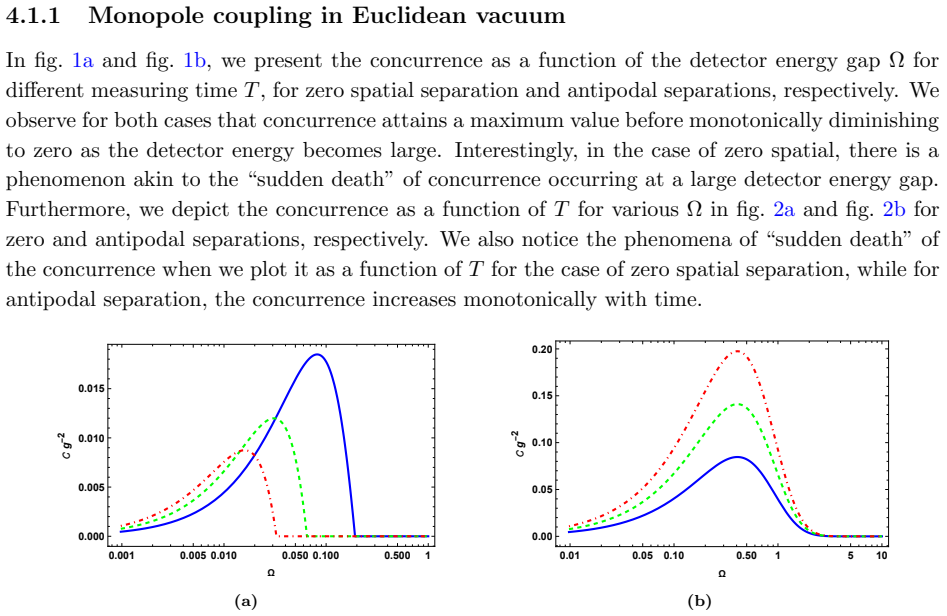
Quantum entanglement from alpha-vacua in de Sitter space suddenly dies for time-like detector separations but grows for space-like ones.
A machine-rendered reading of the paper's core claim, the machinery that carries it, and where it could break.
Core claim
The central claim is that entanglement gravitated by de Sitter gravity behaves differently for time-like and space-like separations of the detectors. For time-like zero separation, entanglement undergoes sudden death as measuring time or alpha increases. For space-like antipodal separation, entanglement grows with the same parameters. Quantum discord exhibits no sudden death but experiences superhorizon suppression, which accounts for decoherence in the inflationary scenario. These contrasting dependencies demonstrate the nonlocal character of quantum correlations in alpha-vacua.
What carries the argument
Analytical reduced final state of two static Unruh-DeWitt detectors coupled to the scalar field in an alpha-vacuum, from which concurrence and quantum discord are extracted for monopole or dipole interactions.
If this is right
- Entanglement harvesting distinguishes time-like from space-like separations through opposite dependence on measuring time and alpha.
- Quantum discord persists without sudden death, providing a continuous measure of correlation even after entanglement vanishes.
- Superhorizon suppression of discord supplies a mechanism for the decoherence observed in inflationary cosmology.
- The spectral gap and alpha parameter control the strength of the harvested quantities, offering tunable diagnostics of the vacuum.
Where Pith is reading between the lines
- The separation-dependent entanglement could produce distinct signatures in cosmological observables when alpha differs from the Bunch-Davies value.
- The same detector protocol might be applied to other maximally symmetric spacetimes to map how vacuum choice affects harvested correlations.
- Dynamical rather than static detectors could test whether the sudden-death versus growth contrast survives in an expanding background.
Load-bearing premise
The derivation of the reduced detector state assumes perturbative coupling so that higher-order corrections can be neglected when evaluating entanglement and discord.
What would settle it
Numerical evaluation of the concurrence for time-like detector pairs at successively larger values of alpha or interaction time, checking whether it drops discontinuously to zero at a finite threshold.
Figures


read the original abstract
The CPT invariant vacuum states of a scalar field in de Sitter space, called $\alpha$-vacua, are not unique. We explore the $\alpha$-vacua from the quantum information perspective by a pair of static Unruh-DeWitt (UDW) detectors coupled to a scalar field with either monopole or dipole coupling, which are in time-like zero separation or space-like antipodal separation. The analytical form of the reduced final state of the UDW detector is derived. We study the entanglement harvesting and quantum discord of the reduced state, which characterize the quantum entanglement and quantum correlation of the underlying $\alpha$-vacua, respectively. Our results imply that the quantum entanglement gravitated by de Sitter gravity behaves quite differently for time-like and space-like separations. It experiences ``sudden death" for the former and grows for the latter as the measuring time or the value of $\alpha$ increases. This demonstrates the nonlocal nature of quantum entanglement. For the quantum discord, we find no ``sudden death" behavior, and it experiences superhorizon suppression, which explains the superhorizon decoherence in the inflationary universe scenario. Overall, the time-like or space-like quantum entanglement and correlation behave differently on their dependence of $\alpha$, measuring time and spectral gaps, with details discussed in this work.
Editorial analysis
A structured set of objections, weighed in public.
Referee Report
Summary. The manuscript explores the quantum information properties of α-vacua in de Sitter space using pairs of static Unruh-DeWitt detectors with monopole or dipole coupling. It derives analytical forms for the reduced detector states for time-like (zero separation) and space-like (antipodal) separations and analyzes entanglement harvesting (via concurrence/negativity) and quantum discord, reporting sudden death of entanglement for time-like separations and growth for space-like as measuring time or |α| increases, along with superhorizon suppression of discord.
Significance. If the perturbative results hold in the reported regimes, the work provides analytical insight into how α-vacua modify quantum correlations in curved spacetime, with potential implications for superhorizon decoherence in inflation. The explicit analytical expressions for the reduced state (rather than purely numerical) are a strength, enabling direct study of parameter dependence.
major comments (2)
- [Abstract; derivation of reduced final state (Dyson expansion)] The reduced density matrix is obtained from the second-order Dyson expansion of the UDW interaction (monopole or dipole). The central claims of sudden death (time-like) and growth (space-like) are reported for increasing measuring time T or |α|, yet no estimate is given for the radius of validity of the O(λ²) truncation (e.g., condition on λ²T ≪ 1). Higher-order terms could modify the eigenvalues of the partial transpose and thus the location or existence of sudden death.
- [Quantum discord section] The superhorizon suppression of quantum discord is presented as explaining decoherence in inflation, but the manuscript does not quantify the difference relative to the Bunch-Davies vacuum (α = 0) or provide an explicit scaling with the spectral gap that would make the suppression falsifiable.
minor comments (2)
- [Methods/UDW setup] The switching functions for the detectors are not specified in sufficient detail to allow independent reproduction of the integrals over the α-vacuum Wightman function.
- [Introduction] Standard references for α-vacua (e.g., the original construction by Allen or Mottola) should be cited when introducing the CPT-invariant states.
Simulated Author's Rebuttal
We thank the referee for the careful reading and constructive comments on our manuscript. We address the major comments point by point below, agreeing to make revisions where they strengthen the presentation of our results.
read point-by-point responses
-
Referee: [Abstract; derivation of reduced final state (Dyson expansion)] The reduced density matrix is obtained from the second-order Dyson expansion of the UDW interaction (monopole or dipole). The central claims of sudden death (time-like) and growth (space-like) are reported for increasing measuring time T or |α|, yet no estimate is given for the radius of validity of the O(λ²) truncation (e.g., condition on λ²T ≪ 1). Higher-order terms could modify the eigenvalues of the partial transpose and thus the location or existence of sudden death.
Authors: We agree that the validity regime of the perturbative truncation should be stated explicitly. In the revised manuscript we will add a dedicated paragraph (likely in Section II or III) specifying the condition λ²T ≪ 1 (in units where the detector gap and curvature scale are order one) under which the O(λ²) results remain reliable, together with a brief justification that the qualitative features—sudden death for timelike separations and growth for spacelike separations—persist within this regime. This addition will reference the standard UDW literature and confirm that the parameter values used in our figures satisfy the bound. revision: yes
-
Referee: [Quantum discord section] The superhorizon suppression of quantum discord is presented as explaining decoherence in inflation, but the manuscript does not quantify the difference relative to the Bunch-Davies vacuum (α = 0) or provide an explicit scaling with the spectral gap that would make the suppression falsifiable.
Authors: We accept that a quantitative comparison to the α = 0 case and an explicit scaling with the spectral gap would make the inflationary implication more precise. Using the closed-form expressions already derived for the reduced state, the revised version will include additional analytic or numerical results (new figure or subsection) that (i) plot the discord difference ΔD = D(α) − D(α=0) versus |α| and (ii) extract the leading scaling with the gap parameter Ω. This will render the superhorizon suppression directly falsifiable against inflationary observables. revision: yes
Circularity Check
No circularity: derivation uses independent QFT inputs and standard perturbation
full rationale
The paper computes the reduced detector state via the second-order Dyson series applied to the UDW interaction Hamiltonian and the independently defined α-vacuum Wightman function of de Sitter space. Entanglement and discord measures are then obtained directly from the resulting density-matrix elements (integrals over switching functions and the two-point function). No parameters are fitted to data and then relabeled as predictions, no self-definitional loops appear, and no load-bearing uniqueness theorems or ansatze are imported via self-citation. The central claims follow from explicit evaluation of these standard expressions rather than reducing to the inputs by construction.
Axiom & Free-Parameter Ledger
axioms (1)
- domain assumption Standard quantum field theory in curved spacetime, including the definition of alpha-vacua as CPT invariant states.
Reference graph
Works this paper leans on
-
[1]
G. Gibbons, S. Hawking and S. Siklos, The Very Early Universe: Proceedings of the Nuffield Workshop, Cambridge 21 June to 9 July, 1982 , . 2
work page 1982
-
[2]
Mottola, Particle Creation in de Sitter Space , Phys
E. Mottola, Particle Creation in de Sitter Space , Phys. Rev. D 31 (1985) 754. 2, 11
work page 1985
-
[3]
Allen, Vacuum states in de sitter space , Phys
B. Allen, Vacuum states in de sitter space , Phys. Rev. D 32 (1985) 3136. 2, 8, 9, 11
work page 1985
-
[4]
A. Higuchi and K. Yamamoto, Vacuum state in de sitter spacetime with static charts , Phys. Rev. D 98 (2018) 065014. 2, 9
work page 2018
- [5]
-
[6]
M. Srednicki, Entropy and area, Phys. Rev. Lett. 71 (1993) 666 [ hep-th/9303048]. 2
work page internal anchor Pith review Pith/arXiv arXiv 1993
-
[7]
C.G. Callan, Jr. and F. Wilczek, On geometric entropy, Phys. Lett. B 333 (1994) 55 [hep-th/9401072]. 2 29
work page internal anchor Pith review Pith/arXiv arXiv 1994
-
[8]
Geometric and Renormalized Entropy in Conformal Field Theory
C. Holzhey, F. Larsen and F. Wilczek, Geometric and renormalized entropy in conformal field theory, Nucl. Phys. B 424 (1994) 443 [ hep-th/9403108]. 2
work page internal anchor Pith review Pith/arXiv arXiv 1994
-
[9]
S. Schlieder, Some remarks about the localization of states in a quantum field theory , Communications in Mathematical Physics 1 (1965) 265. 2
work page 1965
-
[10]
Notes on Some Entanglement Properties of Quantum Field Theory
E. Witten, APS Medal for Exceptional Achievement in Research: Invited article on entanglement properties of quantum field theory , Rev. Mod. Phys. 90 (2018) 045003 [1803.04993]. 2
work page internal anchor Pith review Pith/arXiv arXiv 2018
-
[11]
On the Reeh-Schlieder Property in Curved Spacetime
K. Sanders, On the Reeh-Schlieder Property in Curved Spacetime , Commun. Math. Phys. 288 (2009) 271 [ 0801.4676]. 2
work page internal anchor Pith review Pith/arXiv arXiv 2009
-
[12]
The Large N Limit of Superconformal Field Theories and Supergravity
J.M. Maldacena, The Large N limit of superconformal field theories and supergravity , Adv. Theor. Math. Phys. 2 (1998) 231 [ hep-th/9711200]. 2
work page internal anchor Pith review Pith/arXiv arXiv 1998
-
[13]
Holographic Derivation of Entanglement Entropy from AdS/CFT
S. Ryu and T. Takayanagi, Holographic derivation of entanglement entropy from AdS/CFT , Phys. Rev. Lett. 96 (2006) 181602 [ hep-th/0603001]. 3
work page internal anchor Pith review Pith/arXiv arXiv 2006
- [14]
-
[15]
Unruh, Notes on black-hole evaporation , Phys
W.G. Unruh, Notes on black-hole evaporation , Phys. Rev. D 14 (1976) 870. 3, 4, 5
work page 1976
-
[16]
DeWitt, Quantum gravity: The new synthesis , in General Relativity: An Einstein Centenary Survey, pp
B.S. DeWitt, Quantum gravity: The new synthesis , in General Relativity: An Einstein Centenary Survey, pp. 680–745 (1980). 3, 4
work page 1980
-
[17]
S.J. Summers and R. Werner, The vacuum violates bell’s inequalities , Physics Letters A 110 (1985) 257. 3
work page 1985
-
[18]
S.J. Summers and R. Werner, Maximal Violation of Bell’s Inequalities Is Generic in Quantum Field Theory , Commun. Math. Phys. 110 (1987) 247. 3
work page 1987
-
[19]
Valentini, Non-local correlations in quantum electrodynamics, Physics Letters A 153 (1991) 321
A. Valentini, Non-local correlations in quantum electrodynamics, Physics Letters A 153 (1991) 321. 3
work page 1991
-
[20]
Reznik, Entanglement from the vacuum , Found
B. Reznik, Entanglement from the vacuum , Found. Phys. 33 (2003) 167 [quant-ph/0212044]. 3
- [21]
-
[22]
J. Wilson-Gerow, A. Dugad and Y. Chen, Decoherence by warm horizons, 2405.00804. 3, 6
-
[23]
D.L. Danielson, G. Satishchandran and R.M. Wald, Gravitationally mediated entanglement: Newtonian field versus gravitons , Phys. Rev. D 105 (2022) 086001 [ 2112.10798]. 3
-
[24]
D.L. Danielson, G. Satishchandran and R.M. Wald, Killing horizons decohere quantum superpositions, Phys. Rev. D 108 (2023) 025007 [ 2301.00026]. 3
-
[25]
D.L. Danielson, G. Satishchandran and R.M. Wald, Black holes decohere quantum superpositions, Int. J. Mod. Phys. D 31 (2022) 2241003 [ 2205.06279]. 3
-
[26]
A. Dhanuka and K. Lochan, Unruh DeWitt probe of late time revival of quantum correlations in Friedmann spacetimes, Phys. Rev. D 106 (2022) 125006 [ 2210.11186]. 3
-
[27]
S.E. Gralla and H. Wei, Decoherence from horizons: General formulation and rotating black holes, Phys. Rev. D 109 (2024) 065031 [ 2311.11461]. 3
-
[28]
Acceleration-assisted entanglement harvesting and rangefinding
G. Salton, R.B. Mann and N.C. Menicucci, Acceleration-assisted entanglement harvesting and rangefinding, New J. Phys. 17 (2015) 035001 [ 1408.1395]. 3, 6 30
work page internal anchor Pith review Pith/arXiv arXiv 2015
-
[29]
Precise space-time positioning for entanglement harvesting
E. Martin-Martinez and B.C. Sanders, Precise space–time positioning for entanglement harvesting, New J. Phys. 18 (2016) 043031 [ 1508.01209]. 3, 5, 6
work page internal anchor Pith review Pith/arXiv arXiv 2016
-
[30]
E. Mart´ ın-Mart´ ınez, A.R.H. Smith and D.R. Terno,Spacetime structure and vacuum entanglement, Phys. Rev. D 93 (2016) 044001. 3, 5, 6
work page 2016
-
[31]
Harvesting Entanglement from the Black Hole Vacuum
L.J. Henderson, R.A. Hennigar, R.B. Mann, A.R.H. Smith and J. Zhang, Harvesting Entanglement from the Black Hole Vacuum , Class. Quant. Grav. 35 (2018) 21LT02 [1712.10018]. 3, 5, 6, 17
work page internal anchor Pith review Pith/arXiv arXiv 2018
-
[32]
Harvesting large scale entanglement in de Sitter space with multiple detectors
S. Kukita and Y. Nambu, Harvesting large scale entanglement in de Sitter space with multiple detectors, Entropy 19 (2017) 449 [ 1708.01359]. 3, 6
work page internal anchor Pith review Pith/arXiv arXiv 2017
- [33]
- [34]
-
[35]
D. Mendez-Avalos, L.J. Henderson, K. Gallock-Yoshimura and R.B. Mann, Entanglement harvesting of three Unruh-DeWitt detectors , Gen. Rel. Grav. 54 (2022) 87 [2206.11902]. 3, 6
-
[36]
H. Ollivier and W.H. Zurek, Introducing quantum discord, arXiv preprint quant-ph/0105072 (2001) . 3, 6, 7
work page internal anchor Pith review Pith/arXiv arXiv 2001
-
[37]
Classical, quantum and total correlations
L. Henderson and V. Vedral, Classical, quantum and total correlations , J. Phys. A 34 (2001) 6899 [quant-ph/0105028]. 3, 6
work page internal anchor Pith review Pith/arXiv arXiv 2001
- [38]
- [39]
- [40]
-
[41]
Evolution from Entanglement to Decoherence of Bipartite Mixed "X" States
T. Yu and J. Eberly, Evolution from entanglement to decoherence of bipartite mixed” x” states, arXiv preprint quant-ph/0503089 (2005) . 5
work page internal anchor Pith review Pith/arXiv arXiv 2005
-
[42]
A. Rau, Algebraic characterization of x-states in quantum information , Journal of physics a: Mathematical and theoretical 42 (2009) 412002. 5
work page 2009
-
[43]
R.F. Werner, Quantum states with einstein-podolsky-rosen correlations admitting a hidden-variable model, Phys. Rev. A 40 (1989) 4277. 5
work page 1989
-
[44]
M. Ali, A. Rau and G. Alber, Quantum discord for two-qubit x states , Physical Review A 81 (2010) 042105. 5, 7
work page 2010
-
[45]
J.-I. Koga, G. Kimura and K. Maeda, Quantum teleportation in vacuum using only Unruh-DeWitt detectors, Phys. Rev. A 97 (2018) 062338 [ 1804.01183]. 5
work page internal anchor Pith review Pith/arXiv arXiv 2018
-
[46]
Wootters, Entanglement of formation of an arbitrary state of two qubits , Phys
W.K. Wootters, Entanglement of formation of an arbitrary state of two qubits , Phys. Rev. Lett. 80 (1998) 2245. 6
work page 1998
-
[47]
Q. Chen, C. Zhang, S. Yu, X. Yi and C. Oh, Quantum discord of two-qubit x states , Physical Review A 84 (2011) 042313. 7 31
work page 2011
-
[48]
Y. Huang, Quantum discord for two-qubit x states: Analytical formula with very small worst-case error, Phys. Rev. A 88 (2013) 014302. 7
work page 2013
-
[49]
M.A. Yurischev, On the quantum discord of general x states , Quantum Information Processing 14 (2015) 3399. 7, 22
work page 2015
-
[50]
N.A. Chernikov and E.A. Tagirov, Quantum theory of scalar fields in de Sitter space-time , Ann. Inst. H. Poincare A Phys. Theor. 9 (1968) 109. 9
work page 1968
-
[51]
L. Niermann and L.C. Barbado, Particle detectors in superposition in de Sitter spacetime , 2403.02087. 13
-
[52]
Entangling detectors in anti-de Sitter space
L.J. Henderson, R.A. Hennigar, R.B. Mann, A.R.H. Smith and J. Zhang, Entangling detectors in anti-de Sitter space , JHEP 05 (2019) 178 [ 1809.06862]. 15
work page internal anchor Pith review Pith/arXiv arXiv 2019
-
[53]
H. Maeso-Garc´ ıa, J. Polo-G´ omez and E. Mart´ ın-Mart´ ınez,How measuring a quantum field affects entanglement harvesting , Phys. Rev. D 107 (2023) 045011 [ 2210.05692]. 15 32
discussion (0)
Sign in with ORCID, Apple, or X to comment. Anyone can read and Pith papers without signing in.