Potential of constraining the Fifth Force Using the Earth as a Spin and Mass Source from space
Pith reviewed 2026-05-23 19:13 UTC · model grok-4.3
The pith
A low-Earth-orbit spacecraft using Earth as source can tighten bounds on velocity-dependent exotic forces by three orders of magnitude.
A machine-rendered reading of the paper's core claim, the machinery that carries it, and where it could break.
Core claim
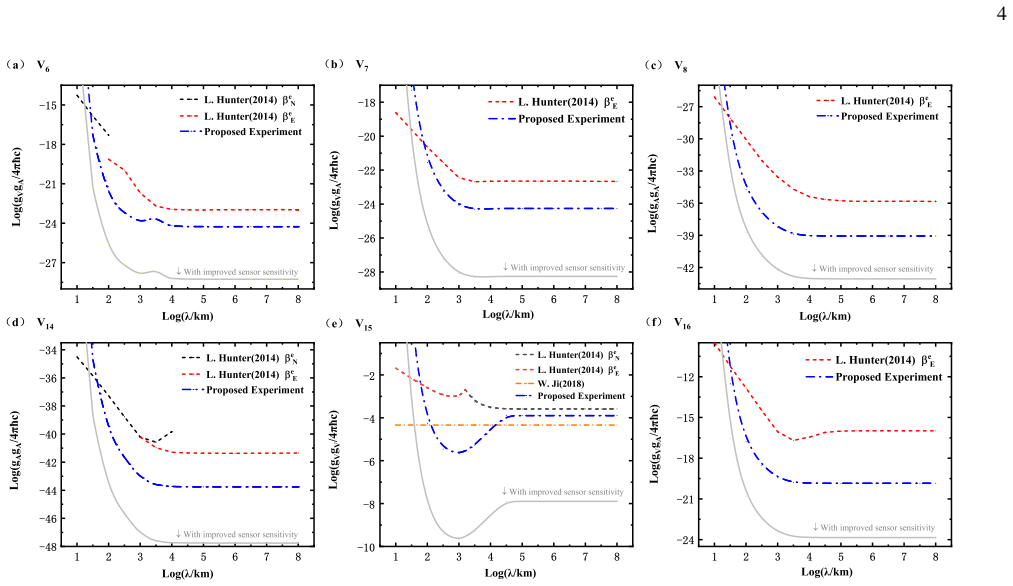
The novel Spacecraft-Earth model uses the high velocity and periodic motion of a low-Earth-orbit platform together with the Earth’s mass and spin to enhance sensitivity to velocity-dependent and spin-dependent exotic interactions mediated by ultralight vector bosons, yielding a theoretical improvement of up to three orders of magnitude over present bounds when the China Space Station is taken as the carrier.
What carries the argument
The Spacecraft-Earth model, in which orbital velocity and periodicity convert the Earth into an effective moving and spinning source for probing ultralight-vector-mediated fifth forces.
If this is right
- Orbital speed directly boosts the signal strength for any velocity-dependent coupling.
- The orbital period supplies a known frequency template that isolates the exotic signal from constant or slowly varying backgrounds.
- Existing laboratory limits on the coupling constants of these interactions can be improved by factors of up to 1000.
- The same geometry offers a new route to constrain or detect ultralight dark matter through its possible mediation of such forces.
Where Pith is reading between the lines
- The technique could be ported to other low-Earth-orbit platforms or even higher orbits to trade velocity for longer integration times.
- Cross-correlation with simultaneous ground-based torsion-balance runs would help separate orbital-motion effects from local systematics.
- If the signal is observed, its velocity dependence could be mapped by varying the spacecraft’s orbital inclination or altitude.
Load-bearing premise
That the orbital velocity and repeated passages will produce a clean periodic signal whose amplitude can be extracted without unmodeled systematics erasing most of the projected sensitivity gain.
What would settle it
A quantitative noise model or flight data showing that residual systematics from gravity gradients, magnetic fields, or attitude control reduce the net sensitivity improvement to less than one order of magnitude.
Figures




read the original abstract
We explore the potential of conducting an experiment in a low Earth orbit spacecraft and using the Earth as a spin and mass source to constrain beyond-the-standard-model (BSM) long-range spin- and velocity-dependent interactions, which are mediated by the exchange of an ultralight $\left(m_{Z^{\prime}}<10^{-10}\text{eV}\right)$ or massless intermediate vector boson. The high speed of the low Earth orbit spacecraft can enhance the sensitivity to velocity-dependent interactions. The periodicity enables efficient extraction of signals from background noise, thereby improving the experiment's accuracy. Combining these advantages, we demonstrate theoretically that the novel Spacecraft-Earth model can improve existing bounds on these exotic interactions by up to three orders of magnitude, using the China Space Station (CSS) as a representative low-Earth-orbit carrier. Such a model, if successfully implemented, may provide an innovative strategy for detecting ultralight dark matter and yield tighter constraints on certain coupling constants of exotic interactions.
Editorial analysis
A structured set of objections, weighed in public.
Referee Report
Summary. The paper proposes a novel experimental setup using a low-Earth-orbit spacecraft (exemplified by the China Space Station) with the Earth as a combined mass and spin source to constrain beyond-Standard-Model long-range spin- and velocity-dependent interactions mediated by ultralight (m_Z' < 10^{-10} eV) or massless vector bosons. It argues that the spacecraft's orbital velocity enhances reach for velocity-dependent couplings while orbital periodicity enables efficient signal extraction from backgrounds, yielding a theoretical improvement of up to three orders of magnitude over existing bounds.
Significance. If the projected sensitivity gains are substantiated by explicit calculations, the approach would offer a meaningful advance in testing exotic fifth forces and ultralight dark matter candidates by exploiting existing space infrastructure, potentially providing tighter constraints on velocity-dependent couplings than current laboratory or astrophysical limits.
major comments (2)
- [Abstract] Abstract: the central claim of an improvement 'by up to three orders of magnitude' is asserted without any derivation, sensitivity formula, background power spectrum, or propagation of LEO-specific noise sources (gravity-gradient torques, residual magnetic fields, atmospheric drag modulation) into the final limit, so the factor-of-1000 gain cannot be verified.
- [Abstract] Abstract: the assumption that spacecraft velocity (~7.8 km/s) and orbital periodicity will produce a net gain for velocity-dependent interactions after common-mode rejection is stated but unsupported by any quantitative residual-acceleration model or error budget, leaving the weakest assumption untested.
Simulated Author's Rebuttal
We thank the referee for the careful review and constructive feedback on our manuscript. Below we respond point-by-point to the major comments, clarifying what is contained in the full text versus the abstract summary.
read point-by-point responses
-
Referee: [Abstract] Abstract: the central claim of an improvement 'by up to three orders of magnitude' is asserted without any derivation, sensitivity formula, background power spectrum, or propagation of LEO-specific noise sources (gravity-gradient torques, residual magnetic fields, atmospheric drag modulation) into the final limit, so the factor-of-1000 gain cannot be verified.
Authors: The abstract is intentionally concise and summarizes the main result. The derivation of the sensitivity improvement, including the explicit sensitivity formula that incorporates the orbital velocity enhancement and periodicity for signal extraction, is provided in Sections III and IV of the manuscript. A complete background power spectrum and full propagation of every LEO-specific noise source (such as gravity-gradient torques) into the final limit is not performed, as this is a theoretical proposal focused on the potential reach rather than a detailed experimental design. We will revise the abstract to include a brief reference to the relevant sections for the supporting calculations. revision: partial
-
Referee: [Abstract] Abstract: the assumption that spacecraft velocity (~7.8 km/s) and orbital periodicity will produce a net gain for velocity-dependent interactions after common-mode rejection is stated but unsupported by any quantitative residual-acceleration model or error budget, leaving the weakest assumption untested.
Authors: Section II of the manuscript presents the quantitative model for the velocity-dependent interaction, showing the enhancement from the spacecraft's orbital speed of approximately 7.8 km/s, while Section IV includes the sensitivity analysis that accounts for the use of orbital periodicity to extract the signal. A full residual-acceleration error budget with common-mode rejection details for all backgrounds is not included, as the work emphasizes the conceptual advantages of the setup. We believe the calculations in the main text substantiate the stated improvement under the assumptions made. revision: no
Circularity Check
No circularity: forward projection from external models
full rationale
The paper presents a theoretical projection of sensitivity gains for BSM interactions using the spacecraft-Earth geometry and LEO orbital properties. No load-bearing step reduces a claimed prediction or bound to a parameter fitted inside the paper, a self-defined quantity, or a self-citation chain. The three-order improvement is framed as a calculation from standard interaction models and orbital kinematics rather than a tautological re-expression of inputs. The derivation remains self-contained against external benchmarks.
Axiom & Free-Parameter Ledger
Reference graph
Works this paper leans on
-
[1]
Particle Dark Matter: Evidence, Candidates and Constraints
G. Bertone, D. Hooper, and J. Silk, Phys. Rept. 405, 279 (2005) , arXiv:hep-ph/0404175
work page internal anchor Pith review Pith/arXiv arXiv 2005
-
[2]
Dark Energy and the Accelerating Universe
J. Frieman, M. Turner, and D. Huterer, Ann. Rev. Astron. Astrophys. 46, 385 (2008) , arXiv:0803.0982 [astro-ph]
work page internal anchor Pith review Pith/arXiv arXiv 2008
-
[3]
R. D. Peccei and H. R. Quinn, Phys. Rev. Lett. 38, 1440 (1977)
work page 1977
-
[4]
The origin of the matter-antimatter asymmetry
M. Dine and A. Kusenko, Rev. Mod. Phys. 76, 1 (2003) , arXiv:hep-ph/0303065
work page internal anchor Pith review Pith/arXiv arXiv 2003
-
[5]
P . W. Graham, D. E. Kaplan, and S. Ra- jendran, Phys. Rev. Lett. 115, 221801 (2015) , arXiv:1504.07551 [hep-ph]
work page internal anchor Pith review Pith/arXiv arXiv 2015
-
[6]
M. S. Safronova, D. Budker, D. DeMille, D. F. J. Kimball, A. Derevianko, and C. W. Clark, Rev. Mod. Phys. 90, 025008 (2018) , arXiv:1710.01833 [physics.atom-ph]
work page internal anchor Pith review Pith/arXiv arXiv 2018
-
[7]
Cong et al., (2024), arXiv:2408.15691 [hep-ph]
L. Cong et al., (2024), arXiv:2408.15691 [hep-ph]
-
[8]
J. E. Moody and F. Wilczek, Phys. Rev. D 30, 130 (1984)
work page 1984
-
[9]
B. A. Dobrescu and I. Mocioiu, JHEP 11, 005 (2006) , arXiv:hep-ph/0605342
work page internal anchor Pith review Pith/arXiv arXiv 2006
-
[10]
P . Fadeev, Y . V . Stadnik, F. Ficek, M. G. Kozlov, V . V . Flambaum, and D. Budker, Phys. Rev. A 99, 022113 (2019) , arXiv:1810.10364 [hep-ph]
work page internal anchor Pith review Pith/arXiv arXiv 2019
-
[11]
E. G. Adelberger, B. R. Heckel, and A. E. Nelson, Ann. Rev. Nucl. Part. Sci. 53, 77 (2003) , arXiv:hep-ph/0307284
work page internal anchor Pith review Pith/arXiv arXiv 2003
- [12]
- [13]
-
[14]
The Low-Energy Frontier of Particle Physics
J. Jaeckel and A. Ringwald, Ann. Rev. Nucl. Part. Sci. 60, 405 (2010) , arXiv:1002.0329 [hep-ph]
work page internal anchor Pith review Pith/arXiv arXiv 2010
-
[15]
H. An, M. Pospelov, J. Pradler, and A. Ritz, Phys. Lett. B 747, 331 (2015) , arXiv:1412.8378 [hep-ph]
work page internal anchor Pith review Pith/arXiv arXiv 2015
-
[16]
G. D. Hammond, C. C. Speake, C. Trenkel, and A. Pulido Pa- ton, Phys. Rev. Lett. 98, 081101 (2007)
work page 2007
-
[17]
B. R. Heckel, W. A. Terrano, and E. G. Adelberger, Phys. Rev. Lett. 111, 151802 (2013)
work page 2013
-
[18]
W. A. Terrano, E. G. Adelberger, J. G. Lee, and B. R. Heckel, Phys. Rev. Lett. 115, 201801 (2015) , arXiv:1508.02463 [hep-ex]
work page internal anchor Pith review Pith/arXiv arXiv 2015
- [19]
-
[20]
T. C. P . Chui and W.-T. Ni,Phys. Rev. Lett. 71, 3247 (1993)
work page 1993
-
[21]
J. C. Long, H. W. Chan, A. B. Churnside, E. A. Gulbis, M. C. M. V arney, and J. C. Price, Nature 421, 922 (2003) , arXiv:hep-ph/0210004. 6
work page internal anchor Pith review Pith/arXiv arXiv 2003
-
[22]
F. Ficek, D. F. J. Kimball, M. Kozlov, N. Leefer, S. Pustelny, and D. Budker, Phys. Rev. A 95, 032505 (2017) , arXiv:1608.05779 [physics.atom-ph]
work page internal anchor Pith review Pith/arXiv arXiv 2017
-
[23]
F. Ficek, P . Fadeev, V . V . Flambaum, D. F. Jack- son Kimball, M. G. Kozlov, Y . V . Stadnik, and D. Budker, Phys. Rev. Lett. 120, 183002 (2018) , arXiv:1801.00491 [physics.atom-ph]
work page internal anchor Pith review Pith/arXiv arXiv 2018
-
[24]
Limits on new long range nuclear spin-dependent forces set with a K-3He co-magnetometer
G. V asilakis, J. M. Brown, T. W. Kornack, and M. V . Romalis, Phys. Rev. Lett. 103, 261801 (2009) , arXiv:0809.4700 [physics.atom-ph]
work page internal anchor Pith review Pith/arXiv arXiv 2009
-
[25]
N. Crescini, G. Carugno, P . Falferi, A. Ortolan, G. Ru- oso, and C. C. Speake, Phys. Rev. D 105, 022007 (2022) , arXiv:2011.07100 [hep-ex]
- [26]
- [27]
- [28]
- [29]
-
[30]
Constraints on exotic dipole-dipole couplings between electrons at the micrometer scale
S. Kotler, R. Ozeri, and D. F. J. Kim- ball, Phys. Rev. Lett. 115, 081801 (2015) , arXiv:1501.07891 [physics.atom-ph]
work page internal anchor Pith review Pith/arXiv arXiv 2015
-
[31]
Searching for new particles beyond the standard model with a single electron-spin quantum sensor
X. Rong et al. , Nature Commun. 9, 739 (2018) , arXiv:1706.03482 [quant-ph]
work page internal anchor Pith review Pith/arXiv arXiv 2018
-
[32]
X. Rong, M. Jiao, J. Geng, B. Zhang, T. Xie, F. Shi, C.-K. Duan, Y .-F. Cai, and J. Du, Phys. Rev. Lett. 121, 080402 (2018) , arXiv:1804.07026 [hep-ex]
work page internal anchor Pith review Pith/arXiv arXiv 2018
-
[33]
H. Yan, G. A. Sun, S. M. Peng, Y . Zhang, C. B. Fu, H. Guo, and B. Q. Liu, Phys. Rev. Lett. 115, 182001 (2015) , arXiv:1412.8155 [nucl-ex]
work page internal anchor Pith review Pith/arXiv arXiv 2015
- [34]
-
[35]
L. R. Hunter and D. Ang, Phys. Rev. Lett. 112, 091803 (2014) , arXiv:1306.1118 [hep-ph]
work page internal anchor Pith review Pith/arXiv arXiv 2014
- [36]
-
[37]
B. J. V enema, P . K. Majumder, S. K. Lamoreaux, B. R. Heckel, and E. N. Fortson, Phys. Rev. Lett. 68, 135 (1992)
work page 1992
-
[38]
D. F. Jackson Kimball, J. Dudley, Y . Li, D. Patel, and J. V aldez, Phys. Rev. D 96, 075004 (2017) , [Erratum: Phys.Rev.D 107, 019903 (2023)], arXiv:1707.00745 [physics.atom-ph]
work page internal anchor Pith review Pith/arXiv arXiv 2017
-
[39]
B. R. Heckel, E. G. Adelberger, C. E. Cramer, T. S. Cook, S. Schlamminger, and U. Schmidt, Phys. Rev. D 78, 092006 (2008) , arXiv:0808.2673 [hep-ex]
work page internal anchor Pith review Pith/arXiv arXiv 2008
- [40]
-
[41]
N. Leefer, A. Gerhardus, D. Budker, V . V . Flambaum, and Y . V . Stadnik, Phys. Rev. Lett. 117, 271601 (2016) , arXiv:1607.04956 [physics.atom-ph]
work page internal anchor Pith review Pith/arXiv arXiv 2016
-
[42]
D. J. Wineland, J. J. Bollinger, D. J. Heinzen, W. M. Itano, an d M. G. Raizen, Phys. Rev. Lett. 67, 1735 (1991)
work page 1991
-
[43]
A. N. Y oudin, D. Krause, K. Jagannathan, L. R. Hunter, and S. K. Lamoreaux, Phys. Rev. Lett. 77, 2170 (1996)
work page 1996
- [44]
-
[45]
Y . Tian and D. Zhao,PHYSICS OF THE EARTH AND PLANETARY INTERIORS 200, 72 (2012)
work page 2012
-
[46]
B. A. Dobrescu, Phys. Rev. Lett. 94, 151802 (2005) , arXiv:hep-ph/0411004
work page internal anchor Pith review Pith/arXiv arXiv 2005
- [47]
-
[48]
A. M. Dziewonski and D. L. Anderson, Physics of the Earth and Planetary Interiors 25, 297 (1981)
work page 1981
-
[49]
T. Irifune, T. Shinmei, C. A. McCammon, N. Miyajima, D. C. Rubie, and D. J. Frost, Science 327, 193 (2010)
work page 2010
-
[50]
R. Jeanloz, E. Knittle, R. K. O'Nions, R. Clayton, and B. Parsons, Philosophical Transactions of the Royal Society of London. Series A, Mathematical
-
[51]
J. W. Morgan and E. Anders, Proceedings of the National Academy of Sciences 77, 6973 (1980)
work page 1980
-
[52]
H. S. Wang, C. H. Lineweaver, and T. R. Ireland, Icarus 299, 460 (2018)
work page 2018
- [53]
-
[54]
S. K. Peck, D. K. Kim, D. Stein, D. Orbaker, A. Foss, M. T. Hummon, and L. R. Hunter, Phys. Rev. A 86, 012109 (2012) , arXiv:1205.5022 [physics.atom-ph]
work page internal anchor Pith review Pith/arXiv arXiv 2012
- [55]
- [56]
-
[57]
F. D. Stacey,Physics of the Earth and Planetary Interiors 15, 341 (1977)
work page 1977
-
[58]
Chulliat et al., The US/UK W orld Magnetic Model for 2020- 2025: Technical Report, Tech
A. Chulliat et al., The US/UK W orld Magnetic Model for 2020- 2025: Technical Report, Tech. Rep. (US/UK, 2020)
work page 2020
-
[59]
B. A. Buffett, E. J. Garnero, and R. Jeanloz, Science 290, 1338 (2000)
work page 2000
-
[60]
S. K. Peck, D. K. Kim, D. Stein, D. Orbaker, A. Foss, M. T. Hummon, and L. R. Hunter, Phys. Rev. A 86, 012109 (2012) . 7 SUPPLEMENTAL MATERIAL Model of the Earth and the CSS The model is based on Ref. [ 34], which assumes that the Earth’s paramagnetism is predomin antly due to unpaired d-shell electrons in the iron ions contained within the Earth’s mant l...
work page 2012
discussion (0)
Sign in with ORCID, Apple, or X to comment. Anyone can read and Pith papers without signing in.