TeV to PeV neutrinos from AGN coronae
Pith reviewed 2026-05-23 18:53 UTC · model grok-4.3
The pith
AGN coronae modeled with UV discs in hot plasma can explain IceCube TeV to sub-PeV neutrinos via photohadronic interactions.
A machine-rendered reading of the paper's core claim, the machinery that carries it, and where it could break.
Core claim
Within the framework of this approach it is possible to describe both ∼100 TeV and sub PeV neutrinos from AGN taking into account only photohadronic interactions, using Monte-Carlo modeling of photopion interactions in AGN coronae modeled as thermal accretion discs emitting UV-optical light inside hot electron plasma, after including cosmological evolution.
What carries the argument
The analytical solution for the Comptonization problem derived at the microscopic level, which determines the photon spectrum available for photopion interactions without spectral fitting.
If this is right
- The same AGN population can account for neutrinos at both ~100 TeV and sub-PeV energies.
- Photohadronic interactions are sufficient without contributions from other processes.
- Accounting for AGN cosmological evolution is required to match the total neutrino flux.
- The model predicts neutrino production based on microscopic Comptonization rather than empirical spectral fits.
Where Pith is reading between the lines
- Neutrino data could provide independent constraints on the properties of AGN coronae.
- Correlations between neutrino arrival directions and AGN positions might become detectable with larger samples.
- This production channel could contribute substantially to the diffuse high-energy neutrino background.
Load-bearing premise
The TeV to sub-PeV neutrinos detected by IceCube are produced in the coronae of active galactic nuclei that can be described as thermal accretion discs emitting UV-optical radiation surrounded by hot electrons.
What would settle it
Detailed comparison showing that the neutrino spectrum predicted by photopion production in this corona model deviates significantly from IceCube observations at either energy range after full cosmological integration.
Figures



read the original abstract
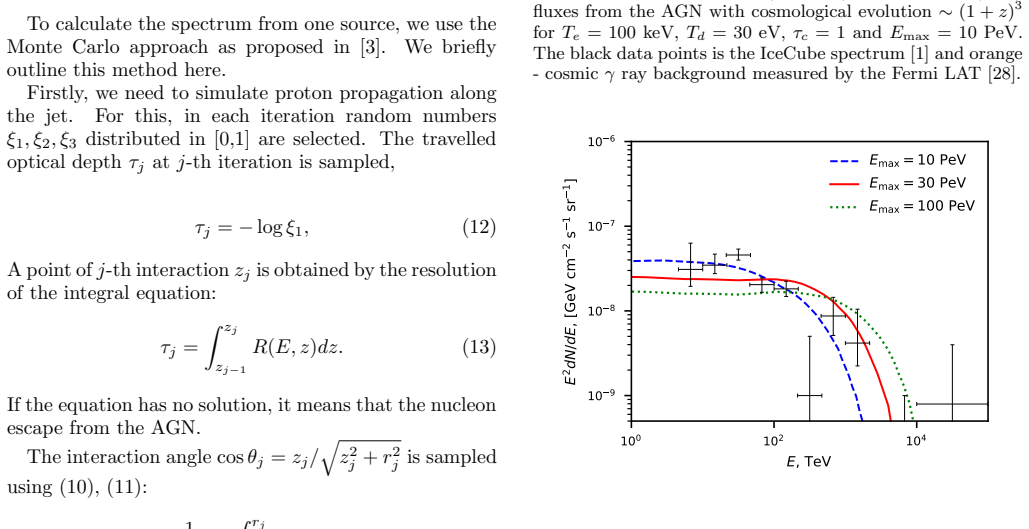
In this paper, we attempt to explain the TeV - sub PeV neutrinos observed by IceCube assuming that their sources are active galactic nuclei (AGN). The results are obtained in the model where the thermal accretion disc emits in the UV-optical range inside the hot electron plasma cloud. We focus on the analytical solution for the comptonization problem obtained from consideration at the microscopic level and try to avoid fitting the coronal spectrum from spectral observations. Using the Monte-Carlo approach to model photopion interactions in the central regions of AGN and then after taking into account the cosmological evolution it is shown that within the framework of this approach it is possible to describe both $\sim$ 100 TeV and sub PeV neutrinos from AGN taking into account only photohadronic interactions.
Editorial analysis
A structured set of objections, weighed in public.
Referee Report
Summary. The paper claims that TeV to sub-PeV neutrinos observed by IceCube originate from photohadronic interactions in AGN coronae. The model consists of a thermal accretion disk emitting UV-optical photons inside a hot electron plasma cloud; an analytical microscopic solution to the Comptonization problem is used to determine the target photon field without fitting to observed spectra. Monte-Carlo simulations compute photopion production and neutrino yields in the central regions, after which cosmological evolution of the AGN population is applied to show that photohadronic processes alone can account for both the ~100 TeV and sub-PeV regimes.
Significance. If the result holds, the work would be significant for multi-messenger astrophysics by demonstrating a self-consistent, less empirically tuned route from coronal plasma physics to neutrino production. The explicit adoption of an analytical Comptonization solution derived at the microscopic level, combined with Monte-Carlo photopion tracking and cosmological integration, supplies a reproducible pathway whose predictions can be tested against future IceCube data or other messengers.
major comments (3)
- [Analytical Comptonization solution] The section presenting the analytical Comptonization solution: because the photopion optical depth and resulting neutrino yield are linear in target-photon number density, any systematic offset between the derived UV–soft-X-ray photon field and real AGN coronae directly scales the predicted flux after cosmological integration. The manuscript does not demonstrate that the solution reproduces observed coronal spectra at the relevant energies, leaving the central claim that photohadronic interactions alone suffice vulnerable to this uncertainty.
- [Monte-Carlo photopion modeling and cosmological evolution] Monte-Carlo photopion results and cosmological integration: no quantitative spectra, error bars, or direct comparison to IceCube flux measurements are shown, so it is impossible to verify whether the output reproduces the observed ~100 TeV and sub-PeV fluxes without post-hoc adjustment of plasma temperature or optical depth.
- [Parameter selection and cosmological integration] Choice of plasma temperature, optical depth, and AGN evolution parameters: although the paper states it avoids fitting the coronal spectrum, these parameters are not shown to be fixed by independent observables; their values therefore remain free to be chosen to match the neutrino data, undermining the claim of a non-circular description.
minor comments (2)
- Notation for the Comptonization optical depth and electron temperature could be defined more explicitly on first use to aid readers outside the immediate sub-field.
- Figure captions for the neutrino spectra should state the exact parameter values adopted for the corona model so that the curves can be reproduced.
Simulated Author's Rebuttal
We thank the referee for the constructive feedback and for recognizing the potential significance of our self-consistent approach. We address each major comment below with clarifications and proposed revisions.
read point-by-point responses
-
Referee: [Analytical Comptonization solution] The section presenting the analytical Comptonization solution: because the photopion optical depth and resulting neutrino yield are linear in target-photon number density, any systematic offset between the derived UV–soft-X-ray photon field and real AGN coronae directly scales the predicted flux after cosmological integration. The manuscript does not demonstrate that the solution reproduces observed coronal spectra at the relevant energies, leaving the central claim that photohadronic interactions alone suffice vulnerable to this uncertainty.
Authors: The analytical solution is obtained from a microscopic treatment of Comptonization and is intended to provide a physically grounded photon field without empirical fitting to spectra. We agree that an explicit comparison would mitigate concerns about possible systematic offsets in the UV–soft X-ray range. In the revised manuscript we will add a direct comparison of the derived target photon spectrum against representative observed AGN coronal spectra from X-ray observations to confirm consistency within the relevant energy band. revision: yes
-
Referee: [Monte-Carlo photopion modeling and cosmological evolution] Monte-Carlo photopion results and cosmological integration: no quantitative spectra, error bars, or direct comparison to IceCube flux measurements are shown, so it is impossible to verify whether the output reproduces the observed ~100 TeV and sub-PeV fluxes without post-hoc adjustment of plasma temperature or optical depth.
Authors: The present version emphasizes the overall viability of the photohadronic channel after cosmological integration. We accept that quantitative verification requires explicit spectra. The revised manuscript will include the predicted neutrino spectra from the Monte-Carlo runs, with uncertainty bands arising from the model parameters, together with direct overlays of the IceCube measurements in the ~100 TeV and sub-PeV regimes. revision: yes
-
Referee: [Parameter selection and cosmological integration] Choice of plasma temperature, optical depth, and AGN evolution parameters: although the paper states it avoids fitting the coronal spectrum, these parameters are not shown to be fixed by independent observables; their values therefore remain free to be chosen to match the neutrino data, undermining the claim of a non-circular description.
Authors: Plasma temperature and optical depth are taken from standard values reported in X-ray spectral studies of AGN coronae, while the cosmological evolution follows established AGN population models; neither set is adjusted to the neutrino data. To make this independence explicit, the revised text will cite the specific independent observables used for each choice and add a brief sensitivity study demonstrating that the neutrino flux remains consistent across the observationally allowed parameter range. revision: partial
Circularity Check
No significant circularity; derivation remains self-contained
full rationale
The paper derives its neutrino flux estimates from an analytical Comptonization solution obtained at the microscopic level, followed by Monte-Carlo photopion modeling and cosmological evolution integration. The central claim is a demonstration that the framework can describe the observed fluxes using only photohadronic interactions, without any quoted reduction of the output to a fitted neutrino normalization or to a self-citation that itself depends on the target result. Parameters such as plasma temperature and optical depth are model inputs whose values are selected within the stated framework; the text does not present a fitted parameter as an independent prediction. No self-definitional loops, load-bearing self-citations, or ansatz smuggling are exhibited by the provided equations or statements. The result is therefore a standard model exploration rather than a closed derivation.
Axiom & Free-Parameter Ledger
Lean theorems connected to this paper
-
IndisputableMonolith/Cost/FunctionalEquation.leanwashburn_uniqueness_aczel unclear?
unclearRelation between the paper passage and the cited Recognition theorem.
analytical solution for the comptonization problem obtained from consideration at the microscopic level... G(x,x0) = α(α+3)/(2α+3) (x/x0)^{3+α} ... α = sqrt(9/4 + π²me/(3Te(τT+2/3)²)) - 3/2
-
IndisputableMonolith/Foundation/RealityFromDistinction.leanreality_from_one_distinction unclear?
unclearRelation between the paper passage and the cited Recognition theorem.
Monte-Carlo approach to model photopion interactions... SOPHIA event generator... cosmological evolution ∼(1+z)^3
What do these tags mean?
- matches
- The paper's claim is directly supported by a theorem in the formal canon.
- supports
- The theorem supports part of the paper's argument, but the paper may add assumptions or extra steps.
- extends
- The paper goes beyond the formal theorem; the theorem is a base layer rather than the whole result.
- uses
- The paper appears to rely on the theorem as machinery.
- contradicts
- The paper's claim conflicts with a theorem or certificate in the canon.
- unclear
- Pith found a possible connection, but the passage is too broad, indirect, or ambiguous to say the theorem truly supports the claim.
Reference graph
Works this paper leans on
-
[1]
Different heating mechanisms pro- pose different geometries (see e.g
Geometry Despite many studies in theory and X-ray observa- tions, the question of nature and geometry of the AGN corona is still open. Different heating mechanisms pro- pose different geometries (see e.g. review [18]). However, Recent X-ray measurements in Seyfert galaxies favor an extended geometry of the corona rather than a point-like geometry [19–21]....
-
[2]
Spectrum To find the spectrum of the two-component disk- corona system, it is necessary to solve the Kompaneets equation [26], which describes the Comptonization of radiation on electrons. Assuming that the source of low-energy photons is located inside the electron plasma cloud with electron temperature Te, the solution can be written as [27]: F (x) = Z ...
-
[3]
Proton acceleration and propagation Studying of particle acceleration is not the goal of this work, so we limit ourselves to a simple situation proposed in [3]. According to this assumption, protons are accel- erated by an electric field near the vicinity of the SMBH and then released at some point z0 from it. The proton spectrum at point z0 is assumed to...
-
[4]
Preliminary The photon density created by the small segment of the corona rdrdφ at distance r from the jet axis and distance z along the jet axis: n(p, r, z) = 1 2π δ(3)(n − n0)rdrdφ z2 + r2 n(p, Ω), (8) where n0 is the unit vector in the direction from the small corona segment to z. Because of the model is cylindrical symmetry the integration over φ give...
-
[5]
We briefly outline this method here
Simulation To calculate the spectrum from one source, we use the Monte Carlo approach as proposed in [3]. We briefly outline this method here. Firstly, we need to simulate proton propagation along the jet. For this, in each iteration random numbers ξ1, ξ2, ξ3 distributed in [0,1] are selected. The travelled optical depth τj at j-th iteration is sampled, τ...
-
[6]
The Thomson optical depth dependence is shown in Fig. 4. The greater the Thomson optical depth τT, the more photons from the accretion disk will fall into the X-ray range, thereby giving the opportunity to nucleons of lower energies to produce neutrinos. In order to make Fig. 4 more visual, we simulate protons in the range 0.1 PeV - 10 PeV. The model depe...
work page 2024
- [7]
-
[8]
A. Palladino, M. Spurio, and F. Vissani, Neutrino Tele- scopes and High-Energy Cosmic Neutrinos, Universe 6, 30 (2020), arXiv:2009.01919 [astro-ph.HE]
-
[9]
Neutrinos in IceCube from AGN's
O. Kalashev, D. Semikoz, and I. Tkachev, Neutrinos in IceCube from active galactic nuclei, J. Exp. Theor. Phys. 120, 541 (2015), arXiv:1410.8124 [astro-ph.HE]
work page internal anchor Pith review Pith/arXiv arXiv 2015
- [10]
- [11]
-
[12]
P. Padovani et al., High-energy neutrinos from the vicin- ity of the supermassive black hole in NGC 1068, Nature Astron. 8, 1077 (2024), arXiv:2405.20146 [astro-ph.HE]
- [13]
-
[14]
The Cumulative Bakground of High-Energy Neutrinos from Starburst Galaxies
A. Loeb and E. Waxman, The Cumulative background of high energy neutrinos from starburst galaxies, JCAP 05, 003, arXiv:astro-ph/0601695
work page internal anchor Pith review Pith/arXiv arXiv
-
[15]
High Energy Neutrinos from Cosmological Gamma-Ray Burst Fireballs
E. Waxman and J. N. Bahcall, High-energy neutrinos from cosmological gamma-ray burst fireballs, Phys. Rev. Lett. 78, 2292 (1997), arXiv:astro-ph/9701231
work page internal anchor Pith review Pith/arXiv arXiv 1997
-
[16]
A. M. Hillas, The Origin of Ultrahigh-Energy Cosmic Rays, Ann. Rev. Astron. Astrophys. 22, 425 (1984)
work page 1984
-
[17]
K. V. Ptitsyna and S. V. Troitsky, Physical conditions in potential sources of ultra-high-energy cosmic rays. I. Updated Hillas plot and radiation-loss constraints, Phys. Usp. 53, 691 (2010), arXiv:0808.0367 [astro-ph]
work page internal anchor Pith review Pith/arXiv arXiv 2010
-
[18]
Sotirov, General constraints on sources of high-energy cosmic rays from interaction losses, Phys
S. Sotirov, General constraints on sources of high-energy cosmic rays from interaction losses, Phys. Rev. D 107, 123018 (2023), arXiv:2212.03483 [astro-ph.HE]
-
[19]
N. I. Shakura and R. A. Sunyaev, Black holes in binary systems. Observational appearance, Astron. Astrophys. 24, 337 (1973)
work page 1973
-
[20]
A. C. Fabian and X. Barcons, The origin of the x- ray background, Ann. Rev. Astron. Astrophys. 30, 429 (1992)
work page 1992
-
[21]
Y. Ueda, M. Akiyama, G. Hasinger, T. Miyaji, and M. G. Watson, Toward the Standard Population Synthe- sis Model of the X-Ray Background: Evolution of X-Ray Luminosity and Absorption Functions of Active Galac- tic Nuclei Including Compton-Thick Populations, Astro- phys. J. 786, 104 (2014), arXiv:1402.1836 [astro-ph.CO]
work page internal anchor Pith review Pith/arXiv arXiv 2014
-
[22]
Cosmic X-ray background and Earth albedo Spectra with Swift/BAT
M. Ajello et al. , Cosmic X-ray background and Earth albedo Spectra with Swift/BAT, Astrophys. J. 689, 666 (2008), arXiv:0808.3377 [astro-ph]
work page internal anchor Pith review Pith/arXiv arXiv 2008
-
[23]
Luminosity-dependent evolution of soft X-ray selected AGN: New Chandra and XMM-Newton surveys
G. Hasinger, T. Miyaji, and M. Schmidt, Luminosity- dependent evolution of soft x-ray selected AGN: New Chandra and XMM-Newton surveys, Astron. Astrophys. 441, 417 (2005), arXiv:astro-ph/0506118
work page internal anchor Pith review Pith/arXiv arXiv 2005
- [24]
- [25]
-
[26]
D. Tagliacozzo et al. , The geometry of the hot corona in MCG-05-23-16 constrained by X-ray polarime- try, Mon. Not. Roy. Astron. Soc. 525, 4735 (2023), arXiv:2305.10213 [astro-ph.HE]
-
[27]
A. Ingram et al. , The X-ray polarization of the Seyfert 1 galaxy IC 4329A, Mon. Not. Roy. Astron. Soc. 525, 5437 (2023), arXiv:2305.13028 [astro-ph.HE]
-
[28]
F. Haardt and L. a. M. U. Maraschi, A two-phase model for the X-ray emission from Seyfert galaxies, Astrophys. J. Lett. 380, L51 (1991)
work page 1991
- [29]
-
[30]
Gravitational Lensing Size Scales for Quasars
G. Chartas, C. Rhea, C. Kochanek, X. Dai, C. Morgan, J. Blackburne, B. Chen, A. Mosquera, and C. MacLeod, Gravitational Lensing Size Scales for Quasars, Astron. Nachr. 337, 356 (2017), arXiv:1509.05375 [astro-ph.HE]
work page internal anchor Pith review Pith/arXiv arXiv 2017
-
[31]
C. Jin, M. Ward, C. Done, and J. M. Gelbord, A Com- bined Optical and X-ray Study of Unobscured Type 1 6 AGN. I. Optical Spectra and SED Modeling, Mon. Not. Roy. Astron. Soc. 420, 1825 (2012), arXiv:1109.2069 [astro-ph.HE]
work page internal anchor Pith review Pith/arXiv arXiv 2012
-
[32]
Kompaneets, The Establishment of Thermal Equilib- rium between Quanta and Electrons, ” Sov
A. Kompaneets, The Establishment of Thermal Equilib- rium between Quanta and Electrons, ” Sov. Phys. JETP 4, 730 (1957)
work page 1957
-
[33]
R. A. Sunyaev and L. G. Titarchuk, Comptonization of X-rays in plasma clouds. Typical radiation spectra, As- tron. Astrophys. 86, 121 (1980)
work page 1980
-
[34]
The spectrum of isotropic diffuse gamma-ray emission between 100 MeV and 820 GeV
M. Ackermann et al. (Fermi-LAT), The spectrum of isotropic diffuse gamma-ray emission between 100 MeV and 820 GeV, Astrophys. J. 799, 86 (2015), arXiv:1410.3696 [astro-ph.HE]
work page internal anchor Pith review Pith/arXiv arXiv 2015
-
[35]
Monte-Carlo simulations of photohadronic processes in astrophysics
A. Mucke, R. Engel, J. P. Rachen, R. J. Protheroe, and T. Stanev, SOPHIA: Monte Carlo simulations of photo- hadronic processes in astrophysics, Comput. Phys. Com- mun. 124, 290 (2000), arXiv:astro-ph/9903478
work page internal anchor Pith review Pith/arXiv arXiv 2000
-
[36]
O. E. Kalashev and E. Kido, Simulations of Ultra High Energy Cosmic Rays propagation, J. Exp. Theor. Phys. 120, 790 (2015), arXiv:1406.0735 [astro-ph.HE]
work page internal anchor Pith review Pith/arXiv arXiv 2015
discussion (0)
Sign in with ORCID, Apple, or X to comment. Anyone can read and Pith papers without signing in.