Dynamics of edge modes in monitored Su-Schrieffer-Heeger Models
Pith reviewed 2026-05-23 17:24 UTC · model grok-4.3
The pith
Protecting the edges from dissipation in monitored SSH models recovers unitary edge-mode features via trajectory averages.
A machine-rendered reading of the paper's core claim, the machinery that carries it, and where it could break.
Core claim
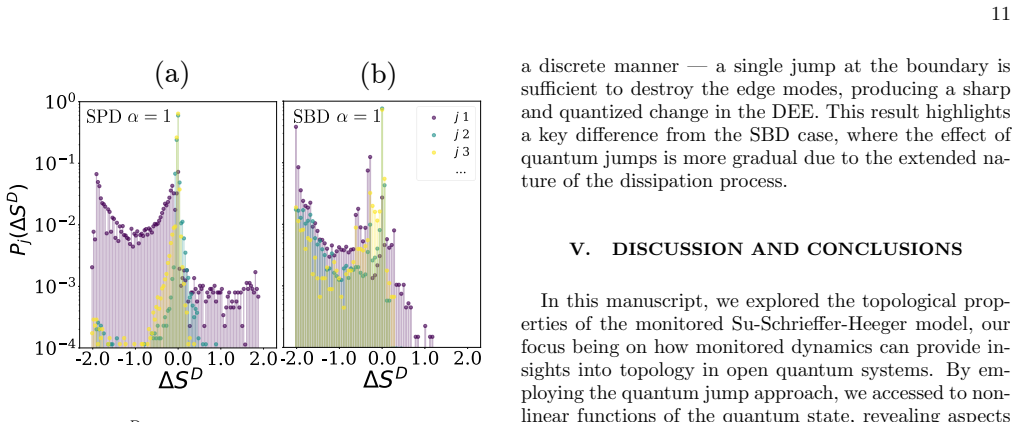
Statistical analysis of quantum trajectories in the monitored SSH model shows that protecting the chain's edges from dissipation recovers characteristic features of edge modes analogous to the unitary limit, as seen in two-point correlation functions and disconnected entanglement entropy.
What carries the argument
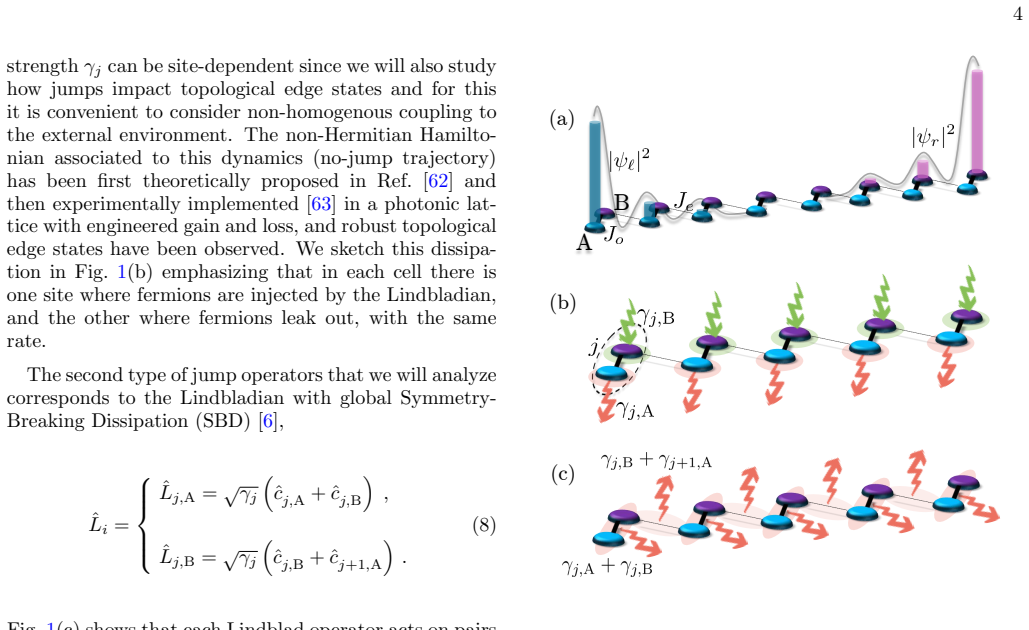
The spatial pattern of monitoring, with zero rate at the edges, which shields topological edge modes in the ensemble of quantum trajectories.
If this is right
- Edge-mode dynamics can be preserved under monitoring by spatially selective dissipation.
- Trajectory ensemble averages can mimic closed-system behavior for protected edges.
- Both linear and nonlinear diagnostics show recovery when edges are unmonitored.
- Dissipation pattern is crucial for topological features in open monitored systems.
Where Pith is reading between the lines
- The result implies that experimental implementations could use boundary protection to study monitored topological phases.
- Similar spatial control might enable observation of edge modes in other monitored models.
- Future work could test if this holds for different monitoring types or interaction strengths.
Load-bearing premise
The chosen spatial pattern with zero monitoring at edges is representative and the trajectory average captures the dynamics without post-selection bias.
What would settle it
If measurements show that even with edge protection the averaged correlation functions or DEE do not match the unitary case, the claim would be falsified.
Figures



read the original abstract
We investigate the effect of dissipation on the dynamics of edge modes in the monitored Su-Schrieffer-Heeger (SSH) model. Our study considers both a linear observable and a nonlinear entanglement measure, namely the two-point correlation function and the Disconnected Entanglement Entropy (DEE), as diagnostic tools. While dissipation inevitably alters the entanglement properties observed in the closed system, statistical analysis of quantum trajectories reveals that by protecting the chain's edges from dissipation, it is possible to recover characteristic features analogous to those found in the unitary limit. This highlights the fundamental role of spatial dissipation patterns in shaping the dynamics of edge modes in monitored systems.
Editorial analysis
A structured set of objections, weighed in public.
Referee Report
Summary. The paper investigates the effect of spatially inhomogeneous dissipation on edge modes in the monitored Su-Schrieffer-Heeger model. It uses the two-point correlation function and disconnected entanglement entropy (DEE) as diagnostics and claims that nulling the monitoring rate exactly at the two boundary sites allows statistical averages over quantum trajectories to recover characteristic features of the unitary (closed-system) limit.
Significance. If the numerical evidence is robust, the result would show that spatial patterns of monitoring can selectively protect topological edge modes, adding to the literature on measurement-induced phases and non-unitary dynamics in topological systems. The dual use of a linear observable and a nonlinear entanglement measure strengthens the diagnostic power.
major comments (2)
- [§3] §3 (Monitoring protocol): the central claim rests on setting the monitoring rate exactly to zero at the edge sites. No robustness test against small but finite edge rates is reported; without it the recovery cannot be distinguished from a tuned boundary condition.
- [§4] §4 (Trajectory statistics): the manuscript does not state whether the reported ensemble averages are taken over the complete stochastic unraveling (all jump trajectories) or incorporate an implicit filter such as no-jump post-selection. This distinction directly affects whether the recovered unitary signatures are generic or biased.
minor comments (1)
- [Abstract] The abstract could explicitly state the monitoring-rate pattern rather than using the phrase 'protecting the chain's edges'.
Simulated Author's Rebuttal
We thank the referee for the careful reading and the constructive comments on our manuscript. Below we respond point by point to the two major comments. Both points can be addressed by clarification and additional checks; we therefore plan a revised manuscript.
read point-by-point responses
-
Referee: [§3] §3 (Monitoring protocol): the central claim rests on setting the monitoring rate exactly to zero at the edge sites. No robustness test against small but finite edge rates is reported; without it the recovery cannot be distinguished from a tuned boundary condition.
Authors: We agree that an explicit robustness check against small but nonzero edge monitoring rates would strengthen the presentation and help distinguish the selective-protection mechanism from a purely tuned boundary condition. In the revised manuscript we will add a short subsection (or appendix) reporting ensemble averages for edge rates set to 1–5 % of the bulk value. These data will show how the recovered edge-mode signatures in the two-point correlator and DEE degrade as the edge rate is increased from zero, thereby quantifying the sensitivity to the exact nulling condition. revision: yes
-
Referee: [§4] §4 (Trajectory statistics): the manuscript does not state whether the reported ensemble averages are taken over the complete stochastic unraveling (all jump trajectories) or incorporate an implicit filter such as no-jump post-selection. This distinction directly affects whether the recovered unitary signatures are generic or biased.
Authors: The reported averages are performed over the complete stochastic unraveling, i.e., the full ensemble of quantum trajectories that includes all possible jump sequences; no post-selection or no-jump filtering is applied. We will add an explicit statement to this effect in §4 (and in the caption of the relevant figures) of the revised manuscript, together with a brief remark on the numerical procedure used to generate and average the trajectories. revision: yes
Circularity Check
No significant circularity; derivation is simulation-driven and self-contained
full rationale
The paper reports results from direct numerical simulation of quantum trajectories in the monitored SSH model, using the two-point correlator and DEE as diagnostics. The central observation—that protecting edge sites from monitoring recovers unitary-limit features—is obtained from ensemble averages over stochastic trajectories rather than from any fitted parameter, self-referential definition, or self-citation chain that reduces the reported outcome to its inputs by construction. No equations or modeling choices in the provided text equate a prediction to a fit or rename an ansatz as a theorem. The spatial monitoring pattern is an explicit modeling choice whose consequences are computed, not presupposed.
Axiom & Free-Parameter Ledger
free parameters (1)
- monitoring rate gamma
axioms (2)
- standard math Quantum trajectories generated by continuous monitoring obey the standard stochastic Schrödinger equation derived from the Lindblad master equation.
- domain assumption The disconnected entanglement entropy and two-point correlation function remain well-defined and computable along individual trajectories in the presence of local monitoring.
Lean theorems connected to this paper
-
IndisputableMonolith/Cost/FunctionalEquation.leanwashburn_uniqueness_aczel unclear?
unclearRelation between the paper passage and the cited Recognition theorem.
statistical analysis of quantum trajectories reveals that by protecting the chain's edges from dissipation, it is possible to recover characteristic features analogous to those found in the unitary limit
-
IndisputableMonolith/Foundation/AlexanderDuality.leanalexander_duality_circle_linking unclear?
unclearRelation between the paper passage and the cited Recognition theorem.
the Disconnected Entanglement Entropy (DEE) ... quantifies the entanglement between topological edge states
What do these tags mean?
- matches
- The paper's claim is directly supported by a theorem in the formal canon.
- supports
- The theorem supports part of the paper's argument, but the paper may add assumptions or extra steps.
- extends
- The paper goes beyond the formal theorem; the theorem is a base layer rather than the whole result.
- uses
- The paper appears to rely on the theorem as machinery.
- contradicts
- The paper's claim conflicts with a theorem or certificate in the canon.
- unclear
- Pith found a possible connection, but the passage is too broad, indirect, or ambiguous to say the theorem truly supports the claim.
Forward citations
Cited by 1 Pith paper
-
Superconducting Proximity Effect in an SSH-Superconductor Junction
A microscopic model of an SSH-superconductor junction finds stable quasiparticle states inside the gap for bulk superconductors but finite temperature-dependent lifetimes from phase fluctuations in lower-dimensional s...
Reference graph
Works this paper leans on
-
[1]
Edge modes Considering the Hamiltonian of Eq. (6) with space- dependent couplings [56], it is straightforward to see that, in the thermodynamic limit, two zero-energy eigenmodes of the Hamiltonian can be found in the form |L⟩ = NX i=1 aiˆc† i,A |0⟩ = NX i=1 ai |i, A⟩ , (A1a) |R⟩ = NX i=1 biˆc† i,B |0⟩ = NX i=1 bi |i, B⟩ , (A1b) which are states exponentia...
-
[2]
The reduced system is thus ˆρB = 1 2 [|0N B⟩ ⟨0N B| + |1N B⟩ ⟨1N B|] , (A5) 13 (a) (b) FIG
Disconnected entanglement entropy It is thus possible to analytically understand the role of the DEE in the fully-dimerized and topological limit of the SSH chain and show that the ground state always contains the maximally entangled superposition of the two edge states in the topological phase. The reduced system is thus ˆρB = 1 2 [|0N B⟩ ⟨0N B| + |1N B⟩...
-
[3]
Nambu Formalism Let ˆcj be the destruction operator for a system of spinless fermions labelled by j = 1 , · · · , L. We define a Nambu column vector ˆC and its Hermitian conjugate row vector ˆC†, each of length 2 L, by [69] ˆC = ˆc1 ... ˆcL ˆc† 1 ... ˆc† L , (B1) and ˆC† = ˆc† 1 , · · · , ˆc† L , ˆc1 , · · · , ˆcL . (B2) Majorana...
-
[4]
Symmetry classes for open systems: review of the tenfold way classification of quadratic Lindbladians We review the symmetry classification for quadratic open Markovian systems proposed in Ref. [6]. We start by writing the quadratic Hamiltonian in Eq. (6) and the linear jump operators in terms of the 2 L Majorana oper- ators {ˇcj} defined in Eq. (B5) such...
-
[5]
Hamiltonian Let us start considering the SSH Hamiltonian of Eq. (6). In Nambu formalism it reads as: ˆHSSH = ˆC†HSSH ˆC , (B17) with HSSH = AH 0 0 −AH , (B18) where the L × L real symmetric matrix AH reads: AH = 1 2 0 −Jo 0 · · · · · · · · · 0 −Jo 0 −Je 0 · · · · · · 0 0 −Je 0 −Jo 0 · · · 0 0 0 −Jo 0 −Je · · · 0 ... ... · · · ... ... ... 0 .....
-
[6]
SPD dynamics In the SPD dynamics, the dissipation matrix, in terms of Majorana operators, is: M = γ 4 1 −i(1o − 1e) i(1o − 1e) 1 . (B25) where 1o is an identity only on the odd (A) sites, and similarly 1e for the even (B) sites, hence 1 = 1o + 1e. The real matrix X appearing in Eq. (B14) is therefore given by: X ≡ −2iH M SSH + 2MR = γ 21 A H −AH γ 21 . (B...
-
[7]
SBD dynamics In the SBD dynamics the dissipation matrix is: M = γ 4 MA −iMA iMA MA , (B27) with the complex L × L matrix MA given by: MA = 1 1 0 · · · · · · · · · 0 1 2 1 0 · · · · · · 0 0 1 2 1 0 · · · 0 0 0 1 2 1 · · · 0 ... ... · · · ... ... ... 0 ... ... ... 0 1 2 1 0 · · · · · · · · · 0 1 1 . (B28) which does not allow to se...
-
[8]
Quadratic Hamiltonians Let us consider the most general form for a quadratic Hamiltonian ˆΘ = X i,j h Ai,jˆc† i ˆcj − A∗ i,jˆci ˆc† j+ +Bi,jˆci ˆcj − B∗ i,jˆc† i ˆc† j i , (C1) where A is a Hermitian matrix and B is a skew- symmetric matrix. This general quadratic Hamiltonian can be also rewritten as [69] ˆΘ = ˆC†Θ ˆC , (C2) where Θ = A B −B∗ A∗ (C3) and ...
-
[9]
Gaussian states A Gaussian state is any state whose density matrix can be written as ˆρ(t) = 1 Z(t)e−ˆΘ(t) (C4) where Z(t) = Tr e−ˆΘ(t) enforces the normalization. For Gibbs states, ˆΘ is the real quadratic Hamiltonian of the equilibrium state, while, in general, it plays the role of an effective Hamiltonian, which we will refer to as entan- glement Hamil...
-
[10]
Covariance matrix As previously done, let us restrict our study to the number-preserving quadratic Hamiltonian of Eq. (C5). Let us consider the covariance matrix of Eq. (11) whose average is computed over the Gaussian state with effec- tive Hamiltonian (C5). Since ˆρ is a Gaussian state, Wick’s theorem holds, and all the higher correlation functions can b...
-
[11]
Reduced system When we consider a subsystem of {α, β} ∈ X sites, the reduced density matrix ˆρX allows to reproduce all expec- tation values in the subsystem and, as long as it remains Gaussian, so does the reduced two-point covariance ma- trix GXα,β = Tr(ˆρXˆc† βˆcα). (C17) In order for ˆρX to be Gaussian, it is still required to be the exponential of a ...
-
[12]
Quantum-jump unraveling for Gaussian states We refer to Ref. [77] for more information regarding the adopted algorithm for the computation of the quantum- jump trajectory. Suitably arranging the latter, exploiting the Gaussian nature of the states we deal with, we actu- ally apply the algorithm directly on the covariance matrix related to the Gaussian sta...
-
[13]
Evolution of the norm In order to consider the occurrence of the quantum jump when ⟨ψ(t∗)|ψ(t∗)⟩ > r , where r is the random number uniformly distributed in [0 , 1], we simultane- ously compute the time-evolution of the norm n(t) = ⟨ψ(t)|ψ(t)⟩ when it evolves under ˆHef f n(t + dt) = n(dt) − 2dtn(t)Λ(t) + o(dt), (E5) so that n(t + dt) − n(t) dt = −2Λ(t)n(...
-
[14]
B. Bernevig and T. Hughes, Topological Insulators and Topological Superconductors(Princeton University Press, 2013)
work page 2013
- [15]
-
[16]
N. Okuma and M. Sato, Non-Hermitian Topological Phe- nomena: A Review, Annual Review of Condensed Matter Physics 14, 83–107 (2023)
work page 2023
- [17]
- [18]
-
[19]
S. Lieu, M. McGinley, and N. R. Cooper, Tenfold Way for Quadratic Lindbladians, Phys. Rev. Lett.124, 040401 (2020)
work page 2020
-
[20]
A. Altland, M. Fleischhauer, and S. Diehl, Symmetry Classes of Open Fermionic Quantum Matter, Phys. Rev. X 11, 021037 (2021)
work page 2021
-
[21]
A. Altland and M. R. Zirnbauer, Nonstandard symme- try classes in mesoscopic normal-superconducting hybrid structures, Physical Review B 55, 1142 (1997)
work page 1997
-
[22]
K. Kawabata, K. Shiozaki, M. Ueda, and M. Sato, Sym- metry and Topology in Non-Hermitian Physics, Phys. Rev. X 9, 041015 (2019)
work page 2019
-
[23]
D. Bernard and A. LeClair, A Classification of Non- Hermitian Random Matrices, in Statistical Field Theo- ries (Springer Netherlands, 2002) p. 207–214
work page 2002
-
[24]
Prosen, PT-Symmetric Quantum Liouvillean Dynam- ics, Phys
T. Prosen, PT-Symmetric Quantum Liouvillean Dynam- ics, Phys. Rev. Lett. 109, 090404 (2012)
work page 2012
-
[25]
B. Buca and T. Prosen, A note on symmetry reductions of the Lindblad equation: transport in constrained open spin chains, New Journal of Physics 14, 073007 (2012)
work page 2012
-
[26]
V. V. Albert and L. Jiang, Symmetries and conserved quantities in Lindblad master equations, Phys. Rev. A 89, 022118 (2014)
work page 2014
- [27]
-
[28]
M. Kawasaki, K. Mochizuki, and H. Obuse, Topologi- cal phases protected by shifted sublattice symmetry in dissipative quantum systems, Phys. Rev. B 106, 035408 (2022)
work page 2022
-
[29]
L. Mao, F. Yang, and H. Zhai, Symmetry-preserving quadratic Lindbladian and dissipation driven topologi- cal transitions in Gaussian states, Reports on Progress in Physics 87, 070501 (2024)
work page 2024
-
[30]
F. K. Kunst, E. Edvardsson, J. C. Budich, and E. J. Bergholtz, Biorthogonal Bulk-Boundary Correspondence in Non-Hermitian Systems, Phys. Rev. Lett. 121, 026808 (2018)
work page 2018
-
[31]
Z. Gong, Y. Ashida, K. Kawabata, K. Takasan, S. Hi- gashikawa, and M. Ueda, Topological Phases of Non- Hermitian Systems, Phys. Rev. X 8, 031079 (2018)
work page 2018
-
[32]
H. Shen, B. Zhen, and L. Fu, Topological Band Theory for Non-Hermitian Hamiltonians, Phys. Rev. Lett. 120, 146402 (2018)
work page 2018
-
[33]
O. Viyuela, A. Rivas, and M. A. Martin-Delgado, Uhlmann Phase as a Topological Measure for One- Dimensional Fermion Systems, Phys. Rev. Lett. 112, 130401 (2014)
work page 2014
-
[34]
O. Viyuela, A. Rivas, S. Gasparinetti, A. Wallraff, S. Fil- ipp, and M. A. Martin-Delgado, Observation of topolog- ical Uhlmann phases with superconducting qubits, npj Quantum Information 4, 10 (2018)
work page 2018
-
[35]
Uhlmann curvature in dissipative phase transitions
A. Carollo, B. Spagnolo, and D. Valenti, Uhlmann curvature in dissipative phase transitions, (2017), arXiv:1710.07560
work page internal anchor Pith review Pith/arXiv arXiv 2017
- [36]
-
[37]
R. Unanyan, M. Kiefer-Emmanouilidis, and M. Fleis- chhauer, Finite-Temperature Topological Invariant for Interacting Systems, Phys. Rev. Lett. 125, 215701 (2020)
work page 2020
-
[38]
Z.-M. Huang and S. Diehl, Mixed state topological or- der parameters for symmetry protected fermion matter, 22 (2024), arXiv:2401.10993
- [39]
-
[40]
A. Nava, G. Campagnano, P. Sodano, and D. Giuliano, Lindblad master equation approach to the topological phase transition in the disordered Su-Schrieffer-Heeger model, Phys. Rev. B 107, 035113 (2023)
work page 2023
-
[41]
E. G. Cinnirella, A. Nava, G. Campagnano, and D. Giu- liano, Fate of high winding number topological phases in the disordered extended Su-Schrieffer-Heeger model, Phys. Rev. B 109, 035114 (2024)
work page 2024
-
[42]
H. Carmichael, Statistical Methods in Quantum Optics 1: Master Equations and Fokker-Planck Equations , The- oretical and Mathematical Physics (Springer Berlin Hei- delberg, 2013)
work page 2013
-
[43]
A. J. Daley, Quantum trajectories and open many- body quantum systems, Advances in Physics 63, 77–149 (2014)
work page 2014
-
[44]
M. B. Plenio and P. L. Knight, The quantum-jump ap- proach to dissipative dynamics in quantum optics, Re- views of Modern Physics 70, 101–144 (1998)
work page 1998
- [45]
-
[46]
H. P. Breuer and F. Petruccione, The theory of open quantum systems (Oxford University Press, Great Clarendon Street, 2002)
work page 2002
-
[47]
Y. Li, X. Chen, and M. P. A. Fisher, Quantum Zeno effect and the many-body entanglement transition, Phys. Rev. B 98, 205136 (2018)
work page 2018
-
[48]
B. Skinner, J. Ruhman, and A. Nahum, Measurement- Induced Phase Transitions in the Dynamics of Entangle- ment, Phys. Rev. X 9, 031009 (2019)
work page 2019
-
[49]
A. C. Potter and R. Vasseur, Entanglement Dynamics in Hybrid Quantum Circuits, in Entanglement in Spin Chains: From Theory to Quantum Technology Applica- tions, edited by A. Bayat, S. Bose, and H. Johannes- son (Springer International Publishing, Cham, 2022) pp. 211–249
work page 2022
- [50]
-
[51]
B. Zeng, X. Chen, D. Zhou, and X. Wen, Quantum Infor- mation Meets Quantum Matter: From Quantum Entan- glement to Topological Phases of Many-Body Systems , Quantum science and technology (Springer New York, 2019)
work page 2019
-
[52]
J. Chen, Z. Ji, C.-K. Li, Y.-T. Poon, Y. Shen, N. Yu, B. Zeng, and D. Zhou, Discontinuity of maximum entropy inference and quantum phase transitions, New Journal of Physics 17, 083019 (2015)
work page 2015
-
[53]
S. V. Isakov, M. B. Hastings, and R. G. Melko, Topologi- cal entanglement entropy of a Bose–Hubbard spin liquid, Nature Physics 7, 772–775 (2011)
work page 2011
- [54]
-
[55]
A. Kitaev and J. Preskill, Topological Entanglement En- tropy, Phys. Rev. Lett. 96, 110404 (2006)
work page 2006
-
[56]
M. Levin and X.-G. Wen, Detecting Topological Order in a Ground State Wave Function, Phys. Rev. Lett. 96, 110405 (2006)
work page 2006
- [57]
- [58]
-
[59]
H. Pichler, G. Zhu, A. Seif, P. Zoller, and M. Hafezi, Measurement Protocol for the Entanglement Spectrum of Cold Atoms, Phys. Rev. X 6, 041033 (2016)
work page 2016
- [60]
-
[61]
T. Brydges, A. Elben, P. Jurcevic, B. Vermersch, C. Maier, B. P. Lanyon, P. Zoller, R. Blatt, and C. F. Roos, Probing R´ enyi entanglement entropy via random- ized measurements, Science 364, 260 (2019)
work page 2019
-
[62]
P. Fromholz, G. Magnifico, V. Vitale, T. Mendes-Santos, and M. Dalmonte, Entanglement topological invariants for one-dimensional topological superconductors, Phys. Rev. B 101, 085136 (2020)
work page 2020
-
[63]
T. Micallo, V. Vitale, M. Dalmonte, and P. Fromholz, Topological entanglement properties of disconnected par- titions in the Su-Schrieffer-Heeger model, SciPost Phys. Core 3, 012 (2020)
work page 2020
- [64]
-
[65]
W. P. Su, J. R. Schrieffer, and A. J. Heeger, Solitons in Polyacetylene, Phys. Rev. Lett. 42, 1698 (1979)
work page 1979
-
[66]
W. P. Su, J. R. Schrieffer, and A. J. Heeger, Soliton ex- citations in polyacetylene, Phys. Rev. B 22, 2099 (1980)
work page 2099
-
[67]
M. Z. Hasan and C. L. Kane, Colloquium: Topologi- cal insulators, Reviews of Modern Physics 82, 3045–3067 (2010)
work page 2010
-
[68]
X.-L. Qi and S.-C. Zhang, Topological insulators and superconductors, Reviews of Modern Physics 83, 1057–1110 (2011)
work page 2011
-
[69]
J. K. Asb´ oth, L. Oroszl´ any, and A. P´ alyi,A Short Course on Topological Insulators (Springer International Pub- lishing, 2016)
work page 2016
- [70]
-
[71]
G. Lindblad, On the generators of quantum dynamical semigroups, Communications in Mathematical Physics 48, 119 (1976)
work page 1976
-
[72]
D. S. Simon, S. Osawa, and A. V. Sergienko, Topo- logical boundaries and bulk wavefunctions in the Su–Schreiffer–Heeger model, Journal of Physics: Con- densed Matter 31, 045001 (2018)
work page 2018
-
[73]
M. V. Berry, Quantal Phase Factors Accompanying Adi- abatic Changes, Proceedings of the Royal Society of Lon- don. A. Mathematical and Physical Sciences 392, 45 (1984)
work page 1984
-
[74]
Zak, Berry’s phase for energy bands in solids, Phys
J. Zak, Berry’s phase for energy bands in solids, Phys. Rev. Lett. 62, 2747 (1989)
work page 1989
-
[75]
Schomerus, Topologically protected midgap states in complex photonic lattices, Opt
H. Schomerus, Topologically protected midgap states in complex photonic lattices, Opt. Lett. 38, 1912 (2013)
work page 1912
-
[76]
S. Weimann, M. Kremer, Y. Plotnik, Y. Lumer, S. Nolte, K. G. Makris, M. Segev, M. C. Rechtsman, and A. Sza- meit, Topologically protected bound states in photonic parity-time-symmetric crystals, Nature materials 16 4 , 23 433 (2017)
work page 2017
-
[77]
Other choices could also be considered, but with less ex- perimental relevance and a more complicated interpreta- tion in terms of mutual information [49]
-
[78]
I. Peschel, Calculation of reduced density matrices from correlation functions, Journal of Physics A: Mathemati- cal and General 36, L205 (2003)
work page 2003
-
[79]
A. Polkovnikov, K. Sengupta, A. Silva, and M. Ven- galattore, Nonequilibrium dynamics of closed interacting quantum systems, Rev. Mod. Phys. 83, 863 (2011)
work page 2011
-
[80]
Calabrese, Entanglement spreading in non-equilibrium integrable systems, SciPost Phys
P. Calabrese, Entanglement spreading in non-equilibrium integrable systems, SciPost Phys. Lect. Notes , 20 (2020)
work page 2020
discussion (0)
Sign in with ORCID, Apple, or X to comment. Anyone can read and Pith papers without signing in.