McFACTS II: Mass Ratio--Effective Spin Relationship of Black Hole Mergers in the AGN Channel
Pith reviewed 2026-05-23 16:53 UTC · model grok-4.3
The pith
Dense moderately short-lived AGN disks with a steep black hole mass function produce the observed anti-correlation in mass ratio and effective spin for mergers.
A machine-rendered reading of the paper's core claim, the machinery that carries it, and where it could break.
Core claim
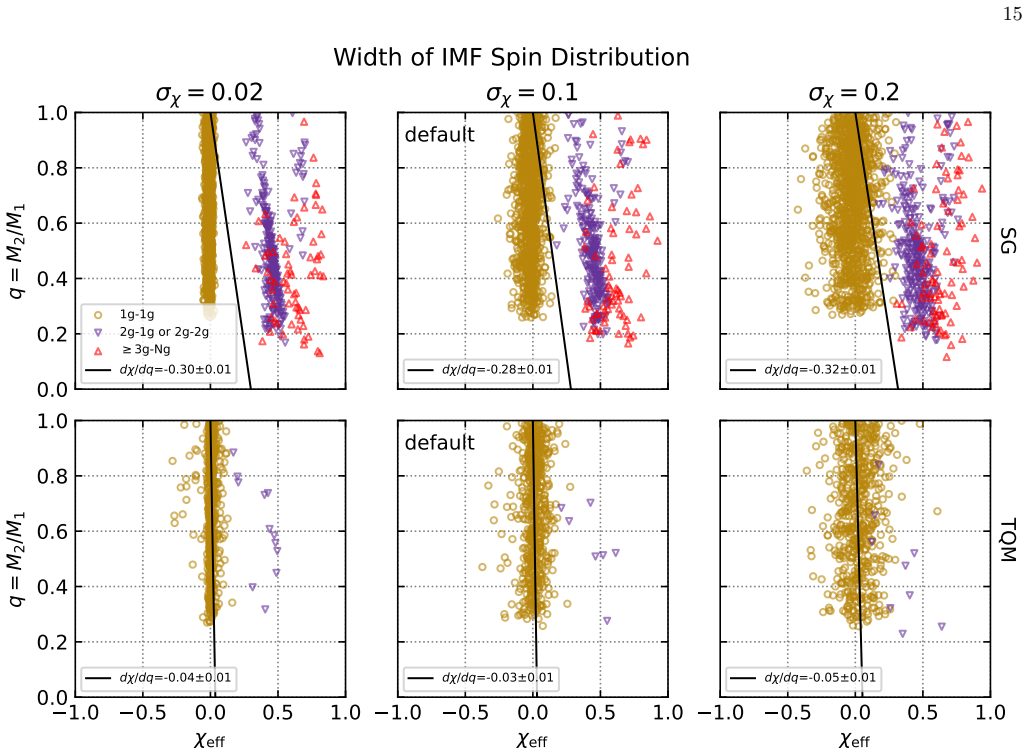
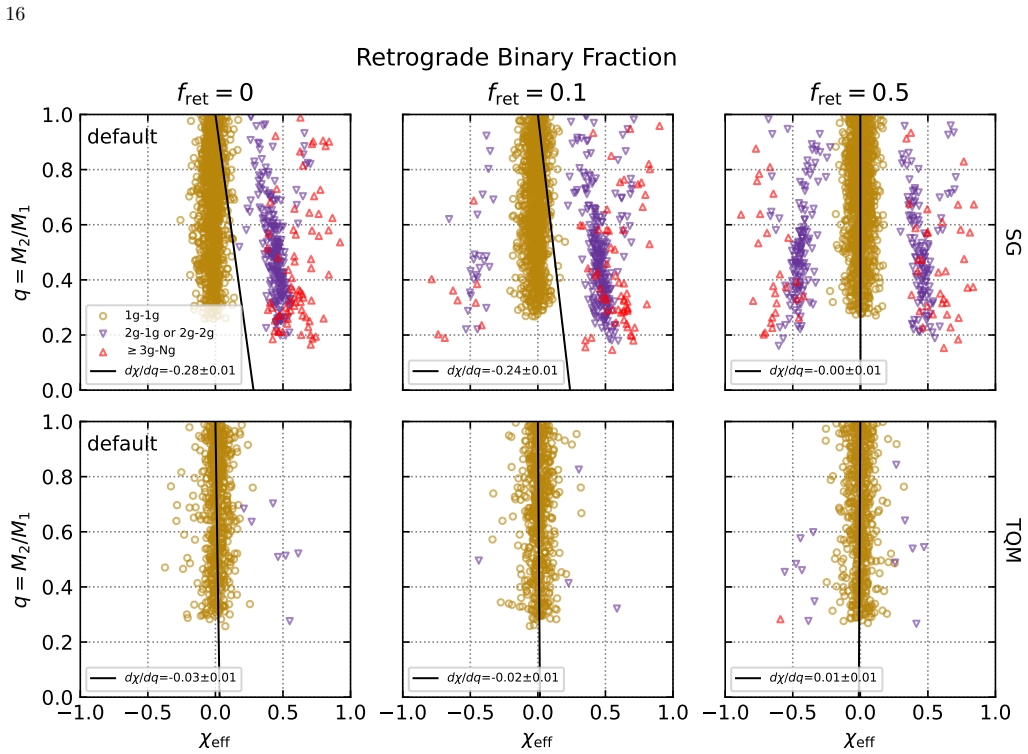
Using the McFACTS Monte Carlo code, varying the black hole initial mass function, disk model, size, lifetime and prograde-to-retrograde fraction shows that dense, moderately short-lived AGN disks are preferred for producing a (q, χ_eff) anti-correlation like those identified from existing gravitational wave observations, with a BH initial mass function proportional to M to the minus two also preferred over a top-heavy one, and a prograde-to-retrograde fraction greater than ninety percent required for consistency with observations.
What carries the argument
Monte Carlo simulations of migration, binary formation, spin evolution and merger processes inside AGN disks, testing different initial conditions and disk parameters.
If this is right
- Dense AGN disks with moderate lifetimes match the observed (q, χ_eff) anti-correlation better than other configurations.
- A black hole initial mass function scaling as M^{-2} is favored over M^{-1}.
- Greater than 90% of newly formed black hole binaries must be prograde to match data.
- The AGN channel can produce results consistent with LVK observations under these preferred conditions.
Where Pith is reading between the lines
- If the anti-correlation persists or strengthens in future larger gravitational wave catalogs, it would increase the inferred contribution from the AGN channel.
- Altering the assumed gas dynamics or stellar interaction rules in the simulations could shift the preferred disk lifetime or mass function.
- The results connect the nuclear star cluster environment around supermassive black holes directly to observable spin and mass distributions in mergers.
Load-bearing premise
The McFACTS Monte Carlo code accurately captures the dominant physical processes of migration, binary formation, spin evolution, and merger inside AGN disks without major omissions or incorrect prescriptions.
What would settle it
A large sample of gravitational wave events showing no anti-correlation between mass ratio and effective spin, or a different preferred mass function, would falsify the claim that these AGN disk parameters are required.
Figures




read the original abstract
We use the Monte Carlo For AGN (active galactic nucleus) Channel Testing and Simulation (McFACTS, https://www.github.com/mcfacts/mcfacts) code to study the effect of AGN disk and nuclear star cluster parameters on predicted mass distributions for LIGO-Virgo-KAGRA (LVK) compact binaries forming in AGN disks. The assumptions we vary include the black hole (BH) initial mass function, disk model, disk size, disk lifetime, and the prograde-to-retrograde fraction of newly formed black hole binaries. Broadly we find that dense, moderately short-lived AGN disks are preferred for producing a $(q,\chi_{\rm eff})$ anti-correlation like those identified from existing gravitational wave (GW) observations. Additionally, a BH initial mass function (MF $\propto M^{-2}$) is preferred over a more top-heavy MF ($M^{-1}$). The preferred fraction of prograde-to-retrograde is $>90\%$, to produce results consistent with observations.
Editorial analysis
A structured set of objections, weighed in public.
Referee Report
Summary. The paper uses the McFACTS Monte Carlo code to explore the effects of varying AGN disk and nuclear star cluster parameters—including the black hole initial mass function (IMF), disk model, disk size, disk lifetime, and prograde-to-retrograde fraction—on the predicted mass-ratio (q) and effective spin (χ_eff) distributions of black hole mergers formed in AGN disks. By comparing simulated populations to the (q, χ_eff) anti-correlation reported in existing LVK gravitational-wave observations, the authors identify preferred parameter combinations: dense and moderately short-lived disks, an IMF ∝ M^{-2} (rather than a top-heavy M^{-1}), and a prograde fraction exceeding 90%.
Significance. If the McFACTS sub-grid prescriptions for migration, binary formation, and spin evolution prove accurate, the parameter study would map AGN disk properties onto an observable GW signature, offering a route to constrain the contribution of the AGN channel and the properties of nuclear star clusters. The explicit variation of free parameters and the focus on a specific observable correlation constitute a concrete, falsifiable exploration within the AGN formation scenario.
major comments (2)
- [Abstract] Abstract and parameter-variation description: the quoted 'preferred' values for disk lifetime, density, IMF power-law index, and prograde-to-retrograde fraction are obtained by selecting the combinations that reproduce the observed (q, χ_eff) anti-correlation. This selection is performed on the same data the model is intended to explain, rendering the preferences fits rather than blind predictions and weakening the claim that these values are physically required.
- [Methods (McFACTS implementation)] Methods section describing the McFACTS implementation: no direct validation is shown for the sub-grid models of gas-driven migration rates, binary capture, or spin alignment/accretion against analytic limits, hydrodynamical benchmarks, or independent observables. Because the central claim rests on the fidelity of these prescriptions (particularly any mass-ratio dependence or prograde/retrograde spin evolution), the absence of such tests makes the reported parameter preferences vulnerable to systematic artifacts in the Monte Carlo code.
minor comments (1)
- [Abstract] The abstract would benefit from a brief quantitative statement of how the anti-correlation is measured (e.g., slope or correlation coefficient) and the precise ranges explored for each varied parameter.
Simulated Author's Rebuttal
We thank the referee for the constructive comments on our manuscript. We address each major comment below and indicate where revisions will be made to the next version.
read point-by-point responses
-
Referee: [Abstract] Abstract and parameter-variation description: the quoted 'preferred' values for disk lifetime, density, IMF power-law index, and prograde-to-retrograde fraction are obtained by selecting the combinations that reproduce the observed (q, χ_eff) anti-correlation. This selection is performed on the same data the model is intended to explain, rendering the preferences fits rather than blind predictions and weakening the claim that these values are physically required.
Authors: We agree that the parameter combinations identified as 'preferred' are those that reproduce the observed anti-correlation and therefore constitute fits to the LVK data rather than blind predictions. The manuscript's objective is to determine which AGN-disk and nuclear-cluster parameters are capable of producing a (q, χ_eff) anti-correlation consistent with existing observations. We will revise the abstract and the relevant discussion sections to make this distinction explicit and to avoid any implication that the values are uniquely required on physical grounds independent of the data. revision: yes
-
Referee: [Methods (McFACTS implementation)] Methods section describing the McFACTS implementation: no direct validation is shown for the sub-grid models of gas-driven migration rates, binary capture, or spin alignment/accretion against analytic limits, hydrodynamical benchmarks, or independent observables. Because the central claim rests on the fidelity of these prescriptions (particularly any mass-ratio dependence or prograde/retrograde spin evolution), the absence of such tests makes the reported parameter preferences vulnerable to systematic artifacts in the Monte Carlo code.
Authors: We acknowledge that the manuscript does not present new, direct comparisons of the sub-grid prescriptions against analytic limits or hydrodynamical simulations. The migration, capture, and spin-evolution modules in McFACTS are based on models previously published in the literature; the code repository and the McFACTS I paper provide the relevant references and implementation details. We will add a concise subsection to the methods that summarizes the provenance of these prescriptions, cites existing validation studies where available, and explicitly notes the limitations of the current implementation. New benchmark calculations against hydrodynamical simulations lie outside the scope of this parameter-exploration study. revision: partial
Circularity Check
No significant circularity: parameter survey matches external observations without reduction to inputs.
full rationale
The paper conducts a Monte Carlo exploration varying AGN disk parameters, BH mass function, and prograde fraction, then reports which combinations reproduce the observed (q, χ_eff) anti-correlation. This constitutes a standard forward-model comparison to independent GW data rather than any self-definitional loop, fitted input relabeled as prediction, or load-bearing self-citation. No equations or claims in the abstract reduce the output to the varied inputs by construction; the central result is the identification of matching parameter sets, which remains falsifiable against future observations.
Axiom & Free-Parameter Ledger
free parameters (4)
- prograde-to-retrograde fraction =
>90%
- BH initial mass function power-law index =
-2
- AGN disk lifetime =
moderately short-lived
- AGN disk density/size =
dense
axioms (2)
- domain assumption The McFACTS Monte Carlo code correctly models black-hole migration, binary formation, and spin evolution inside AGN disks.
- domain assumption The (q, χ_eff) anti-correlation reported in LVK catalogs is a genuine astrophysical signal rather than a selection or measurement artifact.
Forward citations
Cited by 3 Pith papers
-
Population Properties of Binary Black Holes with Eccentricity
First joint population inference on binary black hole eccentricity from GWTC-4 bounds the eccentric branching ratio below 5% at 90% confidence, with results consistent with quasi-circular models but highly model-dependent.
-
How do the LIGO-Virgo-KAGRA's Heavy Black Holes Form? No evidence for core-collapse Intermediate-mass black holes in GWTC-4
No evidence for core-collapse IMBHs in GWTC-4; heavy BHs from hierarchical mergers, with low-spin mass distribution truncating at ~65 solar masses and PIMG upper edge estimated at 150 solar masses.
-
How do the LIGO-Virgo-KAGRA's Heavy Black Holes Form? No evidence for core-collapse Intermediate-mass black holes in GWTC-4
No evidence for core-collapse formed low-spin IMBHs in GWTC-4, with 90% upper limit on merger rate of 0.077 Gpc^{-3} yr^{-1}, low-spin BH mass truncation at 65 solar masses consistent with pair-instability gap lower e...
Reference graph
Works this paper leans on
-
[1]
, " * write output.state after.block = add.period write newline
ENTRY address archivePrefix author booktitle chapter doi edition editor eprint howpublished institution journal key month number organization pages publisher school series title misctitle type volume year version url label extra.label sort.label short.list INTEGERS output.state before.all mid.sentence after.sentence after.block FUNCTION init.state.consts ...
-
[2]
" write newline "" before.all 'output.state := FUNCTION format.url url empty "" new.block "" url * "" * if FUNCTION format.eprint eprint empty "" archivePrefix empty "" archivePrefix "arXiv" = new.block " " eprint * " " * new.block " " eprint * " " * if if if FUNCTION format.doi doi empty "" " " doi * " " * if FUNCTION format.pid doi empty eprint empty ur...
-
[3]
F 0j7 7-qERu P)JI(> ? q 0 K5>kx_0s 7KVO7R zU W9 93 9
thebibliography [1] 20pt to REFERENCES 6pt =0pt -12pt 10pt plus 3pt =0pt =0pt =1pt plus 1pt =0pt =0pt -12pt =13pt plus 1pt =20pt =13pt plus 1pt \@M =10000 =-1.0em =0pt =0pt 0pt =0pt =1.0em @enumiv\@empty 10000 10000 `\.\@m \@noitemerr \@latex@warning Empty `thebibliography' environment \@ifnextchar \@reference \@latexerr Missing key on reference command E...
-
[4]
Abbott , R., Abbott , T. D., Abraham , S., et al. 2020 a , , 900, L13, 10.3847/2041-8213/aba493
-
[5]
2020 b , , 125, 101102, 10.1103/PhysRevLett.125.101102
---. 2020 b , , 125, 101102, 10.1103/PhysRevLett.125.101102
-
[6]
Abbott , R., Abbott , T. D., Acernese , F., et al. 2023, Physical Review X, 13, 041039, 10.1103/PhysRevX.13.041039
-
[7]
---. 2024, , 109, 022001, 10.1103/PhysRevD.109.022001
-
[8]
Antonini , F., & Rasio , F. A. 2016, , 831, 187, 10.3847/0004-637X/831/2/187
-
[9]
2023, Universe, 9, 138, 10.3390/universe9030138
Arca Sedda , M., Naoz , S., & Kocsis , B. 2023, Universe, 9, 138, 10.3390/universe9030138
-
[10]
Astropy Collaboration , Robitaille , T. P., Tollerud , E. J., et al. 2013, , 558, A33, 10.1051/0004-6361/201322068
-
[11]
Astropy Collaboration , Price-Whelan , A. M., Sip o cz , B. M., et al. 2018, , 156, 123, 10.3847/1538-3881/aabc4f
-
[12]
Astropy Collaboration , Price-Whelan , A. M., Lim , P. L., et al. 2022, , 935, 167, 10.3847/1538-4357/ac7c74
work page internal anchor Pith review doi:10.3847/1538-4357/ac7c74 2022
-
[13]
Bahcall , J. N., & Wolf , R. A. 1976, , 209, 214, 10.1086/154711
-
[14]
2024, arXiv e-prints, arXiv:2411.15112, 10.48550/arXiv.2411.15112
Banerjee , S., & Olejak , A. 2024, arXiv e-prints, arXiv:2411.15112, 10.48550/arXiv.2411.15112
-
[15]
2017, , 835, 165, 10.3847/1538-4357/835/2/165
Bartos , I., Kocsis , B., Haiman , Z., & M \'a rka , S. 2017, , 835, 165, 10.3847/1538-4357/835/2/165
-
[16]
2016, A&A, 594, A97, doi: 10.1051/0004-6361/201628980
Belczynski , K., Heger , A., Gladysz , W., et al. 2016, , 594, A97, 10.1051/0004-6361/201628980
-
[17]
M., Mac Low , M.-M., McKernan , B., & Ford , K
Bellovary , J. M., Mac Low , M.-M., McKernan , B., & Ford , K. E. S. 2016, , 819, L17, 10.3847/2041-8205/819/2/L17
-
[18]
2010, , 523, A30, 10.1051/0004-6361/201014414
Bitsch , B., & Kley , W. 2010, , 523, A30, 10.1051/0004-6361/201014414
-
[19]
Calcino , J., Dempsey , A. M., Dittmann , A. J., & Li , H. 2023, arXiv e-prints, arXiv:2311.13727, 10.48550/arXiv.2311.13727
-
[20]
Callister , T. A. 2021, arXiv e-prints, arXiv:2104.09508, 10.48550/arXiv.2104.09508
-
[21]
Callister , T. A., Haster , C.-J., Ng , K. K. Y., Vitale , S., & Farr , W. M. 2021, , 922, L5, 10.3847/2041-8213/ac2ccc
-
[22]
Cornejo , S., Masset , F. S., Chametla , R. O., & Fromenteau , S. 2023, , 522, 678, 10.1093/mnras/stad681
-
[23]
2023, , 523, 1126, 10.1093/mnras/stad1412
DeLaurentiis , S., Epstein-Martin , M., & Haiman , Z. 2023, , 523, 1126, 10.1093/mnras/stad1412
-
[24]
Delfavero , V., Ford , K. E. S., McKernan , B., et al. 2024, arXiv e-prints, arXiv:2410.18815, 10.48550/arXiv.2410.18815
-
[25]
Dittmann , A. J., Dempsey , A. M., & Li , H. 2024, , 964, 61, 10.3847/1538-4357/ad23ce
-
[26]
2024, arXiv e-prints, arXiv:2404.08138, 10.48550/arXiv.2404.08138
Dodici , M., & Tremaine , S. 2024, arXiv e-prints, arXiv:2404.08138, 10.48550/arXiv.2404.08138
-
[27]
Fabj , G., Nasim , S. S., Caban , F., et al. 2020, , 499, 2608, 10.1093/mnras/staa3004
-
[28]
Ford , K. E. S., & McKernan , B. 2022, , 517, 5827, 10.1093/mnras/stac2861
-
[29]
2025, arXiv e-prints, arXiv:2506.08801, 10.48550/arXiv.2506.08801
---. 2025, arXiv e-prints, arXiv:2506.08801, 10.48550/arXiv.2506.08801
-
[30]
Fragione , G., Grishin , E., Leigh , N. W. C., Perets , H. B., & Perna , R. 2019, , 488, 47, 10.1093/mnras/stz1651
-
[31]
A., Bonnerot , C., & Gerosa , D
Gangardt , D., Trani , A. A., Bonnerot , C., & Gerosa , D. 2024, , 530, 3689, 10.1093/mnras/stae1117
-
[32]
Generozov , A., Stone , N. C., Metzger , B. D., & Ostriker , J. P. 2018, , 478, 4030, 10.1093/mnras/sty1262
-
[33]
Gilbaum , S., Grishin , E., Stone , N. C., & Mandel , I. 2025, , 982, L13, 10.3847/2041-8213/adb7dc
-
[34]
Grishin , E., Gilbaum , S., & Stone , N. C. 2024, , 530, 2114, 10.1093/mnras/stae828
-
[35]
M., Jiang , Y.-F., & Armitage , P
Hankla , A. M., Jiang , Y.-F., & Armitage , P. J. 2020, , 902, 50, 10.3847/1538-4357/abb4df
-
[36]
Harris, C. R., Millman, K. J., van der Walt, S. J., et al. 2020, Nature, 585, 357, 10.1038/s41586-020-2649-2
-
[37]
Hoang , B.-M., Naoz , S., Kocsis , B., Rasio , F. A., & Dosopoulou , F. 2018, , 856, 140, 10.3847/1538-4357/aaafce
-
[38]
2012, , 750, 34, 10.1088/0004-637X/750/1/34
Horn , B., Lyra , W., Mac Low , M.-M., & S \'a ndor , Z. 2012, , 750, 34, 10.1088/0004-637X/750/1/34
-
[39]
Hunter, J. D. 2007, Computing in Science & Engineering, 9, 90, 10.1109/MCSE.2007.55
-
[40]
Jim \'e nez , M. A., & Masset , F. S. 2017, , 471, 4917, 10.1093/mnras/stx1946
-
[41]
2022, , 517, 1602, 10.1093/mnras/stac2577
Li , R., & Lai , D. 2022, , 517, 1602, 10.1093/mnras/stac2577
-
[42]
Lu , J. R., Do , T., Ghez , A. M., et al. 2013, , 764, 155, 10.1088/0004-637X/764/2/155
-
[43]
2010, , 715, L68, 10.1088/2041-8205/715/2/L68
Lyra , W., Paardekooper , S.-J., & Mac Low , M.-M. 2010, , 715, L68, 10.1088/2041-8205/715/2/L68
-
[44]
McKernan , B., & Ford , K. E. S. 2024, , 531, 3479, 10.1093/mnras/stae1351
-
[45]
McKernan , B., Ford , K. E. S., Callister , T., et al. 2022 a , , 514, 3886, 10.1093/mnras/stac1570
-
[46]
McKernan , B., Ford , K. E. S., Cantiello , M., et al. 2022 b , , 514, 4102, 10.1093/mnras/stac1310
-
[47]
McKernan , B., Ford , K. E. S., Cook , H. E., et al. 2024, arXiv e-prints, arXiv:2410.16515, 10.48550/arXiv.2410.16515
-
[48]
McKernan , B., Ford , K. E. S., Kocsis , B., Lyra , W., & Winter , L. M. 2014, , 441, 900, 10.1093/mnras/stu553
-
[49]
McKernan , B., Ford , K. E. S., Lyra , W., & Perets , H. B. 2012, , 425, 460, 10.1111/j.1365-2966.2012.21486.x
-
[50]
McKernan , B., Ford , K. E. S., & O'Shaughnessy , R. 2020 a , , 498, 4088, 10.1093/mnras/staa2681
-
[51]
McKernan , B., Ford , K. E. S., O'Shaugnessy , R., & Wysocki , D. 2020 b , , 494, 1203, 10.1093/mnras/staa740
-
[52]
S., Fabj , G., Caban , F., et al
Nasim , S. S., Fabj , G., Caban , F., et al. 2023, , 522, 5393, 10.1093/mnras/stad1295
-
[53]
2024, , 689, A305, 10.1051/0004-6361/202450480
Olejak , A., Klencki , J., Xu , X.-T., et al. 2024, , 689, A305, 10.1051/0004-6361/202450480
-
[54]
A General Code for Modeling MHD Flows on Parallel Computers: Versatile Advection Code
Paardekooper , S. J., Baruteau , C., Crida , A., & Kley , W. 2010, , 401, 1950, 10.1111/j.1365-2966.2009.15782.x
-
[55]
Papaloizou , J. C. B., & Larwood , J. D. 2000, , 315, 823, 10.1046/j.1365-8711.2000.03466.x
-
[56]
2024, , 962, 143, 10.3847/1538-4357/ad1b53
Qian , K., Li , J., & Lai , D. 2024, , 962, 143, 10.3847/1538-4357/ad1b53
-
[57]
2024, arXiv e-prints, arXiv:2407.16113, 10.48550/arXiv.2407.16113
Renzo , M., & Smith , N. 2024, arXiv e-prints, arXiv:2407.16113, 10.48550/arXiv.2407.16113
-
[58]
Reynolds , C. S. 2019, Nature Astronomy, 3, 41, 10.1038/s41550-018-0665-z
-
[59]
L., Amaro-Seoane , P., Chatterjee , S., & Rasio , F
Rodriguez , C. L., Amaro-Seoane , P., Chatterjee , S., & Rasio , F. A. 2018, , 120, 151101, 10.1103/PhysRevLett.120.151101
-
[60]
2023, , 524, 2770, 10.1093/mnras/stad1926
Rowan , C., Boekholt , T., Kocsis , B., & Haiman , Z. 2023, , 524, 2770, 10.1093/mnras/stad1926
-
[61]
Samsing , J., Bartos , I., D'Orazio , D. J., et al. 2022, , 603, 237, 10.1038/s41586-021-04333-1
-
[62]
2023, arXiv e-prints, arXiv:2308.12998, 10.48550/arXiv.2308.12998
Santini , A., Gerosa , D., Cotesta , R., & Berti , E. 2023, arXiv e-prints, arXiv:2308.12998, 10.48550/arXiv.2308.12998
-
[63]
Schawinski , K., Koss , M., Berney , S., & Sartori , L. F. 2015, , 451, 2517, 10.1093/mnras/stv1136
-
[64]
2019, , 878, 85, 10.3847/1538-4357/ab20ca
Secunda , A., Bellovary , J., Mac Low , M.-M., et al. 2019, , 878, 85, 10.3847/1538-4357/ab20ca
-
[65]
2021, , 908, L27, 10.3847/2041-8213/abe11d
Secunda , A., Hernandez , B., Goodman , J., et al. 2021, , 908, L27, 10.3847/2041-8213/abe11d
-
[66]
2021, , 921, 70, 10.3847/1538-4357/ac1ce4
Shen , Y. 2021, , 921, 70, 10.3847/1538-4357/ac1ce4
-
[67]
Sirko , E., & Goodman , J. 2003, , 341, 501, 10.1046/j.1365-8711.2003.06431.x
-
[68]
Stone , N. C., Metzger , B. D., & Haiman , Z. 2017, , 464, 946, 10.1093/mnras/stw2260
-
[69]
2025, arXiv e-prints, arXiv:2501.16258, 10.48550/arXiv.2501.16258
Su , Y. 2025, arXiv e-prints, arXiv:2501.16258, 10.48550/arXiv.2501.16258
-
[70]
2022, , 513, 5465, 10.1093/mnras/stac1294
Sz \"o lgy \'e n , \'A ., MacLeod , M., & Loeb , A. 2022, , 513, 5465, 10.1093/mnras/stac1294
-
[71]
2020 a , , 899, 26, 10.3847/1538-4357/aba2cc
Tagawa , H., Haiman , Z., Bartos , I., & Kocsis , B. 2020 a , , 899, 26, 10.3847/1538-4357/aba2cc
-
[72]
2020 b , , 898, 25, 10.3847/1538-4357/ab9b8c
Tagawa , H., Haiman , Z., & Kocsis , B. 2020 b , , 898, 25, 10.3847/1538-4357/ab9b8c
-
[73]
Tanaka , H., & Ward , W. R. 2004, , 602, 388, 10.1086/380992
-
[74]
GW231123: a Binary Black Hole Merger with Total Mass 190-265 $M_{\odot}$
The LIGO Scientific Collaboration , the Virgo Collaboration , & the KAGRA Collaboration . 2025, arXiv e-prints, arXiv:2507.08219, 10.48550/arXiv.2507.08219
work page internal anchor Pith review Pith/arXiv arXiv doi:10.48550/arxiv.2507.08219 2025
-
[75]
A., Quataert , E., & Murray , N
Thompson , T. A., Quataert , E., & Murray , N. 2005, , 630, 167, 10.1086/431923
-
[76]
2008, , 78, 081501, 10.1103/PhysRevD.78.081501
Tichy , W., & Marronetti , P. 2008, , 78, 081501, 10.1103/PhysRevD.78.081501
-
[77]
P., Mapelli , M., P \'e rigois , C., et al
Vaccaro , M. P., Mapelli , M., P \'e rigois , C., et al. 2024, , 685, A51, 10.1051/0004-6361/202348509
-
[78]
Vajpeyi , A., Thrane , E., Smith , R., McKernan , B., & Saavik Ford , K. E. 2022, , 931, 82, 10.3847/1538-4357/ac6180
-
[79]
Virtanen, P., Gommers, R., Oliphant, T. E., et al. 2020, Nature Methods, 17, 261, 10.1038/s41592-019-0686-2
-
[80]
Volonteri , M., Madau , P., Quataert , E., & Rees , M. J. 2005, , 620, 69, 10.1086/426858
discussion (0)
Sign in with ORCID, Apple, or X to comment. Anyone can read and Pith papers without signing in.