Neutrino masses, anomalous magnetic moments and dark matter with vector-like fermions and an inert scalar doublet
Pith reviewed 2026-05-23 17:34 UTC · model grok-4.3
The pith
A Z2-symmetric extension with two generations of vector-like fermions and an inert scalar doublet generates neutrino masses radiatively while also explaining electron and muon anomalous magnetic moments and the observed dark matter relic.
A machine-rendered reading of the paper's core claim, the machinery that carries it, and where it could break.
Core claim
The central claim is that a single Z2-odd sector consisting of two generations of vector-like fermions and an inert scalar doublet can simultaneously generate the observed neutrino mass spectrum and mixing angles through radiative corrections, produce the measured deviations in the electron and muon anomalous magnetic moments via loop contributions, and yield the correct thermal relic density for dark matter from the annihilation of the lightest Z2-odd state, all while remaining consistent with experimental bounds on lepton flavor violation, direct detection, big bang nucleosynthesis, and cosmic microwave background observations.
What carries the argument
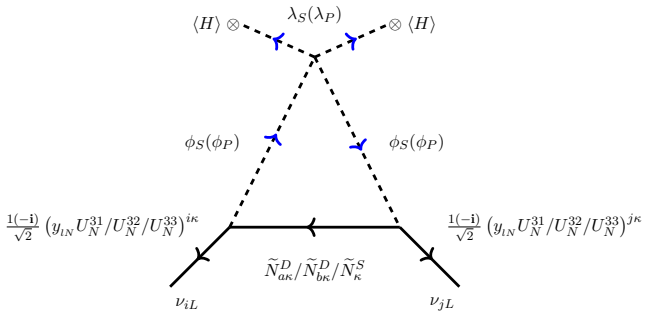
The Z2 symmetry that forbids tree-level neutrino masses and stabilizes the dark matter candidate, together with the one-loop diagrams involving the vector-like fermions and inert doublet that generate both neutrino masses and magnetic moment corrections.
If this is right
- Radiative neutrino masses are produced at the observed scale without requiring large tree-level Yukawa couplings.
- The same new particles account for both the electron and muon anomalous magnetic moment deviations through shared loop diagrams.
- The lightest Z2-odd particle furnishes a dark matter candidate whose annihilation cross section yields the measured relic abundance.
- Parameter regions exist that avoid conflicts with lepton flavor violation searches and direct detection experiments.
- Production of the new vector-like states at the LHC can yield testable signatures.
Where Pith is reading between the lines
- The shared loop structure implies that adjustments to neutrino mixing angles could correlate with shifts in the predicted magnetic moment values.
- Precision measurements at future neutrino experiments could indirectly constrain the dark matter annihilation rate in this setup.
- Non-observation of vector-like fermions at the LHC would force the dark matter candidate mass into a narrower window testable by direct detection.
- The radiative origin suggests that certain lepton flavor violating rates remain suppressed but could become accessible at next-generation facilities.
Load-bearing premise
Suitable masses and Yukawa couplings exist for the vector-like fermions and inert doublet such that the same loop diagrams simultaneously reproduce the correct neutrino mass scale, the measured magnetic moment deviations, and the observed dark matter relic density while satisfying all listed bounds.
What would settle it
A measurement of the muon anomalous magnetic moment that lies outside the narrow range of values allowed by the parameter choices needed to match both the neutrino oscillation data and the dark matter relic density would falsify the simultaneous explanation.
Figures



read the original abstract
The beyond-the-standard-model scenario in this work is motivated from the observations of neutrino masses, anomalous magnetic moments of electron and muon, and dark matter in the Universe. We explain these observations by extending the standard model with two generations of vector-like fermions and an inert scalar doublet, all odd under a $Z_2$ symmetry. The light neutrino masses and mixings are generated radiatively while maintaining consistency with bounds on lepton flavor violation. Loop diagrams with the very same fields also serve to explain the anomalous magnetic moments. Similarly, the correct dark matter relic abundance is reproduced without coming into conflict with direct detection constraints, or those from big bang nucleosynthesis or the cosmic microwave observations. Finally, prospective signatures at the LHC are discussed.
Editorial analysis
A structured set of objections, weighed in public.
Referee Report
Summary. The manuscript proposes a Z2-symmetric extension of the SM with two generations of vector-like fermions and an inert scalar doublet. It claims that one-loop diagrams involving these fields radiatively generate the observed neutrino masses and mixings while satisfying LFV bounds, that the same loops explain the electron and muon (g-2) anomalies, and that the inert doublet reproduces the observed DM relic density without violating direct detection, BBN, or CMB constraints. LHC signatures are also discussed.
Significance. If the numerical results establish viable overlapping parameter regions, the model would constitute a compact, multi-purpose BSM scenario linking three distinct phenomena through shared fields and loops. The radiative neutrino-mass mechanism and the reuse of the same particles for (g-2) and DM are standard but cleanly implemented features; explicit benchmark points or scans that simultaneously satisfy all observables would strengthen the case for a unified explanation.
major comments (1)
- [Numerical results / parameter scan section (presumably §5–6)] The central claim (abstract and §1) is that suitable values of the vector-like fermion masses, Yukawa couplings, and inert-doublet parameters exist such that the same loops simultaneously reproduce the neutrino mass scale, Δa_e, Δa_μ, and Ωh² ≈ 0.12 while obeying all listed bounds. The manuscript must therefore supply explicit benchmark points (or allowed regions from scans) with the numerical values of all relevant masses and couplings, together with the resulting predictions for neutrino masses, (g-2), relic density, and the most constraining observables (e.g., BR(μ→eγ), σ_SI). Without such concrete demonstration, the assertion that the requirements are compatible remains unverified.
minor comments (2)
- [Model Lagrangian / §2] The quantum numbers and Z2 charges of the vector-like fermions should be stated explicitly in the model-definition section rather than only in a table or appendix.
- [Figures] Figure captions and axis labels in the (g-2) and relic-density plots should indicate which constraints are active in each panel.
Simulated Author's Rebuttal
We thank the referee for the constructive report and the clear identification of the key requirement for explicit numerical verification. We address the major comment below.
read point-by-point responses
-
Referee: The central claim (abstract and §1) is that suitable values of the vector-like fermion masses, Yukawa couplings, and inert-doublet parameters exist such that the same loops simultaneously reproduce the neutrino mass scale, Δa_e, Δa_μ, and Ωh² ≈ 0.12 while obeying all listed bounds. The manuscript must therefore supply explicit benchmark points (or allowed regions from scans) with the numerical values of all relevant masses and couplings, together with the resulting predictions for neutrino masses, (g-2), relic density, and the most constraining observables (e.g., BR(μ→eγ), σ_SI). Without such concrete demonstration, the assertion that the requirements are compatible remains unverified.
Authors: We agree that the manuscript as submitted does not contain the explicit benchmark points or tabulated scan results needed to verify simultaneous compatibility. In the revised version we will add a new subsection (within the numerical results section) that presents three to four benchmark points. Each point will list the input masses and couplings (vector-like fermion masses, Yukawa matrices, inert-doublet parameters) together with the output values for the neutrino mass matrix, Δa_e, Δa_μ, Ωh², BR(μ→eγ), and spin-independent direct-detection cross section, confirming that all experimental bounds are satisfied. revision: yes
Circularity Check
No significant circularity; model accommodates data via viable parameter space
full rationale
The paper constructs a Z2-odd extension and shows that radiative loops from the new fields can generate neutrino masses and (g-2) contributions while the inert doublet can yield the observed DM relic density. These are presented as simultaneous explanations achieved by suitable choice of masses and Yukawa couplings, subject to experimental bounds. No equations are shown to reduce by construction to their inputs (e.g., no fitted parameter renamed as a prediction, no self-definitional relation, and no load-bearing self-citation chain). The central claim is an existence demonstration for a common parameter set, which is self-contained against external data and does not rely on renaming or smuggling prior results. This is the standard non-circular structure of a BSM phenomenology paper.
Axiom & Free-Parameter Ledger
free parameters (2)
- masses and Yukawa couplings of the two generations of vector-like fermions
- mass and quartic couplings of the inert scalar doublet
axioms (2)
- domain assumption Z2 symmetry under which the new fermions and scalar doublet are odd
- standard math Neutrino masses generated radiatively at one-loop level
invented entities (2)
-
two generations of vector-like fermions
no independent evidence
-
inert scalar doublet
no independent evidence
Lean theorems connected to this paper
-
IndisputableMonolith/Cost/FunctionalEquation.leanwashburn_uniqueness_aczel unclear?
unclearRelation between the paper passage and the cited Recognition theorem.
The light neutrino masses and mixings are generated radiatively while maintaining consistency with bounds on lepton flavor violation. Loop diagrams with the very same fields also serve to explain the anomalous magnetic moments. Similarly, the correct dark matter relic abundance is reproduced...
-
IndisputableMonolith/Foundation/RealityFromDistinction.leanreality_from_one_distinction unclear?
unclearRelation between the paper passage and the cited Recognition theorem.
mν ⟨H⟩² = λ3 / 16π² ylN MΔ⁻¹ yTlN (one-loop radiative seesaw)
What do these tags mean?
- matches
- The paper's claim is directly supported by a theorem in the formal canon.
- supports
- The theorem supports part of the paper's argument, but the paper may add assumptions or extra steps.
- extends
- The paper goes beyond the formal theorem; the theorem is a base layer rather than the whole result.
- uses
- The paper appears to rely on the theorem as machinery.
- contradicts
- The paper's claim conflicts with a theorem or certificate in the canon.
- unclear
- Pith found a possible connection, but the passage is too broad, indirect, or ambiguous to say the theorem truly supports the claim.
Reference graph
Works this paper leans on
-
[1]
S. Navas et al. Review of particle physics.Phys. Rev. D, 110(3):030001, 2024
work page 2024
-
[2]
Y. Fukuda et al. Evidence for oscillation of atmospheric neutrinos.Phys. Rev. Lett., 81:1562– 1567, 1998
work page 1998
-
[3]
Q. R. Ahmad et al. Measurement of the rate ofνe + d → p + p + e− interactions produced by 8B solar neutrinos at the Sudbury Neutrino Observatory.Phys. Rev. Lett., 87:071301, 2001
work page 2001
- [4]
-
[5]
F. P. An et al. Observation of electron-antineutrino disappearance at Daya Bay.Phys. Rev. Lett., 108:171803, 2012
work page 2012
-
[6]
J. K. Ahn et al. Observation of Reactor Electron Antineutrino Disappearance in the RENO Experiment. Phys. Rev. Lett., 108:191802, 2012
work page 2012
-
[7]
Ivan Esteban, M. C. Gonzalez-Garcia, Alvaro Hernandez-Cabezudo, Michele Maltoni, and Thomas Schwetz. Global analysis of three-flavour neutrino oscillations: synergies and tensions in the determination ofθ23, δCP, and the mass ordering.JHEP, 01:106, 2019
work page 2019
- [8]
-
[9]
Matter-antimatter symmetry violated.Nature, 580(7803):323– 324, 2020
Silvia Pascoli and Jessica Turner. Matter-antimatter symmetry violated.Nature, 580(7803):323– 324, 2020
work page 2020
- [10]
-
[11]
M. Aker et al. Improved Upper Limit on the Neutrino Mass from a Direct Kinematic Method by KATRIN.Phys. Rev. Lett., 123(22):221802, 2019
work page 2019
-
[12]
Verifiable radiative seesaw mechanism of neutrino mass and dark matter.Phys
Ernest Ma. Verifiable radiative seesaw mechanism of neutrino mass and dark matter.Phys. Rev. D, 73:077301, 2006
work page 2006
-
[13]
Chuan-Hung Chen and Takaaki Nomura. Influence of an inert charged Higgs boson on the muon g − 2 and radiative neutrino masses in a scotogenic model.Phys. Rev. D, 100(1):015024, 2019
work page 2019
-
[14]
Peter Minkowski.µ → eγ at a Rate of One Out of109 Muon Decays? Phys. Lett. B, 67:421–428, 1977
work page 1977
-
[15]
Horizontal gauge symmetry and masses of neutrinos
Tsutomu Yanagida. Horizontal gauge symmetry and masses of neutrinos. Conf. Proc. C, 7902131:95–99, 1979
work page 1979
-
[16]
Mohapatra and Goran Senjanovic
Rabindra N. Mohapatra and Goran Senjanovic. Neutrino Mass and Spontaneous Parity Non- conservation. Phys. Rev. Lett., 44:912, 1980
work page 1980
-
[17]
W. Konetschny and W. Kummer. Nonconservation of Total Lepton Number with Scalar Bosons. Phys. Lett. B, 70:433–435, 1977
work page 1977
-
[18]
Revisiting type-II see-saw: present limits and future prospects at LHC.JHEP, 03:195, 2022
Saiyad Ashanujjaman and Kirtiman Ghosh. Revisiting type-II see-saw: present limits and future prospects at LHC.JHEP, 03:195, 2022. 43
work page 2022
-
[19]
T. P. Cheng and Ling-Fong Li. Neutrino Masses, Mixings and Oscillations in SU(2) x U(1) Models of Electroweak Interactions.Phys. Rev. D, 22:2860, 1980
work page 1980
-
[20]
George Lazarides, Q. Shafi, and C. Wetterich. Proton Lifetime and Fermion Masses in an SO(10) Model. Nucl. Phys. B, 181:287–300, 1981
work page 1981
-
[21]
J. Schechter and J. W. F. Valle. Neutrino Masses in SU(2) x U(1) Theories.Phys. Rev. D, 22:2227, 1980
work page 1980
-
[22]
M. Magg and C. Wetterich. Neutrino Mass Problem and Gauge Hierarchy. Phys. Lett. B, 94:61–64, 1980
work page 1980
-
[23]
Mohapatra and Goran Senjanovic
Rabindra N. Mohapatra and Goran Senjanovic. Neutrino Masses and Mixings in Gauge Models with Spontaneous Parity Violation.Phys. Rev. D, 23:165, 1981
work page 1981
-
[24]
Robert Foot, H. Lew, X. G. He, and Girish C. Joshi. Seesaw Neutrino Masses Induced by a Triplet of Leptons.Z. Phys. C, 44:441, 1989
work page 1989
-
[25]
Saiyad Ashanujjaman and Kirtiman Ghosh. Type-III see-saw: Phenomenological implications of the information lost in decoupling from high-energy to low-energy.Phys. Lett. B, 819:136403, 2021
work page 2021
-
[26]
Saiyad Ashanujjaman and Kirtiman Ghosh. Type-III see-saw: Search for triplet fermions in final states with multiple leptons and fat-jets at 13 TeV LHC.Phys. Lett. B, 825:136889, 2022
work page 2022
-
[27]
G. Hinshaw, D. Larson, E. Komatsu, D. N. Spergel, C. L. Bennett, J. Dunkley, M. R. Nolta, M. Halpern, R. S. Hill, N. Odegard, L. Page, K. M. Smith, J. L. Weiland, B. Gold, N. Jarosik, A. Kogut, M. Limon, S. S. Meyer, G. S. Tucker, E. Wollack, and E. L. Wright. Nine-year Wilkinson Microwave Anisotropy Probe (WMAP) Observations: Cosmological Parameter Re- s...
work page 2013
-
[28]
P. A. R. Ade et al. Planck 2015 results. XIII. Cosmological parameters.Astron. Astrophys., 594:A13, 2016
work page 2015
-
[29]
A.A. Abdo et al. Observations of Milky Way Dwarf Spheroidal galaxies with the Fermi-LAT detector and constraints on Dark Matter models.Astrophys. J., 712:147–158, 2010
work page 2010
- [30]
-
[31]
J. J. Condon, W. D. Cotton, E. W. Greisen, Q. F. Yin, R. A. Perley, G. B. Taylor, and J. J. Broderick. The NRAO VLA Sky Survey.Astron. J, 115(5):1693–1716, May 1998
work page 1998
-
[32]
Handbookofvectorlike quarks: Mixing and single production.Phys
J.A.Aguilar-Saavedra, R.Benbrik, S.Heinemeyer, andM.Pérez-Victoria. Handbookofvectorlike quarks: Mixing and single production.Phys. Rev. D, 88(9):094010, 2013
work page 2013
-
[33]
Sebastian A.R. Ellis, Rohini M. Godbole, Shrihari Gopalakrishna, and James D. Wells. Survey of vector-like fermion extensions of the Standard Model and their phenomenological implications. JHEP, 09:130, 2014
work page 2014
-
[34]
Junhai Kang, Paul Langacker, and Brent D. Nelson. Theory and Phenomenology of Exotic Isosinglet Quarks and Squarks.Phys. Rev. D, 77:035003, 2008
work page 2008
-
[35]
Unification of gauge couplings in the standard model with extra vectorlike families
Radovan Dermisek. Unification of gauge couplings in the standard model with extra vectorlike families. Phys. Rev. D, 87(5):055008, 2013. 44
work page 2013
-
[36]
Unifica- tion with Vector-like fermions and signals at LHC.JHEP, 05:090, 2018
Biplob Bhattacherjee, Pritibhajan Byakti, Ashwani Kushwaha, and Sudhir K Vempati. Unifica- tion with Vector-like fermions and signals at LHC.JHEP, 05:090, 2018
work page 2018
-
[37]
D. Emmanuel-Costa and R. Gonzalez Felipe. Minimal string-scale unification of gauge couplings. Phys. Lett. B, 623:111–118, 2005
work page 2005
-
[38]
Barger, Jing Jiang, Paul Langacker, and Tianjun Li
V. Barger, Jing Jiang, Paul Langacker, and Tianjun Li. String scale gauge coupling unification with vector-like exotics and non-canonical U(1)(Y) normalization.Int. J. Mod. Phys. A, 22:6203– 6218, 2007
work page 2007
-
[39]
Light vector-like fermions in a minimal SU(5) setup
Ilja Dorsner, Svjetlana Fajfer, and Ivana Mustac. Light vector-like fermions in a minimal SU(5) setup. Phys. Rev. D, 89(11):115004, 2014
work page 2014
-
[40]
S.Y. Choi, D. Choudhury, A. Freitas, J. Kalinowski, J.M. Kim, and P.M. Zerwas. Dirac Neutrali- nos and Electroweak Scalar Bosons of N=1/N=2 Hybrid Supersymmetry at Colliders.JHEP, 08:025, 2010
work page 2010
-
[41]
S.Y. Choi, D. Choudhury, A. Freitas, J. Kalinowski, and P.M. Zerwas. The Extended Higgs System in R-symmetric Supersymmetry Theories.Phys. Lett. B, 697:215–221, 2011. [Erratum: Phys.Lett.B 698, 457–458 (2011)]
work page 2011
-
[42]
Stephen P. Martin. Extra vector-like matter and the lightest Higgs scalar boson mass in low- energy supersymmetry. Phys. Rev. D, 81:035004, 2010
work page 2010
-
[43]
Stephen P. Martin. Raising the Higgs Mass with Yukawa Couplings for Isotriplets in Vector-Like Extensions of Minimal Supersymmetry.Phys. Rev. D, 82:055019, 2010
work page 2010
-
[44]
Graham, Ahmed Ismail, Surjeet Rajendran, and Prashant Saraswat
Peter W. Graham, Ahmed Ismail, Surjeet Rajendran, and Prashant Saraswat. A Little Solution to the Little Hierarchy Problem: A Vector-like Generation.Phys. Rev. D, 81:055016, 2010
work page 2010
- [45]
-
[46]
Higgs mass, muon g-2, and LHC prospects in gauge mediation models with vector-like matters.Phys
Motoi Endo, Koichi Hamaguchi, Sho Iwamoto, and Norimi Yokozaki. Higgs mass, muon g-2, and LHC prospects in gauge mediation models with vector-like matters.Phys. Rev. D, 85:095012, 2012
work page 2012
-
[47]
Stephen P. Martin and James D. Wells. Implications of gauge-mediated supersymmetry breaking with vector-like quarks and a ~125 GeV Higgs boson.Phys. Rev. D, 86:035017, 2012
work page 2012
-
[48]
Vector-like Fields, Messenger Mixing and the Higgs mass in Gauge Mediation.JHEP, 05:151, 2014
Willy Fischler and Walter Tangarife. Vector-like Fields, Messenger Mixing and the Higgs mass in Gauge Mediation.JHEP, 05:151, 2014
work page 2014
-
[49]
K.S. Babu, Jogesh C. Pati, and Hanns Stremnitzer. A Simple reason based on supersymmetry for replication of chiral families.Phys. Lett. B, 256:206–214, 1991
work page 1991
-
[50]
K.S. Babu, Jogesh C. Pati, and Hanns Stremnitzer. A Hint from the interfamily mass hierarchy: Two vector - like families in the TeV range.Phys. Rev. D, 51:2451–2462, 1995
work page 1995
-
[51]
Bogdan A. Dobrescu and Christopher T. Hill. Electroweak symmetry breaking via top conden- sation seesaw.Phys. Rev. Lett., 81:2634–2637, 1998
work page 1998
-
[52]
Dobrescu, Howard Georgi, and Christopher T
R.Sekhar Chivukula, Bogdan A. Dobrescu, Howard Georgi, and Christopher T. Hill. Top Quark Seesaw Theory of Electroweak Symmetry Breaking.Phys. Rev. D, 59:075003, 1999. 45
work page 1999
-
[53]
Newtopflavormodelswithseesawmechanism
Hong-JianHe, TimothyM.P.Tait, andC.P.Yuan. Newtopflavormodelswithseesawmechanism. Phys. Rev. D, 62:011702, 2000
work page 2000
- [54]
-
[55]
Hsin-Chia Cheng, Konstantin T. Matchev, and Martin Schmaltz. Bosonic supersymmetry? Get- ting fooled at the CERN LHC.Phys. Rev. D, 66:056006, 2002
work page 2002
-
[56]
Debajyoti Choudhury, Anindya Datta, and Kirtiman Ghosh. Deciphering Universal Extra Di- mension from the top quark signals at the CERN LHC.JHEP, 08:051, 2010
work page 2010
-
[57]
Geraldine Servant and Timothy M. P. Tait. Is the lightest Kaluza-Klein particle a viable dark matter candidate? Nucl. Phys. B, 650:391–419, 2003
work page 2003
-
[58]
Dobrescu, Eduardo Ponton, and Ho-Ung Yee
Thomas Appelquist, Bogdan A. Dobrescu, Eduardo Ponton, and Ho-Ung Yee. Proton stability in six-dimensions. Phys. Rev. Lett., 87:181802, 2001
work page 2001
-
[59]
Phenomenology of spinless adjoints in two Universal Extra Dimensions
Kirtiman Ghosh and Anindya Datta. Phenomenology of spinless adjoints in two Universal Extra Dimensions. Nucl. Phys. B, 800:109–126, 2008
work page 2008
-
[60]
Kirtiman Ghosh. Probing two Universal Extra Dimension model with leptons and photons at the LHC and ILC.JHEP, 04:049, 2009
work page 2009
-
[61]
Search for the minimal universal extra dimension model at the LHC with√s=7 TeV.Phys
Biplob Bhattacherjee and Kirtiman Ghosh. Search for the minimal universal extra dimension model at the LHC with√s=7 TeV.Phys. Rev. D, 83:034003, 2011
work page 2011
-
[62]
Bogdan A. Dobrescu and Erich Poppitz. Number of fermion generations derived from anomaly cancellation. Phys. Rev. Lett., 87:031801, 2001
work page 2001
-
[63]
Gustavo Burdman, Bogdan A. Dobrescu, and Eduardo Ponton. Resonances from two universal extra dimensions. Phys. Rev. D, 74:075008, 2006
work page 2006
-
[64]
Bounds on Universal Extra Dimension from LHC Run I and II data.Phys
Debajyoti Choudhury and Kirtiman Ghosh. Bounds on Universal Extra Dimension from LHC Run I and II data.Phys. Lett. B, 763:155–160, 2016
work page 2016
-
[65]
Minimal and non-minimal Universal Extra Dimension models in the light of LHC data at 13 TeV.Phys
Avnish, Kirtiman Ghosh, Tapoja Jha, and Saurabh Niyogi. Minimal and non-minimal Universal Extra Dimension models in the light of LHC data at 13 TeV.Phys. Rev. D, 103:115011, 2021
work page 2021
-
[66]
Light custodians in natural composite Higgs models
Roberto Contino, Leandro Da Rold, and Alex Pomarol. Light custodians in natural composite Higgs models. Phys. Rev. D, 75:055014, 2007
work page 2007
-
[67]
Realistic Composite Higgs Mod- els
Charalampos Anastasiou, Elisabetta Furlan, and Jose Santiago. Realistic Composite Higgs Mod- els. Phys. Rev. D, 79:075003, 2009
work page 2009
-
[68]
Discovering the composite Higgs through the decay of a heavy fermion
Natascia Vignaroli. Discovering the composite Higgs through the decay of a heavy fermion. JHEP, 07:158, 2012
work page 2012
-
[69]
A First Top Partner Hunter’s Guide.JHEP, 04:004, 2013
Andrea De Simone, Oleksii Matsedonskyi, Riccardo Rattazzi, and Andrea Wulzer. A First Top Partner Hunter’s Guide.JHEP, 04:004, 2013
work page 2013
-
[70]
Modified Higgs Physics from Composite Light Flavors.JHEP, 09:090, 2013
Cédric Delaunay, Christophe Grojean, and Gilad Perez. Modified Higgs Physics from Composite Light Flavors.JHEP, 09:090, 2013
work page 2013
-
[71]
Vector- like Bottom Quarks in Composite Higgs Models.JHEP, 03:037, 2014
Gillioz, Marc and Gröber, Ramona and Kapuvari, Andreas and Mühlleitner, Margarete. Vector- like Bottom Quarks in Composite Higgs Models.JHEP, 03:037, 2014. 46
work page 2014
-
[72]
Constraining Composite Higgs Models using LHC data.JHEP, 03:062, 2018
Avik Banerjee, Gautam Bhattacharyya, Nilanjana Kumar, and Tirtha Sankar Ray. Constraining Composite Higgs Models using LHC data.JHEP, 03:062, 2018
work page 2018
-
[73]
Logan, Bob McElrath, and Lian-Tao Wang
Tao Han, Heather E. Logan, Bob McElrath, and Lian-Tao Wang. Phenomenology of the little Higgs model. Phys. Rev. D, 67:095004, 2003
work page 2003
-
[74]
Collider signature of T- quarks
Marcela Carena, Jay Hubisz, Maxim Perelstein, and Patrice Verdier. Collider signature of T- quarks. Phys. Rev. D, 75:091701, 2007
work page 2007
-
[75]
LHC signals of T-odd heavy quarks in the Littlest Higgs model
Debajyoti Choudhury and Dilip Kumar Ghosh. LHC signals of T-odd heavy quarks in the Littlest Higgs model. JHEP, 08:084, 2007
work page 2007
-
[76]
S.Rai Choudhury, Alan S. Cornell, A. Deandrea, Naveen Gaur, and Ashok Goyal. Lepton flavour violation in the little Higgs model.Phys. Rev. D, 75:055011, 2007
work page 2007
-
[77]
Testing the Littlest Higgs Model with T-parity at the Large Hadron Collider.Phys
Shigeki Matsumoto, Takeo Moroi, and Kazuhiro Tobe. Testing the Littlest Higgs Model with T-parity at the Large Hadron Collider.Phys. Rev. D, 78:055018, 2008
work page 2008
-
[78]
Dijet Signals of the Little Higgs Model with T-Parity.JHEP, 07:013, 2012
Debajyoti Choudhury, Dilip Kumar Ghosh, and Santosh Kumar Rai. Dijet Signals of the Little Higgs Model with T-Parity.JHEP, 07:013, 2012
work page 2012
-
[79]
A Fermionic Top Partner: Naturalness and the LHC
Joshua Berger, Jay Hubisz, and Maxim Perelstein. A Fermionic Top Partner: Naturalness and the LHC. JHEP, 07:016, 2012
work page 2012
-
[80]
Higgs-field portal into hidden sectors
Brian Patt and Frank Wilczek. Higgs-field portal into hidden sectors. 5 2006
work page 2006
discussion (0)
Sign in with ORCID, Apple, or X to comment. Anyone can read and Pith papers without signing in.